Shownotes
The OCC's 376-page proposed rule under the GENIUS Act is converting stablecoin policy into binding compliance requirements with formal issuer categories. Paxos, BitGo, and Ripple all received OCC trust charter approvals, but a trust charter does not guarantee Fed payment rail access. Klarivis data shows deposit movement from stablecoin-adjacent products is already measurable at community banks. The 26-month application timeline puts anyone starting today against a potential administration change, and sponsor bank programs face new pressure from charter competition and yield-based products.
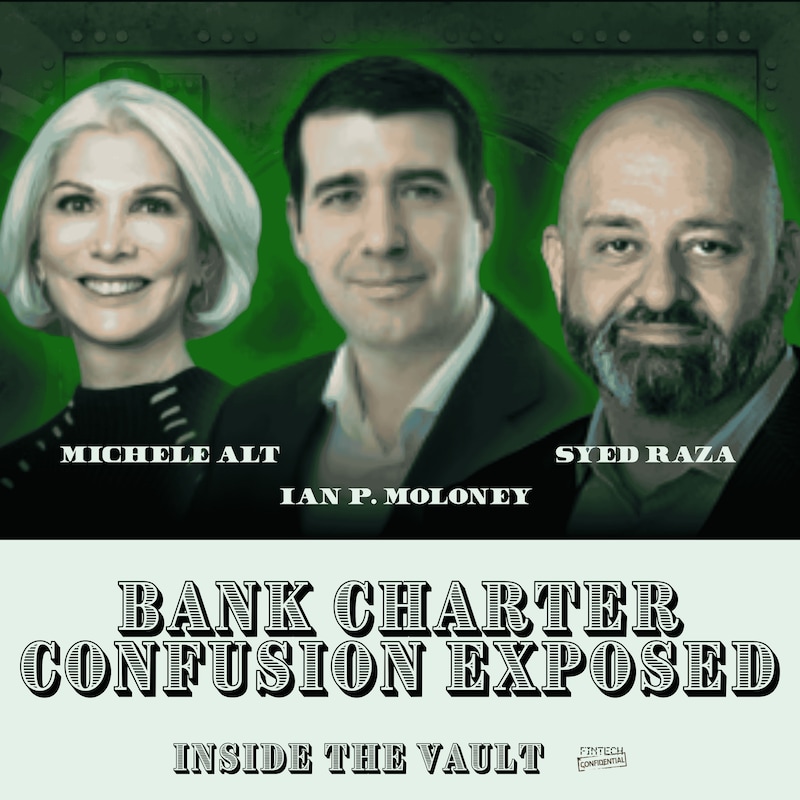
Bank charter confusion, trust charter risks, and Fed Master Account access gaps are creating real problems for fintech operators, sponsor banks, and community bank executives right now. Tedd Huff, CEO of fintech advisory firm Voalyre and founder of Fintech Confidential, and co-host Steve Bishop sit down on Inside the Vault with three former and current regulatory insiders: Syed Raza, former Acting Chief Innovation Officer at the OCC and Managing Director at FTI Consulting; Michele Alt, Co-Founder and Managing Director at Klaros Group; and Ian Moloney, Chief Policy Officer at the American Fintech Council.
Find out more
1️⃣ Answer four questions before filing: who grants the charter, what powers it includes, what activities are limited, and who examines the institution.
2️⃣ Start compliance documentation now; controls, funds flow maps, and exception handling should be ready before the examiner asks.
3️⃣ Read the conditions attached to charter approvals; those conditions reveal what regulators did not trust in the application.
4️⃣ Align cost sharing, control ownership, and data ownership with your partner before examination forces the conversation.
5️⃣ Price the M&A path into your charter strategy; the 26-month timeline means the political window may close before your application clears.
Guest Links
Fintech Confidential
Podcast: https://fintechconfidential.com/listen
Notifications: https://fintechconfidential.com/access
LinkedIn: https://www.linkedin.com/company/fintechconfidential
X: https://x.com/FTconfidential
Instagram: https://www.instagram.com/fintechconfidential
Facebook: https://www.facebook.com/fintechconfidential
Supporters
Under: Streamline your application and underwriting process by digitizing PDFs for digital signature. under.io/ftc
Skyflow: Zero-trust data privacy vault delivered as an API covering PCI, CCPA, GDPR, and SOC 2 compliance. skyflowsecure.com
Hawk AI: Real-time payment screening, ML transaction monitoring, and dynamic customer risk rating to fight fraud and financial crime. gethawkai.com
About the Guests
Syed Raza is a Managing Director at FTI Consulting with over 30 years in risk management and regulatory compliance. He previously served as Acting Chief Innovation Officer at the OCC, guiding regulatory policy for fintech licensing.
Michele Alt is Co-Founder and Managing Director at Klaros Group. She spent 22 years in the OCC Law Department and advises banks and fintechs on charter applications, regulatory strategy, and bank design.
Ian Moloney is Chief Policy Officer at the American Fintech Council. He previously led policy and regulatory affairs at Cross River and served as a Senior Analyst at the U.S. Government Accountability Office.
About the Co-Host
Steve Bishop is Founder and Chief Ally at amBaaSsador, an education and advisory platform focused on embedded finance and Banking-as-a-Service for financial institutions.
About the Host
Tedd Huff, CEO of fintech advisory firm Voalyre and host of Fintech Confidential. Fintech Confidential is a production of DD3 Media, bringing you the people, tech, and companies that change how you pay and get paid.
Chapters
00:00 Episode Highlights
00:36 Welcome to Fintech Confidential
03:31 Sky Flow: Building Fast and Secure (Sponsor)
04:33 What a Charter Means
07:06 OCC Rules and Stablecoins
09:43 Why Trust Charters Boom
13:50 Under.io: AI-Powered Onboarding & Risk Verification (Sponsor)
14:20 Fed Master Account Gap
17:59 Sponsor Banking Under Pressure
22:15 What to Watch Next
25:28 Action Steps and Wrap
27:50 Hawk.ai: AI-Driven Financial Crime Detection (Sponsor)
28:36 Disclaimer
#bankcharter #trustcharter #fintech #occ #stablecoin #geniusact #fedmasteraccount #sponsorbank #baas #fintechregulation #communitybank #bankingcompliance #fintechpolicy #occcharter #depositinsurance #stablecoinyield #bankholding
Transcripts
The bank charter now represents what it always
Michele Alt:has represented, which is the keys to the financial kingdom.
Syed Raza:Getting the charter and getting all the approvals and opening
Syed Raza:your door is really the day one.
Syed Raza:The real challenge starts after that.
Syed Raza:The forward-leaning
Syed Raza:Ian P. Moloney: quality of the current administration has not been
Syed Raza:matched by other administrations.
Syed Raza:The potential that a new Democratic administration may return to that,
Syed Raza:that previous, uh, status quo.
Michele Alt:These banks
Michele Alt:Ian P. Moloney: are like the dogs
Michele Alt:who
Michele Alt:Ian P. Moloney: bought the car.
Michele Alt:" Michele Alt: Okay, do we know how to drive it?
Michele Alt:We're dogs."
Tedd Huff:This is Inside the Vault.
Tedd Huff:I'm Ted Huff, here with Steve Bishop.
Tedd Huff:Let's talk about what bank charter actually means and what it doesn't.
Tedd Huff:Welcome to Fintech Confidential, bringing you the people, tech, and companies
Tedd Huff:that change how you pay and get paid.
Tedd Huff:Welcome to Inside the Vault.
Tedd Huff:I'm Ted Huff, the CEO of Fintech advisory firm Volere.
Tedd Huff:Today I'm joined by Fintech Confidential informant Steve Bishop, and we're talking
Tedd Huff:about bank charters today, specifically why so many people are confused about
Tedd Huff:them right now, and why that confusion is starting to cost real money.
Stephen Bishop:And Ted, you've been watching this play out
Stephen Bishop:for a while now at Volere.
Stephen Bishop:What made you want to do a full episode on it?
Tedd Huff:Well, honestly, it's, it's the phone calls.
Tedd Huff:Founders who just announced a charter application, bank executives trying
Tedd Huff:to figure out what a competitor's trust charter actually means for
Tedd Huff:them, board members who got a briefing and still couldn't explain what
Tedd Huff:their company had actually done.
Tedd Huff:And honestly, the word charter is doing a lot of heavy lifting right now, and
Tedd Huff:it's not always earning all of it.
Stephen Bishop:And we've brought some serious people to help unpack it.
Stephen Bishop:We have Syed Raza, who is a chief innovation officer at the OCC
Stephen Bishop:before joining FGI Consulting.
Stephen Bishop:You know, he's seen how these decisions look from the
Stephen Bishop:inside the regulator's office.
Tedd Huff:We did.
Tedd Huff:We also talked to Michelle Ault at the Claros Group, former OCC who
Tedd Huff:now advises management teams on exactly these structural choices.
Stephen Bishop:And Ian Maloney at the American Fintech Council, who works
Stephen Bishop:with Fintech companies and their bank partners on the Hill, translating
Stephen Bishop:what these regulatory shifts mean for how the programs actually operate.
Stephen Bishop:Three different vantage points on the same set of questions.
Stephen Bishop:And I will say a lot of what we're gonna cover today is stuff I've been
Stephen Bishop:hearing in conversations that don't actually make it to a public panel.
Stephen Bishop:That's kind of the whole point of what I do.
Stephen Bishop:These are questions boards and examiners are asking when the cameras are off, and
Stephen Bishop:a lot of the time the answers are not as clean as a press release make them sound.
Stephen Bishop:Let's be honest, that gap is costing some teams real money right now.
Tedd Huff:Right, and, and what's really interesting is where our featured
Tedd Huff:guest agreed- And where they didn't.
Tedd Huff:We're gonna work through all of this, what a bank charter actually is, why
Tedd Huff:trust charters are everywhere right now, the Fed master account gap, which
Tedd Huff:is the place most people are really not talking about, and not only that,
Tedd Huff:but what all of this means for sponsor banking, and last but not least, what
Tedd Huff:to watch over the next six to 12 months.
Tedd Huff:So let's get started with something that, well, sounds pretty
Tedd Huff:basic, but turns out not to be.
Tedd Huff:Support provided by Skyflow.
Tedd Huff:What if you could build fast but not break privacy?
Tedd Huff:What if you could ensure data privacy, governance, and compliance
Tedd Huff:with just a few API calls?
Tedd Huff:What if you could worry less about PCI requirements while actually
Tedd Huff:improving privacy and security?
Tedd Huff:How much more time would your team have to truly innovate?
Tedd Huff:How much faster could you build and ship new features?
Tedd Huff:How much more powerful could your app be?
Tedd Huff:Skyflow is a zero trust data privacy vault delivered as an API.
Tedd Huff:Skyflow's radically simple design lets you collect, secure, and
Tedd Huff:tokenize personal information like card data and payment details.
Tedd Huff:And with built-in features like encrypted data analysis and sharing,
Tedd Huff:anonymization, and advanced governance, your days of choosing between data
Tedd Huff:security and data usability are over.
Tedd Huff:Whether you're just concerned with PCI compliance or need to go further
Tedd Huff:to include CCPA, GDPR, SOC 2, and beyond, Skyflow has you covered.
Tedd Huff:What if you could build fast but not break privacy?
Tedd Huff:With Skyflow, you can.
Tedd Huff:Visit skyflowsecure.com today to learn how.
Stephen Bishop:Ted, when someone says their company is getting a bank
Stephen Bishop:charter, what are they actually saying?
Tedd Huff:Well, they may be saying about seven different things all at the same
Tedd Huff:time, and well, that, that's the problem.
Tedd Huff:A bank charter is the legal authorization to operate as a financial institution
Tedd Huff:under specific regulatory authority.
Tedd Huff:It really just defines who approved you, what you can do,
Tedd Huff:and who gets to examine you.
Tedd Huff:And the last part, that's one that matters most and generally gets
Tedd Huff:the least amount of attention.
Tedd Huff:The OCC charters national banks and federal savings associations, state
Tedd Huff:banking regulators charter state banks, and whether the Federal Reserve
Tedd Huff:or the FDIC layers on top of that really depends on status and where the
Tedd Huff:institution carries deposit insurance.
Tedd Huff:You can end up chartered in one place and examined by three different agencies.
Stephen Bishop:So when a fintech announces a charter, that announcement
Stephen Bishop:tells you almost nothing on its own.
Tedd Huff:Well, that's right, Steve.
Tedd Huff:Uh, you could be a national bank, a state bank, a federal savings association,
Tedd Huff:industrial loan company, a trust bank, a national trust bank- None of these
Tedd Huff:things are the same, and saying we got a charter without naming the type
Tedd Huff:leaves out the part that really matters.
Stephen Bishop:The thing that stands out to me from conversations I've been
Stephen Bishop:having is founders are treating the, the charter announcement as a finish line.
Stephen Bishop:I've had a founder tell me that a board celebrated when
Stephen Bishop:they had the, the announcement.
Stephen Bishop:If that examiner is gonna ask about VSA staffing day one, what do you think a bank
Stephen Bishop:charter actually represents, especially right now, and, and how has that changed?
Syed Raza:There are two schools of thought in chartering process.
Syed Raza:There's old school who saw the chartering window closed for many, many years.
Syed Raza:They think it's going to be extremely difficult to go through
Syed Raza:the national charter process.
Syed Raza:Uh, the other school of thought is mostly new organization,
Syed Raza:technology, fintech, digital assets.
Syed Raza:They actually think it's very easy to get a national charter, and they think
Syed Raza:it's much easier than it actually is.
Syed Raza:Getting the charter and getting all the approvals and opening
Syed Raza:your door, per se, the day one for the bank is really the day one.
Syed Raza:Real challenge starts after that.
Stephen Bishop:Yeah, that's a useful reminder that this is not just a label.
Stephen Bishop:The real operating consequences depend on which box you're operating in.
Tedd Huff:And people are not always reading the fine print on
Tedd Huff:which box they're applying for, and that's where the OCC's recent
Tedd Huff:activity really gets interesting.
Tedd Huff:Because the OCC just issued a 376-page proposed rule to implement
Tedd Huff:the Genius Act, what it does is create formal issuer categories.
Tedd Huff:Once those categories exist, firms start positioning for the
Tedd Huff:one they think serves them best.
Tedd Huff:The headline is a proposed rule.
Tedd Huff:The practical implication is that stablecoin policy is starting to
Tedd Huff:become operating requirements.
Tedd Huff:And who is the issuer?
Tedd Huff:Who supervises it?
Tedd Huff:What backs it?
Tedd Huff:How does redemption work?
Tedd Huff:And who can prove the controls?
Tedd Huff:These really aren't even product questions anymore.
Tedd Huff:They're compliance questions.
Stephen Bishop:So what should an operator actually take away from that?
Tedd Huff:Well, I mean, really there are four questions, right?
Tedd Huff:So who grants the charter?
Tedd Huff:What powers come with it?
Tedd Huff:What activities are limited?
Tedd Huff:Who examines the institution?
Tedd Huff:And if a management team can't answer all four of those, they're not really done
Tedd Huff:thinking about their charter strategy yet.
Tedd Huff:So where do you think the biggest gaps are between what people
Tedd Huff:believe about the chartering process and what it actually involves?
Michele Alt:Think of applying for a bank charter as about as much fun as
Michele Alt:a financial and emotional colonoscopy.
Michele Alt:If you're thinking that they can do it quickly and painlessly and have an easy
Michele Alt:ride, ah, you got another thing coming.
Michele Alt:Still a big lift.
Stephen Bishop:So what does, uh, the current regulatory activity tell
Stephen Bishop:you about where oversight is headed?
Stephen Bishop:Ian P. Moloney: The current regulatory activity shows that there's an opportunity
Stephen Bishop:to allow bank managers to manage and to engage in their activities, whether it be
Stephen Bishop:fintech companies or stablecoin providers.
Stephen Bishop:There's a real opportunity within that chartering conversation, whether
Stephen Bishop:it be limited purpose or, you know, more broadly for a national bank
Stephen Bishop:charter.
Stephen Bishop:So the OCC has drawn some lines.
Stephen Bishop:What we're seeing is firms racing to get on the right side
Stephen Bishop:of those lines before the final rule makes the entry cost higher.
Translation:if you can't answer those four questions about your own program
Translation:right now, you're not ready for the conversation your bank partner or your
Translation:examiner is going to have with you.
Translation:And most visible move right now is trust charters.
Translation:Yeah.
Translation:Paxos, BitGo, Ripple, all OCC trust charter approvals
Translation:in a pretty short window.
Translation:What's actually going on there?
Tedd Huff:Steve, it's, it's positioning.
Tedd Huff:Firms are trying to get into federal supervisory structure before the markets
Tedd Huff:get more defined, before the final rules make the entry cost even higher.
Tedd Huff:That is strategic logic.
Tedd Huff:The timing is definitely not accidental, and what's most important
Tedd Huff:to understand is that a national trust bank charter is not a full charter.
Tedd Huff:It can put a company inside of the federal supervisory framework.
Tedd Huff:It can support custody activities, certain payment functions, and even
Tedd Huff:stablecoin positioning for them.
Tedd Huff:It doesn't make them a community bank, no insured deposits, no lending
Tedd Huff:authority, and it still brings real examination expectations, governance
Tedd Huff:requirements, capital considerations, and compliance obligations.
Stephen Bishop:So if I'm a fintech founder reading one of those headlines
Stephen Bishop:and thinking we should do that next- What's the one thing you want them to slow
Stephen Bishop:down on before the application goes in?
Tedd Huff:What is your read on why trust charters have
Tedd Huff:gotten so much attention lately?
Syed Raza:Because it serves a very specific purpose for organizations who
Syed Raza:are only interested in custody services.
Syed Raza:Crypto wallet, crypto exchanges, and the capital requirements for trust banks
Syed Raza:are a little bit lower than a full bank.
Syed Raza:For them, it gives them the regulatory fiduciary authority to get involved in
Syed Raza:that business, but they are not interested in maintaining deposit accounts or loans.
Syed Raza:They are not interested in, uh, of- offering traditional
Syed Raza:deposit accounts or loans.
Stephen Bishop:What are firms actually missing when they go through this process?
Tedd Huff:Well, getting a trust charter is just the start
Tedd Huff:of the work, not the finish.
Tedd Huff:The regulators' expectations don't wait for the press release to clear.
Stephen Bishop:I wanna push on you slightly there.
Stephen Bishop:Uh, there's a counterargument that I keep hearing.
Stephen Bishop:A trust charter creates real credibility with bank partners
Stephen Bishop:and institutional investors even before the exam gets serious.
Stephen Bishop:Is that wrong or, or just incomplete?
Michele Alt:A trust company, although it is a bank for purposes of state
Michele Alt:and federal law, and therefore is not subject to all sorts of individual state
Michele Alt:and local licensing requirements, it is not considered a bank for purposes
Michele Alt:of the Bank Holding Company Act.
Michele Alt:So that means you get the benefit to be a bank and conduct your
Michele Alt:activities nationwide, but you're not, uh, subjecting your parent to
Michele Alt:Bank Holding Company Act supervision.
Michele Alt:It's huge, but here's the trade-off.
Michele Alt:Conditional approval for some applicants is it makes it a lot
Michele Alt:easier for them to raise money.
Michele Alt:But not everybody's Coinbase.
Michele Alt:Ian P. Moloney: What tends to get overlooked is the need for good timing
Michele Alt:on the charter application to make sure that you get in within this
Michele Alt:administration as opposed to a potential next administration, which may be less
Michele Alt:favorable in the chartering space.
Stephen Bishop:That Bank Holding Company Act piece is one I'd not fully appreciated
Stephen Bishop:till I started having these conversations.
Stephen Bishop:A trust charter gives you the bank benefits without pulling your entire
Stephen Bishop:parent company into Fed supervision, and most of the founders I talk to have
Stephen Bishop:no idea that trade-off even exists.
Stephen Bishop:And the part that does not make the press release is the one that
Stephen Bishop:may matter most operationally.
Tedd Huff:Right, and the one that matters a lot more than people seem to
Tedd Huff:realize is the headline says approved.
Tedd Huff:The operating reality says the, you may still need some infrastructure you needed
Tedd Huff:before the announcement even happened.
Tedd Huff:So getting a trust charter and getting direct access to Federal Reserve payment
Tedd Huff:rails are Two completely different things.
Tedd Huff:Hey, Ted Huff here.
Tedd Huff:Ever thought about how you could streamline your application
Tedd Huff:and underwriting process?
Tedd Huff:Well, let me introduce you to Under.
Tedd Huff:Why keep using the outdated methods of PDFs when you can
Tedd Huff:digitize them effortlessly?
Tedd Huff:All you gotta do is upload the PDF, send it out for digital signature, and
Tedd Huff:voila, you're set for the digital age.
Tedd Huff:Are you curious on how to make that happen?
Tedd Huff:Head over to under.io/ftc and get started for free.
Tedd Huff:It's really that simple.
Stephen Bishop:Ted, walk us through what a Fed master account
Stephen Bishop:actually is and why it matters here.
Tedd Huff:A Fed master account is a direct account at the Federal Reserve.
Tedd Huff:It gives an institution access to FedWire, FedNow, and the core
Tedd Huff:payment infrastructure of the United States financial system.
Tedd Huff:If you have one, you can move money directly across those rails, and if you
Tedd Huff:don't have one, you need an intermediary bank or a sponsor bank to do that for you.
Stephen Bishop:So... And a trust charter doesn't automatically come with one?
Stephen Bishop:It doesn't.
Tedd Huff:A trust charter may make a firm eligible to apply for
Tedd Huff:a master account, then the Fed decides whether to approve it or not.
Tedd Huff:The Tenth Circuit confirmed late in 2025 that the Fed has full
Tedd Huff:discretion here, and even when an applicant is legally eligible.
Tedd Huff:The first limited purpose payment account of that kind was approved in March of
Tedd Huff:2026, and before that, the firms holding trust charters but without master account
Tedd Huff:were still routing through partner banks to reach the Fed payment rails.
Stephen Bishop:Okay, so the charter changed the supervisor relationship,
Stephen Bishop:but the operating dependency on a partner bank may still be exactly
Stephen Bishop:what it was before the charter.
Tedd Huff:Yeah, and that's the gap.
Tedd Huff:And it appears to be the same thing most management teams have not
Tedd Huff:fully priced in when they treat a charter approval as the finish line.
Stephen Bishop:So a trust charter gives the firm eligibility to
Stephen Bishop:apply for a Fed master account.
Stephen Bishop:Doesn't guarantee one though.
Stephen Bishop:How significant is that gap, or what does it mean for those counting on Fed payments
Stephen Bishop:as part of their, their payment strategy?
Michele Alt:Don't go with a limited purpose charter if it's an absolute
Michele Alt:must to have a master account.
Michele Alt:That's too big a risk because there are no guarantees.
Michele Alt:I would say they have a choice.
Michele Alt:Either proceed now with a full service bank application, or
Michele Alt:they could wait a little bit.
Michele Alt:We need to wait and see how it shakes out.
Tedd Huff:The shorter version, institutions without deposit
Tedd Huff:insurance sit in a higher scrutiny tier, which means longer timelines
Tedd Huff:and no guarantee at the end.
Stephen Bishop:You know what I keep hearing from operators that have
Stephen Bishop:gone through this process is timeline assumptions going in were way off,
Stephen Bishop:and, and not just by a week or two.
Stephen Bishop:One operator I talked to had an 18-month product roadmap built
Stephen Bishop:that required FedRail access.
Stephen Bishop:They're now well into that window, but the roadmap hasn't moved.
Tedd Huff:A trust charter makes a firm eligible for a FedMaster
Tedd Huff:account, but it doesn't guarantee one.
Tedd Huff:How significant do you feel the gap is, and what it means for firms
Tedd Huff:counting on Fed payment access as part of their primary strategy?
Syed Raza:So I think because of all the developments recently with implementation
Syed Raza:of Genius Act, there's a very good chance that they will have that access.
Syed Raza:I have not heard anything otherwise.
Syed Raza:I think it's a very high probability of, of and likelihood of people having
Syed Raza:access to FedMaster account if they have a federally chartered banking organization.
Syed Raza:Ian P. Moloney: So the current gap between getting a charter and
Syed Raza:getting a FedMaster account is a fair size under the current regime.
Syed Raza:However, it has every sign of shrinking directional cues of Governor
Syed Raza:Waller, as well as the administration to a broader range of entities.
Syed Raza:So which means everything we're about to talk about still applies.
Tedd Huff:Steve, that is exactly right.
Tedd Huff:The charter changes the supervision picture.
Tedd Huff:It doesn't necessarily change the operating picture.
Tedd Huff:And the sponsor bank conversation is where this gets very real for
Tedd Huff:a lot of people in this audience.
Tedd Huff:So why don't we go ahead and,
Stephen Bishop:uh, go there?
Stephen Bishop:Let's say you're a community bank or a fintech running a sponsor
Stephen Bishop:bank program, no trust charter, no OCC application in the works.
Stephen Bishop:Why does any of this matter to you right now?
Tedd Huff:See, because the charter conversation and the stablecoin
Tedd Huff:yield conversation are heading toward the programs, whether
Tedd Huff:they're positioned for it or not.
Tedd Huff:And if a fintech partner gets a charter or starts competing with
Tedd Huff:financial institutions with yield, the structure of the existing programs at
Tedd Huff:the sponsor banks really get tested.
Stephen Bishop:Sponsor banking works on a clear division of roles.
Stephen Bishop:The bank holds the regulatory accountability, and the fintech
Stephen Bishop:holds the customer relationship.
Tedd Huff:Well, and what's changing is that some of the fintechs are now
Tedd Huff:pursuing the charter, specifically to remove that bank from the equation.
Tedd Huff:And in the meantime, stablecoin yield is starting to compete
Tedd Huff:directly with deposit-funded products at the same community banks
Tedd Huff:running those exact same programs.
Stephen Bishop:The Claravis data suggests deposit movement from
Stephen Bishop:stablecoin-adjacent products is already underway at community banks.
Stephen Bishop:That is not a future risk, it's a current one.
Tedd Huff:How do you think the sponsor bank model is holding
Tedd Huff:up under current pressure and- Where do you see it straining?
Tedd Huff:Ian P. Moloney: I think generally the sponsor bank
Tedd Huff:model is holding up quite well.
Tedd Huff:Bank fintech partnerships rely upon ability for banks and fintech companies
Tedd Huff:to leverage their core competencies, and so many fintechs will continue
Tedd Huff:to do that, and that will never lead to a, a charter conversation.
Tedd Huff:The yield question is where charter strategy and
Tedd Huff:deposit competition converge in the most, most uncomfortable way.
Stephen Bishop:A firm with a trust charter and a stablecoin product
Stephen Bishop:can offer something that looks like yield without carrying deposit
Stephen Bishop:insurance, CRA obligations, or the capital requirements a bank carries.
Stephen Bishop:Ted, how should a community bank think about that?
Tedd Huff:Well, the honest answer is that a product paying something that
Tedd Huff:looks like interest on customer balances, well, Steve, you know, it's gonna draw
Tedd Huff:scrutiny regardless of what it's called, and banks will flag this competitive gap.
Tedd Huff:Regulators will ask who's accountable when something goes wrong, and the
Tedd Huff:charter type depends on the answer to that question, which is exactly why it matters.
Tedd Huff:What are the banks and fintechs getting wrong about their shared
Tedd Huff:responsibilities in these programs?
Syed Raza:Both the sponsor banks and the fintechs are misaligned when it
Syed Raza:comes to cost sharing, uh, control ownership, uh, and data ownership.
Tedd Huff:How do you think the sponsor banking model we know today is holding
Tedd Huff:up under the current pressures, and where do you see it straining the most?
Michele Alt:I was talking with one of my partners, Seth Ross, about this just
Michele Alt:this morning, and he had a good line.
Michele Alt:He said, "It's not dead. Sloppy BaaS is dead," Seth, so shout out to Seth.
Michele Alt:Accountability and accurate reconciliation are absolute musts.
Stephen Bishop:So for the sponsor bank that's still in the model, not chasing
Stephen Bishop:a charter, not competing on yield yet, what is the one test that tells you
Stephen Bishop:whether your program is actually well-ran?
Tedd Huff:Steve, one question.
Tedd Huff:If an examiner walked in today and asked you to walk through the program from
Tedd Huff:customer onboarding to funds movement to exceptions to shutdown, could you do
Tedd Huff:it without calling three vendors first?
Tedd Huff:If the answer is no, that is the work that needs to happen.
Tedd Huff:The program documentation, the controls, the oversight structure, that is what
Tedd Huff:gets examined, not the term sheet.
Stephen Bishop:The programs that are gonna hold up are the ones where both
Stephen Bishop:parties can answer examiners' questions without calling three vendors first.
Stephen Bishop:If you can't do that today, then that is the work.
Stephen Bishop:We've covered what a charter is and why trust charters are
Stephen Bishop:attracting so much attention.
Stephen Bishop:Let's talk about what to actually watch.
Tedd Huff:The thing I'm watching most closely is not the approvals
Tedd Huff:It's the conditions attached to them, because a conditional
Tedd Huff:charter approval tells you what the regulator saw in the applications.
Tedd Huff:The conditions tell you what they did not trust yet.
Tedd Huff:The firms that close that gap really quickly will be in a completely
Tedd Huff:different position than the ones that are still working on it
Tedd Huff:when the pre-opening exam lands.
Tedd Huff:What are the, the one or two things you are watching most closely right now?
Syed Raza:I am really closely watching the organizations that were
Syed Raza:given conditional approval to see how they will fare with pre-opening
Syed Raza:exam and the opening process.
Syed Raza:Secondly, community banks' profit margin model, uh, because as fintechs are coming
Syed Raza:into very low on overhead, very high on efficiency, so their profit margins are
Syed Raza:going to be much higher in the banking service as compared to traditional banks.
Syed Raza:Uh, that will add a lot of pressure to traditional banks.
Syed Raza:The thing that
Stephen Bishop:I keep watching is the enforcement gap on the compliance side, s-
Stephen Bishop:specifically operators who built programs assuming someone downstream handled
Stephen Bishop:the AML and the, the sanctions picture.
Tedd Huff:The piece I think that is underpriced is the conversation at
Tedd Huff:the state level and that activity.
Tedd Huff:Federal charters and federal preemption gets most of the attention though,
Tedd Huff:but consumer protection laws sit heavily at the state level and are
Tedd Huff:not preempted by the federal law.
Stephen Bishop:A fintech operating under a sponsoring model is still
Stephen Bishop:reachable by states that can't regulate that bank directly.
Stephen Bishop:That's where the next wave of enforcement pressure is likely to come from.
Tedd Huff:A bunch of conversations that we've been having are, "Don't do de novo
Tedd Huff:if you really need a Fed, Fed account. Go find a financial institution you can
Tedd Huff:acquire that already has a master account and acquire them." Or, and you kinda hit
Tedd Huff:on it, is, is wait to see what happens, especially after Kraken getting their Fed
Tedd Huff:master account through their Wyoming LLC.
Tedd Huff:What are your thoughts on those options that I've been hearing?
Michele Alt:Preparing a decent application takes about four months, at
Michele Alt:least four months for the regulators to approve it, and then you've 18 months
Michele Alt:to build it and get final approval.
Michele Alt:If you add up that math, you're getting right up and against the
Michele Alt:next presidential administration.
Michele Alt:Given the timeline, where you are in your thinking- Mm-hmm ... you
Michele Alt:might wanna be thinking about M&A.
Tedd Huff:So the through line is that the gap between announcement
Tedd Huff:and operating reality is where the real risk actually lives.
Tedd Huff:And now, most firms are closer to the announcement than they are to the reality
Tedd Huff:Ian P. Moloney: So what I'm personally watching most closely right now is
Tedd Huff:the chartering conversation, the conversation around true lender, and
Tedd Huff:then also no conversation would be complete without discussion of AI.
Stephen Bishop:All right, last question.
Stephen Bishop:What do you actually do before the final rules land?
Tedd Huff:There are three things that need to happen.
Tedd Huff:One is watch the final OCC rule for how stablecoin issuer
Tedd Huff:categories get conditioned.
Tedd Huff:The conditions matter way more than the approval.
Tedd Huff:And watch whether trust charter firms can convert this conditional approval
Tedd Huff:into a full charter before this really narrow political window closes.
Tedd Huff:Also, watch deposit movement at community banks and segments already
Tedd Huff:using wallets or yield products, because that pressure is already
Tedd Huff:showing itself present in the data.
Tedd Huff:For operators, don't wait to start your documentation work now.
Tedd Huff:Customer funds flow, legal authority, partner roles, controls, disclosures,
Tedd Huff:exception handling, uh, have it all ready before the examiner asks.
Tedd Huff:If someone were to come to you today and ask you what they should actually
Tedd Huff:do, not just what to watch and... What would you tell them to do?
Michele Alt:If you're thinking about doing it, you better get cracking
Michele Alt:because the clock is ticking.
Stephen Bishop:That is a bank charter confusion episode.
Tedd Huff:A charter is a supervisory relationship.
Tedd Huff:A trust charter, it's not a full bank charter.
Tedd Huff:Getting one doesn't mean Fed payment rail access, and sponsor
Tedd Huff:banks still need to understand what they are actually supporting.
Stephen Bishop:Uh, special thanks to Syed, Michelle, and Ian, three
Stephen Bishop:people with generally different views who are direct about all of it.
Stephen Bishop:The thing that stayed with me is that the regulatory structure is often moving
Stephen Bishop:faster than the operating structure.
Stephen Bishop:The announcement is real, the readiness is still catching up.
Tedd Huff:So if you're building, sponsoring, or supervising one of
Tedd Huff:these programs, we're here to help.
Tedd Huff:And thanks for listening to Inside the Vault.
Tedd Huff:If this discussion got your attention today, there's much
Tedd Huff:more where that came from.
Tedd Huff:Head over to YouTube, Spotify, Apple Podcasts, or wherever
Tedd Huff:you listen and hit follow.
Tedd Huff:And if you wanna stay plugged in to everything we're tracking over here, go
Tedd Huff:to fintechconfidential.com and sign up.
Tedd Huff:Be sure to share this with someone who is serious about where fintech is going,
Tedd Huff:and as always, keep moving forward.
Tedd Huff:As we wrap up today's episode, I've got one last thing for you.
Tedd Huff:If you're in the trenches fighting fraud and financial crime, you
Tedd Huff:know it's a complex battlefield.
Tedd Huff:That's where Hawk's AI tools for real-time payment screening, AML,
Tedd Huff:transaction monitoring, and dynamic customer risk rating come into play.
Tedd Huff:These aren't just buzzwords.
Tedd Huff:They're game changers designed to make your compliance more
Tedd Huff:effective and less of a headache.
Tedd Huff:Imagine slashing through false positives with precision and giving your
Tedd Huff:compliance strategy the edge it needs.
Tedd Huff:Head on over to gethawkai.com to sign up for a demo and discover how
Tedd Huff:their platform can revolutionize how you fight fraud and financial crime.
Disclaimer:This has been a production of DD3 Media with all rights reserved.
Disclaimer:This is provided for informational purposes only.
Disclaimer:It is not offered or intended to be used as legal, tax, investment,
Disclaimer:financial or other advice.
Disclaimer:We strive to provide accurate and up-to-date information but will
Disclaimer:not be responsible for any missing facts or inaccurate information.
Disclaimer:You comply and understand that you should use any of this
Disclaimer:information at your own risk.
Disclaimer:Cryptocurrencies are highly volatile financial assets, so research and
Disclaimer:make your own financial decisions.






