Shownotes
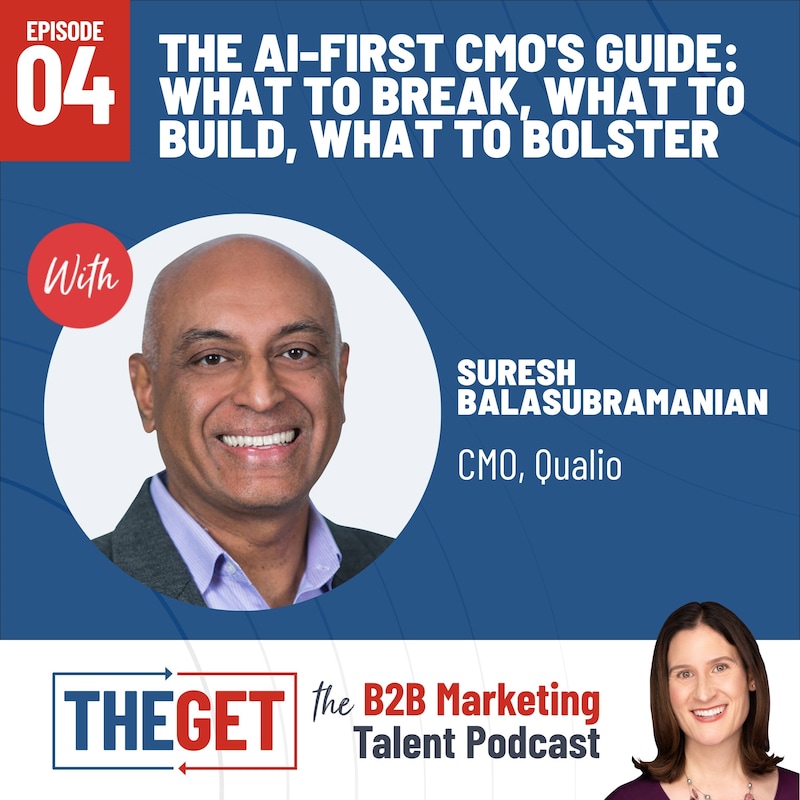
In this episode of The Get, host Erica Seidel talks with Suresh Balasubermaniam, CMO at Qualio, about how AI is reframing the CMO role and what it takes to move from a larger-company CMO seat to a smaller, faster AI-first build.
You’ll hear about:
- Inverting the change management playbook to focus on tech before people and process, since the tech can provide great results from the start
- Advice for hiring a marketing leader from a bigger company to a smaller company…and how to tell if the candidate is really ready for a smaller company
- Why it would be dangerous for a CMO -- of even a big company -- to say about AI, "Yeah, I've got a team that does that"
- Responding to Board members who encourage you to chase shiny AI objects: maintain your balance and stay true to your function
- Why marketing should be the catalyst for AI usage across the organization, given that marketing has the most connective tissue
- How to interview someone for AI-first thinking, and for the ability to not just improve processes, but re-imagine them
- A question that will separate AI posers from AI natives: "What did you build last weekend?"
- How to encourage AI use without producing AI slop, by insisting on human insight, distillation, and measurable outcomes
00:00 Show Intro and Guest
01:17 Why Move to Qualio
03:22 Proving You Can Scale Down
05:24 AI Teammates in the Funnel
08:11 The Rise of GTM Engineer
10:20 Inverted Change Playbook
14:11 AI First Without Slop
15:27 Beating AI FOMO
19:00 Hiring for AI Fluency
19:30 Wrap Up and Takeaways
The Get is here to drive smart decisions around recruiting and leadership in B2B SaaS marketing. We explore the trends, tribulations, and triumphs of today’s top marketing leaders in B2B SaaS.
This season’s theme is focused on how AI is reshaping the CMO role: how you lead, how you hire, and how you get hired."
The Get’s host is Erica Seidel, who runs The Connective Good, an executive search practice with a hyper-focus on recruiting CMOs and VPs of Marketing, especially in B2B SaaS.
If you are looking to hire a CMO or VP of Marketing of the ‘make money’ variety, rather than the ‘make it pretty’ variety, contact Erica at [email protected]. You can also follow Erica on LinkedIn or sign up for her newsletter at TheConnectiveGood.com.
The Get is produced by the team at Simpler Media Productions.
This podcast uses the following third-party services for analysis:
OP3 - https://op3.dev/privacy
Transcripts
Welcome to The Get, the podcast that's all about recruiting and
Speaker:leadership in B2B SaaS marketing.
Speaker:I'm your host, Erica Seidel.
Speaker:I recruit CMOs and VPs of marketing for B2B SaaS companies from
Speaker:scale-ups to larger companies.
Speaker:My tagline is that I place the make-money marketing leaders,
Speaker:not the make-it-pretty ones.
Speaker:This season on The Get, we're looking at how AI is reframing and reinventing
Speaker:the CMO role, especially as relates to hiring, getting hired, and leadership.
Speaker:Today, we do a deep dive on what it's like to go from a CMO role in
Speaker:a bigger company to a CMO role at a smaller company for an AI-first build.
Speaker:And we look at advice for Chief Executive Officers who are hiring CMOs today.
Speaker:My guest today is Suresh Balasubermaniam.
Speaker:Suresh is CMO at Qualio, the quality and compliance management platform
Speaker:for the life sciences industry.
Speaker:Suresh previously held marketing leadership roles at MeridianLink,
Speaker:Qualys, Elevate Security, and also the Myers-Briggs Company.
Speaker:He also held a GM role at Adobe, so he has a really broad perspective.
Speaker:Suresh, welcome to the show.
Speaker:Thank you, Erica.
Speaker:Glad to be here, and appreciate the intro.
Speaker:I was looking forward to a great conversation.
Speaker:One thing I wanted to talk with you about is that you were
Speaker:previously CMO at MeridianLink, which is much smaller than Qualio.
Speaker:You can maybe tell me about the delta between the two of them.
Speaker:So what made it the right move for you to go to Qualio and switch from a, from a
Speaker:bigger company to a much smaller company?
Speaker:Yeah.
Speaker:MeridianLink, uh, was, I would say, almost an order of magnitude bigger,
Speaker:so it was closer to, like, almost two hundred million plus on a trajectory
Speaker:to about three hundred and thirty, three hundred and fifty million.
Speaker:Yeah, I think it also has to do with the timeframe that we're talking about.
Speaker:You know, nowadays everybody talks about, you know, ChatGPT and post-ChatGPT.
Speaker:You know, everybody remembers November 2022 very well.
Speaker:Uh, but I think, uh, for me, the exciting thing was, you know, we had
Speaker:done a, a tremendous amount of growth at MeridianLink, growing from kind of the
Speaker:two hundred to sort of doubling in about, you know, two and a half, three years.
Speaker:I would call it in a more traditional way, where we would use more of the
Speaker:traditional demand gen playbooks, and there's a messaging positioning refresh.
Speaker:I was then, you know, advising a, a bunch of different, um, portfolio
Speaker:companies for one of the venture, venture companies that I'd, I'd known
Speaker:really well for almost 15 years.
Speaker:I worked with them, and to me, the catalyst for this switch was really
Speaker:the, the AI transformation, right?
Speaker:So I saw an opportunity where the amount of things that you could do with
Speaker:AI were just very, very interesting, and the pace at which companies could
Speaker:adopt those things were interesting.
Speaker:And for me, it was an interesting- it was very much a coincidence/opportunity
Speaker:where I saw a smaller company that was ready to move much faster that still
Speaker:had all the traditional challenges of, you know, we need to tell a different
Speaker:story, we need to rebuild our engine.
Speaker:But I saw an opportunity to implement a lot of the AI
Speaker:things in a much faster path-
Speaker:Yeah
Speaker:than what I could have done at MeridianLink, which is
Speaker:a much larger organization.
Speaker:So when I looked at those two things, it was sort of an interesting, you
Speaker:know, opportunistic timeline to say like, "Yeah, you know what? Maybe,
Speaker:maybe I can take all the things I knew that worked really well, and then come
Speaker:in here and then kind of drive growth at a, at a much higher scale using
Speaker:some of the latest technology," right?
Speaker:So that's-
Speaker:Yeah
Speaker:… that's what was interesting.
Speaker:Plus, compliance is something I've always been involved in from a security
Speaker:standpoint, and I got to do it in a, in a new vertical like life sciences.
Speaker:I'm like, I'm a continuous learner, so this was like, oh, I get to, I get to
Speaker:get smarter in other new industries, so.
Speaker:Was it hard to convince them that you could kind of scale down?
Speaker:Because I know in my recruiting practice, the biggest thing often that people look
Speaker:for is ability to kind of work at that scale, at the scale the company is at.
Speaker:And if a company wants to scale from, like, 20 million to 100 million, they
Speaker:yo-yo back and forth between, oh, the candidate that's really great at 20
Speaker:million, which is where they are now, and the candidate who's done the scale-up
Speaker:to 100 million or beyond or whatever.
Speaker:So, did that come into play in the process of looking at this role?
Speaker:To some extent, but I think that also then gets counterbalanced with, you know,
Speaker:you kinda look at it from a, from a role perspective, or you kinda get, as you
Speaker:get through the individuals that come through the process, and then you sort of
Speaker:really double-click into evidence, right?
Speaker:Everybody says, "I'm a hands-on person." Everybody says, "I work with a small
Speaker:team." But I think where it gets interesting is when the company and the
Speaker:candidate can sort of really match up and say like, you know, "Okay, I wanna see
Speaker:real evidence, not just saying it, but have you done it?" You know, maybe it's
Speaker:a, it's a take-home exercise or maybe it's a conversation you have with them.
Speaker:And 'cause when you're in the thick of the conversations, you can quickly tell
Speaker:if somebody has just sort of ChatGPT'd their answers or they've actually done it.
Speaker:I think the key thing when you're downscaling is you get the benefit
Speaker:of somebody who has seen larger scale, which is absolutely vital.
Speaker:Yeah.
Speaker:And then you wanna see evidence if they are able to switch gears.
Speaker:I like to call it, you know, do they have enough gas left in the tank to
Speaker:do another run from that 25 to 50?
Speaker:'Cause just because a person has done the 25 to 50, it doesn't mean that-
Speaker:they may not wanna do it again, right?
Speaker:They may be, "You know what? I did it. Uh, now I wanna go this way."
Speaker:But there are a few people that go like, "You know, I did it. I enjoyed
Speaker:it. Now I see the environment is different." Like, in my case, the
Speaker:environment was different with AI.
Speaker:I was like, "I wanna do it again, and I've got gas in the tank."
Speaker:So I think that's a good way to calibrate for both sides, actually.
Speaker:And it comes out in the conversation.
Speaker:Something I like to ask people is just what is something you like
Speaker:to be hands-on with, and what is something you do not deign to do?
Speaker:And that usually is telling, yeah.
Speaker:Yeah, that usually is telling.
Speaker:Yeah, what do you outsource and, and what can you do yourself?
Speaker:Can you step in and run a sales call?
Speaker:Can you step in and I, I don't know, send an email or a blast
Speaker:or, you know, something like that.
Speaker:So-
Speaker:Right.
Speaker:Where are AI teammates showing up in your org chart?
Speaker:Or/and where, like, humans with new titles that wouldn't have existed a few years
Speaker:ago showing up in your org chart now?
Speaker:This is the, the exciting part of this role that I'm in, and at a
Speaker:company where experimentation is highly, you know, not just allowed,
Speaker:but highly encouraged, right?
Speaker:We very much look at our funnel in kind of the traditional bow tie model.
Speaker:So, a good place to start, if anybody's looking at retooling,
Speaker:is really look at those points of friction all the way through.
Speaker:You know, we used to talk about the marketing funnel, right?
Speaker:Like, then you had folks from companies like Winning by Design that said
Speaker:it's not just about the initial part of the funnel, it's the bow tie.
Speaker:You know, in a regular SaaS business, how do you retain and grow value?
Speaker:So we very much look at the whole bow tie, and I started doing that here
Speaker:when I got to, got to Qualio, and you just look for points of friction.
Speaker:You look for areas where, either things are just not flowing fast enough for
Speaker:the velocity that you want to build into, or you're finding people that
Speaker:are just doing a lot of manual tasks.
Speaker:Or you don't have enough people to do it, so they're like, "Oh, you know
Speaker:what? I need to hire two more people."
Speaker:To me, that's almost like, especially now, you know, you look for those
Speaker:areas and say, "How can we do this better?" Not just improving the
Speaker:process flow through automation.
Speaker:Like for instance, we did a, an entire rebuild of the top of
Speaker:the funnel lead qualification.
Speaker:So we didn't just improve the process marginally, but we built an AI agent that
Speaker:takes everything that comes in, does a seven, eight source Perplexity, Gemini
Speaker:content search, maps it to our ICP, and scores them on the fly, and it gives you
Speaker:a red, green, yellow flag, and we only pass the green and yellows to the BDRs.
Speaker:We don't even pass the reds.
Speaker:So to me, that's an example of it's not a simple task, it's an agentic workflow.
Speaker:We tested it, and then we put it in production.
Speaker:Over a quarter, we did the analysis.
Speaker:So that's the other thing is, like, you don't wanna just put a bunch of AI stuff
Speaker:out there and you have, like, no idea.
Speaker:Like, okay, I saved money on not hiring more people, but I have
Speaker:no idea to tell you whether those things were valuable, right?
Speaker:That's another big thing as, as marketers, you know, we love to measure everything,
Speaker:and we are held accountable for things.
Speaker:So this was a great example where this project worked, where I was
Speaker:able to look back and saved almost six hours a week of BDR time by not
Speaker:calling on the reds and just finding out that they are not a good fit.
Speaker:So in our organization, AI teammates are starting to pop up.
Speaker:You know, we built a little sales ops analyst, responds to simple questions so
Speaker:you don't have to bug a human about it.
Speaker:So-
Speaker:Yeah
Speaker:the best way to think about this is look at your friction
Speaker:points and start building agentic workflows and experiment with them.
Speaker:But before you do that, have a clear idea of what success looks like and
Speaker:make sure the success is defined in terms of hours saved or some new,
Speaker:something new enabled so that this is something that you could never do before.
Speaker:Are there any new people or new human job titles that have cropped
Speaker:up, or is it more like these agentic workflows are supporting the, you
Speaker:know, the typical marketing, you know, people in the, in the org chart?
Speaker:I think the only one that has sort of come up more recently, I would say more
Speaker:recently in the sense like maybe the last 18 months is, is the GTM engineer, right?
Speaker:Like I think that's one that I think any of us who spend in a marketing capacity
Speaker:in LinkedIn definitely come across that.
Speaker:In a way, I think it has come about because the older models of rev ops
Speaker:or marketing operations, campaign managers that are digital marketers,
Speaker:having those roles separate, uh, made sense in the older world.
Speaker:Older world means before the AI technology really took over, because
Speaker:they were running on systems that were siloed and required expertise in
Speaker:those systems to be able to operate and to extract value out of them.
Speaker:So that's why you needed to have those roles as separate people who
Speaker:were trained up, groomed in that way, and then, and it had its, you know,
Speaker:moments, and then it had its challenges.
Speaker:As that world collapsed into like, look, there's no reason you need to
Speaker:have two separate roles to do this.
Speaker:You know, the, the campaign strategy, ideation, digital marketing versus
Speaker:data analysis, especially with AI has gotten so much easier to do.
Speaker:I think there's a natural evolution with the role of GTM engineer,
Speaker:somebody who has a little bit more of an engineering problem-solving
Speaker:mindset, but they're not 100% engineer.
Speaker:They, they understand campaign strategy, campaign architecture, and
Speaker:you definitely see that role starting to really pop up and people kind of
Speaker:growing into that role from either side.
Speaker:So if you either have an operations person that has a, a digital marketing
Speaker:bent, they can come in through that or you have a digital marketer
Speaker:that is good on the numbers and operations side, they grow into that.
Speaker:So I would say that's probably been the one sort of net new role that has emerged,
Speaker:I would say, in the last 18 months.
Speaker:Everything else is sort of a, a better, more hands-on version,
Speaker:more AI savvy version of a product marketing person or content marketer
Speaker:or a demand gen leader, et cetera.
Speaker:I think those are roles that whose scope and characteristics have evolved.
Speaker:But a true net new role I think is, is GTM engineer, I think.
Speaker:Cool.
Speaker:Thank you.
Speaker:Let's - change management.
Speaker:So, often, you know, when you, when you come in as a new C- CMO, you
Speaker:know, it's like you look at people, process, and technology, and, and
Speaker:when we talked earlier, you talked about, like, inverting that playbook.
Speaker:Can you talk about that?
Speaker:Is it tech first or people first?
Speaker:And, you know, how did you, how did you tackle this role?
Speaker:That's been the biggest area of surprise for me, I would
Speaker:say, the last 12, 18 months.
Speaker:You know, I've done many change managements.
Speaker:Usually I get brought in to drive change 'cause the, the status quo
Speaker:wasn't just not working, you know?
Speaker:So the… usually the remit is to rebuild the marketing engine.
Speaker:Please get the pipeline generation out of the doldrums we're in.
Speaker:Let's make it much more responsive.
Speaker:And in the past, I would say the last three or four roles, I pretty much
Speaker:used a very similar playbook, subject to certain size changes of like,
Speaker:okay, let me do a 30-day assessment of the people that are in seats.
Speaker:You know, I know what good looks like, what great looks like.
Speaker:I know what this organization needs.
Speaker:And then let's do a change out, change out, bring the right
Speaker:people in within 60 days, and then look at in parallel process.
Speaker:Let me get the people and process in place correctly.
Speaker:We'll use existing technology.
Speaker:We can do a little bit of experimentation, and then go for
Speaker:overhaul of like, you know, okay, we need to bring in a new ABM platform,
Speaker:or we need to do this or that, right?
Speaker:So it was a-- that sort of staging of, of change management worked well.
Speaker:It usually produced results that within, like about six months, you
Speaker:know, we get to a certain amount of predictable pipeline with all that.
Speaker:This last time around, I think it, it literally was like turned on its head
Speaker:because I walked into an environment where I had access to incredible technology
Speaker:that was just producing amazing results right from the get-go, because you didn't
Speaker:need to be an expert in a particular tech stack to get value out of it, because
Speaker:of how fast AI had moved in there.
Speaker:There was a need to hit targets in a much shorter timeframe than before.
Speaker:Uh, again, back to that velocity.
Speaker:And so I almost changed the… I kind of recognized that, and then
Speaker:that's an important attribute we can touch on later as well.
Speaker:How do you recognize which playbook to employ?
Speaker:Because it's not, it's definitely not a one size fits all, right?
Speaker:So it's sort of like you kind of have to read the situation a little bit and
Speaker:apply, apply the right playbook in there.
Speaker:But this one definitely was a change management turned on its head.
Speaker:So I had to move fast in looking at technology first.
Speaker:So we looked at things like Clay or things like revamping of our,
Speaker:our enrichment process, et cetera.
Speaker:And I didn't need a whole lot of new people, new process to do that
Speaker:because we had technology that was ready to deploy with the new systems.
Speaker:We could just bring them in either because the system itself was fairly automated,
Speaker:or we didn't need to have a huge amount of professional services and set up like the
Speaker:way you used to for enterprise systems.
Speaker:So-
Speaker:Yeah
Speaker:it was helpful to sort of get the tech in there.
Speaker:And in a way, the process, it was not so much about building old processes.
Speaker:The process itself changed.
Speaker:You know, like, like for instance, the agent, uh, example I gave you,
Speaker:it's no longer about automating that process to make it better.
Speaker:We have a completely new process.
Speaker:So it's no longer about somebody fills a form and a BDR calls
Speaker:them, qualifies the opportunity.
Speaker:That whole process is gone.
Speaker:Like somebody fills a form, they could just get an automated email from
Speaker:us because they're not a good fit.
Speaker:And so it didn't make sense to sort of bring people first process.
Speaker:We kind of went the other way.
Speaker:Then it's like now that I have a more AI-first system in place, what's
Speaker:the right set of people to bring in that have that mindset so that
Speaker:the change is more durable, right?
Speaker:So it's almost like you bring stuff in, it starts sticking, growing its
Speaker:legs, but then if you bring in people that are still stuck in the traditional
Speaker:mindset, they're either gonna undo it or they're not gonna be successful, right?
Speaker:So to make the change durable, you bring in people that have
Speaker:an AI-first mindset, AI-native workflow, hands-on thought process.
Speaker:They take that stuff, and then they help it make better, right?
Speaker:This is the first time I'm trying this.
Speaker:I'm calling it the inverted playbook.
Speaker:Maybe the new new, right?
Speaker:It's like the playbooks may be different moving forward just because
Speaker:of what we have available to us.
Speaker:So you're trying to get this AI-first mindset, but of course,
Speaker:everybody's trying to prevent AI slop.
Speaker:So how do you message what you're trying to do without sending mixed signals?
Speaker:I think it is super, super important to continue to reinforce,
Speaker:you know, the following, right?
Speaker:Which is, hey, we highly encourage AI.
Speaker:You should be using it every day.
Speaker:Use it to do analysis, use it to gather data, use it to help you
Speaker:through the thinking process.
Speaker:In a way, AI is like having access to the hundred best product marketers
Speaker:and their brains when you're trying to do, like, competitive research, right?
Speaker:Like, so it's kinda like use it with that mindset, but every output
Speaker:that AI produces is just that.
Speaker:It's, it's an AI output.
Speaker:Don't outsource your brain.
Speaker:You can't just copy-paste a document and send it to somebody or, or send it to
Speaker:your manager, 12, 15 pages of content.
Speaker:They're not gonna go through that.
Speaker:They're not employing you to push a button in an AI system.
Speaker:They're employing you to bring your insights, your experience, your
Speaker:analysis on top of that, right?
Speaker:So you kind of do that in a trickle-down fashion.
Speaker:So if you're a leader, a CMO, or a marketing leader, make sure that your
Speaker:first-line managers or reports to you are enforcing that, uh, so that when they send
Speaker:you stuff, it's their thought process, you know, it's their distillation, and
Speaker:encourage them to do the same for their…
Speaker:And the fast follow is not discouraging AI use, but it's really
Speaker:about the right AI use so that the, the slop doesn't compound itself.
Speaker:How do you kind of keep your sanity and navigate all the FOMO that is out there?
Speaker:'Cause I feel like, like you say, you're, you're on LinkedIn, you see all the stuff
Speaker:that people are writing and producing, or AI is producing for them, and everybody's,
Speaker:like, kind of bragging about their usage.
Speaker:Does your brain ever feel like it's gonna explode with all the stuff
Speaker:that, like, you could be doing differently and, like, you're, you're
Speaker:rethinking creating new processes?
Speaker:Is that, is that hard?
Speaker:First of all, noise is everywhere.
Speaker:It's really hard to not pay attention to that.
Speaker:But I would say that for those of us who've been doing this for a while,
Speaker:and even if you've not been doing it for a while, remind yourself that these
Speaker:technological waves are just that.
Speaker:They are technological waves.
Speaker:Now, obviously, some may be cresting faster, some may be coming at you
Speaker:faster, but at the end of the day, you know, even for those of us who've
Speaker:been working, let's say for 10, 15 years, you know, you saw the cloud
Speaker:wave, and then you saw the mobile wave, and then now you see the AI wave.
Speaker:And everybody would say like, "Yeah, you know what? This is,
Speaker:this is a little different. It feels, it feels different." Yeah.
Speaker:Every wave, wave has its own little differences, and some
Speaker:may feel more overwhelming than other, you know, things like that.
Speaker:So first is just remind yourself that, look, things are gonna come at you,
Speaker:more things are gonna come at you, but what you need to sort of keep
Speaker:in top of mind is what is my role?
Speaker:Like, if, if you're a chief marketing officer, your role is make sure that
Speaker:you're understanding the market, you're able to represent your
Speaker:organization in the best possible way, understand your customers, their
Speaker:buying behavior, and go to metrics.
Speaker:Nobody can argue against successful execution against metrics, right?
Speaker:No matter what.
Speaker:The FOMO manifests in many ways because you may believe that you're doing
Speaker:everything right, and you may get an email from a board member or from a CEO like,
Speaker:"Hey, I just saw this wonderful thing.
Speaker:Like they're doing this." Like, "Look, why are we not doing this stuff?"
Speaker:Like, you know, "Can we do this?"
Speaker:And you know, it is possible that it'll, it'll sort of knock you off your balance
Speaker:a little bit, but the way you sort of recenter yourself is go back to, like,
Speaker:reminding yourself like, "Okay, what is my core role, and how do I define
Speaker:success in my role?" And make sure you are continuously delivering successful
Speaker:things and telling others about it.
Speaker:I think that's the big point.
Speaker:As marketers, sometimes we get so caught up in just doing things or
Speaker:reacting to things, we often find it hard to market ourselves, including me.
Speaker:I'm guilty of that.
Speaker:I don't quite often talk about things that we've done that have gone well.
Speaker:Make sure that you're maintaining a steady drumbeat of how marketing is succeeding at
Speaker:these things and how is it doing things.
Speaker:So go back to the basics.
Speaker:Nowadays it is helpful to take everything in, and now we have,
Speaker:we have a helpful handy AI agent.
Speaker:You just dump it into your AI agent and say like, "Hey, I just got these
Speaker:three emails from my CEO. What is it talking about?" Use that a little bit
Speaker:to your advantage too and say like, "You know, help me understand what this is
Speaker:all about. Have we seen this before?"
Speaker:So kind of fight the battle, AI battle with a little bit of AI help on your side.
Speaker:You know, have your own little sidekick do some, you know, burn
Speaker:some Fable tokens and come back and, like, have an intelligent response.
Speaker:But don't just send it as it is, you know.
Speaker:Put your thoughts into it and say like, "Hey, thanks for sh- sharing this. Here's
Speaker:the three ways in which we could use it."
Speaker:It's all about centering yourself, going back to the basics.
Speaker:How marketing success is defined has not really changed, so kind of
Speaker:stick to that and be strong in your conviction that that's what matters.
Speaker:Be fluid in how you handle things that come in.
Speaker:There is no stopping this or slowing this down.
Speaker:And I love your characterization of the role.
Speaker:It's … O- one thing I ask people often when I interview them is just
Speaker:like, "How would you characterize the, the role of the marketing
Speaker:leader?" And it's an instant way to see kind of their level of altitude.
Speaker:You know, 'cause you said you went right into, like, the markets, so
Speaker:it's like the, you know, the Chief Market Officer kind of viewpoint.
Speaker:And, and everybody articulates it differently, and that's
Speaker:so fascinating to see that.
Speaker:Uh, let's talk hiring.
Speaker:Like, how do you evaluate somebody's skills, and how important do you think
Speaker:of AI fluency, call it, versus industry experience, and how are you hiring?
Speaker:First thing is, across all roles, at least for us, AI fluency is a must-have.
Speaker:We, as a company, have decided to completely roll the dice on this.
Speaker:We see AI-native and AI-mindset folks really as the key to our success, right?
Speaker:'Cause we, we see that as a way for everybody to punch above their weight.
Speaker:So you hire somebody with, like, you know, let's say three to five years experience.
Speaker:They have AI-native thinking.
Speaker:They've demonstrated that they're actually punching, like, at five
Speaker:to seven years of experience.
Speaker:That … I see that across the board, even without looking at new
Speaker:talent, just across the board, just enabling the teams to, to do that.
Speaker:That's already happening, and I would recommend that to others as well.
Speaker:I think smaller companies, and smaller I mean like, say, you
Speaker:know, 500 employees and below, can probably move a little bit faster.
Speaker:I think they are all definitely moving faster than larger organizations
Speaker:in terms of this AI-first mindset as a, as a hard screen.
Speaker:Because smaller companies, I think it's, it's survival.
Speaker:It's, it's life or death.
Speaker:If you bring in a bunch of people that are operating in the old mindset way, you're
Speaker:just gonna keel over, no matter which function it is, and marketing definitely.
Speaker:But larger organizations can use this as a way to catalyze change, right?
Speaker:Because you … The change has to start somewhere.
Speaker:Most people know that product development teams are already using AI very heavily,
Speaker:you know, all the different tools.
Speaker:But the product development teams are often not … They're not gonna
Speaker:go out and convince a lot of other teams to use AI, 'cause they're
Speaker:happy building their own stuff.
Speaker:You know, no, no slight against them.
Speaker:They're just doing their work, and they're, they're getting more productive.
Speaker:You know, whereas if you look at, like, a marketing team or a sales team
Speaker:or product teams, these teams tend to work much more cohesively together.
Speaker:So a change in one organization can definitely percolate and impact
Speaker:positively other organizations, right?
Speaker:There's more connective tissue there.
Speaker:So, so I would say that if you're looking at recruiting people today- Certainly
Speaker:for companies that have either AI as a mandate or they're making AI products.
Speaker:If you're building AI-enabled products, there's no reason you wouldn't be
Speaker:bringing more AI thinkers into your organization, 'cause you're hoping that
Speaker:your customers make that change, and how are you gonna ensure your customer
Speaker:are gonna make that change if you're not ready to make the change, right?
Speaker:So it's, it's a little bit of a you have to walk the walk and talk the talk there.
Speaker:So, so that's an initial bar you bring in.
Speaker:But the, I think the, the bigger question you're asking
Speaker:is like, okay, so how do I know?
Speaker:Like, if I'm talking to somebody, uh, you know, they send me a resume and,
Speaker:you know, nowadays it's easy to just AI wash a resume, throw in a bunch of
Speaker:keywords, and the next thing you know, it's like, it's hard to tell, right?
Speaker:I've found that, you know, in these kind of situations, it's, it's
Speaker:almost back to that earlier question.
Speaker:It's like, people that are hands-on can be easily discerned by just a few questions.
Speaker:Even as simple as like, "Hey, tell me the last interesting AI project
Speaker:you worked on or, or an agent that you built." And I even tell them that
Speaker:it doesn't have to be work related.
Speaker:And, and the worst somebody could say is like, "Well, you know, I really wanna do
Speaker:it, but my company has all these, like, data restrictions and I can't really
Speaker:use AI at work." Well, yeah, but if you truly are the kind of person you're
Speaker:looking for, you would be hacking on the side and building your own little AI
Speaker:agent and, you know, there's a general curiosity that we would look for, right?
Speaker:So, so that excuse like, you know, my, my company's data policy prevents
Speaker:me from like… And I'm like, you know, that's, that's, that's probably
Speaker:a good yellow flag or a red flag.
Speaker:Uh, but I would say, yeah, somebody that's curious,
Speaker:hands-on, they've built something.
Speaker:They're able to talk about it.
Speaker:They'll be like, "Okay, so what pain point were you a- experiencing,
Speaker:and what did you do about it? And how did you go about it, and how do
Speaker:you know it's successful?" Right?
Speaker:So simple questions.
Speaker:And if they've done it themselves, you would easily-- you can easily tell,
Speaker:and you can tell from a few questions.
Speaker:So I look for definitely people that are not just about improving processes, but
Speaker:they've really reimagined it, and they're kind of coming in with that fresh mindset.
Speaker:So I would say, you know, certainly if you're building, uh, marketing
Speaker:organizations, let's say for example, if you're building a-- if you're, uh, hiring
Speaker:a product marketer, I absolutely wanna see what they have done from a competitive
Speaker:analysis and research standpoint.
Speaker:Have they built their own little agent that does a continuous
Speaker:market analysis, brings content, and, and how have they used it?
Speaker:You know, most companies do, they have some version of
Speaker:gong calls or outreach calls.
Speaker:You know, have they built something to analyze those things?
Speaker:So for each of the functions, there's definitely early evidence that somebody's
Speaker:actually thinking differently that you can use in an interview process to flesh out.
Speaker:Worst comes to worst, I sometimes pull up my Claude co-work, and I just show them,
Speaker:like say, "Hey, this is what-- This is how I built my Chief of Staff plugin," and
Speaker:then we start riffing, and I'm like, okay, I know this person is hands-on, right?
Speaker:This is interesting because I know some investors are saying, "Show
Speaker:me what you're building in AI," which, you know, pros and cons.
Speaker:You know, hopefully they see something.
Speaker:But on the other hand, some people, like you say, their work,
Speaker:their work is multiplicative.
Speaker:It's across-- not just marketed, but, uh, m-marketing, but it, you know,
Speaker:touches sales and success, et cetera.
Speaker:So you-- if you just see one person's Claude instance, you may
Speaker:or may not see as much of that, that kind of connective tissue.
Speaker:But interesting that you share your own, and you ask them to riff.
Speaker:I like that.
Speaker:But it's like you have to have certain amount of context around the stuff, right?
Speaker:So I would say for product marketing, I think the industry
Speaker:expertise is very helpful.
Speaker:Um, if you're on the demand gen side, I would say it's less of a hard requirement
Speaker:on the industry expertise because there are ways to layer on buyer persona
Speaker:types, archetypes, channels that are, uh, that you reach certain archetypes,
Speaker:et cetera, that transcend industries.
Speaker:And I think there you want the expertise to be more around experimentation.
Speaker:You know, how good are you at experimenting across
Speaker:multiple channels, you know?
Speaker:When are you ready to kill something because it didn't work?
Speaker:So I would say it depends on the function.
Speaker:So let's talk about advising CEOs now.
Speaker:So like if you were advising a CEO hiring a CMO today, what would you
Speaker:tell them to look for that might not show up clearly on a resume?
Speaker:I think it is absolutely reasonable when you're talking to candidates to
Speaker:expect both a level of the craft of marketing and marketing leadership,
Speaker:but also very recent AI hands-on experience, even at the CMO level.
Speaker:Even if the CMO says, "Look, yeah, I've got a team that does that."
Speaker:Um, I mean, I, I'm in Claude Cowork every day, right?
Speaker:Like, and I would still be in Claude Cowork even if I'm at a,
Speaker:at a $200 million organization.
Speaker:I think there's a mindset that you definitely wanna look for, because no
Speaker:matter what size you're at, you wanna, you wanna sort of have a leader that
Speaker:has that transformative mindset that you can, you can rely on to drive change.
Speaker:'Cause as we talked earlier, if you bring in a good leader at that marketing
Speaker:function, there's a opportunity for you to drive that change in
Speaker:through sales, through customer success, through product, because
Speaker:they tend to work with those, right?
Speaker:So it's a good way to sort of introduce change in one function and drive it out.
Speaker:So I would definitely say, you know, look for that mindset.
Speaker:Look for some hands-on skills.
Speaker:Examples would be very helpful.
Speaker:Not just AI for AI's sake.
Speaker:It's like, you know, what-- how did you know what you deployed worked?
Speaker:What substantially improved?
Speaker:Certainly at a CMO level, they should be able to step back and talk about
Speaker:projects at a larger scale in terms of their transformative power and,
Speaker:and what results came out of that.
Speaker:I would say over the last 12 months, there's enough of this technology that's
Speaker:gone into these organizations for us to see some tangible improvements.
Speaker:So it's not so much like, "Oh yeah, we just put this in place.
Speaker:We don't know yet," right?
Speaker:Like, that's not really a defensible position anymore.
Speaker:I like that.
Speaker:And your point, that even at a $200 million company, $500 million company,
Speaker:you should be seeing that hands-on.
Speaker:So another, you know, way to put it is that, you know, a lot of
Speaker:CEOs are pushing for AI everything, you know, when teams are already,
Speaker:you know, kind of overwhelmed.
Speaker:And so I think CMOs can be caught in between unless they have all these
Speaker:AI-native people on their, on their teams.
Speaker:And so what should CEOs expect from their CMOs in that kind of situation?
Speaker:I, I think there should definitely be, um, a, a very solid dialogue
Speaker:on that front and not a monologue.
Speaker:I think the CMO should feel very comfortable setting the
Speaker:expectations of success, you know, going back to that metrics.
Speaker:'Cause that relationship still needs to be grounded in the business
Speaker:fundamentals independent of AI.
Speaker:That's the first order of business, which is you should still be
Speaker:able to have a conversation.
Speaker:The CEO and the CMO should be able to have a business conversation in
Speaker:terms of the outcomes that they want to drive, the kind of projects that
Speaker:they wanna do, and then how will they know that if it's successful.
Speaker:They should be have, be able to have that 15, 20-minute
Speaker:conversation without the use of AI.
Speaker:That's business fundamentals.
Speaker:Like, C- CEO, CEO should be able to say, yeah, you know what?
Speaker:These are the markets or challenges we have.
Speaker:This is the kind of growth I wanna drive.
Speaker:This is the kind of ROI I'm looking for.
Speaker:And the CMO should be able to talk about it in just sort of business terms.
Speaker:The AI then becomes more of that grease the wheels or
Speaker:the, you know, the accelerant.
Speaker:Like, that allows the organization as a whole to achieve those o- uh,
Speaker:those objectives either at a faster rate or on a more efficient scale.
Speaker:That's the way to think about that, right?
Speaker:So, and then give grace on both sides, right?
Speaker:Like, you know, don't bring in a CMO and then expect them to do wonders
Speaker:in 30 days just because you dumped them in the role and then, you know,
Speaker:dumped them with a lot of the AI stuff.
Speaker:It's not the magic pill.
Speaker:I think it needs to be used thoughtfully.
Speaker:You could absolutely deploy something in 15 days and have it be slop, or
Speaker:you can deploy it in 30 days and have it take root and have a drive
Speaker:change that is more sustainable.
Speaker:Clearly, there's a, there's a middle ground there.
Speaker:You know, if somebody said, "I'm gonna take six months to do this AI
Speaker:project," there's something wrong.
Speaker:But, you know, something in one week, uh, two weeks versus fi-
Speaker:four weeks, I think it's okay.
Speaker:I think, I think it's, uh … I would say have good expectation
Speaker:managing conversations on both sides, and be ready to handle
Speaker:FOMO, 'cause that's gonna happen.
Speaker:Like, the, the LinkedIn stuff's not gonna go away.
Speaker:So but I would say it's good to have the business conversations.
Speaker:Those fundamentals have not changed.
Speaker:That also becomes a nice catalyst to drive change across the other departments.
Speaker:Hiring with that mindset, I think that's a nice side bonus as well,
Speaker:'cause this leader can then help you drive that transformation.
Speaker:Well said.
Speaker:This is fabulous to have you on the show.
Speaker:Thank you so much for joining, Suresh.
Speaker:Thank you.
Speaker:I've enjoyed the conversation.
Speaker:That was Suresh Balasubramanian.
Speaker:Now that you've heard from Suresh, think about how you can balance business
Speaker:knowledge with AI fluency in your role.
Speaker:Thanks for listening to The Get.
Speaker:I'm your host, Erica Seidel.
Speaker:The Get is here to drive smart decisions around recruiting and
Speaker:leadership in B2B SaaS marketing.
Speaker:We explore the trends, tribulations, and triumphs of today's top
Speaker:marketing leaders in B2B SaaS.
Speaker:For more about The Get, visit TheGetPodcast.com.
Speaker:If you like The Get, please share it, and please leave a review.
Speaker:To learn more about my executive search practice, which focuses on recruiting the
Speaker:make-money marketing leaders rather than the make-it-pretty ones, follow me on
Speaker:LinkedIn or visit TheConnectiveGood.com.
Speaker:The Get is produced by Evo Terra and the team at Simpler Media Productions.


