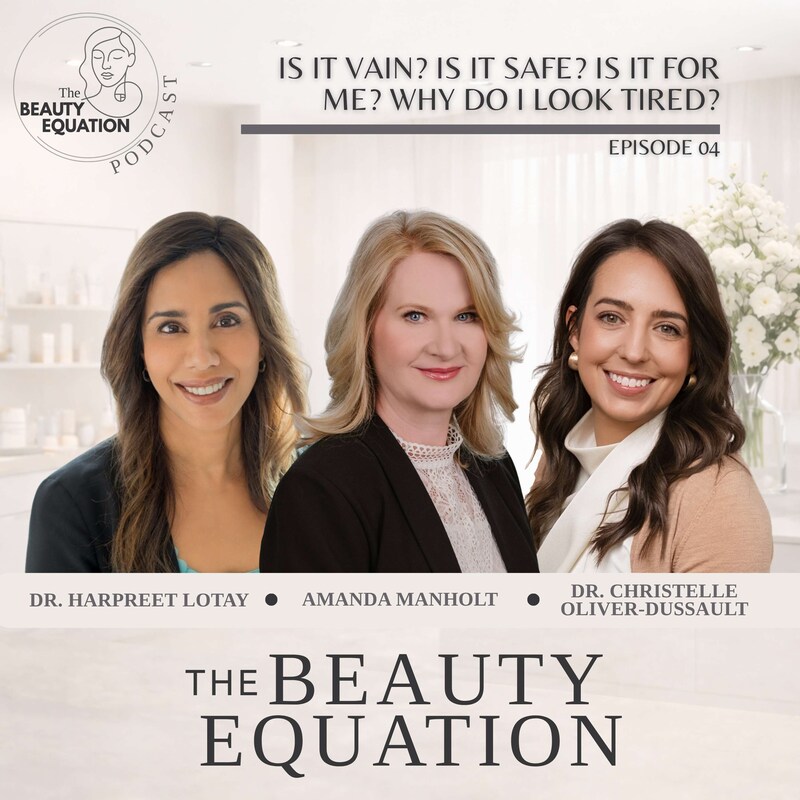
Shownotes
In this episode of The Beauty Equation Podcast, Dr. Christelle Oliver-Dussault, Dr. Harpreet Lotay, and Amanda Manholt dive into the hesitations many women feel about aesthetic treatments. They debunk common myths and fears—especially around Botox and injectables—while emphasizing the importance of skin health and the proven safety of these procedures. The hosts also discuss the pressures women face about appearance, the need for informed choices, and the value of working with qualified providers to achieve natural, confident results.
About the Hosts:
Dr. Harpreet Lotay is a family physician specializing in aesthetic medicine. She is the founder of Sona MD in Kamloops, BC, and serves as Chief Medical Officer at Bios Wellness Clinics. Known for her artistic approach and comprehensive non-surgical treatments, Dr. Lotay combines medical expertise with an eye for natural results. She is also an educator, a national trainer and holds academic appointments where she shares her knowledge in clinical dermatology and aesthetics. You can get in touch with her on Instagram @hlotaymd
Dr. Christelle Oliver-Dussault is a family physician specializing in aesthetic medicine, women’s health, and psycho-education. She brings a holistic, whole-person perspective to her clinical work, blending science with a deep understanding of the mind-body connection.
She is also the founder of Reclaim The Pink Within, a movement that empowers women to rediscover themselves during life’s most transformative stages. In addition, she is passionate about medical education and mentors the next generation of family physicians through her work with the department of Family Medicine at the University of British Columbia.
You can connect with her on Instagram @drchristellemd
Amanda Manholt is a clinic manager, patient consultant, and co-host of The Beauty Equation Podcast. With over 30 years of experience in beauty, aesthetics, and leadership, she has guided patients and teams alike toward confidence, growth, and empowerment. Known for her ability to connect with people and simplify the often-overwhelming world of aesthetics, Amanda brings a warm, practical, and relatable perspective to every conversation. You can find her on Instagram @crowsfeetandconfidence.
Websites
https://www.getyourpinkbackproject.com/
Disclaimer: The Beauty Equation is for informational purposes only and not medical advice. This podcast does not create a doctor–patient relationship. Always consult a qualified healthcare provider before making medical or aesthetic decisions. Information may change as the field evolves.
Thanks for listening!
Thanks so much for listening to our podcast! If you enjoyed this episode and think that others could benefit from listening, please share it using the social media buttons on this page.
Do you have some feedback or questions about this episode? Leave a comment in the section below!
Subscribe to the podcast
If you would like to get automatic updates of new podcast episodes, you can subscribe to the podcast on Apple Podcasts or on your favourite podcast app.
Leave us an Apple Podcasts review
Ratings and reviews from our listeners are extremely valuable to us and greatly appreciated. They help our podcast rank higher on Apple Podcasts, which exposes our show to more awesome listeners like you. If you have a minute, please leave an honest review.
Transcripts
Well, skin health is foundational, so it's. And it's a. It's a
Speaker:friendly, approachable way to get them to start to understand
Speaker:that this is a very holistic thing. That one thing ties into the next, ties
Speaker:into the next. So I love it when I can review what they're using for
Speaker:their skin and give them some education and understanding about, you know,
Speaker:things that will actually make a difference to their skin. I would say
Speaker:neuromodulators like Botox and Dysport, that's probably one of the first.
Speaker:First treatments. I don't know if you'd agree with that too, Harpreet, where it's,
Speaker:you know, it's not a huge investment in terms of money per se.
Speaker:And at the end of the day, if they don't like the results, guess what,
Speaker:it goes away, and it's like you never had it. So I feel like that's
Speaker:a real. I call it the gateway drug. Welcome back to the beauty equation.
Speaker:I'm Dr. Christelle Oliver Dusseau. And I'm Dr. Harpreet
Speaker:Lotade. And I'm Amanda Manholt. So today
Speaker:we're talking about the. A specific group of women, women
Speaker:who haven't really had any treatments done before, who are a bit
Speaker:hesitant and are wondering, is this
Speaker:the right space for them? Are they behind what's
Speaker:available to them? And anyone who's feeling a little bit intimidated or
Speaker:overwhelmed by the variety of options that we
Speaker:have to offer or. Ashamed, I think that's the big one.
Speaker:Yeah. Yeah, we see a lot of that too. So let's start with you,
Speaker:Amanda. Since you do so many consults and you get a lot of these
Speaker:con. You have lot of these conversations on a day to day basis, what
Speaker:are some of the biggest myths or fears that you would like to
Speaker:dispel? So many. But the number one myth
Speaker:or the number one fear is that they're gonna look
Speaker:fake. Today I had a lovely gallon for a consult,
Speaker:and she was concerned that her forehead would look shiny and
Speaker:plastic. So it's that feeling
Speaker:like they look odd, like someone can point them out in a room and say,
Speaker:I know what you did. Mm. And
Speaker:I feel like that the underlying current for that is shame.
Speaker:It is right. You know, and it depends. And I see it with,
Speaker:you know, boomers and Gen X people like me, and
Speaker:even sometimes with the millennials, but the, like, the younger ones I find are sort
Speaker:of less averse. I feel like it's really these boomers and
Speaker:millennial or Generation X and. And some of the
Speaker:Older millennials. Yeah. The younger ones, I think, grew up
Speaker:with more of a social media presence that
Speaker:they don't seem as intimidated or bothered. Not at
Speaker:all. It's like getting your nails done. You know, it's something that they do for
Speaker:prevention. But their moms come in and it's.
Speaker:Let me tell you, it's a whole other con, you know, a whole other
Speaker:conversation. And I think the thing that's so frustrating and challenging about
Speaker:aging is if you do nothing. Oh, God, she's let
Speaker:herself go. Look at her. And if you do
Speaker:too much, who does she think she is? Oh,
Speaker:she's one of those people. Oh, she must be vain. Why would. Who would
Speaker:do that? Right. So there's so much judgment or
Speaker:perception of judgment. So what are some of the
Speaker:treatments that you'll often introduce to women who are
Speaker:coming into the clinic who would like to
Speaker:have something done but are very hesitant and concern?
Speaker:What are the most common things you'll usually find that they're
Speaker:open to or feel comfortable trying? Well,
Speaker:skin health is foundational, so it's. And it's a. It's a
Speaker:friendly, approachable way to get them to start to understand
Speaker:that this is a very holistic thing. That one thing ties into the next, ties
Speaker:into the next. So I love it when I can review what they're using for
Speaker:their skin and give them some education and understanding about,
Speaker:you know, things that will actually make a difference to their skin.
Speaker:I would say neuromodulators like Botox and Dysport, that's probably
Speaker:one of the first treatments. I don't know if you'd agree with that, too, Harpreet,
Speaker:where it's, you know, it's not a huge investment in terms
Speaker:of money per se. And at the end of the day, if they don't like
Speaker:the results, guess what, it goes away. And it's like you never had it.
Speaker:So I feel like that's a real. I call it the gateway drug.
Speaker:Yeah, right. I think the fear. It's interesting that
Speaker:Botox, yes, definitely one of the first aesthetic
Speaker:treatments that will be introduced to women. And from a medical perspective,
Speaker:it's super, super safe. It's been around for
Speaker:decades, and it's been used in for treating medical
Speaker:conditions, you know, migraines, spasticity in stroke
Speaker:victims, even so. But there's such a. Yes.
Speaker:Overactive blood. So, so many aspects in medicine. We use
Speaker:Botox, and yet it's, you know, considered the
Speaker:boogeyman. And you'll find all kinds of misinformation out there
Speaker:about how it's gonna, you know, change your
Speaker:brain. It's going to travel all over the place
Speaker:and give you botulinum. And,
Speaker:you know, it's a toxin, which technically it is, but it's
Speaker:extremely, extremely safe. So I feel very comfortable as a
Speaker:physician recomm injecting that. And it is,
Speaker:to Amanda's point, temporary. So that's very
Speaker:nice because if people aren't loving the results,
Speaker:they don't have to worry everything about it is going to go away.
Speaker:So I love that. And like, those who are new to
Speaker:Botox, because there's a lot of confusion around
Speaker:the different injectables that we use. And I'm saying Botox not
Speaker:just for the brand. It's just people commonly refer to.
Speaker:How does it work? Well, it
Speaker:basically stops your muscles from receiving the
Speaker:impulse from the nerves that tell the muscles to contract. So it
Speaker:stops contraction. That's all it does. And then
Speaker:your body's clearing mechanisms will go in and break
Speaker:down that protein and stop it from binding that receptor,
Speaker:will open up again and contraction will start again.
Speaker:You know, so a lot of people will say it magically erases
Speaker:wrinkles. All it does is it stops muscle
Speaker:activity and it lets your skin repair itself from the
Speaker:micro trauma, from that repetitive creasing that you're creating that
Speaker:you are not able to repair quickly anymore as you age.
Speaker:So just stops muscle movement. Yeah, I totally
Speaker:blame Tim Allen. And what was that Christmas movie? He goes
Speaker:to the mall and he goes and apparently
Speaker:gets a Botox treatment and then comes back and meets his family in the food
Speaker:fair. And his face, like, is all. Yeah,
Speaker:twisted up who are on the podcast. She's
Speaker:making a very funny face. Oh, yeah. His face is all
Speaker:contorted and. And it's like, looks ridiculous. And he's like, I just got a
Speaker:Botox treatment. And I'm like, okay, come on. Like, first of
Speaker:all, it's probably the most anticlimactic thing you could ever do. It's
Speaker:literally a couple of pokes and you're on your way, and you don't really see
Speaker:a whole lot until it starts to take effect somewhere between,
Speaker:you know, depending on what you guys are using, four days to a week
Speaker:or so later. Yeah, but it's, you know, this
Speaker:myth that's been perpetuated that, you know, you're going to look crazy or
Speaker:unnatural. And I have to say to people, I'm the winner in the clinic for
Speaker:number of units. Like, what am I at? 100. Where am I using you guys?
Speaker:121. Hundred and nineteen, baby. And,
Speaker:and I, you know, that was the comment with when I did the consult today.
Speaker:And she's like, I just, I really, I said, well, tell me what you're worried
Speaker:about. Tell me what bought, like what is, what does it bad look
Speaker:like for you in terms of an outcome? And she said, I don't want a
Speaker:shiny forehead. I said, totally fine. I
Speaker:said, but just so you know, I'm the, you know, the winner in the
Speaker:clinic and is my
Speaker:forehead shiny? Things still move, right? So yeah, unfortunately there's
Speaker:just been a lot of misinformation and it feels like fear mongering
Speaker:and, and it just feels like putting us in our place. I'm sorry,
Speaker:I'm just gonna say it. That's what it feels like to me.
Speaker:Like, how dare you want to show up and be
Speaker:vibrant and still and be relevant. Right. Well, I mean the
Speaker:interesting thing is is women worry about whether or
Speaker:not they're vain. I don't think I've ever, I mean in
Speaker:any context, I don't think I've ever had a man say,
Speaker:am I being vain? They own
Speaker:that. They're like, yeah, I care.
Speaker:But that was a commercial media and commented on our appearance constantly.
Speaker:Of course we're going to then reflect on the way we look and appear if
Speaker:that's all we see. Yes. And popular
Speaker:media. Well, and I think in our culture, you know, it's, a woman can never
Speaker:be too beautiful and a man can never be too strong.
Speaker:Yeah, I've heard, I've heard it said. Do you, do you remember there was a
Speaker:commercial years and years ago and I want to say it was for Special
Speaker:K or some sort of cereal and it was this guy sitting at
Speaker:a bar with like, you know, a bit of a beer belly and
Speaker:crying into his beer about looking fat. And it was just,
Speaker:it was such a great commercial because it was just
Speaker:so you're like, well that's just ridiculous.
Speaker:Why was it ridiculous? Because it was a guy in a bar with a
Speaker:beer and a belly. I don't know. So going
Speaker:back to our hesitant listeners,
Speaker:dipping your toe in often looks like a conversation
Speaker:around skin health. How it ages and what
Speaker:is suited to your skin type, what will
Speaker:help, what will cause harm, and then introducing some
Speaker:neuromodulators. And that's a really lovely combination because as
Speaker:Harpreet said, once it kicks in and your skin isn't moving as much or
Speaker:wrinkling or creasing like a piece of paper would, then those actives
Speaker:that we're using on Your skin are starting to work, and it's a really nice
Speaker:symbiotic relationship. And absolutely.
Speaker:Usually, if you're going to be doing regular treatments, you should
Speaker:probably think about your daily skincare. The other thing I really love about
Speaker:Botox, too, it's not just the effects that it has on the overlying
Speaker:skin, but it almost lets us play a little puppet game with
Speaker:people's faces, particularly. I know last time, Harper, you talked about how I don't
Speaker:want my face to droop. The effects of gravity and
Speaker:on the lower face. That's where I've really enjoyed exploring the
Speaker:use of neuromodulators, because you can get a real
Speaker:lifting effect and definition of the jawline there, which a lot of people aren't
Speaker:usually familiar with. So that's something that,
Speaker:if you were thinking it's just for your forehead, your frown, or the
Speaker:11s, as people say. No, we have lots of uses that go way beyond just
Speaker:the upper third of your face that we can use. Yeah, absolutely.
Speaker:In term. Oh, go ahead, Amanda. I was gonna say, I think another thing that
Speaker:holds women back in particular is
Speaker:their spouse. Oh, yeah. And I'm sure you guys
Speaker:can both talk about this, but it's like, my partner can't know. It's
Speaker:kind of funny. I think a lot of times it's grocery cash that comes in.
Speaker:Again, it's just either they
Speaker:don't want to have to talk to their partner about it, or they don't
Speaker:want to feel guilty or the shame or. But that definitely comes in.
Speaker:That conversation is, you know, had many times.
Speaker:Well, at the end of the day, I think what sometimes
Speaker:happens in those situations is that whatever the person in our
Speaker:chair is noticing does not impact the spouse.
Speaker:And what I mean by that is when the person looks in the mirror and
Speaker:they see that line and it makes them feel like they're old or
Speaker:they look angry, that affects that person, that woman
Speaker:that's looking. And so she's seeking help for that
Speaker:feeling. And that look, that has nothing to do with her
Speaker:spouse or whether her spouse finds her attractive or not.
Speaker:Because more often than not, the comment is,
Speaker:you know, he thinks I look fine, but that's not the point. Right.
Speaker:So, yeah. And I think, too, I mean,
Speaker:we've been. I've been married for, gosh, 25 years now, and,
Speaker:you know, obviously we're both aging. But when I look at my husband, I.
Speaker:I don't tend to see a lot of that.
Speaker:He's just who he is because we've been together so
Speaker:long. I remember going to, I think it was my 30 year high school reunion.
Speaker:Now that's a trip. And talking to a fellow that I literally did
Speaker:not recognize. I had to read his name tag. And then once I figured
Speaker:out who I was talking to, I was like, oh my gosh, Kelly. And
Speaker:the weird thing that happened is as I was talking to him,
Speaker:his beard sort of melted away, his weight sort of melted away.
Speaker:And as I heard his voice, he was like the 17
Speaker:year old person that I remembered. I just, that was
Speaker:just an odd experience. So then I wonder, like with your spouse
Speaker:again, to your point, I don't. It shouldn't be about. It
Speaker:should never be for your partner, it should always be for you. And
Speaker:I think from my experience, most people aren't coming in
Speaker:to do this for somebody else, they're coming in to do it for themselves.
Speaker:Yeah. And they just want to feel more
Speaker:confident and they're coming into us to have a
Speaker:conversation because they don't know where to go and what is
Speaker:available and what can be done. We, you
Speaker:talked, we kind of touched on a little bit about the skin
Speaker:care, some of the injectables which are neuromodulators.
Speaker:There's a few other injectables that we use and I think a lot of people
Speaker:get confused with what that is. Harpreet, you want to give a quick
Speaker:overview of what's available and when we might use it.
Speaker:Neuromodulators come in different flavors, as Christel
Speaker:mentioned. So those are those injectables that stop your
Speaker:muscles from moving. So those are great for addressing
Speaker:lines that are caused by movement or creasing. But there are other
Speaker:things that we can inject as well to address other aspects of
Speaker:aging. So one of the things that happens when we age is we lose
Speaker:volume. Our fat pads start to sort of get smaller
Speaker:in all the wrong places, like our cheeks, like our temples.
Speaker:And we start to get some jowling and softening of the jawline.
Speaker:So we can replace that volume with fillers that
Speaker:are made out of sugars. And we have these natural
Speaker:substances in our skin as well. It's called hyaluronic acid.
Speaker:But when we want to use them to create volume, they're sort of
Speaker:created in a way that gives them a little bit more substance. So we can
Speaker:use them to create a structure like effect. We
Speaker:can use them in thinner forms to
Speaker:soften certain lines so they can be used in various
Speaker:ways. So fillers are. And those are what is
Speaker:injected into lips as well. And then we have
Speaker:yet other injectables that will address the loss of collagen
Speaker:that happens when as we age, we lose about 1% of our
Speaker:collagen after the age of 20. And it just is this compounding
Speaker:thing, snowballing thing that happens and decreases
Speaker:elasticity in our skin. And we can inject things like
Speaker:Sculptra, which is an injectable that will stimulate your
Speaker:fibroblast to make its own collagen. We have
Speaker:Radiesse, which also can be injected to do similar
Speaker:things as well as create a scaffolding for volume.
Speaker:So there are so many different injectables that we
Speaker:use presently and other injectables coming
Speaker:down the road, like harvested adipose tissue that's
Speaker:sterilized and can be used. Down in the States they use that.
Speaker:So yeah. Have you too. You may. You probably
Speaker:don't get it as often as I do, but when you're doing an initial consult
Speaker:with someone and they're just like, oh no, no
Speaker:injectables for me for sure. Which is
Speaker:totally fine. If that happens,
Speaker:what. Where do you tend to go? Christelle, why don't you
Speaker:take that one? Yeah. So oftentimes when people come into me,
Speaker:the conversation is usually around what they're noticing and
Speaker:what they want to address. And then if I
Speaker:notice any hesitancy, particularly with regard to like fillers, I'll dig it in
Speaker:to ask a little bit about like, what are those fears? What worries you? And
Speaker:some are valid fears because there's been, it's
Speaker:still a very unregulated industry in certain parts
Speaker:of the world and sometimes even we've noticed issues here too.
Speaker:And there can be complications if not
Speaker:injected properly. If so,
Speaker:I usually address those head on with them and
Speaker:tell them what the degree of risk is and what to expect and
Speaker:also tell them, well, if this complications arises, this is
Speaker:how we manage it. So for example, with fillers, one of the
Speaker:biggest, the most worrisome, although very rare,
Speaker:is a vascular occlusion. So that's when the blood supply to the
Speaker:area near where you injected gets blocked. And that can either happen
Speaker:because the product has ended up in the blood vessel, if there's a big bruise
Speaker:pressing on that blood vessel.
Speaker:And we in our practice always give post care sheets to
Speaker:our procedures with emergency contact numbers. Because if that
Speaker:happens, that is the one emergency we have to deal with. And we have
Speaker:a protocol on how to address that and break down and
Speaker:return blood flow to the area. So that's something that you should
Speaker:have a discussion with your provider. If you're somewhere else and you
Speaker:want to, you're concerned. It's important to be aware about
Speaker:what the potential risk and complications are. And then if they arise, how's
Speaker:your provider going to manage those? Because if they know how
Speaker:to manage them, then you know, or they have a protocol in
Speaker:place, then you know you're in safe hands, that they're aware of the risk of
Speaker:what they're doing and they also know how to address those issues. So I
Speaker:break down those fears and sometimes it's still something that they're not
Speaker:interested in and then we go to other tools. So
Speaker:injectables aren't our only tools. And I have patients who have medical conditions that
Speaker:prevent them from using filler type injectables. And then
Speaker:we might go to more medical devices. So we have
Speaker:microneedling, radio frequency microneedling, we have various light
Speaker:based therapies like BPL or lasers. So,
Speaker:Amanda, you'll often talk to our patients about that and link them in with
Speaker:our medical esthetician, Alyssa John, and
Speaker:maybe say a few words on those types of treatment and what people might expect
Speaker:to see with those. Yeah, well, I think going back to the fact that great
Speaker:skin looks good, it looks amazing on everybody, right. So I think there
Speaker:was a study done. We should find that picture and use it.
Speaker:But I know it's a twin study where one worse, the one that wore sunscreen,
Speaker:the one that didn't wear sunscreen. And you know,
Speaker:or I think of some of our patients where we've done things like my
Speaker:favorite, which is the BBL halo combination where
Speaker:you've got somebody that, you know, they lived a life of, they've had fun, they
Speaker:lived in the sun. And I mean, gosh, when I was a kid, there was
Speaker:no sunscreen. So just improving the overall tone and
Speaker:texture of their skin with a, with a treatment like that,
Speaker:I don't know, it makes them look less tired, it makes them look more
Speaker:approachable, it makes them look more vibrant. So it doesn't
Speaker:always have to be injectables. No, no. And I think
Speaker:that's again, why skin health is just so
Speaker:impactful and foundational. And going back
Speaker:to the physiology of why wrinkles happen, right, it's because
Speaker:our skin loses the reparative capacity over
Speaker:time. So Botox, all we're doing is buying your skin time.
Speaker:So the other aspect of that equation is up
Speaker:regulating the skin's ability to repair itself using
Speaker:actives that we know are
Speaker:medically effective. You know, whether it be retinol or
Speaker:antioxidants et cetera. Yeah,
Speaker:yeah. I think, you know, so in terms of is it safe? I think,
Speaker:as you know, you said her pre Botox is
Speaker:pretty darn safe. And I think, you know, how do you determine if it's safe?
Speaker:And I love, you know, hearing you both talk
Speaker:and we'll parrot you, really, to say, you know, it's
Speaker:been around. I think it's gotta be close to 40 years now,
Speaker:Botox, because I think I've been saying it's been over, you know, over so many
Speaker:years, and I've been saying that for the last 10 years. So as physicians,
Speaker:I would assume that that's one thing that helps you feel
Speaker:safe and comfortable using a product. If there's been umpteen million
Speaker:treatments. So many studies on Botox and studies.
Speaker:It was actually Dr. Jean Carruthers, who's based in Vancouver,
Speaker:who first discovered it with her husband when they were treating someone for
Speaker:blepharospasm, which is the spasm. Of your low eyelid. And she noticed, huh,
Speaker:their wrinkles are getting better on their eyes. Yeah. See, it just needed another. I
Speaker:just needed a smart lady. Exactly. So it has been
Speaker:tried and tested and used, and the bigger numbers we have
Speaker:and the more information you have in terms of potential side effects, the more comfortable
Speaker:we feel because then we know how to deal with something if it goes
Speaker:wrong. And I think too, Christelle, with you having
Speaker:worked in the uk, there are some real challenges there. It's
Speaker:different to the uk. Sorry. Right. Just for all the Irish
Speaker:listeners out there who are about to get riled up. Sorry,
Speaker:thank you for watching. I did training in the uk, though, so it is confusing.
Speaker:I did training in London, but I. My aesthetic practice
Speaker:was in Ireland, so. In Ireland, because I. Because I am
Speaker:aware that there are some real challenges in
Speaker:the UK with. Is it the same in Ireland where things like
Speaker:dermal filler have been categorized as a device? Is that
Speaker:how you say? Yeah, it was a similar issue and there's been huge talks. They
Speaker:actually RT is the main news station and they recently did
Speaker:a series on this and the safety. And there's now a new aesthetic board in
Speaker:Ireland who is overseeing and try to establish guidelines around
Speaker:safety. Last year, there were some products that had been brought
Speaker:in through the north that
Speaker:we don't really know what they were, dear. Yeah, so there's been issues.
Speaker:And I think that's not just the UK and Ireland. There's been a few areas.
Speaker:So in terms of safety for the public,
Speaker:go to someone who's licensed. So we have a licensing body,
Speaker:myself and Dr. Lotte, where we are registered. We have to
Speaker:show that we have. Continuing medical education for this special interest
Speaker:area that we've developed. We have to publish our
Speaker:licensing authority in our clinic and it's there. If you're
Speaker:at a clinic and you want to know who's injecting you and you don't see
Speaker:a sign, just ask the front desk. They'll be more than happy to show you.
Speaker:So that's a good little safety nugget that you can put in place.
Speaker:And my advice is, if you have a consultation
Speaker:with someone who is there to inject your face and you
Speaker:think they look really weird,
Speaker:run, don't walk as fast as you
Speaker:can out the door, because
Speaker:everybody's perception of beauty is
Speaker:a little bit different. And there is a lot of dysmorphia
Speaker:in this industry, not only with patients, but I think also
Speaker:it's with providers. Let's be real. We've all been to conference.
Speaker:Yes. Yeah, yeah. And I would like to add that, you know, make
Speaker:sure you're being injected in a clinical setting and it's not,
Speaker:you know, a conjoint party or something like that where
Speaker:you can't guarantee sterility and so on and so forth.
Speaker:Yeah. And make sure that it's legitimate product.
Speaker:I. You know, there's always ways to
Speaker:get. For people to get their hands on things. And unfortunately,
Speaker:you know, we even had a situation where we are,
Speaker:where, you know, the woman was charged. She was making
Speaker:claims about her credentials that were
Speaker:untrue and that was really upsetting for the
Speaker:people that had had treatments. They felt ashamed, they felt
Speaker:embarrassed. And here's the thing that's crazy to me is if
Speaker:something had happened that had been terrible, like she doesn't have
Speaker:a governing body. No. There's no accountability.
Speaker:No. So, yeah, generally speaking, I would say
Speaker:aesthetics is very safe. We use products that have been studied for
Speaker:decades and in the right hands, in the right credentialed people,
Speaker:it's quite safe. So,
Speaker:yes, it's safe and no, it's not vain. I don't think
Speaker:it's not vain. It's safe. You still have
Speaker:to be careful, I think, and I think that was part of the reason why
Speaker:we wanted to do this is so that the listener,
Speaker:you. The listener has the tools to assess whether it's
Speaker:safe. So if the price is too good to be true. Yes, that is
Speaker:a bit of a red flag. If there isn't any licensing body, that
Speaker:is a bit of red flag if the place doesn't Seem clean. I think that's
Speaker:just a no brainer. It's a medical procedure. Their provider
Speaker:should be washing their hands and putting on gloves and the rooms are cleaned after
Speaker:every person. So, yeah, just common sense, stuff like that. And then
Speaker:like to your point, Amanda, if you like the appearance and the
Speaker:aesthetic of someone who's injecting you, then you probably
Speaker:have a similar view to what beauty is
Speaker:and to it you feel. And to each their own. And just make sure you
Speaker:feel heard when you're talking to your provider if you feel like they're not
Speaker:understanding you don't ever feel pressured to get a treatment on the day. So.
Speaker:Absolutely. Yeah. Yeah. There's probably a lot more
Speaker:that we could go on about this topic. The other thing that I really value
Speaker:with both of you is that there isn't this
Speaker:pressure to bring in the latest thing.
Speaker:It's very much, there's a lot of critical thinking that goes into it because. I
Speaker:think it's very easy to get. Caught up into marketing.
Speaker:Hoorah, rah about the newest, the latest, the greatest.
Speaker:I really respect the fact that there's critical thinking about, okay, well, does
Speaker:this make sense? Does this resonate with what I want to do or
Speaker:what you want to do as physicians? Right. The
Speaker:questions I always ask are like, okay, well, what were the side effects in the
Speaker:study? What went wrong? And I like to wait till it's been out a bit
Speaker:so other people can experience those mistakes.
Speaker:Yeah. And you know, it is a
Speaker:industry that is impacted tremendously by
Speaker:marketing and there are always products coming
Speaker:out that don't stand the test of time and don't
Speaker:stand up to critical scrutiny when you come and
Speaker:look at the data. So it is important to
Speaker:insist on that scientific rigor, I think. Yeah.
Speaker:So to everyone listening today, thank you for
Speaker:tuning in. If you have questions on today's episode,
Speaker:you can send us an [email protected] or
Speaker:as if you're watching, put a few comments below. We always love to hear
Speaker:from you and we will see you or chat to you
Speaker:soon. Bye.


