Shownotes
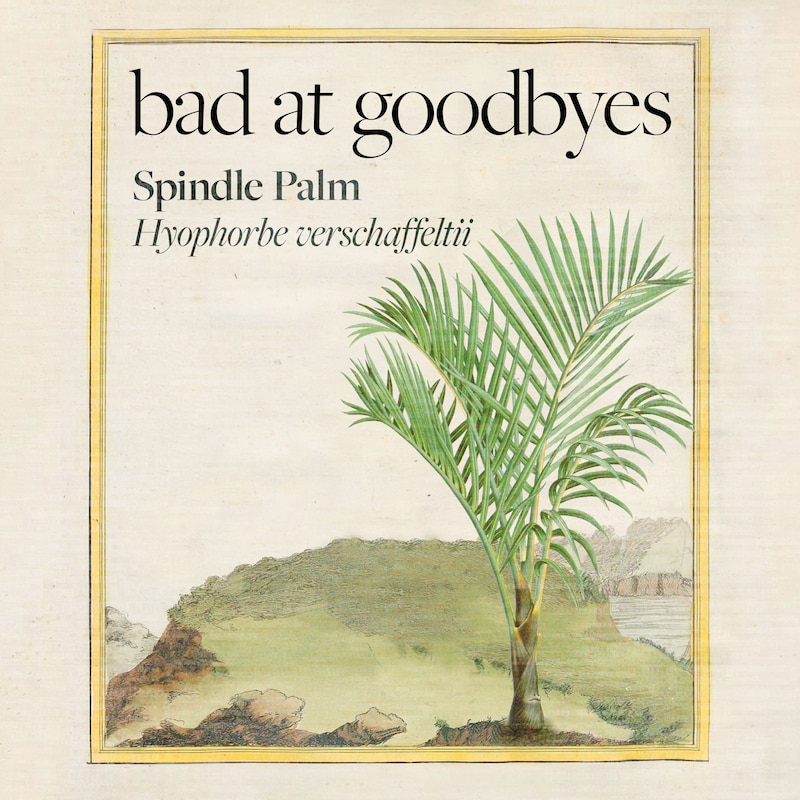
Spindle Palm :: Hyophorbe verschaffeltii
Bad at Goodbyes :: Episode 082
On today’s show we learn about the Spindle Palm, a critically endangered flowering palm native to the Republic of Mauritius on Rodrigues Island in the southern Indian Ocean. Its scientific name is Hyophorbe verschaffeltii and it was first described in 1866.
For more information about conservation on the islands of Mauritius please see the Mauritian Wildlife Foundation at https://www.mauritian-wildlife.org
- (00:05) Intro
- (02:05) Species Information
- (18:43) Citations
- (20:25) Music
- (27:11) Pledge
Research for today’s show was compiled from:
- Bailey, L. H. (1942). Palms of the Mascarenes. Gentes Herbarum, 6, 51–85. – https://media.e-taxonomy.eu/palmae/protologe/palm_tc_121020_P.pdf
- Botânico, M. P., & Angyalossy, V. (2013). Is the secondary thickening in palms always diffuse? [Annals of the Brazilian Academy of Science 85(4)] Anais da Academia Brasileira de Ciências, 85(4), 1461–1472. – https://doi.org/10.1590/0001-37652013108612
- Friedman, M. H., Andreu, M. G., Quintana, H. V., & McKenzie, M. (2010). Hyophorbe verschaffeltii, Spindle Palm: FOR 241/FR303, 5/2010. EDIS, 2010(4). – https://doi.org/10.32473/edis-fr303-2010
- Henderson, A. (2024). Pollination Systems of Palms (Arecaceae). Journal of Pollination Ecology, 36, 144–248. – https://doi.org/10.26786/1920-7603(2024)782
- iNaturalist - https://www.inaturalist.org/observations?captive=false&nelat=-19.653424450781902&nelng=63.51122182&quality_grade=research&subview=map&swlat=-19.779143834184264&swlng=63.317004655&view=species
- Kew Royal Botanic Gardens. (n.d.). Plants of the World Online. Retrieved June 24, 2026. – https://powo.science.kew.org/taxon/urn:lsid:ipni.org:names:667456-1
- Maunder, M., Page, W., Mauremootoo, J., Payendee, R., Mungroo, Y., Maljkovic, A., Lyte, B. (2002). The decline and conservation management of the threatened endemic palms of the Mascarene Islands. Oryx, 36(1), 56–65. – https://doi.org/10.1017/S0030605302000091
- Mauritian Wildlife Foundation. (2025). Annual report: On the activities of the Mauritian Wildlife Foundation year 2024. – https://www.mauritian-wildlife.org/mwf-files/files/files/Mauritian%20Wildlife%20Foundation%20Annual%20report%202024.pdf
- Ortega-Chávez, N., & Stauffer, F. W. (2011). Ontogeny and structure of the acervulate partial inflorescence in Hyophorbe lagenicaulis (Arecaceae; Arecoideae). Annals of Botany, 108(8), 1517–1527. – https://doi.org/10.1093/aob/mcr149
- Tatayah, V., Jhangeer-Khan, R. & Bégué, J.A. 2021. Hyophorbe verschaffeltii. The IUCN Red List of Threatened Species 2021: e.T38582A67537366. Accessed on 23 June 2026. – https://dx.doi.org/10.2305/IUCN.UK.2021-2.RLTS.T38582A67537366.en
- Wikipedia - https://en.wikipedia.org/wiki/Hyophorbe_verschaffeltii
Please find us on the web at Bad at Goodbyes and on instagram. Please subscribe and rate/review Bad at Goodbyes wherever you listen to podcasts. Please help spread the word about the show and about the species we feature. Please take care of each other, and all of our fellow travelers.
A note on accuracy: I strive for it! These episodes are well-researched and built from scholarly sources, hoping to provide an informed and accurate portrait of these species. That said, I’m a musician! I am not an academic and have limited scientific background. I may get things wrong! If you are using this podcast for scholarship of any kind, please see the cited sources and double-check all information.
Transcripts
Welcome to Bad at Goodbyes.
On today’s show we consider the Spindle Palm.
Species Information:The Spindle Palm is a critically endangered flowering palm native to the Republic of Mauritius on Rodrigues Island in the southern Indian Ocean. Its scientific name is Hyophorbe verschaffeltii and it was first described in 1866.
The Spindle Palm is a medium sized palm that generally grows to a height of 20 to 30 feet. Their light gray trunk, which lends the tree its name, is widest in the middle about halfway up the trunk, so: skinnier at the bottom near the root base, bulging at roughly the midpoint of their total height, and tapering again narrow at the top near the crown.
The bulge is a water reservoir, allowing the tree to survive seasonal drought by storing water collected during rainy periods. Specialized internal cells absorb moisture, and store carbohydrates, expanding and dividing which results in this swollen midsection.
Palm trees have a different growth structure than a deciduous tree like a maple or an oak. Palm do not produce wood, and all growth develops from a single large bud, the Apical Meristem, which produces new leaves, upward. The leaves are attached by a flat, wide sleeve that wraps completely around the trunk. As the palm continues to grow upward and produce new leaves from the very top, leaves at the bottom die off leaving behind their leaf base. A palm trunk's outer layer, its quote unquote bark, is in fact an accumulation of these past leaf bases, appearing as horizontal rings called leaf scars.
Atop the trunk is a roughly 2ft tall green crownshaft, from which the leaves grow. The Spindle Palm’s crown is usually 8 to 10 large, pinnate leaves. Pinnate means the leaves have a central stem with many smaller leaflets, or leaf blades, attached along its length, picture a stereotypical palm frond. In the case of the Spindle Palm these fronds are big, and can reach lengths of roughly 7 feet, with leaf blades as long as 2 feet. The leaves are dark green and have a leathery texture.
The Spindle Palm is monoecious, distinct male and female flowers grow on the same individual. Its reproductive cycle is continuous, with inflorescences, flower clusters of typically six, both male and female flowers, appearing throughout the year. These small, creamy white to yellowish flowers grow below the palm's crown, and are pollinated primarily by insects, particularly bees, drawn to the flower’s nectar. The nectar provides a food source for the pollinators, who unbeknownst transfer pollen from the male flowers of one individual to the female flowers of another.
Once pollination occurs, the female flowers develop into small, oblong fruits that take several months to mature. The fruits are initially green, gradually turning yellow, orange, red and eventually ripening to a deep blackish purple. The heavy ripened fruit falls from the tree releasing a single, solid brown seed roughly half an inch in length.
g, land-clearing fires in the:And so today there is no natural regeneration in the wild Spindle Palm population. Pollination is occurring and fruit is being produced but scientists are not observing any new seedlings; new Spindle Palm are only being produced through managed human cultivation.
Cultivated seedlings can take 10 to 20 years to reach reproductive maturity and start flowering. And we estimate the Spindle Palm can live 80 to 100 years in the wild.
————
In the dream,
A dream of the before-times,
Of palm forest, of dense herds of giant tortoise,
Flocks of night heron, blue pigeon, and starling,
Giant day gecko in Ebony trees, skittering.
A green breathing Arcadia
An abundance in balance
In the dream.
————
in the Indian Ocean, roughly:Rodrigues is a volcanic island; its land area is only 42 square miles, a strip of land roughly 11 miles long and 4 miles wide surrounded by hundreds of miles of ocean in all directions. The geography is diverse, white beach shoreline meets coastal plains and then gives rise to limestone uplands: caves, ravines, ridges, that peak at Mont Limon, a summit a quarter of a mile above sea level.
Historically the Spindle Palm was found across the island, today we find scattered individuals and small concentrations of the remaining population in Anse Quitor, Grande Montagne, and Ravine de la Cascade.
This is a seasonally dry tropical forest biome with marked seasonal contrasts: wet, windy summer months, and then prolonged periods of winter drought. The dry forest ecosystem is adapted to survive limited moisture availability and strong ocean winds.
This is a mild tropical maritime climate, with high humidity. Summer highs reach into the 90s°F and winter lows dip into 60s. The island sees roughly 40 inches of rainfall per year, which is concentrated in January, February, and March. In this rainy season the Spindle Palm stores water, to be later relied on during dry months like September and October when the island averages less than 2 inches of rain.
The Spindle Palm shares its island home with:
Mourning Gecko, Rodrigues Warbler, Plain Tiger Butterfly, Pink Trumpet-Tree, Beach Morning Glory, Royal Blue Pansy, Redleg Orbweaver, Common Waxbill, Asian House Gecko, Tall Pricklypear, Common Passionfruit, Indian Garden Lizard, Brown Noddy, Blue-billed White-Tern, Black-bellied Plover, White-tailed Tropicbird, House Sparrow, False Olive, Ruddy Turnstone, Rodrigues Flying-Fox, Mauritius Hemp, Zebra Dove, Common Myna, Pinkwing Stick Insect, Spotted House Gecko, Macao Paper Wasp, Rosy Wolfsnail, Baycedar, Little Heron, Common Bluetail, Madras Thorn, Rodrigues Day Gecko and many many more.
Historically the Spindle Palm was abundant on Rodrigues but roughly five hundred years of habitat destruction and human encroachment, specifically deforestation for resource extraction and land clearing for agriculture, has severely diminished their population.
Relatedly human introduced invasive plant species compete with the palm for scarce water resources. And invasive animals, pigs and goats, have overgrazed the island, feeding on seedlings before they can reach reproductive maturity. And introduced black rats consume seeds before establishment and germination.
Human induced climate change, resulting from persistent over-reliance on fossil fuels, also threatens the island. Global warming has resulted in average localized temperatures increasing by 1-2°F compared to mid-twentieth-century baselines. And shifting weather patterns have resulted in longer periods of drought and an increase in severity of powerful cyclonic storms. These storms deliver high winds and flash flooding, snapping tree canopies, stripping foliage, and destabilizing hillside soils.
Fortunately most of the remaining Spindle Palm are in managed protected wilderness reserves on Rodrigues. In the late 20th century and now presently the island has made significant progress conserving, protecting, and restoring natural habitat.
The Anse Quitor and Grande Montagne Reserve both have constructed perimeter fencing to deter invasive mammals and the land is actively managed to remove both invasive plants and invasive animals.
Established in:And a program at the Francois Leguat Reserve is exploring the reintroduction of giant tortoises, in hopes they may play a similar role to their extinct ancestors, in aiding the regeneration of native vegetation.
ed on the IUCN Red List since:Our most recent counts estimate that less than 20 adult Spindle Palm remain in the wild.
Citations:Information for today’s show about the Spindle Palm was compiled from:
Bailey, L. H. (: ico, M. P., & Angyalossy, V. (: ntana, H. V., & McKenzie, M. (: Henderson, A. (: .: ,: Y., Maljkovic, A., Lyte, B. (: uritian Wildlife Foundation. (: ávez, N., & Stauffer, F. W. (: geer-Khan, R. & Bégué, J.A.:Wikipedia - https://en.wikipedia.org/wiki/Hyophorbe_verschaffeltii
For more information about conservation on the islands of Mauritius please see the Mauritian Wildlife Foundation at https://www.mauritian-wildlife.org
Music: Pledge:I honor the lives of all Spindle Palm. I will commit their name to my record. I am grateful to have shared time on our planet with this being. I lament the ways in which I and my species have harmed and diminished this species. I grieve.
And so, in the name of the Spindle Palm I pledge to reduce my consumption. And my carbon footprint. And curb my wastefulness. I pledge to acknowledge and attempt to address the costs of my actions and inactions. And I pledge to resist the harm of plant and animal kin and their habitat, by individuals, corporations, and governments.
I forever pledge my song to the witness and memory of all life, to a broad celebration of biodiversity, and to the total liberation of all beings.




