Shownotes
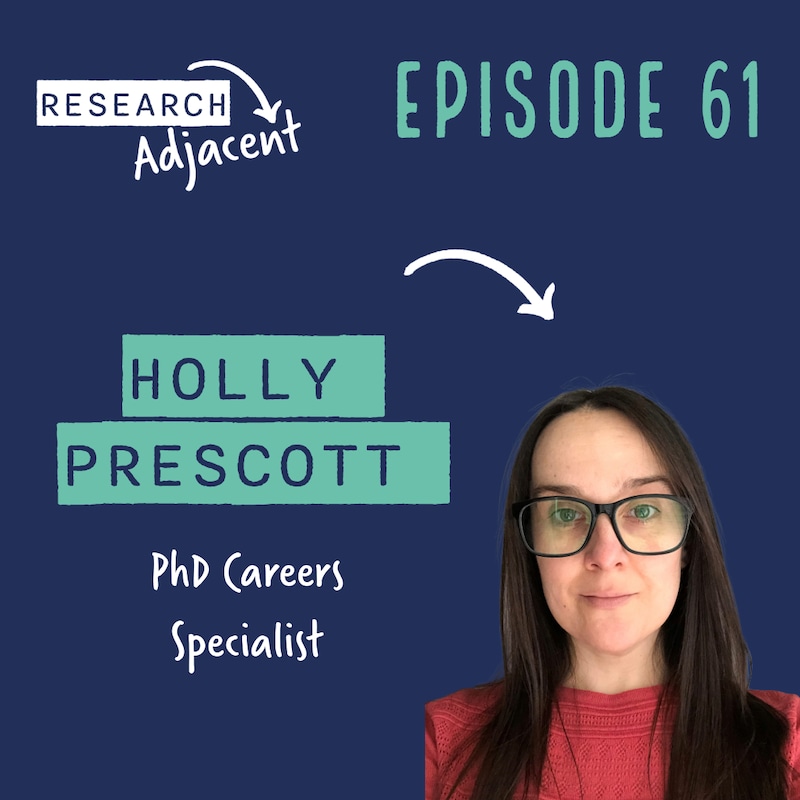
Holly helps PhD researchers navigate careers beyond academia.
She is a PhD Careers Specialist at the University of Birmingham and creator of Post-Gradual: The PhD Careers Blog.
Sarah and Holly talk about
- How a nudge from a friend kick-started her career
- The shortage of research-specialist careers advisers
- Navigating life and work with a disability
- Why we need better language to define roles in research and higher education
Find out more
- Read the show notes and transcript on the podcast website
- Connect with Holly on LinkedIn or BlueSky
- Visit Post-Gradual: The PhD Careers Blog
About Research Adjacent
- Fill out the research-adjacent careers quiz
- Sign up to the Research Adjacent newsletter
- Follow Research Adjacent on LinkedIn Instagram and BlueSky
- Email a comment, question or suggestion
- Leave Sarah a voice message
Mentioned in this episode:
Come along to our Manchester networking event
Join host Sarah McLusky and fellow research-adjacent professionals on Thursday 12 March 2026 at 5.30pm. Find out more and register here https://researchadjacent.circle.so/c/open-events/manchester-research-adjacent-community-networking
Member of the Month: Duncan Yellowlees, DY Training
Let’s put rubbish presentations in the bin – where they belong. Get in touch with Duncan for specialist research presentation skills training www.duncanyellowlees.com
Transcripts
What worked for their supervisor, what worked
Holly Prescott:for their predecessors, will not work for them just because of
Holly Prescott:how things are now. Tell people you're looking and what you're
Holly Prescott:looking for, because that automatically multiplies the
Holly Prescott:number of people who are job hunting for you. If you've got a
Holly Prescott:disability or a long term health condition, I think what you have
Holly Prescott:to be really good at doing is you have to be really good at
Holly Prescott:understanding your boundaries and understanding what you need
Holly Prescott:and being able to ask for it.
Sarah McLusky:Hello there. I'm Sarah McLusky, and this is
Sarah McLusky:Research Adjacent. Each episode I talk to amazing
Sarah McLusky:research-adjacent professionals about what they do and why it
Sarah McLusky:makes a difference. Keep listening to find out why we
Sarah McLusky:think the research-adjacent space is where the real magic
Sarah McLusky:happens.
Sarah McLusky:Today's guest Holly Prescott is one of the wonderful people who
Sarah McLusky:I didn't know before the podcast, but is now one of our
Sarah McLusky:biggest champions. Holly is a careers advisor at the
Sarah McLusky:University of Birmingham. She specializes in working with PhD
Sarah McLusky:students and postdocs, advising on both research and
Sarah McLusky:research-adjacent careers, which explains her enthusiasm for the
Sarah McLusky:podcast. Thanks Holly. Holly also writes regularly for
Sarah McLusky:Post-Gradual, her PhD careers blog, which provides a wealth of
Sarah McLusky:advice on things like identifying skills, redefining
Sarah McLusky:success and using LinkedIn. There's even a book version
Sarah McLusky:coming soon, which you'll hear about in this episode. In our
Sarah McLusky:conversation, we talk about why Holly found herself drawn to
Sarah McLusky:working in the research careers advice area, why specialists
Sarah McLusky:like her in short supply, navigating life and work with a
Sarah McLusky:disability, and why she wants to find new language to describe
Sarah McLusky:the world of opportunities that are out there for graduates,
Sarah McLusky:speaking of which, if you're listening to this podcast for
Sarah McLusky:career inspiration, then make sure you check out our podcast
Sarah McLusky:back catalog. Take a minute to hit subscribe in your podcast
Sarah McLusky:app, and then you have instant access to our growing archive of
Sarah McLusky:research-adjacent career stories. In our conversation,
Sarah McLusky:Holly talks about the importance of role models. Well, we have
Sarah McLusky:got over 50 role models to choose from, and around half of
Sarah McLusky:them have got PhDs, so you're bound to find somebody whose
Sarah McLusky:story resonates with you. Then, without further ado, let's add
Sarah McLusky:Holly to that archive of inspiring role models. Listen on
Sarah McLusky:to hear her story.
Sarah McLusky:Welcome along to the podcast, Holly. Thank you so much for
Sarah McLusky:coming along as a guest. I wonder if we could start by just
Sarah McLusky:hearing a bit about what it is that you do
Holly Prescott:Absolutely and thank you so much, Sarah for
Holly Prescott:having me. I am a fan of the podcast, so it's it's great to
Holly Prescott:be talking to you. A little bit about what I do, I'll start with
Holly Prescott:where I came from. I did a PhD, which I finished in 2011 it was
Holly Prescott:kind of humanities, social sciencey sort of PhD. And since
Holly Prescott:then, I have worked in what I would consider to be academic
Holly Prescott:adjacent roles. So I originally I went for a job in postgraduate
Holly Prescott:student recruitment, where I was helping people to apply for
Holly Prescott:postgraduate degrees, and I was going all around Europe, which
Holly Prescott:was very exciting, doing exhibitions, convincing people
Holly Prescott:they should come to University of Birmingham to do their post
Holly Prescott:grad. I got that job because when I was coming towards the
Holly Prescott:end of my PhD, a friend sent it to me and said, you'd be good at
Holly Prescott:this. And I said, Great, what is it? And but no, I'd worked with
Holly Prescott:him, helping out, doing post grad open days, and so knew the
Holly Prescott:office a little bit, and I went for the interview. I didn't get
Holly Prescott:the full time job, but I got taken on part time because the
Holly Prescott:the department had some extra funding. So tip number one,
Holly Prescott:always go for interviews, because even if you don't get
Holly Prescott:the job, you might get offered something else. And so I worked,
Holly Prescott:I did there. I worked there for about three years, and what I
Holly Prescott:did as I was going through that was I kept thinking, What do I
Holly Prescott:like about this and everything there was, I like present,
Holly Prescott:presenting. I like being student-facing. I like the
Holly Prescott:advisory capacity. What I liked less about it was the salesy
Holly Prescott:aspect, and I thought, wouldn't it be nice to have a
Holly Prescott:conversation with these people I'm talking to, and put them and
Holly Prescott:their needs at the center, rather than selling them a
Holly Prescott:postgraduate course. And I thought, well, there's something
Holly Prescott:that does that isn't there. There's career guidance, and
Holly Prescott:that's what then led me down this path. I was also always
Holly Prescott:drawn back to the example that was a model, really, of my own
Holly Prescott:careers advisor when I was doing my PhD, Lucy. She was a person
Holly Prescott:I'd always looked at and thought I could see myself doing what
Holly Prescott:you do. And I think having those examples and models is really
Holly Prescott:important. So in 2014 I enrolled on a professional qualification
Holly Prescott:in career guidance. Did that alongside my post graduate
Holly Prescott:recruitment job, and then in 2015 got a secondment to the
Holly Prescott:Career Service. And then I never went back. So I started working
Holly Prescott:with taught postgraduates to begin with, but since 20 since
Holly Prescott:early 2017 I've been a postgraduate researcher careers
Holly Prescott:advisor. So focusing mostly on working with PhD and other
Holly Prescott:research students and early career researchers as well. So
Holly Prescott:that's what I do officially. I all I started a blog in 2021
Holly Prescott:called Post-Gradual, because I, I was really enjoying the work.
Holly Prescott:I, I mean, I find career guidance really fascinating, and
Holly Prescott:it's got a really interesting social science theoretical
Holly Prescott:background to it, which coming out of social science PhD sort
Holly Prescott:of grabbed me immediately. And being able to do it with
Holly Prescott:researchers, specifically, I have really enjoyed finding that
Holly Prescott:niche, but I was kind of wanting more, wanting sometimes, when
Holly Prescott:you work in an institution, it can be frustrating, feeling like
Holly Prescott:sometimes you're not having the impact that you could have. And
Holly Prescott:I thought, well, I miss writing. I'll start a blog, and I'll put
Holly Prescott:some of my ideas and some of my frameworks into the ether and
Holly Prescott:see if anybody else finds them useful. It turns out they did,
Holly Prescott:and I started getting invitations from that to do
Holly Prescott:workshops for other types of organizations, professional
Holly Prescott:bodies, other universities and things like that. So since 2021
Holly Prescott:I've also worked as a consultant, doing talks,
Holly Prescott:workshops and commissioned posts for other institutions and
Holly Prescott:organizations as well. So I've got that side business that grew
Holly Prescott:out of the blog that I never intended. I never sought it out,
Holly Prescott:that it just happened. I kind of put, put something out into the
Holly Prescott:universe, and then things
Sarah McLusky:Sometimes, sometimes, that's just the way
Sarah McLusky:it goes, isn't it? So it sounds that, although, sounds that once
Sarah McLusky:you found yourself on this path, you know you've you've really
Sarah McLusky:found your niche and and followed it. When you went in,
Sarah McLusky:you said that you did a PhD yourself. Did you have a sense
Sarah McLusky:of what you might do afterwards, or was it just something that
Sarah McLusky:that kind of just, yeah, somebody saw something in you
Sarah McLusky:that maybe you didn't see in yourself,
Holly Prescott:Both. I think I did the PhD because it came out
Holly Prescott:of my master's research, and I thought, I'm not done yet. This
Holly Prescott:could go further, and I want to be the person to take it
Holly Prescott:further. I definitely had some aspirations for an academic
Holly Prescott:career, but my brain shoots off in a lot of different
Holly Prescott:directions, and sometimes that's bad, but sometimes it's also
Holly Prescott:really useful. And what I realized when I got into PhD
Holly Prescott:level was there were a lot of people working in other roles in
Holly Prescott:the university who seemed to be able to do it, be doing similar
Holly Prescott:things to the academics, like teaching, training, even still
Holly Prescott:publishing, in some cases, but with more doing it on their
Holly Prescott:terms and were working in student kind of student facing
Holly Prescott:in different ways, were experts in different ways, and I was
Holly Prescott:really interested in exploring that. So I think it was in the
Holly Prescott:second year of my PhD where I thought I might want to do
Holly Prescott:something else here. And I'm interested in what else there is
Holly Prescott:within the university environment. So I took quite a
Holly Prescott:few bit like bitty jobs. I was a student ambassador, and that
Holly Prescott:introduced me to student recruitment. I got a random part
Holly Prescott:time job working on, of all things, a website for career
Holly Prescott:resources for research staff, which was the first kind of
Holly Prescott:career thing I did, just anything that was in my graduate
Holly Prescott:school newsletter that was like, oh, we'll pay you by the hour to
Holly Prescott:do this thing I would go for and just try it. And so whilst going
Holly Prescott:into the PhD with some aspiration of potentially an
Holly Prescott:academic career. What the PhD taught me was, well, what are
Holly Prescott:the bits of that that I actually like, which is all the student
Holly Prescott:facing stuff? What do I not like? Pressure to publish,
Holly Prescott:pressure to find my own funding and all of that. But what
Holly Prescott:manifestations can I find of the things I do like? Where is that
Holly Prescott:happening? Who's doing it without the pressures of the
Holly Prescott:things I don't like? And that sort of emerged for me as I went
Holly Prescott:through so I'm a bit tongue in cheek when I say about my friend
Holly Prescott:Simon giving me that is showing me that job, and saying, Oh, you
Holly Prescott:could do it. He did that. I think with the knowledge that
Holly Prescott:I'd spoken to him about this, I'd said, oh, you know, I'm
Holly Prescott:interested in working in a university environment in the
Holly Prescott:capacity advising, presenting, not doing research. So he had
Holly Prescott:something to go on. It wasn't completely random, yeah, I think
Holly Prescott:he did see something in me as well, but it was an educated
Holly Prescott:guess for him that that would be something I'd be interested in.
Holly Prescott:And this is why I say to people, tell people you're looking when
Holly Prescott:you are job hunting. Tell people you're looking and what you're
Holly Prescott:looking for, because that automatically multiplies the
Holly Prescott:number of people who are job hunting for you, and they might
Holly Prescott:come across things that you don't. Yeah
Sarah McLusky:I imagine though, that yeah, that's excellent
Sarah McLusky:advice in and of itself. And I'm sure some of what you've just
Sarah McLusky:spoken about there, the experience that you went through
Sarah McLusky:will will be the kinds of things that you now speak to
Sarah McLusky:postgraduate researchers about, or it'll also it just gives you
Sarah McLusky:that empathy that you've been on a similar journey.
Holly Prescott:Yes, although careers advisor school teaches
Holly Prescott:you, you've got to be careful about that. You can quite often
Holly Prescott:find yourself in a one to one consultation with a researcher
Holly Prescott:who you find you have something in common with, and good
Holly Prescott:guidance is to put that back, file that away, put the person
Holly Prescott:you're talking to at the center, because they are coming from a
Holly Prescott:different place than I came from. They're also existing now.
Holly Prescott:They're job hunting in a very different economic, political,
Holly Prescott:social climate than I was. So you've got to be very careful
Holly Prescott:not to project your own experience onto them. You've got
Holly Prescott:to appreciate the differences. If there's a way of balancing
Holly Prescott:it, I think there's a way balancing that I understand, I
Holly Prescott:empathize, but I think that, Oh, I've been there. You've got to
Holly Prescott:be careful with that, because you've been there, but you've
Holly Prescott:been there with your own perspective, at your own time.
Holly Prescott:So I think, I think having gone through it, having got the PhD
Holly Prescott:and been through that experience, I think it gives
Holly Prescott:credibility, definitely, but, yeah, but as a guidance
Holly Prescott:practitioner, you've got to be really careful that you're
Holly Prescott:meeting that person, you're meeting that researcher. You're
Holly Prescott:talking to where they are and not where you were or where you
Holly Prescott:expect them to be based on your own experience. Does that make
Holly Prescott:sense?
Sarah McLusky:It does. It makes a lot of sense. Yeah.
Holly Prescott:And that idea is very important, because I think
Holly Prescott:in academia, specifically, we've suffered a lot from careers
Holly Prescott:advice that goes something like, well, if I were you, I would or,
Holly Prescott:well, this work, here's what worked for me. And you know, a
Holly Prescott:lot of PhD researchers, what worked for their supervisor,
Holly Prescott:what worked for their predecessors, will not work for
Holly Prescott:them just because of how things are now. So the so the impartial
Holly Prescott:guidance that we offer, I think, is really important, and I think
Holly Prescott:the researchers really appreciate that space.
Sarah McLusky:I bet they do, because, I mean, that's
Sarah McLusky:certainly one thing that's that's a case from some of the
Sarah McLusky:PhD students and early career researchers that I've talked to
Sarah McLusky:is that if, if all they're seeing around them day to day
Sarah McLusky:are other academics, then it's very hard to conceive of what
Sarah McLusky:else might be an option for them
Holly Prescott:Yeah. Or if all they see around those academics
Holly Prescott:who did it a certain way, they're going to think there
Holly Prescott:might not be another way to do it, or another way to manifest
Holly Prescott:that, or what that could look like. So I would definitely hope
Holly Prescott:that the work I do with them helps them to to see more
Holly Prescott:possibilities, not just beyond the academy, but potentially
Holly Prescott:within it as well.
Sarah McLusky:Are you listening to this podcast for career
Sarah McLusky:inspiration? Even though research-adjacent roles are
Sarah McLusky:pretty niche there are still so many different paths that you
Sarah McLusky:could take. For a bit of a nudge in the right direction try the
Sarah McLusky:research adjacent careers quiz at researchadjacent.com/quiz
Sarah McLusky:based on your strengths and interests. It will suggest a job
Sarah McLusky:category to explore further with some recommendations for podcast
Sarah McLusky:episodes from the research adjacent back catalogue. To give
Sarah McLusky:you some more inspiration, complete the quiz at research
Sarah McLusky:adjacent.com or click the link in the show notes.
Holly Prescott:Jack Grove put out an article in the Times
Holly Prescott:Higher it was two weeks ago now, saying what a shortage there is
Holly Prescott:of career guidance professionals who specialize in working with
Holly Prescott:PhDs. And I read Jack's article, and it was like, Ah, thank you,
Holly Prescott:because he was talking about a report that Robin Mellors
Holly Prescott:Bourne, has published recently, which is excellent, because the
Holly Prescott:focus of that has shifted. The focus whenever still felt there
Holly Prescott:were, there were a few years where we went through the
Holly Prescott:reviews of doctoral education from a couple of the from a
Holly Prescott:couple of the research councils and from UKRI, and the discourse
Holly Prescott:tended to be, there's not enough not enough support, not enough
Holly Prescott:career guidance for PhDs. There needs to be more. Do more. Do it
Holly Prescott:more. Do it better. And we were, you know, myself and my
Holly Prescott:colleagues are plugging away, saying we're doing what we can
Holly Prescott:with the resource we can with the funding we can in the time
Holly Prescott:that we have. But Jack's article, the references Robin's
Holly Prescott:report, shifts that discourse a little bit and says it's
Holly Prescott:happening, but the people who are doing it are stretched, and
Holly Prescott:these jobs are needed, but it's difficult to recruit to them, so
Holly Prescott:like kind of starting to shift that narrative, not saying
Holly Prescott:there's not enough career support for PhDs, but saying
Holly Prescott:there's a shortage of people in there's a shortage of roles, or
Holly Prescott:a shortage of people to do those roles, which is a slight shift,
Holly Prescott:but it feels a bit more it's a bit less defeating. So, yeah, I
Holly Prescott:think there is, and I'm so much has come out recently, say the
Holly Prescott:reviews of doctoral education from some research councils,
Holly Prescott:UKRI statement of expectations for doctoral training and new
Holly Prescott:deal for postgraduate researchers from UKRI. And in
Holly Prescott:all of these things you will see making postgraduate researchers
Holly Prescott:aware of their career options, aware of the skills they need
Holly Prescott:for those options, is is a priority, and so it's quite it
Holly Prescott:is interesting and quite energizing at the minute to sort
Holly Prescott:be in the center of that, yeah. And I think, yeah, I think it's
Holly Prescott:definitely come to the fore over the past, over the past few
Holly Prescott:years. Yeah,
Sarah McLusky:Well, we'll have to get a link to that article,
Sarah McLusky:then we can put it in the show notes. But as you say, You do
Sarah McLusky:seem to have found yourself in a position where the sorts of
Sarah McLusky:things that you're writing about are getting attention and
Sarah McLusky:they're the kinds of things people want to hear about, they
Sarah McLusky:want to read about, to the extent that you're going to be
Sarah McLusky:putting together a book.
Holly Prescott:That's right, yeah, which I love, because I
Holly Prescott:think a lot of people who do PhD think that turning your PhD into
Holly Prescott:a thesis is the only chance you'll ever have to write a
Holly Prescott:book. And if you don't do that, you've missed the boat. Well,
Holly Prescott:you absolutely haven't. But yeah, that that's right. Ah,
Holly Prescott:over the past seven or eight years, I've kind of surveyed the
Holly Prescott:landscape, and there have been, there are quite a lot of voices
Holly Prescott:in North America that have been talking about these issues
Holly Prescott:around career options, broader career thinking for researchers
Holly Prescott:and the people in mainland Europe as well. But I noticed, I
Holly Prescott:mean, there's lot, there's lots of great resources from people
Holly Prescott:who were based in the UK. But what I noticed was there wasn't
Holly Prescott:a book, like a sort of practical handbook type volume that was
Holly Prescott:written both by a trained careers advisor, which comes
Holly Prescott:back to not that n equals one advice of, here's how I did it,
Holly Prescott:here's how you should do it. But who was also writing for an
Holly Prescott:audience of researchers from all subject areas. There are some
Holly Prescott:brilliant volumes by, you know, like Sarah Blackford, for
Holly Prescott:example, focusing on the life sciences. There are a few other
Holly Prescott:good ones as well, focusing on specific subject areas. But
Holly Prescott:think this my center of my Venn diagram was that I had a PhD. I
Holly Prescott:was a trained careers advisor, and I was writing for all
Holly Prescott:subject areas, and there wasn't Oh, and I had a UK focus as
Holly Prescott:well. And that was how I got the pitch. That was, that was the
Holly Prescott:pitch I made for the book, which is Navigating Careers Beyond
Holly Prescott:Academia, A Practical Handbook for Doctoral and Postdoctoral
Holly Prescott:Researchers. The book contracts with Routledge and my manuscript
Holly Prescott:deadline is Halloween next year, I deliberately chose the
Holly Prescott:scariest day of the year
Sarah McLusky:I was gonna say, Did you get a choice in that?
Holly Prescott:I did. I chose it myself. I'll not it's because
Holly Prescott:I'll not forget it. What's the scariest day of the year? That's
Holly Prescott:my deadline. Yeah, basically, and it's really exciting,
Holly Prescott:because to go back to what I said about starting the blog out
Holly Prescott:of the motivation of having a wider impact for more people,
Holly Prescott:being able to formalize some of the exercises and the frameworks
Holly Prescott:that I've come up with in my practice, and put them into
Holly Prescott:something official feels really nice and really tangible.
Sarah McLusky:Yeah, excellent. Well, I'm looking forward to
Sarah McLusky:seeing it. Maybe we'll have to, if we're still going, then maybe
Sarah McLusky:we'll have to have you back to hear about it once it's out in
Sarah McLusky:the world, so maybe, well, that leads us on to I don't know how
Sarah McLusky:it might relate, but to ask you about some of the things you've
Sarah McLusky:done in your career that you're really proud of, I don't know if
Sarah McLusky:maybe it touches on some of the things we've already mentioned.
Holly Prescott:Yeah because I thought about this question, I
Holly Prescott:know you usually ask people, and there are two sides of it. To
Holly Prescott:me, I think professionally, the book is right up there. Because
Holly Prescott:I, as I say, a lot of people who come from an academic research
Holly Prescott:background, you think your thesis is your one shot at that.
Holly Prescott:And if you don't publish that, and then you move away and you
Holly Prescott:do something else, you might not get the chance again, that's
Holly Prescott:absolutely not the case. So I'm proud of the fact that I have
Holly Prescott:kind of come out of my original academic subject area, found
Holly Prescott:something that I'm just as if not more interested in, and that
Holly Prescott:I've kind of applied my researcher brain to it to to to
Holly Prescott:get the book contract, which is brilliant. But there's
Holly Prescott:definitely a personal aspect as well that I'm proud of. So I had
Holly Prescott:talked about this a little bit in my blog, but not in a lot of
Holly Prescott:detail, but so 16th of June, I think it was 2020 it was a
Holly Prescott:Wednesday. Whatever day was Wednesday, mid June, 2020 I woke
Holly Prescott:up one morning and I couldn't see properly out of one eye, and
Holly Prescott:I thought, oh, it's grit or something, and it's carried on
Holly Prescott:blinking all the way through the day. Anyway, what turned out
Holly Prescott:happening was that I was diagnosed with a very rare eye
Holly Prescott:condition. We don't know definitely what causes it. It's
Holly Prescott:called AZOOR, but what we think happens is that the immune
Holly Prescott:system attacks the photoreceptors in the retina,
Holly Prescott:and it the effects of that can be temporary or it can be
Holly Prescott:permanent visual loss. So I have lost about a third of the visual
Holly Prescott:field in my left eye, and I have other aberrations, like flashing
Holly Prescott:lights, what we call photopsia and some other interference.
Holly Prescott:Looking at bright things is very difficult, and as somebody who'd
Holly Prescott:always had perfect eyesight, this was really difficult to get
Holly Prescott:my head round. And I think one of the things that I'm proudest
Holly Prescott:of is adjusting to that, being able to stay working, stay
Holly Prescott:working full time, and not and not using it as a force to say,
Holly Prescott:I can't do things, but I think what it's given me is a force to
Holly Prescott:say, let's do this while I still can. Yeah, because we don't, we
Holly Prescott:don't know what will happen with it.
Sarah McLusky:So is it something that can get
Sarah McLusky:progressively worse over time, or is it a bit unpredictable?
Holly Prescott:It's a bit unpredictable that we think it
Holly Prescott:is affected by a viral infection. If I contract a viral
Holly Prescott:infection, then I tend to get something will happen, and
Holly Prescott:that's when the lesions happen. And then it takes a while to
Holly Prescott:know whether that lesion is permanent, or whether it or
Holly Prescott:whether it self resolves, but we don't know. It's not
Holly Prescott:progressive, which means it doesn't kind of slowly get worse
Holly Prescott:over time. It's an acute condition. But yeah, I might
Holly Prescott:have other attacks of it. I may not. If I do, we don't know when
Holly Prescott:they'll be so you have to get quite good at living with
Holly Prescott:uncertainty. And I think what I've developed is, which is
Holly Prescott:useful most of the time, not so useful when I have to do any
Holly Prescott:long term planning, but I try as much as I can not to think past
Holly Prescott:the day I'm in, if that makes sense. I yeah, I wake up in the
Holly Prescott:morning I think, ah, today's not the day I go blind. Brilliant.
Holly Prescott:Let's do this day. Let's do all the things we're going to do in
Holly Prescott:this day, which I think sounds odd to some people, but that's
Holly Prescott:how I've coped with itthat.
Sarah McLusky:I mean, I think it's something that's probably
Sarah McLusky:very good for your mental health, yeah, just to take it
Sarah McLusky:one day at time and not think too far ahead and and also not
Sarah McLusky:to think backwards as well, because it can, you can get
Sarah McLusky:bogged down and like, why did it happen? Why me? You know, all
Sarah McLusky:that sort of thing. So it does sound a very positive way to
Sarah McLusky:approach it, but it does also, as you say, it must make it hard
Sarah McLusky:to think sometimes about longer term projects, like like your
Sarah McLusky:book, for example,
Holly Prescott:Exactly that there's a new kind of anxiety
Holly Prescott:that comes with something that I'm committing to a year in the
Sarah McLusky:Yeah, well, like, see, that's just sounds like
Sarah McLusky:future and but there's what I found also helps, is just being
Sarah McLusky:open and authentic with people about it. So with my editors,
Sarah McLusky:I've explained to them the situation. This is why one like
Sarah McLusky:another, it's a real interest of mine is supporting students and
Sarah McLusky:researchers to talk about health conditions and disabilities with
Sarah McLusky:very positive attitude, because I'm sure that when you're saying
Sarah McLusky:potential employers. And I call it when I do it, I call it
Sarah McLusky:bringing them onto Planet Holly, before they meet me, or before
Sarah McLusky:we commit to anything, so that they understand the parameters
Sarah McLusky:I'm working with, and how within those parameters I can work with
Sarah McLusky:them, and they can work with me. So yeah, but I yeah so I think
Sarah McLusky:adapting to that I still been able to do all the things that
Sarah McLusky:I've been able to do and still committing to things. I'm proud
Sarah McLusky:that I've been able to do that, and that it hasn't stopped me
Sarah McLusky:saying yes.
Sarah McLusky:as well, now that you're in that position to speak to and
Sarah McLusky:students and postdocs about having those conversations
Sarah McLusky:themselves as well, because that's the kind of thing that
Sarah McLusky:people really worry about, isn't it? It's, you know, who's going
Sarah McLusky:to want me if I if I can't do X, Y, Z, yeah,
Holly Prescott:Feeling like a liability.
Sarah McLusky:Yeah, yeah
Holly Prescott:Is how, is how it can feel, but showing how
Holly Prescott:you've overcome it, adapted to it, manage it, I honestly
Holly Prescott:believe far outweighs any liability you feel you are. It's
Holly Prescott:just having the it's having the belief, or the confidence in
Holly Prescott:that. I've had some brilliant examples of, certainly of PhD
Holly Prescott:researchers using health conditions, how they've managed
Holly Prescott:those, how they've recruited their own carers, and things
Holly Prescott:like that. Actually using those on their CV and on applications
Sarah McLusky:It demonstrates incredible skill and resilience
Sarah McLusky:and all those sorts of things that employers are looking for,
Sarah McLusky:doesn't it?
Holly Prescott:I think so. Getting people to believe that,
Holly Prescott:you know, is, is a step. But yeah, I think, I think, I think
Holly Prescott:if you do have, if you've got a disability or a long term health
Holly Prescott:condition, I think what you have to be really good at doing is
Holly Prescott:you have to be really good at understanding your boundaries
Holly Prescott:and understanding what you need and being able to ask for it,
Holly Prescott:which I think in a relationship with a line manager is actually
Holly Prescott:a really useful thing to be able to do, because I think line
Holly Prescott:managers will find you more self aware than potentially employees
Holly Prescott:who don't have those challenges, because you've had to, you've
Holly Prescott:had to understand yourself, you've had to understand the
Holly Prescott:impact on you, and you've had to understand what you need to to
Holly Prescott:to perform at your best. And you know, other people don't always
Holly Prescott:know that. So, yeah, obviously, I strongly believe in those
Holly Prescott:benefits of it for you in the workplace and but working with
Holly Prescott:researchers to understand and believe that there is a bit of
Holly Prescott:work that needs to be done there.
Sarah McLusky:Yeah, I can imagine, I can imagine that it's
Sarah McLusky:not as I say. I think, I think your attitude, where you said
Sarah McLusky:that some people find it surprising, I think it's
Sarah McLusky:probably fairly unusual as well, that you know that the way that
Sarah McLusky:you've coped with it, but, but yeah, fantastic that there is
Sarah McLusky:that you can use that experience to help others as well. Yeah. So
Sarah McLusky:as I think you know, I do like to ask my guests, if they had a
Sarah McLusky:magic wand, what would they do with their magic wand in the
Sarah McLusky:world that they live, in the world that they inhabit?
Holly Prescott:If I was the PhD careers fairy godmother, there'd
Holly Prescott:be a lot of glitter involved, a lot. I know I love this
Holly Prescott:question, and I do, I do have an answer for it. So I was, if I
Holly Prescott:was PhD careers Fairy Godmother for a day and I had a magic
Holly Prescott:wand, I would use it to invent a new language for talking about
Holly Prescott:careers that doesn't involve that in academia and out of
Holly Prescott:academia,
Sarah McLusky:Oh please, yes please,
Holly Prescott:Because, and I, because I have wrestled with
Holly Prescott:this. All of the language we have at the moment for talking
Holly Prescott:to researchers about options and paths is we've got non academic
Holly Prescott:alternative, outside, even adjacent. And there's two issues
Holly Prescott:for me with that. One of them is it situates everything as if
Holly Prescott:academia is somehow at the center, and that everything else
Holly Prescott:is defined by its proximity to or its distance from academia,
Holly Prescott:which sit doesn't really sit well with me, but also I think
Holly Prescott:it bolsters that idea that you either have to totally stay or
Holly Prescott:totally leave, and that there are not variations on that. And
Holly Prescott:that's why, in my book, what I've tried to do is there's got
Holly Prescott:to be case studies in there from real PhD graduates and former
Holly Prescott:postdocs. And I've tried to get what as much as I can, as many
Holly Prescott:different ways that people are combining contributing to
Holly Prescott:academia and contributing to research or higher education,
Holly Prescott:but also applying their skills beyond. They're not doing one or
Holly Prescott:the other. They've created they forge this career where they're
Holly Prescott:doing both
Sarah McLusky:yeah,
Holly Prescott:because it is a false dichotomy. So if I could
Holly Prescott:wave my magic wand and solve something, it would be that
Sarah McLusky:It's definitely something that's needed,
Sarah McLusky:definitely something as you know, the whole premise behind
Sarah McLusky:this podcast is about how we talk about these roles and where
Sarah McLusky:they sit in relation to research. Another thing I'd love
Sarah McLusky:it if you could solve with your magic wand as well is I really
Sarah McLusky:hate when people talk about hard skills and soft skills. That
Sarah McLusky:drives me up the wall as well. So if we could sort that at the
Sarah McLusky:same time, that would be an amazing wave of the magic wand.
Sarah McLusky:So definitely granted for that one? Yeah, fantastic. Well, we
Sarah McLusky:need to start thinking about wrapping up our conversation.
Sarah McLusky:It's gone really quickly. Where about can people find you find
Sarah McLusky:the blog that you've mentioned all those sorts of things?
Holly Prescott:Yeah, sure. You can find me where I usually hang
Holly Prescott:out, on LinkedIn and Holly Prescott and there. My blog is
Holly Prescott:called Post-Gradual, The PhD Careers Blog. You can find it at
Holly Prescott:PhD-careers.co.uk, and oh, you know what I've done this week as
Holly Prescott:well I joined BlueSky, and I'm Holby83 so H O L B Y 83 on
Holly Prescott:there, which I think I'm going to now use as my second social
Holly Prescott:media platform after LinkedIn. Yeah, those are the places where
Holly Prescott:I am.
Sarah McLusky:Well, we'll get the links to all of those and
Sarah McLusky:put them on the show notes. Yeah. I'm also dipping my toe in
Sarah McLusky:BlueSky, but not, not quite sure just yet, but we shall see how
Sarah McLusky:it goes. Yeah, um, thank you so much for coming along, sharing
Sarah McLusky:your story and uh, yeah, telling us about the book and
Sarah McLusky:everything. So we'll look forward to that coming out. But
Sarah McLusky:for now, thank you.
Holly Prescott:Thanks so much, Sarah. Thank you for having me.
Sarah McLusky:Thanks for listening to Research Adjacent.
Sarah McLusky:If you're listening in a podcast app, please check your
Sarah McLusky:subscribed and then use the links in the episode description
Sarah McLusky:to find full show notes and follow the podcast on LinkedIn
Sarah McLusky:or Instagram. You can also find all the links and other episodes
Sarah McLusky:at www.researchadjacent.com. Research Adjacent is presented
Sarah McLusky:and produced by Sarah McLusky, and the theme music is by Lemon
Sarah McLusky:Music Studios on Pixabay. And you, yes you, get a big gold
Sarah McLusky:star for listening right to the end. See you next time.
