Shownotes
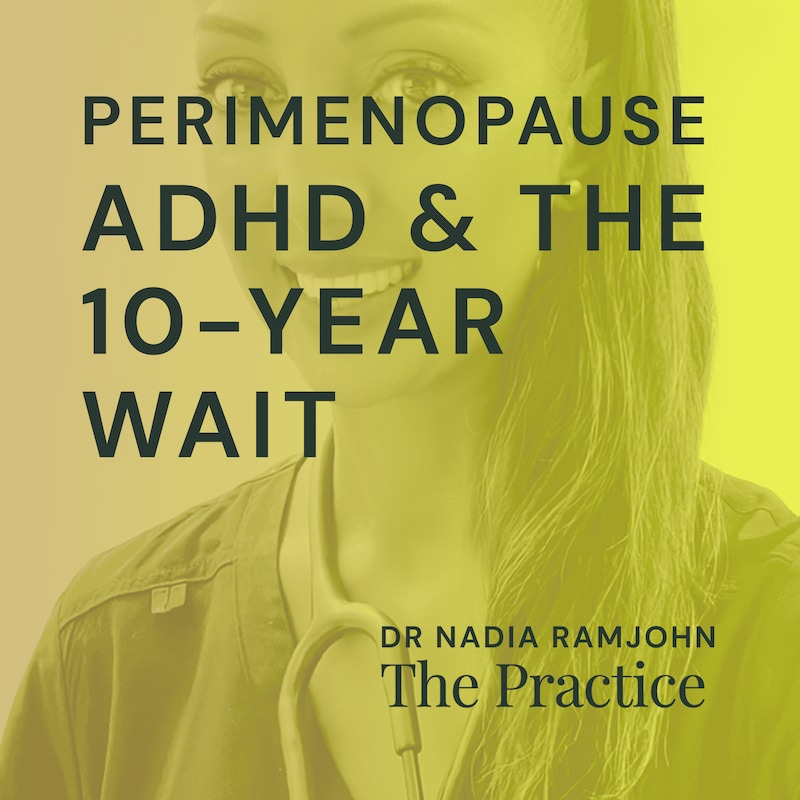
Oestrogen protects the brain. When it starts to fall in your late thirties, the mask comes off, and symptoms women have managed their whole lives suddenly can't be managed. This episode is about what that looks like in a consulting room, why so many women are told it's anxiety, and the ten years most of them wait before anyone says the word perimenopause.
Dr Nadia Ramjohn is a GP and women's health specialist, a perimenopause specialist and an ADHD diagnoser. She's also a mum and a Wagyu beef farmer.
WHAT WE COVER
— A&E, general practice, then a farm: how a GP ends up keeping Wagyu cattle
— Why perimenopause and ADHD get mistaken for each other, and the role of oestrogen
— "I'm not coping and something's not right": the golden nugget in a consultation
— Why perimenopause can last ten years, and why nobody waits for night sweats anymore
— The silent benefits of HRT, and why starting before 60 matters
— What actually changes when a woman is diagnosed with ADHD in her forties
— Practising prevention when nothing in the system pays for it
— Know your normal: the blood tests to have while you're well
— The hardest conversations, from the hospice to the ones about screening that came too late
— Earning trust in five minutes, and why silence is the tool
— Why she leads with the farm, not the credentials
ABOUT DR NADIA RAMJOHN
Dr Nadia Ramjohn MBBS BSc DRCOG MRCGP is a GP and women's health specialist with a focus on prevention, perimenopause and ADHD diagnosis. She is writing a children's book about hormones and farms Wagyu beef in the British countryside. Find her at @drnadia_perimenapause.
tobygoodman.com
Mentioned in this episode:
INTRO: BYPR CHECKLIST
Clinicians: your patients and clients choose who they trust. A podcast can help build that trust and save you time before anyone contacts your practice. 'Before You Press Record' is my FREE checklist - get it now over at tobygoodman dot com.
Transcripts
Dr Nadia Ramjohn: And a farmer
Toby Goodman: So what came first, and how did the others find you?
Dr Nadia Ramjohn: So I trained as a doctor. I actually trained up in accident and emergency, and loved that, was at King's for years. But then, as life had it, and you get married and have kids, because my husband does a lot of out of hours as an equine veterinary surgeon, he then, and I, couldn't both work shift work, so I switched to general practice, moved to the countryside, bought some land, built a farm, and now I am a Wagyu beef farmer and chicken owner.
out that. But it just didn't [:And having going through it myself and struggling with the symptoms, I was like, "I need to know what's going on." And when I got the knowledge myself, I was like, "Right, I've gotta spread the word, get it out there, give it to my patients." And then realizing it wasn't accessible to everyone, thought, "Right, I've gotta do this on social media, try and do it privately, and get it all out there."
So that's the sort of rough order of everything going on.
Toby Goodman: Can you remember a moment in a consulting room where you thought, I'm gonna go deeper into this women's health menopause thing"?
and just feeling exhausted, [:Toby Goodman: From what I understand, perimenopause and ADHD in women can sometimes look similar So how often are you seeing one mistaken from the other?
Dr Nadia Ramjohn: Absolutely they can overlap and be mistaken, and I'm seeing it every day. So when you've got this anxiety, when you've got this nervousness, this flush, this feeling inside there that you haven't had previously, 'cause that's sometimes the key when we're talking about perimenopause and when we're talking about ADHD.
rogen is decreasing, that is [:And so when that's protective in the brain receptors, then your dopamine decreases in the brain receptors, and that's when your ADHD symptoms really come up. And they were masked before with that estrogen, but that decreases and then they come up. So you can have perimenopause and you can have ADHD, or you can have one or the other, both together, but it's that estrogen that changes, that often unmasks everything coming together.
Toby Goodman: So there's women that come to you perhaps being told it's anxiety or it's depression, but then there's this other thing that's coming in.
Dr Nadia Ramjohn: Yeah.
Toby Goodman: How do you have a conversation like that? How do you sit down with someone and unpick that and address that in a sensitive manner?
What do those initial conversations look like?
not cope with work. I cannot [:I am not coping and I need to know what's going on, and something is not right." And it can be, "Actually, I feel exhausted, tired. I'm putting on weight." It's not your standard night sweats. That's often the last thing I'm seeing now. So women particularly, are coming in saying, "I'm not coping and something's not right.
There's a shift." And then we start to say, "Right. Well, tell me about your sleep. Tell me about your mood. What is your husband, your partner, your wife saying about how you're feeling? And tell me about your history. So have you suffered with anxiety, depression in your teens, in your 20s?" And they say, "Well, no, this is new."
dig deeper, which is so hard [:I will do anything to get the help I need right now to get back to me being me."
Toby Goodman: I'm just thinking about how, you know, menopause is portrayed on TV as just the, the temperature problem.
Dr Nadia Ramjohn: Yeah.
Toby Goodman: And it's a woman who opens a fridge or a freezer door,
but there's so many other things, and it's so much more complicated. So I wonder what the critical conversation happening in women's health- Right now is that the public don't hear?
Dr Nadia Ramjohn: So the perimenopause can last for up to 10 years, and that is 10 years before the menopause starts.
king about this now for your [:We want to help you now. We want to help you get through the day. We want to help you not struggle for years before realizing what it is. That's why I'm really trying to scream to everyone, perimenopause can last for years. Don't wait until the damage is done and you're not coping and you do something silly or drastic.
dementia runs in my family, [:I've seen what it's done to my mother, my sisters, et cetera." And I said, "I'm so glad you've come in to have this conversation, but the silent benefits of HRT are best started before the age of 60."
So if we're starting in our 40s and our 50s, we're going to get those benefits. But coming in at 65, you're not going to get the three major, benefits of, silent benefits of HRT, such as decreased risk of dementia, decreased risk of cardiovascular disease, and bone protection.
So when you go down heavy on your wrist and get a scaphoid fracture, it might not be a fracture when you're on HRT. It might be more of a sprain. So those are the things that I'm just telling everyone I know
i'm just discussing, actually, there are so many amazing benefits.
, ADHD ... When a woman gets [:Dr Nadia Ramjohn: So as I mentioned before, estrogen is protective, but as that estrogen starts decreasing in your 30s and your 40s, the mask comes off. And as you were able to cope before, now all of a sudden you can't cope. You've got these symptoms. You're looking for questions, and that's often why women are getting diagnosed in their 40s, 'cause they want to know why.
Why is this happening? Why am I feeling this? And explains so much of their previous symptoms. And it gives them a chance to say, "Actually, okay, so before I couldn't cope. Now I have a reason why I'm the way I am." And then you can use the tools, even just lifestyle tools, to get to what you need to achieve that day.
hieve so much more than just [:But so you can use the tools you need to make your day more productive, better, and that doesn't necessarily have to be medication. It can just be lifestyle ways to do things, and it explains how you couldn't do it before, but now you can. It's so fascinating. I got diagnosed in my 40s, and it just made me realize, wow, that explains so much going on and how it was my estrogen decreasing, and then I saw it, got diagnosed, and now I use all these little just tricks of the trade and tools just to get things done every day.
Toby Goodman: So going back, I suppose, mainly to the National Health Service here in the UK, nothing really pays for prevention. So how do we practice prevention before, it gets so bad that we book an appointment or we start, paying for things perhaps blindly?
What does practicing [:Dr Nadia Ramjohn: So I think it's taking back the responsibility ourselves and starting sooner. So we don't want to wait until we're in our 60s and we've got that hip fracture, or it's too late to start nipping. Let's start in our 30s and our 40s taking back our health.
We are lucky in the UK that we do have a brilliant NHS if it's used in the right way, but not relied upon when it's too late. So I think it's always great to do well women and men bloods, so this is just for everyone, to have a set of bloods when we're not really, really unwell, so we know what our normal hemoglobin's like, we know what our sugar levels are before it's too late and before the damage is already done.
all of that. Let's get that [:Know your normal iron levels, what you feel like when you're well, so that when you're feeling off, and you know when you're feeling off, you've got that gut feeling something is not right. You're waking up tired after having okay sleep. You're waking up and you're aching, your back's aching.
You're h- hurting when you go to the toilet. You know something is not right with your body. That's when then we can go back and say, "Well, these are my symptoms. This is not right for me. Let's start doing further investigations. I know what's normal for me," so then we know what's abnormal for you and get to the problem,
let's take back our health.
Toby Goodman: It's almost- Blindingly obvious- But- ... but people don't do it. Yeah
Dr Nadia Ramjohn: and it's such a simple thing to do as well.
Toby Goodman: Yeah.
Dr Nadia Ramjohn: And then we can have a look and say, "Well, actually, your cholesterol's high, but your cholesterol was high 10 years ago when you were younger, and you had no other risk factors."
uff, it's not gonna make any [:Toby Goodman: Yeah. And I suppose that answers my next question, which is what do you wish every woman knew 10 years before she walks into your clinic?
Dr Nadia Ramjohn: They know their bodies. They know what's normal. So when you've got pain, we know that there's usually a pathology associated with that. And we're talking so much more about polycystic ovaries, endometriosis, all these diagnoses that weren't really formal diagnoses 20, 30, 40 years ago.
It was just, "Shush, shush. You're a woman. You've got tummy pain. It's your time of the month." That's not the case now. We have proper formal diagnoses of what's going on inside us.
lood tests when you're well, [:And you know when things aren't going well, there are so many medications, investigations that are there to help you. So if you know that before you need it, then when you need it, and you can go, and you can just ask for it.
Toby Goodman: Love that. Nadia, what's the hardest conversation you've had to have with a patient who perhaps doesn't wanna hear it?
Dr Nadia Ramjohn: I've worked in a hospice. I've worked in a wonderful hospice, and I think some of the hardest conversations are not necessarily with patients, but with their family members who are talking about, "Well, you know, should I, for dad, do this?" Or, "You know, should I take some time off work? I'm really busy at the moment."
how long someone have maybe [:That's one of the hardest conversations I've had with family members. With patients, some of the conversations I've had are, did we ever talk about doing well women bloods, those cancer markers? There are things like such as a CA 125, which is for various female cancers, and we can do that at, on the NHS in the UK.
rdest conversations I've had [:So if you get early treatment for cancer, it can be curable, and you can live until you're 80, 90. But if you didn't trust your gut, it can be a really bad outcome and such a sad conversation that we have to have almost every day.
Toby Goodman: Yeah Let's move over to practice owners, because you run these two distinct services, the perimenopause and the ADHD diagnosis.
How, at the moment, do patients of yours, or clients sometimes you may refer to them as, how do they understand which door to walk through when they come across you online?
e. I think for the ADHD, men [:But we have the conversation when we're doing, when I'm doing perimenopause consultations, and vice versa. When we're doing an ADHD consultation, when I'm doing a consultation with a woman, and I'm going through all the various scoring systems and psychiatric scales, et cetera, and they're talking about their feelings, their mood, their anxiety, and I say to them, "What medications are you on?
Are you on A HRT? Are you taking this? Are you taking that?" And they say no. So there's so much overlap with women when we're talking about it. And when we talk about goals and a management plan, I'm like, "Right, well, we've got to have a conversation about HRT." Mm. And particularly when I talk about the silent benefits and the dementias, that's when they really sort of sit up straight and say, "Well, actually I had no idea about that."
But there is so much overlap with it now.
ow do you earn trust in that [:Dr Nadia Ramjohn: Take a moment. We all need a moment, and there is nothing wrong with silence. And I use silence a lot because we have eight minutes in the NHS, and there's a lot of talking going on, and it feels quite frantic at times.
But when we're in a different environment, going down possibly a private consultation where we've got time, we can take a breath, and we can just take a moment just to gather your thoughts as the patient and my thoughts as the clinician and just say, "Right, take a moment, and let's take a breath, and we're gonna make a plan.
And we will get there, but it's okay just to let it out. If you want to have a cry, if you need to take a deep breath, if you want to reschedule, that's all okay." 'Cause we're humans, and we're just trying to get to the end goal together and to get the best possible outcome for the patient. So it's okay to take a moment.
Toby Goodman: Yeah. [:Dr Nadia Ramjohn: Absolutely.
Toby Goodman: Yeah.
Dr Nadia Ramjohn: And
Toby Goodman: the impact of giving somebody space and the respect it shows someone is incredible, and yet we're living in this sort of other world of pushing out our socials and all of that-
Dr Nadia Ramjohn: Yeah
Toby Goodman: where the silence is like, "Oh, well, cut the silence." It's, "No, no, no. Like, the silence is what frames it. It's like a piece of art. It's the white space around the subject," or what have you. So I love that answer. Now, I've got a friend who's been on this podcast, Lamine Abdul Malik. He won a Nobel Peace Prize for helping to build Zambia's first cancer hospital.
Dr Nadia Ramjohn: Wow.
in your case, is often what [:And I can't help but draw the parallel between what you're doing with farming. And so my question to you, thinking about him, is do patients know that you're doing this? And how does it change their perception of you when they come in?
Dr Nadia Ramjohn: When I'm with anyone, everyone, I talk about it, and I l- and I think that patients warm to that more than being a doctor. Way more. Like, "Sorry, what? T- I thought you've said that you're a Wagyu beef farmer." I'm like, "Yep, that's exactly what I said." Like, "Sorry. W- so you were up what time, and what were you doing?"
e conversation. That's life. [:It's actually my cows. They have to take priority and they are gorgeous, and I love them, and it gives me just this sense of walking outside with them or when they give birth or when you're sticking your hand in there. I mean, Clarkson's Farm's getting so much, great publicity for farmers. Farming's doing really badly right now.
The weather is just so... I mean, we talk about the weather as Brits. We're constantly talking about, and I'm constantly talking about it with my patients. Like, "My God, the grass is so dry, it's gonna be a really bad crop." And I love it, and it gives me so much excitement, motivation, dopamine. When that's decreasing in the perimenopause.
And I think everyone's got to find that s- that passion that's outside of their job and outside of their day-to-day life and on the list of the things that the kids and the... Like, so everybody needs a little something 'cause that gives them that spice and that, that absolute excitement, that kick. I love it.
I lead with that now.
Toby Goodman: Great. And I [:Dr Nadia Ramjohn: Yeah ...
Toby Goodman: so tell me, what are you working on next? I've got these kind of three things that you do in my mind, but what is your focus right now?
Dr Nadia Ramjohn: So with this ADHD brain that I've got, I feel it is a superpower, because there are times when I'm just, procrastinating and so forth, and I'll suddenly wake up and be like, "Right, I'm gonna write a book.
I've booked in to do a law degree. I'm starting in January." So there's always something else going on, that I can't sit still. I've got ants in my pants. But I feel that that is all benefiting us to know, to, to keep learning, to keep going, to keep understanding. So I can't sit still, but I do want to write a book.
's going to happen, and make [:I am growing the farm, which is really exciting, but takes a lot of time.
I think having ADHD in the perimenopause diagnosed specifically means that it just gives me a new lease of life to just get so much done when you're in the right frame of mind, but choose the right time.
Toby Goodman: Love it. Well, Dr. Nadia, thank you very much.
Dr Nadia Ramjohn: It's been great. Absolute pleasure talking to you.




