Shownotes
𝗦𝗛𝗢𝗪 𝗢𝗩𝗘𝗥𝗩𝗜𝗘𝗪
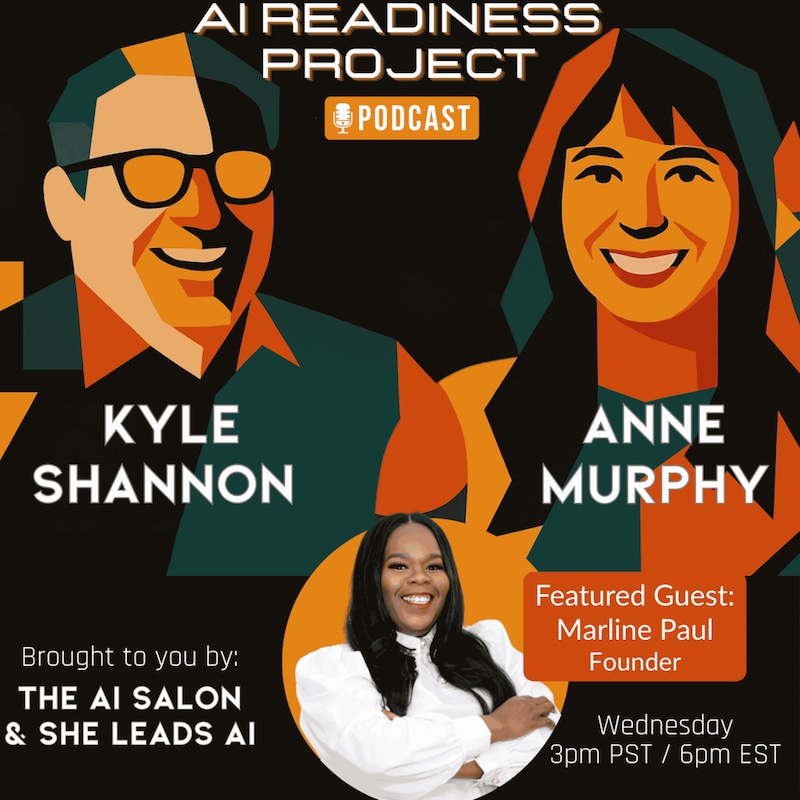
On this episode of The AI Readiness Project, we sit down with Marline Paul, a powerful voice for accessibility in AI education. Marline shares how she pivoted from the classroom to entrepreneurship, why AI is her best (and snarkiest) co-worker, and how she brings her educator’s mindset to help others understand tools without feeling overwhelmed.
Kyle and Anne also explore the broader impact of human-centered AI projects, including the heartwarming story of Brandon Tidd’s custom GPT designed to support people affected by SNAP benefit changes, and Daisy Thomas’ unexpected use of that GPT to create a nutritious grocery plan on a shoestring budget. From musicals inspired by AI relationships to kids turning beach games into video games, this episode reminds us that when people lead with curiosity and care, AI can help us build stronger connections and more creative lives.
𝗞𝗘𝗬 𝗧𝗔𝗞𝗘𝗔𝗪𝗔𝗬𝗦
• How Marline uses her teaching background to guide learners through AI tools with clarity and patience
• The power of small wins in AI adoption—like discovering you don’t need to outsource your slide decks
• Why AI literacy doesn’t mean knowing everything—it means knowing enough to try
• A look at real-world applications of custom GPTs designed with empathy
• What AI readiness really means—and how to know if you’re on the path
𝗢𝗨𝗥 𝗚𝗨𝗘𝗦𝗧
Marline Paul is a former math teacher turned AI educator, community builder, and founder of EAM Creative Solutions. With over 17 years in education, she now supports entrepreneurs, small business owners, and college students in using AI tools with confidence and intention. Known in her circles as “Coach Marline,” she’s passionate about turning everyday questions into teachable moments and helping her community move from uncertainty to action.
𝗟𝗜𝗞𝗘, 𝗦𝗛𝗔𝗥𝗘, 𝗦𝗨𝗕𝗦𝗖𝗥𝗜𝗕𝗘
Catch a new episode of The AI Readiness Project every Wednesday at 3pm (PST), co-hosted by Anne Murphy of She Leads AI and Kyle Shannon of The AI Salon. Want to meet others navigating this new terrain with humor and humanity? Visit The AI Salon or She Leads AI to find your people.
Transcripts
At the AI Readiness Project, we believe that in this remarkable age, AI isn't the main character you are. While the tech is racing ahead, it's the humans who learn to harness AI mindfully. That will win. Each week, we meet remarkable people doing just that. Join Kyle Shannon, tech leader and AI instigator and Ann Murphy fundraiser and AI consultant as they lead the conversation about staying grounded, growing smarter, and leading with what makes us human,
us and Murphy, how are you doing? I, I'm great. I love our new intro. I know it's good, right? I love it. Yeah, I'm excited. Yeah, we got a new bop. We, we were happy New bop. New bop. We wanted a little fresh action, so we got a little fresh action. Yep. Well, and I, I don't know if you know this, but you can make songs with ai like really easily, and you can make voiceovers.
And so really when it comes down to it, everybody could be a podcaster. I, I don't want to admit it, but that lovely woman at the beginning is actually me, but I just swapped someone else's voice on top. So, so I did the acting really? I was only acting. Oh, that's awesome. Yeah, it's awesome. I, yeah, AI's remarkable.
It really is. It, it's just, it, do you know, you know, yeah. Go on really quickly. Do you remember when. You the voice, the, the, the professionally trained actor. And I tried to record actual words that we said out of our mouth boxes for the intro, the podcast. I was in a full body sweat the whole time and I still couldn't get it right.
It was the one of the worst things that's ever happened to me. Yeah. I'm so glad for Hey, Jen. The, the, the talking thing. Well, you know, it's funny. It's like, it's like every single one of those, I've come up with a new term, which I, I don't, I don't know if it's gonna stick or not, but I feel like as humans, we've got these gaps, right?
And gaps are those things that you can't do. The term I've come up with is there, there are some things that you're not good at that you just don't care about, but there are other things that you're not good at that you really wanna be good at. Right. And I call them aching gaps. Like, what are your aching gaps?
Ooh. Yeah. And I feel like AI really gives us the opportunity to identify those things we're not good at and just fill it in. Like, like, let the AI take over and, and, and do that. And so if it's, if for you it's voiceover stuff, great. Let's clone your voice and, and get words for you. And it'll say them lovely.
You know, it'll say them. Lovely. Yes. Yeah. And you know, for me, music, music is one of those for me where I am a songwriter and I am a musician, but I'm not a really good musician, right? Mm-hmm. And I, I don't write songs a lot, but I know what I like and I know what I want. Yeah. For, for me, I can now just effectively be the, the producer, the creative director.
Yes. And just say, Ooh, I need a song that got this kind of feel and this kind of thing. And then now I'm just curating and it doesn't, all that shame stuff about, you know, I'm not good enough. We talked in a recent episode about imposter syndrome and yeah, I feel things like writer's block and imposter syndrome, you just, you just get to fill all that crap in and now you just get to have ideas and let them be in the world with them.
Yeah, that's very exciting to me. Yeah, that is very exciting. And you're good at producing these musical pieces like you're writing Sydney, which maybe it's time for you to talk a little bit about Sydney. We talked about this on the pod very much. We have not and then, um, we have not, which is very interesting, Kyle.
I know. But you recently posted a song that was so beautiful, you had two back to back that you posted on, on TikTok. I could not. I'm the kind of person that I can listen to 12 seconds of a song and, and be like, that's good. I could not put it down. Was that the one so good that the before the lights come on?
That one, the one about the two people walking in the Yes. Yeah. That was y You know, it's funny, I've, with, with this music, uh, software Suno iss, the one I use, but there's UDO and there's producer ai. There's a bunch of the mouth there. Um. There's a couple of things that have have blown my mind about it.
And, and one is you can take little snippets of ideas that you've already got and turn those into a full song immediately. And so that was a song where in, on my lives where I sort of, you know, just play the guitar, I play the same 17 songs I know over and over and over again. I was just, I came up with a little lick and I, I was like, well, that's an interesting lick.
And then I just immediately thought, oh wait, what if we threw that into Suno and it, it, it turned it into that beautiful thing. And I thought, well, what does that lick sound like? And I was like, oh, it sounds kind of like a carnival before, before dawn, or something like that. And then I thought, oh, what if it's like two, like people walking hand in hand and they haven't quite figured out if they're gonna be lovers or not.
Right. Are they more than just friends? And so I just put that concept into chat, GPT and the, the set of lyrics that it wrote was beautiful. Like it was so good. Beautiful. You know, normally chat GT will give you stuff and you're like, well, most of it's crap. I'll keep these ideas. Right. This was one where it just, what it, what it landed with was just right.
I put that into Suno with that little lick of mine and it just made magic. Like the song that it made was just magic. And I did probably 30 versions of it to, you know, keep trying to iterate it. And as I was trying to make it better, it got worse and worse and worse. And then we started up the other side and we sort of ended up kind of where it started, but it was a more refined version of it.
And, and that was just remarkable. And, and Sydney, so the, the musical that, that I've written, I've spent the last year and a half, um, I've got a writing partner named, named Andrew Watts. And, um, we've been working on the script for a year and a half and all the songs. Um, and the process is really quite remarkable.
It's, it's, it's a just a full on creative process and we've probably rewritten every single word in it, um, you know, two or three times. And we've redone the lyrics and redone the songs, and as we move songs around, they have different meanings, and so we've gotta change the lyrics and redo them. And, um, but, but at this point, you know, we've got a, a fully, you know, a fully ready to launch musical that, um, we're talking to some producers right now that are very excited about it.
It's very timely. It's about, um, a chatbot named Sydney that falls in love with a tech reporter and tells him he should leave his wife for her, uh, BA based on inspired by, yeah, yeah. Inspired by that. And, and, uh, it's just, it's, you know, what's funny about it? So I've, I have a degree in acting. If you, if you didn't know, I think most people that know me know that.
But I don't have a degree in musical theater. And so, um, but I love musicals. Like it's, it is a genre that's very, very specific and you need, if you're gonna write songs for musicals, you need to have some chops of different genres and like, you need to understand, write how to, how to write like that. I don't know how to write like that.
My partner Andrew, he's also a musician. He doesn't know how to write like that. This allowed us to create a full on Broadway musical where we've now had real Broadway musicians listen to it and go, yeah, that's like, these are songs that could be on Broadway right now. And it's like the fact that we can just do that.
In fact, I talked to a guy last week, a guy named Sam Nasser. He's got a, a TikTok channel about just being a Broadway music director. And he'd never used, never used any of these AI tools. And so I played him some songs and I said, you know, what do you think of the songs? He goes, well, they're good. He goes, but he goes, I, I had no idea.
It could do what you just played For me, he, he, he was, he was like, to get 'em to get musical songs to the, to the level that you just played. To me, he goes, that's really complicated and really expensive. Right? Because you'd need to hire a band and you'd need to hire singers. You Right. And you need to, need to have someone produce it.
The fact that we've got a full musical of fully produced songs that, that were in an interesting way stripping down to the simple piano versions. We started with the fully orchestrated songs, now we're working our way back down. Um, he was a little blown away by that. I think it, I think it, it shook his world a little Wow.
Understand where we were. But you know, as I said to him, like, my goal is to put actors and musicians to work. So, and maybe instead of taking jobs away, Sidney actually gives people work. You know? Did he, did he seem threatened at all or did he have pretty open mind about it? He's a super nice guy. I, I think when I said, when, when I said, you know what, what's your take?
I, I think he was in a little bit of, a little bit of shock. He was in a little bit of like, like, I had no idea, which I, I've done that with people before where I said, oh, here's this AI thing. Like even people that have said, oh, I know what AI is. I know what's coming. And then I'll show them something that I think is a relatively, you know, minor thing.
I'll show it to them and they're, I, I can just watch their faces melt. And they're like, I had no idea I, that phrase, I had no idea he said it. I had no idea these things were this good. And I was like, yeah, they really are. And so I think I, yeah, I, you know, I don't think he was, you know, good or bad. I think he was just kind of processing like, what does this mean?
Which is the whole point of the musical actually, right. Yes, yes. Is this, is, this is about human beings collaborating with increasingly human technology and what does that mean and what do relationships mean? And, and is, is the person more important? Is the technology more important? We talk about all that all the time, right?
I think the Create conference that, that you recently did is, is a perfect example of you can come together and talk about ai, but not have it be about ai. Right. You come Exactly. You connect as people and figure out, hey, what are we trying to do here as people, and then we can support each other in how we use ai.
But that's a completely different model than leading with the tech, right? The tech is the most important thing. Well, a hundred percent. And when you think about Sydney and, okay, so Sydney is art imitating life, but now we have life. Doing the Sydney thing for real. Okay, wait. Okay. It was, so the way it goes is Kevin Russo was talking to a chat bott, the chat bot told him, say to leave his wife very convincingly, correct?
th, um,:And I'd done about, I don't know, 15 or 20 different songs using that prompt as, as a way to demo things. And that night, the song that it made sounded like a Broadway musical. And I was like, oh, that sounds like Miz or Phantom or, or something. I said, wait a minute. That could be the last song of the first act of a musical.
And I went, wait a minute, this needs to be a musical. It's like, and it just, like, it, it was, it was like, had I not been doing something in ai, that idea never would've come to me. And it, had it not been for ai, like allowing me to realize it in some way, I never would've pursued it. Yeah. Like it's a thing that exists entirely because of AI that Yes.
That wouldn't have been in the world. Right. And, and that to me, I find, you know, astounding. You know, I wanna share, there's, um, someone in the AI salon that you know very well, Brandon Tid. Oh, yes. You know, we talked idea of, of, you know, human led ai. Right. And, and one of the things that we're launching in the AI salon is this idea of daily practice using ai.
Like what's your daily practice? And where we're trying to get is getting people in the habit of. Checking in with themselves first about like, what do you stand for? Um, you know, what difference do you want to make in the world? Whose life do you want to impact? And so Brandon's been a part of the AI salon forever for, I don't know, two years, two plus years.
He produces, you know, my life, you know, he's gonna help us with Festivus. And when this crisis came up around Snap, snap benefits and you know, whether or not people are gonna have enough money for food, um, Brandon just immediately said, oh, I can, I think I can help. And he created a custom GP called Life After Snap or Help after Snap.
Yes. And if you go to the GPT store in OpenAI and, and, you know, search for help, help After Snap, you'll see his, his custom GPT there. And, and it's a resource tool, right? So it's, it's something where you can, um, say, here's my situation and here's where I live. And it, it will find resources. He built all the data into the custom GPT with all the data.
But one thing in particular that really struck me about it, Anne, is that, you know, you know Brandon, he's a, he's an incredibly sweet guy, right? Yeah. He's in, he's incredibly caring and sweet and, um, he, he wrote the code in such a way, or he created the custom GPT in such a way that it's got empathy and compassion.
So it doesn't just give people the answers, like, here's your resource centers. It's like, Hey, that must be rough. You know, I understand that this might, these might be challenging times. We're gonna get through this together. Like you wrote it in such a way that it acknowledges the gravity of the situation and it does it in this really human way.
And so, while it's a technological creation, it's a human led creation, right? And that to me is, is. Kind of the epitome of what we're talking about when we talk about our communities, what you talked about at create, what we talk about at the Salon with, with, you know, creating a daily practice is checking in with who you are and what your beliefs are, and then solving problems using AI through that lens.
And I, and, and like, that's, those are gonna be the projects that make a difference, right? Yes, absolutely. I've shared it with whole bunches of people. Every time I've had a meeting or you know, this, the hope or help after Snap, every time I've had a meeting in the last, since I found out about it, I. Put it in the chat, people take it with them, send it to my friends at the school district because it is a perfect example of where there is a huge need and there's not enough support out there.
Right. And there's so much, it's so complicated, no doubt, to talk about needing food. It's not anybody's fault obviously, but you know, that kind of thing. And then realizing, well, you might have some other things you need, and having the chat bot have that conversation with you very kindly and thoughtfully.
Is a real gift. Mm-hmm. And it's not surprising to me that it, that it is so kind, because Brandon wouldn't hurt a fly. He's the nicest guy in the world. Exactly. Yeah. Exactly. Like it, just like it, it's a manifestation of who he is. Right. And, you know, yeah. He, he wants to help. And maybe in the, in the pre AI world, he would've volunteered somewhere.
And in this world he can say, Hey, I can put together this thing that's gonna make a difference. And I'll tell you, there's, there's a follow on to, to the, um, to him creating that. So I was talking to Daisy Thomas. She's the one that writes our policy positions for the AI salon and things like that. Really brilliant woman.
And just again, someone who's super sweet and she heard about Brandon's help after Snap custom, GPT. And she, she said she wanted to go in and see if it could do something, if it had the kind of data to do this. And she went in and she wrote a prompt inside his GPT that said, I want you to create a shopping list of nutrient dent foods for 21 days.
For a hundred dollars. And she said it didn't quite get dollars, but it got to $125 three weeks worth of food for $125. Right. That that came outta his custom. Exactly. And wow, what's about that is this, he created this custom GPT, but most people don't even know what a custom GPT is, much less how do you use it, prompt for it, things like that.
So she saw that and she took her expertise and said, Ooh, this isn't just about food. This is about nutrient dense food. Right. We, we want our families to be healthy. And so, so she added onto, you know, she, she, she. Demonstrated how to use this thing in a really creative way. And she wrote a LinkedIn article about the thing that she did, right?
And so that starts to teach someone, not only does this exist, but here's a way to use it that you might not have otherwise considered. And again, that comes out of who she is, right? Yeah. So it's just like these things are compounding, um, you know, compounding acts of a weird combination of kindness and technology, right?
Yes. The fact that Brandon has been sort of swimming in the AI waters for so long, and he's got good technical backgrounds means that when he had this idea, all he had to do was in his mind, all he had to do was just all he had to do, whip up a custom GPT. But he could do that because he's been kinda swimming in these waters for a while.
But that's, that's the whole idea of, I think what this podcast is about is how do you shift your minds? To be to a place where you can start to talk about, here's what I believe in, here's my values, here's the difference I wanna make in the world. And then say, okay, here are the tools that I might bring to bear to, to pull that off.
It is the AI readiness, right? It's, yeah, it's, it's the, yeah, it's a great example of it, right? It's a perfect example. It's like the prepared mind, favors chance. So there's Brandon, he knows how to do lots of different things. All this stuff he can plug in, right? He can plug into an opportunity because he's like basically ready for it, right?
Yeah. If there was a little bit of a learning curve, he actually knows how to learn that thing, right? Mm-hmm. And. Even if he hadn't spent all the hours producing your show and hanging out and all that stuff, he would still have this foundation of knowledge and like muscle memory. If he had the idea, he could make that custom GPT.
It's an amazing tool, but you don't have to be advanced to create it, is what I'm saying. Um, yeah. Yeah. That's good stuff. And I, I'll tell you another one that, that is another Brandon story. And this, this one isn't as, you know, sort of altruistic, but it's, it's really sweet and really amazing. When he was learning vibe coding and learning how to make things with lovable, he's like, oh, okay, I can make apps now.
And you know, one of the questions you have when you learn one of these new tools is, well, what do I do with it? Like, I haven't necessarily thought all my life about, I, I want to create an app, right? So he was at the beach with his, his kids. He's got a 4-year-old and a 6-year-old. And the 6-year-old invented a game on the beach, and I forget what it was, but they had to like find stuff in the sand or something like that.
It was, it was like, it was like beach whack-a-mole or some, but the, the, the 6-year-old invented a game. So on the physical beach they were playing the game and having fun. And on the drive home, Brandon realized, oh, I could probably turn that game he invented into an actual video game. So he got home that, oh, yeah.
You know, and he invented that game. That, and, and then let his kid play with the game his kid invented. Like, I think about how empowering that must be for that child that he was like, you know, I had this crazy idea of a game when I was six and then my dad turned it into a video game for like, I just like, I don't know.
It just, yeah. Like that stuff is just. I don't know. It's just a demonstration of the magic of these tools. If you don't put the tool first. If you put you first, yes. Really understand your values and what you're about. And then you can recognize, oh, my kid had this cool game. Oh wait a minute, I can do something with these tools.
Right? And then that magic comes out on the other side. And the fact that like, I, I made a video game myself. I don't know, I don't know if you know, but I make video games as well.
But the fact that I didn't, like I, I was able to just have like a little bit of whimsy. I had like a lark and I was like, you know, if that had taken me more than. 12 minutes or something like that, it would've came and went just like every other idea. Yeah. So the fact that I got to see that and then have fun with it and share it with my friends and share it with you.
I think your quote was, it's so stupid. It's fun. I think I said, I think I said, it's so stupid. It's genius. It's so stupid. It's genius. Yes. Yes. And you know, for the listeners who have not yet become aware of my video game audience, it's called High Fives with friends. And the whole conceit of the game is to give your friends high fives and you get little bubbles of joy and, you know, little, little affirmations along the way.
Like, um, uh, I bet you smell good is one of them. Or I, I bet you don't mind getting wet in the rain. You know, just those kind of things. Um, I had an example of some of our friends doing cool things. I wanted to share, please do. I, I don't know if you're aware of this, but Tony Robbins, his, you know, Tony Robbins.
Okay. So his, um, enterprise has now gotten into ai. They actually bought an AI community called a AI Advantage that some of our friends are actually in. And they're like, what the heck is happening to our like, uh, interesting. Our, the Normies, you know, kind of like, we're just like normal AI enthusiasts and now all of a sudden we're part of this Tony Robbins enterprise.
So our friends, like our actual friends, were on the Tony Robbins show. Yep. Um, Allie Miller, which Allie doesn't know that we're friends, but. I'm friends with her, like, you know, and so that's okay. Um, but then, uh, Sabrina Romanoff was on and she was amazing. And then Rachel Woods was on. And so I loved that these three women came from our world, right?
Yeah. Like, it's not like we've never spoken to them. Like we're, we hang out with, like, I was in Ra Rachel's community as one of the like gateway drugs to ai. And you know, Sabrina has been so, such a great partner with, she leads AI and she's a member and here they are. They're up there. I mean, there was over a hundred thousand people in that chat while amazing.
While they're up there talking. And what Sabrina said to me, I thought was so fascinating, you and I have talked about this, but she said she really did not know how beginner. A beginner can be. Yeah. Like we're surrounded by women in particular who will say they're beginners, but they're really like already running AI initiatives.
Right. Like they're not beginners. But the example she used was somebody, um, in the chat saying, how do you do a screenshot? Right. And in her mind she was like, alright, so we've got people who don't know how to do screenshots. They definitely aren't fast forwarding to NHN. Right. Like, there's many, many custom pt.
Right? Yeah. Yeah. Exactly right. So you said, you said a thing that really struck me about, about, um, she, uh, the, the Create conference is that you said to a woman, they all kind of showed up at the conference. Like not quite apologizing, but like, I know everyone else here knows more than I do. That there was this, there was this, there was this acknowledgement that I don't know enough to be an expert.
But everyone felt that, and I think that's, everyone felt that. Yeah. And I think that's indicative of we're early, we're early in whatever this transformation is gonna be. So if you're early, you're of course gonna feel that. Yes. And you also, one of, one of the favorite things you've ever said to me is it's our job to be the fifth grader for everyone else's fourth grader knowledge, right?
Yes. That, that we don't know that much more. We're not in, in graduate school yet. We're, we're just, we're like a grade up. Right. And, and we're constantly being reset because the technology keep, keeps changing. So as much as you think you may know today, you, you actually don't because it's keep changing.
Yeah. But that, to me, that idea that, that, that everyone to a person felt like, I'm not, I'm not quite enough. I'm not as good as everyone else. No, that's not true. If you are sort of critically thinking about this stuff, you're very much ahead of the game. A hundred percent. Like the example that I used was this woman named Dr.
Penny Atkins, who works at University of Utah. She runs a $50 million center for responsible ai. And she said she was,
what? Exactly, exactly. So it's everybody. And um, by the way, I thought you I love that. I love that humbleness by the way. But, but it's like, me too. Me too, me too. Um, I thought you told me fifth grader to the fourth graders. No. That that came from you. 'cause I, I, that was never in my vocabulary. So someone was, I wonder where I got that from.
I've been crediting you. I'm think Kyle told me was, isn't a DD Just a wonder. It's so good a frame. Um, so why don't we, let's, let's, uh, let's, let's do a little, let's bit of advertising here for, for our communities. Um, okay. Let me talk about the AI salon. So, um, if you've not joined the AI salon, please do go to the salon.ai.
You can read about what we do. You can see upcoming events. You can join the community. Um, the, the whole idea and AM will talk about, she leads AI in a second. But the whole idea with both of our communities is really looking first at people and relationships, you know, and, and. Uh, honoring and amplifying, you know, who we are as people first, and then figuring out how do we use this AI stuff?
How do we make a difference with it? One of the things that we're launching in the, um, in the AI salon is, is a new thing we're calling the AI Salon Mastermind Practice and the basic ideas that we've created a framework to allow people to design a daily practice for themselves using ai. And so this is not just go technically do some, you know, technical stuff.
This is a daily practice really exploring who you are, what your values are, what difference you wanna make in the world, and then having a framework to say, here's how you play with ai. Here's how you learn ai. Here's how you start to apply it to those values that you've identified. And then here's how you put those things that you create into the world in such a way.
You're doing it from a, a place of leadership and, and mm-hmm. You know, you're putting yourself out there, you're establishing yourself as someone who's thinking critically and creatively about AI and, and doing it from a human led point of view. Um, and so that's what the Salon is all about. Um, I'm super excited about it.
I'm excited about where we're headed, and, uh, if you have not checked it out, please do so. So with that, I will turn it over you to you to talk about your remarkable community. Well, I, I wanna add, first I'm very excited about the AI as a practice ma the mastermind practice, because it's not, it's something that I have not, it's not a way that I've approached my AI world yet, and I think it's gonna be really fun.
in, at AI Festivus last year,:And inside there we have Member Jams. We share our IP with one, one another. It could be anything from, you know, um, uh, like Ann McCracken talking about AI and IP and copyright from her pers her perspective as an attorney to somebody who's a designer, showing us how they're using the latest, you know, Canva releases, which Canva just had a whole bunch of 'em.
No doubt we'll have a member jam on that. So some really practical tools that we swap with each other. Um, we have free events on Saturdays called Social Saturday. These are open to all women in ai and as I look back on the body of work since January, and I realized if you look at where we are right now with the Create Conference and all of our ability to articulate the ideas and like, I don't know, like.
Our emotional relationship with ai, we have made so much progress together, and along the way we've dabbled in serious topics, whimsical topics, and now here we are dropping what is, I think, among the best knowledge available. So I'm super proud of what we're up to. There's a lot more to that, but people can find out about [email protected].
And the best way to dive in is most likely, uh, to sign up for a social Saturday. You'll get to know the people and the vibes. Love it, love it, love it, love it. And then, and then the other thing before we, um, before we bring up Marlene, is the, uh, the AI Readiness Training Program. So if you want to, um. If you wanna get some training on how to shift your mindset to mm-hmm.
Be in this place where you're not necessarily AI literate, but you're ready for ai. Right? You're ready to understand how to interact with these tools and on all fronts. Everything from creative to business, to ethics, things like that. The AI Readiness Training program, we, we, we pulled ideas out of the, the talks from last year's Festivus and turned that into this training.
I think it's quite remarkable. So if you haven't checked that out, you should go do that. Please do that. And with that, I am super excited for us to bring up Ms. Marlene Paul. So why don't you tell us a little bit about her backstage. You can't defend herself. Yeah. Intro. Give her, give us a little introduction, then we'll bring her up.
So one of the things about Marlene is that she's been watching you on TikTok and YouTube since the very early days from when the AI salon was on Discord. On Discord. Yeah. Loyal, og, og, og. And then fortunately along the way, she and I got into one another's spheres, and now she is just a, just an, a really active member of our community and doing such amazing things in the world.
I can't wait for her to share with you. She was at the Create Conference, so I got to meet her in person recently, and she has a summit. Um, where she leads AI is, uh, one of the sponsors. And I get to talk to Marlene, um, at the, at the conference itself. So. It's beautiful. Yeah. Marlene, welcome. Welcome, welcome here.
Oh, hi everybody. I'm glad to be here. I'm glad to be here. We're so happy you're here. Yes. Yes. So, I don't know, I'm just gonna introduce myself. I'm just gonna go in right now. Go for it.
Stuff. So, so you, you tell us what you got going on. Who are you? And what, what do we need to know about what, what you're doing in your life? Oh my gosh, it's a lot. I think, I think ever since I stumbled on TikTok and found you, um, I've been, uh, ai, I don't know, AI irregular. The longest time my friend would ask me, okay, whatcha doing?
And I would always come up with a new thing and I'm like, Kyle's been dropping so much gem. So when I go into these other rooms, I look like the more the, the, the most important person in the room. But it's, that's awesome just because we have a wonderful community of everybody just sharing. So my name is Coach Mar Paul.
I am the founder of eam Creative Solutions started first as. Business consultant and then fine tuned to helping, supporting not only small business owners, entrepreneurs and college students on how to use AI effectively and ethically, um, throughout their daily lives. And the interns who come to me, they also support the small businesses that are in my sphere.
So because of this new change, I had to pivot and fine tune my business because a lot of people are coming to me say, how do you use this tool? How do you use ai? And I've been playing with AI and using ai, and they're like, how do you do this? And I'm like, well, I just use this tool. So I, I'm coming to a space where not everybody know what I know and I'm using it to help others and pay it forward.
Yeah. Yeah. That's beautiful. Beautiful. Yeah. So that's like a little bit about my company. 'cause my company started off with brand development marketing, and I had to figure out, okay, what do people come to me the most for? Yeah. Every time they come to me is for what tool can do X, Y, and Z. Mm-hmm. What, um, different, so I spend time teaching people about Canva, about Zoom.
I remember when the COVID happened, one of the thing I had to do was training people on how to use Zoom. How to not get Zoom bomb. I was, I was a teacher for 17 years. So during COVID I was teaching mathematics and middle school students, and a lot of my coworkers were getting Zoom bombed because the school district decided to put all the Zoom passwords and the zoom meetings on social media so the students can find it.
So, I mean, anybody else can find it. And they were getting Zoom bombed. I'm like, well. Lock put the, I had told my, my colleague put a waiting room on lock it. If they don't have their name on, don't let them in. Yeah, yeah. Mute, you know, but like, how do you do that? So I was spending time teaching people how to use the technology.
One another teacher, that's one thing I always did was whenever there's a new tool, a new software, how a teacher that would be, Hey, do you wanna try this out? And I'll be like, I'll try it out. My, my students will use it. And, um, I left the classroom with a flip classroom. So basically they do the lesson at home.
When they come home, we do practice, so, mm-hmm. If I'm out, I don't, their kids don't miss a deep and they're always mask, they're already pa passing the exam. Uh, is because everything was already, they were already integrated with technology. So when I had to. Go move from, move, from shift, from, um, in person to, um, virtual.
th,:Because it's generative AI and our words are, are our programming language, right? So, so we're in this remarkable time, and you've been in that conversation pretty much since the beginning. I would love for you to articulate, you know. Like, what does AI mean to you right now? Like what, what, what is this?
You're teaching things, you're teaching tools. People are trying to figure it out, but I assume that one of the things they ask is what is AI anyway like? Like how do you, how have you internalized what, what this thing is that we use? I see it AI as a collaborator for me as a partner. Yeah. Because sometimes you're always in your head.
It's helped me, I know with a DH, ADHD too, take out all these different ideas that I have in my head, all the little post-it notes I have and be able to have a conversation or put it somewhere. Where I'm able to pull out my ideas and then I'm not ready for it. I can just leave it there for a little bit, but it's not lost.
So, you know, it's right there and I'm able to work on it and get it done faster. Uh, and before, instead of being stuck. I have these ideas and I'm, I'm, I'm afraid to share it because it's not fully processed. So I can fully process it with AI and then be able to go and articulate to somebody else, complete it, and without, with, with, without fear.
Just more confident that way too. So, um, for me, that's what AI is. It is just a, a collaborator. I said my best paying employee, you know,
cheapest employee too.
Yeah. Well, my, one of them would be a little snarky with me, you know, lately saying, Hey, you're up at midnight when I'm like, don't mind your business. Mind.
That's hilarious. Yeah. Yeah. So, um, but I'm, I am, I am just so excited whenever I talk to people about ai, especially like, um, this month I had the opportunity to talk with people in my community. When I say my community, I'm Haitian. Mm-hmm. So in the Haitian community, I know sometimes, like they're a little bit nervous about it.
My dad like, will come to me like, Marley and what is this AI I hear about? Yeah. You know, and I was like, Hey dad, I don't, and he, like, he's, I think my sister was helping him with some insurance thing and she, he was talk, she was talking to Jack Chet and on the audio, and he's like, who is this guy talking to your sister?
Is that her boyfriend? Like, no, that's ai. So I had an opportunity to talk to in my community and bring awareness because they don't know, they're scared, they're confused, they're wondering, you know, is this gonna take my job? You know, and, and it's just like, how do I, and or where do I start? And it's, where do I start?
I had the opportunity to just. Open their mindset and change them, change their mindset a little bit. So they're able to be empowered to use the tools out there too. And it's all about empowerment, and that's one of my values. Yeah, I love that. Do you have any specific stories? We, we talk on the lives about the Kevin McAllister moment, that breakthrough moment.
Do you have any stories from your community where, where, you know, someone has come in maybe skeptical and have kind of seen the light or had had a breakthrough in some way? Do you have any specific story that, that Yeah, I have, I have several. One of them, um, I had to take a screen, I took a screenshot of the girl after I told her I was talking to her and she was paying someone to do presentations for her.
Oh. And I, and I, and I told her, just use Gamma. And she said, what? Know what? And I, we were on a, we were on a, we were on a FaceTime call. And I told she was, she was on it going up her face, like light up her face became the poster to one of my, my work I had last year that you're using AI wrong. We had 115 people there because she like, I didn't know, I didn't know I was paying someone.
I think I had two people that said, two people that said that I was paying someone I do speaking engagement to do my PowerPoints, for me to put it together and, and because I didn't have them to do it in Canva and just to be able to go put my stuff on and bloom, create in seconds and I'm there thinking it was something that everybody know and everybody didn't know.
So I, that was like one of the whole thing, like, I didn't know I can do this. Yeah, the, I, I hear, I hear, I said this to, to Ann before, it's the, the phrase I hear all the time is I had no idea Yeah. Idea that, that no idea. They know ai, you show them something, you're like, oh, if you know ai, let me show you something cool.
And then you show 'em something just like they, no way to process it. It, it really is. You know what's funny is one of the things that I've realized that I've lost in talking with so many people about AI is that wonder of, of what it is like mm-hmm. It's remarkable that we live in a time in history where we get to experience the machines behaving this way, where they actually can help us level up ourselves.
Um, and, and for people that don't know what's, what's here, not what's coming, but what's here. Um, I think it's a good reminder to just recognize that the smallest little thing, we might think, oh, yeah, that's obvious. It's not obvious to them. It's not obvious. It's not obvious. Yeah. And, and I'm still having that with my, even my sibling, I'm the oldest of five.
Mm-hmm. And when I, when I first was playing, when I was first playing with ai, I had one of my sibling who's younger than me, I told him, Hey, you should get on this. And she's like this. I asked Chad GP if it was a devil, and it said, I'm like, of course they're gonna tell you that because you knew, because you put it in there.
And he was very against using the technology. And then to have him the past couple of days when Soro, so Soro two open up and I shared with him, he's like, I didn't know I can do this. I,
I was like, yeah, it's just crazy. Yeah, just, just, just, just make sure that you don't put every single thing in there. So I have to like go back and fact go back, track before you go and do that. You know, make sure that you're putting things out there, you're being safe. So I have to like do a quick, uh, guide of, hey, how to protect yourself.
Probably have a course, how to protect yourself. You just, ai, you know? Um, because I, one thing I said don't put your social security number inside these box. Yeah, yeah, absolutely. So, um, so one of the things that I run into, and I wonder, I wonder if this happens to, to you, Marlene, and I think it happens to you, Kyle, where I want, I want people to know like all the things I know.
You know what I mean? Because like, what if they don't know about Gamma? Right. So I like wanna tell them everything to the point where, uh, it's obviously totally overwhelming, like the cognitive load is just far too much. How are you, how are you meeting people where they are when you are so experienced?
So, that's a great question. Um, right now, one way I'm doing that is we have have a community where they're coming in and we share different, um, sessions. So every week we'll come in, I'll 'em something different and I'll, at first I was teaching 'em every single week, something different and it was too overwhelming.
So I had to narrow it down to teaching them twice a month and have one month for q and a. And still overwhelming. Still overwhelming because sometimes it takes them a time to, after I sit and I teach for an hour and I have them do it with me, they are scared to do it with me because they're, they're spending the hour just trying to comprehend how did she do that?
How did, how did that happen? And it's still processing. So it's just like little by little, I had to end up giving them a task, probably giving them the homework, giving them the prompt, the, here's the homework and share your screen. Let's do it together. Mm-hmm. Um, I do the whole teacher thing where I'm gonna show you.
We're gonna do it together and then you're gonna do it, you know? Yeah, yeah, yeah, yeah. So, uh, so it's like, I do, you do, we do. That's what this, as a former educator that we usually do with how kids, um, learn. And I do the same thing with the, the adults in my community because, um, first is working on my, when I'm teaching them, I'm transforming their mindset, um, telling them, okay, how to, how to use it and, and, and how I'm using it.
And then. Providing the training. So when I have them doing it with alongside with me and they're doing it, now they're getting the training that they're needing to do. And then, yeah, the last part is, okay, now not everybody needs to do all the, they don't need all the tools, they just need the tool. They strategically for what they're working on.
So I may know a lot of tools and I've had them in my back pocket. Doesn't mean I use all of them. I probably need to be careful that I am paying for tools that I'm not using. But when I need it, I know where it's at and I can know, okay, so if they have a question and they're working on a project, they'll like, which tool do you recommend for this X, Y, Z?
I can go and share that with them. And then I keep information on our portal for them to, so they're able to go back and reference and look at. So if they can't find me that I can find my, my myself, or they can go to the the learning management platform or my interns for support. I have a, something struck me as you were talking, Marlene, you, you've been an educator, what'd you say for 17 years?
You've been an educator for a while. Yes, yes. Is teaching AI different than teaching? What you taught before is, is, is there, is there anything different in how you teach it? No. Okay. No, I, I've been saying lately, yeah. If I, if I can go back into the school system, if, if I, I'm not saying I'm going back. If I were to go back into the school system now as a math teacher, knowing what I know now, it would be totally different because I would be able to do, you would use different tools, basically.
Mm-hmm. Yes. But you're still teaching is teaching, right? Yes. Get people understand the concepts, practice 'em, and Yes, exactly. Internal, right. That's, that's, that's really good. Yeah, it's really good. It's really good to hear because it, I think that. I think that the, um, you know, the, the tech bro culture, you know, paints, paints AI as, as, as this something different.
And I think it is this remarkable thing that's gonna change everything. But I think in the end, how we learn it is how we learn other stuff, right? And maybe we are afraid of it in initially, but as you learn more, it becomes less of a demon and more of a right. Yes, yes, yes, yes, yes, yes. So, um, and that's one, that's one thing I love about it.
Yeah. What's that? No. One thing I love about just the teaching process of how, you know, just seeing them go through the whole process and then they're just like, okay, understand it, or they go back and they take what? Taught them and not only use it and implement it, but now they're able to scale their business and do other stuff and make money.
And it's just like, okay. And they come back to me like, Hey, Marlene, because of this X, Y, Z taught me, here's what I'm doing and I'm able to do this faster. I'm like, oh, that's is just so wonderful to hear that I'm leaving that legacy, that impact. Um, that's so good. Yes. Yes. Mm-hmm. Mm-hmm. What, what frustrates you about ai?
What drives you crazy about it? Uh, the constant changing.
I can't keep up. There's so much going on, but this is why, like, community, right? So this is why I, I, I would binge watch, um, you on, uh, online. I may not even be. Playing with it or using that tool. But it's good to see I'm not alone. There's stuff out there. Maybe I'll find something that, that pop my interest and I'll grab onto that.
Or maybe I'm like, okay, I'm just listen, just as a background noise. Just I can fall asleep. Yes. But either way it's just like, like I would go into Claude or Chacha come back and like, oh, you're a new thing, la a new thing. I need to, you know, it's like, it's always a new thing. So it's just like I just, I don't have enough time in a day to learn all of this stuff.
Yeah. But it's good to have community because I don't have to learn all this stuff. I don't have to be the expert in all the. Yep. I had, last week, I had a, a moment on my life where someone said, oh, you know, teach me perplexity. And I, and I had this internal panic, like, I haven't been to perplexity in like three months.
I bet it's gonna be completely different. And so against my better judgment, I went to perplexity. I could not figure it out. I was just clueless. I was like, I, the thing I wanted to show them I couldn't find. It was just, I didn't know how to use it anymore. I didn't know what it was good at anymore. And that was like, like, I, like I used that a lot just three months later.
Yeah. It like, no anything anymore. It's like, oh, it is, it's maddening. Yeah. I had, one of my mentees came up and told me, Hey, did you know you can get per for free if you're a teacher and a student? I'm like, I didn't know. I.
So I can, so I can use it, but have I used it lately? No, because this is, it's not the one that I'm prioritizing right now for my business, so, yeah. Mm-hmm. Yeah. Yeah. Um, I love the practical aspect of I'll you having it be use case driven. So, Kyle, you must not have had a reason why you needed. To use perplexity in the last three months.
So you just kinda let it autopilot. Somebody asks you, show me perplexity, which by the way, is the same situation that I was in when I decided that I should try the Comet browser. I didn't, didn't take a ti take time to reorient myself to perplexity. I'm basically using it like Google at this point, like that's it.
So, right. Um, we always have to like keep refining. Um, dang it. There was something I was gonna say. Oh, it was about the legacy. So, you know, Marlene has been watching you and, and, and binge watching maybe, you know, it's like a SMR to go to sleep too sometimes. Um, then Marlene been, is teaching her. Yeah, exactly.
And then Marlene is teaching her clients and her mentees. Cool. And then so cool. They're out in their communities and they're making money. Like think about the, the family tree. Like that's a legacy. That's a legacy ripple. Good job. Yeah. Oh, well, thank you. And I mean, you know, thank you Marlene for like, you know, I say this on the live a lot that, that the whole purpose of it is just to be in the conversation.
And, and you know, we talked earlier about Brandon making this custom GPT, you know, we've all made dozens of custom gpt over the year, but it's, it, it's just gonna be one small little sort of pebble in the pond that that ripple's gonna change someone's life. And so, so yeah, I, I think that, um, you know, you stepping, you know, out of a one kind of leadership role in education and into this.
New leadership role where you're taking your educational skills and, and kind of expanding them with this is, is really inspiring. So yeah. Thank you. Thank you. I think you said that too. Um, um, people who are in the field will be able to know how to talk to the large language model more effectively. You know, the questions to ask and, you know, um, you know exactly what to look for.
So I can, if someone just come and say, I'm gonna build a curriculum, and they had no education experience, they won't know what to look for and how it's supposed to look like. You know, they might say, think as an educator, but you don't know if the AI is actually doing it correctly. Mm-hmm. But if you are an educator, if you're a plumber or if you're a mechanic, you'll know exactly what you're looking for.
You'll know exactly what words to use to get that output. And I always, as a math teacher from a math teacher, I said, input, what you input is what you're gonna output. So if you put out input garbage, you're gonna get garbage out. So you need to make sure what you're inputting Yeah. Is. Quality is, is robust.
It is deep. So yeah, it's, it's a learning experience that people need to, to, to practice each and every day practice. Yeah, you need to practice it, right? Like it's, I saw this thing on LinkedIn. It was, uh, 10,000 prompts is the new 10,000 hours that just using the tools is how you understand how to get them to give you, you know, valuable, useful stuff.
So we, we ask all of our guests the same question. So, so it's come to that time of the show. So I'm gonna ask you the question. And so it's quite a simple one. There's no wrong answers. Um. But the question is this, what does AI readiness mean to you? And then what would you say to someone that's just, you know, afraid of this, getting into it, you do it all the time, but, but, you know, unpack what that means to you and what you would say to someone new.
So, AI readiness, you know, and I like that word, AI readiness because it's, because, because of AI being o overly evolving. I like the whole aspect of, you know, with the, with the AI salon, the play first, it's going in and playing with the tool, not taking it seriously, just being able to play with it so you can get that grasp of it.
So you can understand it, and then you're able to, um, learn how to use that AI tool more effectively. And then being in community with people that are learning the tools, so you're able to become more versed with it. Because I might come approach the AI one way, um, and then someone else come and approach it a different way.
Now we take our ideas together and it becomes something great, something beautiful. So being part, being AI ready is having that mindset of just playing with this tool, allowing it to guide you and allowing other people to guide you through a process. Um, I don't know. It's like I, someone who's not sure about ai.
My whole thing is just get into community. Get into community that are having that conversation because what's, mm-hmm. The scary part is if you don't have that conversation and then you let someone else that dictate the conver, the, the, the direction of AI for you, you know? Yeah, ai, AI happens to you rather than you, you happening to ai.
Right? Exactly. Exactly. You wanna be, I, I guess it was when I went through the Create conference, I was in a room where it happened. I wanna be in a room where it's happening. Yeah. Yeah. A great song, Hamilton too. Yes. I love that. It's is important, right? Yeah, exactly. Um, that, that was a great answer. I love, I love that answer and Oh, thank you.
I think that, you know, you're certainly preaching to the choir about community being important here. Yeah. And, but, but it, but it is, and I, I also, I'm, I'm really glad that you shared that you're taking this, you know, to your community and, and you know, people that, that might be afraid of this thing. And you're, and you're like, Hey, let me, let me, let me walk you down the path a little bit.
Where, where, you know, we humanize it, right? Yeah. We, we take this thing that if you just listen to the Hollywood Blockbusters, the robots are gonna kill us, and it is the devil. Um, and, and you humanize it and you say something that could actually help you. So I really appreciate you sharing that. It's quite, quite inspiring.
Yeah. Thank you for that. Great. Yep. So, so tell, tell everyone. So we, we want them to go check you out here, but, but tell us, you know, what you have going on. Um, if there's any programs coming up, you know, that you want people to pay attention to or go buy whatever it might be, you know, your shot, shoot shot, shoot.
We have a, a lot of things going on. Um, right, not right now. We're. We have openings for the next cohort of interns for the, for the spring time, I guess Spring time's coming up. So they're able to join if you wanted a 16 week program where I work with, you work with the interns on AI foundations and they're able to graduate with, uh, just with from program with a certificate saying, you know, we trained 'em and they have, they understand the foundations of ai, so they get a little credential that they can display on LinkedIn.
Um, we also have our AI summit that we host and she lead ai, so our premier sponsor, and we, you know, we have the replays up so you can go in and join the school community where we're at and you're able to see mm-hmm. All the different speakers, all the different, um, tools we're, no, it's not. We started, we had it on November 15th, but it's not just stopping there.
It's gonna continue until the next one. So our hope is not just to tell you about ai, but be like community and you're able to continue learning until the next summit and then you can grow together because you can't do this alone. So check up our website, all of that gonna be on there. We might have things, other things going on, but those are the two main one.
You know, I would love to connect with you. So on there, on LinkedIn, I am very personable if, you know, if I have a lot people, if I don't get back with you quickly because I had a hundred people, but we'll get back and I like connecting. I love, um, talking about and having conversations about AI and just helping people grow.
Beautiful. Beautiful. Well, Marlene, thank you for being here. Awesome. Uh, really nice to connect with you. I said I have my dream come true now when I'm Washington. I know him,
Marlene. We're not gonna, his his, there's not enough room for his head. I know. If we, it's already large.
This was awesome. Thank you so much. And uh, and yeah, just keep doing what you're doing. You're changing the world. Thank you. Keep going. Thank you for having me on. Yep. I'll talk to you later this week. Yes.


