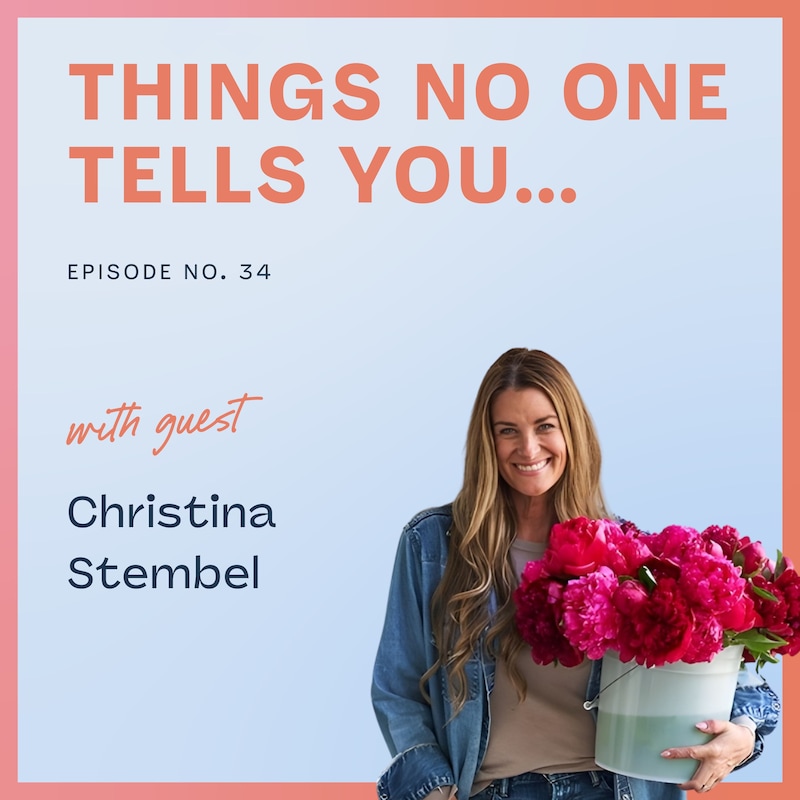
Shownotes
From the outside, Farmgirl Flowers looks like an overnight success. Beautiful arrangements, a recognizable brand, and a company that’s lasted 15 years. But as Christina Stembel shares in this conversation, the reality was far slower, and far harder, than most people realize.
Christina shares what no one talks about when you build a company without investors, without a pedigree, and without a backup plan. From growing up on a farm in Indiana to teaching herself how to design flowers she’d want to receive, her journey is rooted in grit and creativity.
We also talk about creativity born from constraints, how women buying flowers for other women reshaped Christina’s business, and what it means to build something sustainably instead of chasing fast growth. This is a conversation about patience, resilience, and redefining success on your own terms, especially when the timeline doesn’t go the way you planned.
What You’ll Hear:
- Why flowers became a business problem to solve (06:55)
- Bootstrapping without investors or a safety net (15:17)
- The reality of perishable margins and slow growth (29:24)
- When quitting felt logical (34:59)
- Redefining success on her own terms (46:07)
If you’ve ever built something quietly, questioned how long it was taking, or wondered if it would all be worth it, Christina’s story isn’t just inspiring; it’s validating. Christina’s story is exactly why Things No One Tells You exists, to share the parts of success that don’t make the highlight reel. If you enjoyed this episode, be sure to subscribe, rate, and review Things No One Tells You wherever you listen.
You can watch this interview on YouTube: https://youtu.be/6thbYEYvSx8
For a full transcript and more, check out our blog post: https://www.lindsaycz.com/show-notes/christina-stembel-34
Check out more from Christina Stembel:
Discover Christina’s website: https://farmgirlflowers.com
Follow Farmgirl Flowers on instagram: https://www.instagram.com/farmgirlflowers
And follow Christina on instagram: https://www.instagram.com/christinastembel
Transcripts
[00:00:25] You know, having to really figure out. You know, why are you doing this? How are you doing it? We're a very different company from the one I started to build and the one that I wanted to build, even. And that's okay.
[:[00:00:44] I cannot wait for you guys to hear more from Christina and this week's episode of Things No One Tells You. first I wanna just real quick set the table because I am in the midst of Winter Olympics coverage, which I just wanna take a minute to say that one of the coolest things about covering the Olympics.
[:[00:01:21] All in for 17 straight days where it's these storylines of like triumph, heartbreak, adversity, you know, and I'm talking about like Lindsay Vaughn, all the figure skating, winning gold, like everything, it is like this emotional rollercoaster in the best way possible. And it really gives me a lens into humanity, which sounds really weird, but it's true.
[:[00:02:09] And the guest that I'm introducing you to this week, Christina Stembel she is the founder of Farm Girl Flowers, and I can't wait for you to hear what she says. The thing is that no one's told her on her journey, I think it is. You know, it's something that might not be surprising, but it's definitely helpful, and her business is.
[:[00:02:54] I was like, this is really different. This is really awesome. They're gorgeous. And I sort of wanted to know more because there was such a specific style. But the thing that Christina mentioned during the interview, which is not spoiling it, is what it has meant to her and how it has sort of changed her. To get a glimpse of that human kindness, and I've never thought about this, but she gets to see all of those notes and letters of people who choose to send flowers.
[:[00:03:38] I hope you learned something from it. Here is Christina. Stan. Christina, I can't thank you enough for joining us here. I am so excited to hear all about the business, all about, you know, how you do it all, and the team that you guys have working with you together. Where are you joining us from?
[:[00:03:54] I'm excited to be here. I'm here fromWashington State, up near Seattle, a little town called Gig Harbor on the water here.
[:[00:04:06] Christina: Yes. Yes. So I moved from California, during COVID, during kind of the great exodus of many states that a lot of people did.
[:[00:04:29] but that kind of goes hand in hand with when you have a company. So yeah, I came up in 2021, bought a small farm here. We're starting to just kind of dabble in growing some of our own flowers as well. but just nice to have kind of an actual farm for farm girl flowers for the first time.
[:[00:04:56] receiving flowers, like just an experience, you know, when you step back and think, okay, farm girl flowers celebrating 15 years, what goes through your mind?
[:[00:05:25] Working 30 hours straight without any sleep and falling asleep at stoplights, which is really dangerous, and I don't recommend it to people just 'cause you're so tired delivering flowers at 11 o'clock at night on a Valentine's Day, and you know, just so many things. And then also just people, I just have so many like thoughts of all the people along the way that have helped me build this into what it is.
[:[00:06:04] And it's because of our loyal customers. You know, we do that. And our team that works so hard to do it.
[:[00:06:34] It feels very organic. What do flowers mean to you? I know that sounds like a weird question, but before I get into, like, really how this all started, I just Yep, Obviously this is a gift that you were given.
[:[00:06:54] Lindsay: Thank you.
[:[00:07:10] I wish I could have cured cancer or, you know, something much, you know, greater than just making things pretty. But you know, when I started Farmwell, I didn't actually see a whole lot of value in flowers because I didn't like what I was receiving. You know, I didn't like what I would send as a sender. I didn't like what I would receive as a recipient.
[:[00:07:52] That really surprised me when I started from where I thought it was gonna be, men buying flowers, but 92% of people that buy flowers are women buying for women
[:[00:08:01] Christina: Real stat. And if you take Valentine's Day out of it, it's probably really close to a hundred percent of the time because that's the day they all buy for.
[:[00:08:19] Lindsay: That's hilarious.
[:[00:08:28] They're. Excuse me, their sisters, their moms, their friends, to feel that same love. And so now, flowers mean love to me and mean care and consideration, and so many things that I think we need more of in the world right now.
[:[00:08:47] Christina: Yeah, absolutely.
[:[00:08:49] Christina: Kind of, they change seasonally, and they also change when I get tired of one because we use it too much or something. And I hate to be really cliché, but peonies are still my absolute favorite. Even though they're everybody's favorite, you know, flour, they're very fleeting.
[:[00:09:19] But, you know, the season for when you're harvesting them is very short. It's usually a few weeks long, at most six weeks long. So it’s a very fleeting season, which I think makes 'em more special, because you can't get them all the time. The other flower I love is the Garden Rose. It's very traditional.
[:[00:09:56] This was a good business message or lesson for me because I'm really not a fan of Gerber daisies or sunflowers personally.
[:[00:10:05] Christina: Yeah, some people love them. I find you're either in the love or hate category with them. Yeah, and I don't love them. And so we didn't have a Gerber daisy bouquet on our site for 10 years, for the first 10 years, because I just didn't like them.
[:[00:10:21] And then, yeah, and then we had a grower with COVID that was throwing away. You know, hundreds of thousands of dollars of Gerber daisies. So we put a Gerber daisy bouquet up on our site, and it became one of our most popular bouquets.
[:[00:10:40] Lindsay: That is so funny. You know what's interesting is I've realized this about myself, and this is gonna sound like a weird story, but ever since I was a kid, my mom.
[:[00:11:08] Like, I am using her as a measuring stick as I did for a lot of things. Do you know what I mean?
[:[00:11:22] Lindsay: Yeah. So I was excited to ask you about that because I was wondering why I, why she has such an aversion to them, and therefore, me and I get that's exactly it, right?
[:[00:11:34] Christina: Yeah. They were so common. They were in every grocery store, and they're also in. You know, it used to be in very primary colors, often dyed to be an unnatural color. So it just felt a little startling. Even like this crayola box color that would not be in a natural form is in a natural form.
[:[00:11:55] Lindsay: That's hilarious.
[:[00:12:00] Lindsay: Really.
[:[00:12:11] It can last, you know, a month easily. They're the only flowers that can last. Like a month outside of a cooler. So, we call 'em the workforce flower, trying to bring 'em back because they just have such staying power, and they're beautiful, and they actually have a scent still, which so few flowers do, but people aren't ready for the Olds mobile to come back yet.
[:[00:12:34] Christina: The colors. Yeah. The colors are just, I mean, there's one that looks just like a David Austin Gold, garden rose to me, and it's. A carnation will cost you 50 cents. You know, a wholesale Yeah. Like the big old, you know, between 30 and 50 cents, and a garden rose will cost you $2 wholesale.
[:[00:13:11] Lindsay: Okay. So you, as a kid, were a girl who grew up on a farm in Indiana. Mm-hmm. Correct. Can you tell me about that and what that life was like?
[:[00:13:27] You can't have just a couple hundred acres as we had, so we rented it out to our neighbor, farmed it for us. But you know, I grew up on, you know, I don't know, 200 and some acres and, you know, big barns and outbuildings and very far from town, which I thought was horrible at the time because everybody else was, you know, going to the community pool and the parks and.
[:[00:14:05] Lindsay: Yeah. What were your, I mean,
[:[00:14:21] And you know, like all that.
[:[00:14:24] Christina: Yeah. And you know, the chores seem to be, you know, but the chores that they use are like making their bed. And so I'm like, no, that was not our chores. Ours was like. You know, go clean the barn or, you know, we're gonna burn the fence row today, or you're gonna mow the lane back to the pond, which is, you know, a half a mile long and on a tractor, you know?
[:[00:14:44] Christina: There were different types of chores, or my mom had so many gardens that you know, now I like working with flower farmers that are like, we have a flower farm, it's half an acre. And I'm like, we had probably an acre of gardens. It's called a garden, not a farm. I get a little catty that way. I'm like, that's not a, that's not a farm.
[:[00:15:17] Christina: Yeah. I didn't go to college, so another thing with growing up on a farm was, you know, girls didn't, I mean, there wasn't a lot of investment put into girls'education.
[:[00:15:43] I wanted to be an actress. I moved to New York City two weeks after I graduated high school. I just had all of these. Big aspirations. but ithow I got here was very different than most trajectories to start a business. You know, I didn't come with a fancy pedigree or, you know, working at a lot of, you know, big, fancy companies first.
[:[00:16:23] Did catering for the university. And when I went to the alumni relations department, which oversaw, you know, all the events. For each specific school. So we would do, I would do all the events for the law school and all the programs, and I really excelled at that. I was really good at that. When the economic downturn happened in 2008, you know, the provost's office called me in to talk about how I was able to do just as many events with half the budget.
[:[00:17:02] So I just, I always knew that was gonna be my. Something creative. You know, I, wanted to start a business and I would carry a notebook around with me everywhere and come up with like, probably had thousands of ideas of businesses, you know, one of, and I would turn every girl's night into a focus group where I'd be like, Hey Mona, margarita, what do you think of this company called Pockets?
[:[00:17:37] Lindsay: So the scrappiness, and I think that's a really interesting example, likan e example when you're trying to get wholesale wine. Like, does that mean that you would just show up onsite wherever you needed to meet someone and talk it out, negotiate it? How did, how were you do that scrappiness?
[:[00:17:58] I could probably easily talk to them about it. So that's where I would start, you know, and then it was just, you know, I, you know, I got a kind of a poor performance review once, the only one in my entire life, and it was cross-departmental, one from the university at large. You know, it had given performance reviews to the, those.
[:[00:18:41] And I was like. Well, thank you. Thank you very much. I thought that was like a big compliment. She's like, that wasn't a compliment. I was like, oh, you know, like I thought that was a great thing. So, you know, I think. It when you're working at a giant company there with all the red tape, it's hard when you're somebody who's very entrepreneurial like I am, you know, to that I'm just gonna like see that this is a problem and just go tackle that problem and get it done.
[:[00:19:23] Lindsay: No, I think that's really interesting, and I think also, what that makes me think about a little bit is sports, because. Really, what that person, think, was talking about in that review was probably the communication that they wanted. Right. Like, maybe, like maybe that's the difference 'cause Right.
[:[00:19:56] Of course. Like that's something that I would love to dig in with you too, and about how you do that. And so, to get there, what was the seed that planted Farm Girl flowers? No pun intended.
[:[00:20:15] I would see how much the flower arrangements cost, which is why I started doing them myself, and saving a ton of money. And so. Anytime I would see a problem like that, I would business plan it out on the weekends because I was a dork like that, and I was just like, why do flowers cost so much? That's where it started.
[:[00:20:49] Okay. $3 billion a year coming from four companies, you know, more than 3 billion. And I was like, wait. The other side, the event side, has so many, like hundreds of thousands of people on that side of the business, mostly women on that side. All men on the e-commerce side. That's ironic. also in kind of interesting to kinda dig into where the small, tiny businesses are run by women doing, you know, weddings and events from their garages mainly and calling themselves studio florists.
[:[00:21:38] I'm looking at all their reviews and I'm like, this isn't working. You know, every time I would send my mom flowers, I'd have to use one of those companies because there wasn't a florist in this little tiny town in Indiana where I grew up. And I would spend an hour trying to sort through the least ugly options online.
[:[00:22:02] Lindsay: Wow.
[:[00:22:05] These are ugly. These look like they were, you know, $10 at the grocery store and I spent a hundred dollars on them. So I looked at it as this is the first idea I had that checked all the boxes, and it was creative. So I knew I could do it, and I could do it well. It was something I could bootstrap because
[:[00:22:35] and I knew I could bootstrap it. I had almost $50,000 at $49,000 saved up, which I thought was so much money back then. And so this was an idea where I knew I wasn't going to be able to get funding down from Sandhill Road with no. Pedigree. No. Education, nothing, and say, Hey, come, you know, give me a million dollars to start this company.
[:[00:23:04] Lindsay: Oh, really? Why?
[:[00:23:22] You know, if I were an investor, I probably wouldn't wanna invest in flowers either. Took me a long time to get there because I was so mad that all of our counterparts that were owned by men were able to get, you know, a hundred million dollars and up on investments, and we were not able to.
[:[00:23:36] Christina: So there's definitely that was involved in it, and nobody will ever convince me it's not part of it because, you know, we were doing really well and not able to even raise a million dollars.
[:[00:24:05] You know, I've never been able to buy a farm and grow flowers and things like that, that take a lot of capital, you know, ahead of time. You know, we're investing a lot that we won't get out for five years, but when we do, it's gonna be worth it. Probably, but it just, I'll let you know in a couple of years.
[:[00:24:30] Lindsay: So when you took that 49,000, what happened next?
[:[00:24:43] I had a friend who made my first website for me, took a couple of months. I quit in June and launched in November, so it took longer than I thought. And then I just taught myself how to make a flower arrangement that I would wanna receive. So, to your point earlier, I wanted it to look like it was just picked from the garden.
[:[00:25:18] We had one bouquet on our site, and that was it. And found out that people, wow. Yeah. I saw that people were buying it for themselves instead of as a gift, and I was like, this doesn't make sense. Why are they buying it for themselves? We're supposed to be in the gifting space.
[:[00:25:33] Christina: Yeah.
[:[00:25:54] 'cause I think we had only been in business six months when I did this, and asked them like, why are you buying flowers for yourself? And they gave me great intel. They were like. Because you only have one size, and it's really small. Like, I don't wanna send that as a gift. I wanna send something bigger as a gift.
[:[00:26:25] Lindsay: Did you always have the burlap wrap from the beginning? 'cause that's one of the things, if people have not received this, when you get your farm girl flowers, it comes out of this really nice box also. But that has a beautiful burlap wrap with a ribbon tied around it.
[:[00:26:45] It's been 15 years now, and it started out where we were. It was amazing. I love this part of the story. You know, I contacted coffee roasters in San Francisco to see if they would let me buy their coffee. Burlap sack. I originally was thinking of potato sack from Indiana, so I was like, oh, they don't have those in California.
[:[00:27:16] Lindsay: Nice. Got it.
[:[00:27:34] And then I would go, and I'd cut them like with. Big giant scissors till my hands would bleed, you know, into pieces. And then we got bigger, and then we got, you know, Pete's coffee would donate and some other, you know, bigger ones. And then those companies stopped donating, probably for legal reasons, which I totally understand.
[:[00:28:10] But every time we try to do something else, our customers get really upset. So we come right back to the burlap. We're like, okay, well, keep it, keep the burlap. People love it. So.
[:[00:28:26] Christina: Yeah. If anybody is at Pete's or Starbucks listening or anyone that wants to donate some burlap to us, we'll figure out how to get it to us and get it cut and everything, lemme know,
[:[00:28:44] but also, and just seeing what you liked that looked the way that you described it.
[:[00:29:01] All over the place. Like, I was definitely learning on the job to get to where we are now. There was also a lot of engineering that went into it when we started shipping flowers, 'cause shipping took a lot longer. Yeah. So now we shipped to the lower 48 and I thought I'd be able to get that going in like a year, but it took me five years to get that going because it was really, it is really expensive to ship flowers.
[:[00:29:24] Christina: Five years. Yeah. And the subsidies are huge. I mean. When we started, I could only ship 20 a day, which we could ship, and then we went up to 40 a day because we're subsidizing, you know, each box would cost us, you know, I think at that time it was like $40 a box, but we're charging 25.
[:[00:30:01] So you don't have a lot of subsidy that you can afford. You can't, you know, take from the flowers or anywhere else because everything is expensive. With perishable products, you have to rush the shipments in, rush them out. You wanna get them in your customer's hands, you know, as quickly as possible, so they'll last longer for you.
[:[00:30:33] But shipping is just really expensive, which makes sense. I mean, there's a lot that goes into it.
[:[00:30:42] Christina: I hired my first employee when I moved out of my apartment in 2012. And yeah, I was just talking to the payroll provider that we use. I remember they came out to the flower market to set me up on a payroll system so I could do everything legally, and make sure that.
[:[00:31:17] So we didn't have any profit for 10 years. It, which is crazy. Like, I almost gave up at year nine 'cause I was just like, this is crazy. We did. $34 million in revenue and $36,000 in profit, and I was paying myself 60,000 a year. I was like, this is, and I'm working a hundred hour weeks minimum. Right? Never taking a day off, you know, like this is too much, you know, and gave myself one more year, and then COVID happened, and then it was just like, okay, you know, just.
[:[00:32:04] Lindsay: You mean because people were sending flowers?
[:[00:32:14] Lindsay: Right.
[:[00:32:18] We couldn't make everything in one warehouse any longer, as we did until then. So we had to diversify it, spread it out, which gets us closer to the end consumer. So shipping rates are lower, we make them more places. So if one gets shut down, we still can have production other places or, you know, something comes in vitus or some kind of, you know, disease on a flower we have somewhere else to, you know, to send those orders.
[:[00:32:55] Lindsay: So what would you say is the thing no one tells you that means the most to you from the journey that you've been on?
[:[00:33:08] Lindsay: Oh.
[:[00:33:20] How physically and mentally demanding everything would be. But no one told me that the stress that would come from,l ike, worrying about running out of money and how to build a good company, and you know, kind of more like things like that are much more stressful than actually having to work 36 hours straight.
[:[00:34:00] And also understanding that just in business, there's not a lot of fairness, and I'm a right fighter to the nth degree. Like I just will fight for what's right, girl. Yeah, I'm like, foot on those boots and let's go, you know? But you can't do that in business. You have to, you know, do things you don't wanna do morally, and that, that's hard for me.
[:[00:34:37] And then it's like, okay, but you're gonna spend a hundred times the amount fighting, you know, and then that hurts your team members worse because you don't have the money to pay them better. You know? So, yeah. You just, you gotta make concessions that you're, that I was never, nobody ever told me that was the reality of running a business.
[:[00:34:59] Christina: Before I started it. So in 2019, when I was, or early 2020. Before 2000, I mean, nine or 10, sorry. Before I quit my job at Stanford, I actually came up with the name. I had gone through so many different names, probably. I don't know, 500 names to try to figure out what to call it.
[:[00:35:18] Christina: Probably there's, just define anything that had the URL open was almost impossible, even back in 2009 and 2010.
[:[00:35:25] Christina: Which is crazy. Yeah. So, yeah.
[:[00:35:31] Christina: I think so. I was concerned about it because I didn't want it to be.
[:[00:35:52] Right. So. Yeah, I was worried about that. But I did ask, like, you know, I had a focus group of friends in those early days that I would ask a lot of questions to, and they all loved Farm Girl, and it was a nickname of mine from long ago, so it was kind of fitting too.
[:[00:36:07] Christina: Yeah, back in New York when I moved to New York City. That was my friends in New York who called me Farm Girl. So.
[:[00:36:27] Like, and knowing that you had the confidence to really push through, regardless of how bootstrapping it was, like what was that measuring stick for you?
[:[00:36:38] Lindsay: Wow.
[:[00:36:48] Like the pandemic taught me that, you know, like when we were shut down on March 16th, like everybody else in the world, but we had one, you know, one major fulfillment center in the US, and that got shut down. I was like, we have all these orders in the system. I have nowhere to ship 'em from. I have this little tiny distribution center in Ecuador that we just set up two months ago, and we're gonna have to train them on WhatsApp on how to do it.
[:[00:37:30] Is now going down the drain. Like, you know, I turned off all my credit cards immediately. I'm like, I don't know how much longer we can even stay in business. We still have to pay rent, we still have to do all these things. We have, how are we gonna do this? And I just sat on my couch, and I was like, I cried a little.
[:[00:38:05] Like I'm still having to claim bankruptcy and go outta business, so I'm just gonna give it everything I've got. I'm just gonna. Like, and I thought I'd given it all I'd gotten before, and it was nothing compared to 2020, like nothing. And so I think that was the moment where it's not like I knew that I was gonna make it, 'cause I had no idea.
[:[00:38:51] And, you know, we're bootstrapped. I don't have endless, I don't have money trees growing in the backyard. I don't have a huge, you know, cache of a private equity or venture capitalist that I can go to for more money or anything. It just is what it is. And if I, run out of money, we go out of business and I've done all the things I need to do to make sure that we're as safe as we possibly can be, but there's still so many things that I, that could happen that I will have no control over, that I know I, I need to be realistic.
[:[00:39:29] It keeps me on my toes; it keeps me working really hard.
[:[00:39:39] Christina: Not all.
[:[00:39:59] Lindsay: I think it's amazing. And I also love how you describe your team as a high-performance sports team. Not really, not as a family. You don't use that. Yes. To describe it, can you talk a little bit about it? About that. I love that.
[:[00:40:22] and people will say it a lot because we are a very close team. But I stop them every time I hear this because it's so important to me that we do not think we're a family. You know, there's. Only a few family members of mine that I would even hire. So for what we do, yeah, let's think about that. Like you can't treat your family the same way that you treat, you know, team members.
[:[00:40:59] Just because you love them. You know? That's not fair to the rest of the team. And so. I actually stole that from the Netflix Culture Deck is so great. We created our own culture deck, kind of based on that, we use that in the One Madison Park one as an example. They both have great culture decks that people wanna go see how really amazing companies lead.
[:[00:41:19] Christina: Yeah. Yeah. We created ours based on that and came up with our, our core values. And it's like, you know, things like, you know. Being a workhorse in a sea of unicorns or gristle like grit and hustle together, and you know, being competent and kind and things like that. They're just really important to us.
[:[00:41:53] We all have to like, and even if you're on the bench, you're not like the, you know, don't think you're the most valuable player. You're still really important. And so everybody on our team is really important. And we run very lean, leaner than any. Company I know. Everybody wears a lot of hats, and we like it that way.
[:[00:42:16] Lindsay: That's a lot of work, right? Yeah. For one person. Yeah. I think it's funny because I think there are a couple of different analogies in sports that certainly apply. One of them is. When you hear people talk often about really great coaches, they talk about how they can find their way to connect and get through to, and really motivate all different types of athletes.
[:[00:42:53] Christina: Nope.
[:[00:42:54] Christina: Nope. But the best teams do have great camaraderie, like you said, right? Like it's not like saying it's less than a family. Like a lot of team members, probably wanna hang out with each other more than they want to hang out with their family. So it's not a bad thing. It's a great thing, actually.
[:[00:43:10] Lindsay: Oftentimes, it's what you said about people, that a leader being, like making the person that has maybe a job that's perceived as a lesser job in the totem pole. making that person feel just as validated and important and seen as the person that's like their right-handed man.
[:[00:43:39] Christina: Yeah, I mean, I think the hardest thing is letting people go that aren't a good fit, honestly. Yeah. I think, you know, every book on leadership that I'd read, you know, before starting farmwell and even after was like, you know, the.
[:[00:44:05] Because in order to be a good leader for your sports team, you need to make sure that everybody's a good fit for that team. And it's not always a good fit. It's not always for both, you know, more for them. And, you know, I really believe that people want to do well. And if it's not a good fit for them to do well at your company, you should let them go do well somewhere else with one that's more aligned with what they're looking for.
[:[00:44:45] I had to learn to be okay with conflict and to, you know, sit in my stomach ache for a while, you know?
[:[00:44:52] Christina: Because it's the right thing to do for the team, even though it's really hard, 'cause you never wanna let people down.
[:[00:45:05] Christina: I think we have a culture of integrity.
[:[00:45:26] Absolutely. Everybody has really high integrity and wants to do a good job. He genuinely wants to do a good job. They care tremendously for themselves, for each other, and for the company. And I think that's the best thing you can have on your team.
[:[00:45:58] Maybe they're thinking about investing, maybe they're just wondering what the options are, but what would you tell them about what you've learned about the bootstrapping piece of it?
[:[00:46:12] You know? I think about the reason why you're building your company, and if it's because you have to get the cover of that magazine, which was truly one of the goals I had as well. So I'm not here to judge that. I had to get over that. Then bootstrapping is gonna be hard 'cause you're never going to get there quickly.
[:[00:46:49] I wanted to, you know, start and scale a business. I wanted to know what that felt like. I wanted to be able to prove to myself that I could do it. and probably wanted to prove to other people a little bit too, which is not great, but it's. The truth, you know? Yeah. There's just kind of this, like, when you've been underestimated a lot in life, you're just like, I wanna show people that I'm capable.
[:[00:47:22] Just know what your outcome is before you start. Know what the possibility is before you start. Like, if you wanna start a company and you want it to, you know, just spin off enough for you to live on, see what other companies are doing before you start with that. Or if you want a company that's gonna be a billion-dollar company, like I started off my company wanting it to be, know that I would've had to get investment for that.
[:[00:48:04] Then bootstrapping is a great thing, and you know, you actually can make a lot more money bootstrapping than a lot of people make with investment companies that have a lot of investment, and nobody talks about that. Because, you know, again, it's not gonna make the magazines because you're looking at numbers that are small, medium businesses instead of being giant companies where you own 2% of your company at the end of the road.
[:[00:48:40] Christina: Yeah, I mean, I still have to pinch myself. We're so fortunate that. I mean, the Today Show is so kind to us, and I just, I mean, your husband's so kind, they're just so amazing.
[:[00:49:11] This is a very long trajectory, and for being able to do this, we have a story, and it's a good story.
[:[00:49:22] Christina: I'm most excited about what's next. I love that we get to keep. Recreating who we are and what we wanna do. I'm really excited about having a farm Quarters in Washington, where we're all back in person, and we get to work.
[:[00:49:52] And so I'm excited about where we're gonna go in the next five to 10 years.
[:[00:50:12] Christina: Oh, the water tubes, yep.
[:[00:50:27] Christina: It does help your mental health.
[:[00:50:30] Lindsay: Is that what I believe that?
[:[00:50:37] Lindsay: Do you talk to your flowers?
[:[00:50:42] Probably that person's a little, you know, I even answer sometimes.
[:[00:50:57] Christina: Yeah.
[:[00:50:59] Christina: Like so many people told me early on, like you, you are like, you know, I'm in a CEO group, and I heard this a lot.
[:[00:51:19] Like, if I'm not in the business, I'm not gonna know that. You know?
[:[00:51:23] Christina: I just, I disagree with that. So I, and I think there's finally now more talk, you know, Airbnb founders have been talking about like small teams and things like that. Like I think the doers are the people that are gonna know how best to do, and so stay being a doer, you know, that's what I think.
[:[00:51:46] Lindsay: It’s also, it's funny, I think that's something that's really relevant to all industries. It certainly is relative in ours. Like in the way that I see that is, you know, there's sort of a trajectory when you're coming up, even in broadcasting, and maybe, well, the way it used to be now, it's very different with streaming, but it's like it used to be maybe you start out and you're reporting than you're anchoring.
[:[00:52:25] Christina: Yeah. I don't. Absolutely makes sense. Like you, you're like, but this is the part where it's like good, you know,
[:[00:52:32] Christina: Here.
[:[00:52:45] I think that's a, that's something that no one really tells you and talks about, and you have to fight for that and just figure out how you are gonna do that. Don't step on toes and just do you, you know?
[:[00:52:58] Lindsay: We just talked about working for it, and now your husband is kind of working for it. I did wanna ask before we go, so you got married in August?
[:[00:53:06] Lindsay: Tell me like, how'd you meet him? Yeah. And what's his name? We should get that up.
[:[00:53:22] You know, like, my mom's a doer too, and I'm like, I gotta keep her busy. You know, she. The farm mom. So, I, you know, called a friend, we're gonna meet her for dinner. And she's like, oh, but I'm hosting a flower crown workshop making workshop. Before that, why didn't you bring her to that? And I was like,
[:[00:53:38] Christina: You know, on a Saturday, though, like the last thing I really wanna do is flowers, honestly.
[:[00:54:13] You're from the Midwest. I think you guys would really hit it off. And I was like, what? You know? And I was. Yeah, first my first response was gonna be like, no, you know, but I was like, you know what? I'm new to the area. It's always good to have friends anyway, so I said, sure, why not? And the rest is history.
[:[00:54:49] So it's just perfect and super hard. The worker comes in all in Bud and stuff like this is like full circle Indiana, you know, I never thought I'd be here, you know.
[:[00:55:04] Christina: My reaction was that he was really nice, but probably like would be friends only. And I was wrong, but I do like the first date was so funny, where we had done a Capital One commercial, and we, you know, two small business owners talking a lot of business, and he's like, oh, I have the best hack for you. I don't like, I just, I don't know if you know this, but Capital One has a cash back card that's 2% off everything, and that's how you can, you know, pay yourself and all that through this cash back.
[:[00:55:58] Lindsay: Oh, that's so funny. What's his small business?
[:[00:56:11] Lindsay: Oh, wow.
[:[00:56:13] Lindsay: Oh my gosh. That's amazing.
[:[00:56:18] Lindsay: I love it. I'm gonna come visit the farm. Can't wait.
[:[00:56:22] Lindsay: I'm gonna drag Melvin.
[:[00:56:30] Lindsay: Oh my gosh. One of my dreams is that I've always been intrigued by donkey farms, and I know that sounds like the weirdest thing, so I'm not gonna talk anymore about that.
[:[00:57:04] It is always exciting. Like it always seems like, 'cause you're just like, okay, what's in here? But it's really, you guys have really nailed like the aesthetic, just a creative vibe. And I think it's really, I love not knowing stuff. Like we did not find out what, if our, you know, kids were gonna be boy or girl.
[:[00:57:26] Christina: I love that.
[:[00:57:32] Christina: Good.
[:[00:57:35] It's so great. Thank you. To talk to you, and hear your story, and I think there's just, there's so much in it that can be so relatable and also helpful for others. Is there anything else you wanted to share before we say?
[:[00:57:52] Lindsay: Oh, thank you. I would absolutely love that. And good luck with everything, and I know that we'll, you know, we'll see you down the road soon, but just best of luck with keeping it all going. I love Christina's story, and I just think there's so much in there that's applicable to so many different, you know, types of people, whether you are in the workforce, whether you are not, if you have an idea that you're percolating on.
[:[00:58:38] I always think that's a lesson that is like, okay, take note, shameless plug, not shameless because I'm the one saying it, but for Christina, just go to her website, Farm Girl Flowers. It is amazing, and there are so many different options there. So anyway, check that out. We will include all of that information in our show notes, so you can find show notes, things about the episode in depth, and just thoughts on lindsaycz.com.
[:[00:59:21] I can't wait to see you back here next week. Please don't forget, follow and subscribe to Things No One Tells You. And of course, if you're listening on Apple Podcasts, don't forget to leave a five-star review because that's really what helps people get more. Listeners, we would love to grow this community.
[:



