Shownotes
You think you’re prepared for aging… until you’re not.
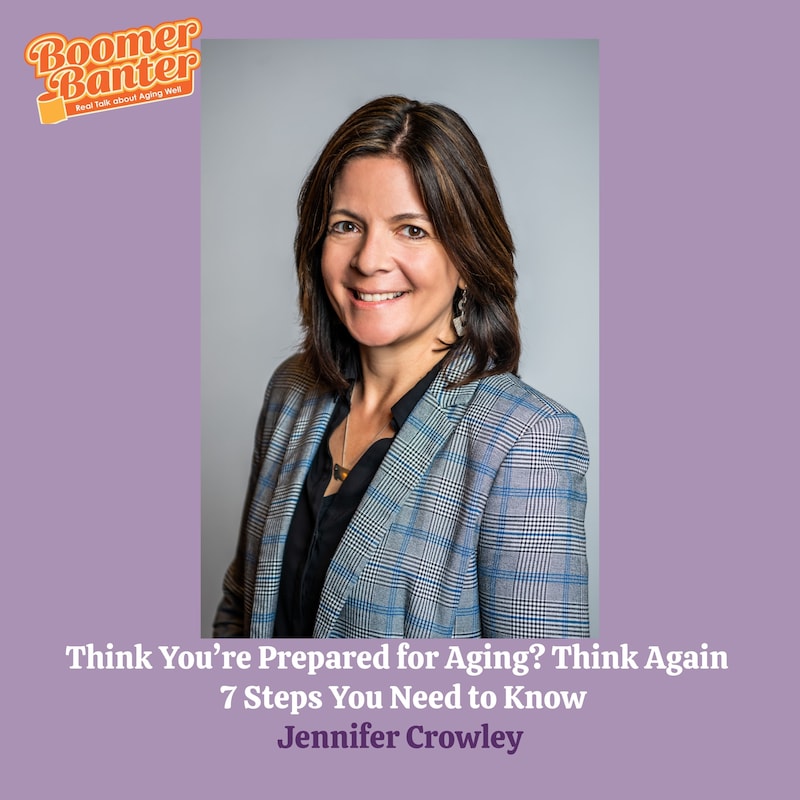
In this episode of Boomer Banter, I talk with registered nurse and life care expert Jennifer Crowley about what really happens when aging becomes real—when you’re making decisions for a parent, managing your own future, or trying to do both at the same time.
Jennifer shares her practical and compassionate 7-step framework for aging well, helping families navigate caregiving, housing, finances, and the emotional weight that comes with it.
If you’ve ever felt overwhelmed, unsure where to start, or worried about making the right decisions, this conversation will give you clarity—and a place to begin.
💡 In this episode:
- Why families often wait until a crisis
- The emotional toll of care-giving
- What “being prepared” really means
- How to start important conversations
- The 7 steps to aging well
Links referenced in this episode:
- Jennifer Crowley's website: Life Care Experts
- Life Care Management Institute
Transcripts
Hello and welcome to Boomer Banter, where we have real talk about aging well. And every week we talk about the challenges, the changes and the possibilities that come with this season of YOUR life. I am your host, Wendy Green.
And as most of you know, I am 72 and my mother is almost 96. And here's what I'm learning, and I have not learned it completely, but here's what I'm learning.
Even when you think you've planned for aging and even when you've had some of the conversations, even when you're experiencing it firsthand, like I'm doing now, there are still moments when reality catches you off guard. Because aging isn't one conversation. It's not one decision. It's a series of transitions. And we all know that.
And those transitions each bring new questions that you didn't even know to ask. Things like, when do the car keys need to come away? How do we handle medication management when memory starts to get fuzzy?
What happens when the house your parents have lived in for 40 years doesn't work anymore? Who coordinates all of this when you are also navigating your own aging at the same time?
I know some of you listening are right here with me, managing your own health while trying to support your aging parents. And some of you are thinking about your own future, knowing you need a plan, but you're not sure where to start.
So today we're going to have a conversation about how to manage aging intentionally. Not just the financial planning, but the whole picture, because my guest works with families every day who are trying to navigate this.
And she's going to share what actually works when you're in the middle of it. This is a conversation about love and fear and the gap between knowing we should be doing something and actually doing it.
My guest today is Jennifer Crowley, and Jennifer knows what happens in that gap. She has been a registered nurse for 32 years. She started Life Care Experts in her living room over 20 years ago.
Care management Institute in: Wendy Green:I think that would be amazing to align shared values. Anyway, now she's getting so many calls from families in crisis that she can barely keep up.
But here's what I want you to know about the work that Jennifer does.
When families call her, they're usually at the end of Their rope, exhausted, second guessing everything, maybe overwhelmed by medical decisions and family dynamics and the weight of trying to do right by someone they love. So let's welcome Jennifer to Boomer Banter. Thank you for joining us.
Jennifer Crowley:Thank you. It's so great to be here and.
Wendy Green:There is so much to talk about. I just, I. Yeah. So I want to start with something that you wrote on LinkedIn that really stuck with me.
And you said when someone comes to you for care guidance, it's rarely because the situation is simple.
It's usually because they're carrying a lot and they need a place where they can talk through the situation openly with no judgment, no pressure, just clarity. So would you tell us about that? What are people carrying when they finally reach out to you?
Jennifer Crowley:Oh, so much. A lifetime, A lot of it. But obviously what's happening with them in the current space they're in. But there's so many layers to most of it.
Wendy Green:Yeah. So, I mean, can you give me an example of some of the kind of panic calls that you get?
Jennifer Crowley:Yeah, I mean there's most the time what it is, is and you know, an unintentional pathway that someone's put on without having the tools to, to kind of give them the guidance they need.
And so it ranges from anywhere from I need help in the home right away because I have this going on in my own life and I can't be this care person right now in the way that I want. Right. That sounds like more logical that someone might call exactly with that.
But typically it's more of a, a statement that's blurry for them and I help unravel that to really kind of find what the real priority is and, and what the issue is at that moment, trying to kind of dial back where their worry is. Sometimes it's about bringing them down from the ceiling and trying to climb up and climb on top of things and direction.
Wendy Green:So there's a big cost emotionally. Right. When you wait until that crisis hits before you reach out to ask for help.
So why do you think people, you know, they wait so long, they pretend everything's fine or they want to try and hold it all together? Why do you think people do that before they ask for help?
Jennifer Crowley:It's no one's fault. It's really just kind of where we are in society of having this be really kind of a unique new experience for most of us.
So the generation that's probably the, you know, our elders right now in, in the, in the nation are in their 80s, maybe 70s, late 80s, and then we see longevity, people living to well past the century mark. Right. And.
But this hasn't always been the case, and we haven't had the number of individuals, also the transparency and availability of the conversation to be normalized. And so a lot of individuals haven't been given the opportunity, and there's just an unawareness.
Wendy Green:Yeah. I think, you know, that takes it into this realm of we never had a role model for dealing with a parent in their 80s, 90s, hundreds, and.
Jennifer Crowley:Correct.
Wendy Green:You know, I think some of us from this generation, you know, we were so independent. Right. We're like, well, I can handle this on myself, and. And there shouldn't be any shouldn't. Shouldn't is not the right word.
But we need to overcome that guilt of I'm failing if I reach out.
Jennifer Crowley:Correct. Yeah. This is not. It shouldn't be a journey that's solo.
And I think that we have to give a lot of credit to our oldest generation in America and the innovations they have provided for all of us to. You know, the Internet, cell phones, they've been a part of all of that rapid technology and the.
And the, you know, accumulation of wealth because of opportunities that came to them.
But they were never really led to believe that aging was something that they could be intentional about and that they could really be strategic and almost treat it as a business, because it's almost becomes the most important part of your life as you look at the legacy of your life and, And. And. And how you want the last part of your journey here on Earth to be.
Wendy Green:Yeah. And I think maybe some of it has to do with our own internal ageism.
You know, like none of us imagined ourselves as old or needing help or feeble or any of that. So we just kind of keep pushing it down the road, trying to ignore that that's happening.
Jennifer Crowley:Right. And the mindset that it has. I have to be the one to take care of myself and. Right.
The fortitude and independence and frugality oftentimes in that of just being. I'm the one that take care of myself and just me.
You know, we need to kind of change the paradigm to be more of the village concept of how we age together on a continuum.
Wendy Green:Yeah. So I know these conversations are hard.
My parents did a pretty good job of talking to us about their last wishes and, you know, having a will and all of that.
But, you know, I. I know people in my family don't want to talk about it, and I think part of it is the grief, you know, not just the grief that Our parents are aging, but that we're aging too. And so we see our, you see like a mirror, you know, going, oh gosh, that's where I'm headed.
So I, I, I'm excited to talk about your seven step plan that hopefully will help our listeners have these, these thoughtful conversations, these intentional conversations with themselves and with their parents. But before we dig in, I want to have you talk about how you came up with this plan.
Jennifer Crowley:Okay, thank you.
The seven steps to Long Term Care planning was really brought to life out of a need that I saw in the community a long, long time ago when I was working in the bedside as an intensive care nurse. And you know, it was in that journey of helping families.
And nurses really are doing a lot at the bedside, but they're really have profound impact with taking care of the whole family structure, the individual helping to look at the larger, you know, the broader scope of things.
What we realized is that families were coming in very unprepared to respond kind of in a way that was a little bit more peaceful, you know, to what was happening, even though they may have already they knew that this condition existed. But no one really had taken the time to really consider all of the factors. But then it wasn't really their fault.
Like I had mentioned earlier here, it wasn't their fault. It's just no one had really discussed those long term needs with them and looked at it from a very strategic perspective of that holistic life care.
So anyway, what I did is I decided to use my life care planning background and just basically kind of provide a simple framework for someone to get started and having these very personal and value based, personal value based decisions, these conversations that need to happen take time.
Even if I were professional and hired to show up at someone's house, which I am regularly, the conversations can quickly turn into many hours because there is so much right, there's so much to discover and so much that can be strengthened. And so we having a framework helps kind of guide the conversation and kind of come back to a place where we can kind of be more effective.
But also I just wanted it to be a tool that anyone can use. Whether you're a caregiver or a solo ager planning for your aging journey.
The caregivers benefit by looking at it, looking at this perspective for their own needs and just understanding what it would look like and what they would want. Like that mirror that you're suggesting that we all need to have a look see of, of that situation becoming familiar.
Wendy Green:And it's so holistic Jennifer. These seven steps, because, you know, most of what we see are the financial plans.
You know, you need to think about, do you want to leave an inheritance, do you want to have enough for long term care? You know, these kinds of things. This is so holistic about the person and the people in the family.
So tell me the acronym and then we'll break down each one of them.
Jennifer Crowley:Right.
And my whole concept in, in preparing this seven steps was to be again, a simple guide to give people the power, give empowerment to individuals to go through this. I really want it to be informed decision making. But how do we know? How do we get informed about this process? Right?
And we don't want it to be overwhelming. What I saw was there was a lot of information out there in books, but they were so full. And so it didn't really.
It was overwhelming before you even picked it up.
So I took the mnemonic you decide and broke it down into the seven steps and something that is a starting place for anyone to grab and, and get going in these conversations, which then leads to strategic and practical outcomes in the hopes that we can take those steps.
Wendy Green:Okay, so the U is, is the letter U U. And then decide. So the letter U is for understand what you need. Well, how do we even get started on that?
You know, like I said, all we've been told to plan for is we need money so that we can live till the end of our life comfortably. What else do we need?
Jennifer Crowley:It's really a lot, you know, when, and I think about, you know, someone that's come to me with no idea what they need. It's really about trying to slow everything down because they're. When people are overwhelmed, their brain is in survival mode.
So I start with very simple grounding questions of what's keeping you up at night? What's happening daily that feels unsustainable?
What's one thing that would make tomorrow easier, but then also just what's on your mind and in your heart as the most pressing concern for you right now. But what we want to have is clarity. And clarity is really the, the first form of relief to be able to just get going.
You know, suddenly we can see, you know, one, we can see patterns emerge once they answer the questions of what's keeping you out up at night. We start to see, oh, this is actually about safety. What's happening daily that feels unsustainable? Oh, this is about caregiver burnout.
You know, if, if one thing that would make tomorrow easier is revealed, this might be more about medical complexity that no one is coordinating.
Wendy Green:That makes sense. That makes sense because now what you're talking about, you can look at from your own personal point of view.
You know, if I'm aging in place, like you said, a solo ager, what are the safety things I need to think about that I haven't? And if you're having your mom live with you like I am, you know, what are the concerns and how do I take care of myself? Yeah, good.
That's understanding what you need. Okay, so the next one is the just develop goals and discuss legal documents.
Okay, So I think, I hope we all know we need legal documents, although I understand that a lot of people procrastinate around that. But what do you mean by goals? How do you help people articulate what actually matters to them as they age?
Jennifer Crowley:Right. And goals really are the human side of planning, where legal documents are the structural side.
So when I ask someone about goals, I'm really asking them to kind of understand what matters most to them. What can we break down the need to something more specific? And what. What do you want your daily life to feel like? What are you afraid of?
What do you want to avoid at all costs? And then we might hear responses like, excuse me, I want to stay in my home as long as possible.
In which case we though, if someone says, I want to stay in my own home, then we need a strong power of attorney or a healthcare surrogate, maybe a trust. We also need clear instructions for who can hire, help, pay bills, and make decisions.
So goals tell us what legal authority needs to be in place so those wishes can actually happen. But let's be clear, because we talked about how holistic this process is. And when we talk about goals, we may.
Goals are what you want to achieve, right? What's my end goal of this? I think we all begin to realize we want the same thing, but there's a lot to do that same thing.
So the same thing, what is that? We all want a quality of life and to feel like we belong and to not be a burden to others.
We want to enjoy what time we have, and we want to spend more time maybe doing the things we enjoy and spending the time with those that we care about. And so that might be easier in a way than some of the other aspects of planning for the aging journey.
For example, how to make the home safer and more functional for an individual and for the caregiver, regardless of whether the person in the home is maybe using a walker already or maybe having a more difficult time using Stairs. There's all these little steps that, you know, get overwhelming for anyone when they start to look at it.
And so we want to give them a tool that helps them really kind of just treat it like a business, too, in a way.
And I know that sounds like not as caring, but sometimes we need the permission to be really detailed in the way we plan out our daily care needs and our routine care needs and how things go on from day to day. So goal setting becomes part of that. But the legal documents inherently become part of.
Of setting goals because we understand that individuals either are lacking and having the legal documents that are recommended for the aging journey, or they need to bring those out again and make sure they review them and that everything seems the same. And then also, don't forget, we also need to talk to those that we've already given authority to make decisions on our behalf.
They need to be given the grace to know a little bit about what it is they might need to step in and manage or what the wishes are. So they really need to be a part of this conversation.
Going back to, we need to kind of broaden our, you know, unique individualism to include others that we designate as part of our village.
Wendy Green:So this brings up two thoughts for me as you're going through all of that.
One is, if you're a solo ager, meaning then not only do you not have a partner, but you probably don't have children that are going to step in and help and trying to find friends or maybe a nephew or a niece that would help. I mean, that's a much bigger decision, a bigger conversation, don't you think?
Jennifer Crowley:It really is. It takes more time to be very careful because this is a. This is a lot of vulnerability that most of us have when we start exposing who we are and we.
What our needs are and what our fears are, but also then entrusting others with, you know, being able to make decisions, our life choices.
Wendy Green:Right.
Jennifer Crowley:And so it does take time and really hoping that the connections stay strong. Just another reason why our connections to those in our lives becomes really important.
Not only, you know, middle age, but into the whole lifetime of, of how we stay connected to those that we trust and those who have our backs. If we don't have that, then an individual will typically try to find a professional that can fill that space.
Wendy Green:Yeah. And as you're talking, I'm thinking about my situation, you know, with my mom here. And I have to think about this.
I have to talk to somebody because my goal would be to have her here until her end of life, if that's possible. So right now, she's in pretty good health. But I need to think about what might happen and what help I might need.
Jennifer Crowley:Absolutely.
Wendy Green:Yeah. So we'll talk afterwards. Okay. So step three, the it's you for understand d for the goal.
Develop goals and legal documents, and then three, is evaluate the e. What you want. Evaluate what you want. So I guess is where the rubber meets the road, the gap between what someone wants and what's actually realistic.
So do you have some examples of, like, is that me saying I want to hear it? Maybe that's not realistic?
Jennifer Crowley:Well, this is definitely where honesty and compassion meet. Right. I did work with a gentleman once who insisted he could live alone, and he was falling weekly and forgetting to turn off the stove.
He had already flooded his apartment once. His desire for independence was real, but so were all the risk. Right. So we walked through kind of what independence actually meant to him.
And it turned out he didn't really need to really want to live alone. He just wanted to feel in control. He was also struggling with just kind of where he was in life.
So once we reframed the conversation and he agreed to bring in support, it's really about allowing the individual and their family, if there's family and the care. Caregivers really, to come together and kind of hash these details out and talk about these vulnerable moments. Right.
We lay it on the table a little bit so that we can, you know, kind of get through it, because these are hard things, and we just don't. We. We don't want to wait until it's too late, you know, and it's incredibly common to. To wait. And it's incredibly common to see, you know, where.
And someone wants one thing and the family wants another.
Wendy Green:Right. And that's a big one. Right?
Jennifer Crowley:So how do we translate it to both sides so that we can, you know, so, like, mom wants to stay home. The kids are terrified she'll fall.
Wendy Green:Right? The.
Jennifer Crowley:You know, that to the family, your fear is valid, you know, but let's look at what's actually happening, and then you're. To the parent, you know, your autonomy matters, and here are ways to stay safe while honoring your wishes.
So we really need to look also for the third option, the one that no one has considered yet. You know, kind of play that game of, you know, what are the other. What are the other options?
Wendy Green:So. And so you're the calming voice, the voice that kind of relays different options and.
And hears what everybody's fears and Concerns are and wishes and tries to find a balance in there.
Jennifer Crowley:It's. Yeah, it's. It's really about that and really having that space to do that.
When are we actually taking the time to really talk about these very important issues? Because, you know, a child, the kids might be important to them is going to be different than what mom perceives as. As her issue. Right.
But we always want to start with autonomy. Adults don't lose the right to make decisions simply because they're older. And autonomy doesn't also, it doesn't mean ignoring risk.
So we talk openly about what risks are, what the consequences might be, what's, you know, what, how we can reduce risk.
It's a balancing act between dignity and safety, you know, and, and just basically also reminding the kids that, you know, mom has the right to make her own decisions and it might not look like the ones you want her to make, but I believe we can align to respect all of our wishes because they're all the same. We want mom to be safe and have the best life possible, and we want mom to here and be healthy.
You know, we want to be a part of her life and we want her to be part of ours. So how do we, you know, do that?
Wendy Green:But what happens when there's some cognitive decline and you might suddenly see, oh, a lot of money is suddenly coming out of her checking account or, you know, she is, like you said, leaving on the stove and, you know, she may not be as fully capable of having the conversation. You know, what happens then?
Jennifer Crowley:It's again, it's really. It's still a balancing act between dignity and safety and autonomy with decision making.
But if, if the individual lacks in capacity to understand their best interest, what's in their best interest, you know, then of course we want to lean more towards the care giver to be able to be.
Have the tools to be able to step in for them and work around those barriers that exist to like, resistance to care or an impaired judgment due to a cognitive impairment. But we also want to always start with, let's try to do supported decision making so we're not immediately just again, removing their decision making.
You know, we don't want to move. Right. Because of a diagnosis, they can't understand anything. You know, this is. We all want to try to.
Wendy Green:Yeah.
Jennifer Crowley:Bring it down to a level that we all understand. And this takes time. Yeah.
Wendy Green:And I think this step has got to be so hard because there's grieving involved, you know, of the parent that you once knew and letting go of the life that you had with them or the future that you imagined. And I, I imagine that makes this step very hard. Is that what you've experienced?
Jennifer Crowley:Yes. I mean, aging is full of micro griefs, Letting go of roles, routines, identities, and imagined futures. Life goes so fast. I mean, it really does.
When people resist change, too, it's rarely about the change itself. It's about the loss typically, like underneath it.
And that too requires a conversation of, hey, we know we have these tools to help with this grief, but awareness is part of it. Naming that grief is often the turning point. Right. Awareness, naming it. It's okay.
It doesn't make you less of a human to face these vulnerabilities head on. In fact, we need this more than ever to be real humans and the real human journey of, of, of a lifetime.
Wendy Green:Yeah. Okay, let's take a deep breath and move on. So, so you decide. So we're now on c. Consider accessibility.
And this, I believe, is about housing and living arrangements. Is that right?
Jennifer Crowley:Correct. Accessibility is really about, you know, whether your environment supports the life that you want to live.
So we look at proximity to medical care, transportation, not just grab bars and ramps. Right. We're not really picturing that necessarily, but that matters.
Accessibility matters in the home of whether or not you'll be able to navigate as normal aging sets in or health conditions make a normal aging a little bit more challenging or burdensome in the functional way we look at transportation. Like I mentioned, social connections, can your community support you to thrive in that space?
Also, emergency response, whether the home can adapt as the needs change, it's really the intersection of safety, independence, and quality of life.
And sometimes we try so hard to just stay like in, in the homes, just because that's what we know and, and, and that's what we feel like is probably the best place. And it, it can be great. Right? It's your nest.
But sometimes we do that to a detriment because we haven't really looked at the home of whether it's really serving us in this stage of our life.
Wendy Green:I think it's also a financial decision, you know, because you look at the cost of some of these continuing care communities, they're so expensive. So you think, well, you know, I've been in this home 30 years. It's paid for. This is where I should stay.
Jennifer Crowley:It is.
And, and sometimes, look, when you go through these seven steps, you realize while talking about one of them that there's these other factors that are later on in the seven steps that will, will connect to this because sometimes it really becomes more of a financially sustainable plan of where you will live.
And the upkeep of a home inside and out, the potential for isolation that sometimes comes from it is not that great for individuals who don't have those connections or access to the support that they need.
So again, that accessibility becomes that bigger term not about just being accessible for wheeled devices, but accessible in a way to access to the supports, the aging support.
Wendy Green:Yeah, that's a good point. Because once you stop driving, now you've got to get to the doctors or kids got to come see you and. Yeah, good point.
Okay, so now we're on the eye of you decide Step five Identify the unpaid caregiver. So I wasn't sure I totally understood this step.
Isn't it obvious who's doing the primary caregiving even if the person being cared for is in a facility?
Jennifer Crowley:Oh.
So the unpaid caregiver is typically a stage where we're looking at that informal village of who in your life could step in to provide the care if they're not already. And I think for you, you're already, you are that unpaid caregiver. Right.
And then, you know, and without me not knowing exact situation that you're in.
Wendy Green:Right.
Jennifer Crowley:We know that the caregivers today are typically the daughter who manages appointments. Maybe it might be a son who handles finances, maybe it's a neighbor who checks in daily.
You know, identifying the caregiver, that person is essential because they're carrying the emotional and the logistical load. And this can bring up sibling tension and you know, a lot of geography, old family dynamics, guilt and resentment. It all comes to the surface.
But it needs to, because if we're going to make this work and make it the best possible, this is, you know, we don't get a second chance typically to provide.
Wendy Green:Right.
Jennifer Crowley:You know, to, you know, to do this. So it is, it's an interesting area to look at it from a village, a perspective of the continuum of life that we maybe aren't really haven't.
Society really hasn't lent itself to like think of life like that. Like we think of a baby coming into the family and then kids going to college and then retirement. But something just kind of drops off after that.
Wendy Green:Right.
Jennifer Crowley:You know, you know, the village structure. And we see families living at great distance from each other.
Wendy Green:So I was going to ask about that. Right.
So how do you have a village if you're a long distance unpaid caregiver who's now incurring the expense of traveling to come and see and Trying to get eyes locally and. Yeah, yeah.
Jennifer Crowley:My advice is to really create a structured conversation about, you know, what does each person actually have the capacity for. And we can share this, but sometimes other siblings might need a love shove or opportunity to come to the table.
And that's where we also try to give encouragement. Again, opening that door to vulnerability of saying, hey, this is where I am in the journey.
Not being afraid that it's going to weaken you, because you talk about the aging journey as if it's the most important thing in your life. But again, what tasks can be outsourced, what boundaries need to be honored.
You know, when families stop arguing about fairness and start focusing on sustainability, everything shifts.
Wendy Green:And you manage these conversations is, you know, history of conflict between siblings or between even the caregiver and the parent. You know, they may have had a lot of conflict growing up. So you manage those conversations.
Jennifer Crowley:Try to, it's really once. So, you know, what do we, what do we try to do? We, we really want to provide validation.
Of course, that goes a long way because a lot of times individuals have not had a place to air these things out. They didn't know that they could.
And they don't even know what they're really in, the journey they're in until they start raising that awareness level. Right. And so validation of someone acknowledging how hard this is also real breaks, not just running errand breaks. This needs to be a part of it.
We don't. We have the statistics that show the toll that can be taken health wise on a, on a caregiver.
They have their own livelihoods to consider, their own aging journey to plan for. And then we also want to provide a roadmap, clarity about what's coming next so that everyone's on the same page.
And then how do we keep everyone on the same page? Right. And caregivers really are the backbone of the aging journey and they deserve support.
We need every, everybody to know that the care, the caregiving is just kind of almost a natural part of life now.
Wendy Green:Yeah, I'm, I'm sorry for the pause, but you're making me think so much here. Should we move on to step six, the finances?
Jennifer Crowley:Yeah, let's. Let's go for it. And I know it, it can be overwhelming. Remember that this is meant to kind of go at your own pace.
And sometimes individuals have to do it in little nuggets or chunks. And so that's, we tried to build a framework where we can kind of come back, you know, and keep working at these conversations.
Wendy Green:I mean, I can't imagine how intimately involved you have to get with the family to. To get them through these kinds of conversations. And it certainly is raising my awareness that I need to.
I need to be more intentional about this and bring my brother and sister into these conversations more, instead of just feeling like, I got this. I. I got this. I'm the oldest. I got this. Right. Well. Right.
Jennifer Crowley:I mean, caregivers sometimes don't even know they're drowning until they say it out loud or they're given the time to be like, you're right. I am doing a lot. And this is a lot for one person.
Wendy Green:Yeah. Yeah. All right, so let's talk about the finances. I mean, I. I kind of thought this was going to be where we would start with this.
But you're all the way down here to step six.
Jennifer Crowley:Where do we start? Yes. Transparency and safety. Right. About finances. So, you know, not everyone needs to know everything, but someone needs to know enough. Right.
And so when we talk about the legal documents with, you know, for aging, the recommended authority for decision making in case something happens to us, that all of us really, no matter what age we have, if we have certain assets or bills or things we own and owe, you know, we should have a power of attorney for handling our financial matters and Bill Payne and affairs. Right. Just as a backup means. But we often do that and fall short of actually including that person we've given authority to.
We've maybe missed out on them coming into the picture and at least having enough information so they can do their job and they understand what that job is. But finances really determine what's possible in aging, but they're also deeply personal.
So we like to look at what resources exist and what's protected, what's at risk and what future care might cost. And we don't need every detail on day one.
Again, the seven steps is to be a starting point, but we begin to expose the areas that can be strengthened. And finances are often an area of maybe misinformed individuals and their expectations of who will pay for help if mom or dad needs it.
And so we needed to know. We need to know enough details to plan responsibly. Yeah, sorry, go ahead.
Wendy Green:I was going to say, and a lot of times, you know, older adults don't really want to share that with their children, so they don't want you to know how much they have or what they've invested in. How do you get around that?
Jennifer Crowley:I reassure older adults that sharing information is not about losing control. It's really about preserving it and trying to, you know, ensure that legacy that you want to leave. And the.
Wendy Green:In the.
Jennifer Crowley:How do you, how do you want your last time here on earth to look like too? You know, we can be practical, we could be a little bit vulnerable. But, you know, again, this.
You see how this ties into who's your village and who do you trust, who's capable of doing this job, this role of being your power of attorney, who is going to be the one who can pay the bills for you if you can't, or file that claim for insurance or, you know, anything of that matter.
So like I said, it's just kind of saying this, not they don't need to know everything, but they need to know enough to be able to do their job, because I imagine that you don't want to leave them with a big problem, you know, and so we can set up things like limited access or clear roles, guardrails, safety bumpers, if the individual's having trouble currently managing their finances. So we give them an awareness of what options exist today to provide safety bumpers. How do we keep things documented?
How do we prevent, you know, how do we create a portfolio of sort for which that power of attorney for financial can operate, you know, if they needed to? Because if do you want them digging through your files and what do your files look like?
You know, and it's about safety, not surveillance really as much. But sometimes caregivers do provide surveillance for some.
A, A family member who might be struggling with memory or having initial, you know, indicators of a cognitive decline, struggling with some of the bookkeeping type aspects or taking care of the mail and filing it and the mail.
Wendy Green:And I'm thinking, you know, with technology now, email, the text messages, there's a lot of fraud.
And somehow, you know, if you could give access to your caregivers, your family member, whoever has that power of attorney, to watch for that and say, oh, mom, don't. Don't be giving them information because they're just going to try and take everything you have and that's not what you want.
Jennifer Crowley:Yeah, I think, you know, we want to start with also a simple inventory too. So what comes in, what goes out, what's saved, what's insured, you can't plan for what you can't see.
So if we know that we don't really have the funds to pay for any care as we grow old, then how do we come together as a village, the family structure, to meet those needs and plan for maybe the needs that we can't see that third Option I mentioned earlier, that third option that no one's really thought about.
Wendy Green:Yeah, yeah. So which brings us to your last step, where you now have done all this work and you're going to evaluate the paid services.
So you've set your goals, you understand what's realistic. Hopefully you've looked at your housing options, who's going to be what part of the village is going to be caregiving and finances.
So now can we talk about help? What kind of help we might bring in and what's reasonable for us?
Jennifer Crowley:Yes. This step is really where we match needs with the right level of support.
And, you know, families, I guess society too, lends itself to believe that we need to do this alone and that hiring help might be a sign of weakness. Right.
And we want to take this back to, well, we might hire out lawn care and it seems perfectly fine, or we hire a housekeeper, but we're not doing any.
You know, we're not thinking of hiring help to be a personal care assistant or companion and to carry out maybe a social health program is something that is going to be fruitful and that it should be normalized, you know, so paid service can be everything from home health aides to personal care aides and companions, aging life care professionals, therapists, life care planners. Really the goal is to build a sustainable care ecosystem, an ecosystem of care and support for really anything. And that's the thing, too.
We think of like, wow, aging and life care is really, it's everything. It could be taking care of the pets, could be taking care of the home, if that, and, you know, the environment inside and outside.
You know, there's car care and there's. Then there's the care of exercise and socialization and cognitive stimulation and then nutrition. So it just. A lot.
And it's okay to look at this as, you know, who, who in my community can support me in a way, and it helps me, you know, provide an opportunity for someone in their career. You have a community full of carers, and that's what they do for a living. So, you know, we just, again, it's a little bit of a paradigm shift.
And not everyone has the funds to pay for the care, or they might, but the funds might be kind of trapped in something that's hard to get to so that we don't have the means to pay for the care when the time comes anyway. You see how this kind of goes back to knowing what the financial picture looks like, at least so that we know what the budget is.
And what, what is the budget for help Hiring help, that would be so important as part of a caregiver respite.
Wendy Green:Right. And so, you know, you think immediately, oh, I need a home health aide.
Jennifer Crowley:Right.
Wendy Green:If you bring an elderly adult into your home, I need a home health aide. But when would I, if I hadn't met you, when would I think about, I need a professional care manager, someone like you.
Jennifer Crowley:Sure. It really becomes essential when there's, you know, medical complexity, family lives far away.
A care manager really becomes essential when there's a conflict or confusion situation is changing quickly or the caregiver is overwhelmed. So they can often be the bridge between the medical system, you know, the family and the day to day reality.
And also be often a liaison between the family and the care community that's on the professional side.
Wendy Green:Yeah. Okay. Because I'm thinking I need to talk to you more. And you know, it's overwhelming. It is.
When you start to break it down like this in the seven steps and all the things that we should think about, it's overwhelming. So what would you say to, to me and to people listening like, how do you kind of wrap your head around this and get started?
Jennifer Crowley:Well, I think you can start with one question too. What's the one thing that would make tomorrow easier? But you know, we need to look at it as the human journey that we're going through.
We're not talking about, you know, joking about the hamburger we've been craving, but, you know, it's more deeper than that.
But we begin with just trying to take the first step of awareness of, of, of all the, the key important factors in our life that really, really do translate to the personal values that we, we mostly all share. Right? Of wanting to be safe, cared for, be financially secure, have a good quality of life and dignity, sense of purpose. Right.
And aging well isn't really about perfection, it's really about direction. So every small step you take creates, you know, stability, clarity and peace of mind.
You know, it's, we, I think we're missing out too, where we realize that human psychological development, you know, continues through later stages and end of life. Studies have, you know, studies have found there to be risks of poor health due to loneliness, lack of stimulation and sedentary lifestyles.
So, you know, when you're looking at the village, one caregiver, one daughter or one neighbor is not necessarily going to be able to pull off what it is that we deserve and need as more vitality. I mean, you can hire help, you can look at things differently and how you help hire help too.
And how you onboard them and what things they're helping you to do. And this may include exercise and monitoring and tracking daily health measures like nutrition logs and sleep logs.
Providing a buddy system approach for cognitive and mental training activities and engagement in social health programming. Getting outside of yourself and connecting to your outside world and your passionate self.
Wendy Green:Yeah.
Jennifer Crowley:So it's simp. It's okay to simply have someone there too to just allow the caregiver to sleep and recharge.
But what to just empower individuals and families to have this share shift in our mindset of how we prepare and look at it as the whole person that we are.
And for those of us that you know, intersect with families all the time, we want to almost we will have the philosophy of leaving someone or if you're caregiver, you want to leave them better than what we found them. So in today's care climate.
Wendy Green:Wow. Yeah.
Jennifer Crowley:Is the caregiver given enough tools to feel less burden and managing all the logistics to be able to do these things that wholly are really what matter?
Because I think, you know, to me it makes sense that at the end of my life I would want to have reached my highest stage of psychological development. Feeling a sense of purpose and give.
You know, sharing my wisdom and that I've contributed to a life and a livelihood and I've, I've, I've created a legacy and whether it's small or big in an estate, it doesn't matter. Your legacy is how you went out. Right.
Wendy Green:Right.
Jennifer Crowley:How you, how you were the role model for others to.
Wendy Green:That's. That's beautiful. So is there. Right. Right age or stage to begin this kind of planning?
Jennifer Crowley:You know, it's. I get asked that quite a bit. I mean any. So who is today's caregivers is the question. Right.
Wendy Green:And then.
Jennifer Crowley:Or future caregiver. So it might be a 40 to 60 year old or like as you mentioned already and I can say this because you shared that information your age and Right.
It's any age one of us might have to step into caring for another individual but also be looking at our own life and what, what can I strengthen? So any age is a good age. But obviously you know, at least a 5 to 10 year head start is ideal.
If you wait to a crisis, until a crisis, you know, the options will shrink typically dramatically or we'll be trying to unravel and, and straighten the ship, you know, in a. Under duress, like under significant stress. So we can. Our brains do like what's familiar.
So the more we become Familiar with these concepts and strengthening the aging journey, you know, the hopes is that it becomes easier no matter what might shift, you know, unexpectedly.
And so, but yeah, you know, I came out of this thinking that I could get all retirees to kind of do a seven steps because I was seeing that we weren't really, you know, aging looking at this as a practical way to kind of really be intentional. But so, yeah, any, yeah, so it's, there's never a bad time, you know, just. Yeah.
Wendy Green:So let's talk about that. The brave first step. Right.
So people are listening to podcasts in their car, they're cleaning their house or taking a walk or whatever, and they're, they're going, oh my gosh, I need to do something. I'm, I'm ready. I'm going to do this. What's the very first thing you think they should do when this episode ends?
Jennifer Crowley:Well, I think again, understanding needs is the foundation for everything else.
So if you have a need right now, we want to go deeper on that of whether or not the big ones that I see that come up all the time, such as caregiver relief. People don't realize like they're drowning until they say it out loud. Decision making, support.
You know, families assume they must figure everything out alone. Future planning, busy. You're so busy putting out fires that they don't see the next fire coming or the system navigation.
They don't know what they don't know. And that's, you know, where we see the gaps happen.
So I don't know if that answers your question very well because I just gave more information to process.
Wendy Green:Right.
Jennifer Crowley:But the key is to just the.
Wendy Green:First step, take a step.
Jennifer Crowley:I, I, so I've developed this so my programming so that you can do it in chunks. So, you know, this is designed, it's actually a fairly simple book with a lot of complex conversations.
Wendy Green:Yeah.
Jennifer Crowley:Provided. But they're not complex in the way that it's not achievable.
So I mean, just sitting down and taking the time to take just the first step, understanding the needs is really profound. Right. And so we all have a need to stay healthy. We want to reduce risk of brain disease. We want to thrive, not be a burden.
So I mean, sometimes if you have no health conditions, you see, well, I won't need anything. I'm healthy now. There's always something that we can work on to improve or strengthen, I guess is more it.
We want to not necessarily change everyone, but we want to strengthen what we can. But knowing this takes time. So I tell families a lot of times, schedule the meeting where we can all sit down and go through this together.
Or you can have guided, of course, conversation around these steps. And it's really being intentional about it. Set the date, set the time. Hey, mom and dad.
I'm working on my own aging journey because some things I want to make sure I set up okay now rather than later. I was hoping that you would go through this with me so that we can make sure that we're all on the same page.
Or I can align with what you feel is important to you. And the hopes is that through that everybody benefits, you know?
Wendy Green:Yeah.
Jennifer Crowley:How much work we put into certain aspects of the seven steps will vary depending on the individual. And everyone is so different, right? As a human.
Wendy Green:Yeah, but.
Jennifer Crowley:But a lot like you said, a lot of our values are the same when it comes to aging.
Wendy Green:So there's so much that you've shared. I think people are going to have to listen to this episode a few times and we're going to share how they can find all of your resources.
But what I'm hearing as I'm listening to this, Jennifer, is that then the other side of fear, on the other side of these hard conversations, that hope is possible, peace is possible, comfort is possible, but not perfection. Like, no guarantee. It's not going to be easy. We all know that. But.
But knowing that you showed up and you did the work and you honored the people you love, including yourself enough to plan, I mean, that's. That's a good movement in the right direction, I would say.
Jennifer Crowley:Yeah, we can just do the best we can and, you know, and set the stage. And then the hopes is that you have peace of mind because you just need some clarity. I mean, clarity goes a long way.
It's the first, like I said, the first form of relief, permission to ask for help and realize that this is hard and let's do this together. Aging is. It shouldn't be a solo journey, you know, whether or not you have next to kin or not, it's. It doesn't need to be.
You deserve to have the support and kind of have this brought to you so that you can change the mindset to be wholly supported and. And feel not alone in this journey and then just be able to break this, you know, into manageable pieces.
Wendy Green:Yeah. So let me tell people where they can meet you. So your website is the life care experts.com and you are in Montana, is that right?
Jennifer Crowley:Correct. Yes.
Wendy Green:Okay. So I'm in South Carolina. If I wanted to Continue this conversation with you. Could I work with you being out of state?
Jennifer Crowley:Yeah, absolutely.
So we do caregiver consultations or family solo aging consultations, and we help walk through this together, trying to give them some guidance and navigation. And so the Life Care Management Institute.
Wendy Green:Has an also an online course, Life Care Management Instant.
Jennifer Crowley:You know, your listeners can reach me at my website, thelifecare experts.com or feel free to even email me at jenniferthelifecarexperts.com I'm very open. I want to help people kind of get started in this. And I, and you might, I'd like to see them go the full, the full distance of having their own plan.
But we, we know that we oftentimes see that we just need to get going. Right.
Wendy Green:Yeah.
Jennifer Crowley:Start to start understanding those needs and then. And the rest will follow.
Wendy Green:Yeah. So I'm going to include both of these links in the show notes.
So your website is the life care experts.com and then the Life Care Management Institute, which is where the, all of these courses are in the books and things. Right. That's LCM expert dot com. So both of those will be in the show notes. And as Jennifer said, you could also reach out to her through email.
That's very kind of you.
So thank you so much for building this work from your living room because families need you and for being the steady voice in the chaos, you know, for showing up for these hard conversations. It got to take a toll on you, too, I would think.
Jennifer Crowley:Thank you. It's really, you know, I'm really grateful for all the individuals I've been able to, to help.
And it's, it's through helping so many that I realized the gaps that do exist still today and the mindset, you know, that we, we have that just comes from, you know, where we are in society. This is a new, a new era of aging differently and, you know, a great, a great journey for all of us.
If we can adopt these, this paradigm shift that we need for preparedness and intentional planning, I think we could do.
Wendy Green:A whole other episode because there's so much here. But Jennifer, this has been wonderful. I appreciate you. Thank you, listeners.
I hope there's a lot you took away from this and just start one simple step. Just start with either understanding your needs or setting goals or the financial aspects. Just start somewhere.
It's, you don't have to do the seven steps in order. Right. It's just that's the way you design them for the acronym.
Jennifer Crowley:Right? Yeah. And some families might move to a different step because the conversation will lead itself and then they can return back.
Wendy Green:Yeah.
Jennifer Crowley:It's designed to be self, self guided, but you can have professional guidance, too.
Wendy Green:Okay. Well, thank you. Thank you listeners.
Jennifer Crowley:Thank you.
Wendy Green:We will have another new amazing topic next week. But Jennifer, you've been a fabulous guest. I really appreciate all your wisdom and kind, caring. Thank you. Sa.



