Shownotes
Episode #53 Season 25: Shaun Boyce & Justin Yeo
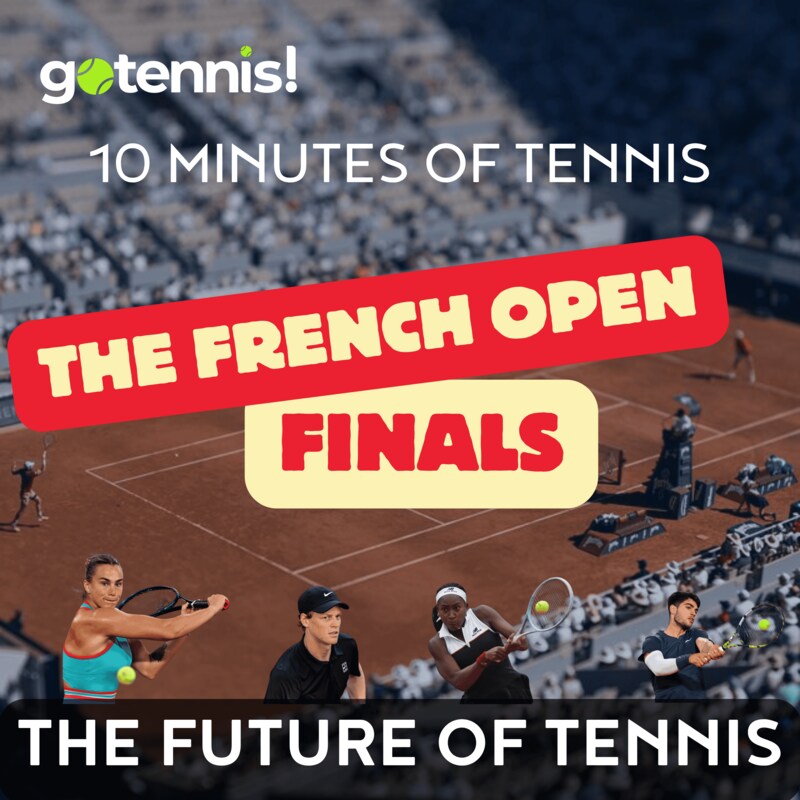
On this episode of 10 Minutes of Tennis, Shaun talks to world renowned tennis coach, Australian in Puerto Rico, Justin Yeo, about the French Open Finals and what it can tell us about the future of tennis.
For more 10 Minutes of Tennis episodes: https://www.youtube.com/playlist?list=PLKLIP3Zrp28TLg1nCs4E-2PzkRcjyePEM
Be Our Next Guest
You can also share your actionable insights. If you are a racket sports coach, club manager, technology expert, industry insider, athlete, or just a tennis enthusiast who has some interesting tennis stories to share, we’re welcoming you! Maybe you have actionable tennis tips for beginners or pickleball tips for advanced players. You could be on one of the best tennis podcasts online. It's possible you have tennis news, pickleball news, or want to share a tennis product or pickleball paddle with our audience. You can visit https://americanracketsportsassociation.com/ and complete the podcast guest form.
Shaun Boyce USPTA: shaun@tennisforchildren.com
https://tennisforchildren.com/
Justin Yeo: https://www.instagram.com/yeocoach/
Bobby Schindler USPTA: schindlerb@comcast.net
https://windermerecommunity.net/
Geovanna Boyce: geovy@regeovinate.com
This podcast is powered by GoTennis! Atlanta: Membership has its privileges
https://letsgotennis.com/join/
https://shop.letsgotennis.com/
https://letsgotennis.com/podcast/
https://www.facebook.com/gotennisatlanta
https://www.instagram.com/gotennisatlanta/
https://www.youtube.com/@gotennispodcast
Do you want to read about some good things going on in the world of tennis?
https://letsgotennis.com/stories/
Check out our GoTennis! Atlanta Facebook page for deals, updates, events, podcasts, news, stories, coach profiles, club information, and more
https://bit.ly/gt_facebook_page
Also, you can support this show (and save some $) by shopping at
https://letsgotennis.com/deals/
Or, donate directly HERE
Want to get into crypto? This is easy: https://www.coinbase.com/join/boyce_3s?src=ios-link
Want donate with Bitcoin? Here's the address: 3EqTU1gQBLoieMeFLC1BQgCUajPpPMCgwB
Considering your own podcast? We (obviously) recommend Captivate: This podcast is hosted by Captivate, try it yourself for free.
Transcripts
Hey, hey, this is Shaun with the GoTennis Podcast powered by Signature Tennis.
Speaker:While you're here, please hit that follow button.
Speaker:And after you listen, please share with your friends and teammates.
Speaker:Also, let us know if you have questions or topics you'd like us to discuss and we'll
Speaker:add them to our schedule.
Speaker:With that said, let's get started with 10 minutes of tennis.
Speaker:Hey, hey, this is Shaun with the GoTennis Podcast powered by Signature Tennis.
Speaker:Check out our calendar of Metro Atlanta tennis events at Let's GoTennis.com.
Speaker:And today is 10 minutes of tennis with World Rennown tennis coach Australian in Puerto Rico
Speaker:Justin Yeo.
Speaker:And we are going to talk about what I am calling the rise of the Gen Z era in tennis.
Speaker:Looking at the finals of the French Open, 2025, all of them were born after 2000.
Speaker:Does this make them young or are they all...
Speaker:Oh, we're definitely old mate.
Speaker:No, I mean, that's good science.
Speaker:The maturing all well and that I remember training Destiny Aver and where else did I train
Speaker:in the 2000s?
Speaker:Jamie Foulis, they were great, great players coming through that I think are all maturing
Speaker:right now.
Speaker:So what we're probably going to see, a big wave of them coming through at this age, more
Speaker:than you would see a teenager.
Speaker:Teenagers are going to be, which are the later past 2000, but 2000, we're going to see
Speaker:a lot, a big wave of those because they're all in that maturity bracket right now for tennis
Speaker:plays.
Speaker:I like the phrase maturity bracket.
Speaker:And I was doing some research trying to figure out are we having more younger players than
Speaker:we used to and then every time I see one of those packages that they put out during the
Speaker:majors and they've got the teenage, Chrissy Everett and the young Bjorn Borg and the young
Speaker:Boris Becker and Michael Chang and all these players that were young and we see a lot of
Speaker:the teenagers coming up and Rafa starting to win at 19.
Speaker:It isn't necessarily new with the young players, but for some reason it feels different.
Speaker:What's going on here where we've got Coco Gauff at 21, we've got Alcaraz, 22, Sinner 23
Speaker:and Sabalenka 27?
Speaker:Well, I mean, we've talked about this in our previous podcasts is that a player needs to be
Speaker:way more mature and mature in so many different avenues.
Speaker:The eyes, the adult eye doesn't mature to the age of 25, which we all know that.
Speaker:Some mature a bit earlier, some don't.
Speaker:But does that mean those names you just mentioned, they've probably got even better tennis ahead
Speaker:if they continue to grow perception wise out of the eyes and get faster and faster.
Speaker:The other thing that we have to realize is they've also had their eyes pretty strange till
Speaker:now too because of the sun and the air and everything we put pressure on ourselves with no glasses.
Speaker:So, yeah, I think just what we're seeing the most of is that when we talk about the five
Speaker:areas, emotional, physical, technical, tactical, mental, we look at all those areas, you've
Speaker:got to be pretty elite at all of those to be the complete package these days.
Speaker:And the other element is that being saying this for quite some time, probably my almost
Speaker:30, 40 years of development teaching tennis is that you've got to be good at every area
Speaker:of the game.
Speaker:You've got to be able to use the different grips and learn how to get yourself out of trouble
Speaker:and I mean, the proof and the pudding right now, you've got to have incredible defense
Speaker:skills because that was what to me was the difference between Alcharez and Senna.
Speaker:Is Senna's really going to work on these defense skills?
Speaker:Yeah, and I think Senna's defense is definitely better and you and I have this conversation often.
Speaker:I think it's Senna's ability to finish a point that is the big difference where Alcharez
Speaker:can come forward and especially later in the match, his ballies got better.
Speaker:I don't think Senna had that same issue.
Speaker:But when we look at the resilience of these players and the maturity, and I think that's
Speaker:one of the things you mentioned earlier just now about the defensive play.
Speaker:If you look at Giff and how good she was defensively, I think that women's match was terrible.
Speaker:Personally, I didn't enjoy watching it.
Speaker:I think it was bad tennis.
Speaker:I think they were both struggling to play well.
Speaker:They both complained about the win.
Speaker:Like I get it.
Speaker:Sometimes neither of us have a good day and somebody's got a win and I get that where it
Speaker:looks like both the men seem to have a good day on Sunday.
Speaker:But that resilience that's there and the maturity is that maybe the difference of having a better
Speaker:team, having those around you, we're back in the day.
Speaker:It was just, hey, look how good this 17-year-old is and there wasn't that whole group of people
Speaker:supporting you.
Speaker:Wow.
Speaker:I mean, what a loaded question.
Speaker:I mean, at the end of the day, if we look back, we saw a lot of replays of Chris Heffett
Speaker:and some of these plays, Boris Becker, some of these guys that were playing, you're professionals.
Speaker:You're out there getting not just a lot of money, but you're playing for something big and
Speaker:you need to handle yourself.
Speaker:So that's what I would say the difference between the Saturday and the Sunday was that you
Speaker:got to get your emotions intact and stop playing the game.
Speaker:I mean, you're also an example and representation of other young athletes watching on the TV and
Speaker:it doesn't make it look good that if you're a 16-year-old out there, you know, we're called
Speaker:it in Australia, spitting the dummy and you smash a racket or you carry on and you go,
Speaker:well, look what the ladies did in the final.
Speaker:Like, you know, I mean, the wind has always been there.
Speaker:The sun is always there and the pressure is always there.
Speaker:So I mean, it does show how much was on the line and how much they felt and how much they
Speaker:let it out, I guess.
Speaker:But at the end of the day, you were professionals as far as I'm concerned.
Speaker:You compared the two Saturday and Sunday, they talked about the wind on Sunday and the only
Speaker:thing that I think we need to bring up in a podcast and make people understand a little bit
Speaker:more about because I wish they had have commentated that on Sunday is that every time there was
Speaker:a momentum change, was a ball change with center and nobody talked about it.
Speaker:And if you look at every seventh and ninth game and the next two, three games, there was a
Speaker:huge momentum change.
Speaker:Center was pounding the ball a little bit further.
Speaker:The wind has started happening.
Speaker:Less drop shots started happening because Alcose couldn't get the feel and the grip on the
Speaker:ball.
Speaker:Less variety was happening.
Speaker:It was just totally different ball game.
Speaker:If center had a serve well first served, this would have been all over earlier if you had
Speaker:just served well.
Speaker:I mean, that was at the end of the day to me.
Speaker:What he missed the most is the first serve.
Speaker:I think you both agreed that if it went five, it favored Alcaraz for a few different reasons.
Speaker:And I want to make a point Alcaraz has a quote about center.
Speaker:It is, it's a privilege to share the court with you.
Speaker:And I think that's, it shows some of that maturity.
Speaker:Absolutely.
Speaker:And those situations and be able to understand that.
Speaker:And that's a lot for somebody young in their 20s.
Speaker:When we look at other sports and we look at how people are handling it or not having a good
Speaker:ability to handle it, to be able to watch that is really a great thing because they're seeing
Speaker:the example that Rafa and Roger brought.
Speaker:Not out there smashing rackets and they were setting a good example for our children.
Speaker:And my wife looks up on the television and sees our two and a half year old notice that
Speaker:somebody's smashing a racket.
Speaker:We know that makes a difference and we know anti-rotic currently is out promoting the sport.
Speaker:And we're trying to do the same thing.
Speaker:Let's get more people to understand how great tennis is.
Speaker:And if they're not smashing rackets and complaining and having bad press conferences, I think
Speaker:that helps.
Speaker:Yeah, I think if you bring up the 2000s and some maturity, if there was something that's
Speaker:probably different now than what it was, is you never would have seen, you know, sort of,
Speaker:well, federated and a dialed Jocovic, you know, they were the era.
Speaker:But the era before that, you know, Agassi and he wrote all of the players that we can think
Speaker:of before.
Speaker:I don't think they would have spent most of their speech humbly appreciating their opponent
Speaker:and their opponent's team and spend a lot of time talking about their opponents and versus
Speaker:themselves and how much they deserve the pad on the back and how much they're going to
Speaker:keep kicking us.
Speaker:I mean, I think it's got a little soft in that way, but on the other hand, you know, it's
Speaker:a new age.
Speaker:It's a different way of people speaking, you know, coaching on the court.
Speaker:If I don't talk positive to the kid and try to give him a little bit of a, you know, tap
Speaker:on the bum instead of a whack on the head, they just don't work the same.
Speaker:So we're seeing a different dialogue, different narrative, different everything and I don't
Speaker:know, I think interesting times, you know, when we talk about men and women even in our
Speaker:normal worlds these days, I think in the next 10 years, we might see a bit of a mix, you
Speaker:know, I like sometimes when I hear Roon speak and he just says, I'm just, I'm a killer and
Speaker:I just want to keep going and I'm going to be the best.
Speaker:And I'm like, that's competitively what you want as a player, you know?
Speaker:And I think probably the one thing I like the most about the open and I hate to say this,
Speaker:that the pain on sinner's face afterwards, even in his speech and then even in his interview
Speaker:afterwards, that pain is Darren K. Hull going to eat that alive and just make him be the
Speaker:work that all the other things that he needs in his game, he's going to use that pain to
Speaker:grow his game.
Speaker:And so Senator Meers, so many years more of development coming ahead.
Speaker:That's it.
Speaker:New title.
Speaker:Use your pain.
Speaker:I like it.
Speaker:We are out of time.
Speaker:Thank you sir.
Speaker:This has been 10 minutes of tennis with Justin Yo.
Speaker:I appreciate your time.
Speaker:We'll see you next week.
Speaker:Thanks.
Speaker:Cheers, man.
Speaker:Well, there you have it.
Speaker:We want to thank reGeovinate.com for use of the studio and signature tennis for their support.
Speaker:And be sure to give us a review in your podcast app.
Speaker:We can't give you a direct link, but I'm sure you can find it.
Speaker:For more Racket Sports content, you can go to LetsGoTennis.com.
Speaker:And while you're there, check out our calendar of events, great deals on Racket Sports products,
Speaker:apparel, and more.
Speaker:If you're a coach, director of any Racket Sports, or just someone who wants to utilize our
Speaker:online shop, contact us about setting up your own shop collection to offer your branded
Speaker:merchandise to the Atlanta Racket Sports World.
Speaker:And with that, we're out.
Speaker:See you next time.
Speaker:[MUSIC PLAYING]
Speaker:[MUSIC PLAYING]
Speaker:[MUSIC PLAYING]
Speaker:(upbeat music)
Speaker:[Music]






