Shownotes
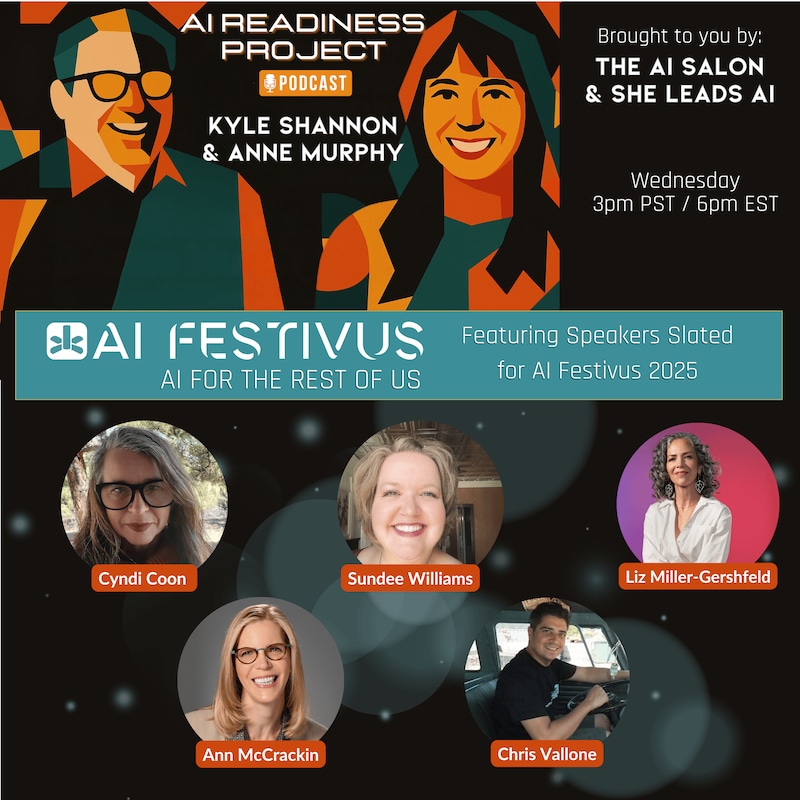
In this special AI Festivus 2025 spotlight episode, Anne and Kyle sit down with five standout voices set to speak at this year’s AI Festivus gathering on December 26–27. Each guest brings a unique perspective on how AI is changing everyday work—creatively, practically, and ethically.
𝗦𝗵𝗼𝘄 𝗢𝘃𝗲𝗿𝘃𝗶𝗲𝘄:
From legal innovation to local journalism, from creative workflows to community resilience, these guests are leading conversations worth having—and not just at conferences. They’re building tools, habits, and mindsets to help professionals use AI with purpose, not panic.
𝗠𝗲𝗲𝘁:
𝗖𝘆𝗻𝗱𝗶 𝗖𝗼𝗼𝗻, founder of Applied Futures Lab and author of 𝘍𝘶𝘵𝘶𝘳𝘦 𝘈𝘐 𝘔𝘪𝘯𝘥𝘴𝘦𝘵, who helps professionals build structured, repeatable AI practices.
𝗔𝗻𝗻 𝗠𝗰𝗖𝗿𝗮𝗰𝗸𝗶𝗻, patent attorney and founder of AI-Enabled Attorney, showing legal teams how to bring AI into real-world legal work—without losing what makes it human.
𝗦𝘂𝗻𝗱𝗲𝗲 𝗪𝗶𝗹𝗹𝗶𝗮𝗺𝘀, founder of Zoned 8 AI, whose boots-on-the-ground work with small-town businesses and newspapers keeps community voices strong in a tech-heavy world.
𝗟𝗶𝘇 𝗠𝗶𝗹𝗹𝗲𝗿-𝗚𝗲𝗿𝘀𝗵𝗳𝗲𝗹𝗱, AI producer and founder of Not Liz AI, who brings just enough chaos (and structure) to help creative teams use AI without losing the creative spark.
𝗖𝗵𝗿𝗶𝘀 𝗩𝗮𝗹𝗹𝗼𝗻𝗲, filmmaker, business owner, and creator reviving his DIY stunt-driven scripts from the early 2000s—now using AI filmmaking tools after a two-decade break spent restoring vintage VW Beetles.
𝗪𝗵𝗮𝘁 𝗬𝗼𝘂'𝗹𝗹 𝗟𝗲𝗮𝗿𝗻:
• What real AI integration looks like in law, journalism, and creative production
• How structured habits, not hype, make AI sustainable
• Why local businesses and communities matter in the AI conversation
• How a filmmaker is blending old-school stunts with new-school AI to bring stories to life
𝗧𝘂𝗻𝗲 𝗶𝗻 𝗲𝘃𝗲𝗿𝘆 𝗪𝗲𝗱𝗻𝗲𝘀𝗱𝗮𝘆 𝗮𝘁 𝟯𝗽𝗺 𝘄𝗶𝘁𝗵 𝗵𝗼𝘀𝘁𝘀 𝗔𝗻𝗻𝗲 𝗠𝘂𝗿𝗽𝗵𝘆 𝗼𝗳 𝗦𝗵𝗲 𝗟𝗲𝗮𝗱𝘀 𝗔𝗜 𝗮𝗻𝗱 𝗞𝘆𝗹𝗲 𝗦𝗵𝗮𝗻𝗻𝗼𝗻 𝗼𝗳 𝗧𝗵𝗲 𝗔𝗜 𝗦𝗮𝗹𝗼𝗻.
🎙️ New to streaming or looking to level up? Check out StreamYard and
get $10 discount! 😍 https://streamyard.com/pal/d/5460595014369280
Transcripts
Speaker: [00:00:00] At the AI Readiness Project, we believe that in this remarkable age, AI isn't the main character you are. While the tech is racing ahead, it's the humans who learn to harness AI mindfully. That will win. Each week, we meet remarkable people doing just that. Join Kyle Shannon, tech leader, an AI instigator, and Anne Murphy fundraiser and AI consultant as they lead the conversation about staying grounded.
Growing smarter, and leading with what makes us human.
Speaker 3: All right? We've gotta be grounded. We've gotta lead with what's human. I realized I'm very geometric today. I've got geometric background. Ooh, grids.
Speaker 4: Yes. Yeah. How you. I am good. Um, I,
Speaker 3: that sounded like there's a qualifier there. Go, go on.
onna say, so I wanna tell, I [:Um Okay. Whe whether you're, whether the nice people are interested or not, but I'm gonna share something. So I realized about myself that I, while of course I appreciate having kind of a front row seat to some of the exciting, you know, neat things that we're doing with AI and that are happening in the world and the projects that people are launching.
isibility on a platform that [:And so, um, it ties into Festivus and what Sandee is talking about because if you think about all the women in small towns who have gotten jobs that weren't available in their small town have gotten opportunities through LinkedIn. That's just one example. Mm-hmm. Of how, of the impact of, you know, suppressing this and to just to see how up close and personal the companies respond to their consumers, their customers is gonna be really interesting.
Right now they've ignored. Everything, the petition, the everything. They've ignored it all, but eventually they're gonna have to talk about it. One would, one would think. Yeah. Um, and I'm, was
Speaker 3: it LinkedIn staff? Was it Microsoft staff? Like has it, how far up the chain has it gone?
is, I'm, I'm unclear on why [:Yeah. It seems to be mostly directed at LinkedIn. Huh. Who knows? I would've thought that Microsoft would've been getting dragged just as much, but doesn't seem to be the case. Yeah.
Speaker 3: Fascinating.
Speaker 4: Yeah, fascinating.
Speaker 3: Cool. Well, I'm, I'm super glad you're on it. And how are you doing otherwise? I, I have a funny thing.
days out from AI Festivus:Two and a half months, whatever it's been. Yeah. And getting speakers and talking and what, what are we gonna do and how are we gonna promote it? And the bundle, the reward bun, the, the, the replay bundle. We've got so many things last year at this [00:04:00] time, this wasn't even an idea yet. Yeah, we hadn't even received it.
I think it was like the weekend coming up, one of, I forget who called who, but like, should we do something this year? Yeah. And then we just kind of, so in less than two weeks we conceived it and launched it last year. Yes. Go on. Oh my
Speaker 4: God. We didn't start until December 14th, which is four days from today.
Speaker 3: Right. Exactly. Exactly. So, so if you're feeling at all behind, no, definitely not. This is luxurious.
Speaker 4: There is so much more adrenaline to be called upon if we need to. Um, how about that, Kyle? How about, I know Nick easy.
Speaker 5: Yeah,
Speaker 4: yeah, yeah. And it's, it's, it's, it's going to be so good. I cannot wait. I'm so excited for all the attendees they're in.
xquisite treat. Every single [:Speaker 3: you've been closer, so you've been curating and, and putting the, the run of show together and you've been telling me some of the good stuff, but I'm kind of liking being on the outside 'cause I'm gonna get to be surprised about it too.
But I'll tell you, here's the thing that I'm really excited about. Last year, so, so two years ago we did GPT for Good. So it was about a tool. We're gonna come together, we're gonna use this tool, we're gonna build stuff for nonprofits. Really powerful people got all excited and I think they kind of expected to do something the next year.
Last year we did festive us where I at least was expecting a fair amount of the, the sessions to be about people talking about tools. Here's how I learned this, what it does, da, da, da. Not a single person. 34 speakers, over 24 sessions, not a single person led with technology. No, they all just talked about their humanness, what they were doing, what their ideas were, how they thought.
I'm gonna create some images [:Speaker 4: Close my eyes. Yeah. We were like, what? What is that?
: Yeah. And, and then:The tools are getting better and better and better and better. And where, where, where my head has gone is, is that as the tools get better and better and better, the specific tools matter less and less because they're all good. Like they're all some version of good. And then what the only real job that's gonna be left for us as people.
Is to like be people, like have an idea, understand what your values are. Like you were just talking about the LinkedIn thing. Like, you know, understand the change you wanna make in the world. Yeah. And, and play enough with these AI tools to know that there's some new things possible that can help you pull that off.
on that journey. Right. And, [:Speaker 4: Well, okay, so in addition to the fact that the tools are, are good enough that in some ways it's like you can be pretty like la la la about the tools. You're gonna end up finding something that's gonna work for your use case approximately well enough. Um, but, but like independent of that, you and I have both gone through another chapter.
ese human-centered people at [:Speaker 3: Mm-hmm. It's perfect. Yeah. Well, it's funny, it's funny, you and I this year have consistently like, you know, we'll, we'll connect and I'd be like, oh, I have this idea. And I would tell you something. You're like, oh, we just launched that and she leads, and then you would tell me something. I'm like, oh, we just did that in salon.
Like I feel like we've been on very parallel paths. Yeah. Um, but it, but it really is that transition from, you know, how do we learn AI to, you know. What are we trying to accomplish? Right. And you know, in the AI salon that's manifested as the AI Salon Mastermind practice, which is this structured daily practice that we're encouraging people to really dive into putting the human front and center.
you can use to amplify your [:Mm-hmm. And, and all of the people that are fighting against it, it's a losing battle because AI's just getting stronger and stronger and stronger. So at some point you're just gonna realize you can't fight against this thing. Right. It's a, it's just a losing proposition. And so, and so, I'm just, I, that's the thing I'm most excited about for Festivus is hearing how people are putting themselves front and center, how they're sort of stepping into the spotlight and then letting AI push them forward and amplify their ideas and all that sort of stuff.
So,
Speaker 4: um, let me give you, give the, the nice people one example of the, the human, you know, human led, um, ai, uh, sessions. One, it's um, Brandon Tid, who is the producer of the AI Learning Lab. Yep. And. All other, other leaderly positions in the AI salon and is a fantastic,
Speaker 3: he's Rick McCauley, he's a producer and a co-host on Rick McCauley's show.
: Oh yeah. Okay. Yeah, [:Speaker 2: Yep.
Speaker 4: With ai and then he just released his book, which I have 10,000 minutes. Yep. And then he's, um, on a panel with a woman named Jam who has, who created an app for moms who are too busy, nice to raise their kids.
That's how she will say it. And then another woman who created an app for like little tiny kids and their parents and like, I wanna say it might be like parent coaching or something like that. Mm-hmm. So here's an example. They're all parents. They've all turned to AI to help enhance their parenting.
They're gonna talk about the guardrails, the concerns that they had, all that kinda stuff. And like, this is GBT for good all over again. Right? Yeah. Now we're just more advanced tools, um, everybody leading with their humanity.
: Yeah. It's [:And it's, it's just amazing and inspiring. And, and so hopefully that will inspire, you know, some administrators. So, so why don't we do this? So today I'm really excited. Normally what we have is we have a single guest and today we actually have five people who are speaking, uh, at ai, Festivus, um, and Chris, Cindy, Liz and Sun.
And so what I'm gonna do is I'm gonna bring everybody up and then we are just gonna have a fun conversation. So there's Chris and Cindy. And
Speaker 4: Cindy,
wo weeks out from ai Festivus:You're all ready. You got your, you got your talks all prepared. You're, you're ready to go, [00:12:00] right? You're rocking, you're rolling. Cindy, do it
Speaker 6: weeks ago. Everything is complete entirely in the bag, and I'm just waiting the date
Speaker 3: done. That's awesome. Awesome. Awesome, awesome.
Speaker 6: You know what, you know what, because last year you, you only gave us like, I don't know, an hour, nine days to kind of get our heads around it, so.
Mm-hmm. I like that kind of pressure. I know myself this year
Speaker 3: some of our brains do better under pressure. So why don't we do this? Why don't we go around and we'll have you each introduce yourself and, and just quickly what you're gonna be talking about, uh, at Festivus. And then, and then we'll, uh, and then we'll just sort of open up the conversation and just, just have a nice conversation if that works.
Does that, does that sound like a plan? Cindy, since, since you, uh, since you So,
Speaker 6: so, so you're the star. Why don't you go
Speaker 3: first?
t you said I was supposed to [:Speaker 5: Yeah, exactly.
Speaker 6: Um, so hi everyone. I'm Cindy Kon. I am an applied futurist and, uh, that means I act like a time traveler and I spend a lot of time in the future thinking about what's going on there.
And then I report back into today. So I am really excited to be here. This will be year two for me at Festivus. And I just think it's the coolest thing in the world and I can't wait for people to find out everything we're all gonna chat about. So that's me. I
Speaker 3: know. Very exciting. Beautiful, beautiful. Liz.
Hello. Hi.
ars immersing very deeply in [:My use of ai, which is something that you and I, Kyle, um, share, uh, share. We we something that we have, um, brought to the AI salon. Um, and so I'm gonna be talking about, uh, I'm gonna be talking about those sorts of things at Festiveness and, um, I'm really excited.
Speaker 3: Beautiful. Yeah, so exciting. So exciting to have you here.
ere, so we're four weeks in. [:Um, Chris, why don't we have you give us a little, uh, intro of who you are.
Speaker 8: Sure. Uh, it's great to be here. Thank you for having me. Um, I'm Chris Fallow and, uh, gosh, I've been an artist for so many years. I grew up on Looney Tunes cartoons. Uh, went to school for fine art, got a BA in fine Arts, and uh, was been a filmmaker for 25 years.
Uh, content creator for 20 years, business owner for 20 years. Um, and ai, I got into it about two years ago and, uh, been resurrecting a lot of my old scripts and stories that I wrote, you know, 18, 20, 25 years ago and bringing them to life. And it seems, it is, it is just a thrilling experience to see your characters that you created years ago and make them move.
, still running my business, [:Speaker 3: Welcome. We're so, so excited to have you and, uh, Emma MCC Kraken. Hello. Hello.
Speaker 9: Hello everyone. Um, I'm Anne McCracken. I am an intellectual property attorney, and so I'm gonna talk at Festivus about how intellectual property rules apply to your creations.
And this is gonna be a beginner friendly session. We'll start just with the basics of what's the difference between a patent and a copyright and a trademark. And then we'll take a look at the current state of the law with respect to what you can protect when you're using generative AI for creations and for work and for inventions.
he latest and greatest in my [:It'll, and then I'll be up all night reading those, so we'll see.
Speaker 3: Yes. And, and you talked to us last year and I, like, over this past year, there've been a fair amount of changes in, in copyright Ask Cap and BMI and the, the music focusing groups allowing AI generated work, you know, to some degree. Yeah. It's so, I'm so excited to hear
Speaker 9: It's all, all evolving.
you know, here at the end of:Speaker 3: Fantastic. Well that is just awesome. Let me move the boxes around here. There we go. Um, so, so Anne, why don't you jump in and, and, you know, ask some questions of who we've got if Sunday, if Sunday shows up, uh, here I'll just bring her up on stage.
don't we just jump into the [:Speaker 4: for sure. Um, so. We, before we went live, we were having some banter about how many things have changed in the world in ai, but in, in all of our individual lives as well, in the last 365 days since our first Festivus. So I would love to hear from you first on like, what have you personally been up to in your life, in your collaborations, in your launches, awards, presentations, et cetera.
Um, I would love to hear from each of you, what, what's been going on, what have you been up to? Maybe do the same order just for, just for kicks.
Speaker 6: You want me to jump in? All right.
Speaker 5: Think so.
that is research heavy, and [:This work in research and, um, looking into the future is not as popular. And that kind of work inside of normal spaces that I've been working for the last couple decades is blown up. It's kind of gone. It's um, it's not just that I can say it's changing dramatically. There are whole sections that are gone.
s were, and then I came back [:What are you gonna do? Mm-hmm. So in the spirit of, you know, festivus and airing grievances, I really do like to say I could have spent the year pouting
Speaker 2: and being
everything I had planned for:Speaker 5: Yeah.
laboration with AI and just. [:And the expansion of everything in AI, or, I mean, all the models and tools have allowed me to prototype in a whole new way that I, there's no time to pout about it. You just rebuild and you start a new practice. So for me, what I've done in one year, last year at Festivus, I put together the, um, AI mindset, and that's what I presented on.
has turned into is a book a. [:Speaker 2: Wow.
Speaker 6: Because we were able to demonstrate what you can do in rural communities with youth. All of that, honest to God, came out of Festivus last year.
Speaker 3: Wow.
Speaker 6: Honestly. Beautiful.
Speaker 3: Beautiful. Wow. Liz, how, how's your, how's your year been? You've, you, you, you, I feel like you, you have emerged from a cocoon in this past year.
ed of, uh, this. This thing, [:I think it's better, I think Pangea, right? Like these tectonic plates are just shifting under our feet, and you have to be kind of with that and, and, and, and still continue. So. It is constant skill development. It's constant creative practice development, so making films, making pieces, and then there's the building tools and experimenting, but then there's formalizing the business offerings and then has grown a great deal in the [00:24:00] past year.
And I say that with, you know, like one thing in the past year, there has been, just in the past couple of weeks, there have been so many enormous disruptions in the advertising business. The, there was an enormous merger and several, um, very beloved companies are being retired. And that hurts a lot of people.
ing I've been working really [:For now and making it also modular so I can grow into whatever it's going to be. So it's, it's where it is today. Ai, creative consulting. It's generative image and video production. It's embedded production, but then it's future growth and then it's formalizing the business offerings of it and making sure that the tech stacks are being approved and risk acknowledged and documents to that, um, that, that acknowledged that.
And, um, just making sure that there's a professional workflow that everyone understands you're moving forward with together. So, so that's what I'm, that's kind of what I'm up to right now. And over the past year,
rly days of AI was very much [:Right? And, and, you know, you you just, the, the thing that you just said of, you know, you take your tech stack and get that approved by the client. Like that's just a different level of engaging with these tools, right? You have to understand them on a much more deep level intellectual property wise and security wise and privacy wise.
Yes. So it's just, it's just really good to see and it's, that evolution to me is very, very exciting. 'cause it means, you know, our little industry is, is growing up, right?
Speaker 7: That's right. That's right. Yeah. And, and still always leaving room for playing and experimenting and building and building,
Speaker 3: and that's where the, that's where the practice comes in.
So, beautiful. Yeah. Thanks. Chris. How about you? What's, what's your year been like? A year in review?
with it about two years ago, [:And when I look at my old films from just last year, um, it's already outdated looking, you know, like they've already, the fidelity is already old and ancient looking and, but it's still thrilling. Uh, I, I, I've been, I've used AI for my business that I run, uh, the content creation that I create on YouTube for that business.
Um, and then I started another YouTube channel for just the filmmaking. And, um, yeah, sometimes it can be overwhelming. I mean, I can jump on my YouTube and see my, my homepage and there's a video after video after video of all the latest tools. And it can be so overwhelming when everything's thrown out at you at, at one time.
ink like in the beginning of [:And then when I changed the format a little bit and went more towards like documentary style, uh, history on, uh, the, I, if anybody knows, I, I restore the vintage Volkswagen Beetle, and that's my business classic VW Bugs. And so for years I made how-to videos all on my, myself in my garage and showing people how to fix the car.
And it, I, I, you know, struggled for 18 years to gain subscribers. I mean, 75,000 subs, right? I changed the format using AI and making now documentary style historical videos. So I went from 75,000 subs. Now I'm at 177,000 subs in just a year. Amazing. And just, and being able to use the technology to make these, these documentaries, uh, which is really cool.
hort films. And it's amazing [:Uh, but, you know, it's, it's all peace of mind. I say, look, just use it to your advantage. It as a partner, let it help you. Let it advance your, your skills. Yeah. Um, and I think we're all gonna be good, but we do gotta get on it. I, I was just at a film festival this past weekend and there was still some people's standoffish with the whole technology.
Speaker 5: Yep.
Speaker 8: Uh, so, but I, I kind of tell 'em, look, get on something with it. 'cause if you don't, this train is moving really fast.
Speaker 2: So, you
Speaker 8: know, we need to hold on and, uh, and enjoy the ride, so to speak. So. Beautiful.
Speaker 3: And is that, is that Herbie the love bug over your shoulder? There?
Speaker 8: Oh, over here. So. Oh, this way?
Speaker 3: Yeah, that way.
. It's a little fiat. It's a [:Speaker 3: Yeah.
Speaker 8: Beautiful.
Speaker 3: And, and McCracken. Well, we, we hinted at this earlier when you introduced yourself that, that the last year's been pretty intense change wise.
What's the, what's it been like for you personally?
Speaker 9: Yeah, so, um, from the legal space, I have two perspectives on it. One is what attorneys are doing and one is what's happening in legal education. And I wanna comment on both of those a little bit. So, um. I'd say a year ago, most attorney, many attorneys were really hesitant to bring AI into their practices because of concerns about confidentiality and security.
rying to figure out how they [:And what's different is now many, well, I'd say all of the, uh, large AI labs have licensing tiers where you can get, um, enterprise level licenses that don't train on your data and that, um, have, you know, you know, um. Your data is, um, encrypted in, you know, end-to-end encrypted and SOC two security certification.
Your data is as safe with, um, tools like OpenAI and uh, Claude and Gemini if you're using an enterprise license, as it would be if you were using Office 365 in the cloud. So that's been a big change and that's changed how attorneys, you know, their willingness. To try to use tools. Um, the other thing that's changed is reasoning models coming out.
roperty and patent law, it's [:So those things have made a big difference, I think, in, in, um, attorney's willingness to try and now everybody's trying to figure out how to bring it into their practices. But the area that I think is really interesting and exciting is legal education. And I didn't mention in my introduction, but I'm an adjunct law professor at University of New Hampshire, Franklin Pierce School of Law, and I teach hands-on patent practice courses.
year where I was able to do [:And the first one was. Was last spring, um, with voice mode becoming available and voice mode becoming very, very good. It allowed me to create a custom GPT that my students could use to learn how to interact with examiners at the US Patent Office. We call that interviewing the examiner. So they have always done this in my class with just a role play where one student would pretend to be the examiner and the other would pretend to be the attorney.
And that's always very fake, you know? Yeah. Um, but I did it where I designed a custom GPT that had the persona of a patent office examiner. Wow. And because they could use voice mode, they could interact with it like a live examiner interview like you would in practice. And I actually got recognized by OpenAI for this.
OpenAI has a. [:Especially 'cause I'm an adjunct, like these are big schools and, you know, full-time faculty members that are mostly featured and I'm a little adjunct and I got featured. So that was pretty, pretty cool and pretty exciting. But voice mode was what enabled that for me that we didn't have a year ago. And then the other thing that I was able to do, I just did a couple of weeks ago, was I actually had my students do a project where they generated, um, you know, patent text, patent claims with AI tools.
use it. And so at the end of [:And I did it that way because they had already done it. So they had already gone through the analysis and they knew what a good output looked like. 'cause they'd previously done this exercise. And then I, so I had them just two weeks ago do the same exercise, but use, you know, pick their tool. I let 'em pick whatever tool they wanted, pick their tool, use, you know, chat, GPT, use Gemini, try to do the same thing and see what you come up with.
ls for the work that they're [:And what enabled that one actually was, um, mid-November. Google announced that they were giving Gemini three Pro right after Gemini three Pro came out, they announced they were giving students college students a free one year subscription to Gemini three Pro. And so a lot of my students were using free versions of tools and they were able to use the most, one of the most advanced tools that was available at that time because Google made that available for free.
And that allowed me to do this exercise where I had them really apply, um, you know, something they'd done before in an AI context and see whether it worked or not. And so those two things as a faculty member and a teacher were pretty cool, um, for me in terms of being able to teach. And so that, those are things I've never been able to do before.
I'm curious, I assume. That [:Speaker 9: It did, and actually I forgot to mention, the other thing that I did that was really cool was I had the GPT at the end of the interview and these interviews, you know, they take 10, 15 minutes maybe at the end of that discussion I had it switch hats and then give them feedback. And so in my GPT and, and so what was also really cool about this was, you know, I have a class with, you know, I think I had 20 some students, and you know, when they're doing this exercise, when they were doing this exercise in previous years, and they were role playing, like I couldn't give live feedback to, to all the different groups.
y had a, an examiner persona [:And then when the discussion ended. It switched hats. And it said, okay, now let me give you some feedback on how you did. And so it gave live feedback on that specific student's responses and interaction with the, you know, patent office examiner. It was amazing. It was, it was, um, from a teaching standpoint, something that, uh, I, I've never been able to do anything like that.
And the experience that I was able to give them was so much more realistic. And any, any teacher that does any kind of exercise where you're teaching a student how to interact with another person, a negotiation, a counseling session, whatever it is, like now you can, you can create a custom GPT that will, that will give such a, such a.
also flip the role and then [:Speaker 3: so amazing, so amazing. Um, let me, I wanna get us back into, into this mode. Um, I'd like to talk about, um, community. Anne and I talk about this all the time, that we, we think that, that, like, the most important thing to do right now is be in community, uh, because it's so hard to learn and keep up with this stuff.
I would love to just, and we can just, we'll just sort of popcorn around, we'll, we'll leave it in this view. 'cause I kinda like the, the, uh, what, what is this? The, uh, Hollywood Squares reference? There's
Speaker 7: Paul Lin.
Speaker 3: Yeah, yeah, exactly. Um, but, but I would love to just hear from, from anyone who, who speaks to you, like, you know, who, what are your important communities?
How is community important to you? Just, just talk about the value of community. In relationship to getting up to speed on AI and, and all that sort of stuff.
: I'll share, [:They're here for me, AI Salon, and she leads those. Those are where I spend all my time. I'm a part of a few other communities, but I would say they're more learning and less, um, connection.
Speaker 5: Oh, interesting.
Speaker 6: So it's an absolute distinction for me.
Speaker 5: Huh.
Speaker 6: Um, I also, I really wanna say, I swear I can't get it in my head without this ending up sounding sort of like, you put me in here to say this, so I didn't, but honest to God, oh.
es, um, it's like they're so [:And this is why I feel like I'm about to sound like a commercial, but I don't care. So one of the things I have done over the last year plus is I host a, um, a space on the AI salon called AI Prototyping. 'cause I'm a pro prototyper and I thought, hey, why not work with folks to prototype through? Whatever things we want to get after.
ll doing that. There's a new [:Speaker 5: Yep. That
Speaker 6: part of the AI Salon Mastermind program. But why that's so important to me is because I am an educator. It, it is in my bones. I'm not ever gonna get rid of it. I love teaching, so everything I do, a part of my practice that is so vital to me and important is I am weirdly hyper organized to the point of like ridiculous nerd fest.
I really am. And but what that allows me to do is I know where everything is and I'm able to give it right back. Mm-hmm. So every time I do a workshop. I have the recording the deck, the PDF. And so part of what community means to me is where am I most motivated to give all that stuff back into the community?
Just generously pour it in, [:Speaker 5: Love that.
Speaker 6: Mm-hmm.
Speaker 3: Beautiful.
Speaker 4: Yeah. I feel that so much, Cindy, like toward the end of the week I'll be like, oh, you know, my battery's down, my battery's down.
I'm like, there's no way I can do another thing at SA Social Saturday. I just can't do it. And then I go and I'm like a hundred percent full again.
Speaker 5: Yeah.
Speaker 4: It just top, it just is. I don't, I never knew that. I never knew that this is what community was or that it could be like this. I mean, it seems like fantasy land.
Mm-hmm. And it's just, yeah, I think it's very, very special. I'm, thank you for saying that, Cindy.
Speaker 6: The generosity. Oozes. Oozes.
: That's great. Who [:Speaker 7: Yeah. Well, I will just echo that the salon and she leads are critical spaces for, for people who are hoping to develop, um, knowledge practice, um, not being in a bubble of their own discipline because they're such cross disciplinary groups.
done your prototyping sprint.[:And I have found them very inspiring. It's, I have an AI avatar character called, not Liz Ann. And, uh, I don't know if it's a, she, it came from one of your, one of your prototyping, your avatar Sprint. Yeah. Um, and I was saying a little bit about earlier, uh, that we have, uh, a, a a A practice lab. We call it the Mastermind Practice Lab in the AI salon.
And it is, um, not about having a practice for using ai, but building a practice, a human led practice around our use of ai. And that's, that's important. Um, and I'll
ide the practice, y'all, I'm [:Speaker 5: Yeah. Beautiful. I'm not
Speaker 6: on ai. I'm doing my practice through my sketchbook watercoloring to get there.
Speaker 7: There you go. Beautiful. That's exactly, that's exactly it. But I was just gonna say the importance of community. I think it's also important to be in community that is not a, for people who are, um, uh, using AI responsibly and curiously and are pushing forward. I think it's important to be in communities that also are not about that because as I touched on earlier, there is a lot of fear and loathing.
Speaker 5: Mm-hmm.
Speaker 7: Understandably. And, you know, we have compassion and empathy for it. And I think it's important to be a person who can talk about it and teach people who are not a part of those communities as well. And that's really important
Speaker 8: to me. Really
Speaker 3: important.
Speaker 8: Beautiful.
Speaker 3: And Chris.
: So Kyle and Ann, you [:And, and again, I hear these terms, human keep, the human element in all of this. I'm all about that. Yeah. And, uh, you guys are at the forefront of this. So I, I hats off to you. Um, I, I also say we could, you, you could start a community, uh, locally, which is what I did. Mm-hmm. You know, I moved here to Florida from, from New York.
And one of the ways to even just, I love, I'm, I'm a people person and I want to be face to face with people. Yeah. This frontal lobe, eye to eye communication is more me than in this whole digital world that we live in. Right. With AI even. Uh, so I, I started a meetup group and it's grown to 30 people in the class that come every month now.
man element in there, settle [:Speaker 5: You know, I know they're,
Speaker 8: they can terminate her, you know, they're thinking iRobot, something like that.
Uh, but, uh, I, I think it's here to, you know, for our advantage, uh, capitalize on it and just yeah, keep the human element in it, and you gotta start locally. That's a great way to do it. Mm-hmm. I, I love face-to-face over anything, you know? Yeah. Beautiful. Yeah.
Speaker 4: I definitely need to widen my, like, my radius of potential local people to involve, because I do.
ned the, she, she joined the [:And like, I mean, she was just dazzled by all of the women there. And, and you know, just like all young women, there aren't that many women for a STEM kid to look up to, right? Mm-hmm. And so she saw all of these ballers and she's like. You know, it's gonna be okay to be a grownup. So I really, I really like that.
And everyone, the other
Speaker 3: thing that, that, that, that reminds me of Ann, is um, is it doesn't matter what someone's age is in these communities because everyone's trying to learn and, and, and we're all having to sort of be in beginner mind anyway. So when someone young comes in, they may think like, oh, these older people have it going on, and the older people are like, I don't have it going on.
on. Right. So it's like, it [:And, and that's something that. One of my goals for 2026 with the AI salon is how do we increase the diversity of, you know, in, in all ways of ages, experiences, things like that. Let's get as many people as possible, you know, even people that are skeptical of ai. Um mm-hmm. And, and how, or I mean, uh, um, hang on, lemme put this down.
Um, and how about yourself with community?
Speaker 9: Yeah. The community that's meant the most to me over the last year is she leads AI and, um, you know, there, there's a lot of things about it that, that are different for me and that add a lot of value. Um, it's outside the legal field, so there's a lot of different perspectives and it's always good to get outside your field.
be surrounded by people who [:Probably the first time in my life at the Create Conference where I was at a conference where it was. Entirely women. I've just never had that experience in, in my professional life. I'm, um, usually one of the, you know, minorities at the conferences that I go to for, in terms of gender. Uh, so tho those things have meant a lot to me and I have, um, gained so much from that community.
ut of it. Mm-hmm. Uh, and so [:Speaker 8: Beautiful. I'd like, I'd like to add, um, you know, I know I live in Florida and people think they've come down here to retire, but I do live in an area that's very youthful. Um, and my meetup group is mostly older people that are coming. My oldest member of the group is 90. Wow. He's coming in and doing AI and working with Adobe Premier in Photoshop, and he's bringing to life old photographs of his family and bringing a, having AI bring it to life.
And he's 90 years old. And the guy, I'm like, it's unbelievable. You know? So it's, it's all facets of life, you know? It's, it's touching a lot of people. Yeah. That's beautiful. That's absolutely. Kyle,
Speaker 4: what about you? What was, what was the best part of community for you this year? Well,
: I, [:Mm-hmm. And. An mo that I've done all my life is, is I'll create something and put it in the world and then I kind of step back from it and kind of hide behind it. I use it as this defense mechanism, right? And, and I was thinking this past week that how I think about projects is a project as an entity, and then that entity has to dos, right?
And how you make projects go is you, you list your to-dos and you go do your to-dos, right? And what struck me this past week, I was in New York, I was meeting with producers for a musical and I was thinking about how the musical came to be in AI Learning Lab. And like we've got the irregulars who are huge fans of this musical.
to see this musical, right? [:What they actually are, are communities of people who are committed to whatever vision I've put in the world. And that, and that The thing to do is to think about am I being generous with the people in that community or stingy with the people in that community, which will motivate, motivate me to do the to-dos, which are really ultimately to serve them.
And so that, for me, I don't know what that looks like in the world, but it, but it, it's just a fundamentally different thing to think about a project as there's just a bunch of people who are excited about whatever that idea is. And, and there's, there's a, there's a kind of very personal responsibility for showing up for that because it's easy to hide behind it to do.
It's harder to [:Speaker 2: Yeah.
Speaker 3: So with that, um. We've got five minutes left. I'd like to just sort of go around, why don't, we'll go in the, in the order that, that, that we, uh, that we did at the beginning.
So, Cindy, you go first on this and this is just, you know, give us a minute or so on. What does AI readiness mean to you?
Speaker 6: Mm-hmm. Yep. Ann already kind of teed this up for me, but I just have a really firm belief that it is our responsibility the minute we understand some basic AI tinkering to be as generous as possible.
more than it is even now is [:Speaker 5: ah.
Speaker 6: So you're not building your raft to protect yourself. You're building a, you're building a ship so that when people are overwhelmed, they see your flag and they know you are one of the people who is safe.
Hmm. Go to
Speaker 5: beautiful. 'cause
Speaker 6: we're just filled with grifting and we're filled with people. I'm meeting with unconditional love, which these communities do. And so the bigger we build our raf, the more people we welcome in whatever way online, in person, all of it hybrid. Welcome, welcome, welcome. We're here to lovingly guide.
Yeah. That's
Speaker 5: beautiful. Yeah. Yeah.
Speaker 3: Love that. Liz. Liz.
. That was so good. I agree. [:This is constant movement and constant change and really checking in with. What is it that you want and what is it that you value and using those to maintain your center. This.
Speaker 3: Love it. Love it. It's also a lot stressful than having figure out all the tools.
: [:But all I can tell you is awareness. AI readiness is also awareness. Knowledge is power. Mm-hmm. And just keep learning. Uh, don't be afraid. Yeah. And we're here for each other, right? Yeah. Uh, let's work together, let's collaborate. Um, it's just don't be afraid to ask questions and just keep it going and.
Everybody will be okay in the end, I think, you know? Mm-hmm. Mm-hmm.
Speaker 5: Yeah,
Speaker 8: I think that's good. Beautiful. And
Speaker 9: yeah, those, I, I agree with what everybody said, so mine's gonna be short and simple. I think to me, I know, to me, AI readiness just means to be ready to try new things and be ready to learn new things.
You know, everything's changing every day. You're, you're never an expert, nobody's an expert. So it's just being ready to try new things and ready to learn new things every day.
: Beautiful. Beautiful. [:Speaker 4: I know. It's kind of fun for a podcast.
Really good. It's like a little party. Yeah.
Speaker 5: We're having a little party.
Speaker 3: Well, you, you all were awesome. So I know I've been putting the, the banner up here, uh, throughout the, uh, throughout the show today. Um, if you haven't yet, go to ai festivus.com register. Um, look at, uh, if you, if you, uh, can look at the replay bundle, the deluxe replay bundle.
ate with, she leads AI who's [:So you can take those graphics and help promote AI Festivus. So please go do that. But. You know, clear your calendar December 26th and 27th. Um, come hear these amazing people speak, and, and Anna, I am so excited to, to, we should probably start organizing this thing in four or five days. Right?
Speaker 4: I think that's about right.
Speaker 5: Alright, beautiful. Well, thank you.
Speaker 4: Thank you everybody. So.


