Shownotes
** Do you want to talk about this episode with us? Come to Macro ‘n Chill, our online gathering. Tuesday, August 4, 8pm ET/5pm PT. Register here: https://us06web.zoom.us/meeting/register/nLks4k8gQWKQzTAn0CEsoA
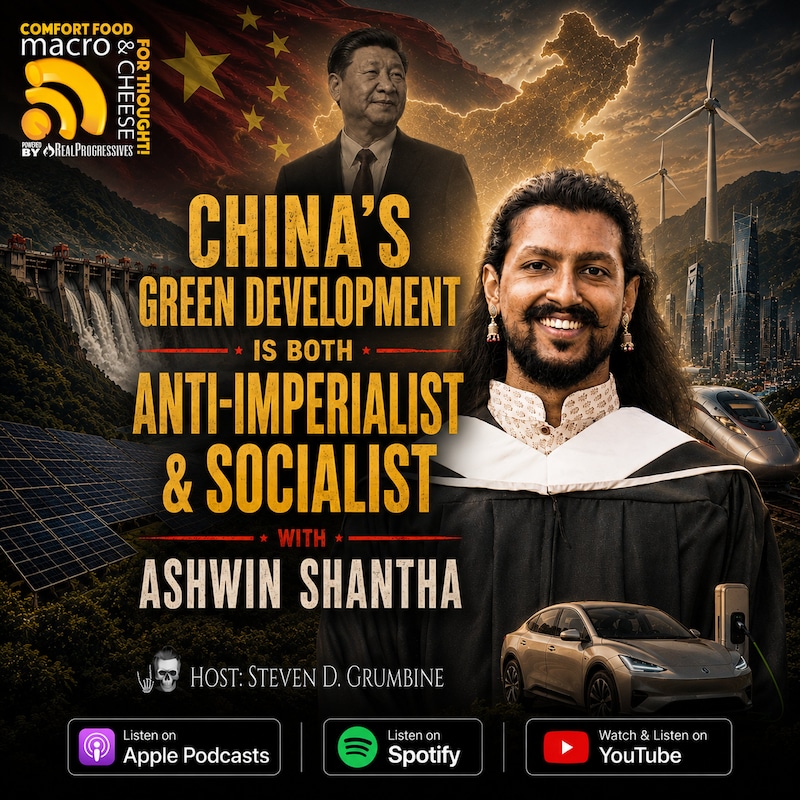
Ashwin Shantha joins Steve for a discussion challenging Western narratives on China – particularly the all-too-common opinions that dismiss its socialist character. This episode makes the case that China is a genuine socialist project where the state disciplines capital rather than being governed by it.
Ashwin illustrates how China's green industrial revolution—driven by rapid progress in electric vehicles and renewable energy—marks a qualitative break from capitalist development paths. Unlike the Global North's extractive model, China's centrally planned approach prioritizes use-value objectives (clean air, energy self-reliance, and technological independence) over exchange-value maximization. The state constructs markets strategically, using mechanisms like the dual-credit policy to force both domestic and foreign automakers toward sustainable production targets.
While the episode isn’t focused on MMT, it highlights how China's monetary sovereignty enables fiscal space for long-term industrial planning. The nation's ability to issue its own currency and direct credit toward clean development highlights a crucial distinction from Global South countries trapped in IMF-imposed structural adjustment programs. This self-determined policy space, which is denied to nations like India and much of Africa, allows Beijing to absorb neoliberal shocks while maintaining state control over the economy.
China's sustainable growth model is anti-imperialist in two key ways. First, energy independence reduces reliance on imported fossil fuels that expose the country to geopolitical leverage through choke points like the Malacca Strait. Second, technological autonomy focuses on developing indigenous productive forces that break the Western monopoly over clean technology.
By keeping private capital subordinate to state priorities, China shows that socialist modernization offers a workable alternative for the Global South, avoiding the de-development and resource plunder that characterizes Western industrialization.
China's model may still have some contradictions, but it continues to show what is possible when state power is wielded in the interests of the working class.
Ashwin Shantha (they/them) is a doctoral student whose research focuses broadly on the political economy of sovereign development in the global South, focusing specifically on China and South Asia. Some of their existing work has researched South-South development cooperation between China and Pakistan through the Belt and Road Initiative, as well as, more recently, China's state-led green industrial revolution in the electric vehicles and renewable energy sectors. Ashwin is also the host of the International Solidarity Podcast, which focuses on the politics of anti-imperialism and socialism in the global South.
YouTube: https://www.youtube.com/@journalofintlsolidarity
Instagram: https://www.instagram.com/journalofintlsolidarity
Substack: https://intlsolidarity.substack.com/
Transcripts
All right, folks, this is Steve with Macro and Cheese. Today's guest is Ashwin Shanta. And I want to be real clear on this. This is a really exciting opportunity we have here. Ashwin is a doctoral student.
Their research focuses broadly on the political economy of sovereign development in the Global south, focusing specifically on China and South Asia.
Some of their existing work has researched south development cooperation between China and Pakistan through the Belt and Road Initiative, as well as more recently, China's state led green industrial revolution in the electric vehicle and renewable energy sectors. Ashwin is also the host of the International Solidarity Podcast which focuses on the politics of anti imperialism and socialism in the Global South.
And for those of you who listen to this program frequently, you know that we talk to people like FADL Kaboob, who works deeply in the Global south, and Jason Hickel and others. And this is just building on a lot of really important work that we've done.
And I'm so excited because the information that we have to discuss today, we're going to largely look back at some of the work that Ashwin has done and particular focusing a lot of the conversation on a article called China's Green Development is Both Anti Imperialist and Socialist. And I'm going to give you the subtitle too. China has become the Global vanguard of green industrial development.
National sovereignty has been a major consideration in this green push and it wouldn't be possible without governing capital. And I want to just be honest with you.
We have talked extensively about the need for not just monetary sovereignty, which China has, but the rest of the Global south needs. Energy sovereignty, food sovereignty, value added production sovereignty.
There's a multitude of ways at looking at sovereignty and Ashwin does an incredible job of discussing China. And for all the little haters out there running around saying that China's a capitalist country, they're not really all that socialist.
We're going to bust that myth out pretty hard today too, I think. So without further ado, let me bring on my guest, Ashwin Shanta. Thank you so much for coming.
Ashwin Shantha:It's great to be here. Steve. Thank you so much.
Steve Grumbine:Absolutely. So look, I am a little bit of a China lover. When I had the opportunity to Finish grad school.
Unfortunately, I didn't get to complete my doctorate, but when I got my Master of Science and my mba, I specialized in international finance. So I went on a three week capstone for my executive program and went to Beijing.
I went to Shanghai and a number of places throughout China to see the great production that they were doing. It was so different than what I thought. But back when I did was still heavily smog.
I mean, when you flew into Beijing International, you could see the smog everywhere. You know, you had the World cup and so there was the stadium got to go by there. But it was not the green empire that it's becoming.
And it's fascinating what the will of a centrally planned government can do when it points its direction in the people's direction, when it points its resources and its capabilities towards lifting everyone out of poverty versus enhancing the richness of a few wealthy people, as capitalism tends to do. We unfortunately here in the United States are subject to. Tell me about your article. Let's start with that.
Let's start with the essence of what drove you to writing about this and maybe lay the groundwork for why this is so important for people to understand.
Ashwin Shantha:Yeah, sure.
I mean, I think, you know, as someone who's been on the left for whatever maybe the last half decade or more to varying extents, you know, how it is with ideological shifts, et cetera, I think it was clear, you know, being based in the west and I'm based in Canada, that there has been rightfully so, a growing climate consciousness. Right. About how climate change has been disrupting natural ecology and is really a security threat for our future.
left, you know, at around the:At the same time, however, and I'm speaking in the west, that sense of things has really dipped.
At the same time, you're seeing an innovation in green productive forces in China, and they, in China are able to increasingly address this issue, are developing the productive capacity to begin to move toward some more ecologically balanced and sustainable system, at least now laying the prerequisites, the productive prerequisites to do so. Right.
But at the same time, the, the narrative in the west around China is still that it's authoritarian, it's dictatorship, it's, you know, committing Uyghur genocide.
These kinds of things that are largely Western imperial propaganda that keep our eyes shut to ensure that we're not cognitively able to look at these examples and process them as legitimate outcomes of a social process that perhaps we could be taking a page from. And so that's kind of the context for, like, why I was, why I even approached this, why I was interested in this.
And the Chinese themselves are famously quiet about their successes. They would rather have the outcome speak for themselves. They're not an economy based on propaganda and marketing, as the west is.
Steve Grumbine:Right.
Ashwin Shantha:We have whole industries dedicated to coming up with bullshit, really. So that also explains why so much of this has been able to fly under the radar on the left.
Now, I also study development, the political economy of development you mentioned. I'm doing my PhD, so I approach this, you know, at a certain level from my research interest as well.
But this substack article that you're referring to is really, I took some of my, you know, findings from my research. You know, I don't claim to be some grand expert on anything I'm studying.
And as I'm studying and as I find my findings in my research, I want to share them with the left. And so this article is really trying to speak specifically to the left. If it goes beyond that, that's fantastic as well.
But I'm really trying to bridge that gap between, or this cognitive dissonance between. Things are getting really bad in terms of climate. Where I am in Ontario, we had really bad storms and tornadoes over the past couple of days.
So that kind of consciousness with, okay, but then what we're not supposed to look at, we're not supposed to talk about China's model at all and perhaps what lessons it has for us, you know, so that's how I was approaching this.
Steve Grumbine:Well, I think it's fascinating because obviously China is probably the most misunderstood place in the world.
We always try to look at the world through our own experiences, our own understandings, the propaganda and the information that we've been fed from our own countries. And China is a very different place.
And so looking at China for outcomes based on the way we have designed our own, you know, North American, let's just say it more broadly, North American societies, because sadly, the US has badly hurt Canada with bringing its neoliberal thinking up north.
But when you think about, people have a hard time understanding because of the red scares that we've been through because of all the other nonsense, and then there's this weird little purity group out there that's wagging their finger and you can almost see them sniveling their nose up that China's not socialist, they're a capitalist, blah, blah, blah. But in reality, China's something more than that. In fact, we've interviewed quite a few Chinese economists.
One of my favorite really at this point in time, expressed China as socialism with Chinese characteristics. Yan Ling is one of our favorite people. She's come back on the show many times. She's an MMT economist that, you know, focusing her efforts on China.
And when we think about China's green development and anti imperialist approach, most folks sit there and say, well, it's still just capitalism, but it's not. It really is different.
Can you describe how they're different in terms of the way that they approach their development as opposed to a capitalist country that just allows capital to make decisions and run amok?
Ashwin Shantha:Yeah, this is a great question. I should say also, Yanliang is, is really great. And every time I hear her media appearances, I really learn a lot and she really has a lot to offer.
Yeah, I mean, in terms of the question of China and socialism, you know, I was recently at a conference, I was talking to some Chinese scholars and they take for granted that of course China is a socialist system. But they talk about how they have kind of moved beyond this debate of, oh, socialism versus capitalism, how does it matter?
The outcomes kind of speak for themselves. And you know, it's us on the Western left that's kind of stuck with this debate of whether China is capitalist or socialist.
Increasingly in China, they're having a discussion or they're talking about modernization among certain parts of the left or the left, intelligentsia perhaps more specifically.
This would be a little bit bothersome because modernization, or the original Western modernization theory is something that stems from a kind of Eurocentric Orientalist view of the global south, that they come from traditional backward societies and they have to catch up through this one unilateral or universal path to, you know, so called European defined modernity, the royal path to Europe, as a friend of mine had put it.
But what the Chinese mean when they're talking about modernization is they're actually questioning, okay, is a modernization possible beyond how the west has defined this question.
So there seems to be an increasing literature in China that I'm beginning to try to get a grasp of and try to familiarize myself with about what does Chinese modernization look like? What is socialist modernization?
And then, you know, this is really important as, you know, someone like myself who also studies the rest of the global south, what are These lessons of modernization for the rest of the Global South.
So I guess that's a little bit of an aside, but I would still, within this debate that we have on the Western left about whether China's socialist or capitalist, I find it important, I would maybe disagree slightly with the Chinese professors that I mentioned that I had met at the conference and say, well, it is an important actually discussion to have because the existence of a market in China does not make it capitalist. And that is. That's like saying a pebble and a boulder are the same thing because they're both rocks, you know what I mean?
Because they both have a certain quality. So I guess let's get into it in terms of socialism, right? The best way to understand China as a socialist project is to one. It really.
It's all about method in a lot of ways. The method, the methodology to studying China. The first thing is compare China to the rest of the global south, right?
China has been, you know, had endured a century of humiliation is how they call it in China, where their economy, their society was dominated by brute force, military violence through the opium wars. I'm from Hong Kong, you know, so I know this history or this history is very familiar to me, right?
The British, after having colonized India, where I'm also from, they. They got Indian peasants to.
To grow opium and kind of forego grain production, food production, instead grow opium to then be shipped and trafficked into China to get Chinese people addicted to drugs so that they can begin a drain of wealth out of China. This is the origins of Western modernity in China, okay? And so after a hundred years of this de development, the People's Republic comes about.
The People's Republic of China comes about and establishes a socialist process, right? And so when you compare. So, so that's the groundwork, like much of other parts of the Global south that were also colonized.
So the starting point of de development is something that's common between China and other Global south contexts that can't directly be, you know, compared with the Global north, because the Global north was never de developed. It was, you know, overdeveloped or it.
It had undergone a process of, you know, maybe we can define it simplistically as stolen resources to develop the Global North. So that's the first thing. So that's to, you know, that's contextualizing, okay, what is the starting point for China's development process?
And then you really see a divergence, right?
You know, if you compare China to India, capitalist India and socialist China during the late 40s to the 70s, you can say, so that's the Mao period in China. You see massive successes, achievements in social indicators, right?
Literacy shot up, health, maternal mortality rates, all sorts of social indicators, education, right. A huge divergence, you can say, between the path in India versus the path in China.
And then again, so that's kind of in the, the late 40s to the early 70s. And then after that is kind of the neoliberal period.
Even in the neoliberal period, you see a difference in approach between China and other parts of the global South. Whereas the Soviet Union, for example, actually collapsed, actually did capitalist restoration, actually underwent counter revolution.
Union, if you look at India,:And when you compare that to China, China took that era of neoliberal counteroffensive, waged against the working class in the global north for sure, but also especially the global South.
That wave of counter revolution, China was able to kind of absorb that shock and then, you know, harness that energy and repurpose it in a way that kind of worked for itself. So, you know, you did not see mass privatizations of state owned enterprises like you saw in the former Soviet Union, Russia and in India.
You did see, sure, privatizations in China. But this was a gradual process.
You know, it was largely initially Hong Kong capital, Taiwanese capital coming in, rather than Western capital flooding China.
And then when Western capital did finally, you know, enter China, it came with, you know, major conditions that, you know, namely that if you want access to our markets, you have to transfer the technology. And there were still, you. Yes, there was still an emphasis on indigenizing production and indigenizing technology.
This was not the case in places like India and in Africa as well.
Africa suffered severe income deflation because of IMF imposed structural adjustment that basically decimated state capacity for them to really be able to indigenize production, to assert any kind of technological sovereignty. And so I'm highlighting here a comparative method to look at China amongst the rest of the global South.
Right, or the global majority, if we also want to include Russia, the Soviet Union.
And then, sure, with the introduction of a market economy in China and the growth of a capitalist class or capitalists in China, there are contradictions that come about there are issues, right? There's inequality, there's internal migration, there's, there's still poverty.
But you do see China beginning now to address those issues of metabolic rift of the vast, like I mean the serious ecological issues that you were talking about at the beginning, addressing issues of inequality that arose from this era, things that still are left unaddressed in a place like India or other parts of the Global South. So. And the importance of the state really cannot be overstated here in that process, in the socialist process.
So I hope that gives us kind of a sense perhaps maybe to start with, of how China's doing. You know, the question of China being socialist. Right.
And the party state being in charge as being making that crucial distinction with other Global south contexts.
Steve Grumbine:Yeah, I think it's fantastic. And I like the way you centered the state. I know people, oh, we got to get rid of the state and stuff like that.
But you know, they haven't obviously done a lot of reading of theory because theory talks about the long withering of the state. And if you consider the transitions that groups have to go through, development wise and the like, I mean, there's struggle.
We're talking, this whole thing is about struggle.
When I think about China, I think about that boot, the US Empire's boot being put on their neck and them still somehow or another finding a way to fight through that and come out on top and say, you know, we didn't have to blow anybody up, we didn't have to plunder and destroy.
And that brings me to the point that you emphasized throughout and something that we at, you know, macaron cheese and real progressives, our mothership, if you will, focus heavily on, and that is the sovereignty and real resources, people tend to focus on money because it's hard to get money right. As an individual that doesn't create it out of thin air. You know, we have to do something to get money.
And states, they don't have to do something to get money. States create money when they issue it and when they spend it into existence. And China has mastered that. They've understood that.
They do not allow some weird, oh, we got a deficit, oh my God, what are we going to do? They say, we got things that need done, let's do them.
And they put together their five year plan, they put together their ten year plan, they centrally plan through the party. They struggle behind the scenes, but when they come together, they move forward.
And I think it's important to understand sovereignty is a key element to that. Monetary sovereignty is something that we heavily focus on because the policy space. Now, mind you, there's another element to this.
And unfortunately a lot of my dear friends in the MMT community refuse to even talk about this. They hear it, they agree with it, and then they move on.
The fact that we don't live in democracies, we don't live in a real democracy in the United States, we don't have any access to power. And the power that is there isn't serving the class interests of the working class. It's serving the class interests of oligarchy.
And it's been empirically proven.
And I don't know why people don't stay right here dead center on this issue, because you can know all the great ledger work in the world, but if you have no power to get to that ledger, you've got another battle you've got to fight first. And part of that battle is sovereignty is democracy, is the ability to impact, to have agency within and China.
The difference I think, which is vast, is that in China the intent is not to maximize capital accumulation, but is to maximize, you know, the quality of life. And, and they're, they build good friends around the world as opposed to predating, though they're not perfect.
I don't want to ever be considered somebody, just fanboys ever. China like that.
But in a world where we're watching increasingly that the first trillionaire, I mean, we got Elon Musk and the people in the United States don't even have health care, you know, I mean, so we have a fundamentally different world that we live in. And I think your focus on sovereignty is really key. Can you talk a little bit about what you mean when you talk about sovereignty?
Ashwin Shantha:Yeah, absolutely. Those are really great points you brought up, Steve, about. Sure.
You can perhaps have a sense of policy solutions, but if you don't have a constituency or you know, a social, if you're not socially organized to take state power to then animate those policy solutions, then what does that mean? You know what I mean? So great points there.
And that's also where you see the importance of the Communist Party in China as opposed to, you know, having other forms of state entities in other parts of the global south that largely subordinate their sovereign interests. Right. To their own, you know, personal class interests. Right.
So sovereignty in the Chinese case is, is very important because how does China exert its sovereignty? It might be a little bit different from how we think about, how we might think about this kind of state power sovereignty in the global North.
Because I'm largely looking at China's sovereignty as perhaps a model or as perhaps an inspiration for sovereignty struggles elsewhere in the Global South. I mean, the. The de development that came with colonialism largely continues.
Of course, there's been progress that's been made of having formal independence, but this de development continues to persist because of imperialism and because of the continued uneven development between the north and the south, the flow of value from the south to the North.
And so, you know, China's assertion of sovereignty actually is a backstop against the flow of value deriving from the natural ecology of China and the labor of China. It's a backstop of that flow from a country like China to the global North. Right.
I mean, there certainly is political economists that are actually tasked with quantifying unequal exchange and measuring unequal exchange, like Jason Hickel and, and Minchi Lee and others, right. That are actually doing this work that obviously still say that there is still unequal exchange in value flowing to the Global north from China.
But by being able to assert its sovereignty, China's been able to reduce that flow of unequal exchange to the Global north by raising its wages. Right? So that's also where the question of sovereignty is important.
But basically sovereignty in the Chinese case is a backstop against imperialism and the ability for imperialism and the west to dedevelop societies in order to continue to overdevelop the north and to.
And importantly for our conversation as well, this is where our ruling class, right, the ruling class in the Global north, they draw their strength from their ability to dedevelop and cheapen labor and raw materials in the Global South. And so the working class struggle in the Global north is inextricably linked to the struggle for sovereignty as well in the Global South. Right.
If we want to get specifically into China's green development and how green development is an assertion of sovereignty on the part of China, I make the point in the article that you essentially have. China's green development is sovereign in two principal ways. It is one, it's energy sovereign and it's technologically sovereign.
when you were in China in the:This was the era of development at whatever the cost is. And then we'll figure out the solutions in due time.
But China has been super reliant on coal, and it still is to a great extent, and they're trying to reduce that.
But Coal was causing all these ecological issues that were not sustainable, that were affecting people's health and lives in Chinese cities and in the countryside, etc. So if we were to move off of coal, what would we use?
Obviously the energy commodity of the 20th century, for sure, and one that's still in great use is fossil fuels, right. Oil and gas, which you would largely have to, in the case of China, largely have to import. Sure.
China also has fossil fuel reserves, but they would largely have to import this from the Gulf countries or the Persian Gulf more broadly.
And we're seeing right now the issues with that, of course, with the, the, with the nationalization of the Strait of Hormoz by Iran in its assertion of sovereignty against imperialism. Right.
So if China was to move off of coal, but it would then have to replace coal with oil that, you know, gives the west geopolitical leverage over China because the west has had designs around the Malacca Strait in specific, right. This narrow strait between Indonesia and Malaysia to perhaps, in the case of a war, to blockade and prevent the flow of energy to China.
So if China wanted to move off of coal and it, you know, was a national security threat, you know, or would have national security vulnerabilities, you know, if it were to make 1.4 billion people rely on imported oil, then I guess the next logical area would be to actually develop indigenous green productive forces and technology.
And so you actually see that in this case, the development of green productive forces in China kind of bolsters its energy sovereignty because it's depriving Western imperialism of a crucial point of leverage in determining China's developmental trajectory. Right. So, you know, access to energy is decreasingly a means through which the west can attempt to dedevelop China. Right. As it does. Right.
This is the important point, as it does with the rest of the Global south. Right. By, you know, in the best of cases, having oil purchases denominated in US Dollars. Right.
Therefore constraining the fiscal space of many global south governments, or at worst by sanctioning or blockading them from accessing energy imports, as is the case with Cuba especially, and North Korea as well. And you know, we've seen the politics of oil and energy being leveraged by the west in all sorts of other ways.
And you know, that's why Iran's actually, Iran's anti imperialist resistance is a very important challenge to this monopoly over fossil fuel energy that the west has really attempted to consolidate, yes, through the dollar, but also through its client states in the Persian Gulf region. Right.
The Gulf Monarchies So if that's on energy sovereignty, right, China's green development by out of, you know, almost out of nothing, developing whole new industries of green vehicles, you know, solar panels, wind power, and then massively scaling that up and being able to be nimble and dynamic in having wind farms and solar energy all the way out west in Xinjiang and then having that power transferred back to the economic centers in China, you know, on the eastern coast. You know, that takes a massive level of being able to scale and reproduce in terms of productive capacity.
So this other issue is technological sovereignty, right? Did you want to come in? Stay, Steve.
Steve Grumbine:Yeah, just real quick, when I think about China doing this stuff, it's really important to understand and you state this throughout. So I want to add this to this moment here that China governs capital, capital doesn't govern China, okay?
And the actual mechanisms of governance, from credit policy, regulation, ownership, procurement, planning targets, party discipline, et cetera, all the rest of all pulls together for what's in China's best interest. And they don't see being predatory as in China's best interest.
You know, overall, when you think about your larger studies or the global south, there's a lot of work being done right now. You know, Africa is trying desperately to own some sovereignty here. They got a young workforce, they've got a massive workforce.
They got incredible amounts of real resources.
But because the very nature of the IMF debt traps and the structural adjustments and all the other things that US Imperialism imposes, China stands apart from that.
And I think that it's really important to kind of bring that part out that, yes, as one of our favorite guests here says, Fado Kaboo, if you don't have a plan, you're going to be part of someone else's plan. Okay? And China, to its credit has at times, I feel like they've been too neutral. At times they haven't flexed the muscle that they could have flexed.
But overarching, they've done no harm in sense of. They're not out there starting wars to get supplies, to get these. You know, that's the US Model.
Let's go ahead and destabilize a country rocking into poverty, put it into debt through IMF debt traps, and then go ahead and open up the borders for us oligarchs to come in there and pill for the, the real resources out of the area. And China's not allowing that to happen. In fact, China's building kind of a parallel world, right? I mean, it's.
It ain't perfect, it ain't there, they still need the U.S. the U.S. still needs China, blah blah blah. That's true. But there is an element here that China's saying, you know what?
We are going to do what we think is correct and we are going to keep capital at heel. They needed capitalism to expand into other things. I don't know that they needed it, but they chose to allow it.
But they have kept a absolute death grip on its power. And if they go out of line, if they don't stay the course, the central party China, they crush them. There is no, oh, you know, we just whoops. No.
Unlike in the US where it's just a complete kleptocracy. I mean we are talking about real legitimate management, literal control, domination for the purposes of the betterment of China.
I just, I want to throw that in there because I think it's an important distinction that while we're talking about all those things you brought up, I hear people in the back of my mind say, yeah, but you know, it's capitalist and they got billionaires and blah blah blah. But they are kept at heel if those guys do something that goes against what the Chinese central government wants done. You know, that's the people.
Because communism is the people. And they would consider themselves to be in that vein. When you look at a government and you can say, whose class interest do you serve?
I don't think there's any question that China is trying to serve the interests of the working class. And I think that's why they're willing as a people to operate in solidarity, operate and push in the same direction. And the results are staggering.
I mean I just to see what they've achieved. But I do think it's worthwhile to mention that like anything, capital is an evil dog. It in and of itself is just a system.
The people may be good or bad, doesn't matter, but the system itself creates needs for more and more profit. I'm curious, what is China doing to control that impulse, that desire, that need for growth, for capitalism?
Ashwin Shantha:Yeah, no, this is a really important question. And in terms of, you know, you hearing the voices in the back of your head of people saying, you know, oh, but it's capitalist.
I think there needs to be some further elucidation of actually how does this socialism work. And you're right, I think the best starting point is we need to understand socialism versus capitalism as regimes of class domination.
So capitalism, if you were to say China's capitalist, you have to necessarily be saying that the capitalist class rules China and that Is not true, right? Because capitalism is about the rule of capital. In China, capital does not rule. Capital is disciplined. Capital is disciplined by the state.
And this is kind of a point. And you know, I'll get into this further. What does this actually look like? How does this look like?
But I make the point in the article that these two components that I was just talking about, right? Energy sovereignty and technological sovereignty. Why haven't other countries in the Global south been able to assert that sovereignty?
It's not sovereignty that just comes out just like that by a capitalist class. Right? The capitalists want to integrate into the imperialist world.
You know, the capitalists in the Global south want to integrate into the imperialist world structure and sell out basically the interests, or you know, at least forego the interests of the rest of their people.
So to have energy sovereignty, technological sovereignty, just sovereignty more broadly within this imperialist world system that has an agenda of imposing de development, you actually do need to discipline capital. You get to energy sovereignty and technological sovereignty by disciplining capital.
And so let's look at perhaps what, you know, what is this disciplining of capital look like? Where does the market fit in this whole socialism versus capitalism thing?
Okay, an offhand example that I think I can give of how exactly is capital disciplined in China is in the green vehicle sector, right? The electric vehicle sector.
This is a recent development, you know, in my article, you know, I would encourage folks, if they're interested to go through it because it gives us a sense of texture. I'm only giving this little glimpse here, but you know, China has largely used subsidies in a very strategic way to develop the green vehicle sector.
You are listening to Macro and Cheese,.
Steve Grumbine:A podcast by Real Progressives.
Intermission:We are a 501c3 nonprofit organization. All donations are tax deductible. Please consider becoming a monthly donor on.
Patreon substack or our website, real progressives.org now back to the podcast.
Ashwin Shantha:But these are not subsidies that are gifts to the private sector. And by the way, the state owned sector in China is still very big.
It's not just the idea of having a market economy in China does not necessarily mean that market economy is dominated by the private sector. Right? The commanding heights of the economy are dominated by the state in, you know, public utilities.
Which is why even in the most rural areas in China you have 5G Internet connection, right? Which is why you have high speed rail in, you know, Xinjiang and Tibet and things like that.
So commanding heights of the economy are dominated by the state, but these subsidies don't go to enriching private individuals. They are used in a strategic way to develop the green vehicle sector.
But at a certain point, you know, the Chinese government wanted to switch tracks, right? You're not going to endlessly give subsidies to. You're responding to how the industry develops and then changing your strategy accordingly.
And this is where something called the dual credit strategy comes about in China, where, and this is how they discipline capital. You have domestic Chinese EV companies, but you also have foreign automakers in China, right?
Think of Volkswagen or Ford, et cetera, General Motors, they instituted a policy, the government, that each auto company has to have a certain level of EV output as a proportion of their total vehicle production. And that, you know, so there's a ratio that you need to be producing a certain level of EVs as a proportion of your total.
And you know, this benchmark changes over time such that you need to actually be producing an increasing proportion of EVs over time. Now, if you don't meet this benchmark, there are consequences.
And I say that there's a good cop approach and a bad cop approach by the Chinese government here in terms of this dual credit policy. The bad cop approach is if you don't meet these benchmarks, you receive negative credits. If you meet them, you receive positive credits.
If you don't meet them, you get negative credit. There are two ways to offset your negative credits. The first way is you can buy them from other auto companies that have positive credits.
And now this is a very smart policy because it's actually the Chinese domestic auto companies that are doing much better at EV production. It's the Western or the foreign auto companies that are very used to producing combustion vehicles, right?
So it's actually them that are the laggards, the, the non Chinese auto firms that are the laggards that actually have to catch up.
So they're telling effectively those companies that are laggards being disproportionately Western, that hey, okay, you can either get these negative credits and risk being kicked out of the market entirely, or you can purchase positive credits from your own competitors, your Chinese domestic competitors, to offset your credits. Or you can form joint ventures with them.
And when you form joint ventures and tap into their supply chains to boost your EV production, you share their credits as well.
So that's kind of the bad cop, good cop scenario, where the bad cop scenario is the burden of subsidizing the EV industry actually shifts from the subsidies doled out by the state to subsidies from the foreign auto companies being paid to domestic companies. In exchange for positive credit, that kind of thing. I hope, you know, this is, the dual credit policy is quite wonky.
I tried my best to explain it, but this is, you know, disciplining capital to meet targets. Right? To meet targets that are planned out in their long term plans. I mean, show me any western country where you have any kind of regime like this.
I mean, there's more to say, but I think I'll yield for now. Steve.
Steve Grumbine:Yeah, no, I appreciate that very much because where I'm really focused as I'm listening to you, my brain is really pivoting to central planning, right? It really is focused on central planning because within this United States there is almost no central planning. It's almost all laissez faire.
Well, I think that's even a misnomer. But it's very much state capitalism in the sense that the country itself spends money into existence, but it doesn't spend it to the people.
It spends it to Halliburton, it spends it to Boeing, it spends it to, you know, few petrol companies, it spends it into existence.
For Elon Musk, the first trillionaire who is absolutely sucking on the teat of the United States treasury, he is literally, I mean everything with SpaceX and all the things he does are things that could be 1 million percent done by the state, nationalized. There's no need for a hero. He's not a hero, he's a predator.
But you know, when you think about China and you think about not just China, but you think about like other countries that are trying to develop through this process. The United States, when it sees that kind of development, it can't have that.
It can't have that because it stands in the way of their capitalist accumulation. You're blocking our free access to lithium, you're blocking our access to cheap labor, you're blocking our acts.
Help me understand how China centrally plans these things knowing full well it's surrounded by hawks like the USSR was, quite frankly. I mean this, how do I say this? You know, you look at the Bolivarian revolution, you look at all Cuban revolution, what's happening now.
You're watching a counter revolutionary force destroy the gains. And it's US imperialism, it's US interests, it's Western interests, China doesn't have that power, China's huge.
But China also centrally plans and maps these things up. How does central planning work in that space?
Ashwin Shantha:I think it's maybe even a little different from how much of us and certainly myself thought about, you know, the question of central planning before I maybe studied it in more detail because we often, you know, we often associate this with the Soviet style kind of command economy.
And it's certainly not like that, the central planning mechanism, you know, and I'll get into this further because I actually do want to talk about this concept of kind of going off of the previous response about how do you discipline capital? What is, where does the market economy fit into socialism?
I want to talk about something called, you know, what they call the socialist market economy for sure. But the central planning is very much part of that. But it's.
These are largely guidances and direction, mapping out the direction for certain sectors and setting targets and things like that.
That's what's done by the central government in terms of planning, but in terms of implementation, historically this has largely been done by, you know, local governments and provincial governments have played a really big role.
There's a misconception that in China everything is, you know, because it's the myth of the authoritarian state and whatnot, we assume that the central government is doing a lot of the heavy lifting, but in fact it's actually quite decentralized in that the central government lays out the roadmap and the implementation is done by the local and provincial governments, often competing with one another.
And that kind of dynamic system produces, you know, some good outcomes in certain areas that then can be taken as models and applied in other areas, et cetera. So that's actually the dynamic of central planning and how that works in China and how it's kind of implemented.
Now, central planning is a very important part of what they call in China the socialist market economy.
And this, I want to get a little bit further into this because it's gives us a texture of, okay, sure, you have a market economy in China and market economies can cause major distortions and major issues, right? For sure. But how is that market economy different from the market economy in the West?
And here I think in the article I drew on these Chinese scholars, Mengjie and Zhang Zhebin. They have a concept called constructive markets.
And this is how, for example, the green industry, or several green industries in China, including EVs, how they developed through something called constructive markets. Where basically the idea about constructive markets there, there are two aspects of it, right?
The first is that the state acts as an embedded agent in the economy, right? Constructing the markets on both the supply and the demand side.
But the issue here is that it's not just, you know, the constructive market is not about like picking.
And here I'm drawing from some other work from Shiran Ilan Peruma, who wrote a really good article for the Tri Continental about the idea of the constructive markets.
But he talks about how the constructive market is not about like picking winners within an existing market or subsidizing private investment, but rather it's a system that coordinates all the different elements within the market. Right. Technology transfer requirements, procurement guarantees, subsidies, consumer subsidies, regulatory mandates, et cetera.
All these aspects of these new industries that are being developed, these are kind of the preconditions for the market's existence that then you have a combination of state owned and private actors then coming in and acting in the market. Right. So this is the state's role in the market. But that's only one aspect of the constructive market.
You know, this still kind of makes it kind of an even playing field between competing interests, Right. The private interests for perhaps profit maximization and then, you know, other people oriented interests.
But the second and very crucial aspect of this concept of constructive markets is that use value objectives are placed in a superior position to exchange value objectives. Exchange value objectives, namely being profit maximization. Right. So, so that's coming back to the question of national planning.
National planning, central planning can be understood as a mechanism for outlining use value objectives in the economy. Right. We want to have clean air, we want to green our electricity grid, we want to green our cities. Right.
We want better places for people, we want green productive forces as a national security concern. In China, these are kind of the use value objectives. What, how are these going to benefit people?
Sure, individually, but also as a collective society. And then the market is kind of used and it's a very curated market as I've mentioned. Right.
The market is then used as a subordinate engine to animate and to realize these use value objectives set out by central planning. So I hope that gives listeners some kind of, you know, texture of. Sure. You have a market economy, you know, and it's not.
But it seems that the Chinese have been very innovative in how to realize outcomes while not allowing the interests of private capital and individual capitalists to, to dominate and colonize its system. You know what I mean?
Steve Grumbine:So, so yeah, I think that's fantastic. Listen, I know you have a hard stop and I don't want to abuse that.
So what I'm going to do is I'm going to let you kind of take us out on like what we didn't get to the high point. Maybe what you think we missed that we probably should have covered in this short time. I would. By the way, I'm gonna have to have you back on?
Because you just got too much knowledge in there not to listen. So I think right now, as we pay forward into this world that we're about to embrace, I mean, we've got real legitimate climate crisis going on.
I mean, it's happening. It's. This may be the one thing that capital can't profit its way out of. It really doesn't care.
I mean, I guess they could have bunkers and all kinds of other stuff, but at the end of the day, we're facing a situation that capitalism alone has been largely responsible for and has no real answers to.
And in China, though, it seems like while they are growing and while they are definitely expanding, they are centering that metabolic rift, as you put. I like that.
We had Ian Angus on a few weeks back, is an ecosocialist who really, really fantastic speaker, and I think he's up in your neck of the woods and Canada, right? Really great guy. But it kind of brings us to this point, right?
Like everybody's talking about growth, everybody's talking about these wonderful things, but it's almost like they're afraid to look over their shoulder to see the tsunami coming. And I know for a fact, I mean, there was this really cheeky movie, corny movie.
It had, you know, I think it was called the Core or something like that. And there was this tidal waves that were coming in. And the guy who had discovered all the problems was like, hey, guys, you never came and got me.
And you're watching the film as the tsunami comes to sweep him and his family away. Ironically, he was in India, I think, or Brazil, one or the other. I can't remember which. But this has got a real deadline here. This is not economic.
This is not socialism, capitalism. This is not. This is biology. This is ecology.
This is systems of, you know, you could go historical and dialectical, materialist, everything connected and so forth through this.
What do you think is the main takeaway that we need to really focus on as we evaluate our own existence, our own survival, and transitioning to these systems like, you know, as China has done? I mean, is this something that can be done elsewhere?
Or is the powers that be within these nation states too entrenched in capital to forego a literal revolution to change?
Ashwin Shantha:I think it is something that basically has to be done. And then the question becomes, you know, how and what is the path, right? Obviously, I don't have all the answers.
I think, you know, the Chinese example of how do. How they develop industries kind of almost from nothing, right? From kind of 0 to 100 in a lot of ways.
You know, in terms of scaling up, sure, adapting some technologies right, from the west, like solar technology, wind technology, etc. But then really the difference in the Chinese model is how they scale that up. Those are lessons for us in the west, for example, right.
Like maybe our focus, I mean, in Canada, the news from the past couple of days is that the Prime Minister, Mark Carney, has been on the west coast and talking with the Premier of Alberta and British Columbia and recently made, you know, a whole bunch of new deals to expand fossil fuel projects.
And, you know, we perhaps cannot, and I think in the Global north, we have the burden of, and the responsibility of making as hard of a pivot as we can away from fossil fuels toward green technologies. Because the Global south still does need fossil fuels to develop. But sure, we're still within that framework.
We might still be needing to use fossil fuels for some time.
But this expansion of fossil fuel projects that we're seeing from the Canadian Prime Minister and the Premier of Alberta is, let's not get this mistaken.
This is not a well planned strategic path to use fossil fuels in certain sectors for a particular developmental outcome while simultaneously developing green productive forces.
No, this is the ramping up of fossil fuel based extraction and the search for new markets for this product in light of Trump's tariffs and basically the reorganization of markets for those at the top. Right.
For these are finding new opportunities for the energy sector, the oil and gas sector in Canada to, to recuperate profits after the destabilization caused from the tariff charade by Trump. And so this capitalism, okay, like we see, you know, Carney doing, and I really like your understanding what state capitalism actually is.
We have state capitalism, right? So this is the politics. This is the politics of energy, fossil fuel versus green versus climate solutions. This is the politics in the North.
Now the question then becomes, okay, Canada, kind of, well, and maybe I'm speaking here about Canada, but Canada, you know, has, you know, had some kind of a rapprochement with China. How can we now kind of, you know, what are the conditions under which we can. And as popular forces.
But sure, at the state level as well, what are the conditions under which we can import some of this green technology?
What are the conditions under which we can maybe then have domestic production of those green productive forces, you know, attract Chinese investment for such things, of course, their national security, whatever considerations that the ruling class and whatnot will bring up.
But you know, if there aren't voices like these and like ours bringing it up in the first place, then that yields the way for more Carney style energy favoritism. Right.
Favoring the oil and gas industry in the super conservative right wing backward oil and gas energy constituency in the west, you know, the big companies. So I think that's kind of, those are the cues that I think we have to take from China. That one, this is actually possible.
Sure, you have to take state power, but in the meantime, like you know, there is a force, a green force in the world. You know, China doesn't want to be whatever all, it doesn't want to be powerful and exert its power in the same way that the west does.
But there is a green force in the world. It has front loaded the cost of innovating and scaling up green productive forces.
Now it's kind of a distribution question that kind of makes it slightly easier for us. So you know, let's kind of focus our energies on this. What can we draw from China's green example?
And you know, in the Global south, very briefly, you know, in the Global south this is a real opportunity that the Global South's energy future is actually more secure with China than with the west as we're seeing. Right. The West's imperialist aggression against Iran has really destabilized the energy situation in the Global South.
And rather than perhaps relying on these narrow straits through which energy, you know, fossil fuel energy is shipped and you know, maybe it's a more secure future with Iran's gradual nationalization and consolidation over the Strait of Hormuz, but the Global south can now increasingly look to China to acquire green productive forces to share in that technology and to perhaps pursue development paths that were even cleaner than China's and certainly the West's development paths.
So those are, I think what's at stake with the question of China's green development and what it represents at the world historical level and at our current conjuncture.
Steve Grumbine:I appreciate that so much and I want to say this for the record. I'm 57 years old, I am arthritic. I'm not going to be the guy at the front line.
Not that I don't want to be, but I will be encouraging and I'll help organize, I'll do whatever to the best of my Professor Xavier ability. Okay. I'm not unfortunately able to be that guy that goes out there.
But you realize that there is a, you know, I don't know whether it is a fever dream or somebody is smoking some chiba that I wished I could get a hold of. But one way or the other people believe that they're going to go to the ballot box and they're going to vote this stuff in.
And you know, you see a dog catcher get elected or you see a mayor get elected, but in reality, it's not really challenging capital. The entire government is set up as capital. It is entirely set up as a capitalist venture.
All the private property rules and laws on the books and the enforcement by the police officers, et cetera, are there to defend and protect private property and capital. All of these things are antithetical to our survival.
It feels good to think in terms of, oh, you know, I'm my own king, which I think is a Western kind of machination.
Because when I talk to Luna Oi from Non Compete and listening to her discuss Vietnam and things like that, I mean, these are folks that they don't have a huge ego. They're not driven towards individual goals, like, I'm going to be the best and I'm going to dominate everyone.
They're interested in survival of their kind of their country, of their people. You know, I guess from my vantage point, I think that we don't have an electoral path to solve these challenges.
a Gillens and page study from:And it's the things that the US does, whether it be supporting genocide in Gaza, whether it be destabilizing Venezuela, whatever it is, whether it be Cuba or Iran or Iraq or Syria, whatever it is, the US government, the people themselves, have a statistical near zero percent impact. This is like empirical. This is data that is driven, not like, you know, hot take conjecture.
The Gillings and Page study shows that the desires of the average person, unless they happen to accidentally be alignment with the ruling class, are never have a 0% chance of happening. So the idea of being able to vote our way to the promised land I think is a dangerous lie.
That while it may feel good, it is not a representation of reality at this point. And I think that a sober analysis of what it's going to take to fix these things, you know, China has got a great setup.
It's not perfect, but it's great comparatively. But that doesn't exist in the U.S. the preeminent empire. It doesn't exist in a large portion of Europe.
I mean, Europe has vassalized itself to the United States to begin with. So maybe I'm not even looking for you to respond, I mean, if you would like to, it's great.
But I genuinely, I hate to say this, but I think that we are at a stage now where tactics outside of the officially sanctioned pathways that oligarchy has given the people are probably the only path forward. We can play games, we can put an I voted sticker on our foreheads, but that Gillens and Page study is vital reading.
It's vitally important to understand that the whims and desires of donors and the rich are all that get met. And it is a capitalist, 100%, a capitalist enterprise that is dominating the world right now. It is not socialism.
Anything you see that you have a problem with, don't blame it on socialism, baby. It is a capitalist thing. So I know that your focus has been on the development of China and green energy, but my focus is that as well. But it's.
It also was a focus on, hey, guys, how do we wake people? How do we get you there? Because your I voted sticker got you John Federman and John Fetterman's out there spooning with Donald Trump.
So help me understand this pipe dream, this fever dream that people keep throwing at me as if I'm the crazy person for noticing the elephant in the room.
Ashwin Shantha:No, I mean, you know, there's not much more to say from that because, I mean, I. You're right. I think, you know, the elections. Electoral democracy is really actually a dangerous thing.
And then it's been imposed also on the rest of the Global South.
And in the Global south, it's just solidified cleavages between a party then represents one kind of national interest or one kind of, you know, sectoral or ethnic interest over another. And then those cleavages get solidified.
And then, I mean, electoral democracy is about money and it's about capital coming through the middle and being able to dominate the system. And, you know, the sooner we have no illusions about this, the sooner we're able to make progress. And, I mean, I'm also, you know, stumped.
I mean, we definitely need to have better levels of theoretical development, right? Like understanding actually how does the world work? How does the US And Canada and the Global north work? How does the Global south work?
We also absolutely need ways to apply that theory and organize on the ground. Climate change perhaps provides those opportunities as people increasingly need to come together. Right. In times of serious danger.
I mean, this is just me speaking from the past three days of like, you know, people's basements getting flooded and things like that, right?
Like people, neighbors in nice suburban Areas who, you know, whatever in our Western individualist culture don't talk to one another or you know, keep it to pleasantries maybe. Actually you'll have to, to get to know one another and to share in the social fabric.
And then these things coming together provide the prerequisites for this broader structural transformation. But one can never lose sight. And I think this is really an important point and I think where I'll round it off is that one can never lose sight of.
There's never going to be a flip of a switch and then the thing changes, right? Like we need to have an understanding of the horizon as beyond us as individuals, perhaps even beyond our own lifespans.
Building a social infrastructure where knowledge and practices can circulate between us and across generations and across organizations to basically keep up this infrastructure. Basically we can't have whatever social infrastructure that is built up that is constitutive of both practice but also theory.
We can't have that infrastructure and institutions destroyed, but we actually have to build them up first. And from that perspective, even though we have a climate deadline, it seems like we're quite a ways off, unfortunately.
Steve Grumbine:Let me throw one more thing at you. I'm a project manager by trade, okay?
And so I get incredibly annoyed because I live in a Gantt chart world where I look at timelines and I look at dependencies and I look at the long pole in the tent and I have to judge risks, actions, issues, all kinds of stuff as it pertains to achieving a project.
Well, when you look at the timeline of climate crisis and you look at the timeline of democracy and you look at the vehicles that we have in project management world, we understand, hey, we're not going to meet the deadline, we've got to crash the schedule, we've got to throw more resources at it, we've got to, you know, do X, Y, Z. We are in an escalation situation to achieve the goal of the project.
Well, in this case I would call the project our salvation, our lives, our survival.
And I think that there is a bourgeois academic tendency that is hyper focused on electoralism because it feeds them, it keeps them in power, it keeps their careers on track. It's access, it's part of being part of a bourgeois society, man. They, they, you know, this is their gang, you know.
And so to me, Vijay Prashad and others have come through here and said shame on leftist academics who stay silent in the face of genocide, who stay silent in the face of all these other things, who play nice with capital, who have the opportunity and the responsibility to speak up and out and to do something fundamental that's risky. That might put their tenure at risk, that might put some of their precious privileges at risk.
And I think that it's all fine and well to be smart and to write books and to write white papers, but there's a praxis side of this that is a vital interest to our survival and unfortunately we're not going to be able to curtsy our way there, not going to be able to tone police our way there. This is serious. And ah, anyway, with that Ashwin Shantha, my guest tonight. Ashwin, tell everyone where we can find more of your work.
Ashwin Shantha:Sure, absolutely. And thank you so much Steve for having me. This was a great conversation and look forward to being further in conversation with you.
For listeners, they can find me on YouTube, that's where my podcast is. And on audio platforms as well.
On YouTube it's the International Solidarity Podcast and on the audio platforms Spotify, Apple Podcasts and the Journal of International Solidarity. Check out the substack as well. Journal of International Solidarity.
This project is focused on the politics of imperialism and anti imperialism more broadly and with a particular focus on the global South. Thank you again Steve. This was great.
Steve Grumbine:Absolutely. All right with that, let me take us out folks. My name is Steve Grumbine.
I am the founder of the nonprofit Real Progressives and the host of this podcast Macaron Cheese. We are a 501c3 not for profit. That depends literally folks, depends on your donations.
We don't have a multi millionaire that flying around dropping money in our bank accounts here we are literally begging for you to give us a hand.
And if you find value in the work that we do, and I believe the work that we do is valuable, please consider becoming a monthly donor or a one time donor. No amounts too small for real. And if you have more, no amounts too great. We really do need your support.
You can go to our [email protected] become a monthly donor or a one time donor there you can go to patreon.com and become a donor at Real Progressives. And you can go to our substack Real Progressives. Please consider supporting us.
And let me just say for the record, and Ashwin, this is for you as well. Every Tuesday night we have something we call Macro and Chill which is where we discuss the podcast for that week.
And sometimes we have the guests join us, sometimes we don't have the guests join us. But either way it's a great time.
It's a community building opportunity to build solidarity and to develop a deeper knowledge about the world in which we live. And that's what this podcast and our efforts here at Real Progressives are all about.
So with that, on behalf of my guest, Ashwin Shantha, myself Steve Grumbine, the podcast Macaron Cheese, we are out of here.
End Credits:Production transcripts, graphics, sound engineering extras and show notes for Macro n Cheese are. Done by our volunteer team at Real.
with the working class since:






