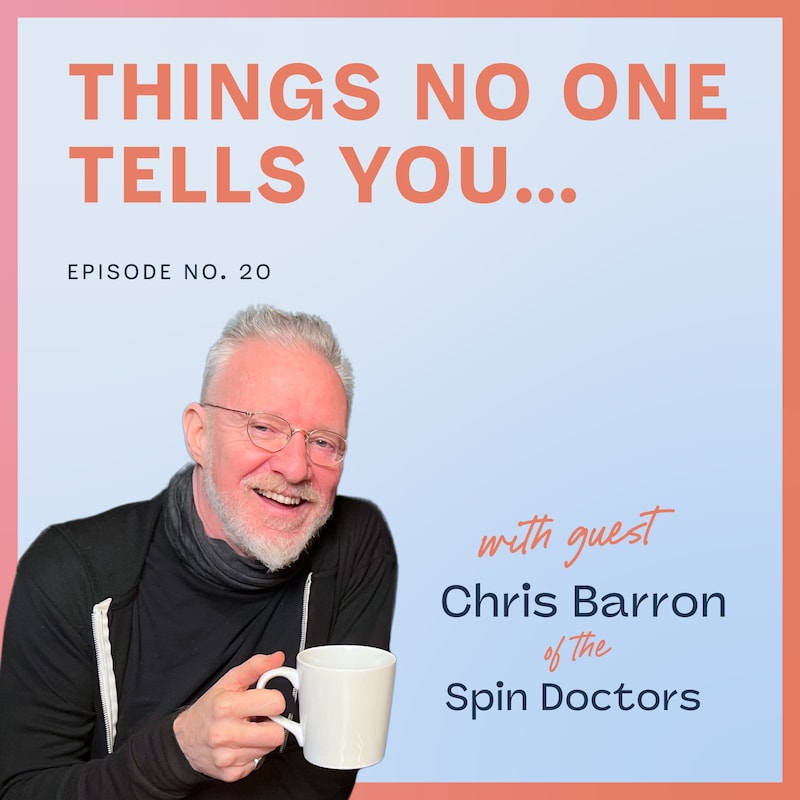
Shownotes
You probably know Chris Barron as the frontman of the Spin Doctors, the band behind iconic songs like the anthems “Two Princes” and “Little Miss Can’t Be Wrong.”
But in this conversation, Chris opens up about the life behind those songs: what it feels like to perform them decades later, how his relationship with music has evolved, and why he still finds magic in the moment the lights come up.
Chris joined me at home along with my neighbor John Nunziato, a branding and creative‑strategy expert. Together we talked about staying creative, the parallels between art and business, and what it means to love the work more than the fame.
What You’ll Hear:
How the Spin Doctors keep music fresh night after night (04:15)
What early fame really felt like (13:28)
Art, branding, and the secret to staying relevant (23:05)
Why creative joy beats chasing algorithms (27:56)
The real definition of staying relevant (31:50)
Reflections on joy, friendship, and creative purpose (40:00)
It’s a fun, reflective, and surprisingly relatable conversation about creativity, longevity, and loving the long game. Tune in to hear the latest from rockstar legend Chris Barron.
You can watch this interview on YouTube: https://youtu.be/ZFxDEqXrSzs
For a full transcript and more, check out our blog post: https://www.lindsaycz.com/show-notes/chris-barron-20
Check out more from Chris Barron:
You can follow Chris Barron on Instagram https://www.instagram.com/thechrisbarron_ or check out his website http://thechrisbarron.com/
See more about the Spin Doctors’ latest album, their touring dates, and other band updates on their website: https://www.spindoctors.com/
Transcripts
[00:00:24] I don't even know how to be like,
[:[00:00:27] Chris: 22, 23, something like that. I look over, and Dan Aykroyd is across the room, and I'm like, oh, I'm gonna go meet Dan Aykroyd. Go. Yeah. So I walk up to him with my bottle off, CCO, and he turns around, and I go, Hi, I'm Chris. I'm the lead singer of the Spin Doctor.
[:[00:00:49] Lindsay: Wow.
[:[00:01:01] Lindsay: Hey, guys. Oh, do we have a special episode of Things No One Tells You for you?
[:[00:01:26] I have come to know him, and I just absolutely adore him. He has this tremendous spirit, infectious, like enthusiasm for life. But his journey is incredible. So Chris and I have become friends. Additionally, my neighbor, John Nunziato, is a brand manager. He basically runs a branding agency. He is amazing at developing different products, helping them burst on the scene, stay relevant, etc.
[:[00:02:18] So Chris came to my house, and he drove up, and we decided we were gonna have lunch, have this conversation. So here it is, and we begin where John and I were waiting on Chris's arrival. This is so fun because Chris Barron, who is the lead singer of the Spin Doctors, the legendary rock group from the nineties, is coming over.
[:[00:03:00] It happened at a golf tournament where we kept running into each other and then. When we were hosting our event that we do in support of colorectal cancer awareness, they had, someone had to bow out at the last minute, and they said, You're gonna be so excited about who we got. And randomly, we're walking through the arena, and it was Chris Baron, and he brought the house down.
[:[00:03:20] John: Yep, yep. Gotten to know Chris. I was fortunate enough to have Chris as our fifth golfer in our group. Yes. On our super rainy day. He was amazing. We had special pants, by the way, for our group. We have to show up in his own special pants.
[:[00:03:37] John: No, he had his own pants. That just happened to work. So yeah. So we've been talking about branding and spin doctors and just what's next for them. Yeah.
[:[00:03:50] Chris: I should have done a handspring in or something.
[:[00:03:54] Lindsay: Oh, you wanna try?
[:[00:03:56] Lindsay: I don't wanna be liable for that.
[:[00:04:05] Lindsay: So good to see you. Thank you so much.
[:[00:04:11] Lindsay: So, Chris, catch everybody up to your latest projects and what you're working on.
[:[00:04:19] and, we are, we have a record. It's a really entertaining, amusing record. I think it's the best record we've made since Pocket Full of Kryptonite, our first and most successful record.
[:[00:04:56] Viewers might not like, might just know our hits, but those three guys are three of the best players of their era.
[:[00:05:10] Chris: It's musically talented. And there's this ongoing musical conversation that, that, when you're in a band, it's like being married, you it's like a marriage, it's like an artistic marriage, and it just goes on and on and you have that thing, where there's like that great Thornton Wilder quote from Our Town where he's talking about marriage and he's I thought. That's like your mother and me would run out of things to talk about in a week, and here we are all these years later, and we still have stuff to talk about.
[:[00:05:56] There's this like conversation going on where we're subtly like pushing and pulling and making small, little internal comments on the music that we're answering to each other. And it's not anything like that. The crowd would necessarily hear it as an effervescence and a spontaneous sort of feeling inside the music.
[:[00:06:41] And I hear that. And so I'll respond like maybe rhythmically to that just by varying what I'm doing very slightly. So he does something in the music, and then I do something in the music. It's all very subtle, but
[:[00:06:59] Chris: And we're just yeah.
[:[00:07:17] I look over at him and smile. Or yeah, sometimes it's just a way of locking together, where like Aaron is playing the rhythm and you can play something with the same rhythm, but you can put like an emphasis on a certain beat, on a certain moment in the music.
[:[00:08:02] Does this make any sense?
[:[00:08:13] ChrisYeahah. Is that what you mean? Yeah, exactly. It's sickening the can. It's a lot like kick the can..
[:[00:08:20] Chris: The game when you're like a kid,
[:[00:08:22] Chris: When you're a, the, I think the best version of that game is like that thing when you're a kid and you're just walking down the street and there's like a rock or a can or whatever in the sidewalk and you're having a conversation and the conversation, you're talking about school or whatever, people that you know and stuff, but you're also kicking that can, and then as time goes on, like the rules emerge about kicking the can.
[:[00:09:12] You're like, together make that decision. Are we just gonna leave that can behind and look for another thing to kick? Or is somebody gonna step off the sidewalk and kick the can and bring it back into the game again? And that's it, it's sort of like that with the musical ideas that are sort of floating.
[:[00:09:48] Yeah, meanwhile, you are constantly evolving it to a new place to entertain yourselves. Yes. And to amp it up. Yeah. But the crowd has to recognize it, as this is what I came to hear. And
[:[00:10:03] But if you are the kind of person who likes to think of everything as art, like life is an art, yeah. An art form. Then that's the art, like screwing around enough to amuse yourself while not messing it up for the outside observer or
[:[00:10:22] Chris: pushing it far enough to be amusing to you and even making it imperceptible for the audience.
[:[00:10:30] Chris: That's the art of it.
[:[00:10:50] Relevance, I guess. Right. The, and things like that. That makes sense. Does this apply? Does what he's saying apply to your world?
[:[00:11:06] And my idea is, how do you take something and a story, tell it through visuals?
[:[00:11:17] And what I find really interesting about it is that people will fall in love with a singular idea of what something is.
[:[00:11:40] Meanwhile, in my head, maybe you have this. I've got like a hundred other extensions of what I want to do from that nugget.
[:[00:11:58] Chris: I mean, one of the things I always say about songwriting is that what I'm doing as a songwriter, I basically don't think most people listen to the lyrics. And lyrics are my thing. And I always say I don't write lyrics because I think everybody is listening to them.
[:[00:12:38] John: This is how I make, this is how I should write lyrics.
[:[00:12:58] It has more meaning as you look deeper into it, but if you don't have to, it still works. If you're just kind of curs, give it a cursory list that still sounds good,
[:[00:13:28] Chris: Yeah.
[:[00:13:33] Chris: It's such a good question and. I think, not to get too deep about it, but we're in this kind of post-lockdown, post-COVID moment where everybody had to kind of reassess, what it is to, do you want to, do you wanna work as hard as you do?
[:[00:14:51] And like none of your family, this is so great, and you're like, I'm fucking terrified. I'm so scared right now. Kind. How do you get over that, though?
[:[00:15:04] Chris: That is the part that has always been the part that you finally feel normal.
[:[00:15:26] And so I, that part has always been the easy part. It's always been like, oh, showtime, I finally feel normal, which is weird because most people are like, this is the scariest thing. And, plenty of performers have a lot of stage fright too. I don't like the hour leading up to performing.
[:[00:15:43] Chris: 'cause I just want to go on, I just want
[:[00:15:47] Chris: Complain about how I hate that hour. Basically, we have, we have like at this point we have, like a scotch 15 minutes before we go on, a nd we just, we don't drink before a show. We're like, go on stage and we're prepared.
[:[00:16:29] John: You should write a song about that. I call it scotch.
[:[00:16:35] Lindsay: I love it. So when, and was there a, like a sort of a moment where, or a timeframe or an incident where you remember that feeling, that sort of, fear for the first time? Oh, we've made it, and this is,
[:[00:16:48] Lindsay: Like unknown.
[:[00:16:58] And he was always like a couple of steps ahead of me musically. Success-wise. And so it was great because I always had John to talk to. And this is a kind of an oblique answer to your question, but the thing that you're really afraid of, I think, when you have stage fright, is not being ready to go on.
[:[00:17:40] So whatever. But early on, I told John God, I don't know if I'm gonna be okay tonight. I'm like just yawning and yawning. And John was like, yeah, I always yawn a lot before kicking. I used to think that it meant I wasn't gonna be ready to go on.
[:[00:18:03] Chris: Yeah, of course. That's
[:[00:18:07] Chris: Yeah, he's he, he was like, I used to think I wouldn't be ready to go on. And I was like, oh, okay, cool. So that's normal. So there's a lot of just.
[:[00:18:15] Chris: There aren't a lot of people to be like, that's normal, and it's not a job. And you would understand this. It's not a job where you can be like it. Most people's jobs are like, guys, and kind of a sad, strange mood. Today I'm gonna hang out by the latter cooler and everybody leave me alone.
[:[00:18:46] Right. But you can't do that. You know how that is. Yeah. You can't show up with the mic in your hand and be like, you gotta be like ready to go. And you have to be like ready to kind of,
[:[00:19:17] Know, tell me about this. How do I navigate this? What's right. So sometimes that comes into it too. Do you and Craig talk about that stuff? Yeah.
[:[00:19:26] Lindsay: way. No, we do.
[:[00:19:31] Lindsay: We do. And what's funny is that John and his wife work in the same office, and they work together.
[:[00:19:53] So that is what he does well. He also thought, It's very clear to me the things that Melvin does well that I wish I were more like,
[:[00:20:12] That's just how I am. That's the beauty of it. More upside down, more right. Yeah, yeah. So sometimes it's, that's great. Sometimes it's like tension. But yeah, it's really fascinating.
[:[00:20:31] She can, we have this great expression, like she can read fly shit at 50 feet. Like, she can really read music really well. I can decipher music. Yeah. So I'm always just like. Always, my wife is a better musician than I am. And she's what the hell are you talking about? You're like the lead singer of this band, yeah, that you have platinum records in our bathroom. Like, how, but she is, she's sort of more together. And I really admire that about her. And shebut you're like a weird sort of unicorn, I think that's like the, I have that same oh, look at that butterfly kind of thing.
[:[00:21:12] Chris: There's a lot of power to that.
[:[00:21:32] And it's funny because Chris says, when I had reseen Chris at the foundational concert, yeah. I didn't know you were playing. I was standing in the back of the crowd, and you came up, and all I said in my head was, Wait, what is going on here. From my perspective, I was just like, and it just kept getting better.
[:[00:22:14] Lindsay: Well, like the same, the guy that liked the images of you and the hat, and just a hat, that was a question I had, is you also, that was the time of grunge,
[:[00:22:38] Chris: It was cool, I'll always be grateful to Nirvana because they kind of kicked the door down for everybody else.
[:[00:22:56] Lindsay: Oh God, I still have their pillowcases upstairs.
[:[00:23:05] Beautifully arranged. And what they were doing was like a really elaborate, cool thing at the time. I was kind of a punk rock, like Savage, coming out of my teenage years into my twenties, and just looking at things very differently. So we wanted to kind of bust that down, and Nirvana did that.
[:.[00:23:59] auditioned a kind of group, they're looking for bands that are kind of different. So that was, they made things a lot easier for us. And,
[:[00:24:20] There was a scene there. Did you question? Where you’re performing at that time, or so, I see this level of success. Should I borrow some of what they're doing?
[:[00:24:46] we were, first of all, we were too busy doing what we were doing to be paying a ton of attention, particularly the kind of scholarly attention that it takes to pick up on, we were already, we were already on the same kind of energetic, we were all already coming at music very aggressively, like the grunge guys.
[:[00:25:24] Excited, get people rocking or you're fired. And at the end of the night, they would tell us how much booze we sold. So at the end of the night, they'd be like, You, good job. You guys sold $3,500 worth of booze. We'd be like, Is that good? And they were like, well, boos Travelers sold $4,700 of booze like a couple of days ago, but nobody sells as much as Boos Travelers..
[:[00:25:55] Lindsay: That was your measure. He said, " Is it a good,
[:[00:26:16] Okay. Big, fat, funky booty. I gotta, we're in this room, we need to get these people going. We need to get them excited and buying liquor. And, so what I realized was that we were like, we were a lead loss. We were an attraction that was supposed to bring people into these rooms to sell beer.
[:[00:26:58] And that's what it's really all about in the like world and society that we're living in. And that's kind of what art is always gonna be like, kind of put in the way of people to satisfy an agenda. And then, meanwhile, the artists are like trying to get their licks in as best they can within those confines.
[:[00:27:33] Lindsay: That's kind of like when you hear bands, I think it was, I'm trying to remember if it was Zach Brown Band, maybe, or someone who was saying that.
[:[00:28:07] Chris: What's really going on? Yeah. Those people are being algorithmically forward so that people stay on the app for longer and more data.
[:[00:28:40] It's no,t it's not rendering, whatever content you're putting out there, it's not rendering that null and void. You're still getting your thing out there, but underneath it all, it's serving like another larger business purpose. That's part of the scheme of the society we live in.
[:[00:29:09] It's also working in a way to elevate you. Yeah. So behind the scenes, which is really neat. We've worked, we've done some work together, so I can see everything that's happening. And then I can tailor the marketing based on the feedback that we're getting on the art you're producing.
[:[00:29:42] John: For you, money that goes in your pocket.
[:[00:29:47] Lindsay: So, yeah. And I, because I am curious about how you define, what is the approach of Spin Doctors, right?. To, for the marketing and for, just to give you the best shot at, I don't wanna use the word, and I wanna ask you that.
[:[00:30:11] Chris: Our bass player isn't in the band. He was like, during COVID, he wouldn't get tested. He wouldn't like to wear a mask. He wouldn't get vaccinated.
[:[00:30:47] So when they weren't out on the road, they were dressed like they would be on stage. So, like us, it's funny because we were neighbors. Jack and I were neighbors, and we'd see each other in the elevator, and I would be like, This guy. Amazing. He'd be in the elevator with a vest on. He's like rail skinny, with like laces and leather pants that were like bell bottoms, laced up the side, and like long, pointy, like snake skin boots.
[:[00:31:33] And he is so, he is looking at me like, wow, this guy's a specimen too. So now that's Beck Jack. Jack is, Jack's, like Jack's in the band now. And we made the most recent record at his studio. And, so yeah, it's, and I'm sorry that things didn't work out with Mark after all of these years.
[:[00:32:29] And being on stage together is being on stage, your brain doesn't know the difference between being on stage and. A very dire situation. You walk out and see, even though I want to be there, being on stage is like tons of people in front of you. Somebody could throw something at you and break your face, or you know what I mean?
[:[00:32:50] Chris: I have, yeah. I got my nose split open in Spain by, like, a big chunk of ice. Somebody like hit me dead on the nose, I, I was like bleeding. Were they trying to reinforce…
[:[00:33:03] Chris: It was a motorcycle race.
[:[00:33:13] Honestly, do you try to duplicate that, or do they enhance what you have?
[:[00:33:47] And when Mark was gonna leave the band, I was like, Alright, break up the band. And Aaron, who's worked with Jack a lot, Aaron, our drummer, who's worked with our new bass player, Jack, was like, Look, let's finish out the summer. We've got six or seven more gigs booked. Let's finish out the summer with Jack, and then we'll decide what we want to do.
[:[00:34:45] John: On brand feel.
[:[00:34:55] Lindsay: Have you gotten a sense of what public perception is of where the band is now?
[:[00:35:48] I'm like, I'm a musician. What kind of musician? Rock and roll. Are you in a band? Yes. What's the name of your band? Spin Doctors. And then they like poop. They're just like, what? That's crazy. I love you guys. And then they say Are you guys still together? Right. Which is kind of maddening.
[:[00:36:08] Lindsay: Why ist maddening? What do,
[:[00:36:31] John: And this is, here the branding and marketing, yeah. Comes into all of this. Yeah. Yeah. I think people hear music, they see a record, they see the album cover, they see a logo, they see whatever it is for that time period, and for however long it lasts.
[:[00:37:03] So I almost felt as though you came, you showed up, the music was great, and it became a piece of history.
[:[00:37:08] John: Whereas now you have the opportunity to not only tell that story like you're doing right now, but. Well, let people know that you're very much still here.
[:There's something about that feeling when you're like, yes, I'm right. Yeah. Yeah. And you're like, I literally had this conversation yesterday with my therapist, and I'm just gonna be honest about this. Yeah, because we were like, I was like, I don't know what it is. Like I, I wanna talk sports.
[:And it's, I don't know that I'm making sense articulating, making sense, YeyeahArticul. But it's a weird feeling when you're like, oh yes, you're, you're still doing things in a certain way. And obviously mine's very different from songwriting and performing, yeah.
[:[00:38:17] John: You said what you said to me, which I thought
[:[00:38:19] John: Sorry.
[:[00:38:20] John: Yeah. Well, being seen. But then what he said to me is that people would think that you would stop writing music after you're done. Right. You're probably done and retired, and you made some music, and you're really happy with that.
[:[00:38:43] Chris: everybody. Not everything. Everybody says just stuff that I'm storing.
[:[00:38:48] Lindsay: It hits you like a wall.
[:[00:38:55] Chris: Music hits me like a stream of ideas.
[:[00:39:02] Chris: Anytime. Like I am, I went through a period of time where it was really hard for me to listen to recorded music because I hear the chord progression.
[:[00:39:29] I'm like, listen here, I go along. Or it's like a connection to a fee. li..ng
[:[00:39:38] Chris: I hear like this chord progression. I hear the production of the, like that they used, like this particular kind of reverb on it.
[:[00:40:04] So I hear, we're trained to be able to hear these ideas. Trained to be able to hear what the time signature is, and what key it is in? How did the notes all go together mathematically? So, my daughter years ago was like, Can I just put on the pop station? We're driving through LA. I was like, yeah.
[:[00:40:39] I was like, I know what you mean, but all music comes at me like, like this string of ideas. Well,
[:[00:40:57] But I had said to you, your music came from a time when it was real. It felt more real. The sound, the lyrics, the instruments. There was a computer.
[:[00:41:14] John: Well, I felt like when you were up on stage, and I turned around and I said, What just happened?
[:[00:41:39] and I thought about you because you were part of a generation that everyone remembers. It was good, it was clean, happy, fun music. It was a little cheeky, a little edgy. And you have a certain style. I called him the other day. I said, I, when after I listened to your music, I was just writing down things that came to mind, I was using his style, which is just writing down things that came to mind.
[:[00:42:19] Chris: Popsicles made with cake,
[:[00:42:24] Except it's bendy. That's him. So when he hits the stage or when he gets animated, and then yeah. Sweet and
[:[00:42:31] John: Chris, he bounces. He has to bounce. You've gotta bounce. That's what you're thinking, and so that's something that is part of you, part of your brand. Nobody has that.
[:[00:43:07] But I think there's an aspect of virtuosity that is, being so fluent in what you do, so fluent in, in, in whatever your medium is that you can fully express your personality through that medium. So the idea of playing a guitar isn't necessarily being able to play a million notes, being able to play really fast, being able to play every scale.
[:[00:43:53] Your true self will come through. And so that's why we never really imitated anybody else, 'cause we were just trying to be so good at what we did play so well that we could be us. We weren't trying to be anybody else beyond that. We were really, actually trying to express a truth about ourselves.
[:[00:44:34] Are you doing it? Does it come naturally for you?
[:[00:44:42] Chris: cause if it's going out into a void, then what's what is it? Right. What is it?
[:[00:44:50] It's a different, it's a unique time, like in our industry and certainly in yours, which is, I think why the. Why? Yeah. I'm curious about the approach that you guys now have with branding. Yeah, is it different? Is it like, what would you say it is?
[:[00:45:24] And that one, it's really encouraging, but two, what I think is happening is they're like these, there's no loops. There's nothing like this; this is just four people, like playing the crap out of their instruments. And it brings me back to when I was a kid, and I would go and see a band and just be like, glued to the band.
[:[00:46:08] It was great. Bands started with great playing. Now that's sort of exceptional because there's so much other stuff that can be happening besides great playing when you see a band playing. So these kids are just like looking, so what's, what hasn't changed is that desire to like just play our asses off and play like beautifully with a great big tone.
[:[00:46:53] We're like, young people are looking at us, going This is cool, what these guys are doing. So we realize we can be a conduit, to cool, to that sort of 20th-century way of playing. But then there are a thousand other modern tools that are available for promotion, which is where you bring somebody like
[:[00:47:13] But which is where I think everyone can make the mistake because, you can tell the, you can be completely over-branded and people can see right through it.
[:[00:47:22] John: So, and I think a lot of people aren't telling the story the right way. Really true, authentic story that you have, that you both have.
[:[00:47:52] Lindsay: So what would you say from your time spent is Chris slash the Spin Doctor's real story, or are you saying it's Chris's story that you think that lean into?
[:[00:48:14] They're in and out pretty quickly. You've stood the test of time, you have incredible history and stories, and what you, what Chris has been able to do is maintain his sound and energy throughout your entire career, and sex appeal. I mean, that was the thing. You tried golfing with this guy.
[:[00:48:33] Lindsay: And I dunno if my uncles could bounce
[:[00:48:38] Chris: jump a lot of rope.
[:[00:48:43] Chris: Yeah.
[:[00:48:47] So I think you have the ability to connect with all different ages in a really humble, genuine way. And I think that the branding should be as honest for your brand.
[:[00:49:07] Radio stations ending and marketing to have
[:[00:49:24] You look in the paper and there'd be like, we were on the same label, as Pearl Jam. So Pearl Jam would have a full page ad, and we'd be like, there'd be like nothing about us. And it happened over, you're like,
[:[00:49:39] Chris: And then at one point, a guy named Jim McGinn wrote this, a radio guy from a station called EQX.
[:[00:50:04] Yeah. And, more people came in and bought a pocket full of kryptonite in this, in the record store. Wow. Then bought Tung Baby during YouTube's Yeah. Oct baby product. And then, he just had all these like stories of there was a club called Bogeys, in Albany, New York. And he was like, we went to see the band there, we were on the guest list, but as we were walking past, there was a line around the block, and it was 20 below, the snow was coming down like an inch an hour.
[:[00:50:54] So there's, it works in, in, in answer to your question. Yeah. These media companies have a tremendous amount of power. And, also, there are other stories like Phish, where people do it on their own. Yep. And, but you know, I'm friends with those guys, a nd we always have these conversations where I'm just like, you guys did 13 nights at Madison Square Garden?
[:[00:51:43] Lindsay: So, was there a moment in that where it was like this sort of, aha, okay, here we go, we made it. That was just like a memory that you have that was pretty incredible.
[:[00:52:27] I don't think they were at the party. And I'm like, what am I gonna order at the bar? What's the most Rockstar thing I could get at the bar? And I was like, I'm gonna order, I'm gonna go over to the bar,and I'm gonna order. I'm like 22 years old, I don't even know how, I don't even know what I'm doing here.
[:[00:53:11] I'm just like, walking around. So I'm talking to Joe Pesci, whom I'd met during the show. That's a whole funny story. And then, I look over and Dan Aykroyd is across the room, and I'm like, oh, I'm gonna go meet Dan Aykroyd. But I was like, what am I, what is my, what's my. DePuy, what's my point of departure with him?
[:[00:53:40] Lindsay: I love that you prepped your yeah in your head conversation.
[:[00:53:49] I'm the lead singer of the Spin Doctors. And he goes, I know. And I was like, and that was it. I was like, Dan Aykroyd knows who I am.
[:[00:53:58] Chris: Yeah. Like I have arrived. It's all. That was the first day of the rest of my life. Kind of, the first moment of the rest of my life.
[:[00:54:11] Chris: A lot of work went into that moment. Yeah. A lot of like vans, but for sure, I mean, there's another story 'cause I think this moment in time. Is this moment where everybody's sort of like looking around at what is like affluence or what everybody's like, kind of taken a moment to, we all jumped off of like the gerbil wheel for a minute during COVID and everybody's do I want to get back on that wheel or do, I want to make another wheel or do I just want no wheel at all?
[:[00:55:03] The club was two clubs. It was Mondo, Connie, and Mondo Perso. And we played like a weekend night, and they paid $500 on a weekend night. So, we split the money between the four guys, and we have a manager, whose name is Jason, and he got his a hundred bucks. We all get a hundred bucks.
[:[00:55:44] Sit down, look at the menu. I'm like, do I want a fried egg sandwich, which is what I usually got when I was in a restaurant, 'cause they were like $2 and 50 cents back then or something. And I was like, What am I gonna eat? And then I was like, I have a hundred dollars in my pocket. So I ordered like a T-bone steak and like a bunch of sides.
[:[00:56:20] We had some big paydays and we. Had some huge concerts and there were moments of like serious, like money or, things like opening for people or like playing with people. Was that, I mean, the, we open up for the Stones. We, there was a moment where we're on the tour bus after a gig and our, we've been paid partly in cash and there was like a wad of cash, like this big, and the, there were like moments, we'd signed, we signed deals where the advances were like really big and it was all these like moments, after that.
[:[00:57:07] John: Yeah. Like you're being paid.
[:[00:57:12] Lindsay: And what did the, why, what did that mean?
[:[00:57:20] Chris: I mean, kind of. Yeah. There was the thing that I got paid 100 American dollars tonight to just sing songs I wrote.
[:[00:57:34] Like when you're describing the way music hits you, I'm like, that's really rare, obviously to you. Yeah. And what a, it just makes you think too about just the talents or gifts or things that, that we have. Right. That sounds super cheesy, but seriously, it doesn't know. It doesn't wait. So, what was the experience like opening up for the Rolling Stones, or opening for them is the right phrase.
[:[00:58:14] I mean, an aesthetic purpose. Not like they weren't building a table on stage, but they were like, every time somebody moved, someone else would fill in the space that they had moved out of. It was just beautiful to watch. They could do anything while they were playing with guitars and walking around, giving each other, like on the beat.
[:[00:58:33] Chris: Everything was just so,
[:[00:58:40] Chris: It was, like, one of those moments when you're like, you are 20, seven years old, and you're still trying to like, do what you're doing as best as you possibly can. And then you're like, how do I do that?
[:[00:59:13] They were, I was at Keith Richards' birthday, and Ron Wood was wearing a Gordon's fisherman, like a rubber hat, like a yellow hat. And he comes over to me, he is Chris, Mike, how are you going? And he grabs me, and I'm like, good man. And he is like, How's the tour? And I was like, you guys are great.
[:[00:59:52] and as in life, Ron's you've seen the band 10 times. Keith. Keith turns around, handChris has seen the band 10 times. He goes, You've seen the band 10 times. And then Ron's Chris, have you had a chat with Mick? And I was like, whoa. I met Mick, but I didn't have a chat with him per se.
[:[01:00:13] Lindsay: And you're feeling what at that moment? What's going through?
[:[01:00:30] And then Ron goes, Chris has seen the band 10 times. And Mick goes, You've seen the band 10 times. I'm like, dude, you're Mick Jagger. Yeah. But yeah, it was, it was a tremendous learning experience watching that. Wow. Just like watching the perfect, you think about cool, and you look at ,g and you're like, wow, they're cool.
[:[01:01:15] They are the reason the concept of cool came into being.
[:[01:01:21] John: You know what it is, though? It's because they're so authentic, and it's, it is, they are like fluid, like water. When you say someone fills a spot, they really do. It's not a preconceived show. It's just whatever happened naturally, and they just have a swagger.
[:[01:01:39] Lindsay: Well. And it's not that different from what people feel when they watch you guys, and for why they light up when they hear that music again. Like you did, you saw it was like, because you're just doing the authentic thing. It's Jalen Hurts, the Eagles quarterback.
[:[01:02:16] So yeah. To that point, where does this go?
[:[01:02:24] John: The thing,
[:[01:02:38] Rather than the grit and the happiness. They're not going to get the success.
[:[01:02:46] Chris: And you can't think about it,
[:[01:02:48] Chris: I think it is hard. I think it's hard because we live in this, like, detached kind of world where so many things are abstracted from, the main thing, cause we're like looking at our phone at a rhino instead of going on a safari and actually looking at a rhino.
[:[01:03:26] but you're so talented and I'm like, the people refuse to like, take in the main thingness of the main thing. And it really does. It's much simpler. What's complicated is sort of like waking up every day and being like psyched to put that work in. But you know, I had a conversation with this woman years ago, and she was part of an illegal syndicate that was writing papers for college students.
[:[01:04:01] These people were like, they were the smartest people I'd ever met. It's like the past version of AI. Yeah. And we're just getting hammered in a bar. And I was talking to this woman, and she was actually saying to me, I don't know whether I want to be a brain surgeon or a rocket scientist.
[:[01:04:41] You guys saw me like on stage and you're like, he's got a lot of energy. 'cause I jump fucking rope, man. I just like jump rope a lot, it's so much fun every time. Yeah. It's not like a but it, but the difference between people who, most people who you know do something really well and people who do it not that well is the amount of like time and effort.
[:[01:05:06] John: It's a craft that you've taken the time to work on through the love of the project of music and what you feel is marketing naturally
[:[01:05:22] John: Well, great brands grow with people. They don't just shove it. If you shove it in front of someone, it's a short life.
[:[01:05:33] John: It's the real thing
[:[01:05:36] John: And it'll evolve. It'll evolve like a good friend or a band member with you as you evolve.
[:[01:05:54] Lindsay: So this leads right into a couple of rapid firsts that I love to do.
[:[01:06:07] John: Elastic cake pop.
[:[01:06:16] Lindsay: Elastic cake pop. You know it's coming. I'm rendering that. It's your Christmas present. You
[:[01:06:22] Lindsay: Best, best part about being a rock and roll star.
[:[01:06:43] Like all alone. Nobody there. Everyone's asleep. What's there? Music like, feel, feeling a note. Fill up a room. The essence of the music itself and being that close. That is, it's magic. It is actual magic.
[:[01:07:12] Lindsay: That's deep. Incredible.
[:[01:07:23] John: But the thing is, I think motivator. You do that because music is such an interesting art, because someone can look at a piece of art on a wall and have a reaction to it, but every time a song comes on, especially with whatever you were doing at that time, that music has a recall.
[:[01:07:51] Chris: A person,
[:[01:07:58] Chris: It really is magic. The, like, where is a song when you're not singing it or hearing it?
[:[01:08:45] Then there's this other Part of music that makes no sense, and it isn't really like a real thing that you're working with in the sense that a table or other kinds of objects that somebody might work with are, and that's, to me, I get endless, like mystery and enjoyment. So it's like I'm still excited about doing it, I get up and you guys see me play it, and you have a response to it because I'm still endlessly mystified and excited and interested in what I do because I know I'll never get to the bottom of it.
[:[01:09:25] Lindsay: That's very cool. Cheers.
[:[01:09:28] Lindsay: Cool. Cheers. Coffee drinkers.
[:[01:09:49] Because it just made me think if someone, if that is what it likes to have the gift that he has been given. Wow. What is that like for other people? And it made me really think about people who have talents that are in the arts, or whatever your talent is. Do you just react differently to those things?
[:[01:10:36] Chris talked about his new music, and I hope that you will check out all the things that we have to say with things no one tells you. So, as always, it's great having you here. Thanks, John. Thanks,Chrisi, for driving up in your Subaru and,
[:[01:11:05] Listeners, we would love to grow this community. We are so grateful that you're a part of it. See you next time.




