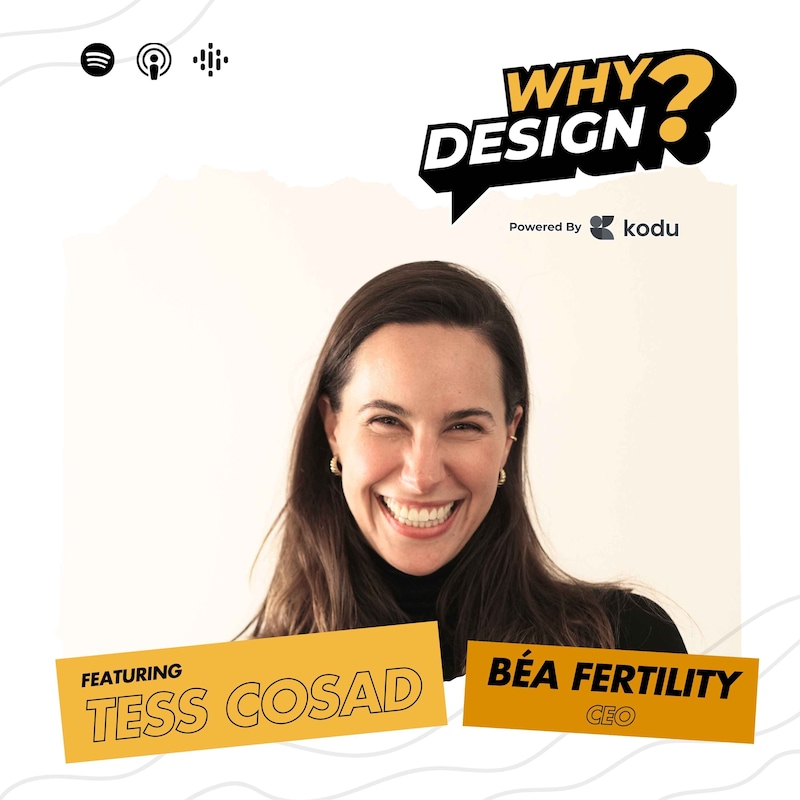
Shownotes
What if the most important fertility treatment of the last decade wasn’t invented in a clinic, but built from scratch, during a lockdown, by someone who had never worked in medicine?
In this episode of Why Design, Tess Cosad shares the belief that sits at the heart of Béa Fertility: that compassionate, clinical-grade care should be available to everyone, not just those who can afford a private clinic, survive a two-year waiting list, or live near the right postcode.
Rather than accepting the gap between DIY conception and IVF, Tess chose to fill it.
That decision led her through 283 investor pitches, a chronic health condition brought on by founder stress, and a phone call from a user in her hospital bed, the day after emergency surgery, who said she wanted to try again.
This conversation isn’t about fertility as a product category.
It’s about design as access.
Design as dignity.
Design as a force that changes what’s possible for real people, in real pain, right now.
Don’t just listen. Go beyond the podcast.
In this episode we’ll learn
- Why intracervical insemination existed before IVF, and why it took a lockdown founder to bring it home
- How lived experience, not research studies, solved the product’s biggest usability problem in a single session
- Why compassion and levity aren’t soft brand choices, they’re clinical design decisions
- What 283 investor rejections reveal about structural bias in venture capital, and how to keep going anyway
- How Béa is building for the US market, and why it’s already outperforming revenue forecasts by nearly 100%
- Why the hardest part of scaling isn’t the product, it’s the loneliness, the letting go, and the coping mechanisms that actually work
Memorable Quotes
“I want to try again.”
“You can’t do your entire career on level 10 difficulty and not come out of it better at your job.”
“283 pitches to close 15. That’s the fundraising reality of femtech.”
“She flipped the diagram. And that was it. One session.”
“Make decisions fast”, the advice I ignored too long.”
Resources & Links
🎧 Listen on Spotify, Apple Podcasts, YouTube & Amazon - whydesign.club
👥 Join the Why Design community - teamkodu.com/whydesign
📸 Follow @whydesignxkodu on Instagram & TikTok
📸 Follow @kodurecruitment on Instagram
🎥 Watch full episodes - YouTube
🔗 Follow Chris Whyte on LinkedIn - Mr Chris Whyte
🔗 Explore Béa Fertility - beafertility.com
🔗 Connect with Tess Cosad - [email protected] / LinkedIn
About the Why Design
Why Design is powered by Kodu, a specialist recruitment partner for the hardware and physical product development industry.
Through honest conversations with designers, engineers and creative leaders, we explore not just what they build, but why they build it, the beliefs, decisions and responsibility behind meaningful work.
About Kodu
Kodu is a specialist recruitment partner dedicated to physical product development.
We connect hardware brands and design consultancies with the very best design and engineering talent, from Industrial Designers and Mechanical Engineers to senior leaders across Product, Technology, and Design.
Our clients range from well-funded start-ups and scale-ups under investor pressure to deliver, through to mature enterprises building new innovation teams. They often face the same challenges: scaling beyond generalists, attracting talent without a recognized employer brand, or struggling with slow, inconsistent hiring processes.
We solve these hiring problems with a proven 7-stage recruitment framework, a proprietary hardware network, and storytelling that builds trust with candidates. This results in a faster, smoother, and more engaging hiring experience.
Kodu consistently delivers results that exceed expectations, with an average time-to-offer of 6 weeks, 97% retention after 12 months, and an all-time NPS of +91 (versus the recruitment industry average of +30).
We act as trusted partners, helping hardware innovators hire better, scale faster, and bring groundbreaking products to market.
🔗 Learn more - teamkodu.com
Transcripts
(Transcribed by TurboScribe. Go Unlimited to remove this message.) Imagine wanting a child and realizing the system
Speaker:wasn't built for you.
Speaker:Not the waiting, not the confusion, not the
Speaker:silence.
Speaker:They're frustrated, it's not working, they don't know
Speaker:what to do, they see their partner going
Speaker:to the ends of the earth and experiencing
Speaker:this emotional stress and trauma.
Speaker:What if fertility care didn't begin under fluorescent
Speaker:lights, but at home with clarity, guidance and
Speaker:control?
Speaker:This is Why Design, where we go behind
Speaker:the scenes of the products shaping our lives
Speaker:and the people brave enough to build them.
Speaker:I mean, to be honest, that first year
Speaker:was really principally just me trying to figure
Speaker:out, like, how do I grapple with what
Speaker:this idea is?
Speaker:What is the vision?
Speaker:What's the potential?
Speaker:Is it actually feasible?
Speaker:In this episode, I'm joined by Tess Cosad,
Speaker:CEO and co-founder of Bayer Fertility, a
Speaker:company building clinical-grade fertility treatment designed for
Speaker:the real world, outside the clinic and inside
Speaker:your life.
Speaker:But this story isn't about tech, it's about
Speaker:stakes.
Speaker:Because early on, one of their first users
Speaker:called from a hospital bed after an ectopic
Speaker:pregnancy.
Speaker:She had emergency surgery.
Speaker:She's down a fallopian tube that impacts your
Speaker:fertility.
Speaker:And yet, here she is saying, I'm going
Speaker:to try again.
Speaker:And I just thought, my goodness, we've really
Speaker:built something here.
Speaker:That moment changes what product means.
Speaker:It changes what design means.
Speaker:In this episode, we talk about designing in
Speaker:the hardest category there is, regulated medical hardware,
Speaker:patient trust, and the emotional reality no pitch
Speaker:deck can capture.
Speaker:I'm Chris White, and this is Why Design.
Speaker:And Tess, welcome to Why Design.
Speaker:Great to have you on the show.
Speaker:Great to be here, Chris.
Speaker:Yeah, wonderful.
Speaker:Well, we're going to dive in.
Speaker:So Tess, you're the CEO and co-founder
Speaker:of Bayer Fertility.
Speaker:You're building clinical-grade fertility treatment that people
Speaker:can use at home.
Speaker:You've raised venture funding, launched in the UK,
Speaker:and now you're doing it all again in
Speaker:the US.
Speaker:But before we get into your background, tell
Speaker:me about a moment where everything shifted.
Speaker:When did this move from, you know, interesting
Speaker:problem to, I'm willing to risk everything on
Speaker:this?
Speaker:Uh, hearing you use the mouthful of clinical
Speaker:-grade fertility care, even I had to remind
Speaker:myself what that is.
Speaker:So a moment that everything changed.
Speaker:It's interesting.
Speaker:It didn't actually all change for me until
Speaker:a little while into the journey of building
Speaker:Bayer.
Speaker:Obviously, one of the things that we do
Speaker:at Bayer is we make babies.
Speaker:We help people make their babies.
Speaker:And we started the company in 2020.
Speaker:We closed our first round of funding sort
Speaker:of early 2021 and started to build the
Speaker:product.
Speaker:Sort of brought in a team, raised more
Speaker:funding.
Speaker:It was sort of the venture go-go
Speaker:days.
Speaker:So we raised a lot of funding and
Speaker:scaled up quite a big team.
Speaker:And we're sort of building this medical device
Speaker:and this treatment experience.
Speaker:And on some level, I understood that it
Speaker:was real.
Speaker:And none of it quite hit home until
Speaker:one of our users, one of our very
Speaker:first users, called us from the hospital because
Speaker:she'd conceived with her first Bayer device and
Speaker:had an ectopic pregnancy and was in hospital
Speaker:having had emergency surgery to remove the fallopian
Speaker:tube.
Speaker:And at that point, we'd actually already had
Speaker:reports of positive pregnancies from other users.
Speaker:And don't get me wrong, those were incredibly
Speaker:impactful moments.
Speaker:But this, I think, was the moment for
Speaker:me that it became so very real because
Speaker:we had someone who had a horrible experience
Speaker:and cared enough about what we were doing
Speaker:to call us from the hospital the day
Speaker:after her surgery and say to us, I
Speaker:want to try again though.
Speaker:I am going to try again with Bayer.
Speaker:And I just thought, my God.
Speaker:I think two things hit home for me
Speaker:in that moment was the gravity of the
Speaker:thing that we were doing.
Speaker:I always used to say, oh, we're changing
Speaker:lives.
Speaker:We're changing people's lives.
Speaker:And it feels like such an airy fairy
Speaker:and a sort of like blithe thing to
Speaker:say.
Speaker:And of course, you're helping people conceive.
Speaker:Yeah, their lives are changing.
Speaker:But in this moment, it had never felt
Speaker:more true to me that this woman, this
Speaker:brilliant, brilliant woman, ectopics are high risk, right?
Speaker:She had emergency surgery.
Speaker:She's down a fallopian tube.
Speaker:That impacts your fertility.
Speaker:And yet, here she is saying, I'm going
Speaker:to try again.
Speaker:And I just thought, my goodness, we've really
Speaker:built something here.
Speaker:Wow.
Speaker:Yeah.
Speaker:What a way to start the podcast.
Speaker:Did she keep in touch?
Speaker:Did she?
Speaker:She did.
Speaker:And she conceived again safely.
Speaker:Her baby boy is.
Speaker:Amazing.
Speaker:Oh, he's going to be turning.
Speaker:He's probably turning one this year, I think.
Speaker:That's amazing.
Speaker:It's pretty cool, huh?
Speaker:That is really cool.
Speaker:You know, you're right.
Speaker:We do throw this kind of changing lives
Speaker:around.
Speaker:I've literally said it to people that worked
Speaker:for me before in my profession.
Speaker:You know, we are, you know, what we
Speaker:do is changing lives in some sort.
Speaker:And I suppose you could say that about,
Speaker:you know, most kind of things and services
Speaker:that are impactful.
Speaker:But yeah, you really are there.
Speaker:And that's, you know, if you need a
Speaker:reason to come to work every morning.
Speaker:It's a pretty good one.
Speaker:Many more.
Speaker:Yeah.
Speaker:It's a pretty good one.
Speaker:And it's interesting.
Speaker:Anytime I'm dealing with a really big fire,
Speaker:the universe gifts us a positive pregnancy report
Speaker:just to remind us that like you're doing
Speaker:the right thing.
Speaker:Huge.
Speaker:Yeah.
Speaker:And it's, you know, we often get caught
Speaker:in that moment of kind of like, just
Speaker:before we started recording, you know, you said
Speaker:you're putting out a tiny fire, you know,
Speaker:and we're dealing with those day in, day
Speaker:out.
Speaker:They're all distractions from, and when you step
Speaker:back, you think about the impact that you're
Speaker:having, you know, and then to everyone that's
Speaker:listening, you know, you're having impact, whatever you're
Speaker:doing, whatever that moment you're in, you know,
Speaker:think about kind of trying to think about
Speaker:the bigger picture.
Speaker:And what a big picture you're having there.
Speaker:So that was amazing.
Speaker:Thank you.
Speaker:Thank you for sharing that.
Speaker:Of course.
Speaker:Let's dive back to the beginning then, because
Speaker:your journey, really your career, it started off
Speaker:marketing, if I'm correct, you know, and research
Speaker:at an astrophysics laboratory, you know, so a
Speaker:bit of a, you know, stratospheric jump.
Speaker:So how did you find yourself, you know,
Speaker:tell us about that journey from kind of,
Speaker:from marketing and research into, you know, devices
Speaker:and fertility, you know, and kind of being
Speaker:a founder of a hardware company?
Speaker:Yeah, it's, I wanted to be an astrophysicist
Speaker:a very long time ago.
Speaker:And I'm one of those wonderful cases where
Speaker:my mathematical abilities were not quite up to
Speaker:my career ambitions.
Speaker:So I tried, I tried really hard and
Speaker:then I went to business school.
Speaker:It's where some of us failed STEM people
Speaker:end up, I suppose.
Speaker:So that was sort of a very humbling
Speaker:moment that arrived fairly early on for me.
Speaker:So I went to the business school and
Speaker:sort of always said to myself, my dream
Speaker:early on was I wanted to have an
Speaker:office and a cubicle.
Speaker:And I wanted one of those little lanyard
Speaker:badges that clips pull out, tap in, you
Speaker:know, the kind of all those things felt
Speaker:very cool to me.
Speaker:And I went, totally, absolutely, sort of look
Speaker:back on it and laugh.
Speaker:But that felt very cool at the time.
Speaker:And, and I tried to apply to all
Speaker:of the consulting firms and got rejected randomly
Speaker:from every single one of them.
Speaker:So another sort of humbling experience that taught
Speaker:me that perhaps my future was not in
Speaker:a cubicle, but I didn't quite know where
Speaker:my future was.
Speaker:And that was when I created my first
Speaker:startup actually.
Speaker:Sort of not in a typical arrangement, but
Speaker:I went to work for a bigger media
Speaker:company that were trying to create a venture
Speaker:studio.
Speaker:And they funded a project that I brought
Speaker:to them that we were working on.
Speaker:And at the time we built this incredible
Speaker:technology.
Speaker:I did not speak to a single user
Speaker:because I was too shy.
Speaker:So learned that lesson the hard way and
Speaker:launched this amazing technology only to realize that
Speaker:A, it was a little bit ahead of
Speaker:its time.
Speaker:And B, most of the people who we'd
Speaker:built it for were like, ha, that's really
Speaker:fun, but why do I need this?
Speaker:So of course, humbled yet again.
Speaker:And that is when I made the jump
Speaker:into marketing.
Speaker:So I was offered the opportunity to start
Speaker:in that agency as a part of a
Speaker:wider group.
Speaker:And I jumped on it.
Speaker:And I had the best time working with
Speaker:some phenomenally interesting companies, sort of really got
Speaker:deep into strategic branding, positioning, storytelling, sort of
Speaker:developed a bunch of skills that I think
Speaker:serve me now, although, you know, jury's out.
Speaker:But had a really great time building that.
Speaker:But I really was kind of itching to
Speaker:build something.
Speaker:I'd always wanted to build something.
Speaker:And there were two things that I was
Speaker:like phenomenally passionate about.
Speaker:One was creating something that did some good
Speaker:in the world and specifically solved an inequity
Speaker:that felt arbitrary and unfair to me.
Speaker:And two, I was very driven to create
Speaker:a company where people would just love to
Speaker:come to work.
Speaker:The idea of creating something where people loved
Speaker:coming to work felt so powerful and so
Speaker:fun to me.
Speaker:And right around, I'd sort of been running
Speaker:the ad agency for a few years, went
Speaker:freelance.
Speaker:And then I met an embryologist who was
Speaker:talking to me about this idea.
Speaker:I never actually saw myself in fertility.
Speaker:Honestly, it was not on my radar.
Speaker:Of course, you're in your 20s.
Speaker:Like, when is it ever?
Speaker:For some people, it is.
Speaker:For me, it wasn't.
Speaker:And so I sort of met an embryologist.
Speaker:We were talking about the space and the
Speaker:technology.
Speaker:And I think two things happened.
Speaker:One is I really started to see with
Speaker:my own eyes the inequities that exist in
Speaker:fertility in particular and how we've landed with
Speaker:a system that enables people with money to
Speaker:have babies, healthy babies, and people without money
Speaker:to just struggle alone and take chances.
Speaker:And that really, like, plucked at that.
Speaker:Well, hang on a second.
Speaker:That's not fair, that sort of desire.
Speaker:And then, yeah, creating a company where I
Speaker:was able to build a team and start
Speaker:creating that sort of culture.
Speaker:Yeah.
Speaker:And it was the early days were really,
Speaker:really fun.
Speaker:Really hard, but really fun.
Speaker:Yeah, because you started, well, according to LinkedIn,
Speaker:at least, started in 2020.
Speaker:You said you raised first fundraising in 21,
Speaker:I think you said earlier.
Speaker:So starting a business during a global pandemic,
Speaker:you know, how was that?
Speaker:Yeah.
Speaker:I incorporated the company literally three days after
Speaker:we went into lockdown, I think.
Speaker:So we're a real pandemic baby.
Speaker:It was interesting.
Speaker:I mean, to be honest, that first year
Speaker:was really principally just me trying to figure
Speaker:out, like, how do I grapple with what
Speaker:this idea is?
Speaker:What is the vision?
Speaker:What's the potential?
Speaker:Is it actually feasible?
Speaker:You know, what we're actually talking about here,
Speaker:the core technology that we built was a
Speaker:medical device that allows someone to perform a
Speaker:clinical insemination procedure on themselves at home.
Speaker:And so if I were to put that
Speaker:into sort of clearer language, we need to
Speaker:create something that allows someone to reliably find
Speaker:their cervix themselves.
Speaker:I know a lot of medical students that
Speaker:can't find cervix.
Speaker:And so there was like a real design
Speaker:challenge in the early days that was like,
Speaker:wow, is it actually feasible?
Speaker:And then, of course, the pivotal question is
Speaker:you need money to build regulated medical hardware.
Speaker:So can we raise money for it?
Speaker:The first sort of 12, 18 months of
Speaker:Bayes sort of 2020 into early 21 was
Speaker:a lot of grappling with like feasibility, building
Speaker:decks, trying to pitch, trying to figure it
Speaker:out and eating a lot of beans because,
Speaker:of course, you're not taking a check at
Speaker:that point because there's no money.
Speaker:The early days were a real grind, but,
Speaker:you know, we made it through.
Speaker:And yeah, how was that?
Speaker:How was that fundraising journey for you then?
Speaker:Because we met at the Fix, didn't we,
Speaker:last year in the Howard campus.
Speaker:And one of the themes there, especially from
Speaker:the investors and the women entrepreneurs was how
Speaker:the cards are definitely stacked against, you know,
Speaker:femtech and female engineers because the majority of
Speaker:the investment landscape is dominated by middle-aged
Speaker:white men who are, you know, they get
Speaker:queasy at best over kind of even the
Speaker:dimension of women's parts.
Speaker:Vaginas.
Speaker:Vagina, yeah.
Speaker:And there was a talk, one of the
Speaker:standout talks was basically the whole crowd just
Speaker:shouting vagina, you know, and it was liberating.
Speaker:But it was, you know, take the fun
Speaker:side of it, you know, it was a
Speaker:real problem.
Speaker:And, you know, you're kind of raising funds
Speaker:as a very complicated kind of problem to
Speaker:solve in a very complicated regulatory and funding
Speaker:landscape.
Speaker:How did you navigate that?
Speaker:It's interesting.
Speaker:There's a real irony to the question, which
Speaker:is we're sort of often lumped in femtech
Speaker:as femtech.
Speaker:But actually, if you look at the core
Speaker:function of the device that we've created, it
Speaker:is a sperm stack.
Speaker:It exists to solve for male factor infertility.
Speaker:Now, there are things around it that obviously
Speaker:solve for female factor infertility, you know, timing,
Speaker:ovulations, all of these are really helpful things.
Speaker:But on broad strokes, the core purpose of
Speaker:this device is it's a male factor infertility
Speaker:solution.
Speaker:And so it always makes me laugh when
Speaker:we're branded a femtech company, because actually, I
Speaker:say to my team, if we were mentech,
Speaker:we'd have raised a lot more money a
Speaker:lot more easily.
Speaker:Yeah, surely with the marketing background, you could
Speaker:play it into that.
Speaker:Well, and I should, right?
Speaker:But what's interesting is still today, women in
Speaker:heterosexual couples, women are the drivers of the
Speaker:buying decisions and timelines and pathways.
Speaker:And a lot of the labor that happens
Speaker:in an infertility context is, labor is probably
Speaker:not quite the right word, but a lot
Speaker:of the work that happens in infertility is
Speaker:on women.
Speaker:And so we brand ourselves to be bought
Speaker:by an appeal to women.
Speaker:I remember you saying it because you, I
Speaker:mean, it's funny, actually, when you mentioned that
Speaker:you were when you started your first business,
Speaker:you were so shy, and you wouldn't wouldn't
Speaker:speak to the customers.
Speaker:And yet, first, our first interaction was you
Speaker:were on stage talking about how times have
Speaker:changed.
Speaker:Yeah.
Speaker:And I think I remember you saying, yeah,
Speaker:it was, you know, it's yet the end
Speaker:user is the male problem, but it's the
Speaker:women that have to empower, it's them that
Speaker:you need to get on board to push
Speaker:it because leave men to their own devices.
Speaker:And we ain't doing anything.
Speaker:We're putting our head in the sand, you
Speaker:know, because it's, you know, it's demasculating, isn't
Speaker:it, to admit that you kind of have
Speaker:a problem down there.
Speaker:It is.
Speaker:And it's a real shame that it is,
Speaker:right?
Speaker:Because the more the more shame there is
Speaker:on the male side, the more that, like
Speaker:on the female side, they sort of pick
Speaker:up and do the work that the shame
Speaker:is preventing the male side from sort of
Speaker:sitting with grappling with and engaging with.
Speaker:And what was always really interesting to me
Speaker:is, you know, obviously, not everyone gets pregnant
Speaker:with our technology.
Speaker:That's just the name of the game, right?
Speaker:IVF is not a sure that either.
Speaker:But we would sometimes get complaints into customer
Speaker:support.
Speaker:And obviously you give someone a support email
Speaker:address and they think that anything they say
Speaker:is, you know, not going to be read
Speaker:by a human.
Speaker:But of course, the entire team would read
Speaker:all of these.
Speaker:And like, we feel it in our bones.
Speaker:Like, yeah.
Speaker:And pretty consistently, some of the worst emails
Speaker:we ever got were from the male partner,
Speaker:the husband.
Speaker:Really?
Speaker:And look, I have so much compassion for
Speaker:it.
Speaker:They're frustrated.
Speaker:It's not working.
Speaker:They don't know what to do.
Speaker:They see their partner going to the ends
Speaker:of the earth and experiencing this emotional stress
Speaker:and trauma.
Speaker:And they feel powerless.
Speaker:And the moment where they're not powerless is
Speaker:when they get to complain to someone and
Speaker:yell at someone.
Speaker:And boy, do they come out swinging.
Speaker:And it was always so predictable and so
Speaker:painful.
Speaker:And, you know, Chris, we have so much
Speaker:compassion for it.
Speaker:But it was, yeah, a really interesting thing
Speaker:that I learned along the way.
Speaker:I didn't think we'd have to grapple with
Speaker:that.
Speaker:But yeah, we did.
Speaker:Let me interrupt for 30 seconds with something
Speaker:most hardware founders learn the hard way.
Speaker:The skills that get you from prototype to
Speaker:product are not the same skills that get
Speaker:you from product to scale.
Speaker:That transition is where leadership matters.
Speaker:At Kodu, we help physical product companies hire
Speaker:senior leaders who can formalize roadmaps, build world
Speaker:-class teams, and align product with commercial strategy.
Speaker:Director, VP, C-suite.
Speaker:If you are entering a new category, raising
Speaker:capital or professionalizing your product function, this is
Speaker:not a hire to rush.
Speaker:So find me, Chris White, on LinkedIn.
Speaker:And let's talk before you make the call.
Speaker:There's so many layers to dig into, isn't
Speaker:there, from a psychological level.
Speaker:It's horrible but fascinating at the same time.
Speaker:And imagine when you kind of embarked on
Speaker:this.
Speaker:You would have been naive to these coming
Speaker:down the line.
Speaker:And, you know, but wow.
Speaker:It's super interesting.
Speaker:So we've kind of skipped around a little
Speaker:bit because I do this when there's a
Speaker:really interesting topic we can dive into.
Speaker:I kind of go off script.
Speaker:I love going off script.
Speaker:But really interesting because I sat in a
Speaker:few of the side sessions around branding and
Speaker:marketing and some of the guerrilla marketing as
Speaker:well around kind of speaking to men and
Speaker:always adding humor to, I can't remember the
Speaker:one that was at the end of the
Speaker:brand, but it was to do with fertility
Speaker:as well.
Speaker:But is there any, how are you tackling
Speaker:that, you know, in terms of that, you
Speaker:know, the shame and kind of maybe de
Speaker:-shaming it, you know, or kind of helping
Speaker:the men out?
Speaker:Yeah, it's a really great question.
Speaker:So I think there's like, I adjust humor
Speaker:a little bit depending on the stakeholder.
Speaker:Yeah.
Speaker:So when I'm talking to investors, I actually
Speaker:quite like to weave a lot of humor
Speaker:and I, you know, drop in the word
Speaker:vagina.
Speaker:If I want to go on level hard,
Speaker:I'll sometimes use the word vulva, like sperm,
Speaker:penis, erectile dysfunction, all of this is like
Speaker:the natural language of what we do.
Speaker:And I think kind of bringing it in
Speaker:with a little bit of levity, like, you
Speaker:know, play with it feels like wrong set
Speaker:of words to use.
Speaker:I'm having like this line of logic, but
Speaker:it's not, it doesn't have to be serious,
Speaker:right?
Speaker:Like you can leave a little bit of
Speaker:room for someone to kind of raise their
Speaker:eyebrows.
Speaker:And then just like handle that with levity
Speaker:and move on.
Speaker:I think the stakeholders where I'm careful is
Speaker:our users.
Speaker:Obviously people who are experiencing infertility.
Speaker:I, Chris, I would not wish that on
Speaker:anyone.
Speaker:It is the worst.
Speaker:And so grappling with it a little bit
Speaker:myself, it truly is just one of the
Speaker:worst experiences you decide that you would like
Speaker:to conceive and then you can't.
Speaker:And the medical system says, we'll go home
Speaker:and try harder.
Speaker:And the NICE guideline says have sex every
Speaker:two to three days for 12 to 24
Speaker:months.
Speaker:Imagine being told to go and have sex.
Speaker:Now for many people that, you know, music
Speaker:to my ears, how great, wonderful, yay.
Speaker:But it's just not practical advice.
Speaker:And like, you know, I don't know anyone
Speaker:in my circles who is like, absolutely, I'd
Speaker:happily have sex every two days for 24
Speaker:months.
Speaker:Why not?
Speaker:Like, you know, like it just doesn't fit
Speaker:with life sometimes.
Speaker:And it takes the romance out of it
Speaker:and the shine if it's just a to
Speaker:-do list.
Speaker:100%.
Speaker:It's a thing that you just have to
Speaker:get done.
Speaker:And so it tears people apart.
Speaker:And so one of the ways, I think
Speaker:we have a very specific tone of voice
Speaker:with users.
Speaker:And this is where I think as a
Speaker:founder, you have to be careful that it's
Speaker:not, I mean, in the early days, it
Speaker:obviously is your voice, right?
Speaker:It kind of has to be while you're
Speaker:shaping it.
Speaker:But in time, it has to become the
Speaker:brand voice.
Speaker:But really to hold people with compassion and
Speaker:really hear them and hold them in moments
Speaker:where they're just so vulnerable.
Speaker:And then in moments where, you know, you're
Speaker:either going to laugh or cry, right?
Speaker:Sometimes people just need to cry and they
Speaker:just need to be held and witnessed.
Speaker:And I think we do a really good
Speaker:job of that.
Speaker:And sometimes they just kind of also need
Speaker:to laugh because there's nothing else you can
Speaker:do.
Speaker:And I think we do a great job
Speaker:of that.
Speaker:You know, we play with it.
Speaker:I write a bulletin every two weeks.
Speaker:And goodness, the topics, you know, we've covered
Speaker:with great hilarity.
Speaker:We covered the trend of scrotal cooling.
Speaker:That was honestly, we've never had a better
Speaker:time with puns ever than writing that one.
Speaker:And, you know, the medical device we've created
Speaker:is obviously it looks big, right?
Speaker:Like, and it kind of looks intimidating.
Speaker:And one of the main questions we get
Speaker:is like, oh, my God, how big is
Speaker:it really?
Speaker:Is it really going to hurt?
Speaker:Like, where does it go?
Speaker:And so we had a really good time
Speaker:with that.
Speaker:I think we, you know, compared it to
Speaker:one of the sort of brooding characters in
Speaker:a romance novel and sort of really played
Speaker:with it.
Speaker:And I think sometimes that tone of voice
Speaker:and to come back to it, that kind
Speaker:of marketing and we are dealing with a
Speaker:space that is shame laden and it's full
Speaker:of taboo and I think just understanding when
Speaker:to use levity to just lighten it.
Speaker:Things are so heavy when you're on this
Speaker:journey.
Speaker:And I think learning how to build that
Speaker:voice and do that has been a really
Speaker:powerful journey.
Speaker:Yeah.
Speaker:Amazing.
Speaker:Because I imagine that, you know, all your
Speaker:years in marketing and venture building, you're not
Speaker:approaching anything as complex as this, all the
Speaker:different emotions.
Speaker:And yeah, but fascinating.
Speaker:Fascinating.
Speaker:So going back to the investors side, you
Speaker:know, in the early days, what did investors
Speaker:push back on hardest in those early days?
Speaker:You know, what was some of the challenges
Speaker:you had to overcome other than what we've
Speaker:already talked about, I guess?
Speaker:Gosh, I mean, what didn't they push back
Speaker:on?
Speaker:Oh, I'll be honest.
Speaker:In the early days, one of the things
Speaker:I got most was, hang on a second.
Speaker:You're not a clinician.
Speaker:You're not infertile.
Speaker:You've never built hardware before.
Speaker:Why on earth are you the person to
Speaker:make this happen?
Speaker:Also, you're a female founder and 2%
Speaker:of VC dollars go to female-founded companies.
Speaker:So you're fighting for a smaller pool of
Speaker:capital to begin with, right?
Speaker:And then in that pool of capital, everyone's
Speaker:like, wait, hang on.
Speaker:And they're trying to do the math on
Speaker:the percentage chance that this is ever going
Speaker:to become anything at all.
Speaker:And so, of course, it's probably going to
Speaker:come as no surprise that to close my
Speaker:very first round of funding, I ended up
Speaker:speaking to something like 283 investors.
Speaker:And I think I closed 15 of them.
Speaker:And, you know, of course, like I was
Speaker:pretty naive at the time.
Speaker:I'm sort of a little bit more battle
Speaker:-hardened now, I suppose.
Speaker:But you sort of raised 500k.
Speaker:And with this 500k, I thought, my goodness,
Speaker:we're going to build the product and get
Speaker:through regs and get it to market and
Speaker:start generating stuff.
Speaker:It's all going to happen.
Speaker:Of course, that 500k lasted like five seconds
Speaker:to go back out and raise again.
Speaker:But I think certainly the pushback in the
Speaker:early days was, who the hell are you
Speaker:to think that you're going to create this?
Speaker:And I remember, you know, I had a
Speaker:co-founder, a male co-founder.
Speaker:And I remember I was in a call
Speaker:with an investor once.
Speaker:And I kind of didn't hit home that
Speaker:there was any kind of like structural issue
Speaker:at all until this call when he was
Speaker:being asked what his vision for the company
Speaker:was.
Speaker:And I was being asked how I would
Speaker:manage family and flight schedules between here in
Speaker:the U.S. when it came time to
Speaker:launch in the U.S. market.
Speaker:I was like, wow, shouldn't I get, like,
Speaker:I'm driving this whole thing.
Speaker:Like, I'm the one, right?
Speaker:Like, shouldn't I get asked what my vision
Speaker:is?
Speaker:I came out of that call and I
Speaker:really sat with that.
Speaker:And I thought, my goodness, that doesn't seem
Speaker:right.
Speaker:And so there was a lot of pushback
Speaker:in the early days.
Speaker:And, you know, sheer force of will.
Speaker:Even to this day, I think a sheer
Speaker:force of will.
Speaker:We're still coasting on sheer force of will
Speaker:that, you know, exists as a company because
Speaker:raising capital hasn't been easy.
Speaker:But, you know, why you?
Speaker:Why this?
Speaker:Why this technology?
Speaker:Will this company in the market fail?
Speaker:Why won't you fail?
Speaker:You're going to fail like them.
Speaker:What's different?
Speaker:Like, there's all of this pushback happens all
Speaker:of the time.
Speaker:And I think the core theme of everything
Speaker:that has come through is probably, like, we'll
Speaker:find a way because we always have.
Speaker:You know, I now have a five-year
Speaker:track record of, like, biting tooth and nail
Speaker:so that this thing is going to become
Speaker:a thing, right?
Speaker:Like, you know, going gray.
Speaker:I now have a chronic health condition as
Speaker:a result of stress.
Speaker:You know, I'm not the only founder that
Speaker:has one of those, right?
Speaker:And I'm kind of laughing as I say
Speaker:it.
Speaker:When I discovered this, it was obviously, like,
Speaker:wildly painful to grapple with.
Speaker:It's sort of health issues that ironically impact
Speaker:fertility, actually.
Speaker:So for me, there's sort of this.
Speaker:You've got an answer now.
Speaker:Exactly.
Speaker:It's like a universe.
Speaker:It's sort of an enormous fuck you moment.
Speaker:But to be honest, like, I turned it
Speaker:around into like, well, actually, hang on a
Speaker:second.
Speaker:Like, I've given so much up for this.
Speaker:I'm not going to quit now.
Speaker:Absolutely not.
Speaker:And so, yeah, like, we're kind of rolling
Speaker:in the U.S. Our first pregnancy reports
Speaker:are starting to come through from users in
Speaker:the U.S. And that's been really rewarding
Speaker:as well.
Speaker:But I think investor pushback continues to be,
Speaker:like, one of the dominating themes of Bayer,
Speaker:which means essentially the dominating themes of my
Speaker:life.
Speaker:And it's very much, why will this succeed
Speaker:when all that has come before has not?
Speaker:Mm hmm.
Speaker:I mean, you've got, like you say, you've
Speaker:got five years plus of data now of
Speaker:pregnancies, of successful births, you know, and.
Speaker:You know, that in itself is fantastic.
Speaker:It's awesome.
Speaker:How many?
Speaker:Do you know how many successful births that
Speaker:there have been?
Speaker:So births are kind of hard to track
Speaker:because obviously it's quite downstream of when we
Speaker:planned the whole proceeding.
Speaker:But I think in the U.K. that
Speaker:we know of, probably in the hundreds.
Speaker:That's incredible.
Speaker:We've got, yeah, those that actually come back
Speaker:nine months later and tell us and send
Speaker:photographs, like that's obviously far fewer.
Speaker:But it's incredible when they do.
Speaker:It's incredible when they do.
Speaker:Yeah, absolutely.
Speaker:I mean, you just need to show the
Speaker:investors that I'm sure you've got a wall
Speaker:of baby photos.
Speaker:Yeah, and it's remarkable how that doesn't move
Speaker:the needle at all.


