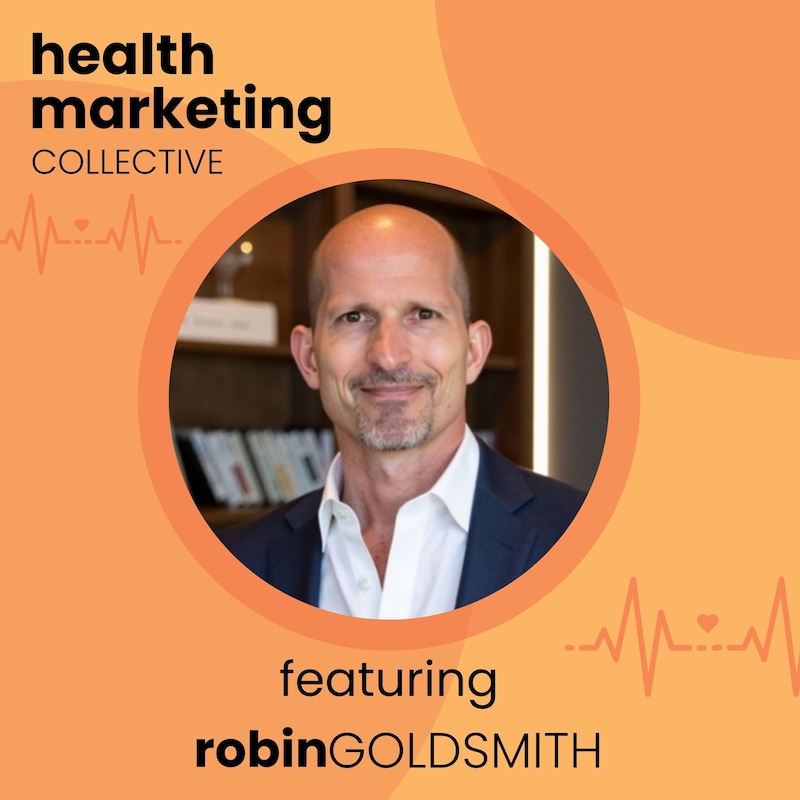
Shownotes
Welcome to the Health Marketing Collective, where strong leadership meets marketing excellence.
On today’s episode, Sara Payne welcomes Robin Goldsmith, practice leader for Verizon’s healthcare domain practice and host of the “Healthcare on Air” podcast. With more than two decades of experience spanning patient engagement, media, data analytics, and digital transformation, Robin Goldsmith shares his unique perspective from the frontlines of healthcare marketing innovation. This conversation explores what it takes to lead through moments when the pace of innovation outstrips understanding—and the old playbook no longer works.
Throughout the episode, Sara and Robin discuss what it feels like to drive (and survive) fundamental change in healthcare, the challenges and surprises of shifting entrenched practices, market readiness for innovation, and the evolving role of marketing leadership as technology transforms how care is delivered and experienced. From navigating resistance and cultivating trust to finding simplicity in complex solutions, this episode is packed with actionable insights for marketing and leadership professionals at every stage of healthcare transformation.
Thank you for being part of the Health Marketing Collective. The future of healthcare depends on strong, innovative leadership and marketing excellence.
Key Takeaways
- Change Management Requires Courage, Storytelling, and Customer Focus
Robin recalls the shift from broad campaigns to data-driven marketing at Everyday Health and CrossX, highlighting that guiding organizations through change demands leaders to step out of their comfort zones. Success hinges on the ability to weave a compelling, benefit-driven narrative and keep the end customer—whether patient or practitioner—at the forefront of every strategy (03:53).
- Market Readiness Is Critical for Innovation Success
Innovations in healthcare marketing only flourish when the market is fundamentally ready for change. Robin emphasizes the importance of identifying early adopters and mapping out educational phases to gradually build acceptance and momentum. Pushing the market too soon often results in resistance; thoughtful go-to-market strategies, incremental testing, and understanding organizational priorities are essential (06:24).
- Building Trust—Not Just Change—Drives Adoption
Trust is the foundation for any successful transition in healthcare marketing. Teams must anticipate objections, map customer concerns, and create easy on-ramps for testing new strategies. Robin notes that allowing incremental adoption and being honest about failure builds genuine trust with stakeholders, crucial for long-term success (10:02).
- Simplicity Over Complexity in Messaging
Both speakers reflect on the challenges of communicating complex technological and strategic shifts. Simplicity in messaging—distilling narratives to their essence—improves understanding, buy-in, and word-of-mouth advocacy. Overcomplicating dilutes impact and drives disengagement, especially within large organizations or when rolling out innovative solutions (14:03).
- Marketing Leadership Must Be Elevated in Times of Change
As healthcare changes faster than ever—accelerated by the pandemic, new technology, and shifting consumer expectations—Robin advocates for marketing leadership to have a seat at the strategic table. By shaping narratives, aligning messaging with organizational objectives, and orchestrating channel strategies, marketing can be the catalyst for successful adoption and meaningful transformation (19:04).
Join us in celebrating moments when healthcare marketing rises to the challenge, forging the path to a future where excellence and innovation go hand in hand.
Thank you for listening and being part of the Collective, where strong leadership meets marketing excellence. The future of healthcare depends on it.
Mentioned in this episode:
Health Marketing Collective is Powered by Inprela
The Health Marketing Collective is powered by Inprela: a communications firm built for health brands determined to lead, not follow. We partner with marketing innovators who aren't just chasing attention—they're building movements. Connect with the audiences shaping the future of care and lead the conversations that move your market. Ready to rise above the noise? Visit inprela.com. Let's create something that moves the market.
Transcripts
Welcome back to the award winning Health marketing collective where strong leadership meets marketing excellence. I'm your host, Sarah Payne and I'm bringing you fascinating conversations with some of the industry's top marketing minds. If you've been in health marketing long enough, you know there are moments when something shifts, not incrementally, but fundamentally. A new capability emerges. The language changes, expectations shift, and suddenly the old playbook doesn't work anymore. Even if nobody has officially said that out loud yet, today's conversation is about those moments. Not the innovation itself, but what it feels like to lead through change when innovation moves faster than understanding, and the kind of leadership those moments demand from marketing.
Sara Payne [:My guest today is Robin Goldsmith. Robin is the practice leader for Verizon's healthcare domain practice and brings more than 20 years of experience across patient engagement, healthcare media, data analytics, and digital transformation. He's worked inside organizations like Everyday Health, PatientPoint and CrossX, and today he focuses on building solutions on top of Verizon's core infrastructure to accelerate digital transformation across healthcare. He's also the host of Healthcare on Air, a podcast by Verizon where he interviews leaders and innovators across the healthcare ecosystem. Robin brings a unique perspective, having seen healthcare marketing evolve from multiple vantage points, and I'm excited to dig into what he's learned along the way. Robin, welcome to the show.
Robin Goldsmith [:Great to be here. Thanks, Sarah.
Sara Payne [:Yeah, I'm excited for this conversation because I know that you've had a front row seat to several moments when healthcare itself was changing in a pretty fundamental way. When you think back across your career, what was that first moment when you really realized, like, oh, wow, hey, the rules just changed?
Robin Goldsmith [:Yeah, I think there's been a couple. It's good to be on a marketing podcast because that's where I started in healthcare. So thank you for having me. I think the big one that I first saw was at Everyday Health when we started playing around with programmatic advertising. So this idea of not just, you know, wide campaigns, but really starting to leverage data to be more specific on the audiences you're targeting. And, and then, you know, that just I added on to that when I had visibility into Cross X, which is obviously very data driven measurement platforms. And I think it's just grown from there where no longer is it the case where, you know, healthcare advertisers can really rely on these wide campaigns. It's very data driven, which I think it started.
Robin Goldsmith [:And that was probably 2016 where I started seeing that maybe even earlier in that timeframe.
Sara Payne [:Yeah, things change. So. So Rapidly. With marketing technology these days, it's sometimes hard to even remember how long ago was that that this change happened. As you reflect on some of those times of change, what did that. Those moments really require from the people leading the work? You know, marketing. Marketing leaders.
Robin Goldsmith [:Yeah, absolutely. I mean, I think it goes back. I think we talked about this. You know, whenever you launch a new way of doing things that goes against. And in hospital marketing, people have been doing the same thing for a long, long time. They've got, you know, their, their channels. They've been working with the same people for maybe decades. And now you're throwing in a different way to do things.
Robin Goldsmith [:That's, that's change and that's always difficult no matter what you're doing. But I think the thing those people had to think about and what I got to work on was how do we tell the story. I think it all comes down to how you tell that story of why is this important and how is this going to help your end customer at the end of the day? I think in your was listening to your 2026 predictions, it's all about the customer at the end of the day. I mean that has to be. It's always been that way, but I think even more important now. But I think the initial. First of all, it takes. It's not easy.
Robin Goldsmith [:You have to step out of your comfort zone to tell a. Have a different conversation with your customers. So I think with that courage and the ability to weave a positive narrative and really weave that narrative with benefits for the customer, I think that regardless of any change, that's critical.
Sara Payne [:Yeah. What are, what are maybe the things that surprised you most in, in going through big changes like that?
Robin Goldsmith [:You know, I, I'm a glass half full kind of guy, Sarah, so I always think people are gonna go, you know, just believe, believe it on the first go. But I was surprised by the pushback, you know, to, to change. And I think that that's stayed with me that whenever change is hard for people, we know that. But I think until you experience it firsthand with people saying, I need, you know, I need reference customers, you know, that first customer. And then, then you have references and building, you build the groundswell. But yeah, a lot of pushback and a lot of people not really believing in. And at that point it was really the power of data. And you know, yes, healthcare is super conservative when it comes to privacy and you know, of course they are for every good reason.
Robin Goldsmith [:But yeah, it was. The doubting was surprising to me.
Sara Payne [:Yeah, I, in Some respect. It's not surprising because if you say, like, people just hate change, like with human beings, we're just not wired for it. Right. And so there's that just sort of initial like, oh, nope, there's pushback that's going to happen. But you know, sometimes it, it can even be more like a much stronger pushback than, than one may even anticipate, I guess.
Robin Goldsmith [:Let me clarify. I think sometimes no matter how good something is, if the market is not intrinsically ready for, is super challenging for marketers to market around that. So I think that, you know, there's this kind of balance of do I, do I push the market to evolve or do I, you know, how do I do that? How do I navigate those waters? So, you know, a lot of innovation. If I'm going to innovate around healthcare marketing, is the market ready? Are they picking or are there some Northern Light customers that are leading the charge? You know, those things all have to come into play. But I think when things fail, it is market readiness and telling. You know, again, I always go back to storytelling. I think the market has to have some inkling that this is where the, where everything's going.
Sara Payne [:Yeah. So let's focus on that a little bit deeper, you know, and go back to sort of decisions that were being made around that time. And the philosophy and the approach is how, how did you decide to move forward when you realized there was a gap in, in market readiness? Right. Was there a. You, you mentioned education is a key component. Like, did you map a plan that's like, okay, we're going to give ourselves. There's going to be multiple phases to this. And so we're, you know, phase one is going to focus more on education.
Sara Payne [:Once we get the market to, you know, give us some signals or early indicators of, you know, xyz, then we're ready for phase two.
Robin Goldsmith [:Sure. So there's the initial kind of go to market strategy and you make some assumptions that, you know, you have to, you don't know for certainty what the response is going to be. But, you know, at every one of those companies, I'm not going to go specifically on each one, but they had, they share common traits. Where we built the go to market, we used data to understand. We did market analysis looking at what, you know, through our, through our lens, through our experience, what, you know, what. Who would be the early adopters? Some key agencies that were pretty progressive who had shown some signs of leveraging these kind of capabilities around data to better target audiences. And you're Right.
Sara Payne [:Yeah.
Robin Goldsmith [:You know, we built a plan of how do we evangelize this to the market? What are the key events? What are the key, you know, times and places we have to show up and have a voice. I think that's. That was critical. And we had a Runway, you know, we had. We had 18 months to really prove this out, I think in both cases. And, you know, luckily, you know, the market was ready and I think the adoption just accelerated. Slow at first, but then you get some customers utilizing it and then it's word of mouth and it. Then it's.
Robin Goldsmith [:Then you have a market to build on.
Sara Payne [:Yeah, absolutely. I think that Runway is key, as you mentioned, as I'm trying to understand if there's anything else, you know, in the work that people don't see. Right. It's the. It's the internal planning and the work and figuring things out. Is there anything in terms of things that your team spent time on that wasn't obvious from the outside, but was really critical to getting momentum and trust with customers?
Robin Goldsmith [:Yeah, I think the key word in there is trust. So we had trust with a lot of customers to begin with. So that's. That's a good footing to begin. Anything on is trust, you know, coming from zero and building trust, that. That's a whole nother conversation. Yeah, but I think you have to kind of build in these scenarios and, you know, leveraging data and understanding really mapping out what are the objections we know are going to be most, you know, most top of mind, you know, get into the heads of who you're speaking to and really, you know, go through those scenarios of we know what these people are going to say, because I would probably say the same thing if I was coming to them with a new way of doing things. So map out those conversations, build a narrative.
Robin Goldsmith [:I think is. Is critical. And then we had, you know, different, you know, a slate of options for people to try. It wasn't just, you know, all in on this strategy. You know, it's giving folks the ability to test, I think is critical in marketing. I mean, marketers love to test a B testing and everything else. But I think being able to provide an easy on ramp to test in small, you know, incremental steps was, I think, why we succeeded and then why we didn't succeed at another company I worked at, which, you know, I'm not going to say these are all successful. Whenever you're innovating, you know, that's where we learn.
Robin Goldsmith [:Oftentimes it doesn't work. You know, probably Priorities change, which happened. And you know, it was, it was looking good and then the priorities of the company changed. And so things that are out of your, things that you can't plan for are, can always come into play to, to shake up the chessboard without even, you know, you've ever thought about that scenario happening.
Sara Payne [:Yeah, absolutely. Great point. And I love the, the, the, the honesty in that too. Right. Because not everything is going to, is going to hit. Right. And some of those things are outside of our control. You mentioned education being key.
Sara Payne [:You also talked about the importance of building a narrative, unpacking both of those things. When you say education, what does good look like to you around that when we're talking about, you know, educating around some, some major change management?
Robin Goldsmith [:Yeah, I mean, educating. I hate to take a tone of. I, I know more than you, but it's. It in that capacity you don't want to come from that position. I think it's just sharing of viewpoints and, and success looks like to me that after hopefully one conversation. But oftentimes it takes more that person who you're relaying this information to can speak that back to you, which is often the case because you know how it is, sir. You need a champion at every organization and that champion then has to go talk to other people and explain it to them. So.
Sara Payne [:Right.
Robin Goldsmith [:And I've. The best scenario is when you're in a meeting and that person, whether it's the upfront in the, in the conversation, says what her opinion is or his opinion is on something and you hear your own words back but in a different way in their, in their voice that they've, they've digested the information, they've come to their own conclusion and they agree.
Sara Payne [:And that's really often that early feedback that the narrative that you've developed is in fact working. Right. Because if the narrative is too complex or we've, you know, we've made it more complicated than it needs to be, chances are they're not either their interpretation of that back to you is going to be a big gap. Right, right. In between what you said and what they said or they're not even going to be able to do it because we've over complicated it. Right. And so they can't distill it into their own. Right.
Sara Payne [:It's not like that light bulb hasn't gone off yet in terms of, oh, I get it, I get what you're saying and how this is going to benefit me.
Robin Goldsmith [:And listen, simplicity is really hard. Simplicity. We like to overcomp like you said, we like to over complicate things because we think we have to pack something in that little brown bag. We got to pack everything into it because it maybe it makes us sound smart or there's so many benefits. I want to talk about all the benefits but distilling it down to really the simplicity is I think really powerful and not easy to do. And so that is a constant challenge especially when you get to bigger companies and there's bigger strategies. I think simplicity is something should be top of mind for everyone as they're thinking about how they're doing business, how they're messaging. I think that's what resonates with people.
Robin Goldsmith [:The over complexity is really just is a turn off in my mind and.
Sara Payne [:It'S a disservice to what we're trying to our objectives and what we're trying to achieve. And yet to your point, like we, we do this all the time. Especially when it's something innovative. Right. Because it's innovative and boy I really got to tell you how innovative it is.
Robin Goldsmith [:Yeah.
Sara Payne [:Right. So I'm going to come in with my PowerPoint. Right. With all these words, buzzwords etc and.
Robin Goldsmith [:Yeah, people's eyes glaze over really quickly.
Sara Payne [:Absolutely. Do you have any sort of key learnings on, on that point of like how to get your. Because sometimes it is like the marketing team can be all be nodding their heads that like, you know, we've, we've talked about this for years that simplicity is important.
Robin Goldsmith [:Yeah.
Sara Payne [:And marketing can get it. Marketing can even be really good at executing it. But then when it goes for broader review with the, you know, executive leadership or even a technical team, that's when some of this more complex jargon can come in and have you, you know, do you have any sort of hard fought, you know, war stories about how, you know, marketing was able to sort of convince and, and overwrite that desire to overcomplicate things?
Robin Goldsmith [:Yeah, I mean I think probably over the last five years I've, I've seen that probably play out best because I'm at a very large company in Verizon, not known to be a healthcare company where you know, in, in a lot of people's eyes we're utility. So leading the efforts around healthcare from a non traditional health care player. That story has to be pretty tight and has to resonate pretty quickly and there's a lot of stakeholders involved when it comes to a big company. So that's, I think that's the biggest balance of understanding the priorities of teams which is not Always easy to do. But as much as you can do, once you have your narrative and you've really looked at what are the trends, what's the data look like, what is the opportunity really weave that narrative into what are the overarching goals of the company? Where are there synergies that I can align to that will make this go through any large company a lot more seamlessly? Because they all have their strategic plans, they all understand. But when you're at a company that works across every industry, it becomes even more important to understand your role, understand what you're trying to do, and then take the data of the major trends that are happening. And there's a lot happening in healthcare over the past five years, as we know, that have been just headwinds for things that, around connectivity and devices and more. The whole industry is going this way and that's incredibly exciting place to be.
Robin Goldsmith [:But don't overcomplicate it. At the end of the day, it has to be anchored in why is this going to be important for our customers. That's, I think, the anchor point for it always is for me.
Sara Payne [:That's such a great point about, you know, being, you know, the role you sit in today in the organization that you're in today being, you know, but one sort of industry vertical inside of a, you know, massive organization. That's another layer of complexity that you're dealing with in terms of being able to communicate that value proposition. And all the more reason why simplicity is so important. And to take that a step further in this whole point is I, I would argue that marketing needs to have a seat at the table on these decisions about not just building the narrative right, but the entire strategy around how to make this adoption successful so that, you know, leadership inside of marketing can help, you know, maybe override or overrule some of those tendencies to steer towards complexity when that's not ultimately going to serve the objective or the brand. And so I think, you know, there's this point here which is we need to make sure that that marketing leadership's role is being elevated, particularly in moments of, you know, major change, change management in key decisions around how this is going to get rolled out. What's your perspective on that?
Robin Goldsmith [:100%. And I've been really lucky to have. Now I have a great, you know, great relationship with our marketing teams of how we, how we're going to convey that messaging in a way that we hope and we think the market will, will respond to you. But I haven't always had that, you know, I've worked at far smaller companies where they're really, you know, the marketing department was overstretched and didn't have much time for this. And so I think it's a balance. I mean you're going to get the good and the bad. When you get that synergy between marketing at, like you said, at the table, I think it's critical because there's, there's things that there's a viewpoint that marketing brings that, that a lot of other folks won't bring to the table. I mean the, the business drivers are one thing that they have to be cognizant of.
Robin Goldsmith [:But how do you shape, how do you shape the messaging in a way and what levers do you pull and what channels are we going to distribute this on? That's all that's in marketing sweet spot. And I think that oftentimes I don't think that gets, you know, the, gets elevated as much as it should because in my mind it's critical.
Sara Payne [:Yeah, absolutely. 100 agree on that. Knowing that you've seen a lot of different and experienced a lot of different changes, you know, across healthcare and frankly across marketing in your career. You know, some of these examples that you are sharing are, you know, maybe, maybe you know, 10 years ago, give or take.
Robin Goldsmith [:Yeah, it's been a while.
Sara Payne [:Has. I'm not trying to say anything about, about either of our ages here, but has there been anything as you look back at what it was like to do change management, say 10 years ago versus now? Like are these learnings the same? Has anything changed or has most of the sort of best practices, if you will, in sort of leading through these times of change changed pretty much the same.
Robin Goldsmith [:No, I think, you know, I think in healthcare specifically, I think you know, if the pan then I to. To overuse, it's been overused. But the pandemic I think accelerated a lot of how quickly we're. We perceive we can change.
Sara Payne [:Great point.
Robin Goldsmith [:And I think in healthcare, not just specific, specific to marketing, but in all the dynamics of healthcare delivery, you know, digital health, all these things that have come were brought to bear out of necessity. My hope is that, you know, not only was the door to innovation open, but the, the ability to know that change can happen quickly was kind of, it was a proof point. We did it. Even older folks adopted telemedicine. Go figure there. People are able to do things that it was for.
Sara Payne [:It was literally forced upon us. Right. And we.
Robin Goldsmith [:Yeah. And we did it.
Sara Payne [:We did it. Yeah.
Robin Goldsmith [:So I think that's, I'm optimistic about that. And I think now more than ever we know we have to change because change, again is being put on us through new technologies, you know, and potentially through new legislation that's coming and the changes to the dynamics of the market. I think things are, and this is just my opinion, but I think things are changing more rapidly than ever in healthcare.
Sara Payne [:Yeah, for sure. Great point. And I love, I think you're right. I mean the pandemic was that thing. It's just like literally overnight all of these things changed. And yeah, we proved to ourselves that we were pretty resilient through that. Right. And we built the muscle and we did the thing.
Sara Payne [:You know, we've all maybe got a few more wrinkles than we did before, but we did it. So I think, yeah, I think we have the ability to potentially adapt faster to other change, but the change itself is also, to your point, happening at a faster pace. And so it's hard to even sort of calibrate whether or not we actually are more resilient because the flywheel. Right. Like the change is happening faster and we all are also more resilient because we've been through it before. So it's just, it's a really interesting dynamic that we're in. For sure.
Robin Goldsmith [:I do think the, the, I think you talked about this, like this the attention economy that we're now find ourselves in, of which marketing plays a very leading role, then that's changing too. I mean it's, can you get people's attention? But then, and I'm quoting you a lot, Sarah, then I love the influence, you know, earned influence. And how do you really. That's more important. I agree with you. That's more important than any anything now because, because as we, we've been in this attention economy, everyone's fighting for your attention. Attention spans have shortened. We all know that with the rise of, you know, some of the social media platforms that are super short form, they've risen to the top.
Robin Goldsmith [:Longer forms are more challenged with definitely younger generations that are consuming things mostly, you know, mostly on their phone. So I think we have to be super aware of the dynamics, the social dynamics at play as well. But I think to the early, to the earlier point, trust, influence go hand in hand. You're only going to be influenced if you trust that source and how, and that's a, that's a tough part to get to, but that's really what everyone's trying to get to. Everyone wants to be that trusted influencer to, you know, to, to, to have folks Listen. And actually influence their change.
Sara Payne [:Yeah, absolutely. And it's interesting, Edelman's trust barometer just came out over the weekend and I haven't had a chance to really dig into it yet. I did have someone from Edelman on last year to unpack the. The findings and, and the results there. Hoping to do that again in an upcoming episode. But key headline there. And this won't. This won't surprise anybody.
Sara Payne [:Trust is down massively. Massively. Right. Trust of institutions is down significantly. And so, yep, getting to that point of, you know, having trust with customers, but also as a brand, you know, being that sort of trusted, coming, being in a place where you have trusted influence, it's harder. It's harder. And you. And on top of that, you have shorter attention spans too.
Sara Payne [:Right. So there's all these dynamics that are making that so much harder and so much more challenged, where this is that moment literally where the old playbook doesn't work anymore. Yeah. Right. Okay. So, Robin, before we wrap, you're in technology. We gotta talk about technology. There's just so much happening in healthcare, AI, broader digital transformation.
Sara Payne [:What's a good. How this technology gets communicated is so incredibly important. How do we do that? Well, and make it understandable. Yeah. Both to, you know, the B2B audience, the clinical audience, but all the way down to the, to the patient level.
Robin Goldsmith [:Yeah. There's so much happening and it's hard to keep up. I mean, every, you know, AI is, is accelerating everything. And you know, out of necessity, I think of any industry, healthcare really needs help because we don't have enough nurses and docs. Right. So I think you need to automate more things. And I think that's it. Right.
Robin Goldsmith [:Because doctors didn't go to. And nurses didn't go to nursing school or medical school to be data entry clerks. They went to those schools, very expensive schools, in time to be at the bedside delivering care. So I think any technology has to be grounded in how do we leverage this tool, these tools to get. To lighten the load of this just cumbersome system of entering data and get them back to the bedside. And that that is happening. So ambient listening is. A lot of people speak to that and point to that as something that's giving back nurses and docs time at the bedside.
Robin Goldsmith [:And, you know, that's a great example because at the end of the day, patients don't want to see their doctor's face in front of a keyboard, not looking at them and not listen. We all have experienced that. So telling that story of hey, the patient experience, the clinician experience are both improving through technology. And the story is that I can see my doctor face to face now. It's not that this is capturing the data and putting it in all the bells and whistles, speeds and feeds. Take that out. And just the story is that one to one connection that's now being enabled through technology that is raising the bar of everyone's experience in that room.
Sara Payne [:Love that last question. What do you think is, is critical to getting through with clinicians as it pertains to rolling out adoption of some of these new technologies? To your point, they didn't go to school to use them. Yeah. And in some cases, you know, people might think, well, you know, I don't, I don't know that this is the best direction, um, you know, for me to deliver my, you know, the, the best medicine, if you will. What's, what's your take on how to push through that resistance?
Robin Goldsmith [:Yeah, it's not easy. Again, back, going back to the change conversation, but I think has to be integrated into their workflows, has to be easy, has to be, have incredibly high value to the doctor. And I think if you boil it all down, the, the, the time of our clinician is the, the measure of if I get more time back, if I don't have to chart at night in my pajamas, that is highly valuable to me. If we can give doctors back any time, that is something I think everyone can relate to. I want more time back in my day, if I adopt this digital tool or this AI or whatever technology it is, I get time back. I'm probably going to use it.
Sara Payne [:Love that. So great. Robin, thank you for being here today. Always a pleasure learning from you.
Robin Goldsmith [:Absolutely. Thanks for having me, Sarah. This is great.
Sara Payne [:Yeah. And how can folks get in touch with you, Robin? Obviously they should check out your podcast, Healthcare on Air by Verizon. Where else can folks. How can they get in touch with you?
Robin Goldsmith [:Yeah, I'm on LinkedIn. I try to be pretty active there again, you know, evangelizing what we're trying to do in healthcare. Thank you for shouting out the podcast. I try to get people on who are doing really interesting things in healthcare. So that's been fun. And then go to, you know, if you want to Google anything about healthcare and what Verizon's doing, just Google Verizon and healthcare and find a lot of resources.
Sara Payne [:Love it. And if people have guest ideas for the podcast, reach out to you on LinkedIn 100%. Love it.
Robin Goldsmith [:Always open for ideas.
Sara Payne [:Fantastic. Well, thanks so much again for being here and to our listeners. If you're a fan of the show, be sure to subscribe and share it with a colleague. Thanks for listening to the Health Marketing Collective, where strong leadership meets marketing excellence, because the future of healthcare depends on it. We'll see you next time. What do you think is critical to getting through resistance with clinicians? What do you think is critical to getting through resistance with clinicians? What do you think is critical to getting through resistance with clinicians? What's your take on how to push through that resistance? What's your take on how to push through that resistance? What's your take on how to push through that resistance? It.
