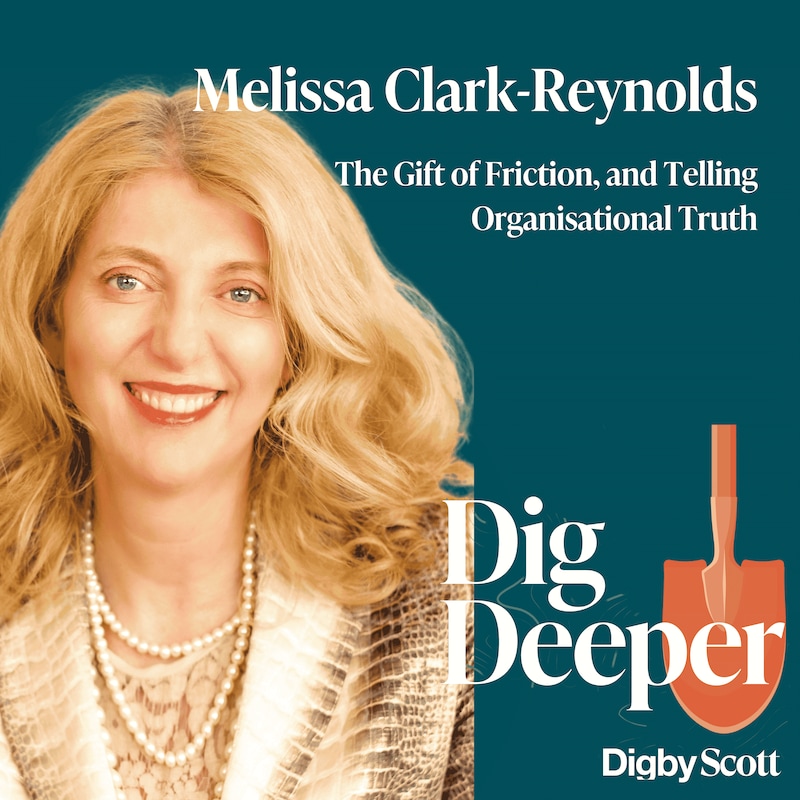
Shownotes
What if the strategies gathering dust in your organisation aren't the problem, but rather the shadow strategies everyone's actually following?
You know the ones. The unspoken "work harder, work longer, make more money" approach that contradicts your official commitment to innovation and people-centred leadership. That tension between what you say you're doing and what's actually happening costs more than productivity. It costs truth. And when organisations can't tell themselves the truth about what's really going on, they plateau in ways that feel both frustrating and invisible.
This conversation explores a different way forward, one that honours healthy friction over comfort, embodied wisdom over abstract strategy, and possibility over certainty.
Melissa Clark-Reynolds brings a rare combination of street-smart entrepreneurship and rigorous futures thinking to help leaders navigate complexity with both imagination and pragmatism. Melissa is a street smart futurist who started university at 15, built and sold multiple tech companies, and was awarded the New Zealand Order of Merit for services to the tech sector. She's trained at Stanford's Institute for the Future and the UK's School for International Futures, bringing both rigorous methodology and practical wisdom to her work with organisations navigating uncertain futures.
In this conversation, you'll discover:
- How to identify the "shadow strategy" your organisation is actually following beneath the official one, and why naming this incongruence is the first step toward real transformation
- Why living in possibility rather than certainty opens more pathways forward than any five-year plan, and what questions like "I wonder" and "how might we" make possible
- How embodied strategy reveals truths that spreadsheets and presentations hide, and what happens when teams physically experience the difference between growth, transformation, and collapse
- Why curiosity combined with commitment to excellence creates the conditions for continuous improvement, rather than the confident mediocrity that keeps organisations stuck
- How to reframe the past as an empowering platform rather than a weight to escape from, particularly through bicultural and indigenous perspectives on whakapapa and time
- What it means to find your tribe, the people who challenge you with love and compassion, see something more in you, and give you invitations to greatness rather than comfortable reinforcement
- Why effective leadership means knowing whether you want to be right or you want to be effective, and how bringing the full triangle of inspirers, doers, planners, and storytellers creates sustainable impact
- How to embrace your outlierness as a superpower rather than moderating yourself into mediocrity, and why the world needs the juiciness of your weirdness
Other References:
- Elisabeth Kübler-Ross
- Sohail Inayatullah
- Jennifer Garvey Berger
- David Snowden - Cynefin framework
- Institute for the Future
- Stanford University
- School for International Futures
- Cultivating Leadership
- Casual Layered Analysis Framework
- Episode 22 with Jennifer Garvey Berger
- Episode 26 with Kirsten Patterson
- Episode 17 with Derek Sivers
Timestamps:
(00:00) - The Power of Healthy Friction
(13:32) - Finding Your Tribe
(20:39) - Embodying Strategy in Organisations
(25:12) - Incongruence in Organisational Strategies
(30:23) - Living in Possibility: Leadership Mindset
(32:27) - Reframing Time: Past, Present, and Future
You can find Melissa at:
Website: https://www.melissaclarkreynolds.com/
LinkedIn: https://www.linkedin.com/in/melissaclarkr/
Check out my services and offerings https://www.digbyscott.com/
Subscribe to my newsletter https://www.digbyscott.com/subscribe
Follow me on LinkedIn https://www.linkedin.com/in/digbyscott/
Transcripts
I think there's something about that healthy friction. know, a clay pot sitting in the sun is just a clay pot. It's the intensity of the fire that turns it into porcelain as Elizabeth Kübler-Ross quote. And I think there is something about that, that actually a friction-free life, you don't learn a thing.
Digby Scott (:What if the future isn't something that happens to us, but something we can shape?
Well, my guest today, Melissa Clark-Reynolds, gives us some ideas about that question. She started university at 15 and while she was there as a student, she became a single mum. So out of necessity, she started her first company. And over the years, she's built and sold multiple tech companies and along the way she's been awarded the New Zealand Order of Merit for services to the tech sector. She now works as what she calls herself as a street smart futurist, helping leaders navigate uncertainty with rigour and imagination.
you
Today in this episode, we're exploring some chunky themes including finding your tribe as a way of accelerating your impact and why the questions we ask shape the futures we create and how healthy friction, not comfort, drives real growth. So if you want to lead with more possibility or you're curious about how strategy can lead to real change, then listen to this conversation. I'm Digby Scott and this is Dig Deeper, a podcast where I have conversations with depth that will change the way you lead.
Melissa, welcome to the show. Great to have you here.
Melissa Clark-Reynolds (:Thanks, I'm really nervous and excited.
What are the nerves about? Come on.
know, we all just, I guess we all like to present ourselves well.
Well, my formula for that is be you. And, you know, I like the idea of you're a conduit of a message. You know, it's not your idea. It's the message coming through you. So get out of the way and just let the message come through. Right. And I reckon you're awesome at that. yeah, nerves aside, let's go for this. You said once that you are a street smart futurist. Yeah. What the hell does that mean?
I guess it means a few things. I've retrained as a futurist about eight, nine years ago. I think like many women, know, my youngest had left home. She went off to Melbourne University at 16, so it was a little earlier than I was originally planning to be an empty nester. And I had that opportunity with the youngest leaving home to go, do I want to do with the next bit of my life?
Melissa Clark-Reynolds (:And I'd been serially in tech, either as a founder or CEO of tech companies, and I was kind of done with it. I had the opportunity to go to Stanford University, and I went to one of those short course exec programs. And while I was there, we spent half a day at the Institute for the Future. And it blew my mind because I realised that it brought a whole lot of my skill sets together. And so I went back a few weeks later and certified with them as a futurist.
And since then I've done a bunch of other training. So I've trained at the School for International Futures in the UK, which has like the most phenomenal world-class faculty at it. And I've also trained with another futurist called Sahaila Nia-Tola, who's probably the world's leading Islamic futurist and has another set of methodologies. So the street smart bit is I've been an entrepreneur. pretty much been an outlier my whole life. feel like I'm one of those people who
sees the future quite clearly. I may well be quite wrong about it, but I've always felt like I was slightly out of step with time. And that outlierness has turned out to be a superpower in my work as a futurist. And then the other side of it is that I have all these like methodologies. So it's not like I sit around
read bit of sci-fi and come up with some kind of bullshit. Do you know? And it really irritates me the number of people who call themselves futurists and what they mean is they've got a rampant imagination. So I'm really interested in applying that to business or to organisations. I work with a number of not-for-profits. I work in some product development teams that are developing products for 10 years out. You know, I'm working on a project at the moment. Like what is the future of the kitchen?
in 10 years. And so the street smart bit as well is it's got to be pragmatic. It's got to be actionable, usable by our clients.
Digby Scott (:So there'll be a few people listening here going, I think I know what a futurist is, but maybe Melissa, you've just challenged my thinking on what I actually understand a futurist to be. What is a futurist?
tarted writing code for AI in:how pollution would move through waterways. So very interested in using computer models to understand flows and movement. Now, when I started explaining that to people in the 80s, their eyes glazed over. And eventually in the 90s, I tried using these words like algorithm and people's eyes still glazed over. But I've spent a big chunk of my career in that more forecasting space. So very quant, very maths oriented.
But I also have an anthropology degree and I'm very curious about humans and human behaviour. And I think what I like about the, so there's the forecasting side of futures and then there's more the thinking about what are demographics in the future going to mean for human behaviour. Give you an example, I've been working with things like milk formula companies that we know that China's population has peaked. New Zealand's milk industry has grown largely on the back of population growth globally.
And so as population growth declines, why will people continue to buy baby formula? Well, if you're a baby formula company, then what you want to think about is how can I sell the highest priced baby formula possible? Because people may only have one child. And if I'm only going to have one child, I'm much more price elastic. And so that's where I get that street smartness. Like what do these things mean? Like what does a demographic change in China mean to a farmer?
Digby Scott (:So you're leading.
Yeah, I'm leading. That's sort of where as a futurist, it's speculative. I'm really aware there are no future facts. Yes. So I love scenarios. I like to build maybe four options for how the future might turn out and then help companies to become resilient for any of those futures. feel like in the 90s, we had this real kind of, you know, all those terrible motivational posters that were all over the offices and all you had to do was like, it into being.
And if a company failed, was because they just didn't have enough will. now I'm much more interested in, well, hang on a minute. We live in these complex environments. You know, what's the impact of Ukraine on New Zealand dairy trade? What's the impact of the rise of birth rates in Africa going to mean? We need to take a more complex, nuanced view of the world.
I get the impression that a large part of your work is bringing different questions.
It's basically complexity. So it doesn't matter whether it's the like the Snowden type Cynefin stuff, or if it's straight out futures scenarios. I teach courses in different scenario methodologies. I think it is bringing great questions. we mostly, I feel like with strategy, which is my other favourite thing, if we keep asking the same questions, we're going to do the same stuff. And it's not enough to ask questions. It's about honing those into great
Melissa Clark-Reynolds (:questions.
How do you do that? That's something I've talked with the KP, Kirsten Patterson, earlier on the podcast, the CEO of the Institute of Directors, and we had a deep conversation about how directors need to really level up how they ask questions. What in your mind, or maybe in your experience, has helped you to hone that skill?
There's a quote from Einstein, which is that, can't remember the exact wording, but the fundamentals of it is like, I'm not actually smarter than anyone else, I'm just more curious. And those aren't his words, that's my interpretation of it. But I realised that there are a couple of things that help good question. One is deep curiosity, and the second one is a commitment to excellence. And I think if we have a commitment to excellence and then deep curiosity, we cannot help but.
continuous improvement is a core result. Whereas I've thought about this with coaching, like I'm not a coach. I know a lot of coaches, but I am an athlete and I've pretty much been like sporting my whole life. And I've watched people over the years, some of them get a coach to reinforce that they're good and some of them get a coach to get better. And that sense of getting better,
That's that commitment to excellence plus curiosity. For me, in the boardroom really helps to sort of say, well, I'm not in this boardroom to bring my wisdom of my 40 year career and impart it to you, we grasshoppers. Like those are the worst board members in my experience. The best board members in my experience go, you know, I've had a few failures and I wouldn't mind figuring out how not to do that so you can learn from my experience.
Melissa Clark-Reynolds (:let's get alongside each other and figure out how it is right now in the world you're operating in and the vertical you're operating in with the people that you're operating with, with the customers that you have. What is special and unique about that that we can really write some experiments around. And so I'm a huge fan of experiments over initiatives too.
me too, that language just opens up a whole way of operating that initiatives or projects or programs just shuts down, you know, the learning opportunity that comes with an experimental mindset. Right. That's awesome. I want to rewind a little bit. You said I've always been out of step with time. Okay. So yeah, shine a light on that from your life. Like, and when you say always I'm going way back, right? What is that?
Yeah. What do I mean by that?
Melissa Clark-Reynolds (:I learnt to read at three and so I arrived at school a weirdo, right? I arrived at school as the only person in my class who could read and so I ended up being part of a little kind of group of buddy reading with others and teaching other kids to read.
And then what I was lucky was that at my primary school, well in fact it was why my parents chose the primary school I went to. It wasn't the nearest primary school, which was the thing that you did back then. You just went to the nearest school. I was bussed sort of halfway across the city into New Zealand's first gifted unit. And there were six of us that were an experiment. And I guess like I was lucky in that sense that I got to.
have a primary school experience that was highly experimental. I had no idea for decades what a gift that was. The gift is a lack of certainty and a massive opportunity. Like, I got to go to Victoria University as an eight-year-old and study Russian. I mean, how many children even get those opportunities now? But I was fascinated by the big Russian like Turgenev and Tolstoy, and I was reading them.
What was the gift?
Melissa Clark-Reynolds (:The librarian at the Wellington City Library, I used to go into the Wellington Library pretty much two or three days a week after school to get books. And the librarian would have a little stack on her desk of books that she'd selected for me for my next set. And by five, she was getting adult books. I read The Hobbit at five, right? So I had no one to talk to. And that's part of what I mean by being out of time.
I talked to my friends and luckily I had these other kids in this gifted unit and I've kept track of where they are. Most of them are professors now. I'm one of the few that it didn't turn out to be a professor. But I had this cohort that was unusual. I had a childhood experience that was unusual. My parents were Vietnam War activists. So I had this broad sense of, the Jewish word mitzvah really made sense to me that your life was a mission that you dedicated to something bigger.
I was fascinated by world events. I read magazines about the war. You know, it just was out of step. And it actually wasn't until I got to my masters that I suddenly found my tribe.
And what did that do?
my God, it's like being at home. I've just, the Avatar launch was here in Wellington on Saturday and I've been able to hang out with a bunch of international creative techs. I might cry, like that sense of being home is just a beautiful thing. One of the guys said to me, don't know if you've noticed, but I'm a little neurodiverse. And I said to him, have you looked at the group?
Digby Scott (:Welcome home.
Welcome home. said you're with friends and it goes I'm a polyglot. I go I think that all of us are
There's something so powerful in this idea of connecting with others and seeing the home is a perfect word for it. It's like the people that I belong with. Yeah. Right. And I reckon in our current context, there's so much loneliness and that sense of disconnection around who are the people I belong with.
And it was what I was excited about social media about when I first got on social media was that I could find my tribe anywhere in the world and hang out with them. And I know it's gone toxic and Twitter isn't what it used to be. And I left it years ago, but I pine for that a little bit. had a early social media. I found my nerdy, geeky, weirdo friends who were interested in the same stuff as me, who spoke the same language as me.
You know, when I talked about things like algorithms, I used to call them complex formulae, you know, we had, we took us a while to create a language that we understood. Yeah, so I think that's one of the things that was sad for me about social media. I just felt like I had such promise at the beginning.
Digby Scott (:You and I both know Jennifer Garvey Berger, who's also been a guest on the podcast. And we were talking offline a little while back about the group that she leads, Cultivating Leadership. And I asked you, what's the reason for you being part of that? And it wasn't really so much about the work opportunities, but more about, I can't remember the language you used, but it was something about my development geeks or something like that. Again, it was the family.
the people that are like me, right?
People like me stretching my boundaries too, you know, like cultivating leadership is a home for deeply inquiring people who are committed to their own development. That may not be their branding words, but that's how I see it. And I just love the opportunity to be part of a community of people who are pushing their own boundaries, committed to their own personal development, committed to their own adult learning edge. I think because of that gifted thing as a kid,
I assumed that you got to sort of 20 or something and that was the end of your development. You learned more. But I never really thought about development. And it was such a revelation to have someone from Cultivating Leadership be my coach and open my eyes to that whole world of adult development and realise that I had been developing. I just hadn't realised that that had its own path too. think, you you think about child development.
but adult development being its own discipline, a bit like probably people who aren't futurists wondering if futurists, you know, as an actual discipline, as a discipline, adult development as a discipline has been an eye opener for me.
Digby Scott (:Yeah, likewise. I remember when I first came across it through Nick Petrie's work and this is the work I've been wanting to do. Yeah. And not just for my own growth but as a professional as well. And again, finding your tribe, finding that language. You know, I reckon for many people they might be going along in life going, I'm doing okay. But maybe there's this sort of blind spot that maybe the people that you actually could really help you accelerate are still out there.
this you still haven't found them. So let's get practical. What would you say to someone who is potentially looking for their tribe or maybe semi looking going, it's not quite right. These people I'm hanging out with. What would be the advice you might give them to help them find home?
I think like find those places that excite and scare you a little. You know, I love that stuff like if you're the smartest person in the room, you're in the wrong room. How can I learn from here? Obviously I can hear in my language, but it's true for me. Learning and curiosity have been my number one value, you know. But I hate complacency. I hate mediocrity. I hate confident mediocrity. That's probably like the little...
Venn diagram that does me in. Do you know? I do. Yeah, so I can see from your body language you know exactly what I mean. Confident mediocrity does my head in. Oh, what?
language for that that's perfect
Melissa Clark-Reynolds (:And so if you're surrounded by confident, mediocre people, you gotta like find somebody else out there. I don't think it matters whether you find them, like I've got swim buddies who kick my ass, right? And I don't mean that they should just kick your ass, but you want people who kick your ass with love and compassion and mercy and who then see in you something that is more and demand that of you.
Those people are the people that I want to hang out with and they are scary, you know, because there are days you're like, you know what, you're not my fucking therapist, you know, and back off. Today I'm happy with being confidently mediocre, you know.
And those people will actually give you the grace of that if they totally.
they know it's a moment. They know it's a moment that right now I'm just on overload, you know, but actually they also know that you're going to take away that thing, that invitation. They give you invitations to greatness, those people. Invitations to be more, you know, this is why I like hanging out with Jennifer and those crew. A subtle question that they may not have even had a consciousness that they asked me takes me somewhere else in my life.
That's good.
Melissa Clark-Reynolds (:but you just gotta find them and double down on them.
I like the way you say find, there's an agency in that, right? That just doesn't happen. You've actually got to seek it out. And I think we need to do as a population as well. Like let's seek out the things that challenge us as a country and let's seek out the things that's challenged us as an organisation or a leadership team, right? Let's not just have the usual safe stuff. And, you know, this is where you're pushing hard.
It is where I'm pushing hard and my clients, if they bring me in to help them with strategy, I'm not gonna go, where do you wanna go and here are the five steps to get there. I'm really gonna take them through, know, okay, what if that all turns to shit? Like, what are you gonna do then? What if actually the world conspires against your brilliant plan? What are we gonna do? Or what if you turn out to be a zombie? What if you grow and then the company flatlines? What are we gonna do then? And how did that happen?
I love that.
You do and I bet they don't and I bet they do down the track, right, for having you in. What's the question that when you ask it you see perhaps the greatest scales from your eyes or the epiphany or the pin drop moment? What's maybe a question other than the question that you see enable something big, a big shift?
Melissa Clark-Reynolds (:Wow, I don't know that I know the answer, but I love the question. That's one of those ones, isn't it? I'll come back to you in a year. What I do see is lots of small questions that conspire together.
What's a small question like strategy in a year or whatever, know that's what we mean.
Okay, so I'll give you, I like somatic practice. I believe that the body knows as much as the head knows. Now, if I put on my website, I'm gonna give you a somatic experience of strategy. Nobody is gonna buy my services, okay? But I believe that I've had the best experience of strategy when it can be fully embodied in the business. Can't be fully embodied in the business if it can't be fully embodied in the bodies of the people creating the strategy.
Now I know for some people that's all going to sound a bit woo woo. So I do put people through physical experiences as we strategize and ask them to check in with their bodies. So I'll give you an example. If we're doing scenarios, I will get masking tape out on the floor and I will masking tape the room into four quadrants. And there are two different ways I like to do strategies, but we'll physically embody each strategy for each.
world that might turn out. And I think there's something, one of those moments that often happens in organisations is that we're having a deep conversation about what it's like to work here, what the clients are like, what the team is like, what the world they're operating is, and we're doing it in a fully embodied way. And the organisation starts to tell the truth about itself in a way that it hasn't before.
Melissa Clark-Reynolds (:And so people suddenly go, my God, we've got a growth strategy, but we're actually zombies. And what I mean by that is that we've flatlined our revenue, we're too good to die, but we're kind of not good enough to grow. And so this is really frustrating and I really don't like working here and I feel like we're better than this, but I can't seem to find a way.
and then people talk to me about what it's like to be disempowered, to feel like the organisation is in blue. But if they write another growth strategy, everybody's gonna eye roll and just be like, yeah, whatever. But often they just paste a growth strategy over the top of what are a bunch of systemic things. And it may be that the company's actually selling a product that was perfect for the 90s, but can't be sold anymore. And then you can get to the guts of what the problem actually is.
Telling the truth right? That's the guts of this.
But sometimes you have to explore the truth. People know the truth in bits and this is why I also think strategy is a team thing because people discover the truth along the way. They haven't had these conversations with each other because they don't want to be dismayed or they think maybe it's just them or they think it's the boss's fault or something. But to realise it's a system is incredibly useful.
You talked about embodying the strategy. A couple of things come up for me there I'm curious to explore. One is what does it actually look like? Like when you're asking people to embody the strategy, what's actually happening? And the other piece is doing it together. We're not doing this in isolation, this collective brilliance that needs to come out for us to have any chance. But tell me first about what does embodying strategy actually look like?
Melissa Clark-Reynolds (:You've worked for corporates, Yeah. And you know that feeling of malaise and exhaustion, like you can feel that in the body, right? That kind of, got to drag myself in on a Monday or...
I remember going up the lift and feeling my body tense on a Monday morning before the lift doors would open. So that's embodying, I wouldn't have called it embodying strategy. It's embodying a relationship to this idea of the organisation and the work.
Yeah, and if too many people are turning up like that, the embodied experience in the organisation is tiredness, frustration, disbelief. There's a lack of congruence between what we're doing, what we're saying, what's being achieved. And so many organisations have an official strategy and then they have what I call the shadow strategy, which is the actual strategy of the organisation.
And so many organisations have an official strategy, but the real strategy is very often work harder, work longer and make more money. But we've got an official strategy that says develop services that customers love. Right? And we know in our bodies that that dis-congruence, I can't think what the right word is, that lack of congruity. Incongruence. Incongruence is there. And so.
congruence.
Melissa Clark-Reynolds (:dis-ease with the official words in my experience. We put people at the heart of everything we do and I'm dragging my ass in there on a Monday. you know, like that's already embodied. So what if, when I ask people what is it to have a growth strategy and when they get really clear on it, they get quite excited. Like they love the idea of doing lots of new things, of the profit flowing, of providing great services.
Like you can see there's a likeness to people's bodies. They're almost on their tiptoes. They're anticipating. There's a physicality that goes with that. When a business is in collapse and I ask them to model the company in collapse, everybody shrinks. They lose eye contact with each other. They look at the floor, they fold their arms, they slump. Like 100%, I get the same body language out of a group, any group, any culture.
of what does collapse look like? And then we'll think maybe about transformation. And one of the important things with transformation is if you've got a loop that does loop the loop, you go backwards before you go forwards. If you have an experimentation culture, you're willing to do lots of loops backwards with small experiments to get like escape velocity. If you only have a growth mentality, you have to do initiatives that always win.
And so what happens is that in that experience, you have an experience of certainty, of commitment, of excellence, and that has a particular way it turns up in the body. But if that doesn't work, you don't actually have a way of having a good conversation about failure. In a truly transformative strategy, you understand that failure occurs before escape velocity. And so there's a
body experience of togetherness, of back to back in the arena together, of holding each other. Like so each form of company form actually has a physical experience and the bodies of the people who work there. Like you can feel it when you walk into that company. What's the truth here as opposed to what it might say on the strategy document or on the value statement. I don't think I've ever explained that so clearly but.
Digby Scott (:we've got it recorded so...
I'm gonna listen to this later and write that down.
You can roll that out as part of your proposals and it's like, it's all there. A couple of things coming up. One is the body as a signal for what's going on. The body as a metaphor for what could be. And both of those things feel true. And I reckon we ignore, most of us ignore that because it feels woo-woo and touchy-feely and purple flowing robes sort of stuff, right?
Partly, I also think that we're used to subsuming the needs of our bodies to our achievements. Okay, so as an athlete, I'm like, okay, I'm hungry. I've got another hour of this marathon to run, so suck it up, right? I'm not gonna kind of go, I think I'll just take a nap now, right? So we're used to controlling the body. We're used to controlling the body as a culture in terms of what you're to look like, what size you're supposed to be, you know.
What does that mean?
Melissa Clark-Reynolds (:how we present ourselves to the world, what our clothes feel like. And then the same, it's almost like, particularly out of the 90s, I think, we admired people who sacrificed themselves, their relationships, their lives, their health, for their work. That's what I mean by we subsume the body and then we stop listening to the signals in our bodies. But our bodies have got a lot of wisdom in them.
Yeah, the Masa cults.
Digby Scott (:Man, they do. Yeah. And you know, my own burnout years ago was a very good example of me living that story of, I don't know, like I'm capable. I can do this. I'm yeah, I've got more capacity than I'm feeling all of those things. And it's like, well, no, I didn't listen to that. And it was terrible. If you're not around, you're working with leadership teamwork, but you're not there. Right. And they don't get access to Melissa's brilliance. What would you say are the
the handful of things that leaders need to be able to do well to help the culture make this shift so the strategy can be enabled.
One of the first ones is living in possibility instead of certainty. So the older I get, the less I know. And this is obviously a complexity theory, but that real willingness to live in possibility, I wonder, is to me one of the best questions a CEO could ask. And then the next one comes out of design thinking, how might we, how might we build a resilient organisation?
How might we deliver products that people will want in 10 years? How might we build a world-class, resilient, high-performing team? Yeah, how might we is one of the best questions ever. I also think there's a real humility, like a lot of organisations pay me to talk to their customers as part of strategy development. There's a humility piece about being willing to hear what your customers have to say about you behind your back.
And I think that's also very youthful. And if you take that well, one CEO I worked with, CEO of Kotahi, he's now gone to Fonterra, but he was really willing to do that. And out of that, his product team developed some whole new lines of business that have been quite successful. But often we don't want to hear the things that are not good. And so I think as a CEO, you're being willing to hear what your customers don't like about you or why they didn't buy from you.
Melissa Clark-Reynolds (:is also really important.
Well, it's actually opens up a whole pathway forward, doesn't it? That's the thing. So those two things, curiosity and humility together. And that I think is one of the biggest challenges when we're against time pressures. Actually, let's go there. Tell me about your thinking around our orientation to time.
This really was spurred by Sahel. Sahel Enartola has got a theory called causal layered analysis. And one of the things he does is he presents this triangle and in the triangle he's thinking about what a plausible future is. And he says that it is the combination of three things in this triangle. One is the weight of history. One is the push of the present and the other is the pull of the future.
And I remember thinking, yeah, that's fantastic. What a great model and using it for a bit. And then I realised it didn't reflect my experience and especially my experience as a bicultural New Zealander that I think it reflects a Judeo-Christian worldview that history is a weight we need to free ourselves from. And this has been a really interesting journey for me where I'm very interested in, and particularly I work a lot in
Bicultural settings and I do strategy for a number of iwi and hapū and Māori owned investment organisations and I keep thinking about the past being empowering You know, what is it for the past to be enduring and empowering and so Now I tend to think about whenua whakapapa being endurance our roots
Melissa Clark-Reynolds (:that the things that remain. So in Sahel's model, the weight of the past to me has become a platform we walk on, the whakapapa that enables us to be here today. And then I think about the doingness corner. So, you know, how oriented are we to action? And I see, as the anthropologist in me sees New Zealanders as very action oriented.
That makes so much sense.
Melissa Clark-Reynolds (:you know, we'd rather get stuff done than stop and think about whether it's the right stuff. We tend to have all these KPIs around activity, not outcomes. And so you could think then about the doingness and we need doingness. And then I now think about the other corner being a creativity corner. And so in te reo wawata, hope is in the creativity corner, mahi in the action corner.
and whakapapa o Whenua in what used to be the past corner. And so I then have also now through continuously using this for five years, I can see that if you are between kind of the past and the present, then that's where people with good data needs to sit. All data is created in the past and, but it's a present moment. So you can't have future data.
that you can only have past data. yeah, so I see that they sit on that side of the triangle between the kind of present and the past, between the whakapapa and the mahi. On the other side of the triangle are the planners. So they're between the present and the future. And consistently when I see someone put their body there, so I do this as an embodied practice again with a big triangle on the floor.
Well, there are no future facts, right?
Melissa Clark-Reynolds (:and ask people questions and they move around and then I see whether they are in integrity. And if they are, what I mean by integrity is wholeness, if they are standing in the right place, they look relaxed and comfortable. And then across the top of the triangle between the past and the future, that's where identity sits. Do I know who I am? Do I know where I came from and where I'm going to? And then in the middle, I call them the weavers now. And the weavers, sometimes they're not sure where to go, mostly.
they can move to any corner if required. So one of the ways I use this is I look at the shapes of teams. So I worked with a Māori investment group recently where everybody was up there in that wawata hope corner and nobody was in planning or data or action. And it was like, well, maybe that reflects our results. Do you know? We're all excited by the shiny stuff, but none of us are really doing good due diligence and none of us are coaching those CEOs.
That's a powerful model.
It's very powerful and I just keep falling in love with it. Like I think that thing about it, like it's an evolution. I built it on the back of giants. Do you know?
Yes, yes, yes, you've evolved it.
Melissa Clark-Reynolds (:So powerful. So coming back to you asked about questions, that's one of those moment ones where the CE realises that they're in that wawata space and they have to be there because they've created a team of action people. Or they see, I worked with another iwi entity where there was only one person in that past space and it was an ageing kaumātua and they realised they hadn't packed enough knowledge like
bearers, young knowledge holders around that kaumātua and the guy died and they hadn't had time to suck his knowledge out of him. So being able to see the pattern of the group is as important, like none of them are more important than any other part, but I found that organisations that have people in all corners.
they execute their strategy and they develop better strategies than people who are all in one corner, whatever the corner is.
Is acknowledging all elements and there's a holistic element to that. What's your preference?
I'm in the identity space. if I get to be me on a team, I get to straddle. I'm deeply interested in the past. I'm a knowledge holder in my family. When the generation before me died, they handed over the boxes of genealogy. I've put them all into ancestry.com so that my family can find them and know where they are. I know who's related to who, why they're related. I take care of the dead.
Melissa Clark-Reynolds (:you know, I've trained my daughter to wash and prepare bodies. So I have a very strong sense of cultural identity and that where I come from. I know that's not true for my cousins and even my son is vaguely interested. It's not for everyone. And then I'm very interested in the future and what we can create and possibility. I'm not a details person. My assistant worked for me for over five years.
Hahaha
Melissa Clark-Reynolds (:My business managers work for me for 20. I always find someone who can do that for me and be on my, the first team member I look for in any enterprise is that person.
wise, Melissa, to have other people around who not how, right? Have the people who can do things for you rather than you working out how to do them yourself. Play to your strengths. That's awesome. Tell me a little bit about how a model like this can help us think about the impact beyond the work that we do today. Because there's, we started with this, with this, what's your orientation to time?
and you've given us a beautiful, elegant model around how to think about that. When we're thinking, okay, one day I'm not going to be around anymore, whether it's in your role or on the planet, how does a framework like this help us think and act differently in relation to the contribution we want to be making, do you reckon?
think there's a few things. One is that whatever your preference is, this idea of being able to really embody and be ourselves is important. Like trying not to be something you're not. So if you're a doer, like double down and be the best doer you can. Don't think, I wish I had more dreamer in me. You're actually gonna miss out on the brilliance of your doing. And this is where I think.
be on a team as well. We need the inspirers. Think about the Greta Thunbergs. She's right up there in that future, what a hope corner. And where activists can sometimes lose their way is that if they don't build a team around them, they just are like the blazing arrow that goes forward. And then you need a million more of those arrows at different moments in time. That in order to get actual momentum,
Melissa Clark-Reynolds (:embodied in momentum. You need the people who are those flying wedges, but you need the people who bring the wisdom of what's worked in the past, what processes and procedures might be needed to make that future thing come into being. And you need the people who get the action done, who get the actual building of this future made. And I think this is important if you want to be a changemaker to bring that team of changemakers with us.
not just to think we can pontificate out there in that futures corner about what other people should be doing or what the world should or could be like. And I've learned this a lot. Like my mother, I would say, was up there in that far, like out the triangle in the futures space, but she never built a community around her that could build the future she really was after. And I think that's the thing.
be very very lonely.
can be lonely, but it also can be righteous. Because you think you're the martyr out there who can see, you you're Joan of Arc. Like, instead of thinking, well, what if I brought a whole team together and I got up and under that team? Then there's a possibility for true social change. Then there's a possibility for actual impact. And we still need those people who are dreamers and imaginers and who rail against the system, but they're very rarely effective.
They're only effective when they bring the rest of the triangle with them, know, when they bring action and they bring planning and they bring data and they bring identity, which is storytelling.
Digby Scott (:There's a lot of humility required there to go again right back to where we started this conversation. You're the conduit. You are not the thing. You know, you are bringing an idea, but it's the idea that needs to be given life and you need to be able to have others to do that. I reckon that's a lesson I'm still learning. You know, I have a strong autonomy streak in me and there's something about how I.
work with others that I still feel like I'm learning to find my ground with. It's interesting because I've had a big pushback against organised structures, typical corporate stuff for me. Yet I know there's so much power in doing it together. Yeah, that's helpful for me to hear that.
I always think it's that, you want to be effective or do you want to be right? And I think we all want to be right. The effectiveness is your real question. It's why you ask the question about impact. The question about how do we have impact is really how do we be effective?
Absolutely.
Digby Scott (:Absolutely. And effort I'm putting in is worthwhile, you know, which is what we all want.
Yeah, and I want to say I'm still learning that too. Like I'm on a team at the moment that I know I'm not bringing my best self, that I'm not enjoying, they're not enjoying the experience of me. I'm not enjoying the experience of me. It's a, you know, that can be really, teamwork is hard. You know, my other teams, it's like just soft enjoyment, great pleasure. This one is hard work.
With a little bit of heart, right? Given you want people around who are going to challenge you. You're definitely, that's a good word, healthy friction. Conscious of your time. And before we bring it to a close, any territory that we haven't covered that you're hoping we would, that we could give a little air time to.
You want some friction?
Melissa Clark-Reynolds (:guess there's just something about that outlier pace. we didn't, you know, obviously I talked about being in New Zealand's first gifted unit. I went to university at 15, which was very unusual. It's still a bit unusual. And I think that there's something about those little weirdos where they are the, especially for women, you're too much, you're too smart, you're too fast, you're too sporty, you're too tall, too pretty, too noisy, too opinionated, too something.
And finding the tribe that loves that about you, I think is just something that is a journey, not just for women, but for men as well. And I don't mean that you shouldn't moderate it. You have to moderate it as well because you have to be on teams. But also that if we hide ourselves under a bushel, it's like the world misses out on the juiciness of that weirdness. And so...
If there's anyone listening who feels like they're working in a job where they're the odd one out, know, go find the people who feed you. You know, go find the people who delight in your quirkiness. And I don't mean behave badly. I don't mean that at all, you know, there are, whether it's neurodiversity or what it might be, I think that even with my downer on social media,
It's got to be easier today to find the people who are home than it has ever been and put that effort in and don't be afraid to reach out to them on LinkedIn or wherever. I've met some of my greatest friends on LinkedIn or through friends, not because I happen to have actually worked with them or been beside them somewhere. So go looking for them because your soul needs them. You need to find some people you really are at home with.
That's beautiful. There's something about also coming back to the somatic side, that listening for the spark. I had a coffee on the weekend with a friend that I don't see very often. And I sent a photo of him and me to another friend who doesn't know him. And I said, this is Chris. He's a good bugger. You know, every time you're going to have a coffee with him, you're going to feel the way coming more alive, feeling more alive. And...
Digby Scott (:To me, that's the listening for the spark in the conversation. So they might actually be there in front of you. It would just allow yourself to slow down and acknowledge that actually this person could be one of them if I just give them a little bit more space in my life. There's something about go looking, but also go looking inside to how you feel around the people that you're hanging out with. So there's something beautiful about that. Wow.
Thank you, I don't feel nervous now at all.
Well, I said, let's get into flow. I think you've been in flow beautifully. Well, we both have. What's something that's maybe you've been reminded of or learned just through the conversation we've been having? What's kind of there that's might stick with you for a bit?
I think there's something about that, like healthy friction. You know, we don't learn, again, like a quote, but you know, a clay pot sitting in the sun is just a clay pot. It's the intensity of the fire that turns it into porcelain, Elizabeth Kübler-Ross quote. And I think there is something about that, that actually a friction-free life is, you don't learn a thing. And so sometimes,
I'm batting myself up over this team that I'm not at my best in. And I think there's something about knowing when to leave a situation, knowing when to go great. Okay, maybe I couldn't learn it there, but I'm not going to not learn the lesson. I'll take that lesson into the next thing I do. So I think there's a reflection on that that I didn't come in thinking about. And there's a sort of a self-compassion again. I struggle with that one.
Melissa Clark-Reynolds (:We're better on teams than we are on our own. None of us are perfect on our own. We've got a real chance to make real difference together, not by ourselves. And I think there's a reminder of that too. So thank you.
Thank you. How could people find you if they wanted to connect and learn more about you?
I am ridiculously easy to find, especially on LinkedIn. So, Melissa Clark-Reynolds. I've also got melissaclarkreynolds.com. Like seriously, you put me into Google. I'm ridiculously easy to find and I'm genuinely friendly.
as we've just experienced. Melissa, thanks so much. It's been a joy, been a great learning experience for me and just loved your energy. Thank you.
Yeah, thanks. I've loved it too. Have a fabulous day.
Digby Scott (:live in possibility rather than certainty. I love that as an overarching way of thinking about how you lead. And when I asked her, what does it take to ask great questions, the way she responded with, well, you need curiosity and a commitment to excellence. Yeah, that's a crisp answer. Like if you could cultivate those two things in your leadership, I reckon you'd be doing really well. Asking questions like, I wonder and how might we? Just good practical stuff to practice.
really got me thinking, love that conversation with Melissa Clark-Reynolds. If you want to dig deeper into some of these ideas, there's three more episodes I reckon you might like to go to in the back catalogue. Episode 22 with Jennifer Garvey Burger around embracing confusion rather than chasing certainty. KP episode 26 on breaking out of answer mode and
Derek Sivers episode 17, where we talk about choosing rather than reacting, all really relevant themes that Melissa and I touched on today. Hopefully this has got you inspired to think and act differently in your leadership. And if you're inspired, maybe someone else will be too. Feel free to share this episode and get a conversation going around that. Until next time, I'm Digby Scott. This is Dig Deeper. Go well.



