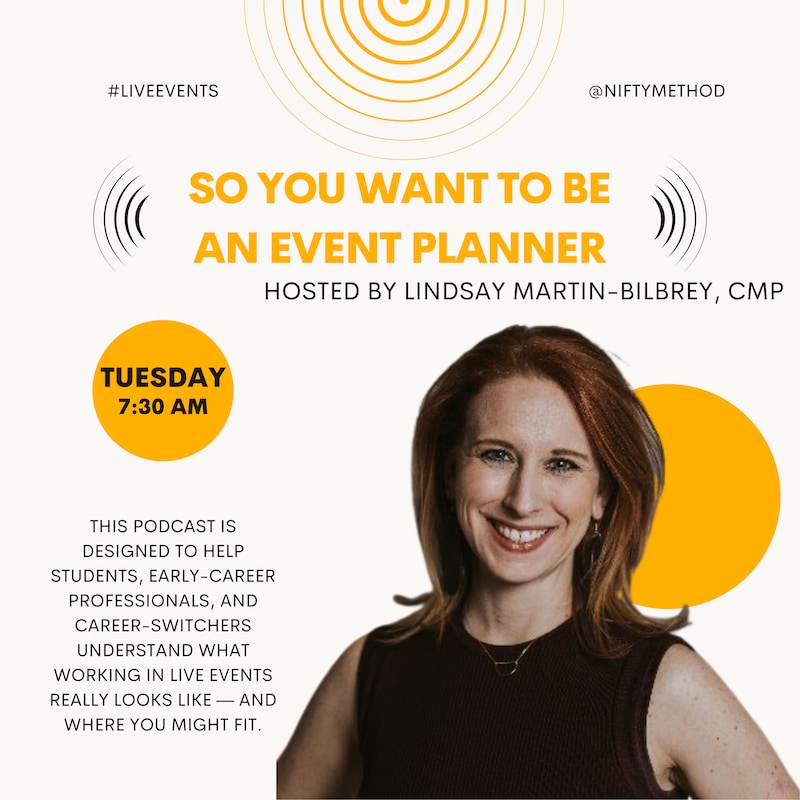
Shownotes
🎙️ Episode 3 — How Do People Get Into This Field?
Almost no one grows up saying, “I want to work in live events.”
So how do people actually find their way into event planning and event management?
In this episode of So You Want to Be an Event Planner, we break down the real entry paths into live events and normalize non-linear career journeys. We explore how people migrate into the field from hospitality, theatre, marketing, sport, nonprofits, corporate roles, and technology—and why transferable skills matter more than having a “perfect” background. This episode also addresses the permission problem that causes many capable people to hesitate before claiming a place in the field.
If you’re a student, career-switcher, or early professional wondering how to get into event planning or whether you belong in this industry, this episode is for you.
🔑 Key Ideas
- There is no single or “correct” path into event planning
- Most event professionals migrate from adjacent fields
- Transferable skills matter more than credentials at entry level
- Career switching is common—and often advantageous
- Belonging in events is claimed through practice, not permission
🧠 Language We’re Using
- Career migration
- Transferable skills
- Entry pathways
- Permission problem
- Adjacent industries
✍️ Try This
Map your own path—real or hypothetical—into events.
What skills do you already have that live events need?
🎧 Coming Up Next
Episode 4: Where the Jobs Actually Are
If people get into events in many ways, where do they actually work? Next, we’ll break down who hires event planners and event managers—and how the event labor market really functions.
🔍 Examples Referenced in This Episode
- Hospitality and venue operations
- Theatre and live performance production
- Marketing and experiential teams
- Nonprofit fundraising events
- Corporate internal events
Transcripts
Episode 3 How Do People get into a Live Events as a Field?
Speaker A:Welcome to so youo Want to Be an Event Planner, a podcast about how people actually find their way into the live events and experience industries.
Speaker A:I created this show because live events are everywhere in our lives conferences, concerts, weddings, festivals, sports and civic moments.
Speaker A:But the field itself is surprisingly invisible.
Speaker A:People work in live events for years without ever being able to explain what the industry really is, how they got into it, or what paths might exist.
Speaker A:My name is Lindsay Martin Bilbrey.
Speaker A:I've spent over 20 years working across hospitality, live events strategy and operations in agencies, venues, brands, associations, and classrooms, and I've seen firsthand how many talented people stumble into this work without a map.
Speaker A:This podcast was designed for students who think they might belong in events but don't quite know what that means yet.
Speaker A:It's for career switchers who found themselves adjacent to this field and are wondering if there's a place for them here.
Speaker A:And it's for parents, advisors, and educators who need better language for explaining what this industry actually is and why it matters.
Speaker A:This isn't a how to show about event planning.
Speaker A:It's about understanding the field, the roles, the pathways, the identities and the systems behind live events and experiences so you can decide where you fit inside it.
Speaker A:Let's get into it Almost no one grows up saying I want to work in live events.
Speaker A:Most people find their way here by accident, curiosity, or by following skills they already had.
Speaker A:So today we're talking about how people actually get into this field, why there is no single right path, and why your background probably makes more sense than you think.
Speaker A:So how do people get into live events?
Speaker A:This is one of the most important questions in our entire series, because it's where a lot of people quietly disqualify themselves.
Speaker A:We assume I didn't major in the right thing.
Speaker A:Maybe I didn't start early enough.
Speaker A:I didn't follow the correct path.
Speaker A:The reality is much simpler and much more generous.
Speaker A:The Myth of the Right Path let's start by clearing something up.
Speaker A:There is no single entry door into live events.
Speaker A:You could ask 20 different people in this industry and you'll hear 20 different origin stories.
Speaker A:There's no standardized career ladder that everyone climbs, no universal degree requirement, no moment where you're officially allowed in.
Speaker A:Instead, most people migrate into live events, and I don't think that's a bug.
Speaker A:I believe it's a feature.
Speaker A:Events attract people from other disciplines because they sit at the intersection of so many skills.
Speaker A:People don't usually leave their previous fields behind Instead they bring them with them, which is why live events feels familiar to people from very different backgrounds.
Speaker A:Here are some of the most common ways people enter the live events field.
Speaker A:Not as rules, just patterns.
Speaker A:A career in hospitality or a degree in hospitality brings you to live events.
Speaker A:People who start in hotels, catering, restaurants or tourism often move into live events through roles in banquets and catering, convention services or or guest experience roles.
Speaker A:These people bring strengths in service systems, logistics, guest flow and problem solving under pressure.
Speaker A:The theater, music and performing arts bring enormous amount of people, usually on the production side.
Speaker A:Producers come from the theater, music, dance, film.
Speaker A:These types of people tend to be fluent in a run of show, backstage or stage management, coordination, show calling, cues and timing and working with talent.
Speaker A:They often rolled towards event roles focused on live entertainment, festivals, stage management, which is a variety of different options inside the ecosystem or programming roles.
Speaker A:People who have a marketing or communications background usually work with corporate events, though you see them again all across the industry.
Speaker A:They find the events originally and experience them for the first time through content and storytelling, public relations, brand activations, B2B and experiential marketing.
Speaker A:They bring audience insights, messaging, conversion driven and economic cognitive and narrative structure.
Speaker A:Live events becomes just another channel for them.
Speaker A:I'll bet a live one sport is another.
Speaker A:They tend to work on the operations, sport management, athletics and recreation.
Speaker A:Professionals enter events throughout through game operations, facility management and fan experience.
Speaker A:They're used to large crowds, safety and risk at scale, scheduling and working in live environments, which makes event operations a natural career fit.
Speaker A:Nonprofits for fundraising and community events work early on in live events in their careers at fundraisers, galas, awareness events or community outreach programs.
Speaker A:They learn stakeholder management, internal politics, volunteer coordination and purpose driven storytelling.
Speaker A:These skills transfer cleanly into many live event sectors.
Speaker A:Corporate roles also lead to internal and external events.
Speaker A:Many people enter live events from inside the organization.
Speaker A:Maybe they've planned a human resources event, internal communications, they've worked as an executive assistant and level up through operations.
Speaker A:They get pulled into company off sites, town halls and leadership meetings and suddenly realize oh, this is my main job.
Speaker A:Design and tech are often where we find our experience roles in the ecosystem.
Speaker A:Graphic designers and technologists help us design our registration platforms, our audio, visual and production technology, the graphics and experience design that you see in our decorations and design on the screens on the floors and the things in the welcome systems that we bring in for environmentals and help us with the digital engagement.
Speaker A:They tend to bring systems thinking, user experience and technical fluency which is central for modern events.
Speaker A:Events loves, transferable skills.
Speaker A:That's one of the most important things to understand about this field.
Speaker A:When I just went through all of the different people and skills that could bring you into it, you might have said, but I don't work in nonprofits, but I have this.
Speaker A:I don't work in sport, but I have this.
Speaker A:It doesn't matter.
Speaker A:We love transferable skills because at any different part of the event cycle, you might find yourself needing to master or find someone on your team who can help you deliver that in order to make the event happen.
Speaker A:Events rewards coordination, communication, adaptability, situational awareness, and most importantly, collaboration.
Speaker A:It's why career switchers are those that started in one job and then came into a career in live events.
Speaker A:Succeed so quickly, you already know how to do the work.
Speaker A:We just teach you how to apply it in a live, planned, intentional environment.
Speaker A:Here's the part most people don't say out loud.
Speaker A:There are many talented people who hesitate to be part of of the live events or to take a leadership role in live events because they're waiting for permission.
Speaker A:Permission to get the right degree to call themselves a live events professional, to apply for that role, to change direction, or simply to belong.
Speaker A:But this field doesn't gatekeep in the way others do.
Speaker A:Belonging isn't granted.
Speaker A:In fact, it's claimed through practice.
Speaker A:You can come to any event association event and say you've done this as your resume and odds are you'll be accepted into the tribe.
Speaker A:So what really matters at the entry level?
Speaker A:If there's no single path, how do you get in?
Speaker A:At the entry level, what matters most is a willingness to learn and to ask questions, being reliable, having curiosity, learning to communicate again and again, and being willing to travel and be exposed to live event environments.
Speaker A:It's hard to learn it sitting just behind a computer.
Speaker A:You need to go on site and live through the event itself.
Speaker A:We're not asking for perfection.
Speaker A:We're not asking for pedigree.
Speaker A:And there's no such thing as having the right resume.
Speaker A:Experience compounds quickly here through simply being there and being willing to learn.
Speaker A:If you're listening to this and thinking, I don't see myself anywhere on that list, try a different question.
Speaker A:Instead of asking, do I belong in live events and experiences, instead ask yourself, what skills do I already have that live events needs?
Speaker A:Because chances are you're closer than you think.
Speaker A:Understanding how people enter this field does something important.
Speaker A:It removes shame or guilt.
Speaker A:It removes comparison.
Speaker A:It removes the myth that you're behind.
Speaker A:Most people don't start in live events.
Speaker A:They arrive there.
Speaker A:Once you understand how you get into it, the next question becomes practical.
Speaker A:So where are the jobs actually located?
Speaker A:Not titles, but employers.
Speaker A:And that's what we're going to cover next.
Speaker A:In the next episode, we're getting very concrete about who actually hires event professionals, venues, agencies, brands, nonprofits, governments, and vendors, and how the labor structure of this field really works.
