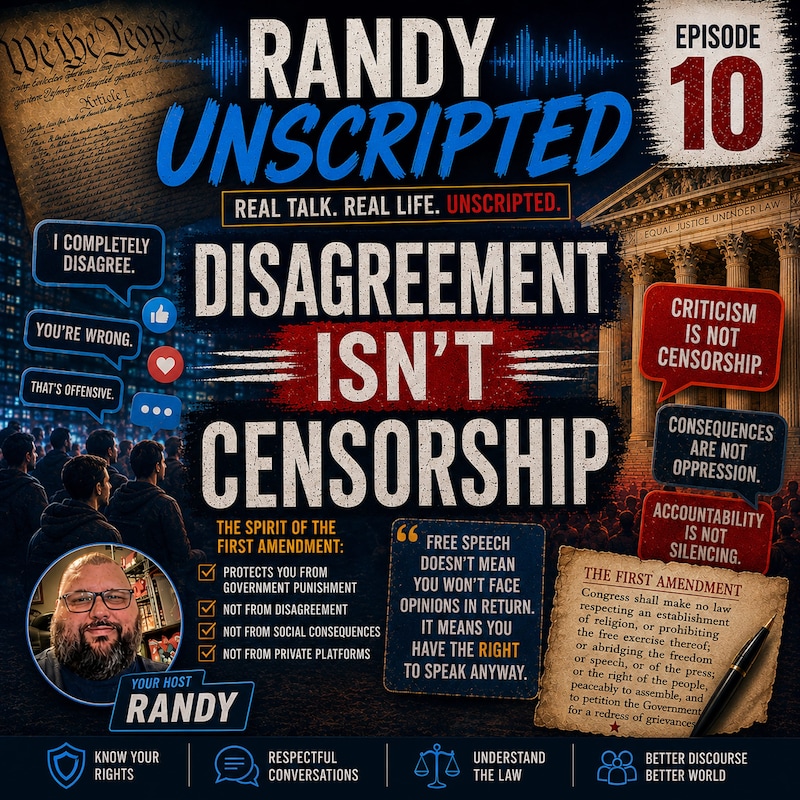
In this episode of Randy Unscripted, Randy reflects on the meaning and limits of free speech while participating in the NAPODPOMO 2025 challenge. He examines how people often reference the “spirit of the First Amendment” in online discussions and explains the important distinction between constitutional protections from government censorship and the policies enforced by private companies and digital platforms.
The conversation explores free expression in the modern internet age, including social media moderation, public discourse, constitutional misunderstandings, and the blurred lines between public and private online spaces. Randy encourages listeners to think critically about civil discussion, personal responsibility, and what the First Amendment actually protects under United States law.
Transcripts
:
Randy Black.
:
Randy Black.
:
Randy Black.
:
Randy Black.
:
Randy Black.
:
Randy Black.
:
Randy Black.
:
Randy Black.
:
He's a troublemaker.
:
You know, before we jump into today's thoughts, I want to take a second to talk about something
:
we've been doing this month, and that's NAPODPOMO, short for National Podcast Post Month.
:
It's kind of like the NaNoWriMo, the National Writing Month, Novel Writing Month, but for podcasters.
:
And it's a challenge to create and to publish 30 podcast episodes in 30 days.
:
Yeah, it's a little wild, but that's the fun of it.
:
It pushes you to stay creative, to keep showing up at your mic,
:
and to explore ideas that might otherwise stay tucked away in a notebook somewhere.
:
And for me, that'd be OneNote. OneNote's my organizational tool. For me, though, this is not about perfection. It's about consistency and about reflection. And every day's episode, each day we do an episode is a chance for me to sit down, to hit record, and just think out loud for a little bit about something that might have been on my mind.
:
And that brings us to what I've been thinking about today.
:
You know, I've been thinking a lot lately about how people talk about the quote unquote
:
spirit of the First Amendment.
:
It's one of those phrases that gets thrown around a lot, especially online.
:
You know, someone gets called out for something they've said and immediately they'll respond
:
with, well, what about the spirit of free speech?
:
What does that even mean?
:
And that's where the conversation usually starts to drift away from what the First Amendment actually is.
:
See, here's the thing.
:
The First Amendment isn't about protecting speech in general in a social sense.
:
It's about preventing government interference with speech.
:
It doesn't guarantee that people won't disagree with you or that private platforms have to let you say whatever you want.
:
that spirit idea, it's often used to stretch the meaning of the law into something that it
:
definitely is not. I get why people will reach for that phrase. It feels good to believe that
:
the Constitution covers every situation where speech gets restricted or gets challenged.
:
But in reality, the First Amendment has boundaries. It's powerful, yes, but it's not unlimited.
:
It applies to the government, not to individuals, not to businesses, and not to private organizations.
:
And here's where we get into some gray areas because our online spaces often feel public, but they're really not.
:
When you're posting on social media, you're in a space owned by a company.
:
You've agreed to their terms of service.
:
So if your post gets taken down, that's not a First Amendment violation.
:
It's a moderation decision. I've lost count of how many times I've seen people start shouting
:
First Amendment, First Amendment in a comment section on Facebook. Oh my gosh, it's out of
:
control. It's important that we remember that nuance of things because once we lose sight of
:
it, we start treating disagreement or accountability as censorship. That's dangerous because real
:
Concentorship does exist, but it happens when governments try to silence voices,
:
not when people face social consequences for what they say.
:
The actual power of the First Amendment is found in how it limits authority,
:
not how it protects popularity.
:
It's not there to make sure everyone likes what we say.
:
It's there to make sure we can say it without the fear of government punishment.
:
And that's an important distinction.
:
We can still talk about values like openness and tolerance and respectful debate.
:
Those are worthwhile goals, and I support them strongly.
:
But they're not the same as constitutional rights.
:
When we blur those lines, we risk weakening our understanding of what real freedom of speech looks like.
:
So maybe instead of talking about the spirit of the First Amendment, we should focus on understanding its substance.
:
and the responsibility that comes with it.
:
Because freedom of speech isn't a shield against criticism.
:
It's a protection against oppression.
:
And if we truly care about it,
:
we'll stop using it as a catch-all defense
:
for anything we want to say
:
and start defending it where it really matters,
:
in the face of actual attempts to silence by power,
:
not by opinion.
:
This has been another entry into my NAPOD POMO journey,
:
a chance to explore ideas like this one episode at a time
:
and to keep that daily rhythm of thinking out loud about the world we live in.
:
If you're another podcaster taking part this month,