Shownotes
The primary focus of this episode is the transformative potential of Positive Prime, a revolutionary neuroscience-based platform founded by Kim Serafini, which seeks to enhance resilience, creativity, and overall well-being.
In our dialogue, we delve into the profound implications of this innovative system, particularly its efficacy in helping individuals and teams recalibrate their mental states amidst life’s uncertainties.
Kim, an esteemed neuro-innovation pioneer, articulates her journey from leading corporate change initiatives globally to developing this impactful tool, shaped by her personal experiences and academic pursuits in applied cognitive neuroscience.
Throughout our discussion, we explore the intersection of positive psychology and digital wellness, highlighting how Positive Prime facilitates a unique flow state that fosters personal growth and better decision-making. We invite our listeners to consider how this cutting-edge approach can serve as a catalyst for unlocking opportunities and prosperity, particularly for women-led enterprises.
Our Guest This Week:
In this week’s episode of #WisdomofWomen we have a 🌟 Neuro-Innovation Pioneer 🌟 in our midst.
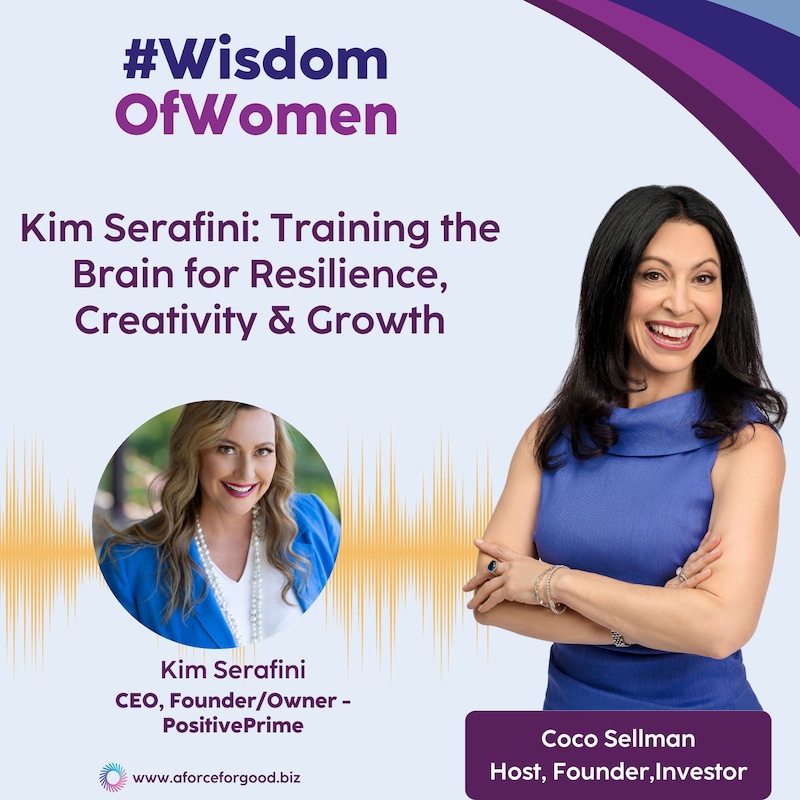
Kim Serafini is the founder and CEO of Positive Prime, a neuroscience-based platform designed to help people rewire their thinking for resilience, creativity, and flourishing. An applied cognitive neuroscience practitioner and ARC Grant recipient, Kim’s work blends positive psychology, brain-computer interface research, and digital wellness innovation to help individuals and teams become “positively primed” in as little as three minutes a day. After an early career leading large-scale corporate change initiatives across more than 22 countries, a serious health crisis redirected her life toward exploring how the brain heals, adapts, and thrives under pressure. Today, through Positive Prime and her broader work in psycho-neuro-immunology, Kim helps founders, leaders, and communities cultivate the inner conditions that unlock better decisions, deeper resilience, and extraordinary performance.
Takeaways:
- Positive Prime is a neuroscience-based platform designed to enhance mental resilience and creativity.
- The discussion highlights how personal experiences shape one's professional path and innovations.
- Kim Serafini shares her journey from corporate change initiatives to developing Positive Prime.
- The episode explores the intersection of positive psychology and cognitive neuroscience in fostering personal growth.
Chapters:
- 02:34 - The Impact of Books on Personal Transformation
- 06:49 - The Journey of Positive Psychology and Personal Transformation
- 19:35 - Navigating Change in a Complex World
- 21:46 - The Concept of Positive Prime
- 30:11 - Understanding the Dynamics of Change
- 36:25 - The Impact of Positive Prime on First Responders
- 39:40 - Introduction to Positive Prime
- 43:58 - Exploring AI and Personalization
Burning Questions Answered:
1.Why resilience is not just grit
2.How the brain responds to uncertainty and stress
3.Why founders need safety in the nervous system before real change can take hold
4.How Positive Prime uses visual neuroscience to help shift the brain into a more receptive, creative state
5.Why gratitude, vision, and identity all play a role in transformation
6.How leaders can cultivate the inner conditions for better decisions, deeper resilience, and extraordinary performance
Guest Offers & Contact Information:
https://www.positiveprime.com/
https://www.linkedin.com/in/kimserafini/
https://www.facebook.com/groups/positivechangemakersgroup
https://www.instagram.com/positiveprimetheofficial/
https://www.youtube.com/user/KimSerafini
Special Offer for #WisdomOfWomen Listeners:
- Sign up here:
- https://www.positiveprime.com/positive-prime-199-offer?ref=COCO
- 7-Day Free Trial – no credit card needed https://platform.positiveprime.com/register?ref=COCO
- Experience the Force for Good Positive Prime Session - https://platform.positiveprime.com/share-session?name=Coco&sessionId=661&ref=COCO
Begin your daily practice and experience the transformative power of Positive Prime in as little as 3 minutes per day.
Follow the #WisdomOfWomen show for more inspiring stories and insights from trailblazing women founders, investors, and experts in growth and prosperity.
YouTube: https://tinyurl.com/yja3w7nh
Spotify: https://tinyurl.com/4tak8ajk
Amazon Prime: https://tinyurl.com/366syddj
Apple Podcasts: https://tinyurl.com/bdhananz
RSS Feed: https://feeds.captivate.fm/womengetfunded/
Coco Sellman, the host of #WisdomOfWomen, believes business is a force for good, especially with visionary women at the helm. With over 25 years of entrepreneurial experience, she has launched five companies and guided over 500 startups. As Founder & CEO of A Force for Good, Coco supports purpose-driven women founders in unlocking exponential growth and prosperity. Her recent venture, Allumé Home Care, reached eight-figure revenues and seven-figure profits in just four years before a successful exit in 2024. A venture investor and board director, Coco’s book, *A Force for Good*, reveals a roadmap for women to lead high-impact, high-growth companies.
Transcripts
Welcome to the Wisdom of Women Show.
Speaker A:We are dedicated to amplifying the voice of women in business.
Speaker A:A new model of leadership is emerging and we are here to amplify the voices of women leading the way.
Speaker A:I am your host, Coco Selman, five time founder, impact investor and creator of the Force for Good system.
Speaker A:Thank you for joining us today as we illuminate the path to unlocking opportunities and prosperity for women led enterprises by amplifying the voice and wisdom of women.
Speaker A:Today we have a neuro innovation pioneer in our midst.
Speaker A:Kim Serafini is the founder and CEO of Positive Prime, a neuroscience based platform designed to help people rewire their thinking for resilience, creativity and flourishing.
Speaker A:An applied cognitive neuroscience practitioner and an ARC grant recipient, Kim's work blends positive psychology, brain computer interface research and digital wellness innovation to help individuals and teams become positively primed in as little as three minutes a day.
Speaker A:After an early career leading large scale corporate change initiatives across more than 22 countries, a serious health crisis redirected Kim and her life towards exploring how the brain heals, adapts and thrives under pressure.
Speaker A:Today, through Positive prime and her broader work in psychoneuroimmunology, Kim helps founders, leaders and communities clients cultivate the inner conditions that unlock better decisions, deeper resilience and extraordinary performance.
Speaker A:So welcome.
Speaker A:We're so excited to have you Kim.
Speaker B:Thank you Coco.
Speaker B:And hello everybody.
Speaker B:It's an honor, privilege and pleasure to be here.
Speaker B:Wow.
Speaker B:What an introduction.
Speaker B:I need to have you come with me everywhere.
Speaker A:I love the introductions.
Speaker A:Right.
Speaker A:I do.
Speaker A:Because I really honor and appreciate that you're here with us and I, I want to make sure our listeners know how special you are and what gifts you're bringing to the world, which are so many.
Speaker A:So as we always start, I like to ask, what is a book written by a woman that has significantly influenced your life?
Speaker B:It's such a difficult question because I literally am thinking through the Celestine Prophecy or the Alchemist or even the biography about Coco Cachinel or by men, women.
Speaker B:I'll be honest, an esoteric book by Lynne Grabhorn called Excuse me, your Life is Waiting.
Speaker B:But I would say there are two women's books who changed the trajectory of my life.
Speaker B:One was Marcy Schimoff's Happy for no Reason.
Speaker B:I actually thought she did the very best job of taking a lot of the positive psychology genius material and turning into something practical and usable.
Speaker B:And I'm very much about that.
Speaker B:There's no good in research being read by the mother and the sister and the it needs to be read by real people who have real lives who can use it.
Speaker B:And then I would say Marcy Scheimoff, who's actually originally very famous for Chicken Soup for the Women's Soul.
Speaker B:These are great.
Speaker B:And at the time she was the CEO of Jack Canfield's organization.
Speaker B:And so she was involved in the success principles and, and the franchise that is the Chicken Soup for the Soul series.
Speaker B:And.
Speaker B:And I suppose it's not just the tens of millions of copies that she sold.
Speaker B:It was what it then enabled me to do in my life because I got to know her very well and she was extremely generous.
Speaker B:And after I asked her, I made a request of her to introduce me to some people, which she duly did.
Speaker B:Everything changed.
Speaker B:And now we sit here and I am who I am doing what I'm doing.
Speaker A:Oh, I love that.
Speaker A:You know, and it's amazing how books can transform us and then sometimes we also meet the authors and that transforms us even further.
Speaker A:We're inspired.
Speaker A:I want to go back to.
Speaker A:Excuse me, you, Life Is Waiting by Lynne Grabhorn.
Speaker A:I know that book.
Speaker A:I read that book a very long time ago and I have to tell you, I don't remember all the bits bits, but I do remember it was recommended to me by another mentor of mine.
Speaker A:Was there anything in particular that you grabbed from that book?
Speaker A:Just to remind me.
Speaker B:Okay, so for those of you who don't yet know me, I had a very successful business in the spa industry, in the wellness industry, internationally.
Speaker B:So we'll go into that because I created what is now known as hot stone massage.
Speaker B:But originally the treatment was actually called lithos therapy.
Speaker B:Now I share that with you because one would imagine that I had come across all that was quite spiritual by that time because I trained thousands of therapists, Eastern and ancient wisdom as well as Western and modern wisdom, all combined really in that industry, that is health retreats and clinics and so forth.
Speaker B:And the longevity movement is where we're at with now.
Speaker B:But here's the crazy thing.
Speaker B:It was the first time I had resonated with a book or felt like I connected with the message.
Speaker B:For somebody who was really quite woo woo around the Law of Attraction, it wasn't yet known as quantum physics at that stage.
Speaker B:And the movie what the Bleak Do We Know that was really about quantum physics.
Speaker B:It like, it spread like wildfire through the spa industry and every massage therapist and body treatment, you know, yoga, nutritionist, that was all about what the bleep do we know?
Speaker B:It's really where Misuro Moto's, you know, water crystals became famous first and then literally infiltrated the rest of the world.
Speaker B:Excuse me.
Speaker B:Your life is waiting.
Speaker B:I read that and I realized that my predominant thoughts and feelings were actually driving my life.
Speaker B:And it wasn't that I hadn't come across psychology.
Speaker B:I had organizational psychology and change management consulting.
Speaker B:It was that I didn't ever actually believe that was relating to me and my life.
Speaker B:Do you know, psychology was this thing out there where people who were troubled went to psychologists.
Speaker A:Yes, yes, yes.
Speaker B:The emergence of positive psychology was a brand new field some 20 years ago, maybe arguably still is in the grand scheme of things.
Speaker A:I just remember that being such a wonderful read and it was transformational for me, and it's inspiring me to go back and pick it up and have another visit with it.
Speaker A:And then Marcy, of course, is a really wonderful leader, happy for no reason in her work with Chicken Soup for the Soul.
Speaker A:And I love seeing these examples of spreading impact, spreading ideas, and also business.
Speaker A:So, you know, I believe that business can be a force for good.
Speaker A:And these are examples, as is your life and your business.
Speaker A:Before we get there, I always like to start to help understand our guests and help our listeners understand the human behind the story of the business and whatever you're building.
Speaker A:So I always ask for three moments from your life that have shaped who you are.
Speaker A:So what are three moments that come to mind?
Speaker A:Moments of overcoming challenge or moments of joy and brilliance?
Speaker A:Moments of success.
Speaker A:What are three moments that stand out for you?
Speaker B:I have to say, first and foremost, I grew up in Papua New guinea, an expat community, little white girl in.
Speaker B:And that was very rare in the 70s, early 70s, late 60s, in a country on the equator.
Speaker B:So most people don't know where Papua New guinea is, but they've heard of Fiji.
Speaker B:It's the same kind of people, the Micronesians and the Polynesians.
Speaker B:What does that mean?
Speaker B:Essentially, I was imbued with an appreciation for diversity because I lived it like it was my earliest experiences, zero to seven.
Speaker B:And I lived in a very subsistence culture.
Speaker B:And so there was every day going to the market to buy fresh fruits and vegetables.
Speaker B:And that was the main aspects of the diet.
Speaker B:And of course, you know, it was tropical reef material I longed for and have recently been to Tahiti, to French Polynesia, the Bora Bora, the images of the overwater bungalow and so forth.
Speaker B:My beautiful husband took me there for a wedding anniversary.
Speaker B:Anyway, the crazy thing is that I have this equatorial DNA, which means I quite like humidity.
Speaker B:But what it also means is it Anchors me in something very basic and pristine and naive and beautiful in its simplicity.
Speaker B:And I know that actually everything in life, I mean, you're in Manhattan, New York.
Speaker B:I happen to live in a beautiful environment, millions of trees.
Speaker B:We have a very large acreage, like a rural property here in Australia.
Speaker B:I need to be anchored to a beach nearby.
Speaker B:I really need to be amongst nature and I need to understand the rhythm of nature.
Speaker B:And I think that actually informs everything that I do.
Speaker B:I had extremely entrepreneurial grandparents who went to this land.
Speaker B:They were some of the very first white people to go there.
Speaker B:Some would argue that was colonialism, but they were Italian, and they escaped persecution in Australia or Mussolini to begin with.
Speaker B:And so they were pioneering in their spirit, very courageous and adventurous, and went to these places that, quite frankly, required you to be brave and incredibly innovative because all of the raw resources that you need in manufacturing were not.
Speaker B:Not there on the ground.
Speaker B:Right.
Speaker B:So I think that's really shaped who I am.
Speaker B:And then very quickly, the other two things.
Speaker B:I would argue that we can go into this.
Speaker B:I spent many years working in the spa industry.
Speaker B:I actually went back and studied as an osteopath and an exercise physiologist in London, because I left the corporate world after working on these mergers and acquisitions projects out of business school.
Speaker B:But the reason why it's interesting is because I live now sitting here with a pacemaker, cardiac pacemaker, in my chest.
Speaker B:I have an extremely rare condition where the S node in my heart doesn't work so well.
Speaker B:But there's nothing wrong with my heart in terms of, like, I didn't have a heart attack, but I had these six episodes where my heart literally stopped and I was neurologically unconscious for extended periods of time.
Speaker B:So, like, technically dead.
Speaker B:And then I came back alive.
Speaker B:But my body had an enormous amount of healing to do.
Speaker B:And we can talk about how now that informs everything I understand about vagus nerve, the nervous system, brain resilience, and so forth.
Speaker B:And how the irony of me having created something called Positive prime literally is probably what saved my life and will arguably become a lot more important than to humanity over the next five to 10 years.
Speaker B:So I want to say that spa industry experience was formative.
Speaker B:And then I'm the girl who did not study any sciences at school, and yet I have one of the most prestigious and highly competitive and regarded grants.
Speaker B:Federal government grants.
Speaker B:In America, you call them the National Science foundation, the nsf.
Speaker B:Here in Australia, we call it the Australian Research Council.
Speaker B:It's the same international system, the same criteria for assessing and so when you apply for one of these grants, and I did so with Dr. Ravina Singh at the Brain Computer Interface Lab at the University of Technology Sydney with a research team, what we needed to prove to a body of scientists who were approving it was that our proposal has the potential to change society positively.
Speaker B:And that's a very big, bold ask, rather ambitious, kind of a little outrageous, some would argue, incredibly pretentious or indeed arrogant.
Speaker B:Like, who even thinks that?
Speaker B:But then I think of Marianne Williamson and you know, I'm a child of God and my playing small does not serve this world.
Speaker B:And yet I have no other capacities or resources that make me believe that I should be doing anything this big.
Speaker B:That's, that's.
Speaker A:I love that.
Speaker A:I love that.
Speaker A:So you have this experience of growing up in Papua New guinea and the subsistence culture and then kind of moving on into life time of M and A and all the rest, and then moving into the spa industry and then sort of having the audacity, right, to say, okay, I'm going to go after an ARC grant, a, you know, very respected scientific grant, and, and create something innovative and new.
Speaker A:And so that brings us really to, to POS Prime.
Speaker A:So tell us about what positive prime is and why did you create it exactly?
Speaker B:Trying to fix myself.
Speaker B:I'm a devotee of the personal development, self improvement Anthony Robbins meets.
Speaker B:Whether it's Joe Dispenza or it's Louise Hay, the truth is I really wanted to see if I could.
Speaker B:Now, this is going to be a little bit out there, slightly wild.
Speaker B:There's a concept called getting into the gap.
Speaker B:I want you to imagine the space between the stars out there in the universe and when we're connected and our brain waves do this beautiful synchronization of alpha and theta, and then there's bursts of gammas.
Speaker B:I want you to know that is called the flow state.
Speaker B:It's actually extremely hard for humans to enter this, the flow state, and sustain that.
Speaker B:And I'm not the kind of A type personality that can sit in a cave and meditate forever and let go of all of my attachments for comfort.
Speaker A:Right.
Speaker B:So the monk life or the nunneries, that's just not for me.
Speaker B:However, I have a lot of respect for that because there's this simplicity and discipline and order and there's this purity to that.
Speaker B:So what's happened in my life is I've started to ruminate, but in a good way, obsess, be passionate about how can somebody living a really convoluted, complex, fast Life in a place like London or New York, where I've lived in both of those places in my lifetime.
Speaker B:And yet I ran these retreats in Bali, really beautiful retreats, where everybody's treated like a princess and is really anchored to this incredible Hindu culture in terms of the way that we think about gratitude.
Speaker A:Yeah.
Speaker B:So I literally, I'm fascinated with.
Speaker B:Can we get the brain into that state of flow with bursts of gamma, which is what we see in functional MRI machines, when people are in very deep meditation and connected to the divine.
Speaker B:And so without being religious person.
Speaker B:Right.
Speaker B:I actually want that experience.
Speaker A:Yeah.
Speaker B:Of heaven on earth for all of us, for more of the time.
Speaker B:And I understand that if you actually don't experience feeling very safe and secure.
Speaker A:Yeah, yeah.
Speaker B:What I mean by that is we actually know that people who have high levels of trauma.
Speaker B:There's a beautiful study that's been happening for 20 years for the first responders of the 911 incidents on Long island at the Renaissance School of Medicine.
Speaker B:And we know now that if you're experiencing.
Speaker B:Experiencing more trauma than the average person over a period of time, you have much higher rates of both dementia and cancer diagnoses.
Speaker B:So it's really important we start to understand how can we recalibrate regulate our nervous system, which is driven by our brain.
Speaker B:And I. I never really understood the nuance between the brain and the mind being different.
Speaker B:It's a bit like we have feelings, we think like love, pure, unlimited love from the heart comes from this heart space.
Speaker B:Right.
Speaker B:But it actually comes from the whole of us, even the esoteric us.
Speaker B:And so what I've discovered is that the way to access the gap and actually plant your seeds out there in the universe so that they manifest, so that you achieve your goals with more elegance and grace and speed, so that synchronicities actually do occur into your life is that you have those thoughts whilst you're in this positively prime state.
Speaker B:So we put EEGs onto people's heads.
Speaker B:We showed them a positive prime session.
Speaker B:We actually hit them with all of these adverse effects, otherwise known as last curveballs.
Speaker B:Right.
Speaker B:In the lab, real people.
Speaker B:And we watched how fast their brains literally started to get into this beautiful, exquisite flow state.
Speaker A:Amazing.
Speaker B:And in that state, you are much more receptive and resourceful.
Speaker B:There's all sorts of magnificent things happening in your mind because your brain is in a completely different state.
Speaker B:And because your brain is in a different state, your nervous system is in a different state.
Speaker B:And so healing occurs.
Speaker B:And that, for me, is like one of the hardest things in the world that we could attempt to accomplish.
Speaker B:And yet one of the most critical for these times, the rate of speed of change.
Speaker B:So I'm a change management consultant by training in my early career.
Speaker B:So when people are faced with uncertainty, usually the uncertainty in life is in only one aspect of life, one sphere.
Speaker B:Not all spheres simultaneously, but advanced artificial intelligence is literally changing all industries in all geographical regions.
Speaker B:And so the level of change, the speed, the volume, and the scope, we've never seen all three combined.
Speaker B:And our brains, our bodies were not evolutionarily built for these times.
Speaker B:And so I just decided to commit myself to how do people actually train themselves to be in this state so that they have it like muscle memory, so they can cope with the level uncertainty that we're actually facing right here and right now.
Speaker B:Like, at the moment, we've just.
Speaker B:We've seen something extraordinary happening in the Middle East.
Speaker B:That alone is enough for most of us to feel discombobulated and for collective consciousness to have us all in more anxiety, more fear, more worry, more concern.
Speaker B:And the effect that has on us is incredibly damaging.
Speaker B:And so given that, what can we do to make sure that.
Speaker B:And I think of positive prime, almost like a bit of an insurance force field system.
Speaker B:The more you positively prime, the more you actually have a nervous system that is in training for you to be able to have these curveballs bounce off you.
Speaker B:That's the beauty of it.
Speaker A:I love this, and I'm grateful.
Speaker A:So I have a belief in life that our natural desires, and I don't mean the types of desires that are like our ambition gone awry or pressure from the outside world that tells us we should go out and do stuff.
Speaker A:We have to be all these things that we're authentically not.
Speaker A:I'm not talking about that kind of desire.
Speaker A:I'm talking about some of us are built to create.
Speaker A:Some of us are built to be builders.
Speaker A:Some of us are built to sit on a mountaintop and be Buddhists.
Speaker A:Right?
Speaker A:And I'm always grateful when.
Speaker A:So the fact that you have a desire within you to be in this world of building and business and find ways for us to perform better as life is uncertain and disruptive.
Speaker A:And I love the way you put it elegant.
Speaker A:Be able to create and go out in the world and achieve our desired goals with elegance, grace and speed.
Speaker A:Right, Elegance, grace and speed.
Speaker A:Not frenzy, worry, anxiety and pressure.
Speaker A:Right.
Speaker A:Elegance, grace and speed.
Speaker A:So it sounds like this system must be so complicated, right?
Speaker A:This positive prime.
Speaker A:But in fact, it has many layers of depth.
Speaker A:But to experience it is Quite simple.
Speaker A:Can you tell us about what it's like to experience this system of positive prime?
Speaker B:All right, for those of you who will want to trial it, we do have a beautiful opportunity for you to have an absolutely complimentary gifted week or two of positive priming.
Speaker B:So wait until we give you the code for that.
Speaker B:Your eyes process information from a survival threat point of view much faster than your ears.
Speaker B:And so the intervention from an integrative medicine point of view is actually through the eyes.
Speaker B:So you view what you would think is a slideshow, but it's a very sophisticated, special type of slideshow inside what we call our own proprietary player.
Speaker B:It's not a video.
Speaker B:It's its own thing.
Speaker A:Right.
Speaker B:A positive prime session is an innovation that didn't exist anywhere in the world and still doesn't exist anywhere else in the world other than here.
Speaker B:Okay, so what does it do?
Speaker B:It shows you randomized images, photographs that are spectacular but very carefully curated.
Speaker B:So every single one of the images, when combined, and the way that it actually flows in front of you, they're like safety cues.
Speaker B:And this is really important because I've just been at Harvard Medical School, and I've been working with some people who arguably are the greatest in the world at this.
Speaker B:Because of my mentor, Professor Stephen G. Post, and his friends, I've been introduced to a whole heap of people who have inspired me.
Speaker B:One of them is Dr. Esther Sternberg.
Speaker B:So she's a pioneer in understanding how we take in our environment.
Speaker B:It impacts what we call the HPA axis in the brain that sends messages.
Speaker B:And essentially our immune system literally responds either based upon what we see.
Speaker B:And so we can show you a variety of images very carefully selected.
Speaker B:We can actually make sure that you believe that it's appropriate and adequate for you by having what we call in the software personalization.
Speaker B:So we call them sessions.
Speaker B:It's our own kind of product.
Speaker B:I don't know how else to describe it.
Speaker B:And those sessions, every single time you press play, it reshuffles.
Speaker B:Imagine the flashcards in this slide deck, so you see them in a different order, and it brings about neuroplasticity.
Speaker B:It actually strengthens your brain.
Speaker B:And what that means is that the more adverse effects, the more negativity in your world, the faster your brain will move into what we call the positive prime state.
Speaker B:Now, what that effectively means, when we've got an EEG on your head and eye tracking and skin conductance and heart rate variability, is that instead of you going into threat fight, flight mode, guess what happens?
Speaker B:You pause for they're fractions of milliseconds, but they're incredibly marvelous in their long term effect or what actually happens downstream.
Speaker B:You look for friends and support and help you become more creative and innovative around your resources.
Speaker B:When you're in a positively prime state, instead of immediately going to fight or flight or freeze or faint.
Speaker B:Friends first.
Speaker B:Now, we actually did this research to prove it that every single one of us as humans, we're looking for friends first.
Speaker B:Now let me extrapolate that for you.
Speaker B:Yeah, it's very different.
Speaker B:It's very difficult for anyone to change a habit, a course direction, an aspect of themselves when their bodies are in threat mode.
Speaker B:It's almost like we can't even receive the advice, even if the advice is given.
Speaker B:You actually have to be in a safety space.
Speaker B:Now, Dr. Gregory Frischon, who's the head of psychiatry at Massachusetts General Hospital, he actually calls this the attachment solution.
Speaker B:Positive prime is an attachment solution.
Speaker B:So you can go and do a whole heap of chat GPT around.
Speaker B:What's the separation challenge and what's an attachment solution?
Speaker B:It's really quite intricate.
Speaker B:It's actually very complex.
Speaker B:But to your point, Coco, we made sure that everybody could receive the brilliance of Positive prime without actually understanding any neuroscience or any, you know, positive psychology or any change management theory.
Speaker B:You press play on what we call a session.
Speaker B:And There are over 200 sessions, which means every single one of these sessions is about a different topic or a subject.
Speaker B:It's been contributed by a world class thought leader, a bestselling author.
Speaker B:In fact, you'll find Jack Canfield's the Success Principles because I've worked with him inside the collection, the library.
Speaker B:Right.
Speaker B:So his is one of the sessions.
Speaker B:But there's lots of other people who are nutritionists or they're doctors or they're psychologists or they're amazing life coaches.
Speaker B:They have sessions in our library, including some other very beautiful humans who happen to be here in our presence.
Speaker B:Like Coco Salman.
Speaker B:Right.
Speaker B:Imagine a positive prime session is something you view for only three minutes at the beginning of every single day.
Speaker B:Now, if you've got a lot of areas of your life to upgrade, you might want to watch three sessions a day.
Speaker B:You might want to watch five minutes or ten minutes per session.
Speaker B:But I want you to imagine if you're watching Coco's session, it's as if Coco is sitting on your shoulder and she is nurturing you and nourishing you in the same time.
Speaker B:What's happening is your brain is entering this flow state with bursts of gamma because you're viewing the Positive prime session with all of these spectacular images, but it's integrating these word statements that are very positive, that are like self fulfilling prophecies or advice or suggestions or recommendations, but they're Cocos.
Speaker B:And so it's like coco is actually literally being integrated into your identity.
Speaker B:And I would argue that I'm one of those people who've actually figured out how to help people change their identity in a very subtle and organic way.
Speaker B:The upgrade happens without you even being aware of it.
Speaker B:But it's because when you're viewing a Positive prime session, the information is bypassing what we actually call the conscious critical judgment factors of your prefrontal cortex that usually has whatever you're trying to change and whatever you're resisting is persisting.
Speaker B:You've actually got to bypass the part of you that is suspicious about what is in your best interest.
Speaker B:But you can't do that unless your body, your nervous system and your brain is in this harmonized, balanced state that allows you to play with new ideas.
Speaker B:Because anything that is unfamiliar to us as humans, we reject simply because we're trying to survive, because we don't know if it's a threat.
Speaker B:So our natural response is let's reject that until we know we want to accept that.
Speaker B:And that is actually not in our best interests.
Speaker B:Even though the survival instinct was built for us to survive, it actually almost prevents us from every single change we want to make in our lives.
Speaker A:Yeah, it's.
Speaker A:I think it's so powerful because when I log into Positive prime, it's.
Speaker A:You can search for people that you know, that you care about or that have created these particular Positive prime messages, or you can search for a particular desire or need.
Speaker A:So maybe you're wanting more rest, or maybe you're wanting more passion, or maybe you're wanting more to connect more with abundance or whatever those desires are.
Speaker A:And a lot of it.
Speaker A:I mean, our audience today as founders and leaders and so much of what we're all trying to grow, our businesses, which growth is code for change.
Speaker A:It's right.
Speaker A:So we are always bombarding ourselves and our teams with need for change.
Speaker A:And if our neurology is in fight or flight, the change is not going to take hold.
Speaker B:And Coco, I am a founder, right.
Speaker B:So I also know what it's like when you think about how am I going to pay my software engineers and are we going to win that deal?
Speaker B:And all of that uncertainty is actually really and truly detrimental.
Speaker B:And it diminishes our abilities as founders.
Speaker B:I mean, that is actually just biological fact.
Speaker A:Yeah.
Speaker B:So, yeah, resilience.
Speaker B:And I don't mean the kind of resilience we've been talking about.
Speaker B:It's not grit.
Speaker B:Resilience is actually a very new field, particularly from a neuroscience point of view, because we didn't have the research tools to actually understand the brain like we do cognitive neuroscience.
Speaker B:And the way that we're actually exploring resilience these days is it's actually impossible for you to develop resilience, which you require if you're going to be a founder.
Speaker B:If, by the way, a new parent, I would actually say that's founding a family.
Speaker B:Like, I see founders everywhere amongst us.
Speaker B:I really do.
Speaker B:Even the college students who taking the gap year who are going to Europe on.
Speaker B:Remember when we all used to do like 30 days on $30 a day, whatever.
Speaker B:It's that adventurous spirit.
Speaker B:We actually need to feel safe first and that allows us to go out there into the world.
Speaker B:And unfortunately, all of the other algorithms driving these social media platforms are deliberately making us feel unsafe because in unsafe states, guess what?
Speaker B:We're easier to manipulate.
Speaker A:So here we are.
Speaker A:Right?
Speaker A:You've designed this incredible platform and people can now access it and feed themselves with it.
Speaker A:I would love for you to share.
Speaker A:You mentioned first responders before and you have some first responders using Positive Prime.
Speaker A:To me, this is such a wonderful.
Speaker A:If it's helping first responders and their level of stress, then imagine how it can help the rest of us.
Speaker A:The reason I wanted you here today is because I do think that it's a wonderful way for us, especially those who are maybe a little unwilling to try meditation or wanting.
Speaker A:This is not.
Speaker A:These are three minute videos.
Speaker A:Videos, like I say that with quotes, they're complicated.
Speaker A:They're not videos.
Speaker A:They are neuroscientifically designed experiences that help rewire your brain for resiliency and to calm you down so you get into flow state so you can be creative and so that your brain starts to think differently so you can change and innovate.
Speaker A:Right.
Speaker A:So talk to us a little.
Speaker A:I'd love for you to share the story about how it's being used with some of your people in the world, like the first responder.
Speaker B:I'll be honest.
Speaker B:The first 10,000 people were using Positive prime as a vision board on steroid software.
Speaker B:Right.
Speaker B:The next 10,000 were probably because, interestingly enough, the reason I became friends with Marcy Shimoff is I sent her a copy of my little book called I Am Grateful for Life, which is not in print anymore.
Speaker B:Other than me gifting it in special occasions.
Speaker B:But I am grateful for life as a really amazing bestseller, cute little gift book.
Speaker B:It's really what started me on the journey towards doing more of this, the Science of gratitude, which led me to understanding all the sciences in all the different kinds of subjects in positive psychology, which then led me to cognitive neuroscience.
Speaker B:Anyway, the crazy thing is that most people then used it as a gratitude board instead of a vision board.
Speaker B:It's a software.
Speaker B:We upload all of the photographs of what's really meaningful and significant for you.
Speaker B:So it's like this incredibly intense and very valuable gratitude exercise.
Speaker B:You see all of these highlights of your life that remind you that you're blessed and fortunate and lucky.
Speaker B:It's amazing, right?
Speaker B:And then I would say the next 10,000 were essentially people who were like direct sales leaders who would use it as motivation for their sales teams, because we've got great content in that respect.
Speaker B:And I would literally have, like, the leader of Doterra essential oils or Norwex cleaning products or whatever.
Speaker B:And then everyone in their team's a member.
Speaker B:And then the truth is, I started to think about how do we apply this to that enterprise level in the business or workplace environment?
Speaker B:And I would love to be proven wrong.
Speaker B:By the way, if you're listening to this, I have a suspicion that most companies provide workplace wellness programs and they don't actually care about its efficacy.
Speaker B:They're simply trying to reduce their liability.
Speaker B:And I worry that something like Positive prime is not ever going to be introduced at scale in large organizations because they actually, well, they don't really care enough.
Speaker B:And so it's going to be up to us as individuals to become members.
Speaker B:Now, when I say that, the difference, though, is if it's government or community related, it seems like there's an appetite.
Speaker B:And so the first responders are actually looked after by their comrades.
Speaker B:I mean, it's an interesting phenomenon for me to observe from the outside.
Speaker B:I'm not a first responder.
Speaker B:I can tell you I've had a need for first responders.
Speaker B:I have, like, physically been dead and there have been ambulances, like, you know, emergency services.
Speaker B:I can tell you I have, I suppose, a commitment here or a dedication here.
Speaker B:That's rather unusual.
Speaker B:What I know from the way their brains process trauma is that if they don't have a way to recalibrate themselves and balance themselves, they will end up part of the statistics with much higher rates of dementia and, quite frankly, cancer.
Speaker B:So we do have trials in sheriff's offices in Colorado.
Speaker B:We Came to this work through an amazing woman named Catherine Savann Xaviery.
Speaker B:Tragically, her husband was killed.
Speaker B:It's a very long story.
Speaker B:But anyway, she got to know very intimately the compassion of first responders.
Speaker B:She decided to buy a 40 acre ranch in Colorado so first responders can go there for recreation.
Speaker B:It's not a mental health facility, it's about recreation.
Speaker B:So anyway, she really is on this mission to help these first responders with recreation.
Speaker B:Rest, rest duration.
Speaker B:She heard about positive prime.
Speaker B:We got to meet each other.
Speaker B:I got to present to sheriffs through and with Catherine.
Speaker B:She is a dynamic, she's an extraordinary woman and she's got a heart of gold.
Speaker B:And so we decided that we would donate thousands and thousands of memberships through her charity to first responders because she was going to take on the responsibility, the accountability to have a group of trainers take this out and in fact, fact to people who are in fire departments, even in New Jersey.
Speaker B:And I could go on and on about this story, but what I really want you to know is they're very suspicious.
Speaker B:But our science is solid.
Speaker B:And so every single time somebody who's like a doctorate in psychology and when they look at positive prime or if they're Esther Sternberg and she looks at positive prime, she goes, oh wow.
Speaker B:I can understand how this has an influence on psychoneuroimmunology.
Speaker B:Like oh wow.
Speaker B:I can actually see how this has an impact on autoimmune diseases or on something like arthritis.
Speaker B:And so that constantly encourages us to just spread our wings a little further.
Speaker B:And all we've got to do is try.
Speaker B:I mean, what we have proven with our science is that it does no harm.
Speaker B:I think that's the most important thing.
Speaker B:The other aspect of all of this, and I'm sure you'll all appreciate this, is that there's a movement for us to make sure that a positive prime session, that's what we call one experience or you know, one three minute activity.
Speaker B:A move to have it regulated in terms of psychology like EMDR.
Speaker B:But that means that people will pay 150 plus for one experience.
Speaker B:And I'm quite frankly very anti that.
Speaker B:I want everyday ordinary, you and me to have access to it and for it to cost like 50 cents a day if we watch one session, but if we watch three sessions, hey, we get better value.
Speaker B:I truly believe we're at that point where we don't need knowledge.
Speaker B:We've all got chatgpt or the equivalence.
Speaker B:What we need is applied knowledge so that it's practical and we can use it, if it's not in a way that we can harness it, it's of no use.
Speaker A:Right, there we go.
Speaker B:That's the truth.
Speaker A:Well, I love it.
Speaker A:I love it.
Speaker A:I feel like you've created something that's very useful and digestible for us all.
Speaker A:It really is.
Speaker A:It's so accessible and useful to really anybody.
Speaker A:And I hope you all.
Speaker A:We're going to give you some more information in a moment about how you can all get in there and start using Positive Prime.
Speaker A:But before we do that, I would love for us to do a quick, quick, fast fire round.
Speaker A:Okay, we're going to do five questions with answers for five words or less.
Speaker A:So here we go.
Speaker A:I know, right?
Speaker A:So what is the most powerful affirmation you personally are returning to right now?
Speaker B:I am love, loved and lovable.
Speaker B:See how fast that is?
Speaker B:That's how often I'm loved, loving and lovable.
Speaker B:I'm loved, loving and lovable.
Speaker A:I love that.
Speaker A:What is one signal that someone's nervous system is out of balance?
Speaker B:Retaliation.
Speaker B:Instead of pausing and responding in a very responsible way.
Speaker A:What do truly resilient people do differently in hard moments?
Speaker B:Everything.
Speaker B:Everything.
Speaker B:They bring about harmony.
Speaker B:They really are more focused on the peace.
Speaker B:It's not a vanity process.
Speaker B:It's a humanity process.
Speaker A:What is one question Founders can ask themselves every?
Speaker B:How do I serve the greater whole whilst serving myself and others who are really important to me?
Speaker A:Ah, beautiful.
Speaker A:And what is one word that describes the future you would like to help create?
Speaker B:Heaven.
Speaker B:Heaven.
Speaker B:Am I allowed three words?
Speaker A:Yes.
Speaker A:Heaven on earth.
Speaker A:I love that you talked about that earlier.
Speaker A:Oh, Kim.
Speaker A:So how can our listeners, listeners and viewers learn more about Positive Prime?
Speaker B:So if you go to positive prime.com you will be able to begin a trial.
Speaker B:But if you use a code, Coco, as in Coco, or you click the link, wherever you're finding this, it will literally gift you Coco's Positive prime session forever, irrespective of whether you actually then become a subscriber or not.
Speaker B:So we're not going to ask for your credit card details.
Speaker B:We want you to experience it.
Speaker B:We want you to dive in deep with a whole heap of courage.
Speaker B:We want you to watch as many Positive prime sessions as you possibly can.
Speaker B:Notice how you're feeling before and after.
Speaker B:There's all of the guidance that you could want.
Speaker B:Make sure you click yes.
Speaker B:Do you want to actually receive all the tips and the hints and the how to make the most of it?
Speaker B:We have an enormous number of really fantastic resources for you.
Speaker B:And then the most important thing I can say to you is personalize each positive prime session with your own photographs.
Speaker B:Play with our AI like future generated.
Speaker B:You know, I've got photographs of me hiking in Iceland.
Speaker B:And by the way, I've never been to Iceland.
Speaker B:I've got photographs of me with penguins in Antarctica.
Speaker B:And I've never been to Antarctica.
Speaker B:I have to tell you this, right?
Speaker B:So my surname is Serafini as an S E, R A F I N I.
Speaker B:But the origin of that is from the Veneto region, as in Venice in Italy.
Speaker B:Yes.
Speaker B:And it is actually of the seraphims.
Speaker B:So this, you know, fire and radiance and luminescence and so forth.
Speaker B:And I've really come to, I think, home as a seraphim, as an earth angel.
Speaker B:That's what my role here is on planet Earth.
Speaker B:And so I've even been playing with AI photographs of me as a seraphim angel.
Speaker B:It literally does now trigger me to be the angelic me, not the.
Speaker B:And we all know the other version of us because we've all got the spectrum.
Speaker B:The bitchy me or the tired and cranky me or the right, the overwhelmed.
Speaker A:I was stressed out, the burned out.
Speaker B:Right, Totally.
Speaker B:All right, so the dishes discombobulated.
Speaker B:The dysregulated nervous system me.
Speaker B:So anyway, what I would argue is use our AI software.
Speaker B:You've got five credits, you may as well leverage them.
Speaker B:Just allow your imagination the creative opportunity again.
Speaker B:So you put in a prompt after you've uploaded a photograph of yourself that you really like.
Speaker B:You know, show me.
Speaker B:And I've got all sorts of things.
Speaker B:Canoeing on Lake Louise in Canada, where I've never been or haven't been yet.
Speaker A:Show me.
Speaker B:Eating lunch with friends in a Greek seaside restaurant.
Speaker A:Show me.
Speaker A:Show me traveling.
Speaker A:Champagne, the region of champagne with my girlfriends.
Speaker A:That's what I want to do.
Speaker B:I went there with my husband not so long ago.
Speaker B:Seriously, I had the most extraordinary day.
Speaker B:A family that has for 13 generations, they've got one of the most prestigious properties, a place where you can definitely go to lunch.
Speaker B:That's very exclusive.
Speaker A:I just love this.
Speaker A:So everybody can go to positiveprime.com and you can use the code Coco.
Speaker A:And we're also in the show notes, going to have a link directly to this positive prime experience.
Speaker A:Kim, thank you so much for joining us today on the wisdom of Women show.
Speaker A:We really appreciate, I mean, this is such a wonderful new way for us to unlock opportunity and growth and process prosperity for women led enterprises.
Speaker A:And I appreciate all that you're doing to make the world better.
Speaker A:And to all, you're so welcome.
Speaker A:And to our listeners, all of our world changers listening today, be sure to follow like and share the wisdom of women.
Speaker A:Show on whatever your favorite listening or viewing platform is and to make sure to weave more of your wisdom into your business.
Speaker A:And you can do this by joining me for the weekly Force for Good masterclass.
Speaker A:Each week we explore one core growth element and share a practical tool to help you install the Force for Good system inside your visionary business.
Speaker A:Learn more and sign up at a ForceForGood Biz weekly tool.
Speaker A:The world is made better by women led business less.
Speaker A:Let's all go make the world a better place.
Speaker B:Thank you.
Speaker A:Cheers.
