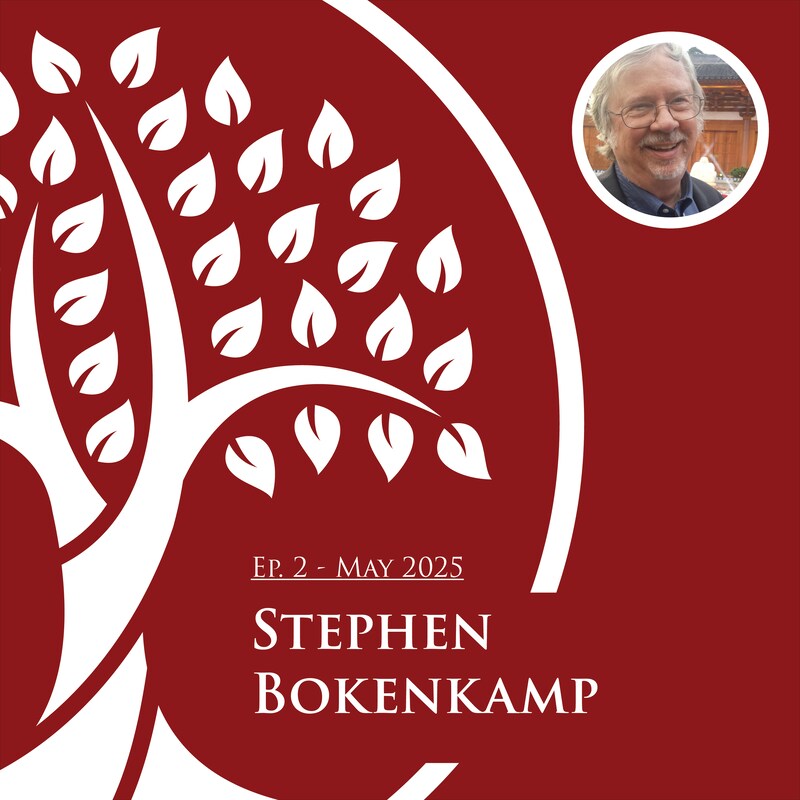
Shownotes
Stephen Bokenkamp talks about his fieldwork in China after the Cultural Revolution, how to better understand the original encounter between Daoism and Buddhism in the 2nd to 6th centuries C.E., and what Daoist and Buddhist Studies can learn from one another today.
Stephen R. Bokenkamp (Ph.D. University of California, Berkeley, 1986) specializes in the study of medieval Chinese Daoism, with a special emphasis on its literatures and its relations with Buddhism. He is author of Early Daoist Scriptures,Ancestors and Anxiety,A Fourth-century Daoist Family: the Zhen’gao, as well as over forty articles and book chapters on Daoism and literature. Among his awards are the Guggenheim Award for the Translation of a medieval Daoist text, a National Endowment for the Humanities Translation grant and the invitation to present the Xuyun and Yanfu lectures for the Philosophy Department of Beijing University. In addition to his position at Arizona State, he has taught at Indiana University, Stanford University, and short courses for graduate students at Beijing, Princeton and Fudan Universities. He was also part of the National 985 project at the Institute of Religious Studies, Sichuan University from 2006-2013.
Interview by Miles Osgood.
Transcripts
[Prologue]
MILES OSGOOD: Welcome to “The Ho Center for Buddhist Studies at Stanford” podcast. Come join us by the tree.
[music - Ani Choying Drolma, guitar]
In the 2nd century C.E., two religions converged in China, and by the 6th century, each was utterly transformed. Daoism grew from an esoteric line of recluses into a religion with an extensive library, formal rituals, and a professional priesthood. Meanwhile, from the west, a foreign religion brought in a new system of monasteries and developed its first major written canon.
STEPHEN BOKENKAMP: “I would argue that the arrival of Buddhism in China is an amazing moment in history, on the level of the spread of Christianity throughout the Roman empire.”
MILES OSGOOD: One story long told is that Buddhism “conquered” Daoism over these four centuries, by filling in gaps in the local religion’s cosmology and providing a model of institutional structure. But is that really what happened?
STEPHEN BOKENKAMP: “One of the factors that I’m quite convinced about is that the Daoists have done more—almost more—to spread Buddhism in China during the 4th and 5th and 6th centuries than Buddhist priests were able to do.”
MILES OSGOOD: Up ahead: a closer look at the first encounter of Daoism and Buddhism, and how that history might change Daoist and Buddhist Studies today.
[music - Ani Choying Drolma, guitar and flute]
We’re recording from the Ho Center for Buddhist Studies at Stanford.
I’m your host, Miles Osgood.
Today, in our second episode, I’ll be talking to Stephen Bokenkamp, Regents’ Professor at Arizona State University and an award-winning translator and writer. Professor Bokenkamp is the author of two major translation projects: the anthology Early Daoist Scriptures and A Fourth-Century Daoist Family: The Zhen’gao, or Declarations from the Perfected, for which he received a Guggenheim Fellowship. In between, in two thousand seven, Bokenkamp published Ancestors and Anxiety: Daoism and the Birth of Rebirth in China, which uses the scriptures of Yang Xi and the Lingbao School from the other two volumes to narrate, analyze, and ultimately re-imagine the first encounter between Daoism and Buddhism in China.
Professor Bokenkamp has taught at Indiana, Beijing, Princeton, Sichuan, and Fudan Universities, as well as here at Stanford. The Regents’ Professorship he holds at ASU is the school’s highest faculty honor. He’s here with us to give this year’s Evans-Wentz Lecture.
[music - Ani Choying Drolma, singing]
As you’ll discover in the conversation to come, Stephen Bokenkamp has got stories to tell. Some of these are personal: there are his seven years working as a cryptographer for the Army Security Agency, where he first learned Chinese; or there’s his first visit to the Chinese countryside, to meet Buddhist and Daoist priests who had survived the Cultural Revolution. Then there are historical stories: against the “prevailing scholarly notion that Buddhist ideas easily swept all before them in a sort of ‘Buddhist conquest of China’” (as Bokenkamp writes at the end of Ancestors and Anxiety), Bokenkamp argues that we need a narrative rounded out with other voices, to understand that Daoism was always “a shape-shifting religion… that did not organize itself around unalterable doctrine or creed in the ways we at first imagined” (quoting, this time, from the beginning of A Fourth-Century Daoist Family).
Like all good storytellers, Professor Bokenkamp knows how to set a scene. Ancestors and Anxiety starts at a hut beside a grave, where a son praises the worth of his late mother by writing about the pear tree with two trunks that has grown out of the tomb. We then jump three hundred years, to the winter rituals of the Retreat of Mud and Ash, where disciples of Lu Xiujing throw themselves on the ground to save their parents from the torments of hell. Surveying these two scenes, Bokenkamp points out that, in the second century, “Cai Yong describes his ancestors as providers of grace,” but in the fifth century, “Lu Xiujing imagines his [ancestors] to be in need of grace.” And so, we realize, something must have changed these Daoist practices in the interceding years.
In keeping with that storytelling style, it seems only fitting for me to set our own scene briefly before you. In the corner of the Buddhist Studies Library where we conduct our interviews, behind our chairs, there’s a wall of red and green hardcover spines, embossed in gold: the definitive edition of the Chinese Buddhist Canon, the Taishō Tripiṭaka, with its supplementary texts: about 250 volumes in total. At the beginning of the conversation you’re about to hear, I had taken these books, and the written tradition they represented, for granted. By the end, I’d learned that their existence is itself a testament to the Daoist-Buddhist encounter.
So, with that, let’s go into the library, and sit by those books.
[bell chime]
MILES OSGOOD: Thank you so much, Professor Bokenkamp, for being here.
STEPHEN BOKENKAMP: Thank you very much, Miles. That was a very kind introduction.
MILES OSGOOD: Of course, of course. Well, so I wanted to start off with a little bit of an opening or offering for you to tell us the story of how you came to this field and became interested in the intersection of Daoism and Buddhism, and what that looked like on the ground when you were doing your field work. And the reason I'm asking that is, I think one thing that's really striking to me
when I read in particular the opening pages of "Ancestors and Anxiety" and "A Fourth-Century Daoist Family," is I see you making that move: kind of putting us on the ground,
giving us a setting to think about, giving us a story to think about, whether that's Cai Yong and Lu Xiujing, at different points in history, thinking about their ancestors and the afterlife in different ways and therefore how to account for the transition from one to the other, or taking us into Yang Xi's mountain meditation chamber and showing us the paucity of that and how as a result, we need to go even further in, into his imagination to really think about what was happening there. So this is just an opening to say, is there an opening scene you can take us to in your own research or your own scholarship when you were getting into this field that would put us on the scene, as it were?
STEPHEN BOKENKAMP: I think that's a wonderful question and I thank you for asking it. I can do that. I think when I began, of course, I came out of the Army where I was an analyst for the National Security Agency and didn't work with people. Then I went to Berkeley and I got to a Chinese-speaking country just as soon as I could. I went to Taiwan, just a year after I got out of the Army. And it turned out to not a very good year to go because it was when we—the United States, I mean— established relationships with the People's Republic of China and disestablished relationships with Taiwan. And so that—I mean, I met some wonderful people in Daoist studies. But I think what really brought about the moments in my writing that you referred to were when I finally got to mainland China, and this was in Chengdu in the mid-eighties. And I had put together a project that would take me out to the countryside. And so I met a lot of Buddhist and Daoist priests
and had a wonderful time talking with them and hearing their stories. These were men and women who had spent the Cultural Revolution hiding their religion, burying their religious statuary.
MILES OSGOOD: Right.
STEPHEN BOKENKAMP: The saddest case is the name, I think his name was (indistinct), who was a— had been ordained during the PRC, but during the Cultural Revolution, he had to hide everything.
MILES OSGOOD: Wow.
STEPHEN BOKENKAMP: I have a picture which I would like to share with you, of him holding the Bagua water container and a broken hairpin, which were the only remnants of his ordination.
MILES OSGOOD: Oh, wow.
STEPHEN BOKENKAMP: And so it was really— it was moments like that when speaking with actual religious practitioners in China who in the face of great odds had continued to do work in religion. And this particular person had been forced to marry. He was a Quanzhen Daoist. And so he brought his elderly wife back to the temple with him and was a little bit diffident about how one would talk about that because it wasn't a decision that he wanted to make, that he couldn't leave her.
MILES OSGOOD: Yeah.
STEPHEN BOKENKAMP: So it would just, it was scenes like that that led me to want—
even though I worked with Six Dynasties Daoism, and getting into private lives is very, very difficult—to focus wherever I could on finding out what religion was actually like on the ground,
in China, during what I think was one of the most remarkable changes in the history of world religion. In the talk I'll be giving tomorrow, I liken it to the arrival of Christianity in the Roman Empire.
MILES OSGOOD: Oh, wow. Yeah, so you mentioned the project that you set out to take on when you were there in the eighties. Is that already a project of trying to work your way back to this period that you're going to be talking about tomorrow—the first to the fifth century, say—or did you set out to have these kinds of contemporary encounters and get your bearing? Or was it somehow the two together?
STEPHEN BOKENKAMP: At that time, I was—in the mid-eighties—I was funded by the National Science Foundation, and it was the result of an exchange of scholars between Mao Zedong and Richard Nixon. And so the project—I was one of the few humanities people who actually—
MILES OSGOOD: Had a National Science Foundation grant.
STEPHEN BOKENKAMP: Yes. And at the time, what I put together was both to look, if I could, for what kind of archeological and physical remains there would be of the original 24 parishes of Celestial Master Daoism throughout Sichuan—which is of course where Daoism started— but also to look for the remnants of religion. I mean, I really wanted to get out into the countryside. And Sichuan at that time had the very first Daoist studies center in the country, Zhang Jiyu and Qing Shitai laoshi decided to put it in Sichuan rather than in Beijing for political reasons. And so this was actually sparked by the Tateshina Conference in Daoism. And they had seen foreigners studying Daoism and thought, "Well, this is our national religion, in a certain sort of way, and we should study it as well."
MILES OSGOOD: Yeah, so you have live encounters then with practitioners and, it sounds like, scholarly encounters with a budding new Daoism research center. What about working your way to—what about those remnants? What were you able to find that gave you a kind of longer sense of the history there?
STEPHEN BOKENKAMP: It was very sparse. I mean, there'd been a lot of change and the 24 parishes were a short-lived sort of institution anyway, but there were some amazing operating temples in China, mountain caves: the rebuilding project was just great.
MILES OSGOOD: Yeah, wonderful. So you also mentioned in passing there sort of ranking major moments in world history for religious change and for religious transformation and the intersection of religion and politics. And I gather that that's going to be kind of the subject of how you think about the relationship between Buddhism and Daoism, perhaps in those centuries: in the first-, second- to fifth-centuries CE. So could you tell us a little bit about how maybe those Daoist scholars in China, or how your Western colleagues thought about that in the seventies and eighties? What was the narrative people were telling about what Daoism's relationship to Buddhism had been when they first met?
STEPHEN BOKENKAMP: I found, interestingly enough, that the narrative was—the master narrative was very much the same in mainland China and in the United States, with the addition that in mainland China, of course—because of the government there and the notion of history there,
which is a Marxist notion of history, the idea that religion was "the opiate of the masses" was also kind of added across the top of people's thinking. However, basically I think the narrative is the one articulated best by Erik Zürcher, and the idea is that there were soft areas in Chinese thought that were shored up or somehow filled by Buddhism. And so he did this remarkable work, which is—he's been my interlocutor, I think for decades now on the Buddhist influence on early Daoism.
This was at the time that Erik Zürcher had put together the "Projet Tao-tsang" to study the Daoist Canon, which resulted in those conferences in Japan and then again in Italy and Tateshina, and then Bellagio, which were international conferences on Daoism following the discovery of the Daoist Canon. And Schipper's project was funded by the E.U., so I was unable to participate as much as I wanted to do so. I was unable to because I was not a European citizen. But, at that time,
Zürcher was given the task of trying to date Daoist texts by the level of Buddhist influence found in the scriptures. We could all see that there were Buddhist elements in Daoist texts. But that turned out to be a false hope, as I show in the study of the "Zhen-gao" that you made reference to.
The text is no longer as it was written. The Buddhist elements have been scrubbed, particularly from Shangqing scriptures— been done rather thoroughly. And so the narrative then basically was
that Daoism had just kind of passively adopted Buddhism. Chinese—and particularly in those areas,
you mentioned rebirth. I've written a lengthy hypothesis. "Ancestors and Anxiety" is really no more than a lengthy hypothesis. But I've written on the question of rebirth. The idea was that there was nothing in China. And somehow—so the idea of rebirth was sold rather easily. And it is quite true that when I started studying Daoist texts, the Lingbao scriptures, suddenly—right, at the end of the fourth century, early fifth century— there was like a light switch that turned on. Rebirth is everywhere in those scriptures. Well, I subsequently found out that the mid-fourth-century scriptures had been sanitized.
MILES OSGOOD: Ah, I see.
STEPHEN BOKENKAMP: And it always seemed to me a very strange idea that Daoism—or, that China had no idea about the afterlife. Why in the world did they spend so much time and effort building those tombs? You know, if there was no idea? There must have been some idea that we're not understanding. And so I've continued to work on it: parts of "Ancestors and Anxiety" I would now like to rewrite.
MILES OSGOOD: Mm-hmm. Would you say a little bit about that? So, well, I guess there's a couple questions that maybe we should come to, to kind of explain what you just went through. So one is this notion, I guess, that maybe there was a pre-existing story that one of the supposed soft areas of Daoism was not having a fully articulated idea of the afterlife, but in fact, maybe that comes down more to certain things, certain elements of earlier texts being scrubbed or simply not available. And so therefore we have to revise that and give a sense that like, actually two different accounts of the afterlife are intermingling here, rather than one imposing itself on the other. Is that right?
STEPHEN BOKENKAMP: I don't think it's quite so simple as "two different," but in general terms, yes. I mean, I think there were many different ideas, and there were some dominant ones and less dominant ones, and we need to deal with that in both Buddhism as it moved into China and in the Chinese receiving system.
MILES OSGOOD: Okay, yeah, and then, so can you give your account a little bit of how you think the Daoist response is not merely an adoption, but perhaps a way of also correcting, clarifying things
that they see as potential contradictions or, as it were, reciprocal soft areas in Buddhism that could be open to new ideas? The first part—the first part of your question has to do with how the story has changed. At the end of "Ancestors and Anxiety," the very last chapter, I dealt with some very kind of cogent and moving elements of the Lingbao scriptures where they're talking about rebirth in particular. And so I came up with this notion that there was kind of a generalized rebirth and then a more particular rebirth, and that what the Lingbao scriptures had done was to buy into individual culpability for deeds and individual rebirth, whereas before there was no kind of generalized rebirth for everyone. That was now, in the Lingbao scriptures, general.
MILES OSGOOD: Okay, and that individual responsibility element we might take to be more Buddhist than Daoist coming in?
STEPHEN BOKENKAMP: That's what I had originally thought. And I divided the Shangqing scriptures out as having rebirth only in special cases where they allowed certain elite people who were practitioners of the Shangqing meditation practices to direct their rebirth. But since then, I've discovered a passage in Dunhuang. And there's a book that I'll be talking about tomorrow,
which is called the "Dengzhen yinjue," "The Secret Instructions on the Ascent to Perfection," which has Tao Hongjing's— he's a sixth-century Daoist writing around 500—his commentary on all of the Shangqing scriptures. That book was originally 24 "juan," and now only three "juan" survive in the Daoist Canon, so that's an example of scrubbing. I've identified in Dunhuang, a portion of that text which actually deals—for the Shangqing scriptures, dated to 360s— which deals with the "atman." Yeah, the standard view of Buddhism is that that "anātman" is the principle that one should adhere to: there is no self, ultimately. Unfortunately, that was not the way the Chinese took it. Nor the way some early translators—Dharmarakśa, Zhi Qian, Kang Senghui—presented it, at least in the southern part of China. What I found in this Dunhuang text is fascinating evidence that these late fourth-century Daoists had come up with a way of taking the transmigrating soul that they'd newly learned about and introducing it to the rest of the spirits of the body in order to direct their rebirth.
MILES OSGOOD: Yeah. Okay, I see. So in broad terms, if we're thinking about general bigger moves in history and the relationship and the relative power perhaps of Buddhism in China, or its kind of relative popularity, what should we now understand about this kind of transitional encounter period? What have you revised for yourself? What would you offer as a revision to those narratives you were reading and hearing earlier on? What should we think about in general terms as far as the population itself is concerned?
STEPHEN BOKENKAMP: I would say, first of all, if we really want to understand what happened in China, we need to understand religion in China better. And what I mean by that is that we've had all sorts of ideas about— oh, for instance, Zürcher, again, brought forth the idea of an "iceberg." That what we're looking at are three peaks that are separate: Confucianism, Buddhism and Daoism. But in fact, they were joined at the base. But I don't—
MILES OSGOOD: Joined at the base by a common set of cultural practices?
STEPHEN BOKENKAMP: Common set of cultural practices, common understanding, and, unfortunately—for the way that iceberg has been—by incomprehension—
MILES OSGOOD: I see.
STEPHEN BOKENKAMP: —or only partial comprehension.
MILES OSGOOD: So actually it was a mystery even to the adherents themselves as to—
STEPHEN BOKENKAMP: —as to what the actual distinctions were between Buddhism and Daoism. And I don't know that that model actually holds all that well. I think that there's actually, even at the elite level, where we can speak with most assurance, there tends to be an understanding of religion that we have not fully comprehended yet. And I've written several— I've started to look in that direction. And I think that that's one thing. The second thing I would say is that it was not the kind of field into which Buddhism was brought to play in China, and through which we try to look, in reading through Chinese characters to get back and see what texts might've arrived—you know, what they might have looked like. This field is much more complex than we tend to think it is,
and Daoism is a part of that. One of the factors that I'm quite convinced about is that the Daoists have done more— almost more to spread Buddhism in China during the fourth, and fifth, and sixth centuries than Daoist priests—I mean, Buddhist priests were able to do.
MILES OSGOOD: Yeah, and they did that by way of just spreading the ideas, or genuinely promoting Buddhism itself as a belief?
STEPHEN BOKENKAMP: By spreading the ideas.
MILES OSGOOD: The ideas within their own system.
STEPHEN BOKENKAMP: And by spreading a version of those ideas and texts in which those ideas were centered and incorporated. And then of course, Buddhists only had to come along and say, well, "The Buddha actually said..." (laughing)
MILES OSGOOD: So it was sort of an entry point for people to understand things that Buddhism might hold. But then if they wanted to know more, Buddhists were happy to clarify?
STEPHEN BOKENKAMP: Happy to clarify.
MILES OSGOOD: Or correct, yeah.
STEPHEN BOKENKAMP: And there is still a way in which the two religions are practiced hand-in-hand, even at the elite level, in Taiwan, and China.
MILES OSGOOD: By "elite level," you mean by the clergy?
STEPHEN BOKENKAMP: Not by the clergy. The clergy is where they're separate. But I'm talking about practitioners who will, for instance, still, if you, you know, maybe Wenchang Dijun
is good to get your kid into college and you know, Guanyin would be a better deity to address if you had troubles in childbirth, or your daughter had troubles in childbirth.
MILES OSGOOD: Yeah, so I mean, I think it's a kind of contemporary cliché that for those of us who are outside this culture and outside this nation that we understand maybe the co-existence of these religions and belief-systems as being able to occupy these different desires and goals in one life, or maybe even different spheres activity in one life: that you could be a Buddhist, Daoist, or Confucian at different times of the day or different parts of the week, depending on your social, ethical interactions, maybe your sort of personal interior outlook, and your thoughts about cosmology or about the afterlife. Is there a continuity there across the centuries from the period that you're looking at historically and sort of how they might coexist for lay people today?
STEPHEN BOKENKAMP: I can only speak to the Daoist part of that. But I would say there's definitely continuity. The key texts that were put together by Lu Xiujing in the fifth century in China: those texts are still used today. They're interpreted sometimes rather differently, but texts like the "Duren jing," right, are part of the liturgy today in China as well.
MILES OSGOOD: Okay, so there's continuity there, at least in terms of the scripture?
STEPHEN BOKENKAMP: That's right. And in terms of the ideas, there probably are cultural continuities that we're unaware of. But one I've kind of come to call is "polytheistic personhood"— the idea that your body is not a single machine inhabited by a soul, the old Cartesian notion, but instead is the collection of entities and forces that can be seen as spirits and visualized as spirits— is not quite as active in China as before, but the way that people conceive of self and their relationship to society—because this is all, of course, based on a correlative cosmology, where the cosmos is basically internalized: that has its nuances and consequences in Chinese thought today. Even in places where they've totally rejected religion.
MILES OSGOOD: Interesting. So this gets me into kind of another area that I'm just generally interested in, which is: where are the sticking points and the hard lines potentially between Daoism and Buddhism, right? You talk about afterlives and birth and rebirth, and we get the sense of Daoism being able to say, "Maybe we are more indebted to our ancestors or family members when it comes to that afterlife than Buddhists would think." Conversely, "Maybe we are interested in the Buddhist sense of individual responsibility when it comes to rebirth and karma." That was really fascinating to me. I wonder when you start to get into questions about the notion of the self, are there hard lines between Daoism and Buddhism? Or again, is it a matter of, "Oh, there's kind of some mutual borrowing happening in China" that allows for maybe a mysterious, but nevertheless coherent— now I'm going back to the iceberg— idea about what the self consists of, for instance. Or are there other dimensions where these religions would seem to be— would seem to have, you know, opposed views that are actually reconcilable or vice versa?
STEPHEN BOKENKAMP: I mean, I think in a general sort of way, we can say that it is indeed true. Once we come to understand the role of religion in Chinese society and how these interactions between the elite and the practitioners of Buddhism and Daoism have worked down through the centuries, we will begin to understand a little bit more about interactions... that maybe, actually, dare I say, will help us deal with the modern world.
MILES OSGOOD: So potentially, the sort of power structure or historical changes to how these religions were organized might tell us something a little bit about how different belief systems were organized—
STEPHEN BOKENKAMP: About the habitus—
MILES OSGOOD: How different ideas actually crystallized?
STEPHEN BOKENKAMP: The habitus of Chinese people. I'll give you a—I mean, while it's not my field: there was a survey done by Pew in which they asked this really stupid question of Chinese people, "Which religion do you believe in?" And of course— and they were aware that this was not a very good question. And so they said, "You can choose two." (Miles laughing) That's not really solving the problem. And of course, they found out that, and predicted right around the time of the Olympics, as a result of this study, that China would be a fully Christian country by twenty fifty, because of course, Christians tend to know what that question means and answer it.
MILES OSGOOD: And to not pick a second option—
STEPHEN BOKENKAMP: They would not.
MILES OSGOOD: —when offered a menu.
STEPHEN BOKENKAMP: No, that's true. That's quite true. But interestingly, if you read that survey, they found that—and we're talking about mainland China now, where the Cultural Revolution happened, where religion is "the opiate of the masses" and is not favored today—over 70% of people tend to practice "Qingming," and do ancestral practices on that holiday, often going out to the grave, preparing food stuffs for their ancestors. So that argues for a perdurance of certain ideas that are really central to the way Buddhism and Daoism operated in China.
MILES OSGOOD: Yeah. That's great. So one other thing that I think will be interesting to our scholarly audience is to think a little bit about how you have experienced the differences
between approaches to Daoist studies in the United States, or generally in the West, and with your colleagues within China. Would you say that there are generally different outlooks on how to approach the religion, the assumptions that we come with, maybe even more specifically the relationship of Daoism to Buddhism?
STEPHEN BOKENKAMP: Well, I think as a result of Schipper's project that I mentioned in the E.U. and those international conferences, which mainly involved the Japanese and French scholars, there was a time when Daoism looked like it was going to have a real revival. And it's certainly flourishing today in China. In China, every university has Daoist— almost every university has a Daoist specialist. There are large conferences held in Hong Kong, in various Daoist mountains. There's just way too much for me to even keep up with. It's amazing. However, in North America in particular, there's been a bit of a die-out in Europe and in Japan, in people interested in studying Daoism. In the United States, for financial and various other reasons, at present, there are maybe two places where you could do a PhD and have education in the history and practices and texts of Daoism. Only two places. And so one of the things that I've been doing as I'm nearing retirement myself is making people aware of this fact and that thinking that perhaps—suggesting maybe is a better word—that I'm suggesting that Daoist organizations in Hong Kong, Taiwan, Singapore, and mainland China get together and focus some of their funding on building programs in the United States, like this wonderful center for the study of Buddhism. There is no such funding right now in the United States or in Canada for a similar sort of program. And there's, right now, I wouldn't— if people say were to read one of my books and become interested in this field, I would not know where to send them.
MILES OSGOOD: Yeah, that's a shame. And I guess, so that answers one part of the question, which is, you know, not just what are the relations between how Daoism is studied here and across the Pacific, but what could be done to, you know, have Asian colleagues strengthen the presence of Daoist studies in the United States and more generally? And then it sounds like there's another question that spins off of that, which is: what should be the relationship of Buddhist Studies centers
and Buddhist Studies departments or divisions within Religious Studies, which sound like they've been much stronger in this country, and Daoist studies, if Daoist studies were to make a resurgence. Is there an opportunity there for collaboration?
STEPHEN BOKENKAMP: I would argue that the arrival of Buddhism in China is an amazing moment in history on the level of the spread of Christianity throughout the Roman Empire. And if you could be on the ground during that period and, say, live for a couple of hundred years, you would see a religion, mainly based on oral traditions and the memorization of long scriptures, coming to China, and suddenly becoming a written tradition. We're building libraries, writing massive numbers of texts, talking about the structure of the Sanskrit language. And, in order to fully understand what that meant and how that happened, I really think we should look at Chinese religion. Because it clearly did something. There were some changes taking place there,
just on a very fundamental level, to the Buddhist religion. And how those happened, the nuts and bolts of that, are things that we're starting to look at now. There's some scholars who are doing good work in this area. And I just hope that that can continue. Daoist studies is a part of that. Now we're still dealing with the case, when the Daoist Canon was released in, you know, nineteen twenty-one to twenty-six or something, over a period of time in Shanghai, the original thought was that all this was all just made up by the Ming. "It's a 'Ming Daoist Canon' that we have today. And so, you know, there's nothing of historical interest there." It's taken us a long time to try to piece together, to start dating things. These scriptures are dated and we have AI now. We can do this in a much better way than we've done heretofore.
MILES OSGOOD: So there's opportunities for new textual studies that we wouldn't have had in previous decades.
STEPHEN BOKENKAMP: We can start to study the language in which Buddhism became a written language.
MILES OSGOOD: Yeah, and it sounds like conversely there are age-old assumptions that we might have about Buddhism, being, as it were, always, perhaps, we might have imagined, a written tradition, which actually is very historically specific to its relationship to Daoism in China—
STEPHEN BOKENKAMP: And Central Asia, of course. I mean, there's a whole process going on there. But one can't deny the number of Buddhist scriptures that are written in Chinese and that this language, we used to think, "Oh, it was shaped by Daoism, by which we meant Laozi and Zhuangzi."
MILES OSGOOD: Yeah. Yeah, wonderful.
STEPHEN BOKENKAMP: And that's really not the case.
MILES OSGOOD: Yeah, well, that sounds like a really strong pitch for the re-establishment of Daoist study centers and Daoist doctorates and all the rest of that, for its own sake and then for the sake of a better understanding of Buddhist transmission and Buddhist transcription. So, well, I hope that call-to-action is heard. And for now, just want to say thank you so much for coming to this interview, for being on our podcast and on our YouTube channel, and for joining us here at the Ho Center.
STEPHEN BOKENKAMP: Thank you, Miles. Very good questions and I enjoyed talking with you.
[Epilogue]
[music - Ani Choying Drolma, guitar and bells]
MILES OSGOOD: To watch a video recording of the conversation you just heard, and to see the photograph that Professor Bokenkamp mentioned, head to our YouTube Channel, @thehocenterforbuddhiststudies (all one word), or visit our website: buddhiststudies.stanford.edu.
On our site, you’ll also find information about future guests and events.
[music - Ani Choying Drolma, guitar and bells]
Thanks again to Stephen Bokenkamp for coming on the show. His full lecture goes deeper into the philosophical negotiations between early Daoists and Buddhists, particularly around the notion of the self.
One major question that arises, that you heard referenced in our conversation, is this: How did Chinese Daoists translate and adapt the Buddhist idea of a singular transmigrating soul, with their own belief in a “bodily cosmos” of many spirits or what Bokenkamp called “polytheistic personhood”? Head to our YouTube Channel to watch the talk and find out.
[music - Ani Choying Drolma, Oṃ maṇi padme hūm̐]
As always, the music for this episode is a recording from Ani Choying Drolma’s “Buddhist Chants and Songs,” performed at Stanford’s Memorial Church in twenty seventeen..
Until next time, this has been “The Ho Center for Buddhist Studies at Stanford” podcast.
[music - Ani Choying Drolma, Oṃ maṇi padme hūm̐]

