Shownotes
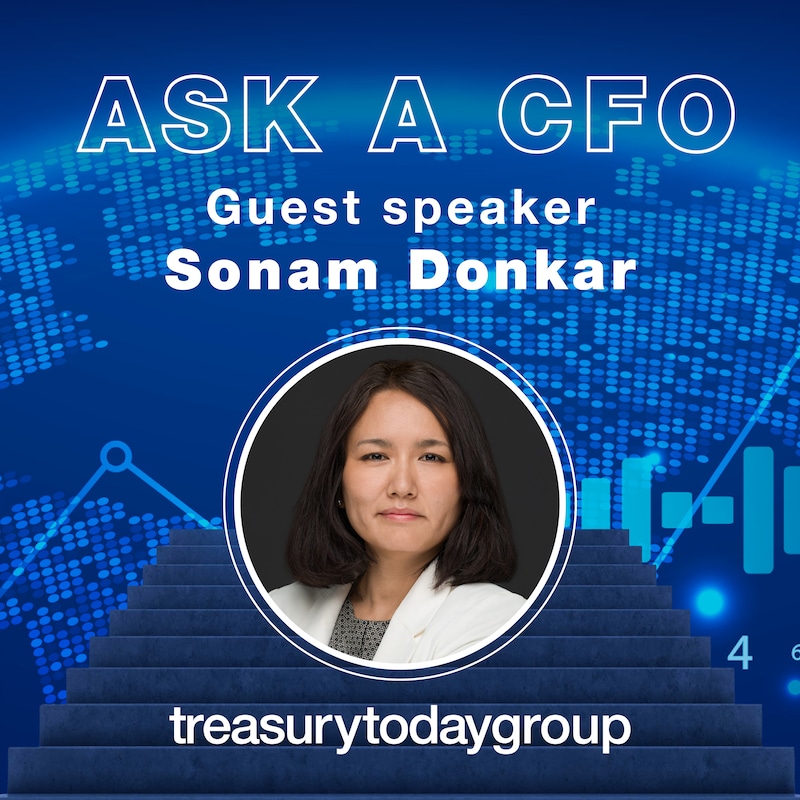
In this episode, Sophie Jackson talks to Sonam Donkar, Chief Financial Officer at Canadian real estate organisation, Rohit Group. They explore Sonam's story, from challenging beginnings to her current role, and discuss timing versus planning, the power of mentors and what it really means to take on a CFO role.
Transcripts
Hello, and welcome to Ask a CFO, the podcast series shining a light on the different paths taken to become Chief Financial Officer, whilst also sharing the personal stories of those that have made the journey.
Sophie:I'm Sophie Jackson, and today I'm delighted to be joined by Sonam Donkar, CFO at Rohit Group. We first profiled Sonam at the Treasury Today Group back in 2017, after she won our Woman of the Year award when living and working in India.
Sophie:This was before she stepped into her current CFO role and made the bold move across the world to Canada. So I was so thrilled to catch up with her again. And in this episode, we'll be exploring Sonam's story. From challenging beginnings to her current role, we discussed timing versus planning, the power of mentors and what it really means to take on a CFO role.
Sophie:All right, so first of all, thank you for being here. Can I ask you to please introduce yourself and tell me a bit about the role that you're in today?
Sonam:Sure. Thank you for having me here. I'm currently the EVP and CFO at Rohit Group of Companies in Edmonton, Alberta, Canada. As a company, this is into real estate. We're into home building, land development, commercial assets, and across Alberta, Saskatchewan and Ontario.
Sonam:So it's largely within Canada, a billion dollar in assets. I've been here four years, and we've more than doubled in size over the last couple of years, and it's exciting because it's got this whole entrepreneurial DNA, and it gives you the freedom to innovate.
Sonam:So the organisation does celebrate a lot of new ideas, and that's something for me really exciting to notice, not just at my level, but across the organisation.
Sonam:But prior to this, about twenty years of experience, across multi-sector, multi-geography, and in different capacities across the length and breadth of finance world. Personally, again, I'm a hustler at heart, a lifelong learner. I love to upskill myself, and I, to date, keep reading and enrolling in courses that just keeps me going because I firmly believe if you don't learn, you're actually outdated. So that's something which keeps me going.
Sonam:And I'm also a proud soccer mom to my eleven-year-old son. He's full of energy, keeps me on my toes. My husband's a finance and real estate consultant. So you can imagine our dinner table conversations are largely about markets and deals. But yeah, it is a lot of fun when it comes to having similar topics and interests at the table.
Sonam:Yeah, so going back to the CFO position and my experience, I think the way I look at it, it does give you the opportunity to drive a lot of strategic initiatives. At least in my current capacity, I can for sure say the way we are looking at things, we are using technology, exploring direct-to-consumer home buying apps.
Sonam:So a lot of new ideas, especially in the world of AI, looking at automation in a very unique manner. And we are at this intersection of a lot of changes happening. So this is exciting times if you're in that CFO position driving transformation.
Sonam:And I think this is where, for me, it goes about. I think the journey is really exciting here onwards. It's a steep learning curve. And the more you keep yourself upskilled, the more you are prepared for what's ahead of you.
Sophie:Amazing. I love that you called yourself a hustler. That's a first for this, but many of my clients always crack up because that's how I describe myself as well. So thank you. Welcome, fellow hustler.
Sophie:So take me back to the beginning of your story. Tell me a little bit about your early life and where you grew up and so on.
Sonam:I was born to a Tibetan refugee family, and I grew up in India. And it's really exciting because when I look at it, it's, it's the way the environment, the ecosystem so different.
Sonam:My parents very orthodox, very conservative and they're not very educated as such. But they sent me to a very strict Catholic school, and they really wanted me to focus on education, get disciplined and structure, appreciate that an early age and again, when I talk about the economic means, we didn't have much. We lived in a ten-by-ten foot room, a family of five. So we learned to be resourceful and appreciate the power of money much earlier on, not academically, but viscerally.
Sonam:So I see the resources, limited choices, and the way it creates stress. That kind of lit me up much earlier in life and that's where the hustling culture came on. Like I would take this one of assignments to write speeches, do some translation work. And this was like thirteen, fourteen years of age.
Sonam:And I tried to make my first investment at the age of eighteen when it's legally allowed in India so that mentality has never left me.
Sonam:And for sure, like I go back to say, education has been and felt like the great equalizer because no one can take that away from you.
Sonam:So I worked my way to really excel academically, did my graduation in business management, did my master's in finance, and then went ahead to do my MBA. Later in life, I got my accounting certification, and it again goes back to the whole upskilling need I got so many other letters and certifications right after that.
Sonam:But I think education definitely going back is something which I felt was my superpower that, again, I could work towards it and say, this is my unique perspective of getting credibility in a market where I look different, I have a different background, but I can showcase that this is my identity and this is where I belong.
Sophie:What an amazing journey, like that's quite an unbelievable trajectory in one generation. So well done, that's not the usual story, so thank you so much.
Sophie:And then you and I have spoken before around different cultural and societal pressures that exist upon us for a variety of reasons, from our family of origin, from our culture of origin and broader society.
Sophie:How has this affected you, if indeed it has? How has this shown up for you over the course of your career?
Sonam:Right, this is an important one for me because, and I want to get it right, because definitely early on, there was a lot of pressure to conform, coming from a refugee background and pursuing corporate finance and as a woman, because that's a male-dominated sector, right?
Sonam:There were definitely a lot of questions whether I could balance ambition with family, whether someone like me could actually thrive in a Fortune five hundred environment. But I saw my heritage as a strength, not a limitation.
Sonam:And going back, the whole lifelong learner aspect, it really drove me in terms of mastering new domains. And that became, like I said, my superpower. So it kind of kept me going.
Sonam:And I, yeah, I did have to work twice as hard. I must admit, I had to focus on the credentials, like I said, get all my certification and I wanted that because it's undeniable competence as you get these and then you definitely feel comfortable owning your story, right? Because, that becomes your advantage, your competitive advantage, your diversity, right?
Sonam:Like I've worked in India, got this whole Asia Pacific experience and now North America. I feel this is where I call it as my superpower or the advantage when I look at it because it's the global perspective that's becoming increasingly valuable, and as a finance professional who's seen different markets and different pace of growth and the risks associated. I think it just is a great turning point if you actually can adapt and learn and leverage on those opportunities.
Sonam:The one thing I believe is always to bring your whole self to work, which is, again, whether it is your analytical rigor, whether it is a strategic thinking, your empathy, and the belief that the business as a force for good, right?
Sonam:So bringing that and just challenging the status quo and being authentic as a leader has somehow worked well for me. And I believe that's actually helped me also navigate all these cultural and professional expectations during my career so far.
Sophie:It's amazing, and I think I'm loathed to say that we can turn challenges or not even challenges but not coming with a set of privileged advantages can sometimes be an advantage.
Sophie:But that's a complicated thing to say, because for many people, there is never a stepping stone to then later be able to use that as an advantage. So I'm reluctant to say that, but I think the ability to do so does, as you will say, equip you with superpowers. So it's a nuanced conversation, I guess.
Soman:Yeah.
Sophie:Tell me a little bit about your early career and which experiences you feel were pivotal in getting you to the great heights that you've achieved?
Sonam:I think for me, my career right from the start has been calculated risks and learning opportunities. Whether it is the internship at Toyota, BNP Paribas or Deloitte.
::All across, there's always been a lot of learning, and of course, with the learning, it was not an easy one you obviously have to put your whole self-there and figure out how to solve problems.
Sonam:My first job at Ballarpur, I was very fortunate to work on a foreign convertible bond issuance, and I was just twenty-two at that time. It was terrifying, it was definitely very complex, but it was just another puzzle to solve so that was really exciting.
Sonam:And I think for me, at that point of time, as I think over it, my first boss, he really profoundly shaped my trajectory. You know, invited me into the critical discussions’ way above my pay grade, right, at investor negotiation, strategic planning, and I was just a management trainee.
Sonam:And I feel that opportunity really taught me not just what to think, but how to think. And it is what really matters, right? And that got me thinking as I watched him in those you know, discussions and you got me at the table and I'm like looking and saying, will I ever become a CFO like that? But that's how I started thinking through and I said, yeah, maybe, maybe not.
Sonam:And that's kept me going and after that, it's been never ending.
Sonam:Like when I joined Standard Chartered Bank, I learned about relationship businesses, like your network is your net worth. Because a lot of that was, again, while it is global markets trading, but it was all with different set of clients. And if you can't really maintain those relations and bring value to the relationship, you don't get much. Either you make money for them, or you make money for yourself, and it's not going to happen, right?
Sonam:At Dell, as well, while we worked on different liquidity options, financing options, I think financial creativity is something which I could say, really unlocked growth, and I got to work with some of the best professionals in the industry.
Sonam:That, again, was an eye-opener, I learned a lot, but I was also very fortunate to be at the table working alongside and driving it. PepsiCo, I must mention, was transformative.
Sophie:Where we came across one another.
Sonam:Exactly, exactly. So that was, for me, truly transformative because that really scaled up like two times, it's three times of what I was doing prior to that. Getting to be in a project team where you're launching an asset-like model, completely new business in a different country.
Sonam:Like in Bangladesh, we got one of the most profitable ventures launched, and this is all remotely done. I was in India and I was managing it, I'm like, okay, we're setting it up, within eight months it's set up and we are rolling it and we were so profitable within the first one year.
Sonam:And so that was just one of the many, like working on a rural distribution network, empowering women entrepreneurs and being able to deliver on the business side in terms of the GTM, go-to-market strategy, is phenomenal.
Sonam:So I think that's where I was also, in fact, honoured by the Treasury Today for the Women of the Year because again, there was so many mile markers and I feel that again, these are mile markers, but these are all milestones or it's not a destination, but these are all milestones as you go along truly changed the way I was looking at it professionally.
Sonam:And I always had my hands up, but then I think this time I had both my hands up, it was really rewarding.
Sonam:And then the last before was, I think, with the Vedanta Group, this was, again, where I deliberately stepped into a CFO seat. It was one of the most challenging roles because P&L for twelve billion dollars, asset-based company, first woman CFO, you know, the responsibility you carry along woman CFO in metals business in India and being one of the youngest. It was for me like, yes, challenge the status quo, but multiple times like, okay, now you have to really take it a notch higher, several notches higher.
Sonam:But I think for me, when I look at it, I'm most proud the way the whole team came along, and especially during the COVID period where there was lockdown and we had four different plans and operations had not shut down we were working twenty-four - seven.
Sonam:So again, it was a moment of challenge, like, okay, should I just take it easy, or we go ahead and like Churchill says, never let a good crisis go to waste. So just went all in.
Sonam:Actually, a lot of companies are going through a lot of problems, especially, you know, commodity linkers of commodity cycles were crashing.
Sonam:But that's when it was great to see how we came together, launched a green aluminium, got our first such production. And this was something which was for us one of the many firsts trying to see how we can solve the supply chain issues, right, because of the COVID lockdown.
Sonam:So it was, again, like when I look back, I just feel there's so many things. It's unfair for me to pinpoint and say there's just one place, but there's so many.
Sonam:And I would again say I believe, firmly believe leadership is not a solo act because it's, again, the teams, the peers, the mentors, right? So I believe all of them came together.
Sonam:And for me, when I look at it, I see so many such similar, the pattern has been there where there's always some willing and working along with me on those complex challenges that others have avoided.
Sonam:And I feel for me, that's where it has really defined my career where I'm walking along the path and saying, let's go on head on and solve these challenges, and it's really worked well.
Sophie:It's amazing. You and I have not discussed this before, but throughout your story, what I'm struck by is the enormous weight of representation that you've carried almost consistently, I should imagine, from when you were a student.
How does that feel and what does that mean for you? Because, yeah, tell me, how does that feel?
Sonam:I think it's a matter of, again, what's ahead of you. Don't let ego come in the way saying, hey, I am this, the title come along, I always feel that this is... and I listen to a lot of leadership podcasts and leaders, right? And this is a consistent thing where they all say, stay humble.
Sophie:Yes.
Sonam:And stay true to yourself. That's what it's all about.
Sonam:It's a servant leadership kind of a model. As a leader, you are a steward for your team, for the organisation and the community, and it's your role to develop that environment which is safe for people to come together and deliver that's all.
Sonam:Beyond that, don't think of all these are the expectations. You don't have to succumb to that and say, oh, I am supposed to do this and be stereotyped.
Sophie:I've often noticed that when you're the first of a group and you're the first of many groups at once. There's a lot of sometimes self-imposed, but sometimes externally imposed responsibility for that in terms of, oh, you now need to speak at everything for this, and you need to mentor everybody and everyone wants you to be their poster child for different things.
Sophie:And I think that can sometimes seem to me unfair. Like it's people who've had to fight the hardest to get somewhere and then they're having to do the most additional things. So that's why I was curious. And does it mean learning to say no perhaps to things as well?
Sonam:Absolutely, you need to prioritise for sure. You can only do these many things in these many hours and I wish I had more hours than twenty four hours in a day, but if you really want to do, instead of doing so many different things, you got to do things differently, like they say.
Sonam:So, my philosophy is for sure, bring your one hundred percent, but do that thing so perfect that no one else, like you're raising the bar for everybody else and you can only get better than this.
Sophie:You mentioned earlier strategic risks, like knowing when to make different decisions in one's journey. Tell me a little bit about your experience of intentional planning for what you desire and then opportunities that have arisen that you've had to just grasp in that moment. Tell me how that's shown up for you.
Sonam:It's such a critical question because it's all about, are you prepared? And you can never be fully prepared, right?
Sonam:But I think both timing and opportunity versus planning, it's so critical because by failing to prepare, you're preparing to fail like this area, so you got to be prepared.
Sonam:And I think for me, like I said, credentials, getting the right experience. And I was not chasing money, I wasn't chasing salary early on, I was talking about and raising the hands for the right opportunities. I said, I want to do more than what is table stakes, I want to get multi-sector experience and that's when you create credibility.
Sonam:The opportunity and the courage to seize it, that obviously comes with more experience, and you obviously take those chances and accelerate the growth path.
Sonam:Like for me, if I look at it, the most defining moments in my career weren’t planned. But I'm pretty sure I was prepared and I had created enough credibility around me that my leaders or mentors actually knew she can get the work done, right? So I believe planning definitely gets you to the door, the timing and opportunity gets you through it.
Sonam:And you cannot plan for everything, like I said, but at your end, all you can do is create more credibility. Like going back to the basics, whatever you're working on, give that one hundred percent and make sure that you've done it so well that it's raising the bar, not just for you, for everybody in that community, right, in that profession.
Sonam:And yeah and keep learning, again, I know I keep going back. You keep learning and keep yourself updated because yeah, when your dreams don't scare you, they're too small. So you got to keep dreaming and keep thinking big that's how I would put it.
Sophie:One hundred percent, someone once said to me, if you're feeling comfortable, that's the moment to be running in terror, not when you're feeling overwhelmed and a bit sick, so thank you for that.
Sophie:You mentioned some of the early people that have influenced you. Tell me a bit about how mentors and role models have shown up for you throughout the course of your career.
Sonam:Yeah, I think I've already mentioned about my first CFO boss. A lot of good leaders, a lot of good peers, they all invested in me, in my development and in my learning. A lot of them were very open to spending time and bringing me up in terms of, you know, improving their knowledge on the operational side of things because again, as a CFO, you don't want to be just an accountant. You don't want to be just looking at the balance sheet, but you need to understand the business cycles and what are the different levers that impact and how do you get more value out of things.
Sonam:So those are the things which, again, I believe in both Pepsi and Vedanta I saw a lot of leaders who actually did invest time in bringing that learning and not just learning about the business, but also a lot of investment in me in terms of allowing me to take those courses that I wanted to upskill myself.
Sonam:I did also get enrolled into a structured mentoring programme when I was in Pepsi. I was getting mentored by the head of PWC India. Again, a very notable women professional in that field.
Sonam:And I had some really, as an early young mother and early-stage CFO, I had a lot of those conversations where she did bring a lot of clarity in my mind as to, okay, like I said, you can't do everything and stop judging yourself.
Sonam:Stop undermining yourself because we do carry that guilt, oh, I'm doing this, but I'm not spending time with my son. He's just a year old and all of that.
Sonam:And the baggage of all the expectations, that really freed me to think clearly and be able to bring a better self at work, at the personal side in my family, be more present. When I'm here, I'm here, when I'm at work, I'm at work, so that's something which really helped.
Sonam:And not to forget, I do believe in the power of reverse mentorship. Young professionals bring a lot of fresh perspectives, so I think when it comes to technology, culture, Gen Alpha, especially now these days, right, how do they work? They work so differently, like Gen Zs.
Sonam:So the lingo is different, but you learn a lot and I believe there's no feedback that is bad. It depends again how you transform and stay on top of the curve.
Sonam:And yeah, I think when you look at it, it's not just me looking at it as a mentorship. I also look at ask, how can I give it back to the society and how do I give it back to the community at large?
Sonam:So I am more actively now mentoring women professionals, newcomers, immigrants in Canada, working through and seeing, okay, this is how it feels. And this is, again, sharing my journey and being able to help them inspire because that's the impact beyond the balance sheet, and that really matters at the end of the day.
Sophie:That's amazing to hear, I'm so glad that it's coming full circle for you, I guess, with meeting this next gen.
Sophie:As you rightly mentioned at the beginning and just there, so you're working as a CFO now in Canada. So you've really transcended so many different things, it's almost impossible to list them all.
Sophie:You're in a new sector, in a new geography. Tell me what drew you to the role? What has that transition been like? Because that is really so many different things to adjust to at once. And as you mentioned, you're also a soccer mum now that you're on that side of the world. But you were a mum before, you've had to move a family. Like, tell me about all these different things that you've had to consider and how that journey was for you.
Sonam:Yep, again, this is one of the most significant transitions with my life, and this is both personally and professionally.
Sonam:To start with on the professional front, like my entire career has been largely in India, Asia Pacific, and moving to Canada felt like a new chapter, and it was not easy for sure. Talk about the laws and talk about the accounting principles and the ways of working, right? It is way different.
Sonam:But yes, I'm fortunate I chose Rohit Group as an employer as strategically as they chose me because, like I said, it was all about doing courage innovation, celebrate new ideas, and have that entrepreneurial DNA. That is the freedom to experiment and the trust to drive transformation, that was really rare and it really worked out well.
Sonam:And as a company, the company is also completing forty years this year, this legacy. So, it just worked well for me as an organisation, blending and getting into the organisation.
Sonam:However, like, yes, I did go and being very honest from a cultural standpoint, it wasn't just about blending in, but learning, like I said, the basics of Canadian culture, embracing the new norms, language. Like, I know English, but the lingo, the expressions are really different that you have here compared to in India, Asia, where you are largely more following the British language, the English is different, pronunciation is different.
Sonam:So just getting that right and business conversations flow differently. You have more networking coffee discussions here than anywhere in the world. So, it is, it is a lot of the business happens on these personal networking.
Sonam:So and also again, it has to be done organically, obviously. It is not to be done like, oh, I have to talk to you because I have to talk to you, but it has to be with a purpose.
Sonam:So I have actually been on several boards, again, these are in science, education, healthcare background, really met incredible professionals across sector. And that's kind of also opened, broadened my way of thinking, okay, how these meetings happen, how these conversations lead to actually something more productive.
Sonam:And that's where, for me, the learning comes not just by reading the laws and reading the accounting or leading the ways of working but also interacting and getting to know the people.
Sonam:So yes, it is really transformative in many ways. And I'm very fortunate, again, that Canada, especially Alberta, really nice people, incredibly kind, welcoming.
Sonam:So that is something which also kind of added on additionally to elevate me with the support and the difference in my ability to adapt, right?
Sonam:So this is something I would say just a lot of things when you are trying to succeed and you're trying to learn and the ecosystem works along with you, I feel it's kind of made my transition smoother, for sure.
Sophie:I'm thrilled to hear that. As you mentioned at the beginning, and as we are all every day dealing with, the roles that we all play, especially those in finance function and particularly CFO, I would argue, are evolving quite rapidly right now.
Sophie:What are your thoughts on this and how do you see this evolution occurring?
Sonam:Oh yeah, this is the most relevant in the age of technology and AI. And I can be candid with you on this. I'm in so many CFO forums and panels and I see a lot of concerns like, oh, is it going to take the job away?
Sonam:The world's changing so rapidly, so the CFO role definitely has transformed from the fundamental scorekeeper, and you largely say, no, this is not happening, to actually saying this is how it's going to happen because it's more strategic. It's beyond this whole reporting accuracy compliance.
Sonam:But again, you've got to be strategist, you've got to be a technologist and communicator, you've got to be a change agent and multiple other things.
Sonam:But yes, we're in the era of gen AI and LLMs. So how do you leverage and bring more efficiencies? That's the onus falling on the CFO.
Sonam:How do you partner with your CEO and actually translate that vision into an executable strategy? That, again, falls on the CFO. CFOs are now like co-pilots in many ways to this CEO.
Sonam:So you got to be walking the same path and working in tandem, building the right team talent. Oh my God, that's absolutely critical team in terms of not just the skillsets, but getting the diversity and making sure the perspectives are obviously being valued because there are a lot of people out there who've got the skillset and the experiences, but the safe environment to speak up to make sure that everybody gets a chance and seat at the table, that's again, falls on the CFO.
Sonam:Risk management, needless to say, cybersecurity now is a CFO issue because yes, we all are hooked on the technology, especially if you have multi-country operations, multi-provincial operations, and you need to understand what are the kind of different risks other than the technology risk associated.
Sonam:Yeah, and again, I may be repeating myself, but then there's so much that comes along with the technology, the FP&A, the data monetisation. So many things are touched by technology these days that how do you move forward with planning, different scenario planning with all the types of risks looming around you, like macro, geopolitical, commodity and all of that.
Sonam:So, getting all that forecast without really getting into the weeds, but making sure that you have all of those more efficiently generated.
Sonam:So, in a nutshell, I think it's a CFO has now become more like a constantly experimenting leader, a strategic business leader who has financial expertise, yes, but has so many other you know, weapons that kind of work in your favour to maintain the rigor and the integrity as well alongside, but just making sure that you're adding value to the business and, you know, scaling up with all these efficiencies.
Sonam:So yeah, no more the traditional CFO.
Sophie:Sounds very straightforward. And then finally, I know given the amount that you've described over the course of our conversation of mentoring and advice and work on the next gen that you do, I'm sure this won't be a new question for you, but our audience is made-up of those of all ages who aspire to get ahead in finance.
Sophie:What is some advice that you would like to offer to everyone that's listening?
Sonam:Yeah. The world's changing around you, everybody's got their own story, everybody's got their own struggles. I think it's important to know who you are, know your strengths, own your story, investing in your own growth and not waiting for the permission to lead.
Sonam:That's for me has always worked as a mantra because if you're looking at a lot of people don't have equal opportunities, the backgrounds are different. There are a lot of people growing up with financial struggles, and especially with what we are seeing around the world with so many war like situations, and there are a lot of people who are displaced from their country, right?
Sonam:And there's this element of saying, hey, am I going to be always painted in that light or am I going to make my own story? And use that as a strength, which is saying, hey, I'm going to be more resilient, I'm going to create value.
Sonam:And this is that, like I said, you have adversity and that creates that fire in you, that lights up the fire in you, and that's where you need to find out that what's that fire, right? And create your own story. That's how I believe you can always carve your own path, right?
Sonam:And yeah, I think for this is for the people and these, again, when I go to the organisations and if they are listening to this, I would say, yeah, if you're navigating growth, digital transformation and all the infrastructure that you need to scale up, it's important to give opportunity to people who are having diverse perspective experiences because you never know those opportunities are where you find that next leader and that leader could be inspiring more leaders.
Sonam:And yeah, for me, it's again, the fact that I wanted to be on the podcast was to make sure that whoever's listening can relate to this and can see that if somebody without a country has been able to adapt and move geographies and still grow and bring so much value to different organisations, so can you, it's definitely doable.
Sophie:I think you are a very remarkable person. We are so lucky to have you in this community. And I'm just, I really love this conversation. Thank you for taking the time to share your story for the reasons that you just outlined. And we're very, very lucky to have you. So thank you very much, I appreciate you, Sonam.
Sonam:Thank you so much for having me, and I hope this conversation, again, encourages someone out there to take the next bold step.
Sophie:A very big thank you to a most unique and inspiring guest, Sonam. Thank you for taking part in Ask a CFO. Please do subscribe and share and stay tuned for the next episode as we continue to share the journeys of current and former CFOs across the world.
