Shownotes
Follow Along & Stay Connected
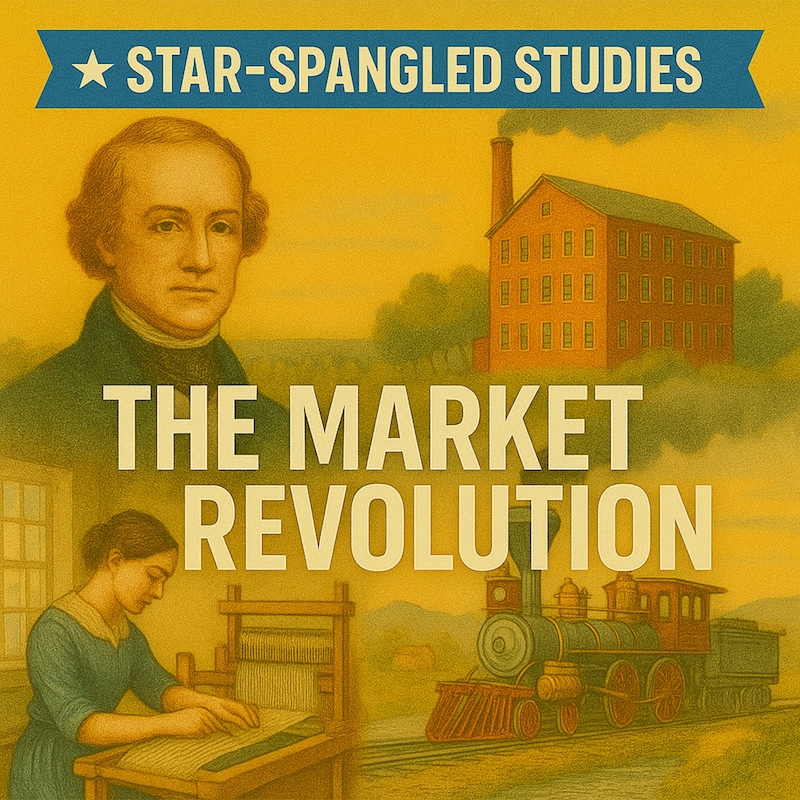
In Episode 8 of Star-Spangled Studies, Dr. G breaks down how steam, railroads, canals, and cotton transformed the young Republic. Key topics include:
• Post–War of 1812 “Era of Good Feelings” and rising nationalism
• Transportation revolution: steamboats, Erie Canal & railroads
• Telegraph & communication revolution
• Market integration: from subsistence farms to cash crops
• Cotton gin, “King Cotton” & the internal slave trade
• Rise of Northern factories: Lowell Mill girls & early labor protests
• Republican Motherhood and separate spheres
• Immigration surge, nativism, & the Know-Nothing movement
• Debating the Market Revolution: progress vs. dislocation
**Links & Resources:**
@star_spangled_studies on Instagram
Star-Spangled Studies on Facebook
Historian Dr. G covers the steam engine, Erie Canal, railroads, cotton gin, factory growth, telegraph, and the paradox of free labor vs. expanding slavery in the early 19th century.
Keywords: Market Revolution podcast, Erie Canal, steamboat, railroads, cotton gin, Lowell Mill girls, telegraph, King Cotton, Dr. G
Transcripts
Hello y'all.
2
:It's me.
3
:It's me.
4
:It's Dr.
5
:G.
6
:The last time we were together on
Star Spangled Studies, the United
7
:States was basking in the glow.
8
:In the era of good feelings, the nation
survived a second war with Great Britain.
9
:A new wave of nationalism
swept through the country.
10
:And the old Federalist party was
all but dead, leaving Jefferson's
11
:Democratic Republicans in charge.
12
:But this good feeling was a thin line
over a society that was about to be torn
13
:apart and rebuilt from the ground up
in the early years of the 19th century.
14
:In almost quote, universal ambition to
get forward as one Baltimore newspaper.
15
:Put it in 1815.
16
:It remade the nation.
17
:This wasn't a political revolution, fought
with guns and pamphlets, but a revolution
18
:of technology, commerce, and labor.
19
:It was a revolution of steam engines
and telegraph wires of newly built
20
:canals that cut through mountains and
factories that rose from the river banks.
21
:Historians call this the market
revolution between the American Revolution
22
:and the Civil War, the old world of
subsistence farming where families
23
:produce mostly everything for themselves.
24
:Died and in its wake a new,
more commercial nation was born.
25
:It was an age of explosive economic
growth of staggering new fortunes
26
:and what felt like endless promise.
27
:The American dream was in its
infancy, but this revolution.
28
:Market Revolution had its costs.
29
:It created new forms of labor,
and it formed new social classes.
30
:It sparked devastating financial
depressions and panics, and as
31
:northern factories boomed their
demand for cotton also boomed, which
32
:accelerated an entrenched slavery,
that brutal institution in the South.
33
:Even more so today we're gonna
explore this massive transformation
34
:that we call the Market Revolution.
35
:How did these new technologies
knit a vast continent together?
36
:How did the way Americans
worked, lived and thought about
37
:themselves change forever?
38
:And how did this new world of free labor
and slavery of wealth and inequality.
39
:Set the stage for the conflicts to come.
40
:So let's go.
41
:So this was a revolution basically at
first in transportation and communication.
42
:In order for us to really understand
the market revolution, we have to
43
:start with a simple problem that was
occurring in these United States, and
44
:that was the problem of overcoming
distance In the early 18 hundreds.
45
:The United States was a huge country
with a transportation system that.
46
:Could not keep pace moving goods from
the interior to the coast was slow and
47
:it was incredibly difficult, and to do
so was actually prohibitively expensive.
48
:It could cost as much to ship a ton of
goods 30 miles over land as it did to ship
49
:it from the ports on the coast to England.
50
:That's how difficult and costly it was.
51
:The reality of this kept
the nation's economy then.
52
:Very local and very agrarian.
53
:Everything you needed had to be
within a close distance of you because
54
:of the costs of transportation.
55
:But with the market revolution that
was about to change after the war
56
:of 1812, a new spirit of nationalism
led to calls for the government to
57
:invest in what they called internal
improvements to strengthen the nation.
58
:In his 1850 under address to Congress
President James Madison, a man once
59
:very wary of federal power like
Jefferson before him now called for the
60
:government and for public investment
from the government to create a
61
:system of national roads and canals.
62
:So this shift in thinking helped what
launched a transportation revolution.
63
:The first great breakthrough
was technological.
64
:It was the invention of the
Steamboat Robert Fulton successfully
65
:launched the Claremont on the
Hudson River in:
66
:just the beginning of steam boats.
67
:Boats powered by steam.
68
:By the 1830s Steamboats, plied,
the rivers of the American
69
:West, especially the Mississippi
turning frontier towns like St.
70
:Louis and Cincinnati, which
were on the periphery now
71
:into bustling commercial hubs.
72
:So what made steam powered
ships so important?
73
:Well.
74
:It can go against the current.
75
:The power of the steam meant that boats
can go in both directions on a river,
76
:not just one direction, and not pulled
by animals back against the current.
77
:That's literally what they had to do.
78
:Now, boats can go in both directions.
79
:In the steam power was
much faster as well too.
80
:But maybe the most spectacular example
of this revolution in transportation
81
:was the building of canals, and
specifically the Erie Canal.
82
:This was completed in 1825.
83
:This was a 350 mile manmade
waterway, and it was a marvel of
84
:technological engineering at the time.
85
:Why was this so important?
86
:To put it simply, it linked the Great
Lakes to the Hudson River, and for
87
:those that don't know, the Hudson
River flowed from upstate New York.
88
:To New York City.
89
:So it linked New York City with the
agricultural heartland in the northeast.
90
:The impact of this was immediate and
staggering the cost of shipping a
91
:ton of wheat from Buffalo, New York
to New York City, New York plummeted
92
:from roughly a hundred dollars to $10
towns along this route, like Rochester.
93
:Exploded into cities overnight.
94
:A British visitor named Basel
Hall described the scene in
95
:Rochester because of this in 1829.
96
:Everything in this bustling
place appears to be in motion.
97
:The very streets seem to be starting
up of their own accord, ready
98
:made, and looking as fresh and new.
99
:As if they had been turned out of
the workman's hands, but an hour
100
:before sawmills planning machines,
flower mills were all hard at work.
101
:The canal banks were covered
with boats loading and unloading.
102
:End quote.
103
:The Erie Canal made New York City,
the nation's premier port and
104
:commercial center, a status that
it has maintained to this very day.
105
:The success of the Erie Canal sparked a
canal building boom, across the country.
106
:It is also in this time period
that the next technological.
107
:Innovation.
108
:The one that would help change this
transportation even more in the
109
:decades to come was the railroad.
110
:In 1827, the Baltimore and Ohio
Railroad, or the b and o Railroad for
111
:you Monopoly fans, became the first
long distance rail line in America.
112
:Though initially slower and more
expensive than Canal Transport
113
:Railroad had a couple of advantages
over canals, which would lead to it
114
:becoming, uh, the country, becoming more
dependent on them in the years to come.
115
:The first was that it
could operate year round.
116
:Winter did not affect going on
rivers or into lakes as would canals.
117
:And second.
118
:The railroads can go anywhere.
119
:There was land as long as you built a
bridge to go over water canals really
120
:only went where you could dig them.
121
:So by 1860, the United States
had over 30,000 miles of track.
122
:This was more than the
rest of the world combined.
123
:The transport revolution was then matched
with a revolution in communication.
124
:These two things together,
the invention of the telegraph
125
:by a man named Samuel Morse.
126
:No wonder we have a Morse
code after Samuel Morse.
127
:This happened in the 1840s and this
itself was another game changer.
128
:Suddenly, information could travel
at the speed of electricity,
129
:not by the speed of a horse.
130
:By the time of the Civil War, there
was a web of telegraph lines that
131
:connected the nation, transforming
businesses, politics, journalism.
132
:People could talk to each other.
133
:At the same time in different places,
that is absolutely revolutionary.
134
:Think about how social media has
allowed you to do the same thing.
135
:That's the power of the telegraph.
136
:So together, these innovations,
one in transportation, and then
137
:later one in communication,
reshape the American economy and
138
:fundamentally change the lives.
139
:Of all people, especially ordinary
people, farmers who once produced
140
:mainly for their own families or their
local community now could grow crops
141
:and send them to distant markets.
142
:They earned cash for what they had
previously consumed, and they were
143
:now able then to purchase goods.
144
:That they had previously
made for themselves.
145
:So a new integrated
national market was born.
146
:You could grow things in the heartland,
sell them to the East coast and use
147
:that money to buy goods that were being
produced in the East coast that could
148
:now from the factories be sent inland.
149
:What a change that really was.
150
:So the new market had.
151
:A voracious appetite and its
hunger would be unfortunately
152
:fed by a system of human bondage.
153
:It is one of the great and terrible
ironies of United States history.
154
:The market revolution, which
created a dynamic economy of free
155
:labor in the north, also led to the
dramatic expansion and entrenchment
156
:of unfree slavery in the South.
157
:These two systems were not separate.
158
:They were deeply and
tragically intertwined.
159
:The key to this story is cotton.
160
:Before the 1790s, cotton was a minor crop.
161
:The long staple cotton that
was easy to clean grew only off
162
:the sea islands off the coast.
163
:The short staple cotton that could
grow inland was filled with sticky
164
:green seeds that took a full day
for an enslaved person to clean
165
:just one pound of cotton by hand.
166
:Then in 1793, a young new
Englander named Eli Whitney.
167
:Invented the cotton gin, a simple machine,
and you used a hand crank to turn a
168
:cylinder with wired teeth that would
pull the cotton fibers through a mesh
169
:screen, separating it from that sticky
seed, a single hand cranked gin could
170
:now clean 50 pounds of cotton in a day.
171
:The effect of this one machine.
172
:Was explosive as it was tragic
cotton production because of it
173
:skyrocketed the South, which had been
facing an economic crisis as its old
174
:crop di tobacco declined in value.
175
:The south was now reborn
as the cotton kingdom.
176
:It came king cotton and as cotton
production boomed, so did the
177
:demand for land to grow cotton on.
178
:And with that.
179
:More slaves to pick the cotton.
180
:This created a massive
internal slave trade.
181
:A second middle passage that saw
over a million slave forcibly moved
182
:from older slave states in the
upper South to the new cotton lands
183
:of the deep south and the west.
184
:The number of enslaved people
in the United States also
185
:grew from around 700,017 90 to
million in the:
186
:So by the end of the Civil War,
cotton accounted for nearly two
187
:thirds of all American exports.
188
:Do keep in mind that with the slave trade
being banned by:
189
:slave trade, the only way that one
could get slaves was internally.
190
:The priority now in Upper South States
was to now keep your slaves alive, have
191
:them have offspring, and sell those
offspring to the deep south, ripping apart
192
:families and the destruction in black
culture that we cannot underestimate.
193
:We like to think sometimes that
slavery was basically a southern
194
:story by the beginning of the 18
hundreds, but that's actually not true.
195
:The North was deeply implicated
and complicit in the slave economy
196
:that grew up until the Civil War.
197
:There's many ways to
think about this, right?
198
:The first is that.
199
:There were new textile mills in the
north places like Lowell, Massachusetts.
200
:The textiles that they were using or
creating were made from cotton grown
201
:in the deep south using slave labor.
202
:The northern banks also were a part of
financing this market of revolution.
203
:They provided loans to southerners and
those loans purchased not only the land
204
:in the south, but also the slaves as well.
205
:Northern Insurance companies made money
insuring southern property and part of
206
:the southern property that was insured.
207
:We're slaves.
208
:The ironies about all this is that
at the exact same time as the market
209
:revolution is going on, slavery was
actually slowly dying out in the north.
210
:After the American Revolution, most
Northern states had passed either complete
211
:emancipation or gradual emancipation laws.
212
:Gradual is the word here.
213
:That is key.
214
:These laws were designed to protect the
property interests of the enslavers.
215
:Most of them only freed the future
children of enslaved mothers, and
216
:only those children who had served
their mothers, uh, enslave for a
217
:period of indentured servitude that
could last into their twenties.
218
:This means that slavery lingered in
states in the north, some like New Jersey,
219
:until the very end of the Civil War.
220
:Despite being a northern state, this
created a nation that was, as our textbook
221
:puts it, quote, a nation of free labor
and slavery, of wealth and inequality,
222
:and of endless promise and untold perils.
223
:And as this new world of work was
transforming, not just in the north.
224
:But in the South as well.
225
:The market revolution
changed several things.
226
:It changed where people worked, but
also the very nature of work itself.
227
:Before the market revolution, the
dominant mode of production was something
228
:that we call the artisan system.
229
:For instance, a young man would serve
for years as an apprentice to a skilled
230
:master craftsman learning the trade over
time before branching out on his own.
231
:We can see this from a contract in 1836
where, uh, in this case a man named
232
:James agrees to serve as a blacksmith's
apprentice, promising not to quote
233
:absent himself day nor night from his
said master service without his leave.
234
:And to avoid quote.
235
:Haunting Ale, houses,
taverns or playhouses.
236
:End quote.
237
:In return, this master craftsman
agreed to teach him, quote.
238
:The art, trade and mystery of a
blacksmith end quote, as well as provide
239
:him with food, lodging, and clothing.
240
:This was a world of skilled labor where
work and home were often intertwined.
241
:I.
242
:But the market revolution brought rise to
the factory system and this shattered the
243
:skilled master craftsman world production
now was broken down into discreet,
244
:repetitive steps, a process that's
called peace work, and this required a
245
:lot less skill and could be performed
by a lot less experienced worker.
246
:The artisan who was once the
master of his own time and his own
247
:labor was increasingly replaced
by something we call wage work.
248
:Your life was governed by the factory
bell and the demands of the boss no
249
:longer was the entire production from
start to finish created by one person.
250
:It was now broken up into many people,
and those many people only had to learn.
251
:One small skill of a larger skill set.
252
:This brings less skilled laborers
into the factory system, and the most
253
:famous of this example of this new
factory system was the textile mills I
254
:had mentioned a moment ago in Lowell,
Massachusetts to avoid creating a
255
:permanent dependent factory class like
the ones they had seen in England.
256
:The founders of the Lowell Mills
recruited a unique labor force.
257
:Young, unmarried women from the farms
of New England, the Lowell Mill girls,
258
:as they came to be known, were housed
in clean supervised boarding houses and
259
:were offered wages and opportunities
for education and cultural enrichment
260
:through lectures and their own
literary magazine called The Lowell
261
:Offering for many of these young women.
262
:Coming to Lowell was a chance
for economic independence and
263
:a break from the drudgery.
264
:Hierarchy in a farm life,
but the realities of factory
265
:work were then and now harsh.
266
:They worked from five in the morning
until seven at night, six days a week
267
:in a very noisy lint filled factory.
268
:Harriet Robertson, who started
working in the mills as a
269
:10-year-old, wrote later about her
experiences as a Lowell Mill girl.
270
:In her autobiography, she recalled that
the greatest hardship was the long hours,
271
:nearly 14 hours a day, six days a week.
272
:As the mill owners continually try
to speed up production to make more
273
:things that they could sell and
thus make more money, as well as to
274
:cut the wages, that is to pay the
workers less, to make more money.
275
:These young women fought back in 1836
when the corporation announced a wage cut.
276
:The mill girls organized one of the
first strikes in American history.
277
:As Harriet Robinson remembered it,
quote, when it was announced that
278
:the wages were to be cut down,
great indignation was felt, and
279
:it was decided to strike on mass.
280
:This was done.
281
:The mills were shut down and the
girls went in procession from their
282
:several corporations to the grove on
Chapel Hill and listen to incendiary
283
:speeches from early label reformers.
284
:End quote.
285
:These protests led to the formation
of the Lowell Female Labor Reform
286
:Association in 1845, the first union
of working women in the United States.
287
:They organized petition drives,
demanding a 10 hour workday, and
288
:published their own newspaper called
The Voice of Industry to expose the
289
:harsh realities of factory life.
290
:In a letter to a friend, the association's
president, Sarah Bagley, a former mill
291
:girl herself, they wrote that they were
not willing to see our sex made into
292
:living machines to do the bidding of
the incorporated aristocrats End quote.
293
:These early labor movements had limited
success, but they show that the new
294
:working class was now not just a
passive victim of the market revolution.
295
:They were active participants
fighting to shape their own
296
:destiny and challenging the power.
297
:Of the new industrial capitalists,
298
:the market revolution transformed
American society, not just its economy.
299
:It transformed the idea
of the American family.
300
:As production moved out of the home
and into a factory, a new ideal of
301
:family life emerged, at least for
the growing urban middle classes.
302
:It emerged, and this is the
ideology of separate spheres.
303
:The public sphere, which was the
world of work, of commerce, of
304
:politics, was now seen as the domain
of men, the private sphere, the home.
305
:Was seen as the domain of women.
306
:French Observer.
307
:Alexis Deville described this arrangement
in his famous book, democracy in
308
:America, which was published in 1840.
309
:In no country has such constant care been
taken as in America to trace too clearly.
310
:Distinct lines of action for the
two sexes and to make them keep
311
:pace one with the other, but in two
pathways that are always different.
312
:American women never manage the
outwork concerns of the family or
313
:conduct a business or take apart
in political life, nor are they on
314
:the other hand, ever compelled to
perform the rough labor of the fields.
315
:If.
316
:On the one hand, an American
woman cannot escape from the quiet
317
:circle of domestic employments.
318
:She's never forced on the
other To go beyond it.
319
:End quote, of course, as our textbook
points out, this ideal was not only
320
:possible for a small number of wealthy
families, for the vast majority of
321
:women, however, these farm women,
working class women, and especially
322
:enslaved women, economic production
remained a central part of their lives.
323
:But the, I.
324
:And the ideology of separate
spheres was powerful.
325
:It redefined the home as the refuge
from the harsh competitive world of the
326
:markets, and it elevated the role of
women as moral guardians of the family.
327
:This led to the ideal of what they called
compassionate marriage, where marriage
328
:was based on affection and mutual esteem
rather than just an economic calculation.
329
:And the idea of a romantic childhood
where children were to be sheltered and
330
:nurtured rather than seen as little du.
331
:American society changed rapidly
between:
332
:over 5 million immigrants came to the
United States more than the entire
333
:population of the country in 1790.
334
:The largest groups of these
were Irish and Germans.
335
:Irish came in huge numbers, especially
after the great famine of the
336
:1840s, a catastrophe of a potato
blight that led to mass starvation.
337
:It also included a lot of
British culpability in that, but
338
:that's a whole different course.
339
:The Irish that came were desperately
poor and they crowded into coastal
340
:cities in the Northeast, taking sometimes
the most dangerous and lowest paying
341
:jobs in construction and factory work.
342
:We can hear the desperation and the
hopes in their letters back home.
343
:I.
344
:A woman named Hannah Curtis said this
quote, dear brother, I'm sorry to hear
345
:of the dis distress of the poor of our
country, but thank God we are not so here.
346
:We have plenty of good fire
and plenty to eat and drink.
347
:I would be very glad you would come
here for, I think you would do well.
348
:I.
349
:German immigrants, however many of
whom were fleeing political unrest
350
:after the failed revolutions of 1848.
351
:Again, totally different course.
352
:They often arrived with a little bit
more skill and some capital, and they
353
:tended to move to the German triangle.
354
:The German triangle being
the cities of Cincinnati, St.
355
:Louis and Milwaukee, where they
established farms and businesses.
356
:But this influx of newly arrived
immigrants was not welcomed by everyone.
357
:And for whatever reason, I
guess some things never change.
358
:Many native-born Protestant
Americans saw these new immigrants.
359
:This time they were overwhelmingly
Catholic as a threat to the
360
:nation's values and institutions.
361
:There was a backlash to this, and
this backlash is known as nativism.
362
:And it was fierce anti-Catholic
nativism sprang up.
363
:In response, they made cartoons like
one from:
364
:priests as crocodiles crawling ashore
to attack American school children.
365
:And these types of cartoons were common.
366
:This Nativist sentiment gave rise to a
new political party in the:
367
:American Party, more commonly known as
the Know Nothing Party, which called for
368
:restricting immigration and limiting the
political power of anyone who is Catholic.
369
:I.
370
:For free Black Americans, the market
revolution often meant more hardship.
371
:They faced intense racism and they
were shut out of most of the skilled
372
:jobs, forcing them into the lowest
paying and most insecure work I.
373
:The abolitionist Maria Stewart in a
powerful speech in Boston in:
374
:the soul crushing consequences of racism.
375
:Quote, I have been most shamefully,
wronged and scandalized, and my
376
:character has been dreadfully traduced.
377
:I.
378
:Tell us no more of southern slavery for,
with the exception of the name, I firmly
379
:believe that none have suffered more than
we look at us and see how we are situated.
380
:Our sons are torn from us and
forbid to expand their minds.
381
:Our daughters are refused situations
and custom has taught us to
382
:believe that we were not capable.
383
:Of acquiring learning, end quote
steward's words are a powerful reminder
384
:that for many, the new market economy
was not a story of opportunity, but a
385
:continued story of exclusion and despair.
386
:So, was the market
revolution a good thing?
387
:Well, the debate
continues for a long time.
388
:Histor historians tended to see
it as a natural and positive step
389
:in American progress, a story of
innovation and an opportunity.
390
:But in 1991, the historian Charles
Sellers published a hugely influential
391
:book called The Market Revolution,
Jacksonian America,:
392
:offered a much darker interpretation.
393
:He argued that the market revolution
was not a gentle evolution, but a
394
:brutal and erve process that destroyed
the more egalitarian and democratic,
395
:self-sufficient agrarian world.
396
:He saw it as a conflict
between two Americas.
397
:One based on land and subsistence
the other on capital and commerce.
398
:He argued that most more ordinary
Americans resisted the encroachment of
399
:the market and the revolution, which they
saw as a threat to their independence.
400
:This resistance ultimately rallied
around the figure of Andrew Jackson,
401
:who would become the champion of
the common man against the quote.
402
:Acquisitive, entrepreneurial and
exploitative forces of capitalism.
403
:Sellers argued that democracy itself
was born in tension with capitalism,
404
:not as its natural political expression.
405
:End quote.
406
:Seller's work has been
incredibly influential, but
407
:it has also been challenged.
408
:Other historians argue that he
romanticizes the pre-market world and
409
:underestimates the degree to which
ordinary Americans embrace the new
410
:opportunities the market offered.
411
:They point to that.
412
:Quote almost.
413
:Universal ambition to get forward, and
they argued that for many, the market
414
:revolution wasn't something to be
resisted, but something to be seized.
415
:So really, where does that leave us?
416
:As with most big historical
questions, the answer is complicated.
417
:The market revolution was both.
418
:It was the story of incredible
innovation and growth and opportunity
419
:that many welcomed and seized, but it
was also a story of dispossession and
420
:inequality and exploitation that many
normal and ordinary Americans resisted.
421
:It created immense wealth, but it
was all immense wealth creation.
422
:It was not shared equally.
423
:It offered new freedoms for some while
deepening the bondage for others.
424
:It was in short, the
messy, contradictory birth.
425
:Of modern America.
426
:The market revolution then utterly
transformed the United States.
427
:By the 1840s, it was a nation
bound together by canals,
428
:railroads, and telegraph wires.
429
:It was a nation of bustling cities and
booming factories, but it was also a
430
:nation of growing inequality of new
class divisions of fierce anti-immigrant
431
:backlash, and of a slave system that
expanded more vast and profitable.
432
:Than ever before, this new dynamic,
deeply divided United States
433
:required a new kind of politics.
434
:The old deferential world of the founding
fathers were gentlemen governed was dying,
435
:if not dead, a new, more boisterous,
more democratic, and often more violent.
436
:Political culture was
rising to take its place.
437
:It was a politics that celebrated
the common man and promise to fight.
438
:The moneyed aristocracy and the man
who came to embody this new age more
439
:than anyone else was a Tennessee
Slaveholder, a celebrated quote Indian
440
:fighter, and he was also the hero
of the battle of New Orleans, a man
441
:his supporters called Old Hickory
and his enemies called King Andrew.
442
:Next time we get together on star
spanked studies, we're gonna dive into
443
:this raucous and revolutionary age.
444
:Jackson, we'll explore the rise of mass
democracy, the brutal policy of Indian
445
:removal, the war against the bank of
the United States, and the nullification
446
:crisis that nearly tore the nation apart.
447
:You won't wanna miss it.
448
:I'm Dr.
449
:G, and I'll see y'all in the pack.