Shownotes
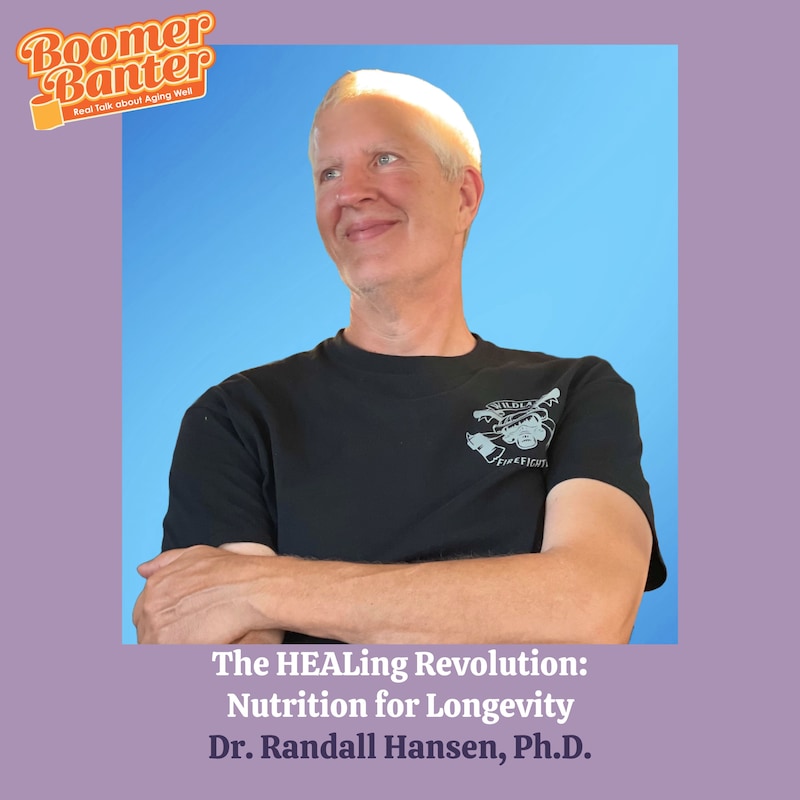
In this episode of Boomer Banter, we tackle the often confusing world of nutrition with Dr. Randall Hansen, who reveals how our perceptions of food have been shaped by outdated science and marketing gimmicks.
The discussion centers around the concept of healthspan – the idea that we should prioritize living well over simply living long. Dr. Hansen illustrates how the food landscape has changed, particularly since the 1950s, leading us to make poor dietary choices that impact our health.
With a focus on real, whole foods and a lifestyle that incorporates movement and connection, listeners are encouraged to rethink their eating habits. The episode is packed with humor and relatable anecdotes, making it not just informative but also a fun listen. By the end, we’re left with practical strategies to cut out the sugar and processed foods that have sneaked into our diets, urging us to reconnect with the basics of nutrition that nourish and sustain us.
Takeaways:
- In this episode, we explore what really supports longevity and health span as we age.
- We discuss how confusing nutrition advice has led to misunderstandings about food and health.
- Dr. Hansen emphasizes the importance of healthy fats and proteins in our diets.
- We learn that sugar can be toxic, leading to chronic inflammation and various health issues.
- The podcast highlights the significance of movement and weight training for both physical and mental health.
- Listeners are encouraged to cook at home more and eat mindfully to improve overall health.
Links referenced in this episode:
- Visit Dr. Randall Hansen's website
- Check out Older Women & Friends
- Schedule a 30-minute Complimentary Session with me
- Email me at [email protected]
Transcripts
Hello and welcome to Boomer Banter where we have real talk about aging. Well, my name is Wendy Green and I am your host.
on of life. And we are ending:At the beginning of this month in episode 258, we talked about the effect of movement and exercise on our brains with Tom Gilliam.
In the next week in episode 259, we talked about the importance of sleep and we shared some useful tips and strategies for improving your sleep with Marie Sennett. If you haven't seen those two, you're going to want to go back and see them today in episode 260. 260.
We're talking about something that matters deeply to all of us as we age. What really supports longevity, but even more importantly, health span the years we spend feeling healthy, capable and engaged in life.
For decades, many of us, well, probably most of us were taught confusing, conflicting or what my guest today says is incorrect information about nutrition, fat, sugar and what our bodies need to thrive.
Add in the ultra processed foods that fill the grocery store aisles, the artificial sweeteners, diet fads and the never ending promise of anti aging products and it's completely understandable that we are feeling confused. So today we're going to attempt to clear up our confusion.
My guest, Dr. Randall Hansen is a researcher, educator and author of the Healing Revolution Diet, a science based practical guide that helps people shift from symptom chasing to true healing through food, movement, mindset and lifestyle. It's a whole package.
We'll talk about how our food system changed, why healthspan matters more than lifespan and the small daily choices that truly make a difference. No gimmicks, no snake oil, just real talk for our lives. And with that, Let me bring Dr. Randall Hansen on. Hi, welcome to Boomer Banter.
Dr. Randall Hansen:Hey Wendy. Wow, what a great introduction. I love the topic and how you framed it. So thank you for that.
Wendy Green:Oh, you're so welcome. So your, your book that I am talking about today, the Healing Revolution Diet. Yes, diet is in the title. But you say this is not a diet.
So talk to me about that.
Dr. Randall Hansen:I, I have a, a good friend of mine who when I was working on the book and working on the title, would send me an email every day saying get title out of the name of that book. It's not about a diet.
And I said I, I understand, but from a marketing standpoint, there are so many diet books and if this is a Way to gain attention that I want it in there. But then like you said, almost from page one, I say, this is not a diet book. This is a lifestyle whatever.
But it's sort of the anti diet book in my mind because it's not Skippy breakfast or skippy lunch, skippy dinner, you know, whatever. And it's more about, just as you said, making real changes.
Wendy Green:Right. And, and why write a book about diet and lifestyle and all of that? What, what made you do that?
Dr. Randall Hansen:The biggest thing. My. What motivates me. And it's going to sound corny or whatever, but I, I hate when the, when the truth is not presented at all or sometimes mud.
You know, we can call it myths, we can call it falsities, we can call it lie, outlight lies, but it just, I don't like it when there's, there's people like you said, either huckster selling gimmicks. Like, I see headlines, you know, be ripped in 30 days. And it's like, no, delete that person. Don't want to ever see that person again.
And so, and, and then about nutrition, I mean, there are still nutritionists today that are posting on social media that say eggs are dangerous. And so it's just, it just fired up in me. I have to write this book that tries to clear the air.
I think if anyone gets anything out of this book, just looking at the timeline that I present early on in the book that kind of highlights all these mistakes that we made through the decades that led us to here. So people are like, oh, I don't believe at least 2/3 of a grocery store items in the grocery store are really unhealthy for us.
And people are like, oh, I don't believe that at all. The timeline and see how the food has changed over these last 50 years.
And all of a sudden you say, oh, maybe there are, maybe these are unhealthy foods. So this is what I'm trying to do.
I'm just trying to educate people with the most current research that we have about food, about nutrition, about health, about lifestyle.
Wendy Green:Yeah, yeah. And, and the timeline was really interesting. So I want you to talk about that.
took a wrong turn in, in the: Dr. Randall Hansen:Yes. Great. And you know, it's funny, this audience especially will have memories of all these things mostly.
So in:What, what caused this? And, and how, how can I avoid it? And the main researcher, and by the way, President Eisenhower was a, was a big smoker.
And we think now that was obviously one of the big re drivers. And I think he was also at least a social drinker, if not more. And those were two big factors for it.
But there was a researcher named Ancel Keys who actually became, was featured on the COVID of Time magazine at one point. He did this research. He was very fascinated. And he did this research that we now look back on and see multiple errors in it.
But he looked, he did these countries, he looked at various countries. He wanted to see where heart attacks or cardiovascular issues were happening. And he found these seven countries.
And he did this book and he said that fat was the cause of cardiovascular disease and that's what caused the presence heart attack. And we all need to be cutting back on fat. As researchers look back at his, how he coded the information, it's fascinating.
So he had two categories for sugar. He had sugary beverages is just one category. And then everything else, pastries, cakes, candies and all those things.
And then he had one category for fat. So by separating the sugar, fat was a little bit higher, according to his research.
When researchers went back and said, well, sugar, sugar, let's combine those. It was clear that sugar was, at least according to his research, his original research was the cause of, or a cause of this issue and that.
But the fat, the misunderstanding about fats changed everything. We started having lowfat products, no fat products, right.
We had the snack Wells in the 80s that were, I don't even know what those were, the strange food products. And, and food, and food totally changed.
You know, I try to tell younger people, you know, that apple pie that you're buying from the grocery store that looks like grandma's apple pie is completely different. You know, grandma's had apple, cinnamon and sugar, couple other spice, clove, maybe some spices, and then the dough, and that was it, right?
Look at one from the store. And it has 30 ingredients that you can't pronounce and you can't pronounce, right? And so it looks like the food we know, but it's not.
And so, you know, we call it ultra processed. I, I like to call other names like imposter foods, because to Me they're, they're an imposter. It looks like what we should remember, but it's not.
Wendy Green:Yeah.
Dr. Randall Hansen:And so, so that led to. Yeah, and then there were other things. That was the biggest thing that happened in that time. But we also was a fat. With the fat. The blaming of fat.
Sugar industry during this time also did a little mischievous work of their own. They paid Harvard researchers to do a study that showed that sugar was perfectly healthy. Somehow that leaked.
The research never was published and Harvard got kind of a black eye for that. And.
But that's also very typical in the food industry, in the nutrition industry, that food companies sponsor the research or trade groups sponsor the research. So it's like, yeah, follow the money. Right, Right. How do we trust this information? That's, that's been the problem for all these years as well.
Wendy Green:Yeah. So I want to talk about a. Your book lists like 10 principles for the Healing Revolution diet.
And I want to talk about a few of them that, you know, when I first looked at them, I was.
Dr. Randall Hansen:Like.
Wendy Green:They get a little more complicated as we go down. But so number one, focus on healthy fats and proteins. And as you were just saying, you know, all this bad press about fats.
So like, what's a healthy fat? Aren't all fats bad?
Dr. Randall Hansen:Great question. We do consume a lot of fat.
In fact, the average person who's doing the ultra processed or standard American diet, whatever we want to call it, is consuming almost a half a cup of soybean oil a day.
Wendy Green:A day?
Dr. Randall Hansen:A day. And it's because soybean oil is the cheapest oil there is. It's subsidized. The growing of soybeans is subsidized by the US Government.
And so food manufacturers are always looking for the cheapest. Many food manufacturers are looking for the cheapest ingredients. Soybean oil is one of those.
And what we've discovered, if you look at the history of vegetable oils, they actually started out as industrial oils for industrial use for machinery. In fact, I have a farmer down the road who uses canola. No, some, I think it's just vegetable oil.
Vegetable oil in his chainsaw when he's doing some butchering. Because he, he. Because it runs the chainsaw perfectly.
And so, but in the, but in the early 40s, I think it was Crisco came out as the first that was a solid vegetable oil. And then they realized it could sell even more if they made it liquefied, which then became, then we had canola, we had corn oil, soybean oil.
All these different oils, sunflower, safflower.
And in the last, I'd say 15 years, there are a bunch of researchers that are really focused on these vegetable oils and have determined that the way they're processed, if they're. Because what happens is the oils come from the seeds, the seeds are pressed and crushed, but then they have to go through a solvent to clean them.
And then they go through a emulsifier and then they are heated and then they have one more bleaching before they get put on the shelf. And so they typically are. Most researchers now looking at these and saying that they are inflammatory to our bodies.
But the bigger issue to me is they are high in omega 6 and our body. We want to. If we look at the history of human consumption, there are two types of fats in our body, fatty acids, omega 6 and omega 3.
And throughout history we've been mostly balanced. Omega threes come from fatty fish and some seeds and nuts and grass fed beef.
Omega 6 comes from vegetables and these vegetable oils and things like that. But because ultra processed foods use so much vegetable oils, we now have a omega six way up here, Omega three way down here.
To have also cut back on fish and other things. And so we need to find that balance.
Wendy Green:Yes. So, so what are the healthy fats?
Dr. Randall Hansen:Healthy fats?
Avocado oil, coconut oil, butter, grass fed butter lard which we, most people used to cook with, or some variation of that tallow, which is from beef.
Wendy Green:Olive oil.
Dr. Randall Hansen:Olive oil. Thank you. And olive oil. Of course. Yes.
The problem, the sad part with the healthy fats is that olive oil, which is fairly expensive to produce, is often cut with seed oils or with these vegetable oils to make it more affordable. So you have to be really careful about finding a pure source of olive oil. And the same thing with avocado oil.
I've also read that there are people that cut that with vegetable oil to reduce the price.
But olive oil and olive oil is, is the best probably fat for cold things like salad dressings, drizzling it over a wonderful caprice salad or something like that. Avocado oil is a higher, what do they call it? Higher burn rate. So it's better in. When you're cooking with. With it. Yeah.
Wendy Green:Okay. All right. So another core principle that you had, you say eliminate refined sugar. You say sugar is toxic. And to me that's a really bold statement.
Especially at a holiday time when cookies and candies, pies and cakes. So how is sugar toxic?
Dr. Randall Hansen:Oh boy, this is gonna be a big one. But let me Let me start off. I know we chatted about this a little bit earlier.
Again, if we think about when we were growing up, we had, of course we still had the holidays, but it were, there were fewer holidays and it wasn't like we had sugar every single day. You know, today you go to a meeting, there are cookies and donuts.
You go to a birthday, there's cake and everything else, and everything is celebrated or often using these sugary foods. So, you know, when we were growing, my mom, yeah, my mom baked like 15 different holiday cookies and little muffins and we chowed down on them.
As you know, we shed four boys and we all consume those. And that wasn't a problem because we weren't eating sugar every day.
So I take the radical approach just because people will say, oh, I'll cut back a little bit, but then they'll still have, you know, that, that latte in the morning with 10 teaspoons of sugar, the equivalent of that, or and then some kind of tasty muffin in late morning. So let me backtrack a little bit. So sugar, our body doesn't process sugar that well. Especially not just.
It's not the sugar itself, but it's the fructose within sugar. Most sugars have two types of sugar and the fructose is the one that's the most dangerous. It affects our liver.
We used to have, we have a disease called fatty liver disease. It used to be only seen with alcoholics because the sugar content is so high in the alcohol and that's how it's processed in the liver.
And then we changed it. In the last 10 years, we saw so much more new fatty liver disease, but not from alcohol, from sugar.
So they renamed it non alcoholic fatty liver disease. And now they don't even call it that anymore because it's so prevalent among that. So that's number one.
Number two, the way the body processes sugar, it's, you know, we, we, fat and sugar have the opposite things. With sugar, the body processes that into fat.
If we can't use the sugar in our muscles, it translates that to fat, unlike fat that we eat, that the body uses for energy. So it's, it's kind of a weird thing to get your head wrapped around. But the more sugar we eat, the more it gets stored in our bodies.
And we've discovered, especially in the last five years, I know your readers or your listeners probably have heard this, but it's this thing called visceral fat and everybody has it. Everybody has it. It's this fat that gets around, excuse me, around our organs.
And it's not an issue unless it just keeps gathering there and gathering there. And that's what's been happening with us with all the sugar consumption.
And when we have too much visceral fat, it starts causing something we call chronic inflammation. And chronic inflammation in our body is when our body is always searching for that toxin. I need to fix it. I need to fix it.
And we now understand that chronic inflammation is probably the number one root cause of 9 out of 10 of the most common diseases that are killing us today.
Diabetes, hypertension, cardiovascular disease, many cancers, dementia, Alzheimer's, all these things are being impacted by chronic inflammation, which is driven by sugar. And then you probably also heard of insulin resistance. And these two work together in a strange combination to increase inflammation even more so.
And I think the statistics are that at least 75% of Americans are insulin resistant, resistant, whether we know it or not. And so this is why sugar, to me. And then we also know sugar is toxic to our brain at some level as well.
And so gut, body, heart, brain, it's just something that. So if we can. And we eat again, on average, we consume about three quarters of a cup of sugar every day in our diets.
Again, if we're following the standard American diet, because almost every ultra processed food has added sugar. You look at salad dressings or spaghetti sauces, things that are savory, have sugar in them.
Yeah, because the food marketers know we have this little thing in our brains about sweet, salty, you know, we love that, that interplay between.
So almost all ultra processed foods have added sugar in it, which is why unknowingly, for many people, I would say, I'd say most people don't look at ingredients labels.
I didn't for the longest time, but the first time you turn that label over and you see five sugars listed in the ingredient, you maybe hopefully will have a wake up call. Yeah, that's why I say, you know, we don't eat sugar in our bodies.
We, you know, people, when I first, I, I've been 99%, if not 100% off refined sugars for about 20 years now. And when I first did it, people said, oh my God, your brain's going to shrivel and die because the brain needs sugar. And.
And I said, no, the brain needs, brain needs glucose. That's true, but the body can create its own glucose, so it's not something that we need in our bodies.
Wendy Green:All right, all right.
So, yeah, you know, we could go so deep on these I have a million more questions about that, but I want to move on because there's so much to talk about. At least we want to give people a 500 foot view, you know, of what you talk about in your book.
And then they can get the book, the Healing Diet Revolution to get more of the details that would help them make the decisions that are right for them. Because that's one thing you say, not every diet is right for everybody.
Dr. Randall Hansen:Yes. And that, that's the other key thing. I thank you for saying that.
You know, there's so many, you know, the carb or diets, you only want the vegan diet or the mind diet. And it's so silly because that's just creating more noise for people. What? Yeah, my message is just start listening to yourself.
You had that coffee or you had that muffin. What's your body saying? Are you feeling sluggish? Are you tired? Are you brain fog? Okay, maybe that's not the right food for you.
So find the right mix that works for you and that's the critical. Yes, you can take things for the Mediterranean diet or whatever diet if you like, but listen to yourself and find the things that work best for you.
Wendy Green:Yeah, pay attention, people, to your body. It's talking to you.
So you, you alluded to this in the beginning about, you know, we were told that eggs are bad, salt is bad, too much red meat is bad. Fat makes us fat. And, and in your book, you kind of put all of those on their heads and you say, no, no, no, eating eggs is, is good.
And if you add salt to your diet, it's not going to hurt you. And not all red meat is bad. So how did we, how did we get there? But how, what are the, what makes these not bad for us now?
Dr. Randall Hansen:Sure, let me talk about, because I'm. Thank you for bringing up the hypertension thing again. And assault.
I think there are kind of two canaries in the coal mine for health right now that everyone should be looking at. One is hypertension and the other is triglycerides. Level for hypertension you can do with a simple blood pressure test.
A lot of stores even have them. But the triglycerides, you need to get a blood test. But those two factors. We can come back to that in a minute.
Those two factors to me are the canaries in the coal mine that if you have high blood pressure and you have high amount of triglycerides, you need to take action pretty, pretty quickly. It's still reversible for most cases, but you need to take action.
So let's take, let's take hypertension, and not just with hypertension, but even cardiovascular disease. When my father had a heart attack 40 years ago, a mild heart attack, his doctor immediately said, stop eating eggs. No more salt ever again.
Wendy Green:That's right.
Dr. Randall Hansen:And that's it. That's, and, and maybe quit smoking. I think that was the third one.
Wendy Green:Oh, that's probably big.
Dr. Randall Hansen:Number two.
Wendy Green:Yeah, yeah.
Dr. Randall Hansen:And we now understand with hypertension, which is fascinating to me. Here's another, here's another impact of sugar. For Most people, about 90% of people, 10% do have a genetic factor.
But for about 90% of the people, we, any excess salt we put in our bodies gets eliminated through our urine. It's just a natural body function that happens. So for most people, we never have to be worried about our salt intake.
The problem was discovered was all of a sudden we saw hypertension rising. And we're like, researchers were like, what's going on here?
And they discovered the sugar consumption that we're, the high sugar consumption that we're doing. Sugar blocks the release of salt in our body. So the salt builds up, leading to higher blood pressure.
So if we eliminate the sugar or as much sugar as possible, many people will see blood pressure go down.
Wendy Green:Really?
Dr. Randall Hansen:Fascinating.
Wendy Green:Of course, that is fascinating.
Dr. Randall Hansen:Yes. Other factors affected too, like chronic stress that you've mentioned before too, eggs. Cholesterol is a, a deep hole we probably can't get into.
But let me just say we've misunderstood cholesterol. We now understand cholesterol is something that's so important to our bodies. We need, cholesterol is in almost every single cell in our bodies.
Where we made the mistake was first calling one good and one bad. And then even within the bad cholesterol, so called bad cholesterol. It's only a teeny portion of that. That's the, the dangerous cholesterol.
But we lumped it all together again. Time magazine had a cover story. Eggs are hard, you know, whatever dangerous, don't eat them.
Wendy Green:Right.
Dr. Randall Hansen:And we, and we now discovered that.
Wendy Green:But it's grass. It's, it's naturally chickens that run around in the grass, right?
Dr. Randall Hansen:Yes, yes. You know, I, I, I can't stress that enough. I have a lot of people that are carnivore and eat a lot of eggs and a lot of beef as they do.
And I keep trying to elevate their, their level because they're like, wow, look at this. I got eggs for 99 cents, you know, and I said, oh, right. And what kind of eggs are they.
And so I'm trying to elevate them to say if you can't, let's put, let's put investment in our health.
And one of the ways we can do that is rather than those 99 cent eggs, let's get the pastured free ranging eggs if possible, ideally from even a local source, a farmer's market, something like that. Same thing with beef if we can. If you like beef and beef works for you. Again, doesn't work for everybody.
Get, find a local rancher if you can or find one of these national sites like Butcherbox and others that do grass, that sell grass fed meat and, and again it's going to cost you a little more but make the investment because I don't know why we've. We've put less and less money into our health.
Probably because we're spending more and more money on health insurance rather than on our health itself. But yeah, so eggs, I hate using the word superfood because it's people, you know, use that too often.
But eggs are one of the most nutrient dense foods, especially the yolks, but the whole thing. And so they are great source of minerals, other nutrients and, and fat. And we should be consuming eggs, you know, not crazily necessarily.
Unless again it's. Listen to your body. If eggs aren't resonating with you, then don't have as many. Just. But, but yes, eggs now are. Are. That has been so debunked.
But yet like I said today people are still talking about that.
Wendy Green:Absolutely, absolutely. That's what we were taught. Eggs are bad.
Dr. Randall Hansen:Yeah. And the no fat craze, that's where snack walls came in. You know. All of a sudden we started using all these, what are they called? The malol.
Wendy Green:Chemicals.
Dr. Randall Hansen:Chemicals for fats. And they caused bloating and all these other things. But we were so determined and so I still chuckle, but also sadly chuckle to myself.
I'm in the grocery store and I see no fat milk, low fat milk because whole milk again has, is just so naturally inherent. Again, if you can drink dairy, that's. Some people do have dairy issues but no one should be afraid of dairy again if it's a quality dairy.
Wendy Green:So you're saying that whole milk, whole yogurt, cheeses that are whole milk are not going to make us fat?
Dr. Randall Hansen:No, no, fat does not make us fat. That's the biggest fallacy that would put out there. And that's why this no fat craze was. Went berserk because everyone believed it.
Oh yeah, fat makes us fat. And it. No, it's actually sugar that makes us fat.
Wendy Green:So that's a, that's a hard one to swallow. Right. Like I buy the low fat yogurt because I think, well, cut out the fat. So.
Dr. Randall Hansen:Yeah. And here's the funny thing or the sad thing. Many of those low fat yogurts have a fruit in them.
Wendy Green:No, I don't do that.
Dr. Randall Hansen:I know, I know. But good for you. I know you wouldn't because I know you. But. But many others do. And so not only is it low fat sugar, dairy has extra sugar.
And so it's. So it's the opposite of healthy.
Wendy Green:Yeah, no, I'm going to add my own fresh berries or whatever if I'm going to. Yeah, and then, and then you still get that. You still get the good taste. And of course I like the taste of Greek yogurt anyway, so.
Dr. Randall Hansen:Yes, and that great point there too, when I'm talking about sugars, natural sugars, when you're eating the fruit, the whole fruit with, you know, not, not a juice, because the juice is a whole separate thing.
Are, you know, first of all, berries are amazingly nutritious for us, but that the fruit, the fructose that's in the fruit is perfectly fine as long as we're eating the fruit as well.
Wendy Green:Yeah.
Dr. Randall Hansen:Because the fruit has fiber that helps dilute the sugar in our, in our bodies.
Wendy Green:Oh, okay.
Dr. Randall Hansen:That's why, that's why that works. It slows the processing down.
Wendy Green:All right, so the fiber. Yeah, you did mention that.
But I want to move on to some of the other parts of your book before we run out of time and they have to deal with our whole health span, which. Can you differentiate that between health span and lifespan? People are confused.
Dr. Randall Hansen:Yeah. Healthspan is fairly recent term that more and more people are using in this area. Longevity.
The problem with longevity is it just means living longer. And I don't know about you, but I don't want to live to 90 if the last 10 years are a chronic illness where I'm stuck in bed or whatever.
And so healthspan says, let's not just look at a long life, but a long healthy life. So that's what we mean by healthspan. And I think healthspan also gets away from some of the, like you said at the beginning, the snake oils.
I mean, so much of longevity is all these people that I see these influences are about either their supplements or their devices or their whatever.
And there are so many simple lifestyle changes that we can make that will help healthspan that we, I'm not going to discount all the, you know, all these crazy things for longevity, but I think start with the basics first and then if you're not satisfied, then maybe look into some of these other kind of crazy things.
Wendy Green:Right. So, so we started out talking about food, but there are other parts that you talk about.
And yeah, as I mentioned in the beginning, we talked about movement and its effect on our brain. So how do you see movement as impacting our health span?
Dr. Randall Hansen:Wonderful. And I, yeah, I love that you've been doing this in December and celebrating you from afar, listening to the podcast and your newsletter.
So thank you for doing this movement here. You know, this is so fascinating. This is what I love about research. You know, we've always known that, you know, movement is important.
And to me, a lot of people think exercise is a four letter word. You know, I, I did that for a while. I'd get up at 5, you know, I'm gonna get up at 5am and go to the gym and do my workout before.
And I think that lasted about, I don't think it lasted the whole week before. I like, oh, I want to hit the snooze button. You know, until we. Anyway, so that was one part of it.
And then we got into the 10,000 steps and that, that became this big thing or weekend warriors, you know, if you can't, can't work out during the week, you know, on the weekend or your days off, go crazy and work out like, like a mad person.
And what we've realized, and this is partly also maybe a change in lifestyle, especially since the pandemic, but even starting before that is we've become very sedentary. We have mostly white collar jobs. A lot of people still work at home. And so we sit all day in front of our laptop or iPad or whatever device.
And so the most recent research says the best thing we can do for ourselves is every hour we should get up. I call them exercise snacks. I have another friend who calls them mobility snacks.
And there's another one, another friend just named is something else cute names to help us remember, huh? The idea is every hour, get up, do something. It could be just walk up and down the stairs. It could be do a couple planks on your floor.
It could be if you have some weights or even some jugs of water, do a little weights up and down, just some crunches. Any yoga for five minutes, just move and re.
The most recent study from last year that showed that doing just those things more than 10,000 steps, more than, you know, three hours on the weekend in the gym have a bigger impact on your health.
Wendy Green:Wow.
Dr. Randall Hansen:The longer we sit, the body just starts not deteriorating. But getting used to not having your muscles kind of go, oh, I don't need to move, and I'm going to get a little softer.
And especially for people in our age and above, we are losing muscle mass every day because it's just the way what happens with aging.
Wendy Green:Right.
Dr. Randall Hansen:And women more so because menopause is a bigger hit on muscles and bone. And so you have to have. I loved, you know, both. We have to have the, the cardio for.
Get our, get our heart rate up, get our breathing a little stronger. But we definitely need the strength training. It doesn't have to be a gym. It could be things you have in your house.
You don't have to spend money on these things, which is also what I love.
Wendy Green:Right.
Dr. Randall Hansen:And as, as you brought, as your expert brought up earlier for your mental health and for neuroplasticity, for. For keeping your brain engaged. Workout is fantastic.
Wendy Green:That was fascinating.
Dr. Randall Hansen:Yeah. So it's, it's a benefit both for your physical health and your mental health. So, yes, that, that if you're not doing that, we need to put more.
And that's why I call it movement rather than exercise. Because everyone, I don't know, it's just so much of a negative kind of, you know, connotation.
Wendy Green:Movement, snacks.
Dr. Randall Hansen:Yeah, okay.
Wendy Green:Movement snacks. And then, so we talked about food, we talked about movement. The other thing is connection, you know, human connection. You. You are not.
We are not islands. We need at least one other person that we know cares about us, thinks about us. We care about them.
Because I think it's just as important to care about somebody else as it is to have them care about you. And the other thing, I think. Well, no, there were two more. One was mindset. And you talked about the impact of our mindset, you know, of.
Oh, I'm getting old. I can't do this anymore. To. I'm listening to a book now that's written. Well, it's by. It's about Erik Erickson's wife.
And she talks about, you know, let's move, let's do. I want to start weaving. I want to learn this, I want to learn, learn that. So mindset, I think, is a big one too, right?
Dr. Randall Hansen:Yes.
Wendy Green:And then hydration. We haven't talked about that yet. So tell me why. Because I think as we age, we don't feel as thirsty. Is that right?
Dr. Randall Hansen:Well. And here's the funny thing. Here's a really interesting thing I'd love all, all listeners to think about next time they, they eat something.
There's a weird process in our, in our bodies that oftentimes when we're thirsty, we think we're hungry and so we eat, which also leads to overeating.
And so the next time any, all of us, any listener thinks they're hungry, try drinking a glass of water or half a glass of water and see if that changes. Many experts think we are chronically dehydrated. And I'm not sure, I'm not sure why that is.
No one's really looked at that reasoning, but I think it's partly because we go, oh, if I drink a soda, that's hydration and it partly is, but there's so many bad things with that. And I also recommend that it's not, you know, so first of all, get rid of as much sugary beverages as possible, but drink more water.
And I think it's also important, especially as we're getting older, is to make sure we're also adding electrolytes to that water so we, we lose minerals. And we don't have as many of those minerals in our foods anymore because we've destroyed our soil, which is a whole nother subject.
So hydration is very important. And so again, there are formulas. And my belief is I don't want to give anyone a task that becomes too complicated, too annoying.
So like counting calories is also a myth. We've kind of gotten rid of same thing. You know, don't, don't measure out your water to make sure you're getting, you.
Wendy Green:Know, exactly those eight glasses of water.
Dr. Randall Hansen:Right, right, right, right. It's, you know, so drink but also, again, listen to your body. How does it feel?
And I say, especially if you're hungry, try drinking first and see if that instead of especially snack time, try to say, maybe instead of a snack, I'll just have water.
Wendy Green:So electrolytes like Gatorade, that's got a lot of sugar, does.
Dr. Randall Hansen:No, no, no, no.
Yeah, so there are, I don't know of any pre made electrolyte brands that are healthy, but there are powders that you can add to your water and there are several brands that if they look up, just do no sugar, electrolyte powder, they'll come up with them and all sorts of flavors and that, that's the best way to do it. That way you control it also. But yeah, no, not, definitely not Gatorade or the other ones.
Wendy Green:Okay. Because those are mostly chemicals.
Dr. Randall Hansen:Yes.
Wendy Green:All right, all right.
So if you want, if you were to leave the audience with two or three things that they could start to do today to improve their health span, you know, because a lot of this stuff that you're talking about are big changes to the way many of us have lived our lives and what we believed. So what would be two or three things that you could say you could start today that's not going to like make you crazy to improve your health span?
Dr. Randall Hansen:Okay, number one, I'd say if you just not even counting the holiday treats, if you just quit whatever sugary beverages, sodas, sugary coffees, power drinks, any of those, just cut those out as much as possible, that's will have the biggest impact. And I can give the example of myself when I, 20 years ago, the first thing I did was I was about a one or two Cannes soda drinker a day.
I quit just those two cans of soda and in one month I lost 20 pounds. And I, I lost. And those sugar crashes stopped. I had less brain fog or sharper mentality. So just as simple as that. Just do that.
Number one thing I would say, number two, I would say try to cook more in your home. At home. Our kitchens have become more like reheating stations these days rather than kitchen.
Used to be the, you know, the, the, the, the heart of the home.
Wendy Green:That's right.
Dr. Randall Hansen:You know, we gather there. You know, my mom would be baking, cooking on there and I had some of my fondest memories with her there actually.
And now it's a reheating station and we sit at our, at our tables with a screen and we don't even remember what we ate. So tied with that, I would add, when you eat, eat, talk about mindset, eat mindfully. Don't eat distracted. Don't eat in front of your screen.
I am on several zooms where I see people eating while we're having this meeting. And I'm like, no, no, don't do that, don't do that. And then I think back to the movement. I would just say just try again.
Don't have to be obsessive about it, but just start trying to add more movement to your day.
Wendy Green:Take those exercise breaks.
Dr. Randall Hansen:Yes. Get those exercise breaks in. I think those alone, those three alone, reduce the sugary beverages or even more if you can.
I know maybe after the holidays, you know, cook more at home and just try to get more movement in, in whatever way that means both types, the cardio and the, the resistance training and those three things Just start there. I do have a bunch of Tuesday videos where I've given people just one idea so they can go to my YouTube channel and go back 40 Tuesdays and see.
I. Oh, it's. I did the same thing. Just one idea each week. The small changes.
Wendy Green:Yeah.
Dr. Randall Hansen:First of all, we remember them better. And then it builds into something.
Wendy Green:Right.
Dr. Randall Hansen:Right. Lasting.
Wendy Green:And on your website, randallshanson.com which will be in the show notes, all kinds of things. Your books, access to your, where you've been on other podcasts, access to your YouTube channel.
People can reach out to contact you with question questions. So it's randallshanson.com.com and the book is called the Healing. Did I not say.com randallshanson.com sorry.
And the book is called the Healing Revolution Diet. And there's recipes in the back which are yummy and lots of information to help you understand some of the things that we talked about today.
So thank you for helping us, you know, break some of this confusion. And for all of you that were listening and that are listening on the podcast, I hope this conversation inspires you to take one small action.
Maybe it's cutting out those sugary sodas or maybe it's cooking at home. So those kinds of things.
And then share this with a friend because we all need to know better how to eat well, how to move, how to, you know, make our, our friendships important. And let Dr. Hansen know that you like this. As I said, from now on, I'll be streaming live to YouTube instead of the other two channels.
d this is my last episode for:I'll be taking the final two and a half weeks off to organize and plan for an amazing next year.
And I will, in:Also, I'm going to continue my writing, working with and learning from the women podcasters who are members of the Agewise Collective group. And I want to tell you about one of them today. She's my friend. Her name is Jane Leader. She has a podcast called Older Women and Friends.
And you can find her on janelader.net she talks about many of the same kinds of things that we talk about here, just with a different slant because, you know, she's a different person. So check out older women and friends. And I want to wish all of you a happy Hanukkah, a Merry Christmas, a happy New Year.
And take good care of yourselves. Really take good care of yourselves, so we can have a great next chapter of our lives. Yes.
Thank you, Randall, for all of that information you shared with us today.
Dr. Randall Hansen:Thank you, Wendy. I loved it. Yeah. Great conversation.
Wendy Green:Thank you. You are so welcome. And you take care of yourself, too.
Dr. Randall Hansen:I shall try.
Wendy Green:And you, too, all.
Dr. Randall Hansen:Sam.



