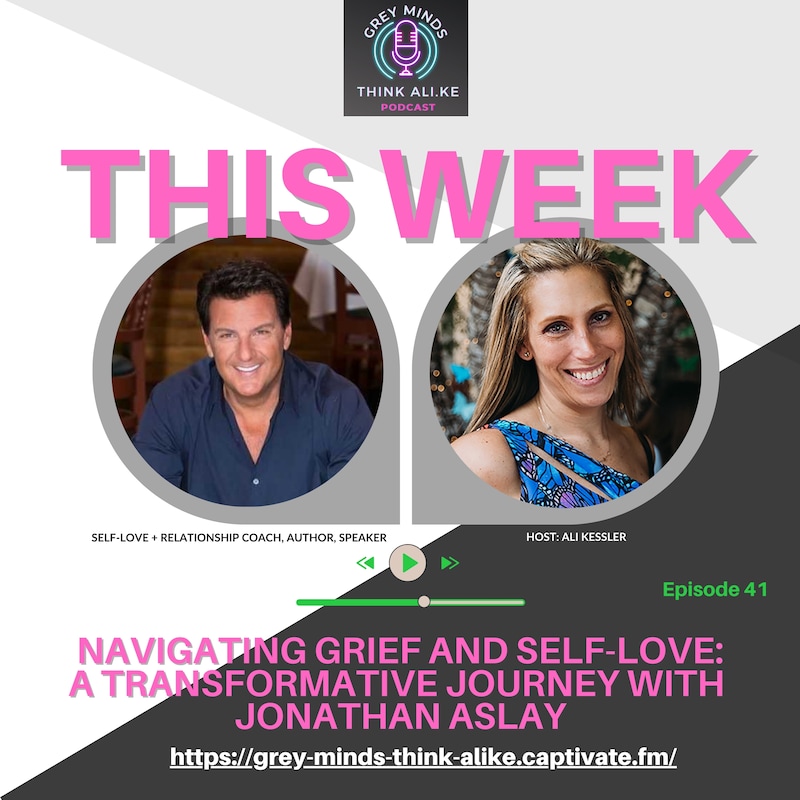
Shownotes
This is your go-to Podcast, where we help parents navigate the complexities of family life. Hosted by Ali Kessler of Greyson’s Choice, we’ll cover everything from understanding domestic violence to navigating the legal system, finding the right therapists, life hacks, family law, mental health, custody battles, and how to protect children in dangerous situations.
About Jonathon Aslay
Jonathon Aslay is one of America’s leading mid-life self-love and relationship coaches, an author, speaker, and thought leader dedicated to helping men and women build healthier relationships by first cultivating a deeper relationship with themselves.
After the devastating loss of his 19-year-old son, Connor, in 2018, Jonathon’s grief led him on a profound inner journey—one that expanded his work beyond dating and relationships into the essential practice of self-love, emotional healing, and personal empowerment. Through this experience, he became acutely aware of a common yet often overlooked issue facing many people seeking partnership: a deep lack of self-worth, self-regard, and self-love.
Today, Jonathon is on a mission to help people heal from heartbreak, divorce, and loss by understanding how relationships serve as powerful mirrors for growth. He is the author of What the Heck Is Self-Love Anyway?, a practical and engaging guide filled with spiritual insight and personal growth practices designed to help individuals reconnect with themselves and create more conscious, fulfilling relationships.
Jonathon’s work bridges grief, emotional health, and relationship wisdom—offering a compassionate, grounded approach to love that begins within.
Contact Jonathan: https://www.jonathonaslay.com/
About Ali Kessler
Ali Kessler is a writer, marketing professional, passionate parent advocate, and founder of Greyson’s Choice, a 501(c)(3) created to raise awareness about the risk of domestic abuse on children. Greyson’s Choice was founded by Ali Kessler in memory of her sweet, vibrant, and fearless 4.5-year-old son, Greyson, who was murdered by his biological father in a murder-suicide during an unsupervised, court-approved visit in Ft. Lauderdale, FL, in 2021. This came just hours after her petition for a domestic violence injunction was denied by a Broward County judge, citing that the “petitioner has failed to allege any overt acts by the respondent which would constitute domestic violence under Florida Statute.”
Ali’s advocacy efforts culminated in successfully passing Greyson’s Law during the 2023 legislative session. This bill now requires the court to consider threats against ex-partners or spouses when making child visitation and custody determinations in the court, expanding to include the following factors: evidence of domestic violence, whether a parent in the past or currently has reasonable cause to believe that they or a minor child is, or has been in imminent danger of becoming the victim of domestic/sexual violence by the other parent, even if no other legal action has been brought or is currently pending in court.
Contact Ali:
Transcripts
Jonathon Aslay Podcast
Ali Kessler: [:I'm honored to be joined by Jonathan Aslay, one of America's leading midlife self-love and relationship coaches, author of. What the heck is self-love anyway? And a father whose life was forever changed after the devastating loss of his 19-year-old son, Jonathan's grief led him inward into a profound exploration of love, worthiness, and emotional health, and ultimately reshaped how he understands relationships dating.
athan. Thank you so much for [:Jonathan Aslay: Thank for having me, Ali. I'm honored.
Ali Kessler: Absolutely. I read about you, and I think we have some things in common. Your work took a deeper meaning after the loss of your son. How did grief change the way you understand love, not just romantic love, but love of self itself and life?
Jonathan Aslay: It's interesting to share tech, answer that question.
I almost have to give a tiny little bit of a backstory to something do that prepared me for that. Because about 20 years ago after turning 40. I went, I turned 40. My now ex-wife asked for a divorce, and at the same time, I lost my high-end corporate job making a significant six figure income, and then the market crashed.
That wiped me out financially and for a period.
Ali Kessler: Period. So things were going well.
rough a significant identity [:And there's a difference between wanting to. End it versus not wanting the pain to go away. And it took me almost a half a decade to recognize that what was gonna take the pain to go away, or what I eventually chose was a deep dive into personal development, self-help, spiritual work and therapy to really rebuild to put emotional scaffolding in place so that by the time my son did pass away, I wasn't in a place where I could be devastated like that can happen to so many parents because I'd done so much inner work. And what that allowed me to do by the time he transitioned was to say, life can change on a dime. In his particular case, he woke up one morning and he was gone, a few hours later.
Ali Kessler: Was he sick?
Jonathan Aslay: No, it was a accident.
Ali Kessler: Okay.
point is it can change that [:And at the moment I had no idea what was coming outta my mouth. I was just saying, I do believe there's a, we can grieve without the pain or at least less pain, and I didn't know what that meant in the moment. I just said it, and it allowed me to explore that when we feel. More whole within ourselves on an emotional level when we feel self-worth, self-esteem, self-confidence, self-reliance, self-discipline, all these juicy self words.
I was like, okay, this love is the encapsulation of all this self-love. And I began writing my now book called, what the Heck Is Self-Love Anyway. Which is really just 30 plus blogs that I had written in the last year from a dating perspective, and I just tweaked it more from a personal development perspective.
And it's my deep [:And without looking in the mirror. And a self-examine life is the capacity to, it's like being at a play and you are the actor on the stage, but a self-examine life is the person in the audience watching everything. And that's what I'm here to encourage is that separation from what's going on to looking at oneself, one's actions, not from a victim, but from a victor place.
Ali Kessler: I don't know if you know a little bit about me, but I also lost my son. It was again, it happened just like that. Yeah, his father killed him in a court ordered supervision, timesharing, and one day I buckled him in the car seat and said, goodbye. I'll see you tomorrow at school. He was four and that was the last I ever saw him.
[:It's bitter. So it's hard to find that inner peace.
Jonathan Aslay: So it's interesting. I knew a little of your backstory, but I didn't know all the granular details. In my particular case, when I lost my identity, it was an opening to work on myself, and as I said earlier, it created emotional scaffolding for me.
hing that can happen to you, [:But we can also, why I said I grieved with love is because the one thing I know my son never would've wanted is to, for any of us to suffer. And so I choose that as my guiding light as my north star, if you will.
Ali Kessler: Right.
Jonathan Aslay: And
Ali Kessler: I do too. Yeah. Obviously I could have stayed in bed, I could have,
Jonathan Aslay: yeah.
Ali Kessler: Done all of those things, but I chose to fight. I actually got a law passed here in Florida called Greyson's Law, which is helping other families. Protect their children, and I started this nonprofit, which I do this podcast for. Yeah, you're
Jonathan Aslay: doing the podcast.
Ali Kessler: So I am doing my best to, yeah, continue his legacy and actually help others.
So his death wasn't in vain. So I guess that is a part of what Greyson and would've wanted, and this love.
Jonathan Aslay: I always think of Adam Walsh and what, I think back to that was like 30 or 40 years ago now, but what, think of how many, let's think of how many children are being saved because of your son's loss.
, I think that's a testament [:And in fact, I would say that in some ways it changed both of our trajectory in this area. So we can make a difference in people's lives anyway.
Ali Kessler: Yeah, absolutely. Obviously, this is not the path or the road that I ever would've chosen. Yeah, but this is what I was dealt. So you said relationships reveal a widespread emotional health issue, lack of self-worth.
Yeah. What do you think so many people, or why do you think so many people, especially after divorce or loss, struggle so deeply with self-love? Why is it so hard to love yourself?
and not suggesting that the [:So whether you had a childhood experience that you know and let me be clear, when I say childhood wound, many people think, abuse
Ali Kessler: that,
Jonathan Aslay: right. Physical, emotional, I'm talking garden variety, little fucked up shit that our parents did to us that didn't, they didn't mean to do. Yeah. But it has an emotional effect on us.
Ali Kessler: Absolutely.
Jonathan Aslay: Couple that with divorce, which is the unraveling of the tapestry of your life with another human being, many of us, I like that, operate from a dependent point of view,
Ali Kessler: right?
ns is we think, oh, the next [:Ali Kessler: right? Yeah.
Jonathan Aslay: And what happens is you realize that no it's about looking in the mirror to work on oneself.
And so dating trigger dating a relationships trigger. I believe the number one emotional health wound is, I'm not good enough. I'm not lovable. I'm not likable. This is my verbiage. I'm not saying this by any statistic.
Ali Kessler: I would say people have lower self-esteem after failure, which I guess what divorce is, maybe not personal failure, but.
End of a resolution of a marriage.
Jonathan Aslay: No. I'm glad you made that distinction because truthfully, some people look at it as a failure and it's just simply an ending.
There is gold if you decide to go mining for the gold and that is, what positive things did I learn about myself in this marriage?
What was good about the marriage? What was not so good about the marriage? What am how have I healed? There's some gold, if there's a self examination.
Ali Kessler: Especially because it opens the door for a new relationship that
Jonathan Aslay: Yeah.
Ali Kessler: Might be the right or the right one. The better choice.
Jonathan Aslay: Yeah. [:We're just looking for the next fix, and I think,
Ali Kessler: right.
Jonathan Aslay: Sadly, these little smartphone devices has created, this. Constant need for dopamine where yes, very few people really get the benefit of serotonin based love. We're just so addicted to dopamine based love,
Ali Kessler: right? That's what dating apps do, right?
You have like instant connection to people that you don't know. Are you for or against?
Jonathan Aslay: I met my beloved through a dating app, so I'm gonna be for it. I do believe most people enter into this is a great tool to meet people you wouldn't otherwise meet your daily life.
Ali Kessler: Sure.
Jonathan Aslay: But just like anything, the operator makes all the, makes the decisions.
here the disconnect with the [:Ali Kessler: oh, absolutely. I always said, 'cause I used to use them when I lived in New York, I used to say, unless someone's going to appear at my front door, I'll never meet them.
Because when I lived in New York City, I worked late and I came, went right home and I watched TV and I just, wouldn't have met people.
Jonathan Aslay: Were you actually in Manhattan? I
Ali Kessler: was, yes.
Jonathan Aslay: And it's interesting because of all the cities, you actually have a, it's
Ali Kessler: the
Jonathan Aslay: hardest an environment where you can actually physically be around people.
Yeah. People, when I live in Los Angeles
Ali Kessler: yeah.
Jonathan Aslay: I have to drive wherever I wanna go. It's not a walk, of all the cities, it's still one of the best places to be because of proximity. And yet look at how daunting and challenging it is.
Ali Kessler: It's actually harder to meet people in New York City, which is like you said, fascinating.
It's because one, there are so many options.
Jonathan Aslay: Yeah.
Ali Kessler: There are too many options that when you meet someone online, they already have four other meet meetups that, yeah. Scheduled that same day. So you're just one of many and it's just.
Jonathan Aslay: So [:So I'm in a significant relationship actually at the end of this week that we're recording this. We're moving in together, and we've been together for not quite a year yet.
Ali Kessler: Congrats.
Jonathan Aslay: Our thank you. And our first telephone call, we ended up getting on the phone about an hour into the call.
We realized we had mutual friends, so we're like, oh my God, you're friends with them. And and I'm talking close friends, not, like some social media friends. And so we got together for a me I called the, I don't call, the first time you meet someone, A date. I call it a meeting.
Ali Kessler: Meeting.
Jonathan Aslay: Yeah. And I say that to take the pressure off of expectations. We had a five hour meeting. We had a great time, but there was no chemistry for both of us. And so two days later we were like, so what do you, she called me up what do you think, Jonathan? I'm like, I gotta be honest. I'm neutral.
[:I'm like. I really like you. And she goes, I really like you. And like I like you. Like the chemistry started to build and then we eventually met and we're now happily together. Most humans aren't familiar with calm connection. We're so indoctrinated that it has to be butterflies, it has to be excitement, it has to be skyrockets through fireworks.
Ali Kessler: Yeah. Sometimes it's your best friend that you realize, wow, I am in love with my best friend.
Jonathan Aslay: Yeah. And if two people are experiencing this is the best kind of relationships out there. Sure. And sadly, coming back to the New York environment, and by the way, I saw the movie The Materialists, and it really fascinated me the dynamics in New York, which, because I believe it to be relatively true.
g intellectual and emotional [:Ali Kessler: Absolutely. I, have been with my partner for six years now and I didn't meet him on a dating app, but it turns out that we're both from the same city, went to rival high schools. And I actually hired him to teach my son how to swim 'cause he was a swim in a swim instructor.
Jonathan Aslay: Yeah.
Ali Kessler: So I always say that Greyson brought us together.
Jonathan Aslay: Aw.
Ali Kessler: Yeah. Okay. So going back to all the fun stuff. So like dating after divorce, I know for a lot of people is hard, confusing or even like retraumatizing 'cause people don't wanna go through it again. Yeah. But what is the one thing that you think that, people should understand maybe about themselves?
Before they start dating
Jonathan Aslay: about my first reaction to that question is ideally have it be clean with your previous partner to some degree. Sure.
And in many cases that may not be clean, but I think it really is a benefit to, to be as clean as possible with your previous partner. But that's not always possible the case.
So to really, to [:Ali Kessler: I feel like everyone has all of that.
Jonathan Aslay: Yeah. And so your desire, your capacity, and your vision for a relationship has to exceed the fear, the pain, the fantasy, and the word capacity is the keystone in the that word capacity.
Most human beings have weak emotional maturity. Poor relationship skills and everybody that's hearing this is saying, but I'm the exception to what you just said, Jonathan, and I'm here to say everyone who thinks that you are the rule, not the exception. Most of us have a, again, poor emotional maturity and weak relationship skills.
unication skills, to improve [:Today's relationship almost requires ninja level skills and very few people are trained at this level.
Ali Kessler: Absolutely. It, it does take work. The benefits have to outweigh the work I guess you could say, which everyone, even the happiest of marriages. It's always a give and take.
Jonathan Aslay: It's interesting ' cause you brought up something work, i'm in full agreement. So given that most couples greatest challenge is genuine emotional intimacy I believe that one of the things on your checklist is look, once we start a, if we decide to explore a relationship together, then let's put personal development, counseling, therapy is part of our plan.
someone has resistance over [:Most people are so naive about it. They're so caught up in the fantasy of love that they're not prepared for the real challenges of conflict resolution, being there for one another. That's building real, genuine trust through right? Emotional safety.
Ali Kessler: So even if like we do the work for ourselves before a relationship, which is probably when you need to do it, and then you enter a relationship and that person has not done the work.
Yeah. How do you get them on board to maybe get that conflict resolution in play? Like maybe therapy or some sort of,
hip before they got married. [:He said, look, therapy is part of our process of getting to know one another. Do you have a problem with that? And she said, I love it. The same thing goes to a woman saying that to a guy if they have resistance to it. Then they probably lack open-mindedness, and now I got some bad news. For most people, eight outta 10 people will say no to it because they're naive.
Yeah, but trust me, you're rolling the dice with those eight people. Maybe you might, because open-mindedness is the most important thing. They may have never have done personal development, self-help, spiritual work or therapy, but if they're close-minded. That's gonna be, I guarantee you, you're rolling the dice with that person, right?
The open-minded person who's never done anything is at least the one that I would take the gamble with.
lot of inner work to do, and [:Jonathan Aslay: Do you remember earlier, Ali, when I said people are in victim consciousness? I would venture to say eight i, eight out of 10 people that are divorced blame their previous partner for the reason for the end of the marriage. Sure. And take no ownership on their part.
Ali Kessler: No accountability. Yep.
Jonathan Aslay: That's the fastest clue to recognize who's worth investing in.
Ali Kessler: Are there early warning signs that someone is in the wrong relationship? What should people pay attention to I guess early on?
Jonathan Aslay: That's a great question and I just was, someone just messaged me on social media and I was reflecting upon this.
So our body gives us so many clues, and I'm thinking back to a personal circumstance where prior to meeting my beloved. Briefly in a relationship and great first date. Lot of fun. But I woke up the next morning and for some reason I was just like, the know that was coming outta my body was like, clear.
And so I [:Ali Kessler: unconscious consciously or subconsciously,
Jonathan Aslay: I think it was subconscious, right? And then I realized, but this was the fascinating piece.
Ali Kessler: Right.
Jonathan Aslay: So then I went completely into damage control, going to the opposite of begging for forgiveness because I said something jackass.
So then I was trying to repair this subconscious. My body was telling me no. But I'm like okay. So then I went into repair mode and then we started to see each other. And for the brief time that we were together, which was about six weeks, my body was like. Constantly like a Pacheco ball. It was like all over the place.
I wasn't feeling calm. I wasn't feeling safe, and by the way, she did nothing wrong.
Ali Kessler: It
Jonathan Aslay: was, she did.
Ali Kessler: So you were just uneasy.
Jonathan Aslay: She, yeah. And what it was we were two people f we were like a frequency that was misaligned. She was like, I'm at AM 5 90 and she's at FM 10. Kind of thing.
ation was screaming to me. I [:We're misaligned. It's probably best that we don't move on, but we don't know how to listen to our intuition, our body, and usually our body. By the way I'm talking about here, right at this. This is speaking to us all the time, but we do a terrible job of listening. Our ego gets in the way, our hormones get in the way because we don't know how to operate logically in the, and that, by the way, that's where the first 90 days needs to be.
Be more in your head than your heart or your hormones. But we go straight to hormones and heart, and we bypass the logic that's screaming at us,
Ali Kessler: right. Now, do you believe in attachment styles? Because I used to study them because I was just so fascinated by how different people have different attachment styles.
e boy one's always the mouse [:Jonathan Aslay: I've studied attachment theory. I subscribe to a majority of it.
The challenge with it is that from, a lot of people don't really practice the tools necessary so if you're an anxious person and you're with an avoidant first off, avoidant people, rarely, like first off, they struggle with emotional intimacy. They're emotionally constipated. They're emotionally unavailable, so right off the bat, if they're not willing to examine their.
Part, you're already in trouble. That's the clue. So then now there's a great I
Ali Kessler: don't know if that avoidance know that they're avoidant.
Jonathan Aslay: Exactly. So then, and they, by the way, everybody who does the survey, they do the online test. Everybody is, I
Ali Kessler: did that test.
Jonathan Aslay: This is the fantasy because people project who they are.
the anxious person, anxious [:Ali Kessler: right? They know something's not right. So
Jonathan Aslay: if you have an avoidant who's actually aware that reads the books, that does the work, then an anxious and avoidant person can eventually build secure love.
Now, I don't believe the percent like I believe. I believe most of the authors of the primary books along the lines of attachment theory believe that 50% of the population is secure. I think that's a crock of shit. I
Ali Kessler: agree.
Jonathan Aslay: I think they are so misaligned because it's a self-examine tool anyway. You're like, you're not gonna get accuracy.
I believe most humans have a default of anxious or avoidant. Okay. And I'm not talking about the subclasses within the two. So really boils down to, do you grab the three primary books that have been written attached by Amir Levine, Rachel Heller. Wired for Love by Dr. Stantec and Learning Love by Vais Gibson.
Grab those three books and make that part of your dating process.
Ali Kessler: Yeah, I used to study them. I don't know if it helped.
y if two people are deciding [:You are, I guarantee your likelihood of success diminishes tenfold if this isn't part of your pro. Now, I'm not saying you won't have a successful relationship, but boy, if you wanna improve your odds, work on your work, on learn as shit, so you can be better at relationship.
Ali Kessler: Yeah, why wouldn't you wanna have the best life ever?
Jonathan Aslay: Wait. You just said say, why wouldn't you? Cause we humans are delusional. We are in fantasy. Remember I said fear, past hurts and fantasy. Most everybody, a lot of men just, okay, let me just be clear about men in general for the listen to this. Okay? By the way, can I curse? I already did, but
Ali Kessler: you can do whatever you want.
such fucking good leaders of [:Ladies, you're giving the job to the wrong person. Now, with that said, ladies, you require a big amount of self-responsibility too, because you always blame men for everything, right? And it takes two human, you're saying
Ali Kessler: they're driving us crazy.
Jonathan Aslay: Yeah. So you can already tell, I get amped up when I get into these parts of the conversation, so it's not obvious to people.
We were never trained this. Sure. Now my son has been indoctrinated this because I fed him all this stuff when he was, 14 years old and he's better prepared at 29 than my other son. And so he's. Radically aware man. Most people that are in are baby boomers and Gen Xers. They're still rather clueless and in fantasy.
Ali Kessler: Now, before I move on, I just have a quick question from my own knowledge. Did your son pass away and then you got divorced or were you getting a divorce first?
Jonathan Aslay: No, I got a divorce 20 years ago. Went through my identity crisis, then he passed away. Let's see, 13 years later.
Ali Kessler: So you were already divorced?
Jonathan Aslay: Yeah, I'd already been divorced and we
sler: Okay. I'm just curious [:Jonathan Aslay: it didn't. Actually the divorce, it took me about a half a decade to be more of a conscious father. I was going through a lot of emotional turmoil.
, he passed away in:Ali Kessler: yeah.
Jonathan Aslay: Allowed me to perfect communication skills. But no and honestly, and I'm grateful, my relationship with both my boys while tenuous for the first half of the divorce began improving, 10, 10 years in. And thankfully I have a really great relationship with my son
Ali Kessler: now. Yeah you're lucky that you had a lot of that foundation in yourself to, to deal with that grief.
[:Jonathan Aslay: yes,
Ali Kessler: my son's death. Totally. Which is a lot harder. But now
Jonathan Aslay: let's, the best man in his wedding also lost his, my best man in my wedding three years ago lost his son, and I've witnessed being a support person to him, and he found a spiritual path. He and his wife now found a spiritual path as their foundation for this.
Yes I was. Blessed in the sense that I had built a foundation emotionally beforehand, but I also look at, sadly, it takes humbling events for humans, right? To make a choice. It'd be great absolutely if we didn't have to be hit with a two by four or have a 9.0 earthquake happen in our lives.
But in many cases, sadly, for a lot of people, drugs, alcohol, and other outlets are their replacement. To the inner work, like what you're doing. And I, by the way, I suspect, what year did your son pass?
Ali Kessler::Jonathan Aslay: 2021. It's fascinating to me. I'm eight years ahead of you in this case. Seven and a half.
Sadly, find [:It's, I was gonna say, it's a blessing and a curse, but it's not a curse. It's a blessing to be able to be of support to other people in this regard. And I suspect for you, look at what you're doing, you changed a law in your state fucking that is just awesome.
Ali Kessler: Yeah. A law that would've. Kept my son alive.
Jonathan Aslay: Yeah.
Ali Kessler: Had it. And it was common sense. It's just common sense. That's what it takes tragedy to, for common sense to exist. It's insane,
eople's lives. Like you said [:Ali Kessler: Only for him, right?
Jonathan Aslay: Yeah.
Ali Kessler: It's really only for him. So let's talk about your book. So your book title asks the questions that people wonder, what the heck is self-love?
So how do you define self-love in a way that goes beyond bubble baths, affirmations, and, yeah. Staring in a mirror and just, giving a mantra, what is it?
Jonathan Aslay: That's a great question. 'cause a lot of people look at self-care, like bubble bath messages, that
Ali Kessler: is part of it for sure.
Jonathan Aslay: Self-care is a, is a part of it. In other words, certainly our body is a machine and one of the chapters is our body is a machine. And taking really good care of it versus the idolization of our body. As a temple, I look at it as a machine and we take good care of the machine. It's gonna last longer.
onor of my son, there's some [:There's a, a chapter in there. Don't let anyone F with your Chi because he had a, he had an interesting way of not letting other people's opinions of him bother him. So I gave, he's peppered throughout the book. There's a chapter, his name chapter, what's his name? Connor.
Ali Kessler: Connor.
Jonathan Aslay: And there's another chapter if it's sincere and from the heart.
You can't say the wrong thing to the right person. In other words, when you're coming from a heart-centered place and I, that's a particular chapter in the book that I encourage, particularly my female clientele. Many people are afraid to speak their truth to their partner for fear of abandonment.
And I'm here to say, your partner's, the person you can share your deepest, darkest fears and insecurities, if they're the right person, that they're not gonna run away, they're going to embrace it even deeper. So there's, that's the way the book is laid out. And let me just say this, self-love to make it easier for those people that resist the word self-love.
, all these juicy self words [:Ali Kessler: you. It's like from live, I'm good enough, I'm smart enough, and up people like me,
Jonathan Aslay: And for the record for everyone listening, let me just say this. It's a de, it's a journey. It's not a destination buddy. It perfectly loves themselves. It's narrative. Even I used to talk about you have to love yourself to be a love another.
Ali Kessler: Yeah.
Jonathan Aslay: It's that you are loving yourself. It's not that you reach the destination that you're in the practice of it.
That's what matters now.
Ali Kessler: And you're not settling, you're listening to yourself. Also, I believe,
Jonathan Aslay: It's. Interesting. I just wrote a blog. I had to settle to fall in love, but I had to settle down, not settle. But the idea was to settle down.
Ali Kessler: Yeah. That's
Jonathan Aslay: different fantasy. I had to settle down the projections.
I had to settle all those down, settle the ego down, and really operate from a heart-centered place.
that was, tied to trauma or [:Jonathan Aslay: Yeah, that's a great question. So coming back to self-examination, if you do. Look at every part of it that you take ownership on your part of the ending. And now some people love to point the finger. I was with a narcissist, I was with an abusive person, I was with an alcoholic, all those things.
And I get that exists. But taking at least 3% ownership and making that 3%, a hundred percent, in other words, and what I mean to say is really take ownership on your part and then examine. What did I learn from this experience? Okay, now I'm calling the word relationship experience. Okay. What did I learn from this experience?
and really sit in gratitude [:They point the finger at the other person. They become jaded, bitter, tainted, angry, and they're living in that energy that is so dense.
Ali Kessler: Right.
Jonathan Aslay: That until that becomes the light of love,
Ali Kessler: right?
Jonathan Aslay: Yeah, you might get a new relationship, but I guarantee you it's gonna be a different version it's gonna be the same thing with a different head on it.
Ali Kessler: There are different phases of, like they say, there's different stages, different phases of grief. You have your angry or denial than yeah. Whatnot. And then the sixth one is making meaning. So I'm sure the same thing is true with. Relationships, when they end, you go through, you're angry and then calm down a little and then you go through, acceptance and things like that.
And it morphs into hopefully something more peaceful for both sides.
Jonathan Aslay: It's interesting, you would think you, and I know this by heart, but for whatever reason I think it's denial, bargaining, anger. I think depression is in there with grief,
Ali Kessler: right?
Jonathan Aslay: And
Ali Kessler: [:Jonathan Aslay: I think acceptance, being in there.
Ali Kessler: And then making meaning and,
Jonathan Aslay: and, yeah. Yeah. Making meanings. The sooner people arrive to acceptance and making meaning is when you're preparing yourself for the capacity to be in a new relationship. Otherwise, what's the definition? Sanity, which most people do, they do the same thing over and over again expecting, oh, somehow magic fairy dust is gonna change.
Change the results. Yeah. And magic fairy dust doesn't exist, folks.
Ali Kessler: No. And a lot of this happens, for generational, right? You see your, what your parents do or how they handled certain, relationships and their capacity of love and how you were raised. I that sort of goes down to you and then you pass it to your children.
So how does modeling self-love impact our children's emotional health and future relationships, their future marriages?
Jonathan Aslay: It's interesting. For the last two weeks I've been binge watching the show Mad Men.
Ali Kessler: I just finished it yesterday for the second
Jonathan Aslay: time. Okay. I just finished it three days ago, so there's some irony here.
Ali Kessler: Yeah. Amazing.
g about that show, which was [:Ali Kessler: 2005, I think.
's interesting is said in the:Ali Kessler: I was born in New York. I grew up in New York,
Jonathan Aslay: But for those that grew up in, Dallas, Alabama, the Midwest and that sort of thing, probably at a slightly different, but the point, coming back to generational trauma, there's an interesting through line for the parents in the show of what they experienced growing up and how they passed it on to their children.
And those children became us. I was just having this conversation with my beloved, literally an hour before we began recording, and I was talking about how I really didn't have a relationship with my father, and we were talking about a scene in the show where the father takes his son to the movies. Yeah, I had a kind of quasi relationship.
My [:Ali Kessler: So do you think Sally's just fucked
Jonathan Aslay: who?
Ali Kessler: Sally Draper.
Jonathan Aslay: It's interesting because I talk about, she's gonna be a chick that has daddy issues, like up the ying. Yeah. And she's going to be, so she will be roughly about 60. Seven years old right now, 68 years old in today's timeline. And I guarantee you she's had a string of men in her life, maybe possibly a marriage in there.
And I don't wanna spoil the show, but at least at the end he does some work on himself. That's
Ali Kessler: yes.
Jonathan Aslay: An interesting,
Ali Kessler: yeah, this is the second time I watched it and I completely forgo. I watched it when it was on real time and Okay. I knew I loved it. I actually worked at Grey Advertising and I'm in advertising.
st, it reaff, reaffirmed how [:Jonathan Aslay: Yeah.
Ali Kessler: And yes, the relationships, between them all and, and just the generation is.
Jonathan Aslay: So for those listening to this right now who have never seen The Mad Men series, it's Seven Seasons, but Why I recommend it and there's another show I wanna recommend that's contemporary.
What's interesting, which I'll say share it in a second. 'cause I wanna tell this to everybody. Again, what Ali and I are talking about is the human behavior and the emotional development of the characters and to really sit with it from an objective point of view, not making him out to be the bad person because he's a philander and all that sort of thing.
What's an interesting characterization today is the show. Nobody wants this on Netflix,
Ali Kessler: which I watched as well.
Jonathan Aslay: With Adam Brody and Kristen Bell and what's interesting about that and why I'm bringing this up is they are role modeling, healthy communication, right? They're role modeling friendship.
episodes, and she's I'm not [:What we need more role models like the show. Nobody wants this, but we need it in real time. Sure. And so I'm gonna be sharing this with your audience right now, but my beloved and I beginning next, in the next two months we're gonna sit on camera. She's gonna join me on my YouTube channel.
I've been doing YouTube for a decade now, and blessed to have a couple hundred thousand subscribers. But I'm bringing her on and I was just talking to her about it today because I wanna. What we don't have is good role models. We have some good role models like the Gottman's or Gay and Katherine Hendricks, just to name a few, but to really role model relationship communication skills and I want everyone to who's listening right now.
when we are able to express [:I think that's gonna change once there's more role models demonstrating healthy communication.
Ali Kessler: Sure.
Jonathan Aslay: And we're still in the infancy of this, but I wanna be a leader in this area.
Ali Kessler: Absolutely. I love that show too, for many reasons. One, I'm Jewish and I've, dated non-Jews and it's, yeah.
Always a thing. Which also brings a point where I don't know how realistic it is because I have never met a rabbi that would date a non-Jewish girl. But I'm happy it exists.
Jonathan Aslay: It'd be interesting how they evolve the characters, right? I think, again, this is TV and it's right.
Ali Kessler: Both the first and second seasons had the same, it leaves you with the same ending is this gonna work?
it's a great, but it really [:Ali Kessler: And
Jonathan Aslay: what, thankfully, what you don't see in, nobody wants this.
Unlike Mad Men, you saw fighting. You saw argumentative behavior, which gets us nowhere with nobody wants this. Disagreements,
Ali Kessler: right?
Jonathan Aslay: That they evolve the communication to work around. Now, they might have an irreconcilable difference in the show that might be. That was a good move, might be a deal breaker for them.
I don't, I think they'll find a way to make it work, which isn't as realistic, but at least we're moving in the right direction.
Ali Kessler: Yeah.
Jonathan Aslay: About healthy communication skills and if nothing else, yeah.
Ali Kessler: You can actually see the evolution through Mad Men too today. Present day, and just, the. The times have changed.
Right?
Jonathan Aslay: Yeah. It's interesting how I, I was, I binge watch about six months ago, friends and thinking about the evolution of television over the years from that friends or Mad Men to today,
Ali Kessler: right?
I love, nobody wants this as [:As much as I can't stand reality tv, I like some of the principle ideas in the show. Love is Blind. Okay. And let me explain why.
Ali Kessler: A couple seasons, huh? I watched a couple seasons
Jonathan Aslay: of it. Okay. And why I'm bringing this up is it's an interesting experiment that you're in a silo together for at least two weeks.
Ali Kessler: Yeah.
Jonathan Aslay: And you're fully d committed to the exploration,
Ali Kessler: and conversation of conversation.
Jonathan Aslay: Exactly what Now again, these are a lot of wannabe influencers that end up on the show, and they're not really, I'd like to see more of an elder demographic golden Bachelor. Golden Bachelorette.
either should or get off the [:Ali Kessler: right?
Jonathan Aslay: I am here to promote a more, I don't, not that you fail fast isn't the goal. But boy, if you're gonna fail, do it as quick as possible then versus don't waste prolong, don't waste. Yeah. And today's dating is really just friends with benefits and nobody knows it. That's what dating has turned into.
It's
Ali Kessler: turned. No, I agree. When I did internet dating, I would know instantly if I had a connection or not, and I wouldn't even dabble in a further text or email because I was like, I don't even wanna waste anyone's time. I just, yes,
Jonathan Aslay: but I'm gonna make an argument. If I'd followed that, I need an connection, I would've missed out on the most amazing relationship in my life because what we, what I didn't pay attention to was.
We had intellectual chemistry, we had emotional chemistry, we had spiritual chemistry. I just got caught up in the whole fantasy about the physical part and we have the best sex we've ever had. We both profess the most amazing physical relationship with one another because we developed those other three areas first.
e I know we have to wrap up. [:Jonathan Aslay: Okay.
Ali Kessler: They were showing clips throughout the show, and what I just love about that show is how realistic their arguments were and between Ray and his wife Deborah and the, the parents, the in-laws, the brother, the family dynamics.
Jonathan Aslay: Yeah.
Ali Kessler: Everything in it was just so real and raw that even if they fought, the TV couple fought, on the show there was real love behind it. Even though this is a scripted show, obviously.
Jonathan Aslay: Yeah, sure.
Ali Kessler: But it's just, it's yeah, it was really funny. Really great
ect clone and it's gonna be, [:So go in knowing that your relationships are gonna have potholes. You have a choice. Do you wanna navigate those potholes before you jump on the bandwagon of fantasy? Or are you gonna say, Hey, look, I know they exist. Let's be grownups about this and let's have people in our lives that can, we can turn to, to help us navigate this stuff.
And that's why I admire Lewis House for being so prolific about it, sharing with his audience. He wanted to build the connection before the physical part, and not that, by the way, not that you need to do that. Everybody's on their own journey, but boy, when you go in more aware, your feet are on the ground a lot more.
I
Ali Kessler: 100% agree Now. Just to wrap up, do you love yourself?
. And at the same time, I do [:Farther along now than I was 20 years ago that I can tell you. But I'm not at the destination yet. I figure, I think I'll figure that out about seven seconds before I transition to my next evolution.
Ali Kessler: Yeah, everyone, I guess is always a work in progress. We were never. At our truly best, right?
I'm better today than I was yesterday. Hopefully.
Jonathan Aslay: Hopefully. But the fact that you can ask that question of me and I can actually examine it from not just a logical point of view, but from an emotional point of view, I think that's the invitation for everybody is that. Is really is to look at I'm really a big proponent of a self-examine life on an emotional level and revel in the, it's so funny I said this to my beloved today.
I revel in my dysfunctionality and what I mean to say is my fears, my insecurities, the parts of me that I'm like, oh my God, why are you going there? And I revel in it.
Ali Kessler: Yeah.
Jonathan Aslay: From a place of curiosity, not
Ali Kessler: my worst qualities are probably my best qualities.
Jonathan Aslay: [:Ali Kessler: I agree. Thank you so much.
I really enjoyed our conversation. Yeah. And having you on, and, these are topics that really can, every, can go into any kind of relationship or, situation, because
Jonathan Aslay: Absolutely.
Ali Kessler: All in all, we all need to work on ourselves before anything that we, come to in life.
Absolutely. I, yeah, I look forward to chatting again.
Jonathan Aslay: Thank you, Ali. I've been honored to be on your show.
Ali Kessler: Sounds good. I'll talk soon.
Jonathan Aslay: Bye now.
Ali Kessler: Alright.

