Shownotes
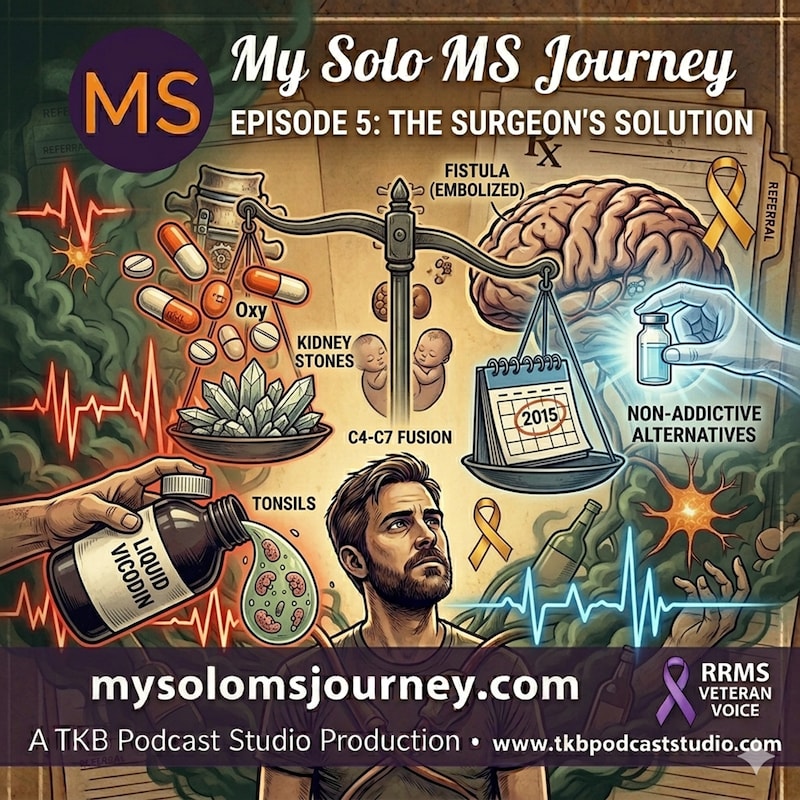
How do you manage debilitating pain without waking hereditary demons? In Episode 5, we enter the core of "History" (2014–2021) and explore the chemical reality of clearing numerous medical hurdles. While still without an official Multiple Sclerosis diagnosis, the sheer volume of surgeries meant that Oxy, liquid Vicodin, and anti-vertigo medications became the new norm. [Your Name] candidly shares the internal battle of relying on these powerful opioids while navigating a family history riddled with addiction.
In This Episode:
- The Surgical Sequence: Tracing the timeline from carpal tunnel and kidney stones in 2014, through tonsil removal in 2016, a neck fusion in 2017, and brain fistula surgery in 2018.
- The Pain Management Toolbelt: A transparent look at using Oxy and liquid Vicodin while also managing severe post-brain surgery vertigo.
- Fighting hereditary demons: The immense mental strain of using highly addictive medications while holding a decade of sobriety against a family history of addiction.
What I Would Tell My Younger Self Now
"I’d sit that younger version of me down—the one looking at that bottle of Oxy with a mixture of relief and absolute terror—and I’d tell him: Use your mouth before you use your hand.
I know you think you have to suffer through the physical pain, but the mental battle is just as critical. You have to communicate with your providers about your addiction history. Do not take it for granted. Demand a clear, shared taper plan before the first pill is even popped. Be relentless about asking for non-addictive alternatives first. The surgeons are experts in physical repair, but you are the only expert on your history of resilience. Make them a partner in protecting your sobriety, not just repairing your bones."
This episode includes personal discussion of chronic illness, mental health, medical treatment, and the lived experience of multiple sclerosis. Listener discretion is advised.
Website: www.mysolomsjourney.com
Email Updates: Subscribe on the site to follow the journey
Produced by: TKB Podcast Studio
Thank you for listening to My Solo MS Journey. This is a deeply personal documentary of Timothy Brien's journey with Relapsing Remitting MS. The views expressed are Timothy's alone and are not meant as medical advice. This production is made possible by TKB Podcast Studio, where we help you lead through the noise with quiet professionalism. For more information on TKB Podcast Studio, go to www.tkbpodcaststudio.com to discover what we can do for you.
Transcripts
All right, welcome back.
Speaker A:We are deep in the history era right now.
Speaker A:The gauntlet era, as sometimes I refer to it as now.
Speaker A:In the last episode, we talked about surgeries, and today we're going to talk about what made getting through them physically possible but mentally terrifying.
Speaker A:The medication.
Speaker A:This is 242 to 20 21.
Speaker A:So I want to start it off by saying that the surgeons did their jobs pretty well for the most part, but surgical success often comes with chemical reliance, and that timeline was relentless.
Speaker A: ou remember, back in February: Speaker A:By September, 3, kidney stones.
Speaker A: February: Speaker A:And with that, I was given liquid Vicodin.
Speaker A: ,: Speaker A:Happy Halloween.
Speaker A:I dressed up as a patient that day, and I had my neck fusion, which meant a steady course of oxy.
Speaker A: And finally, the May: Speaker A:And the surgeon that did that said that there's no way what I did would cause you to have vertigo.
Speaker A:And I wasn't being accusatory towards him.
Speaker A:I was just saying this is what I'm experiencing.
Speaker A:And that's something that with ms, you really need to keep track of every symptom, because what may feel like something may be the key to you getting your diagnosis.
Speaker A:Now, once you have your diagnosis, does that mean it's all, you know, cookies and cream and all that kind of jazz?
Speaker A:No, it just means that you now have a diagnosis and they can start treating for that diagnosis.
Speaker A:Through all of this, I still did not have a diagnosis.
Speaker A:We're not at the diagnosis phase yet.
Speaker A:That will come in upcoming episodes.
Speaker A:We're still trying to figure out what the hell is wrong with Tim.
Speaker A:So I'm on oxy.
Speaker A:I'm on liquid Vicodin.
Speaker A:I'm still taking the niacin for the neuropathy in my hands and feet.
Speaker A:And I even, you know, get the wonderful diagnosis of diabetes.
Speaker A:Yay.
Speaker A:No wonder I had diabetes, because I'm trying to, you know, fight all these surgeries, trying to say, hey, you're doing a good job, Tim.
Speaker A:Let's do an mri.
Speaker A:And then afterwards, let's go grab some ice cream.
Speaker A:And having a more sedentary lifestyle because I was commuting back and forth between Fredericksburg and D.C. every day.
Speaker A:My days would start at 4am and I would not get back home until 7 or 8pm Monday through Friday.
Speaker A:And then having twins.
Speaker A:Now, for those of you that have kids, you know, that, you know, those first couple of years are you're not going to get any sleep.
Speaker A:And not only was I not getting sleep, but I'm working 40 hours a week, I'm commuting two hours each way, so my days are pretty well stacked.
Speaker A:And luckily my wife is going into sainthood, even though she's agnostic, I'm putting her in for sainthood, definitely, for sure on that.
Speaker A:So there's something that you need to understand about my family history.
Speaker A:My mom and dad, alcoholics.
Speaker A:Grandpa, grandma on dad's side, alcoholic.
Speaker A:Grandpa on mom's side, alcoholic.
Speaker A:So you're dealing with oxy, you're dealing with Vicodin, which are highly addictive substances.
Speaker A:Highly addictive.
Speaker A:And you're feeding that to me like candy.
Speaker A:And I'm not angry at the surgeons and the physicians.
Speaker A:They needed to do what they needed to do.
Speaker A:And I wasn't being 100% truthful with them because that's what you learn when you're in a family that is consumed with addiction.
Speaker A: Now, I had quit drinking in: Speaker A:So we quit together.
Speaker A:She went to her program, I went to my program.
Speaker A:And this isn't a story about that, but these are all the things that are going on.
Speaker A:And my mental health, my mental strain, I was completely exhausted.
Speaker A:You know, I wasn't just recovering from surgeries.
Speaker A:I'm a new dad of twins, a stepson.
Speaker A: you know, not to screw up my: Speaker A:And the doctors were only looking at the physical pain.
Speaker A:Nobody was looking at the mental aspects of what I was going through.
Speaker A:I didn't know that there was groups out there that, support groups out there that were specifically for, you know, veterans with ms, men with ms, general population, you know, men and women with Ms.
Speaker A:I didn't know about those groups.
Speaker A:And I was already attending a sport group with Al Anon for the alcoholism and the addiction that occurred in my family.
Speaker A:So, yeah, it was an interesting time, Very interesting time.
Speaker A:And I know a few people that are listening to this podcast are going to be going, oh, that makes sense if you're one of those people.
Speaker A:Sorry I didn't tell you sooner, but I was going through that battle by myself.
Speaker A:And it was a difficult battle, and some days it still is a difficult battle to deal with, the mental exhaustion to deal with.
Speaker A:You know, other people are joking about going out for drinks, Cinco de Mayo, all that kind of stuff.
Speaker A:I can't and I won't, and I'm not jeopardizing that.
Speaker A:And I'm not going down that path.
Speaker A:You know, handling all of that without a diagnosis, without being able at that time to clinically say that I had Ms.
Speaker A:It's a lot of medical events that are happening.
Speaker A:Anytime you go in for surgery, you gotta.
Speaker A:Before you do that, you gotta go in and get blood work done, you gotta go get imaging done, and then afterwards, you gotta go get blood work done again and more imaging done again and rehabilitation and all of that.
Speaker A:And I'm not here to scare you.
Speaker A:This may not be your story.
Speaker A:You may just get that diagnosis of Ms. And beyond with your day, But I just want to give you a heads up that this is a possibility.
Speaker A:You know, when we're peeling that onion and covering, uncovering all those layers, that you may find other things that are wrong with you that need help.
Speaker A:And make sure that you have somebody in your corner, whether it be a family therapist, social worker, whatever.
Speaker A:Make sure you have somebody in your corner that you can sit and scream at.
Speaker A:Sometimes because you're going to want to scream, you're going to want to say, this is on freaking there why me?
Speaker A:And I did not take advantage of that.
Speaker A:So, you know, for my friends that are listening to this, I.
Speaker A:It's not your fault.
Speaker A:It's my fault.
Speaker A:I didn't take advantage of our friendship in a good way, not in a bad way, in a good way.
Speaker A:And I'll probably be apologizing for that till my dying breath.
Speaker A:And if you're just getting your diagnosis or if you're being checked out for your diagnosis, don't do what I did.
Speaker A:That's kind of what this whole podcast is about.
Speaker A:I did some good things.
Speaker A:I did some crappy things is one of the crappy things that I did.
Speaker A:I didn't reach out to the friends, to the network that I already had that were always asking me, what's going on, what can we do to help?
Speaker A:And I always, I'm fine.
Speaker A:I'm good.
Speaker A:No, thanks.
Speaker A:I'm good.
Speaker A:Use your friend network.
Speaker A:Use your network and be honest with the doctors.
Speaker A:If you have addiction in your family, you may want to try something besides oxy or Vicodin or, you know, any of the other opiates that are out there to calm your pain.
Speaker A:Find different therapies that you can use.
Speaker A:There are different therapies that are out there that are just effective, maybe even more effective, and seek those out.
Speaker A:So what would I tell my younger self that I know now?
Speaker A:I sit that guy down and you know, the guy that's looking at the oxy or the liquid Vicodin or all that with absolute Teller.
Speaker A:And I'll tell them, use your mouth before you use your hand.
Speaker A:You know, you may think that you have to suffer through all this physical pain, but the mental battle, that's just as critical to get help with.
Speaker A:You got to communicate with your providers about your addiction history, if you have any about your family history.
Speaker A:Don't take it for granted.
Speaker A:Demand a clear shared taper plan before the first pill is even popped.
Speaker A:Plan your exit before you enter.
Speaker A:Be relentless about asking for non addictive alternatives first.
Speaker A:The surgeons experts at repairing you physically, but you're the only expert on your history of resilience.
Speaker A:Make them a partner in protecting your sobriety if that's the path that you choose.
Speaker A:I'm not, you know, hey, I'm not a teetotaler here.
Speaker A:Not saying, you know, don't go out for a drink or a smoke or anything like that, but don't fall down, don't add to the problems.
Speaker A:Remember back in the military, you know, on a Friday they would say don't add the population, don't subtract from the population and don't get, you know, pulled over by the cops.
Speaker A:Same with you.
Speaker A:Don't add, don't subtract, don't get pulled over by the cops.
Speaker A:Make your doctors, make your physicians a partner protecting you, not just repairing your bones.
Speaker A:My name is Tim Bryan and this is my solo Ms.
Speaker A:Journey.
Speaker A:I want to thank you for listening because I'm tired of going through this journey by myself.
Speaker A:So you're already helping me out with that.
Speaker A:You can find all the episodes at the website mysolomsjourney.com and I'll talk with you soon.