Shownotes
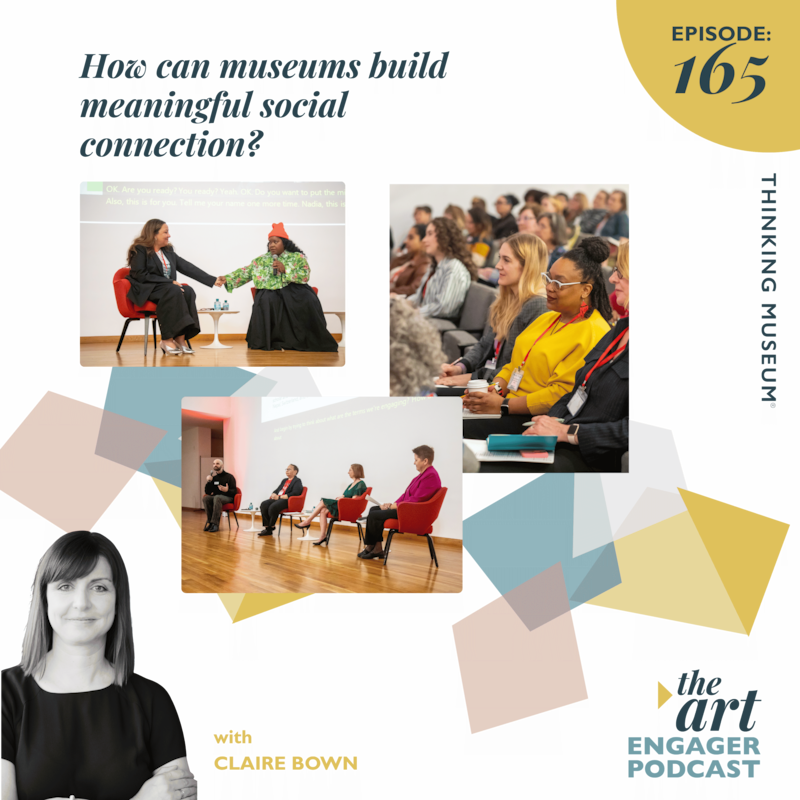
In March 2026, I travelled to Atlanta for the National Convening on Art and Social Connection, a two-day event hosted by the High Museum of Art. It brought together people from the arts, public health, research, aging, social services and policy to explore one big question: how can engagement with visual art help combat loneliness and build more connected communities?
In this special episode, I take you inside the convening and share what I heard, what I learned, and what I think it means for those of us working in museums and cultural spaces.
I carried three questions with me to Atlanta. What does it actually take to do this work well? How do we build the evidence that it works? And how do we make sure the wider world hears about it? Listen to the episode for where those questions led me.
The Art Engager is written and presented by Claire Bown. Editing is by Matt Jacobs and Claire Bown. Music by Richard Bown. Support on Patreon
Mentioned in this episode
The High Museum of Art: https://high.org
The Museums That Helped Power Atlanta’s Rise Are Still Pushing Ahead:
Oasis at the High Museum of Art: https://high.org/event-category/for-adults/oasis/
Art Story: How the High is Engaging Mindfulness with Art at Oasis: https://medium.com/high-museum-of-art/art-story-how-the-high-is-engaging-mindfulness-with-art-at-oasis-8b3592f5f876
Art After Loss at the High Museum of Art: https://high.org/art-after-loss/
Art After Loss: Creating Space for Grief, Connection, and Reflection: https://medium.com/high-museum-of-art/art-after-loss-creating-space-for-grief-connection-and-reflection-7ab2a1113643
TimeSlips: https://www.timeslips.org
Meet Me at MoMA: https://www.moma.org/visit/accessibility/meetme/
LSU Museum of Art: https://www.lsumoa.org
Two prompts to sit with
- For me, social connection looks like…
- One thing I can do next is…
Transcripts
Hello and welcome to The Art Engager podcast with me, Claire Bown.
Claire Bown:I'm here to share techniques and tools to help you engage with your audience
Claire Bown:and bring art objects and ideas to life.
Claire Bown:So let's dive into this week's show.
Claire Bown:Hello and welcome to a new episode of The Art Engager.
Claire Bown:I'm Claire Bown, and today's episode is a little different.
Claire Bown:So in March, 2026, I traveled to Atlanta, Georgia for the National
Claire Bown:Convening on Art and Social Connection organized by the High Museum of Art.
Claire Bown:This was a two day event, bringing together people from across the
Claire Bown:arts, public health research, aging, social services, and policy
Claire Bown:sectors to explore one big question.
Claire Bown:How can engagement with visual art help combat loneliness and
Claire Bown:build more connected communities?
Claire Bown:And if that sounds like a broad question, it is.
Claire Bown:But what struck me about this convening was how seriously and
Claire Bown:how practically it was tackled.
Claire Bown:There were researchers presenting data on the health risks of social isolation.
Claire Bown:There were practitioners sharing real programs with real participants and
Claire Bown:real evaluations, and there were honest conversations about funding, about
Claire Bown:sustainability, and about what it actually takes to do this work well.
Claire Bown:Now if you work in a museum, you'll know that conversations about social
Claire Bown:connection, wellbeing have been growing louder in recent years.
Claire Bown:More and more museums are developing programs that respond to loneliness,
Claire Bown:isolation, grief, aging, and so on.
Claire Bown:But there are harder questions underneath all of that.
Claire Bown:Like what does it actually take to do this work well, as something an organization
Claire Bown:commits to genuinely, something that IT resources and sustains and also how
Claire Bown:do we build the evidence that it works.
Claire Bown:Not just anecdotal evidence, which I'm sure we all have from
Claire Bown:our experiences, but rigorous evidence that stands up to scrutiny.
Claire Bown:And how do we make sure that the wider world actually hears about it.
Claire Bown:Because museums are doing remarkable things in this space, and too
Claire Bown:often it stays within our bubble.
Claire Bown:The health sector, policy makers, funders, and the wider public, they
Claire Bown:just don't get to know or hear about it.
Claire Bown:So these are questions I've been thinking about for a long time now, from doing
Claire Bown:this podcast for nearly five years, from running workshops, from talking to
Claire Bown:museum professionals all over the world.
Claire Bown:And in March, I took these questions with me to Atlanta.
Claire Bown:This convening gave me a lot to think about in response.
Claire Bown:So in this episode, I want to take you through what I heard, what I learned,
Claire Bown:and what I think it means for those of us working in museums and cultural spaces.
Claire Bown:We'll look at the scale of the problem.
Claire Bown:We'll hear from some of the speakers and panelists who were in the room, and we'll
Claire Bown:think about what it actually takes to do this work well, evidence it, and make
Claire Bown:sure the wider world hears all about it.
Claire Bown:So the National Convening on Art and Social Connection was organized by
Claire Bown:Laurel Humble, associate Director for lifelong learning and accessibility at
Claire Bown:the High Museum of Art and her team.
Claire Bown:The High was founded in 1905 and it's the largest art museum in
Claire Bown:the southeastern United States.
Claire Bown:It has built its reputation on being not just a collection of artworks,
Claire Bown:but a civic institution, a museum that takes its role in the community
Claire Bown:seriously, that reflects the diversity of Atlanta and that thinks of itself as
Claire Bown:a place for people, as much as for art.
Claire Bown:And that came through in everything I saw and heard during my time
Claire Bown:there from the staff I met, from the docents, the speakers who traveled
Claire Bown:in to take part in the convening and the visitors I met in the galleries.
Claire Bown:There's a real warmth to this place and a real commitment to the
Claire Bown:kind of community centered work that the convening was all about.
Claire Bown:So it felt like exactly the right setting.
Claire Bown:The convening opened with some welcome remarks from the High's
Claire Bown:director Rand Suffolk, who explained more about the work of the museum
Rand Suffolk:at the High Museum of Art.
Rand Suffolk:We believe our museums must play an active role in strengthening the social
Rand Suffolk:fabric of our communities and every day, as we strive to be among the leading
Rand Suffolk:visual arts institutions in the nation.
Rand Suffolk:It's our goal to be a place where both new and experienced museum visitors
Rand Suffolk:can discover opportunities for connection, inspiration, and meaning.
Claire Bown:And the High has been building this kind of work for the better
Claire Bown:part of a decade through their programs, their research, their partnerships.
Claire Bown:And we'll come back to some of this throughout this episode.
Claire Bown:But first, let's talk about what this convening was actually responding
Claire Bown:to; loneliness and social isolation.
Claire Bown:Now, we often use those terms together or interchangeably, but
Claire Bown:they're actually not the same thing, and the distinction really matters.
Claire Bown:Dr. Kathy Bruss, a clinical psychologist and the former mental health lead at
Claire Bown:the US Centers for Disease Control and Prevention, explained it really
Claire Bown:clearly to us during the convening.
Claire Bown:Have a listen.
Kathy Bruss:So social isolation is really about the lack of relationships
Kathy Bruss:and infrequent social contact activities or group memberships.
Kathy Bruss:So it could be somebody who lives alone, doesn't talk with friends
Kathy Bruss:or other people very much, or just doesn't have contact with people much.
Kathy Bruss:Isolation is associated with health risks, even if people don't feel lonely.
Kathy Bruss:So that comes up a lot where it's like, 'well, I'm not lonely, I'm fine'.
Kathy Bruss:But that makes a big difference.
Kathy Bruss:Isolation in and of itself is at health risk.
Kathy Bruss:Whereas loneliness is the feeling of being alone or disconnected from
Kathy Bruss:others, regardless of the amount of social contact someone has.
Kathy Bruss:So that's more subjective.
Kathy Bruss:So even a person with a lot of friends can feel lonely, and you
Kathy Bruss:can also feel really lonely in a crowd or in a group of friends.
Kathy Bruss:And loneliness also reflects the difference between how much
Kathy Bruss:social contact a person has and how much they would like to have.
Kathy Bruss:So it signals a deficit that something is missing, sort of like thirst or hunger.
Claire Bown:And the scale of what Kathy was describing is really significant.
Claire Bown:In his welcome, Rand shared some statistics that it's worth
Claire Bown:pausing on for a moment here.
Claire Bown:He said that 31% of young adults, aged 18 to 29 say they're always or often lonely.
Claire Bown:Over a third of adults aged 50 to 80 report a lack of companionship.
Claire Bown:And 45% of Atlanta residents report feeling lonely.
Claire Bown:That's about 5% higher than the US national average.
Claire Bown:And roughly 45% of Atlanta households are made up of just one person.
Claire Bown:And that's a factor that can really contribute to social isolation.
Claire Bown:And I'm not quoting these here as just abstract statistics and numbers.
Claire Bown:These reflect real people moving through real stages of life; from early
Claire Bown:adulthood to midlife and later life.
Claire Bown:And loneliness and social isolation can thread through a whole life in
Claire Bown:different ways at different times.
Claire Bown:And the health consequences are really significant too.
Claire Bown:So social isolation increases the risk of heart disease by 29%.
Claire Bown:Stroke by 32% and dementia by 50%.
Claire Bown:And as former US Surgeon General Vivek Murt hy has put it, loneliness
Claire Bown:is far more than just a bad feeling.
Claire Bown:It harms both individual and societal health.
Claire Bown:But here's the more hopeful side of all of this.
Claire Bown:There's a real and growing body of evidence that engagement with the arts
Claire Bown:is consistently linked with stronger social connection across cultures,
Claire Bown:across lifespan, across populations.
Claire Bown:So a UK survey of nearly 6,000 adults found that 82% perceive their arts
Claire Bown:engagement to be linked with social connection at least some of the time.
Claire Bown:A long-term study from Japan found that older adults who sustained
Claire Bown:arts engagement over three years experienced lower loneliness.
Claire Bown:And a major English study tracking adults over time found that frequent
Claire Bown:engagement with museums, galleries, and exhibitions was linked with reduced odds
Claire Bown:of loneliness over a 10 year period.
Claire Bown:So we know the scale of the problem, and we also know with real evidence
Claire Bown:behind it that what museums do helps.
Claire Bown:So the question isn't here whether museums can play a role.
Claire Bown:It's more like what that role should look like and what it
Claire Bown:actually takes to do this work well.
Claire Bown:On day one, we had a keynote from Vanessa German, and I have to be honest, this was
Claire Bown:unlike any keynote I've ever experienced.
Claire Bown:It was much more like an art performance.
Claire Bown:There was singing, there was poetry, there was real emotion in the room,
Claire Bown:and it set the tone beautifully for everything that followed.
Claire Bown:Now for those of you who don't know her work, Vanessa German is a self-taught
Claire Bown:artist based in Pittsburgh, and she describes herself as a citizen artist.
Claire Bown:She works across sculpture performance, communal ritual,
Claire Bown:installation, and photography.
Claire Bown:Her work is in collections all over the US, including the High's own collection,
Claire Bown:and if you'd like to get a sense of what she does, look up The Three
Claire Bown:Headed Girl from the High's collection.
Claire Bown:But what really came through in her keynote was the way her work has moved
Claire Bown:out of the studio and into the community.
Claire Bown:And she talked about lots of projects, but a particular one that
Claire Bown:she ran in her own neighborhood.
Claire Bown:This is, uh, Homewood in Pittsburgh.
Claire Bown:Um, and this project was called The Art House.
Claire Bown:Now Homewood is a low income area that has been deeply affected
Claire Bown:by poverty and gun violence.
Claire Bown:The Art house was a free, open community art space where children and adults could
Claire Bown:come and make art together, where the door was always open and anybody could walk
Claire Bown:in, and it was really a place where people could sit down with each other and create.
Claire Bown:And it was where, as Vanessa put it, adults would lose time where they'd
Claire Bown:start working on something and an hour and a half later look up and
Claire Bown:say, I forgot what this feels like.
Claire Bown:So her central question at the convening was this, how can art help people see
Claire Bown:and care for one another more deeply?
Claire Bown:And she said something during her keynote that I've thought about a lot since.
Claire Bown:Have a listen.
Claire Bown:Here's Vanessa speaking.
vanessa german:And I thought to myself, we got bars and churches on every corner,
vanessa german:but we've done so much research about the benefits of art, but we don't actually
vanessa german:live inside of the truth of that research.
vanessa german:I was like, there could be an art house on every corner.
vanessa german:Yeah, just when the doors open, you can come in.
Claire Bown:So she talks about having an art house on every
Claire Bown:corner, and I love that idea.
Claire Bown:And what Vanessa was really getting at, I think, is that creative
Claire Bown:practice doesn't have to be something that's separate from daily life.
Claire Bown:It doesn't have to be something you go to a gallery for on a special occasion.
Claire Bown:It can be embedded in the neighborhood, on the street, on
Claire Bown:the porch, part of how we live.
Claire Bown:Vanessa also talked about what she called the 'violence of separateness'.
Claire Bown:The idea that disconnection itself is a form of harm.
Claire Bown:And against that, she kept saying about 'returning to wholeness'.
Claire Bown:'We are whole.
Claire Bown:The whole time' she said, 'not broken, not in need of fixing', and
Claire Bown:one of the first places of social connection she said is internal.
Claire Bown:So connecting with yourself through creative practice, before
Claire Bown:you can connect with anyone else.
Claire Bown:Now that vision: art as part of how we live, raises a really practical question.
Claire Bown:How do you actually do this work?
Claire Bown:Not in a kind of abstract sense, but on the ground with
Claire Bown:real people year after year.
Claire Bown:And one person who's been thinking about exactly that for 30 years is Anne Basting.
Claire Bown:Now Anne is a an artist, scholar and professor of English at the University of
Claire Bown:Wisconsin Milwaukee, and she's the founder and president of TimeSlips, a nonprofit
Claire Bown:organization she started back in 1995.
Claire Bown:TimeSlips began as a response to the way people living with dementia were
Claire Bown:being engaged, or rather weren't being engaged, in care settings.
Claire Bown:And Anne's insight was that you could release people from the
Claire Bown:pressure of remembering and replace it with the freedom to imagine.
Claire Bown:So TimeSlips uses creative storytelling, often built around playful images
Claire Bown:and open-ended questions to invite people into shared meaning making.
Claire Bown:And today TimeSlips has over 900 certified facilitators across 48
Claire Bown:US states and 20 countries working in care communities, museums,
Claire Bown:libraries, senior centers and homes.
Claire Bown:And the way that this work is facilitated has three really simple steps.
Claire Bown:Ask a beautiful open-ended question, improvise with 'yes, and', accepting
Claire Bown:whatever the person offers and building on it and then offer
Claire Bown:proof of listening by echoing back, acknowledging what someone has shared.
Claire Bown:And I think if you are a facilitator, you'll recognize the shape of that cycle.
Claire Bown:It's the foundation of any good group conversation.
Claire Bown:Now, one of the other projects Anne shared at the convening was called the Penelope
Claire Bown:Project, and it ran in a long-term care community in Wisconsin over two years.
Claire Bown:And as an aside, Anne is a great believer in long time horizons.
Claire Bown:She works in multi-year projects because as she puts it, that's how long
Claire Bown:it takes for the 'yes, and' to grow.
Claire Bown:And the Penelope project used, uh, homers Odyssey as a starting point.
Claire Bown:Staff, students, artists and residents all working together over time to create
Claire Bown:a full scale theatrical production performed throughout their care home
Claire Bown:residents played roles, they wrote material, you know, they were the
Claire Bown:project, not the audience for it.
Claire Bown:And here's Anne talking about the responses to that project in her talk.
Anne Basting:My favorite response, uh, with a woman who lived in
Anne Basting:the nursing home, 'did you enjoy participating in Penelope?'
Anne Basting:'Oh, yes.
Anne Basting:It's the last important thing I'll do', and it makes you realize
Anne Basting:what opportunities for important things are we giving people.
Anne Basting:Or are we just giving them bingo?
Anne Basting:How can we mobilize the social capital and legacy potential of
Anne Basting:all of the systems that we work in to create something meaningful for
Anne Basting:people to do, with their lives?
Claire Bown:Anne also shared what she called her gleanings from
Claire Bown:this work, the principles that have shaped how she approaches it.
Claire Bown:And I think these are really useful things to remember for us as we
Claire Bown:think about what this work could look like at its best in museums.
Claire Bown:So firstly, she said, be unified by a slightly impossible goal,
Claire Bown:something that no single organization can accomplish on its own.
Claire Bown:Something that demands collaboration, that demands you, bring others in.
Claire Bown:Secondly, she said, we need to hold uncertainty.
Claire Bown:So start a project without knowing exactly what it's gonna be and let
Claire Bown:it become what it needs to become.
Claire Bown:Next was to create ongoing entry points because the people you're
Claire Bown:working with may not be ready to join right at the beginning.
Claire Bown:And trust takes time to build.
Claire Bown:And the fourth is to recognize and build on existing strengths.
Claire Bown:So to look at the people and the assets that are already in the room,
Claire Bown:rather than starting from a deficit.
Claire Bown:So those four things I think are really useful.
Claire Bown:So moving on from this, what does this work actually look like in practice?
Claire Bown:So, across the convening, I heard about a lot of programs from
Claire Bown:museums and arts organizations who were responding to loneliness and
Claire Bown:social isolation in different ways.
Claire Bown:And here are a few that stayed with me.
Claire Bown:So the first is Meet Me at MoMA.
Claire Bown:You may have heard of it before.
Claire Bown:It's a program for people living with Alzheimer's disease and their caregivers.
Claire Bown:It was launched in 2006 and it's just celebrated its 20th anniversary and
Claire Bown:it's reach has been remarkable between.
Claire Bown:2007, 2014 through the wider MoMA Alzheimer's project, moMA staff reached
Claire Bown:over 10,500 colleagues around the world through training, workshops, conference
Claire Bown:presentations, and resources for museums, wanting to develop their own programs.
Claire Bown:And they evaluated it in 2008.
Claire Bown:And they found statistically significant improvements in mood for both people
Claire Bown:with Alzheimer's and their care partners.
Claire Bown:So 20 years on, that's the kind of longtime horizon Anne
Claire Bown:Basting was talking about.
Claire Bown:And what Lara Schweller shared at the convening was where
Claire Bown:the program is going next.
Claire Bown:And they're designing a newer strand designed specifically
Claire Bown:for caregivers themselves.
Claire Bown:The second program is Oasis at the High Museum of Art.
Claire Bown:It's a monthly program and it weaves together art, spirituality,
Claire Bown:conversation, and mindfulness.
Claire Bown:And I was very lucky.
Claire Bown:I got to experience it for myself.
Claire Bown:It was on the day after the convening.
Claire Bown:Um, I saw yoga in the atrium, I took part in sound baths in the galleries
Claire Bown:there was mindful art making and there was also a wonderful strand called
Claire Bown:'Seeing with Spirit', which is a one hour conversation with a single artwork.
Claire Bown:And you look at it through the lens of someone's spiritual practice.
Claire Bown:So each month they invite a different person, whether that's, you know, a
Claire Bown:Baptist preacher or a Buddhist teacher, and that person walks through the museum
Claire Bown:chooses of work of art, and then they create and build a conversation around it.
Claire Bown:And on that day I experienced Oasis.
Claire Bown:The museum was just buzzing.
Claire Bown:It was full of people all ages, engaging with the galleries, with the art, and
Claire Bown:with each other in so many different ways.
Claire Bown:And it was so good to see.
Claire Bown:And I think this is what a museum can be when social connection is built
Claire Bown:into the way it opens its doors.
Claire Bown:The third program is Art After Loss, which is also at the High.
Claire Bown:And this is a four week program for people who have experienced bereavement.
Claire Bown:It's run by specially trained facilitators, museum educators,
Claire Bown:not grief counselors, and they are using art as a way to gather around
Claire Bown:something that isn't the grief itself.
Claire Bown:Now I'll come back to Art After Loss because there's some really
Claire Bown:interesting evaluation evidence for it.
Claire Bown:And the fourth one was Writing as Seeing at the Louisiana State
Claire Bown:University Museum of Art in Baton Rouge.
Claire Bown:And Callie Smith talked about a series of poetry workshops designed
Claire Bown:and led in three different settings.
Claire Bown:One was a bereavement camp for teens.
Claire Bown:One was a men's prison and one was a professional development
Claire Bown:day for school art teachers.
Claire Bown:And I think what Cali showed was that impactful art experiences
Claire Bown:really don't need to be elaborate.
Claire Bown:Sometimes it's just printer paper and a few colored pencils, and a
Claire Bown:willingness to sit with people in places where art doesn't usually go.
Claire Bown:So four programs, four very different shapes, and that's really only a
Claire Bown:small slice of what's out there.
Claire Bown:And it brings me to our next question, which is how do we
Claire Bown:actually know this work is working?
Claire Bown:So let's return to the Art After Loss program.
Claire Bown:So the High recently commissioned a formal evaluation of this program.
Claire Bown:It was carried out by the Georgia Health Policy Center at Georgia State
Claire Bown:University, and they use a validated research tool to measure changes in
Claire Bown:participant's sense of connection.
Claire Bown:And that means connection to themselves, to others, and to the world.
Claire Bown:And they measured it before and after the program.
Claire Bown:And they combined that with qualitative interviews.
Claire Bown:So they had both the numbers and the stories behind them.
Claire Bown:And what the evaluation found was significant.
Claire Bown:So participants reported meaningful increases in their sense of connectedness
Claire Bown:across all three dimensions.
Claire Bown:And one of the insights that came in through the qualitative findings
Claire Bown:was that what brought participants together wasn't the grief itself.
Claire Bown:It was the art.
Claire Bown:It was looking closely at artworks together, with a skilled
Claire Bown:facilitator, gave them something to focus on that wasn't their loss.
Claire Bown:And paradoxically created the conditions for the most
Claire Bown:meaningful connections to happen.
Claire Bown:And in addition, under a new head of research, that's Julia Forbes,
Claire Bown:the High are building research into the fabric of the organization.
Claire Bown:And during one of the breakout sessions, I heard about a major
Claire Bown:project measuring visitor wellbeing across three different programs.
Claire Bown:So they're measuring, Oasis, which we've just talked about, their free entry Access
Claire Bown:for All Days for older adults and their UPS Second Sunday, which is for families.
Claire Bown:And this research is using a framework built on John Falk's categories of museum
Claire Bown:value, that's physical, intellectual, social, and emotional wellbeing.
Claire Bown:And they added a fifth category of spiritual wellbeing.
Claire Bown:So they're using Garmin watches to measure physical wellbeing during visits.
Claire Bown:They're doing surveys and interviews for the social and emotional dimensions.
Claire Bown:And for spiritual wellbeing they're using participatory photography,
Claire Bown:inviting visitors to photograph moments of awe in the galleries.
Claire Bown:And the findings excitingly will be published in a peer
Claire Bown:review journal in May 20 26.
Claire Bown:And what this means is the High isn't just doing the work, it's actually generating
Claire Bown:knowledge that other museums can use.
Claire Bown:And this really matters.
Claire Bown:Because I think one of the hardest things about this kind of work, it's that so much
Claire Bown:of it happens in silos or under the radar.
Claire Bown:Organizations develop programs, they run them well, they get good feedback
Claire Bown:from participants, and then the learning stays inside the building.
Claire Bown:But this work opens the conversation up.
Claire Bown:And I think this matters enormously.
Claire Bown:I think one of the hardest questions facing museums doing this work is how
Claire Bown:to make the case for it to funders, to policy makers, to the health sector.
Claire Bown:And without evidence, it's just a story.
Claire Bown:With evidence, it's a contribution to a much bigger conversation.
Claire Bown:So let's come back to the three questions I carried with me to this convening.
Claire Bown:What does it actually take to do this work well?
Claire Bown:How do we build the evidence that it works and how do we get the
Claire Bown:wider world to hear about it?
Claire Bown:So here's what I've come to think.
Claire Bown:Those three questions aren't separate questions.
Claire Bown:They're all really kind of pointing at the same thing, and that's not
Claire Bown:a program or a project or you know, some kind of commitment on paper.
Claire Bown:It's culture.
Claire Bown:So the museums that are doing this work best have built a culture around it.
Claire Bown:A culture where social connection and wellbeing aren't side projects that
Claire Bown:the learning team runs when there's funding, they're really part of how the
Claire Bown:organization understands its own purpose.
Claire Bown:So this is a culture where the director speaks about this work in the same breath
Claire Bown:as exhibitions and collections, a culture where research and evaluation are built in
Claire Bown:from the start, not bolted on at the end.
Claire Bown:And it's a culture where programs are allowed to run
Claire Bown:for years, not just seasons.
Claire Bown:And finally, it's a culture where staff, docents facilitators and visitors all
Claire Bown:feel that this is what the museum is for.
Claire Bown:And I don't think you can fake a culture like that, and
Claire Bown:you definitely can't rush it.
Claire Bown:At the High it's taken roughly a decade of consistent patient
Claire Bown:building, and that's a really honest timeframe for this kind of work.
Claire Bown:And it's worth spelling out because it really sets realistic expectations for
Claire Bown:anyone wanting to do something similar.
Claire Bown:And of course none of this is simple.
Claire Bown:Cultures don't change overnight and they don't change because just one
Claire Bown:person or one team wants them to.
Claire Bown:But there are questions here worth sitting with wherever
Claire Bown:you are in your organization.
Claire Bown:So think about this.
Claire Bown:Is this work visible in your institution's values, strategy, and language, or does
Claire Bown:it mostly live inside one department?
Claire Bown:How widely is it talked about?
Claire Bown:And by whom?
Claire Bown:Are the programs you run funded as short term projects, or are
Claire Bown:they built as ongoing commitments?
Claire Bown:And are you building evaluation in from the start?
Claire Bown:And when you talk about this work with people outside the museum, with funders,
Claire Bown:with health partners, with policy makers, what do you have to show them?
Claire Bown:And I think if you're wanting to start building that culture in your own context,
Claire Bown:here are a few simple things worth holding onto from what I heard at this convening.
Claire Bown:So number one, work in longer time horizons.
Claire Bown:So real relationships take real time and trust builds slowly.
Claire Bown:Secondly, keep the bar high.
Claire Bown:Keep asking whether what you are offering really matters to the
Claire Bown:people you are offering it to.
Claire Bown:Number three, find partners outside the museum, academics, health professionals,
Claire Bown:community organizations, because doing this work alone is harder
Claire Bown:and lonelier than it needs to be.
Claire Bown:And finally document and share what you are learning so it doesn't
Claire Bown:just stay inside your organization.
Claire Bown:Because one of the ways this whole field moves forward, is when we
Claire Bown:share what we know with each other.
Claire Bown:So before I wrap up, I just want to say a huge thank you to Laurel
Claire Bown:Humble, to Andrew Westover and to the entire learning team at the High for
Claire Bown:putting on such a wonderful two days.
Claire Bown:This convening really practiced what it preached.
Claire Bown:Social connection was built into the design of the two days.
Claire Bown:You know, there were icebreaker questions on the tables in the breakout areas.
Claire Bown:There were reflective prompts at the end of each day.
Claire Bown:And the pacing was generous.
Claire Bown:Plenty of breaks to actually talk to people.
Claire Bown:And boy did I talk to a lot of people.
Claire Bown:It all sounds like small things, but it really matters.
Claire Bown:You can't talk about social connection, without enabling it in the room.
Claire Bown:And I really hope that this is the start of something, a community, a
Claire Bown:movement, or an annual gathering.
Claire Bown:So I want to leave you with two prompts that Laurel shared
Claire Bown:at the end of the convening.
Claire Bown:I think they're really useful, especially if you've listened to all
Claire Bown:of this and you're wondering where to begin, whether you're starting
Claire Bown:this work in your organization, or whether you're trying to deepen what
Claire Bown:you're already doing or thinking about how to make it more sustainable.
Claire Bown:The first question is this.
Claire Bown:'For me, social connection looks like...'
Claire Bown:And the second is this.
Claire Bown:'One thing I can do next is...'
Claire Bown:so sit with those for a moment.
Claire Bown:You might even want to write down some thoughts.
Claire Bown:So one last thing before I sign off.
Claire Bown:Don't miss the next episode.
Claire Bown:There's an announcement coming and that's all I can say about that for now.
Claire Bown:So thank you so much for listening to this special episode,
Claire Bown:and I'll see you next time.
Claire Bown:Bye.
Claire Bown:Thank you for listening to The Art Engager podcast.
Claire Bown:With me, Claire Bown.
Claire Bown:You can find more art engagement resources by visiting my website.
Claire Bown:Thinking museum.com, and you can also find me on Instagram at Thinking
Claire Bown:Museum, where I regularly share tips and tools on how to bring art
Claire Bown:to life and engage your audience.
Claire Bown:If you've enjoyed this episode, please share with others and subscribe to the
Claire Bown:show on your podcast Player of Choice.
Claire Bown:Thank you so much for listening, and I'll see you next time.


