Shownotes
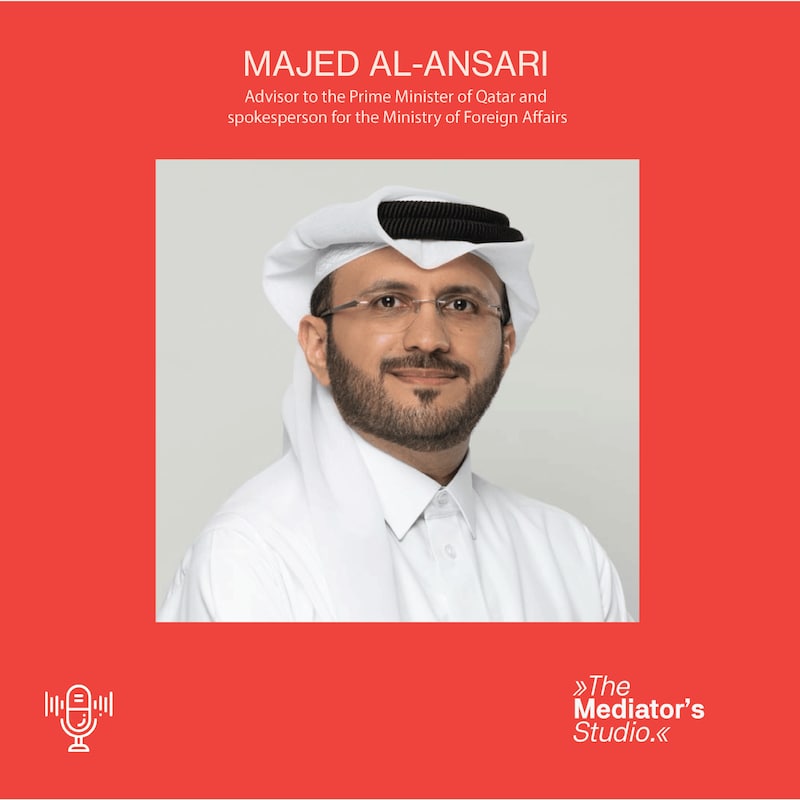
Recorded in November 2025, Dr Majed Mohammed Al-Ansari, advisor to the Prime Minister of Qatar and spokesperson for the Ministry of Foreign Affairs, shares first-hand experience from the front lines of mediating today’s most brutal and entrenched conflicts. From Gaza to the Democratic Republic of Congo and the Russia–Ukraine war, Qatar has found itself at the table in crises where dialogue can feel impossible.
Dr Al-Ansari reflects candidly on what it takes to bring adversaries back into the same room, even when violence has claimed their loved ones, and why lasting peace requires confronting that pain directly. Above all, Dr Al-Ansari emphasises learning from people on the ground, reminding us that effective mediation is shaped as much by human connection as by diplomacy.
We’d love to hear from you! Please take a moment to share your thoughts in our 1-minute listener survey: https://0lotay3liy7.typeform.com/to/BszSNdLf
Transcripts
[00:00:00.320] - Adam Cooper
The world is once again facing a moment of profound uncertainty as the conflict involving the United States, Israel and Iran spreads across the Gulf and the wider Middle East. When I spoke with Dr Majed Al-Ansari in November 2025, many of these tensions were already shaping the region. The conversation you are about to hear was recorded at that time, i.e., before these latest developments. So, some of the references in the discussion reflect the situation as it stood then. While events have since moved on and in some respects overtaken parts of this conversation, I hope that you'll still find it relevant. Many of the themes he raises about dialogue in moments of deep trauma and the importance of keeping channels open even when violence makes it seem impossible, still resonate today.
[00:00:49.090] Billboard clip – Dr Majed Al-Ansari
Unless you come back to the table, unless you are able to exchange views with a party that you believe has killed your loved ones, there will be no end to conflict.
[00:01:07.270] - Adam Cooper
Welcome to the Mediator's Studio, a podcast about peacemakers, bringing you stories from behind the scenes. I'm your host, Adam Cooper, and I'm in Muscat for a meeting hosted by the Ministries of Foreign Affairs of Norway and Oman and the Centre for Humanitarian Dialogue, bringing together leading figures to discuss mediation in the Middle East and North Africa. My guest government has had a ringside seat on mediation efforts to end some of the most intractable and destructive conflicts raging now in places such as Gaza, the Democratic Republic of the Congo, and Ukraine-Russia. Over the past 20 years, he has held academic and civil society posts in his native Qatar, a country now mediating in no fewer than 12 conflicts. Today, he serves as an advisor to the Prime Minister and Spokesperson at the Ministry of Foreign Affairs of Qatar. Dr Majed Mohammed Al-Ansari. Welcome to the Mediator's Studio.
[00:01:59.300] – Dr Majed Al-Ansari
Thank you for having me.
[00:02:07.940] - Adam Cooper
I'd like to start with the story of how Qatar became such a significant mediating nation. I believe it's the only country whose constitution specifies that mediation should be a tool of government foreign policy. Where does that idea come from, the notion that mediation is so fundamental to the very existence of Qatar?
[00:02:27.220] – Dr Majed Al-Ansari
Well, you know, I do believe that these foreign policy roles of Qatar are not unique to the modern history of our country. If you go back to the inception of Qatar in the 1800s, you'll find that our founder, Sheikh Jassim, described Qatar as Kabat in Madhu, the Mecca of the Oppressed. At the time, the foreign policy of Qatar, of this new social political entity starting to form in the peninsula that is now Qatar, was based on a balancing act between much bigger regional actors and colonial powers, and therefore it needed a lot of mediation in the sense of reaching at the social cohesion between the different tribes and different trades groups and social elements in Qatar, but also finding a way to operate in the very complex regional environment where older, richer, more powerful states have a vested interest to keep you at bay, then it's part of our DNA, it's part of the way of thinking in Qatar, it's part of our national identity.
[00:03:25.610] - Adam Cooper
If we trace that forward, that DNA, to how it looks today in Qatar's mediation efforts. You know, our listeners may be familiar with some of your more high-profile efforts, say in Gaza, but perhaps be surprised to hear about the scope of your work in 12 conflicts and that's just the ones we know about. Give us a sense of the breadth of what you're doing and maybe more critically how you decide where to get involved.
[00:03:50.050] – Dr Majed Al-Ansari
In the beginning, of course, especially in the beginning of the 2000s, when we were mediating between the factions in Lebanon after the war over there, when we were mediating between the Houthis and the central government, at the time between Eritrea and Djibouti, in Darfur, our main focus was our region, our ability to utilise our economic and soft power tools in these mediations. And especially coming out of the very turbulent Arab Spring period, there was a very important discussion, I think, in Qatar on what we can do to work beyond the confounds of the conflicts in the region to create peace in the world. What can Qatar present as added value in the international community? And this is where I think the Afghan talks between Taliban and the United States and the Afghan-Afghan talks came in. And of course, since 2006, our goal between Hamas and Israel and our ability to speak to everybody everywhere about everything, our government never shied away from having any discussion that could be conducive to peace. Especially now, as more and more with the conflicts that are raging in the world today, the world is moving from dialogue to a complete isolation in the silos of conflict.
[00:05:05.410] – Adam Cooper
Presumably you do it, of course, for the sake of peace, but also because you believe it's in your national interest. You said, and I quote, you need to take an active role in protecting your own prosperity. Tell me more about the underlying motivations for your mediation.
[00:05:20.690] – Dr Majed Al-Ansari
Qatar is a small country. We have a population of just shy of 3 million. We are the main benefactors of an international rule-based order. We are the benefactors of the international system. We are the benefactors for the rules that are against aggression by large on small. And this is why we have a vested interest in protecting the world from conflict, protecting the world from the decay of the international system. And if you look at our economic model, it's based on our ability to trade overseas, our ability for our shipments to move from Doha to as far as Japan - East, and the United States - West, so spanning the whole world. And that cannot happen if you don't have peace and prosperity around the world. Our clients around the world need their own prosperity in order to be our clients. But it is also the maritime routes that need to be protected. And that can only happen in an environment where powers like Qatar are conducive of peace, and they know how to work with every partner in the world to reach that result. Especially that there is a gap in the international markets today for countries who are ready to spend political capital on peace.
[00:06:30.800] - Adam Cooper
Let's move on to your mediation between Hamas and Israel. And just to give our listeners some background, in January 2006, Hamas won an overwhelming victory in elections in Palestine. And the response of the diplomatic quartet, under pressure from American and Israel was to isolate Hamas and blockade Gaza, Hamas's stronghold. You know, for you in Qatar and many others, it was a historic moment, you know, with a militant Islamic movement in your region moving to become a legitimate civilian government. At that time, President George Bush Jr. and his secretary of State, Condoleezza Rice asked Qatar to engage with Hamas on their behalf, which you did. And then when the Syrian revolution began in 2011, Hamas opened up a political office in Qatar in 2012. And if we just jump forward 13 years, you're now an advisor to the Prime Minister, Foreign Ministry spokesperson with your country deeply engaged in US sponsored negotiations between Israel and Hamas. But the moment I want to ask you about first is the afternoon of 9th of September when Israeli fighter jets attack the compound in Doha where you're hosting Hamas. They miss the top leaders, they kill five people associated with the Hamas delegation and they kill a Qatari security officer. Making this the first time in your history that you lose a serving officer in an attack on your territory by a foreign power. Where are you when Israel attacks and what's going through your mind?
[00:07:59.790] – Dr Majed Al-Ansari
A day before that attack happens, we were with the Prime Minister, engaged in a day long talks with the parties. You know, we've just the night before ended a very long meeting with the Hamas delegation in Doha. We've given them the proposal, we pressed as much as possible that we need an answer by Friday. And the Prime Minister was doing the calls all night to make sure that all the parties, including Israel by the way, understand exactly what is happening between Tuesday and Friday. Wednesday morning, obviously we were busy, you know, seeing all the options and looking at everything. And as I was going home, just arriving at my house, I start hearing the bombs and hearing the explosion that sounded like they were next door, although I was at least 15 minutes drive away from the bomb site. And to be honest, I immediately thought, this has to be an Israeli attack.
[00:08:47.510] - Adam Cooper
That's what you suspected immediately.
[00:08:49.630] – Dr Majed Al-Ansari
Because if you were there, if you were listening to the explosions, this could never be anything else. We've lived through the Iranian missile attacks, for example. We've heard explosions that happens because of safety issues. This sounded nothing like that.
[00:09:03.480] – Dr Majed Al-Ansari
And the number of these rockets coming in. And of course, my first concern was that my daughter was in university, where she just started there that year, and the neighbourhood that was bombed was smack in the middle between my house and the university. And I imagine how many families in Qatar had the same feeling at the time where their loved ones were, when you didn't know the extent of the Israeli bombing. Actually, most people in Qatar did not know that it was an Israeli bombing at that time. So, you can imagine the confusion, the sense of fear, the sense of insecurity at that moment in a country that has prided itself on being secure and safe and prosperous for more than 180 nationalities living in it for so many decades. And therefore, it is not an easy moment to live through, especially when you are a diplomat that is engaged in talks with the party that just bombed your country.
[00:09:49.470] - Adam Cooper
I can hear the emotion in your voice, just how incredibly, when you're used to that safety and security, how disruptive it must have been and how traumatic, in a sense. What did the surviving Hamas officials say to you? There must have been a lot of explaining to do.
[00:10:05.620] – Dr Majed Al-Ansari
As you know, none of the negotiating team were killed in the attack. The wife and son of the lead negotiator were harmed, the son was killed and his wife was badly injured. A number of clerical officers were also killed and obviously the 22-year-old Qatari officer was killed in the attack. I think the first thing that happened was, and I remember that I drove straight to the Prime Minister's office where he had come back and we were reassembled, thinking of what to do next. Our concern at the time was not what are we going to say to Hamas, what is Hamas going to say to us, what are we going to say to Israelis and what the Israelis are going to say to us. The main concern was this is not a threat, but an attack on our national sovereignty. How shall we respond? And that night until 1am we spent every waking moment in the Prime Minister's office working with the whole government in setting the table for everything that we are going to do, including legal action that we are going to take against our aggressors, including diplomatic initiatives with the Americans and with the Arab and Islamic countries, including security measures that were taken during that day.
[00:11:16.200] – Adam Cooper
It sounds almost like a productive anger.
[00:11:19.560] – Dr Majed Al-Ansari
Exactly. I mean, we're used to this in Qatar. We've always dealt with these kinds of threats. You have to remember, it's a small country. The teams are as small as the country is. It's not like a million people working in the civil service in Qatar. I can count on two hands, the number of people who work in the office that day dealing with that issue.
[00:11:35.560] - Adam Cooper
Once you decided on that course of action in the Prime Minister's office and you're putting it into motion, tell me about that first call with Hamas.
[00:11:44.120] - Adam Cooper
That day there was no call with Hamas because that day the call was with the Americans to tell them that we are pulling out and we are not going to negotiate with those who are bombing us through the mediation process. Our focus was on how to deal with the Israeli Prime Minister who was bombing my country. And that meant that the focus of the next week was on our bilaterals with the US and what the US is willing to provide security guarantees for Qatar and what we were willing to do, including calling for the Arab and Islamic summit that was held in Doha. There were three summits that day. The GCC summit, the Arab Islamic Summit was a joint one. And we wanted to make sure that Qatar is not going to be an easy target for Israel or anybody else. This was the second attack in so many months. The first was by Iran and the second by Israel. And we were not going to take it laying on our backs and waiting for a third attack. And of course, the culmination of that was the apology and commitment by Israel never to attack again. And the executive order and the other security arrangements that we have taken.
[00:12:47.590] - Adam Cooper
I want to ask about that because, you know, the narrative is that there was a real turning point in the mediation process because President Trump began to lose patience with Benjamin Netanyahu and applied greater pressure on him to accept an agreement. Do you think that's true?
[00:13:03.770] – Dr Majed Al-Ansari
I do think that while the attack on the 9th of September wasn't the biggest when it comes to human lives lost and an attack since 2023, but it was the most significant when it comes to a red line being crossed. An ally of the United States, a mediating country, during an active mediation, being bombed by a country that is seen as another ally of the West and the United States that is supposed to be a member of the international community and signatory to all international conventions and statutes. And it finds itself in a position where it basically just bombs a safe country just because it's politically pungent for the leadership to do so. And therefore, I think, for us, we wanted to show two things. One, if Benjamin Netanyahu wanted this attack to kill the prospects of a deal to end the war in Gaza, then we would double down. And if it was aimed at Qatar to end our role as a mediator, we would also double down. This is why, by the way, during the attack, there were three delegations in Doha, the Hamas delegation, the Colombian delegation for the Colombian talks, and the DRC and Rwanda delegations for the DRC and Rwanda talks.
[00:14:17.070] – Dr Majed Al-Ansari
We immediately, right after the attack, we continued with the talks. There was an Afghan deal where a British couple was released from Afghanistan to Qatar in mediation just a weekend after the attacks, followed by an American that was released. The first round of the Colombian talks was concluded within a week of the attacks. And obviously we had, within a month, the Sharm El-Sheikh moment where the ceasefire took place in Gaza.
[00:14:44.280] - Adam Cooper
It sounds almost like a spirit of defiance to uphold your mediation no matter what, and even under literal attack. And of course, you've spoken just now about the need to make sure that those negotiations continue, that those delegations feel safe. Once you had spoken to the Americans about the pressure that they were willing to apply on Israel, how reassured do you think that your Hamas counterparts that were being hosted in your country felt? Tell me about the conversations you were having with them at the time.
[00:15:20.480] – Dr Majed Al-Ansari
You are talking in the sense of mediating between Hamas and Israel. You're talking between sides that have been at each other’s throats for decades. The assassination of Ismail Haniyeh in Tehran happened during the mediation. Our Prime Minister said it once that he has stopped giving condolences to the members of the team because every other week, a son, a daughter, a cousin, a father of one of the negotiating team would be killed in Gaza. So, they're not immune to what was happening in Gaza, but they are not also new to the fact that their own security is not guaranteed. We have taken all precautions that all delegations in Doha be protected and be put in secure conditions. But you have to remember the place that was bombed was an official governmental residence known by everybody, including the Israeli delegation that stayed in the Ritz-Carlton, 10 minutes away from that building, driving by that building every day as they go to the place where the talks were being held. This is not a secret location, because we didn't think that a mediating country needs to hide the mediating parties or the parties that's mediating between while an active mediation was taking place.
[00:16:31.780] – Dr Majed Al-Ansari
It's not like we put them in harm's way, because they were never supposed to be in harm's way as they were negotiating for peace on behalf of their respective peoples. The same would have been said, for example, of the Israeli delegation that stayed at the Ritz-Carlton, we didn't need to put them in a safe location because we never thought that they would be in danger. But in this case, you have an air attack on a residential building that is a governmental residential building, that the other party knew that the meeting was taking place in that location at that time, they knew who was meeting there. So, it wasn't an intelligence operation. But at the end, it was the sense of betrayal and complete lack of trust in a party that, instead of appreciating the fact that most of the hostages that are now back with their families as a result of Qatari mediation, decided to kill Qataris instead.
[00:17:22.860] - Adam Cooper
If I try to sort of put myself in the shoes of those who would be caught up in some of those tragic events, even if the Hamas delegation understood their security wasn't assured, as you said, this is a kind of profound violation of the norms of standard international conduct. So how would you describe their kind of emotional state at the time? The kind of combination, perhaps, of anger, grief, fear? How would you summarise it?
[00:17:49.990] – Dr Majed Al-Ansari
We've been dealing with them since 2006. Throughout that history, the number of assassinations and the killings and the death and destruction in this file have been unbelievable. I'm sure you heard about the meeting between Steve Witkoff and Khalil al-Hayya, and the first thing they discussed was the loss of their children. I'm a father and it chokes me up to think of any of my children being hospitalised, let alone being bombed to a state where you don't have a body to bury. But this is the reality of everybody that's been living in Gaza since 2023. It's the reality of everybody who lives in armed conflict that does not have any humanitarian guardrails. And anybody who's mediating on behalf of their people, whether it be on either side, has lived through fear, has lived through death and destruction, has lived through anger in a way that should not allow them to talk when mediation happens. But the reality of the situation is, unless you come back to the table, unless you are able to exchange views with a party that you believe has killed your loved ones, there will be no end to conflict.
[00:19:02.290] - Adam Cooper
I'm sure there's no apology that can make up for that. There is that phone call that President Trump forces Netanyahu to make from the oval office to your Prime Minister apologising. When that call came in were you with your Prime Minister at the time and what was going through your mind?
[00:19:19.650] –Dr Majed Al-Ansari
The call happened, of course, through a very delicate, orchestrated process into getting to that moment. We worked very closely with the Americans to make sure that we manufactured that moment. And we reach a situation where the apology would be basically a diplomatic commitment on behalf of Israel. And let me be very frank here. I don't think any Qatari was waiting for the Prime Minister to apologise in order to forgive. But we wanted a moment where there is a commitment by the same Prime Minister that took the decision to bomb my country, never to do it again. And in front of the international community, but especially in front of the US President. And this is why I think, if you heard the language very carefully stated, very clear, that there is a commitment there. The apology was about attacking our sovereignty and the commitment was never to attack Qatar again. And that was followed, of course, by the guarantees offered by the United States and working with the international community. Obviously, we could have just said, you know what? Enough is enough. They can go and find other mediators. We are opting out of this, and we will consider Israel to be an enemy and we will not deal with Israel anymore. But what would that have meant for the people of Gaza?
[00:20:38.780] - Adam Cooper
Let's take stock of where we are at the moment and some of the real difficulties that undoubtedly lie ahead. In the New York Declaration of July this year, Qatar for the first time agreed to the principle of Hamas ending its rule in Gaza, handing over its weapons to the Palestinian Authority. Has that not strained your relations with Hamas?
[00:20:56.430] – Dr Majed Al-Ansari
No. I mean, the mediation process throughout the past two years have had as an end goal always a result of unifying the Gaza and the West Bank and realising a Palestinian state. It was never to get back to the situation before the 7th of October. We've always maintained in Qatar and all the parties know this. The PA knows this, Israelis know this, Hamas knows this. Our position was always that the situation is not sustainable, that the rift between Gaza and the West Bank that was manufactured by Netanyahu and Israeli governments was not conducive to a sustainable peace. And therefore, our position was always that there should be a Palestinian Authority that is empowered and that has the power to protect its own people, to secure its own people, and to represent the legitimate claims of the Palestinian people in front of the international community. And we've worked very closely with Hamas and all the Palestinian factions at many intervals to make sure that there is always a Palestinian-Palestinian track that is operational, like the one that is taking place right now in Cairo. And I don't think that was an aha moment for Hamas that Qatar has changed its position.
[00:22:01.680] – Dr Majed Al-Ansari
I think they know that this is the trajectory we were going on, and we are still having discussions with them over the future of Gaza and the future of the Palestinian territories.
[00:22:09.000] - Adam Cooper
When it comes to Hamas's role in these discussions around the future of what happens in Gaza, how important do you think the concept of "saving faces" is and consultations with them when it comes to discussions of their potential disarmament?
[00:22:23.320] – Dr Majed Al-Ansari
In most of the mediations we are doing, the production of a peace deal is just like the production of a movie. There are a million elements, but one very important element is to make sure that the protagonists don't look bad. We shouldn't underestimate the importance of narrative in this. You might have all the elements in the deal, you might have all the needed agreements over numbers and formulas and number of trucks going in and kind of aid going in and all of that. But then the way you produce it to the world could basically sabotage the whole process. And therefore, we've always worked on developing the language that both parties can use in their respective communiques, developing joint communiques with the mediators that could produce that result, whether it be Iran and the United States, Afghanistan and Pakistan, Hamas and Israel, Venezuela and the United States. In all of these, the one major element of the success is in finding the language that one party can go back and say to its people, this is why this is good for us. And this is why we still maintain our dignity throughout this deal.
[00:23:31.120] - Adam Cooper
If we just look ahead to the financial investment that's required in Gaza. You know, historically, between 2012 and 2023, you invested $4 billion in Gaza. Are you prepared to invest at those sorts of levels? And how would you mitigate the risk of that investment being at risk? Should the conflict escalate again?
[00:23:51.840] – Dr Majed Al-Ansari
There's a question in the whole region right now. Should we rebuild only for Israel to knock down a couple of months later when there's another conflict? Well, the answer to that is two-fold. One is we need a sustainable governance model in the Palestinian territories that makes sure that there are no more escalations. Two is we need a commitment from Israel that is guaranteed by the international community that wars would not rage on forever whenever it's politically viable to do so. And unless that happens, then whatever we've done in the past would be repeated again in the intervals of the war, before 2014 and after 2014, there was a reconstruction process in Gaza. Now we are talking about more than 85% of residential units in Gaza demolished. No roads, no water, electricity systems. We're talking about a clean slate. Not that clean, to be honest. But the problem here is not who is going to rebuild, it's how we are going to do that rebuilding within a framework that gives ownership to the Palestinians and to the international community. And we think any rebuilding prospect right now has to be mandated through the international community, supported by the international community. And all of us collectively have to pay into it and to have ownership in it, so that whenever there is a conflict in the future, anybody who would be willing to knock down all of the reconstruction that's been taking place, they would know that they would be knocking down projects run by all of these countries around the world. This can never be any more a regional project. It cannot be a Qatari project or a Turkish project or whatever it has to be an international project to rebuild the lives of people.
[00:25:46.410] - Adam Cooper
I would love to talk to you more about Gaza, but I also want to pick your brains on the Qatari mediation in the Democratic Republic of Congo or DRC. Not least because it illustrates a wider mediation lesson about the impact that a mediator can have from outside of the region, bringing in a sort of fresh approach. For decades, the Eastern DRC and Great Lakes region have seen cycles of conflict fuelled by regional rivalries, disputes over minerals. Violence escalated, reportedly led by M23 rebels allegedly backed by Rwanda, though Kigali denies it. And the conflict forcibly displaced millions of people, has led to widespread loss of life, human rights violations, gender-based violence. There's been regional diplomatic initiatives such as the Luanda and Nairobi processes, but have failed to bring peace, as have various regional military initiatives. And in March 2025, Qatar's Emir takes the world by surprise by gathering Rwanda's and DRC's Presidents in Doha. And then your government then mediates talks between the DRC government and M23. And after difficult rounds of negotiations and a visit to Washington by your Minister of State in the Foreign Ministry, the DRC and M23 issue a joint declaration of a cessation of hostilities from Doha. Give me the backstory.
[00:27:05.830] – Dr Majed Al-Ansari
The request we've received from one of the parties a couple of years back was that we have this conflict in Eastern Congo and we want to see the possibility of mediation that goes beyond what was going on at the time in the peace facilitation processes. And the way we do things is when we get one of these requests, we start exploring through sending our chief negotiators, so in this case the Minister of State to both parties to gauge their interest. And then we start the process by inviting both parties to Doha. This is the second iteration of trying to find a solution over there for Qatar. And the first iteration, it didn't materialise because we failed at the time to address all the players in the issue, regionally and internationally. This time around, we made sure that we make contact with all the players. We talked to all the governments in the region that had a stake in the issue, neighbouring states with the AU, and we've talked to our European partners and with the United States. And this is when we found out that the best course of action would be to get the two leaders to Doha through a direct intervention of His Highness the Emir, who called on both leaders and asked for them to visit him in Doha and sit together for the first time in two years since the conflict began.
[00:28:20.560] – Dr Majed Al-Ansari
And that opened the door wide for a long-standing mediation between the parties. And then, you know, we were learning on the job of course, this is an alien context to us. Obviously, the DRC and Rwanda are not neighbouring states to us. We are not heavily involved in the histories of these two great countries. But we started learning, working with our partners, working with NGOs and on the ground, and developing our knowledge on how to conduct talks between both sides. Until the point that we signed the framework that would allow us to monitor the ceasefire, to push further the discussions and would allow us to basically reach a possible end to the conflict that would bring us to a situation where we can be instrumental not only in this conflict, but in the wider security of the region.
[00:29:08.580] – Adam Cooper
I want to talk about that framework because after that April announcement of a cessation of hostilities, it's been bumpy, you know, despite a series of encouraging milestones: a ceasefire agreement signed in Washington in June between the Rwandan and Congolese government, a declaration of principles in July from the M23 and the DRC, deal signed in Doha in October for the monitoring of an eventual permanent ceasefire. You know, earlier in November, the DRC and M23 signed this Doha Framework for Peace during a ceremony also attended by US officials. Talk to me about how Qatar and the Trump administration work together on this.
[00:29:47.550] – Dr Majed Al-Ansari
Well, we are working with the administration right now on a number of mediations. We do believe that the United States can be a force for peace when the United States decides to be a force for peace. And we've seen that happen with Gaza when the United States President put his foot down, a ceasefire happened. We've seen that with Iran, you know, with the ceasefire that happened between Israel and Iran, with Armenia, Azerbaijan, and with other conflicts where we have been working and actively mediating. And to have the might of the United States on our side in these mediations has always been useful. But we are always ready to help all of our partners around the world, including the United States, when there is a decision to move towards peace. And I think one of the important things right now in dealing with the administration is bandwidth, to make sure that we provide the heavy lifting, sometimes, the contact sometimes, and the understanding of the context, sometimes, in order for the administration to be able to formulate policy and use its leverage the right way. And I think in the DRC and Rwanda, this was a very good moment for this.
[00:30:47.680] – Dr Majed Al-Ansari
We are coming in as a country that's mediated for a number of months now between the parties. We have trust from both parties and are able to bring both parties to Doha first and then to Washington DC, in order for that leverage to be useful.
[00:31:03.380] - Adam Cooper
You've talked about bandwidth. I also want to ask with regard to the US the kind of strategic economic interests at play, because some of your efforts are explicitly underwritten by US promises of a minerals deal. So, use a kind of more explicit transactional element of kind of peace negotiations. What do you think the pros and cons are to that approach?
[00:31:24.620] – Dr Majed Al-Ansari
When you are bringing parties of a conflict to the table, you have to understand exactly what is of value to the context, what is of value to the people who are sitting on the table, but what is also of value for sustainable peace in the future? And one main element of that is economy. What kind of economic solutions can you offer that would pin down the economic root causes of the conflict? In many of these conflicts, the economic root cause is one of the biggest under the tree. For example, it's the economic situation in Afghanistan, the economic situation in Syria, in Iran, it's the effect the sanctions have on the Iranian economy. In all of these contexts, you need an economic incentive that is not only an incentive. This is not a bag of money being shifted under the table. This is an economic prosperity promise that offers the side a choice between economic prosperity for your people and continue it and prolong conflict.
[00:32:26.880] - Adam Cooper
A lot of what we've talked about has been at the high strategic level. But I want to remind our listeners that few conflicts have seen as much gender-based violence is what's the war in the DRC. Why have women not been more involved in a voice in some of these negotiations?
[00:32:43.110] – Dr Majed Al-Ansari
There are so many elements you think about when you are conducting these negotiations. You can ask why haven't there been more women? Why haven't there been people from different ethnic backgrounds, from different religions, from different political groupings? Why haven't we seen more capacity building? But the situation is where you work with what you have. You're not going to change the social political context you are working with. You're going to work within that social political context. I'll give you an example. In one of the mediations we are working on right now, we found out that the only way you convince the political leadership is through going to the mothers. It is not something that you learn from the diplomatic books. It's not something written in the international charter. It's not something that an UN-certified trainer is going to come and tell you. It's something you learn by having the local discussions with the local elements, by understanding the context, by going there, by living there, by working with the humans behind the humanitarian story. That meant that we needed to go every time before we meet with the leadership to go to the mothers, to have a discussion with the mothers and to convince the mothers and to come bearing gifts and to be courteous to the mothers.
[00:33:57.620] - Adam Cooper
Let's move on to the Russia-Ukraine conflict and Qatar's mediation role. Your leaders have spent considerable effort, time meeting President Putin, President Zelensky, discussing a range of issues, but carving out a role on the deeply sensitive and emotional issue of family reunifications and repatriating children. Since October 2023, Qatar has successfully contributed to finalising more than 10 separate repatriation agreements. Was there a particular moment when you thought, yes, this is the specific role that Qatar can play and that this might work in an incredibly divisive conflict?
[00:34:34.390] – Dr Majed Al-Ansari
You know, I was appointed to my current position on the 22nd of February 2022, so two days before the war in Ukraine. And I remember, you know, one of the first tasks I did, I was called into the Prime Minister's office, at the time Deputy Prime Minister, and he told me: "Majed, you have to write our statement on the war in Ukraine, condemning the invasion. But use very careful language because I'm going to Moscow next week and I'll see if we can mediate between both parties." So, from day one, our eyesight was towards finding a peaceful resolution over there and finding a role for Qatar to play. Obviously, at the beginning, we were not successful in engaging both parties for a comprehensive kind of mediation. We worked on the Grain deal, for example, with other international partners, but we kept knocking on the door until we get the request from Ukraine over the children that were misplaced as a result of the war. Immediately, His Excellency the Prime Minister went to Moscow with a letter from His Highness to President Trump, asking if we can start a mediation over that issue. And we formed a team in Qatar with envoys from both Ukraine and Russia as our interlocutors, and we started identifying every child and working with every child separately.
[00:35:45.010] – Dr Majed Al-Ansari
This is not the story of political arrangements and economic models and deconfliction and decommissioning and all of these buzzwords of mediation. This is a story of a child lost, with family looking for them. And this is exactly how we have been approaching this. Identifying every child, finding where they are, ascertaining their situation, finding their family and ascertaining their situation, deciding what is the best course of action for the child, not for us or the Ukrainians or the Russians, for that child and his family. And then, when we have a critical, massive number of children, they are delivered to our embassy in Moscow, where our teams ascertain their health and their situation. And they are driven by our diplomats outside of Russia and into Ukraine, where our diplomats and the families from the other side are there to receive them. And every couple of months, we do a retreat in Doha, where we bring these children. And observers from both sides can see that they are doing better with families that love them.
[00:36:47.410] - Adam Cooper
As a father yourself, it must deeply move you to see when those reunifications happen.
[00:36:51.930] – Dr Majed Al-Ansari
For every child reunified with his family, that is the end of their war. And for every child that comes back to their family, it is a small speck of hope in a hopeless environment that brings back the humanity of us all. I have five girls of my own. I'm travelling all the time, but I can't imagine being away from them against my will. And I know that for a lot of these children, they were orphaned as a result of the war or even before the war, and now they are living in loving households. And if we can do that for one child, then all the efforts that are put into that, it's worth it.
[00:37:29.650] - Adam Cooper
You know, as we record this, President Trump has just put forward a 28-point peace plan. Is it your view that a comprehensive peace can be negotiated between Russia and Ukraine, or do you think that the best approach is more incremental, whether it's on the sort of humanitarian issues you've been working on, family reunifications. At one point, Qatar was working on a partial ceasefire that would cover energy and power infrastructure. That is, do you need all the chips on the table at once, or do we try to tackle this bit by bit?
[00:38:01.330] – Dr Majed Al-Ansari
You know, the last comprehensive peace deal that happened around the world was more than 10 years ago in Colombia, and we're still dealing with that deal. Our mediation right now is kind of a continuation of that deal. But it's a sad state of affairs in the world today that conflicts don't end, they are simply frozen for a short interval. And the layers of conflict that are basically just coming on top of each other right now are causing a level of humanitarian catastrophe that the world has never seen before. And therefore, if you ask me today, as somebody who's working on these issues, I would tell you the comprehensive deals are just magnificent. But are they realistic? Well, it depends on a lot of elements. One main element is, are both parties ready to go into a comprehensive deal? Is the situation on the ground conducive to a comprehensive deal or not? We have always worked on incremental peace with the hope that that basically pushes us to a comprehensive deal. The only problem with incremental peace is that it is incremental and saboteurs can come in throughout the processes, within the phases, within the steps, and just create and lay the ground for more conflict to come in the coming days. But the problem with comprehensive peace is that you cannot wait for it, because every day you spend in conflict, more lives are lost and peace becomes harder to achieve.
[00:39:27.460] - Adam Cooper
I'd like to draw our conversation to a close and end with a few concluding thoughts. You know, your government's been involved in many high-profile mediation efforts. There have been results to show for it. What would you say has been the most frustrating moment for you where you felt most disappointed?
[00:39:44.660] – Dr Majed Al-Ansari
I would say that has to be when the second ceasefire between Hamas and Israel broke down. Those who work in the mediation since 2023, they haven't taken a day off from the 7th of October to when that ceasefire took place. I know some of my colleagues who are hospitalised as a result of the stress, of the frustration, of the sheer effort that is needed to conduct these talks. And we were hopeful, against all odds, that the second ceasefire would produce the period of calm needed to reach a sustainable peace. When that broke down, and on the first day, we saw around 100 lives lost, that was a moment of despair that I think echoed across the world, not only for the people who are working on this, but especially for people who need to announce this to the public, like myself, and go and say, yes, we have failed again as an international community to produce peace. And this is why I think, while the situation is nowhere near perfect right now, we should cherish the fact that this ceasefire still holds and that there is still a momentum for peace that is seen and felt, but it's nowhere near finished, nowhere near over. We need to work very hardly, the rest of us and the international community, to make sure that the parties are not allowed to go back to war again, and that we are able to provide the incentive and the stress and the pressure on both sides to go towards peace rather than war.
[00:43:28.220] – Adam Cooper
Well, there we must end. Dr Majed Mohammed Al-Ansari, thank you so much for being my guest in the Mediator's Studio.
[00:43:34.430] – Dr Majed Al-Ansari
Thank you very much for having me, Adam.
[00:43:41.630] - Adam Cooper
That's it for this edition of the Mediator's Studio. To get more episodes as they come out, please subscribe wherever you get your podcasts. We always love to hear from you. So, if Qatar's mediations in Gaza and the DRC have resonated with you, please get in touch via the listener survey in the show notes on our website or do drop me a message on X at Adamtalkspeace. The Mediator's Studio is an Oslo Forum podcast brought to you by the Centre for Humanitarian Dialogue and the Norwegian Ministry of Foreign Affairs. Our managing editor is Christina Buchhold, and the producer is Chris Gunness. The coordinating editor is Ly Buiduong. Research for this episode was by Oscar Eschenbrenner. Hope you'll join me for the next edition. Until then, from Muscat in Oman, this is Adam Cooper saying goodbye and thank you for listening.


