Shownotes
We tend to trust diagrams. Four boxes, four arrows, four services — that feels like shared understanding. But when Vanessa Formicola started asking basic questions about a team's architecture, the boxes came apart in her hands.
What the team called four services turned out to be four deployments of one codebase — the same code with different entry points, barely modularised, with the services quietly intercommunicating underneath the API calls that made them look separate. And this was a medical product. The team owned everything from the app entry point down to the core business algorithms, critical IP scattered across a system nobody could change safely.
Vanessa describes herself as an engineering leader and a sociotechnical architect, which she explains like this: if you bring her a technical problem, she'll start poking around in your people issues, and vice versa. That instinct is the whole story here. The team wasn't incompetent — they were clever people in a high-growth environment that never gave them space to stop and ask what they actually owned. So rather than opening with a redesign proposal, Vanessa ran a series of workshops as the person in the room who didn't know anything. They mapped business capabilities, technical capabilities, and what she calls "real estate" — the stuff you own that has nothing to do with your domain. In parallel, she took ADRs into the company's weekly architecture forum. Only then did they draw a North Star. A year and a half of decoupling followed. Issue time halved. Sprint predictability improved by about 40%.
But the outcome Vanessa values most isn't in those numbers, and neither is her most portable idea: the Social Decision Record. Same format as an ADR, but for organisational decisions — whose test strategy do we adopt, how do we share PR reviews, who lands which developer. In this team, there were more SDRs than ADRs. This conversation explores what that ratio tells us about architecture work, why "just tell me what to do" is a signal about the environment rather than the person, and how career frameworks and quarterly review cycles end up designing your architecture without anyone noticing.
Key Discussion Points
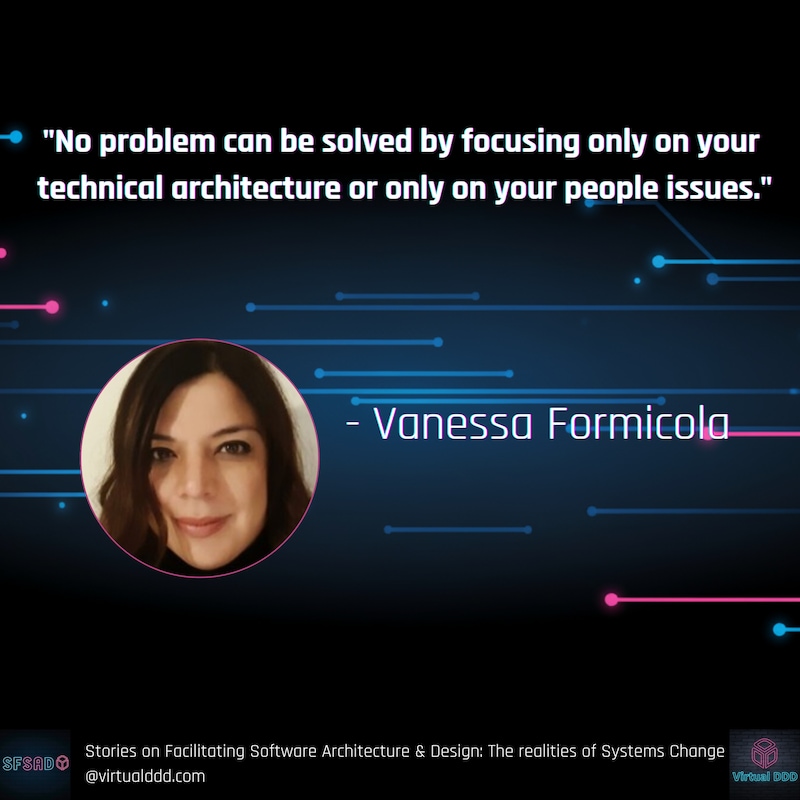
- [00:01] Poking Around in Your People Issues: Vanessa on why no problem gets solved by looking only at technical architecture or only at organisational dynamics
- [02:00] Four Deployments, One Codebase: The discovery underneath the diagram — same code, different entry points, API calls that misled everyone
- [04:00] Capabilities, and the Real Estate You Didn't Ask For: Domain analysis that separates what you own, what you should own, and what you're just carrying
- [06:00] Bringing ADRs to the Forum: Shifting how decisions were communicated to the teams that depended on this one
- [07:00] If We Were Designing This Now: The North Star conversation, and separating the stable medical domain from feature-driven, BFF-style services
- [12:00] "Just Tell Me What to Do": Why this is disillusionment or fear rather than laziness — an organisational issue, not an architectural one
- [15:00] Twenty Lines, Not Twenty Pages: The RFC that would take three months, and why ADRs let people engage at the depth they want
- [22:00] Social Decision Records: Applying ADR rigour to organisational decisions — and why this team ended up with more SDRs than ADRs
Guest: Vanessa Formicola
Hosts: Andrea Magnorsky, Kenny Schwegler
Transcripts
Hello and welcome to another episode of Stories of Facilitating
2
:Software Design and Architecture.
3
:today we are here with my usual
co-conspirator, Kenny, we're joined
4
:by the amazing Vanessa Formicola.
5
:Vanessa
6
:Vanessa Formicola: Thank you.
7
:Welcome, everybody.
8
:So I'm Vanessa Famicola.
9
:I'm an engineering leader and
social technical architect.
10
:That means that whatever role I actually
hold, I try and solve problems from
11
:both a technical and people perspective.
12
:That also means that unfortunately or
fortunately, if you have a technical
13
:problem, I'll probably start poking
around in your people issues and
14
:organizational issues and vice versa.
15
:I found this unfortunately
to be necessary and true, in
16
:most companies I've worked in.
17
:I've worked in very different companies.
18
:I've worked in big corporate
companies like Microsoft.
19
:I've worked in consultancies where,
you know, you see very different
20
:clients, and even in startups like,
Flow Health, where I worked, recently.
21
:And what you find is that no problem
that you can solve, in my opinion,
22
:in my experience, just focusing
only on your technical architecture
23
:or only on your people issues.
24
:usually you have to find, you know, a
balance to understand how to address it.
25
:what I'll be talking about today, like a
story, of an experience that I had that
26
:I thought was very shaping, is about how
a team who had, very difficult technical
27
:legacy issues actually had a lot more
of, like, people issues and technical
28
:issues to solve, and how I try and s-
help them, leading them to the solution
29
:So, this team owned…
30
:So this was a small team at the
beginning, and it became rather
31
:large towards the end, so more
like, uh, size of three, let's say.
32
:they owned the key domain of the product,
so you can imagine the stakes of that,
33
:and also the entry point of the product.
34
:though, although it was a great
team of individuals, as a team, they
35
:weren't working as well, and the actual
situation of the software was dire.
36
:and they were very slow.
37
:So I was asked to try and improve,
the, the velocity of the team.
38
:So what I- one of the first things I did,
you know, with meeting the people was
39
:also start having a series of workshops
to try and just, you know, be the silly
40
:person in the room that doesn't know, and
please help me understand what's going on.
41
:And we started with a
number of workshops on this.
42
:one of the first discoveries was
that given an original monolith that
43
:they had of the product, they had
stripped out a piece, to which they
44
:referred to as four different services.
45
:So in the first instances of
the workshops, people talked
46
:about four separate services.
47
:I had to dig in for quite some time
to actually understand what they
48
:referred to as four services were,
yes, four deployments, but it was
49
:one code base of services that it was
exactly the same code with different
50
:entry points, and they weren't even
modularized as much as you can expect.
51
:Like, the code was actually
intercommunicating.
52
:So we went from a diagram, as you
can imagine, and picture of, like,
53
:four services to an interconnection
of internal and external.
54
:So there were still API calls that,
you know, were there to mislead
55
:you in thinking that they were
separate services, and internal
56
:collaboration of these services.
57
:What made it worse was the high
stakes of the kind of services.
58
:So these services went from the entry
point, so the, the apps, to the actual
59
:core domain, and they had everything
in between in terms of key business
60
:domain, this was a medical domain,
and- App domain in multiple flavors.
61
:So i- it was understandable that
actually all delivery took ages because
62
:you actually had to go through all
of this to be able to go through it.
63
:Now, what I understood there was that
y- there were some clear red flags of
64
:things I would've changed, but I also
understood that if such clever people
65
:up to that point had not redesigned
it in a certain way, had not picked
66
:up on that immediately, we needed
to work on the actual foundation of
67
:understanding of what were the issues.
68
:So instead of trying to say, you know,
you probably want to consider a separation
69
:of concerns, you want to think of
redesign, we wanna think of this, we
70
:started discussing it from two aspects.
71
:So there were some actions that I took
externally to the team, because clearly
72
:there were many dependencies with other
teams outside, and actions internally.
73
:So let's start with the internal ones.
74
:Internally, I started discussing with
them and doing workshops, so this
75
:is different formats over a period
of time, identifying, A, our domain.
76
:So first of all, to try and, join
the team in the direction of what
77
:we actually owned and what it meant.
78
:So domain analysis, and that's
where I started to pick up
79
:that mishmash of domain.
80
:Business capabilities,
technical capabilities, and the
81
:difference with real estate.
82
:So what was the purpose of that?
83
:Was to help them understand- The fact
what we actually owned independently
84
:on how it was implemented, and to be
able to have the conversation of how
85
:we would like this to be, you know,
how would this make things better?
86
:So through the business capabilities,
we discussed things like, okay, so
87
:these are the key responsibilities,
but some of these sound very different.
88
:You know, some of these are understanding
of key business domain, and some of
89
:these are understanding of how the app
works, and those are different things.
90
:in technical domain, we understood how we
actually owned very key algorithms of, you
91
:know, IP of the company, which was spread
around multiple services and people needed
92
:access to them, but we had them scattered
around, you know, and difficult to access.
93
:And also, unfortunately, and this is
something that happens in teams too,
94
:and it's distracting when you're trying
to do this, we own services that have
95
:nothing to do with this domain, but we're
actually, you know, part of the system
96
:and I call that generally real estate.
97
:So you need to know what you're
responsible for, what you should be
98
:responsible for, what, you know, what's
your actual job, you know, what are the
99
:capabilities you're providing, and what
are some key things that you own that
100
:maybe your product manager can't discuss
as well, but you need to protect and,
101
:and make sure that you can discuss.
102
:this conversation helped us have the right
conversations of what direction to take.
103
:At the same time, I went to public
forum, so we had a weekly public forum
104
:of, architecture for the entire company,
and I discussed the architecture
105
:advisory forum and started to try
and change that in that direction.
106
:of the key changes was to actually
discuss architecture through ADRs,
107
:which they did completely differently.
108
:And this for me was a big entry point
to be able to, A, present some of
109
:the changes that we will do next,
but also to be able to have better
110
:collaboration with the other teams.
111
:So you can imagine that such domains
are at the middle of many interdependent
112
:teams, and therefore we needed a
better way to communicate what changes
113
:we wanted to do, and also try and
spread some of the good practices
114
:that we introduced afterwards.
115
:So at this point where I actually
tried to change the system, and I
116
:mean externally and internally, build
awareness, lead them to the solution,
117
:we started discussing how would we
like this architecture to be, right?
118
:So if we were doing it now in a
sensible way, not, you know, all
119
:new technologies, if we were doing
it now, how, how would we have
120
:what would our North Star architecture be?
121
:And that naturally brought out
the conversations of all that I'd
122
:built up over a period of time.
123
:So some key things were we wanted to
separate the business domain, which
124
:changed very rarely and required a
different level of attention from the
125
:app domain as a very, very high level.
126
:Clearly there were multiple domains
inside, but as a very big, big
127
:architectural separation, we needed
to understand that how you represent
128
:things for tools is very different
than algorithmic business domain.
129
:Again, it was medical, so things that
didn't change that often, but they
130
:were very critical and had to be super
secure and super sensitive So having
131
:this was one of our, our first ADRs
that we also presented to the company,
132
:that people started picking up, was
first of all understand whether you
133
:are building for a feature or you are
changing the key business that you have.
134
:And the second aspect was to, in this
new North Star architecture, was to
135
:actually separate services and say, "Okay,
some of these services are core domain.
136
:Some of these services are potentially
back-end for front-end models of services
137
:that are there to help you shape different
features, different functionality,
138
:different channels of communication."
139
:This is a very high level.
140
:Clearly, we could have done multiple
iterations of this to go even
141
:better, but we're talking in a
situation where we have none of that.
142
:So we always, always have to look at, you
know, where we are and where we can go.
143
:So this was fundamental because it
helped all our collaboration with other
144
:teams, so we were able to discuss in
terms that other people understood,
145
:you know, what we were talking
about, why we wanted to shape things.
146
:And also, it was, a good preamble
for the work that we did afterwards.
147
:So we started a program of
refactoring over a period of time,
148
:you know, this lasted for a long
time, decouple these services.
149
:First it was from four to two,
and then we had two domains and
150
:try and split it to redesign.
151
:So slowly breaking internal dependencies
and strengthening external ones and so
152
:on until we got to a place that was much
better than before, but not perfect.
153
:So through this, I found
multiple value for the team.
154
:first of all, there was
a clear, delivery value.
155
:So the issue time halved pretty
much over a period of time when we
156
:started doing, those refactorings.
157
:Clearly, this was over a period
of, like, a year and a half, right?
158
:Slowly through our delivery.
159
:also, predictability of the, of the,
of the sprint improved, like roughly
160
:40%, A, we have a better understanding
even when we were talking features,
161
:but also we started decoupling, right?
162
:Which also sometimes you really
have to do the technical work to
163
:allow people to do the things.
164
:But what I found most valuable,
not that this isn't, is was able to
165
:actually shift the, the feelings of
the team towards ownership of a domain.
166
:We own this medical domain.
167
:We own this functionality, and
therefore you approach it differently.
168
:So the technical decisions of the new
features we did afterwards already fit
169
:into a model of, in any case, a dynamic
North Star that we changed over a period
170
:of time, but it gave people direction.
171
:So even our architecture
discussions afterwards were a bit
172
:more linear because it was more,
"Okay, are we changing direction?
173
:No.
174
:Then therefore it should be around here."
175
:And another big value that I found
was easy onboarding of new people.
176
:It was easy to say, "We own this.
177
:This is what we do.
178
:This is the problems we have.
179
:This is the plan we have."
180
:And whenever there was a shift of
functionality, let's say we had less work
181
:or we needed to change focus, I always
had a full backlog of work that people
182
:can fall back to of refactoring work.
183
:So we had a direction of stuff to work on.
184
:And all of this to me was, a
winning combination to, A, grow the
185
:individuals, improve the velocity of
the team, improve the architecture.
186
:Of course, I would have wanted to do,
you know, a lot more, maybe redesign more
187
:things, but we were able to be infectious.
188
:So other teams when they
collaborated with us, when we did
189
:workshops together, we were able
to say, "Look, we tend to do this.
190
:You know, this is our area.
191
:How can we design it this way?"
192
:A- and it helped.
193
:It helped kick off that stream.
194
:So I find that, you know, just
discussing separation of concerns
195
:at the beginning would have not led
to the same result, and if I hadn't
196
:tried to actually make them feel like
the team that owned that, then what
197
:And help them understand what they
own, they're not just services, of
198
:these architectural changes would have
actually worked the same way, I think
199
:Kenny Schwegler: Yeah.
200
:Very recognizable also from,
the last couple of months.
201
:I, I keep getting sometimes the
feedback of engineers, they don't care.
202
:I, I just want you to
tell me what I need to do.
203
:Is that some behavior
you saw here as well?
204
:And did that shift
after your, your change?
205
:I'm very curious because that's most
of the-- one of the biggest arguments.
206
:Yeah, yeah, but engineers just want to
code, and they just want to do what…
207
:You just need to tell them what to do.
208
:That, th-this whole struggle
209
:Vanessa Formicola: I've had that
experience, not in this team.
210
:This was an extremely opinionated
team, very product-driven, the
211
:most product-driven and less
best practices-driven team I
212
:had, which is an interesting mix.
213
:It's something I had not faced before.
214
:Um, what I find though, that what
you mentioned, I've seen often.
215
:So people want to be told
what to do, and that happened
216
:often when I was a consultant.
217
:Unfortunately, I think that happens when
people feel under threat, and I don't mean
218
:you specifically, but sometimes when you
have contractors or, or consultants coming
219
:in, they feel that if they don't align…
220
:So either they fight it too much, maybe
more than what they would sensibly
221
:do, or they feel they have to align
to survive, so at some point they're
222
:like, "Just tell me what to do."
223
:And that is definitely an
organizational issue, and it's
224
:definitely not an architectural issue.
225
:And I, do believe that we- when we
look at that, we need to understand a
226
:bit more they think the consequences
are to challenge something, and
227
:whether it is laziness, which is
rare in my opinion, and it's more
228
:disillusionment, like this is gonna…
229
:You know, this person is gonna go away in
a month, like, why would should I bother?
230
:Or fear, toxic environment.
231
:You know, those are the things I
would look for in, in those cases
232
:Andrea Magnorsky: Yeah, 'cause
it's a form of disengagement.
233
:It's like, you know what?
234
:I'm, I'm…
235
:You know, you obviously
have strong opinions.
236
:I told you what I think.
237
:You're not listening.
238
:Just tell me what to do.
239
:basically, but they don't
tell you the first bit.
240
:They're like, "Just tell me what to do
because I want a good performance review,
241
:because I went the extra mile last time
and you didn't reward me, maybe for
242
:multiple, reviews, and I'm just tired.
243
:I'm just tired of you not seeing me."
244
:that could be…
245
:That, that's like something
I definitely have seen,
246
:maybe too much.
247
:you know, you said something about the
feelings that, that you were able to kinda
248
:give this team the feeling of ownership,
and you mentioned quite a few things
249
:that might have contributed to that.
250
:And I was wondering, what do you
think were maybe the top three
251
:things that help you help them,
them this feeling of ownership?
252
:'Cause I, I get the feeling maybe
a little bit of the ADR process and
253
:kind of having visibility on decisions
generally tends to help quite a
254
:bit, but I'd love to hear your take.
255
:Vanessa Formicola: So I think
the first one was awareness.
256
:especially when you're in a high,
high-growth environment, you have less
257
:time to sit back a second and say,
"Okay, what do I actually own today?"
258
:unfortunately.
259
:And I think if people are not really
aware of the diversity of what they
260
:own, some people have never had
conversations about business capabilities,
261
:technical capabilities, it's very hard
for them to even do the next step.
262
:It's like, this service works, it
has this quality level, whatever
263
:number tooling they're using, and
maybe that's the world they've known.
264
:So first of all, is awareness.
265
:Understand what you have, what boundaries
you have, what it means to have that.
266
:Because then naturally you start seeing
the dissonance of where the problems are.
267
:So awareness, the first thing.
268
:The second thing was to
make things more concise.
269
:So ADRs were actually a key win.
270
:So nothing wrong with RFCs.
271
:They have worked.
272
:They do work sometimes, but I do find
that people would want to know what
273
:decision you're proposing, and then they
want, you know, enough context, and then
274
:they want an opportunity to go and deep
dive more if, if they want to, right?
275
:So every person has a different
level of how much they want to know.
276
:when you have to start with like
often, and I'm sure other people do
277
:it differently, right, but 20 pages
with like three months of discussions.
278
:So I've worked in places where they
said, "Okay, we pu- we published the RFC.
279
:I think in three months we'll,
the conversation will be done."
280
:And they, they weren't joking.
281
:Um, and you, the ADR, whether, you know,
peop- some people might end up in that
282
:situation, is not designed to be that
way, and people who use ADRs tend to
283
:try and avoid that kind of scenario.
284
:b- saying, "Okay, what we decided to
do is in, I don't know, 20 lines, and
285
:then if you wanna know more, there's
this, and if you wanna know, let's
286
:talk about it," and then, helped.
287
:So clarity.
288
:And then I think the third part to me was
to actually have a concrete action plan.
289
:So we had milestones that we'd
change over a period of time, but
290
:it was like, okay, so if we…
291
:What do we start first?
292
:And deciding together, okay, sh- we
start from this area, these two services.
293
:Okay, what benefit would it bring?
294
:Okay, how do we break it down?
295
:over a period of time people
saw that we had a plan, and
296
:the plan changed massively.
297
:to go from, should refactor this, or
when you have some time refactor this,
298
:to actually backlog ready to a point,
mission to do that, made a difference.
299
:So these to me were the three key points.
300
:Awareness, good approach to communication
with other people, and third was a actual
301
:concrete plan with the same responsibility
that we had for delivery on it.
302
:And that is why I talk about how we
need to fix problems holistically,
303
:so technically and socially.
304
:of
305
:Kenny Schwegler: Yeah
306
:Vanessa Formicola: worked if I only
discussed, "Look, this architecture
307
:is not separating concerns."
308
:I think if I only tried to change
the method or only tried to make the
309
:pe- the team feel like the team, it
would've been a lot of good feelings
310
:for a couple of weeks, but it wouldn't
have led the result at the end.
311
:By the end, I felt that they would…
312
:They felt the ownership of the
team as much as I did, if not more.
313
:It lived independently from me.
314
:And that was a mixture is because
I was working on multiple fronts
315
:Kenny Schwegler: Yeah, and that's for
me is, if you look at RFCs or ADRs, I
316
:don't really matter which one you use,
but in both ways, it's you need to talk
317
:technical because a business process
change, as you say, right, which is
318
:more of a how do they do the work, will
impact your technical choices, but your
319
:impact, your technical choices will also
impact that, and it will impact behavior.
320
:So I feel like, unfortunately,
architecture got a bit tainted, but,
321
:business people also impact architecture,
and engineers impact architecture, and
322
:that needs to be facilitated and changed.
323
:Did, did you run to any,
anything against that?
324
:Vanessa Formicola: So
325
:Kenny Schwegler: in, no, this
is a technical thing, let
326
:the engineers just solve it.
327
:Because I feel like you, you, you
mentioned they don't use the best
328
:practices, which was a weird thing,
and yet they were product-minded.
329
:They had four services, but for some
reason, if you, if you follow Conway's
330
:Law, right, you ha-- they have the four
services, they were product-minded,
331
:then you would expect the code would
also be more dis-- well, decoupled.
332
:So I, I'm very curious at that point.
333
:Vanessa Formicola: Multiple answers there.
334
:So let's try and see, and
remind me if I unpack fast.
335
:So this
336
:Kenny Schwegler: Yeah.
337
:Vanessa Formicola: I think was peculiar
because they were product-minded, but
338
:not in the best practices way that you
just assumed, rightly like I would.
339
:As in you're thinking DDD and
modeling, what I am thinking is were…
340
:And, you know, in some ways
it was very healthy though.
341
:So they were thinking about new
features, they were thinking about,
342
:you know, how to deliver more, and it
wasn't from a technical perspective.
343
:They were more than comfortable to cut
technical corners, while often I had,
344
:uh, conversations with developers who
absolutely didn't want to, not cut
345
:corners, but, um, you know, were very
rigid towards different approaches
346
:that weren't necessarily, you know,
the cutting edge technology and so on.
347
:They were completely willing to cut
any best practice which I wouldn't
348
:be comfortable with in favor of
delivery, which is a sub- it's, a
349
:configuration that I've not seen before.
350
:But- If we talk about actually modeling
your system according to the product,
351
:that wasn't even- that was completely,
an, an alien idea, and that's why
352
:it was new and discussed there.
353
:So this is the context of the team.
354
:Brilliant people, just had different
kind of experiences, and in the
355
:context of startup, so it, it…
356
:there's a, it's a different
environment I want us to understand.
357
:Brilliant people, though.
358
:then when we talk about business
and influence, so I have spoken a
359
:lot actually about how other factors
your architecture quite directly.
360
:Andrea before mentioned
the career framework.
361
:Career framework is one of the biggest
culprit of things in architecture
362
:that you don't expect to see.
363
:People behave according to the,
the, the, performance review cycle,
364
:and they will introduce things
and do things according to that.
365
:And in one of my talks specifically, I
call it Seven Sins of Architecture, I
366
:go through all of these patterns that
I've seen of why people do things for
367
:reasons that have absolutely nothing
to do with what you would talk about
368
:with your colleagues about tech.
369
:So, career, career, cycles have massive
impact on how sometimes we design things,
370
:and this is true at multiple level, not
only individual, but organizational level.
371
:So when you have quarterly reviews and
you have quarterly deliveries, everything
372
:has to fit into the quarter, and you
start designing features independently
373
:from from stages, and assuming that
all teams have the same delivery cycle.
374
:And although I understand the
value of some of these things,
375
:architecture has a different nature.
376
:So then your architecture needs- starts
to be quarterly, you know, designed.
377
:So there's those things.
378
:There's other things.
379
:So my team in particular, this one, had
so many shocks of people moving in and
380
:out, and it grew, so I merged in two
different teams and then split out, and,
381
:uh, it was quite a dynamic environment.
382
:Uh, moving around team people has a
massive effect on the redesign of certain
383
:things, so when you try and do that,
you know, that has a negative impact.
384
:but what I find also is you wanna
make sure that people have the
385
:right balance in the problem.
386
:So, you know, enough product driven,
enough, you know, best practices,
387
:that they believe best practices
is the way to be quicker, but they
388
:also want to deliver above, you
know, just showcasing their skills.
389
:I think is where you balance it.
390
:But one other interesting point,
and I hope I covered all the points,
391
:is, on the length of, you know, RCs
and ADRs and how, you know, business
392
:requirements go in, and, like, how
other organizational things go in.
393
:In that specific, job, I
invented something else which
394
:I call social decision records.
395
:They have the same format of ADRs,
but I put organizational decisions.
396
:So it could be your team decision.
397
:It was used then at, you
know, leadership level too.
398
:But let's say I had a collaboration with
another team, and we needed to land a
399
:developer, or we agreed on using our test
strategy compared to their test strategy.
400
:You can imagine we worked a
lot on test strategy to support
401
:all of this refactoring.
402
:those did not clutter, you know, our ADRs.
403
:Our ADRs were for what I would ca- I mean,
architecture can be blurred, but there
404
:are some things that at least I would
put more in architecture than others.
405
:So decisions were important for
the delivery and significant, but
406
:weren't architecturally, I would put
in exactly the same format of ADRs,
407
:in SDRs, and discuss those and go
through the same process about that.
408
:And that allowed me often
to have a companion.
409
:So if there was a bigger project and we
collaborated between the team, two teams,
410
:and we had, you know, ADRs together,
we probably had an SDR on how we would
411
:make this work over a period of time.
412
:So whether we, you know, shared PRs,
whether we shared developers, whatever
413
:was there, there was an agreement.
414
:And often that gets bled into your
project and ends up in your ADR.
415
:But I want your ADR to say,
"This is what we're doing."
416
:you know, it's one thing to
put it in context, it's another
417
:thing to put all your, you know,
organizational decisions there.
418
:Andrea Magnorsky: Uh, I, I
hadn't, I hadn't seen the
419
:social decision record before.
420
:That's an interesting idea.
421
:I kinda think that, it might be, kind of
good to, to know a little bit about, maybe
422
:as a closing thought, how, how they went.
423
:Like, do you have, like, as many
social decision records as ADRs?
424
:It's like, you know, like, or just
a f- a handful, but kind of the
425
:general experience of, of using them.
426
:And with that, maybe we can finish off.
427
:Our episodes are generally about
20 minutes, and we're a little bit
428
:over that, which is absolutely fine.
429
:But, you know, it's like, yeah.
430
:So how, how … What was the balance?
431
:What was the experience, since it's
a new concept, at least for me?
432
:Vanessa Formicola: we, we
had more SDRs than ADRs.
433
:had more SDRs than ADRs because there
were more organizational decisions
434
:to be made for the delivery than
the key architectural decisions.
435
:I think the scale of the problems in
this specific context was such that
436
:those architectural decisions were,
you know, things that would impact
437
:in a very long period of time, but
they didn't need many different ADRs.
438
:It was, you know, separate those
things, use these patterns.
439
:They were meant to be
guidelines for the future.
440
:They weren't meant, you know,
just … And then we had for specific
441
:project, maybe an ADR and so on.
442
:But the most significant one that
had impact over a long period of
443
:time were there as guidelines.
444
:They kind of became
principles of architecture.
445
:While the SDRs were more specific to
the problem at hand in that specific
446
:thing of collaboration between teams,
and you probably had a couple per,
447
:say, quarter collaboration, let's say.
448
:It was more like that.
449
:So I would say there would be more.
450
:And it's mostly because people
issues very often require more
451
:attention than your actual ones.
452
:And I say this as a very pure
techie, but you end up, you know,
453
:solving the collaboration and making
it clear to everybody, and use
454
:the same openness processes that
we try and use in architecture.
455
:Bring it back to, you know,
your leadership options.
456
:It's very useful.
457
:I think we can all learn from
trying different roles, and
458
:I've learnt things, you know, when I
was devving or doing architecture work.
459
:I've learnt things when I've done pure
leadership roles, and how there were
460
:challenges there, and I've tried to
cross-pollinate, you know, things that
461
:work in one environment in the other.
462
:And that's why I, I always
suggest to people to try different
463
:roles and to approach things
from different perspectives.
464
:'Cause it's very hard to understand
other people's perspective if you haven't
465
:walked in their shoes for a little bit
466
:Andrea Magnorsky: Yeah.
467
:Yeah, absolutely.
468
:What a lovely closing thought, Vanessa.
469
:Thank you so much for your time
and for sharing your story.
470
:Vanessa Formicola: Thanks to you.
471
:It was lovely.
472
:Thank you.
473
:Kenny Schwegler: Thank you.
474
:Bye-bye.
475
:Andrea Magnorsky: you.
476
:Bye-bye.
