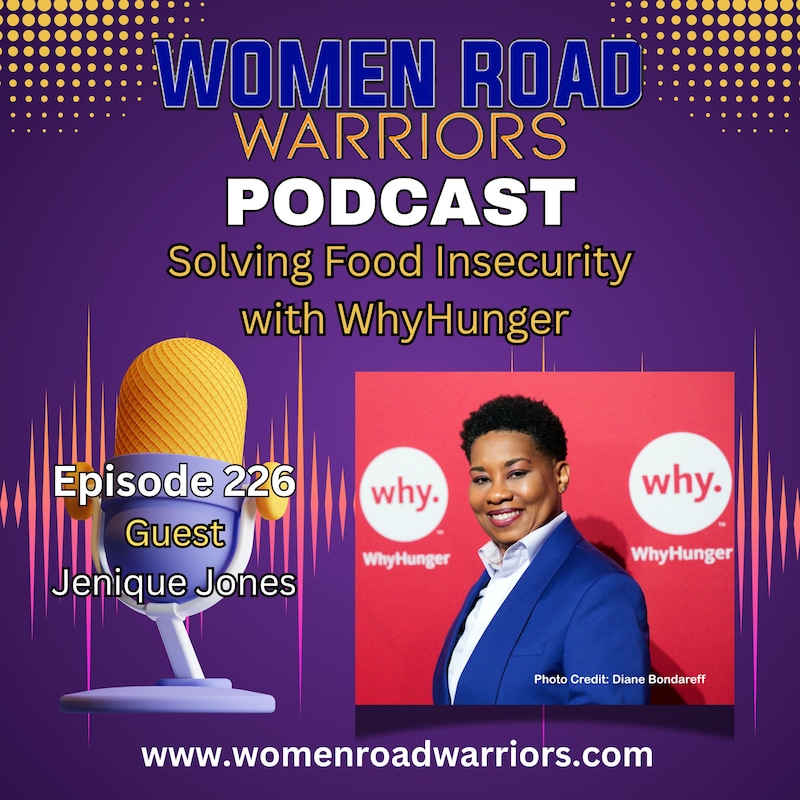
Shownotes
Food insecurity, hunger, food justice, and access to nutritious food are critical issues impacting millions—and the solutions may be closer than we think.
In this compelling episode of Women Road Warriors with Shelley Johnson and Kathy Tuccaro, we speak with Jenique Jones, Executive Director of WhyHunger, about solving hunger through sustainable, community-driven solutions and why hunger is not inevitable.
Jenique’s passion is rooted in lived experience. Growing up in Harlem during the crack epidemic, raised by her grandmother, she witnessed how broken systems prevent access to basic necessities like healthy, nutritious food. That experience shaped her lifelong mission to fight hunger, strengthen communities, and advance food justice.
Her career includes public service with the New York State Senate, building community partnerships in education, and more than a decade at City Harvest, where she led efforts through major growth, technological innovation, and crises including Hurricane Sandy and the COVID-19 pandemic.
Today, Jenique leads WhyHunger, the global nonprofit founded in 1975 by musician Harry Chapin and radio host Bill Ayres, grounded in the belief that access to nutritious food is a fundamental human right. She is expanding the organization’s visibility, partnerships, and funding to drive long-term, sustainable solutions to hunger worldwide.
Through initiatives like the award-winning Plentiful app, corporate and donor partnerships, and investments in sustainable agriculture, WhyHunger is addressing the root causes of hunger. In the past three years alone, the organization has connected more than 3.5 million people to nutritious local food and invested nearly $7 million globally to support community-led solutions that empower people to feed themselves.
This episode also highlights a major gap: many food assistance programs are not aligned with the true cost of living, leaving countless individuals and families food insecure. Jenique emphasizes that those most impacted must be part of the conversation—and part of the solution.
If you’re interested in hunger relief, food insecurity solutions, community empowerment, and sustainable food systems, this episode delivers insight, inspiration, and actionable awareness.
👉 Listen now to learn how hunger can be solved—and why it starts with all of us.
https://womenroadwarriors.com/
#FoodInsecurity #Hunger #SolvingHunger #WhyHunger #JeniqueJones #HarryChapin #BillAyres #HungerRelief #FoodJustice #WomenRoadWarriors #ShelleyJohnson #KathyTuccaro
Transcripts
This is Women Road warriors with Shelly Johnson and Kathy Tucaro.
Speaker A:From the corporate office to the cab of a truck, they're here to inspire and empower women in all professions.
Speaker A:So gear down, sit back and enjoy.
Speaker B:Welcome.
Speaker B:We're an award winning show dedicated to empowering women in every profession through inspiring stories and expert insights.
Speaker B:No topics off limits on our show, we power women on the Road to success with expert and celebrity interviews and information you need.
Speaker B:I'm Shelley and Kathy's on assignment.
Speaker B:Hunger is one of the most urgent challenges of our time.
Speaker B:But today's guest believes it's not inevitable.
Speaker B:In fact, she says hunger is a solvable problem.
Speaker B:Janique Jones knows this, not just as an advocate, but from lived experience.
Speaker B:Growing up in Harlem during the crack epidemic, she was raised by her grandmother and saw firsthand how broken systems can leave entire communities struggling to access basic necessities like nutritious food.
Speaker B:Those early experiences ignited a passion that would shape her life's mission.
Speaker B:Jeannique has devoted her career to strengthening communities and fighting hunger through innovative leadership and partnerships.
Speaker B:She began her public service career with the New York State Senate and later worked in education building community partnerships before spending more than a decade at City Harvest.
Speaker B:There she helped guide the organization through major growth, technological innovation and crises, including Hurricane Sandy and the COVID 19 pandemic.
Speaker B: nonprofit that was founded in: Speaker B:Janique is now leading the organization back to its founding mission while expanding its visibility and funding to advance sustainable solutions to hunger.
Speaker B:Along the way, she's helped launch award winning tools like the Plentiful app, strengthened donor and corporate partnerships and built strong, engaged teams committed to making nutritious food accessible to more communities.
Speaker B:From her base outside Washington, D.C. jeannique is helping lead a worldwide movement tackling hunger at its roots.
Speaker B:In just the past three years, Yhonger has connected more than 3.5 million people to nutritious local food and invested nearly $7 million globally to support sustainable agriculture and community driven solutions that empower people to feed themselves and their communities.
Speaker B:Janique, this is inspiring work and I'm so excited to learn more.
Speaker B:Welcome to our show.
Speaker C:Thank you for having me.
Speaker C:I need to take you everywhere to introduce me.
Speaker C:I'm pretty impressive.
Speaker C:Didn't even know it.
Speaker B:Oh well, thank you.
Speaker B:Jennique, your story too.
Speaker B:Growing up in Harlem and seeing firsthand how systems can fail communities.
Speaker B:And when it comes to something as fundamental as food, that is just egregious.
Speaker B:How did those early experiences shape your understanding of hunger?
Speaker C:What's interesting is where I first learned that systems broke down was actually around education.
Speaker C:And we.
Speaker C:The reason around that was my family.
Speaker C:My grandmother particularly fought for me to always be in the top class, go to the best schools, because we lived in a neighborhood that did not have the best school system.
Speaker C:And years later, seeing friends that I know were just as smart as I was, if not smarter, who were not in the same place that I was in my life as an adult, and really recognizing that, it was the fact that, you know, my grandmother knew how to kind of play the system or how to navigate it, and they had parents who did not, and.
Speaker C:And just realizing that that's not the way that we want our world to be.
Speaker C:Yeah.
Speaker C:And then at that time, I was also, you know, I was still living in Harlem.
Speaker C:I was working in a school, one of the schools that I would have gone to, which had been a very low performing school, had my grandmother not done the things that she had done.
Speaker C:And I met a young lady who had, you know, a lot of health problems.
Speaker C:Her family was very poor, and her and her sister used to come to school because it was the place that they were guaranteed to get two meals.
Speaker C:And so that is where I really began to see again, how the system and how things are set up with that inequity and that inequality.
Speaker C:Because the idea that a child who, you know, is basically depending on either the school system or the hospital, because those are the two places she pretty much spent her time for most of her daily meals.
Speaker C:That's.
Speaker C:That's not.
Speaker C:Not in the richest country in the world.
Speaker C:Absolutely not that.
Speaker C:Just that.
Speaker C:That did not sit right with me.
Speaker C:And it's really what led me to move from, you know, working in education or politics to wanting to be in the food space to try to make, you know, changes.
Speaker B:Absolutely.
Speaker B:You know, I think that we have seen in recent decades more and more children depending on the schools for their meals.
Speaker B:Why is that happening?
Speaker C:You know, what I.
Speaker C:What I always say is that hunger is.
Speaker C:It's a policy choice we have.
Speaker C:There is enough food actually on this, in.
Speaker C:On this planet to feed every last person probably two or three times older.
Speaker C:So, you know, when I worked in the food bank, a large portion of the food we received was from farmers who basically, they're incentivized, in some instances, to plow the food over, you know, not to sell it or Maybe it's misshapen or, you know, they're not going to get top dollar and they would donate that food and then the food banks would come and they would take it.
Speaker C:But it just, that's.
Speaker C:Imagine if that food was just given out to folks.
Speaker C:If that food, it was just made readily available, even without the kind of food banking system.
Speaker C:Because not everyone goes to a food pantry.
Speaker C:Not everyone knows that food pantries even exist, or people are too proud to go to a food pantry, or they don't understand that they can go to a food pantry or they, they're open.
Speaker C:You know, there's so many different reasons.
Speaker C:But what if that food was made available to people?
Speaker C:And so I just think that there, that's a policy we could change so that there wasn't that incentive to plow the food over.
Speaker C:I think that we could say that things like SNAP benefits were based on your income, where you live.
Speaker C:Because what we know is that I think for a family of three in New York City, you have to make around $28,000 a year to qualify for SNAP.
Speaker C:But a single person cannot live a sustainable life in New York City.
Speaker C:So that's not even a family of three.
Speaker C:A single person cannot live a sustainable life and make less than like, I think it's like $75,000 a year in New York City.
Speaker C:In New York City.
Speaker C:And those numbers are just as, they're lower, but they're also there.
Speaker C:You know, some places in, like, Mississippi, that number is 45,000 in terms of sustainability.
Speaker C:But again, the numbers for SNAP are still very low.
Speaker C:So you have working people who are not able to, who are struggling, who are making the choice between food and rent, medicine and food, all of those things.
Speaker C:So just imagine if we said, okay, we're gonna, we're gonna tie SNAP to the cost of living as opposed to, like, the federal poverty, you know, level.
Speaker C:So just those kind of things and what we could be doing to really makes this a real impact on folks.
Speaker B:Is it a fault of the, of the bureaucracy, essentially?
Speaker B:They haven't updated the numbers because when you think about it, what you're talking about, those numbers are just super low and food's not cheap.
Speaker C:I, you know, I couldn't tell you.
Speaker C:I don't know if it's.
Speaker C:I do know that, you know, it's sometimes people, when you are not in those circumstances, you don't really understand it.
Speaker C:It's why the SNAP challenge that they were do, everyone was doing a couple of years ago was so impactful because you had very well off people who were trying to live on what people get the snap, you know, program and were mortified because they really understood what it meant.
Speaker C:I think that, you know, we have a lot of people who make decisions around hunger and poverty who don't.
Speaker C:Who either aren't experiencing those things at the time or maybe, and if they have, they're so far removed from it that it's.
Speaker C:It's.
Speaker C:I don't think they truly understand what people are going through.
Speaker B:Sure.
Speaker C:I won't even say it's.
Speaker C:That they don't care.
Speaker C:I think it's.
Speaker C:It's.
Speaker C:It's hard, you know, to.
Speaker C:Even for myself, you know, I didn't grow up making a ton of money or anything like that, but I have a much different level of living than now, than I did as a child.
Speaker C:And so there's, you know, there's certain things that I still remember, but I.
Speaker C:It's.
Speaker C:It doesn't resonate with me the way that it wants it.
Speaker C:So I think, you know, we really have to make sure that the people who are the most impacted are a part of the conversation.
Speaker C:That's a big thing that we do at why Hunger?
Speaker C:You know, we believe that the communities that we are working in are the ones who are best designed to come up with the solutions.
Speaker C:And so I think that's a part of it.
Speaker C:Let's bring.
Speaker C:Let's bring these folks into the conversation.
Speaker C:When you're passing these bills and you're making these decisions, I think that's really important.
Speaker B:Oh, absolutely.
Speaker B:Well, that makes only good sense.
Speaker B:You can't be up in your ivory towers making decisions for other people.
Speaker B:You should have people who can give you the feedback, who are there, who are in the trenches, if you will, who are on the street walking around saying, this is what's really happening.
Speaker B:Because otherwise you have no idea.
Speaker B:And I think that that's something that unfortunately has gone with government bureaucracy for decades.
Speaker B:I mean, when you're talking about plowing food under.
Speaker B:I know that that was being done even around World War II.
Speaker B:So, I mean, we're talking many, many, many decades where farmers were incentivized not to grow a certain crop and that kind of thing.
Speaker B:So, I mean.
Speaker B:And it's a wasteful thing to do.
Speaker B:Food should be provided for people.
Speaker B:That's why we have it.
Speaker B:And no one.
Speaker B:I agree with you, no one should go hungry in this country at all.
Speaker B:And they should go hungry anywhere.
Speaker C:I couldn't agree more.
Speaker C:And it's.
Speaker C:It's.
Speaker C:I think that to me, food is the one thing we all need.
Speaker C:It's just why, you know, we believe it's a basic human right.
Speaker C:You can go without a lot of things.
Speaker C:You can, technically, you can, you can be stark naked.
Speaker C:You cannot have a home.
Speaker C:You cannot have certain things.
Speaker C:But we need food and water.
Speaker C:And so to me, those are just the, that's the, that should be the floor of what people have access to.
Speaker C:I think it's, you know, we truly believe that food and nutritious food should be a human right.
Speaker B:I agree.
Speaker A:Stay tuned for more of Women Road warriors coming up.
Speaker D:Dean Michael, the tax doctor here.
Speaker D:I have one question for you.
Speaker D:Do you want to stop worrying about the irs?
Speaker D:If the answer is yes, then look no further.
Speaker D:I've been around for years.
Speaker D:I've helped countless people across the country, and my success rate speaks for itself.
Speaker D:So now you know where to find good, honest help with your tax problems.
Speaker D:What are you waiting for?
Speaker D: -: Speaker B:Industry Movement Trucking Moves America Forward is telling the story of the industry.
Speaker B:Our safety champions, the women of trucking, independent contractors, the next generation of truckers, and more help us promote the best of our industry.
Speaker B:Share your story and what you love about trucking.
Speaker B:Share images of a moment you're proud of and join us on social media.
Speaker B:Learn more at truckingmovesamerica.com.
Speaker A:Welcome back to Women Road warriors with Shelly Johnson and Kathy Tucaro.
Speaker B:If you're enjoying this informative episode of Women Road Warriors, I wanted to mention Kathy and I explore all kinds of topics that will power you on the road to success.
Speaker B:We feature a lot of expert interviews, plus we feature celebrities and women who've been trailblazers.
Speaker B:Please check out our [email protected] and click on our Episodes page.
Speaker B:We're also available wherever you listen to podcasts on all the major podcast channels like Spotify, Apple, YouTube, Amazon, Music, Audible, you name it.
Speaker B:Check us out and bookmark our podcast.
Speaker B:Also, don't forget to follow us on social media on Twitter, Facebook, Instagram, Pinterest, LinkedIn, YouTube and other sites and tell others about us.
Speaker B:We want to help as many women as possible.
Speaker B:Before the break, we introduced you to Janique Jones, executive director of why Hunger?
Speaker B:She's leading a powerful global effort to tackle one of the most urgent challenges of our time.
Speaker B:Hunger but here's what makes this conversation different.
Speaker B:Janique doesn't see hunger as inevitable.
Speaker B:She sees it as solvable.
Speaker B:From growing up in Harlem during the crack epidemic to now leading an organization that's connecting more than 3.5 million people to nutritious food in just the past three years, her journey is both deeply personal and incredibly impactful.
Speaker B:Let's dive back in with Janique and talk about what it really takes to address hunger at its roots and why access to nutritious food is a fundamental human right.
Speaker B:Janique, now, your organization was originally founded by Harry Chapin and Bill Ayers.
Speaker B:Could you give us a little brief history on that?
Speaker B:Because I'm not sure everybody knows that.
Speaker C:Yeah.
Speaker C:So, you know, Bill.
Speaker C:Father Bill is what we call him on this side of the world.
Speaker C:But Bill and Harry, they, you know, they became friends partially because, you know, Bill was a radio DJ and Harry was a performer.
Speaker C:And Harry would go around and tour, and he would see the hunger and kind of the ways in which people were struggling.
Speaker C:And he was someone who believed, you know, his models, when in doubt, do something.
Speaker C:And so, you know, and then Bill, who, you know, had got.
Speaker C:Who had actually been a priest, and so he still held on to a lot of those beliefs about, you know, being a good person and helping your fellow man.
Speaker C:And the two of them, you know, around a kitchen table, around Harry's kitchen table, started why hunger?
Speaker C:And the idea was that there is enough food for everyone, and this is solvable.
Speaker C:They called it why Hunger Year at the time, because they actually thought they were going to solve this thing in a year.
Speaker C:And, you know, 50 years later, here we are.
Speaker C:But, you know, the ideas behind it are the same.
Speaker C:And the great thing around, you know, how we were really able to.
Speaker C:To have find our own success as an organization is Harry was coming off of the success of Cats in the Cradle.
Speaker C:And so it really gave him both the financial ability, but also just the name recognition and the platform to be able to speak about these issues and kind of put it out there in the forefront.
Speaker C:And, you know, it's why we still work with so many musical artists today, because they have a voice and they have a way of amplifying this work that's really significant.
Speaker C:But, you know, you're still living by Harry's words, when in doubt, do something.
Speaker C:And trying to continue what I think is a really important legacy.
Speaker B:I love that hunger is solvable, but how do we solve it?
Speaker B:I think a lot of people don't know.
Speaker B:And maybe some people say, well, it's going to happen.
Speaker B:And that's the wrong attitude, too.
Speaker C:I mean, the truth is there's no one way.
Speaker C:Right.
Speaker C:I think that, you know, we've really been leaning into agro ecology and people going back to growing food and empowering, like smaller farmers all over the world to be able to, you know, do that work.
Speaker C:And that can look a lot of different ways from, you know, being able to provide for their own families to in some cases, being able to provide for communities, being able to sell that food at a more reasonable price that people can afford.
Speaker C:So both providing food for their families and then also making money, because we also still live in a world where you have to buy things.
Speaker C:But I.
Speaker C:So I think that that's one avenue.
Speaker C:But I also do think, you know, one of the things I'm really excited about is to move more into, you know, doing policy and advocacy.
Speaker C:We used to do that, you know, years ago, before I was at Y Hunger.
Speaker C:But I think that, you know, having people like us at Y Hunger at some of those tables and being able to even bring some of our community members as we were just talking about to speak to these issues, I think could be really powerful.
Speaker C:I think we should have.
Speaker C:Our.
Speaker C: um wage has not gone up since: Speaker C: I mean, it's: Speaker C:So, I mean, if you just think about if we.
Speaker C:If the minimum wage had kept up with the cost of living, we would be at like 20 some odd dollars an hour.
Speaker C:That alone could be transformational for people.
Speaker C:I think that if we, like I said, if we change some of the rules around who is and isn't eligible for SNAP and other benefits, that could be really impactful.
Speaker C:But I think what we have to remember is hunger isn't actually the reason hunger exists is not just about the access to the food.
Speaker C:It's about so many of these other systematic issues, right?
Speaker C:It's in a bad school system, so you don't get a good education, so you don't get a good job.
Speaker C:It's all of those different societal issues that we have to kind of tackle.
Speaker C:And now granted, why hunger is not out there changing the school system and doing all of those things, but we want to always connect that for people that yes, it's food access and it's money, but it's all of these other issues that underlie it as well.
Speaker B:Well, certainly when you're living in an area where you can't grow food, I mean, obviously many Many decades ago, we were more of an agrarian society.
Speaker B:We were farmers, a lot of us, unless we lived in major cities.
Speaker B:If you're in a major city, you need money to get food.
Speaker C:Exactly.
Speaker B:You can't just go in and say, gimme something.
Speaker B:I mean, people expect money for the food.
Speaker B:And then in a lot of cases you've got what they call food deserts where maybe people are, they're not able to get the kind of food they need, nutritious food.
Speaker B:And I think that even people who may be making what would be considered a decent living food is where they cut.
Speaker B:And unfortunately children suffer because they end up.
Speaker B:A lot of the food that's cheaper is not nutritious.
Speaker B:And you have to have nutritious food, whether you're a child or an adult for us to function.
Speaker B:You need good food.
Speaker C:Yeah, I think you're absolutely right.
Speaker C:Food is your most elastic budget.
Speaker C:You know, you have to keep the lights on, you have to keep the heat on, you need gas to get to work.
Speaker C:But food is the most elastic budget.
Speaker C:And it's, it's one of the reasons why I used to run a nutrition education program at one of the, at the food bank where I worked.
Speaker C:And I really made people focus on.
Speaker C:Because the idea was always, you just got to teach people how to eat healthy.
Speaker C:And I said, no, people know how to eat healthy.
Speaker C:It's about money.
Speaker C:The healthier the food, typically the more expensive, but also, and you can bear this out, if you go to a supermarket in a wealthier neighborhood, the food is often a bit cheaper and it's better quality.
Speaker C:And then you go to the supermarket in the poorer neighborhood, it's more expensive and it goes bad faster.
Speaker C:And I, you know, and I lived in, you know, when I lived in New York, I lived in Flatbush, which is a changing neighborhood right now.
Speaker C:But my supermarket was not the best.
Speaker C:And I would never buy produce from the supermarket because you get it home and it's bad in two days.
Speaker C:I had the means to then go to somewhere else and buy my food or order it from someplace, but most people don't have that.
Speaker C:So when you're making that choice, what you do is you buy the canned stuff with the sodium or you, you know, or think about this.
Speaker C:A container of orange juice is $7, but you can get three 2 liter sodas for five.
Speaker C:Yeah.
Speaker C:So it's, it's those kind of choices.
Speaker C:And people often say, well, just drink water or just do this because there's also this like shaming of people who don't have Money that they should not have treats or they shouldn't have this.
Speaker C:You know, it's.
Speaker C:We never shame rich people for eating junk food, but we do it with poor people.
Speaker B:Yeah.
Speaker B:Why would you say food in a poor neighborhood was typically more expensive and the produce was not as fresh?
Speaker B:That doesn't seem right at all.
Speaker B:I mean, it looks like they're the last to be delivered the fresh produce or something.
Speaker C:I honestly, I've never understood it.
Speaker C:I mean, you know, I could probably sit here and hypothesize, I think, that there is a stigma on poor people, and sometimes there's.
Speaker C:I remember once there was a man who worked at the food bank.
Speaker C:He didn't work there long because he was kind of a jerk.
Speaker C:But one of the trucks was late to the food pantry, and what he said was, people can wait for their free food.
Speaker C:What else they got to do?
Speaker B:Wow.
Speaker C:I think that there's also this attitude of, you know, people who are, in certain circumstances, are there because of poor life choices or they deserve it.
Speaker C:And so, you know, that that's.
Speaker C:That's possible.
Speaker C:You know, I. I can't say that that's for certain, but I've definitely seen that attitude among a lot of people.
Speaker C:So, you know, I would not be surprised if that played a bit into it.
Speaker C:I do know there is also the fact that often in, you know, poor neighborhoods, people like to talk about the crime or things like that or higher insurance rates or what have you.
Speaker C:So then they say they have to up the cost and, you know, those kind of things.
Speaker C:It could very well be a moat, but it's probably a combination of all of these kinds of things.
Speaker B:You know, I remember growing up, my mother used to say that food is the best health insurance you can have.
Speaker C:I mean.
Speaker C:Yeah, yeah, yeah.
Speaker B:Nutritious food.
Speaker B:If you eat well, you're going to have better health.
Speaker B:You know, it just.
Speaker B:It goes hand in hand.
Speaker B:Now, obviously, when I was in college, I used to eat, you know what, ramen noodles and stuff like that.
Speaker B:You cut corners because you got other stuff you'd rather be doing.
Speaker B:But that's where the maturity has to kick in, too.
Speaker C:But they're also delicious, but, you know.
Speaker C:Right.
Speaker B:But a lot of sodium, you know, and you want convenience when you're 18, 19 years old.
Speaker B:But yeah, I mean, the education and I think that our school systems.
Speaker B:I don't know if that's across the board.
Speaker B:They used to have better home economics classes.
Speaker B:I don't know if they're teaching.
Speaker B:Not anymore.
Speaker C:There's no home ec there's no kids.
Speaker C:I mean, kids, preschool now, they, they can't.
Speaker C:They don't know anything about cooking.
Speaker C:They can't balance a budget.
Speaker C:They shop all of those kind of things.
Speaker C:I mean, they may still exist in some school systems or some schools, but on average, those are not things that, that people are teaching anymore.
Speaker B:Wow.
Speaker C:No, not at all.
Speaker C:And I worked in school, so I can tell you firsthand.
Speaker B:So that's just amazing because I'd heard stories like during the Depression, home economics teachers would actually teach the students how to make substitutes.
Speaker B:If you didn't have any butter, you use this or this or this.
Speaker B:Because people didn't have the food, they didn't have the money with the Depression, so they taught them how to make substitutions and various other things.
Speaker B:And that's so essential.
Speaker C:I mean, I'm.
Speaker C:I'm going to be 49 in like a month and a half.
Speaker C:And I did not have Home EC in school, so it's been gone for quite some time.
Speaker C:I never.
Speaker C:I was fortunate that I had a family that really liked to cook, so I learned that way.
Speaker C:But I, you know, and how to cut and how to make healthier meals, even, you know, if I did not have that, I would be in the same boat.
Speaker B:So it's kind of a logarithm.
Speaker B:You've got people growing up that don't necessarily know how to cook healthy.
Speaker B:They don't know how to do the things that they need to do.
Speaker B:So, I mean, then they can't even be their own best advocate either on, I want better food in these grocery stores.
Speaker B:And I mean, how do we make this change?
Speaker B:I mean, it sounds like there's so many elements, it's quite overwhelming and it's wonderful.
Speaker B:What why Hunger is doing.
Speaker C:I mean, I think it's, you know, until we can have large kind of policy shifts, I think it's really taking the work of why Hungers and the other organizations that are out there that are doing these things and trying to tackle it little by little.
Speaker C:You know, what I'm really encouraged to see is that there's now a lot of organizations that are, you know, yes, we might compete or fundraising dollars and things like that, but that, you know, we're all willing to join together in common cause.
Speaker C:You know, when I work at the Food bank, we were part of a coalition of a bunch of folks in New York City that advocated together and tried to really make changes to that system.
Speaker C:And now that I'm at Y hunger, I'm part of another coalition that's made up of different organizations like Feeding America share our strengths, and that's called Nourishing Neighbors.
Speaker C:There's a few other organizations in there as well, you know, and again, we might all be after the same fundraising dollars, but we come together multiple times a year to talk about how can we make these changes together.
Speaker C:And, you know, and, you know, we do this really well, so we're going to tackle this part, and this other organization does this really well, so we're going to tackle that part.
Speaker C:I think that we have to get through some of this together, and I think we have to start to even expanding our coalition, even if not through that particular group, but just in general to organizations that are doing work around income inequality or gender discrimination.
Speaker C:Because what we also know is women are more food insecure than men, you know, which also goes back to money.
Speaker C:And then, you know, that's.
Speaker C:We talk a lot at Wire Hunger about, you know, marginalized communities.
Speaker C:Because what we also know is that, you know, the racial issues involved in that, you know, because even within you think about women who make less than men, white women make the most, and then it's followed by, you know, it.
Speaker C:So there's also those type of issues.
Speaker C:And we know then we also want to support, you know, really coming in coalition with people who are doing work around kind of LGBTQ issues, because we know that, you know, for instance, transgendered women are really, you know, at the lowest end in terms of food insecurity and indigenous women.
Speaker C:So there's just all of these different intersections that, you know, we all have to come together.
Speaker C:And it doesn't have to be why hunger's kind of area of expertise, but really working with and in solidarity with those organizations, it's why a lot of the farms that we support, our bipoc farms, LGBTQ run farms, women farm.
Speaker C:You know, we really try to lean into that idea even within the work that we're doing.
Speaker A:Stay tuned for more of Women Road warriors coming up.
Speaker D:Dean Michael, the tax doctor here.
Speaker D:I have one question for you.
Speaker D:Do you want to stop worrying about the irs?
Speaker D:If the answer is yes, then look no further.
Speaker D:I've been around for years.
Speaker D:I've helped countless people across the country, and my success rate speaks for itself.
Speaker D:So now you know where to find good, honest help with your tax problems.
Speaker D:What are you waiting for?
Speaker D: -: Speaker B:Industry movement Trucking Moves America Forward is is telling the story of the industry.
Speaker B:Our safety champions, the women of trucking, independent contractors, the next generation of truckers and more.
Speaker B:Help us promote the best of our industry.
Speaker B:Share your story and what you love about trucking.
Speaker B:Share images of a moment you're proud of and join us on social media.
Speaker B:Learn more at truckingmovesamerica.com.
Speaker A:Welcome back to Women Road warriors with Shelly Johnson and Kathy Tucaro.
Speaker B:Welcome back to Women Road Warriors.
Speaker B:We're here with Janique Jones and her story is one that really stays with you.
Speaker B:She grew up in Harlem, raised by her grandmother during a time when entire communities were being left behind.
Speaker B:And she saw firsthand what happens when systems fail people.
Speaker B:That lived experience didn't just shape her perspective, it became her purpose.
Speaker B:Today as executive director of WhyHunger, she's helping lead a global movement focused not on just feeding people today, but creating sustainable solutions so communities can feed themselves for generations to come.
Speaker B:Let's get back into this important conversation.
Speaker B:Jeanique, you've certainly gotten a lot of national attention.
Speaker B:Mother Jones Worth and Food with Mark Bittman.
Speaker B:You're bringing together all kinds of people, artists and activists and advocates to fight food insecurity.
Speaker B:Last year you celebrated your 50th anniversary with the Chapin Awards gala and you honored Grammy Award winning artists and lifelong activists Pat Benatar and Neil Girardo.
Speaker B:You've got a gala coming up this year, too.
Speaker B:Could you tell us a little bit about this?
Speaker B:I mean, because you've been able to raise some tremendous amounts of money.
Speaker B:Your 40th annual Hunger Thon, what was it you just raised?
Speaker B:1.3, Almost $1.4 million.
Speaker B:And that involved what Bruce Springsteen and chef Marcus Samuelson and many other people.
Speaker B:I mean, you're doing some tremendous things to get the word out and to create the solidarity too.
Speaker C:Well, I mean, you know, a lot of that is Harry's legacy.
Speaker C:You know, for those who might not know, we are the world.
Speaker C:That concept came to folks, was inspired by Harry.
Speaker C:You know, he wasn't here with us anymore, but you know, Bill Craigen and Harry Belafonte talk about that.
Speaker C:So I think that there are a lot of artists who really respect Harry Chapin and respect that legacy of, you know, musician as activists.
Speaker C:And so they are, you know, excited to be a part of this work.
Speaker C:And I think that people are really excited to be a part of Harry's legacy, you know, and when Bruce Springsteen, when he showed up to I was about to say Bruce, like, he's my cousin.
Speaker C:When he showed up to the concert at the Stone Pony.
Speaker C:He talked about the first, you know, the first time he met Harry and kind of, you know, that relationship.
Speaker C:And so we're very fortunate to kind of stand on those shoulders.
Speaker C:And so, you know, and that's where a lot of that comes from.
Speaker C:There's a reason we call it the Harry Chapin Awards.
Speaker B:So he was a wonderful man and a wonderful performer.
Speaker B:I had the honor of actually seeing him in concert.
Speaker B:What a gracious man.
Speaker B:And I mean, he did lots of encores, too.
Speaker B:Not all performers do that.
Speaker B:And he really appreciated the people who came to see him.
Speaker B:You could tell that he really cared about people.
Speaker B:And why Hunger definitely shows that.
Speaker B:So what are some of your plans this year and going forward and what can other people do if they want to get involved?
Speaker C:Well, our most immediate plan is that we are going, which we announced today, honor the amazing Andra Day at our gala this year with the Harry Chapin Humanitarian Award.
Speaker C:I am so excited about that.
Speaker C:And that's coming up on May 6th in New York City at Cipriani.
Speaker C:So those tickets will be going on sale.
Speaker C:People can and come and, and, and to that, buy tables and such.
Speaker C:I gotta plug that.
Speaker C:And then, you know, we are going to be really focused on our strategic planning and what's coming next.
Speaker C:You know, we just celebrated 50 years, but what's happening for the next 50 years?
Speaker C:Because our goal is to put ourselves out of business.
Speaker C:I actually would love to not be doing this anymore.
Speaker C:So that's our plan is what do we need to do to actually end hunger?
Speaker C:That's why we say we're here, you know, And I think people can support us.
Speaker C:You know, they can go to, you know, why hunger.org and they can donate.
Speaker C:They can volunteer to work our hotline.
Speaker C:You know, in the fall and the winter of last year, our numbers for our hotline with people calling, looking for support went through the roof.
Speaker C:So, like the part they put year prior, we had about a million calls.
Speaker C: In: Speaker C:So we literally doubled the amount of calls in one year.
Speaker C:So that's, you know, we can always use some support there.
Speaker C:And you can do it from your home.
Speaker C:That's the cool thing.
Speaker C:You don't have to come in someplace anymore.
Speaker C:You can actually take those calls from your home.
Speaker C:But yeah, I think, you know, just whyhunger.org and, you know, no check is too small.
Speaker C:One of my favorite things to do is once A week I sit down and I write postcards to the people who've donated to us.
Speaker C:And I don't just do it for the people who give bid checks.
Speaker C:I do it for people who've given as little as $2 because they matter.
Speaker C:I like to say a little bit plus a little bit equals a lot.
Speaker C:Yeah, I think that's.
Speaker C:That those are the main two ways that I'm thinking about.
Speaker C:And also just look up for our events.
Speaker C:We do really cool events.
Speaker C: You know, we was it in: Speaker C:And last year it was Little Steven and Bruce Springsteen and Yola and Young the Giant.
Speaker C:So we do really cool events.
Speaker C:We have our Hunger Thon Hustle, which was at Citi Field last year, which is a 5K that we do.
Speaker C:And it was so much fun.
Speaker C:Mr. And Mrs. Met came out and ran the whole thing with us, and we're going to do it again this year.
Speaker C:We haven't solidified the date yet, but it's going to be the November.
Speaker C:December.
Speaker C:I'm pushing for November because it's a little less cold.
Speaker C:But yeah, you know, even those kind of things, just check it out and come and hang out with us because we.
Speaker C:We actually really do a lot of fun stuff.
Speaker B:It's fun to do fun things for a good cause.
Speaker B:Now, I'm not sure everybody knows that you have a hotline, the why hunger hotline.
Speaker B: -: Speaker B:Now, is that nationwide when people call in and they need emergency food assistance, you guide them?
Speaker C:Yes, it is.
Speaker C:They can call or text.
Speaker C:They can use those numbers to call or text.
Speaker C:And we will provide them food anywhere in the US we will provide them with resources to food anywhere in the US if you text, all you have to do is text.
Speaker C:Text your zip code to that number, and you'll get, you know, you'll get some of the prompts, and it'll direct you to the places that you might need to go.
Speaker C:If you call, there's going to be, you know, typically there's.
Speaker C:There is someone on the other end of the line and we, you know, again, free local food and resources right there in your community.
Speaker B:That's wonderful.
Speaker C:We, we believe in giving people access to food for today while we work to make it so that they never need us again.
Speaker C:That's.
Speaker C:That's kind of.
Speaker C:We're working on poofons.
Speaker B:I like that.
Speaker B:Well, and that's what they need.
Speaker B:I mean, there's nothing more desperate than being hungry.
Speaker B:It's scary enough.
Speaker B:I mean, people can be homeless, they can be without those kind of resources, but when they're hungry too, what do they do?
Speaker B:I mean, and when you have children, too, there are a lot of parents that are feeding their kids and going hungry.
Speaker B:They have to make that kind of choice.
Speaker B:And that shouldn't have to be.
Speaker C:Well, I mean, I think, I think.
Speaker C:And not just children.
Speaker C:I think, you know, even the worst person of the worst person should still have food.
Speaker C:Yeah.
Speaker C:You know, I think that's really important.
Speaker B:Absolutely.
Speaker B:So how can people volunteer?
Speaker B:If they go to your website, would they have places where they could volunteer locally or they can, they can definitely.
Speaker C:Get in contact with us.
Speaker C:And like I said, they can either do some volunteering with us or we can really work to put them together, put them in touch with someone in their community.
Speaker C:I mean, and even if you, if you are looking for someplace to volunteer in your community, you don't even have to go through us.
Speaker C:You can go to your local food pantry, your local soup kitchen.
Speaker C:They need support.
Speaker C:And it's hard work.
Speaker C:I've done it.
Speaker C:But I think that we can absolutely connect folks if they're just looking for a repository of someplace that they can go quick and easy to find that support.
Speaker C:Because even if you text food to that number, it's going to tell you what's in your community.
Speaker C:So if you're texting or calling, even if you're not looking for food resources, it's going to give you the things that are in your community where you can reach out and potentially give them support as well.
Speaker B:Now, is this nationwide or does your organization help in other countries as well?
Speaker C:So for the hotline, the hotline is nationwide, but our work is global.
Speaker C:So we do support organization, organizations with resources and with grants, money outside of the US Typically.
Speaker C:So, for instance, I love to tell the story about the grain mill that we helped purchase for the women in Tamu, I can never say the name, a small village in India.
Speaker C:And essentially the girls in that, that village, they would spend all their days instead of going to school, grinding mill.
Speaker C:And by getting the grain mill, they were able to go to school.
Speaker C:And some of those young ladies wound up becoming leaders in their, in their communities and things like that.
Speaker C:So it's, you know, sometimes it's yes, by have being able to, you know, grind that grain, that helps in terms of food production and, you know, all of those things.
Speaker C:But the fact that those young ladies can now go to school also helps support and uplift that community.
Speaker C:So it's kind of a win win.
Speaker C:So those are the type of things that we do outside of the US or helping a village in Kenya with a fishing village.
Speaker C:So, you know, those kind of things are what we're doing outside of the U.S. we're also, we have a cohort of agroecology schools that we've been working with in the Caribbean and Latin America, really focusing again on teaching people how to grow food, but grow it in a way that is less harmful to the environment.
Speaker B:Sustainability.
Speaker B:And certainly in many areas of the world, water is in short supply, so that can impact the crops as well.
Speaker B:I would imagine.
Speaker B:You're probably working with people in that area too, aren't you, in terms of the sustainability and being able to find food solutions that will feed everybody?
Speaker C:Yeah, I mean, that's a big reason why we're leaning into, you know, the more indigenous ways of farming, because like I said, it is less harmful to the planet.
Speaker C:Industrial farming has actually done a lot of harm to our environment.
Speaker C:And so really trying to teach people how to move away from, from that way of farming.
Speaker C:Because one of the other programs we have is we do a lot of what we call rapid response funding.
Speaker C:And that's when there's a tornado or there's a hurricane and a village got wiped out or something happens and, you know, and people need resources to not just rebuild, but even to survive while they rebuild.
Speaker C:And so the more we're able to help with that sustainability, hopefully we can start to decrease the need for that rapid response.
Speaker B:Well, certainly with the various natural disasters we've had across the country, people have experienced that, you know, when, when you can't get supplies in and there's no way to access food and there's no electric, you've got lots of food spoilage.
Speaker B:People are dealing with, how the heck am I going to eat here?
Speaker B:Food insufficiency can happen to anybody at any time in their life.
Speaker C:Yeah, I mean, we saw that in Covid.
Speaker C:We saw that during the pandemic where, you know, there were so many people who suddenly needed, you know, to rely on emergency food and were wondering where their next meal was coming from.
Speaker C:So you, you would see car, you would see BMWs on a line at a food pantry.
Speaker C:You know, most people, they, you know, there's a saying most people are closer to being homeless or food insecure than they are to being a billionaire and so, or even a millionaire.
Speaker C:So, you know, we're all a few paychecks away.
Speaker C:And so I think it's really important that, you know, we all recognize that as well.
Speaker B:It takes a village and no judgment.
Speaker B:There should be no judgment whatsoever.
Speaker B:If somebody is hungry, they need help, they don't need to be judged in any way or shamed.
Speaker C:Yes, yes, I, I agree.
Speaker C:And you know, we, we do sometimes judge people for asking for help on multiple fronts.
Speaker C:And I think that, you know, we have to, we have to get beyond that.
Speaker B:Well, when you judge them, they're not going to ask for help either.
Speaker C:Exactly.
Speaker B:And then it just keeps that problem going.
Speaker B:I mean, it doesn't solve anything.
Speaker B:Unfortunately.
Speaker B:Human beings have a tendency to like to judge and that's not a good thing.
Speaker B:What would you say?
Speaker B:I know that there's not an easy answer, but what would you say are maybe the real roots of hunger, obviously in this country?
Speaker B:I can't imagine, and I think a lot of people can't, that there's any hunger to begin with.
Speaker B:We are a land of plenty and it should be across the board.
Speaker B:Is there something that people could take away so that they know maybe how they can change this?
Speaker B:Are there some real roots here that they can really dig into and say, this is how we're going to make a change?
Speaker C:I mean, I think one of the first things we have is a lot of the income inequality.
Speaker C:You know, I mentioned the fact that the minimum wage hasn't changed.
Speaker C:You know, we have people working in very low income jobs sometimes and those, a lot of those jobs are like some of the most important.
Speaker C:You know, think about how much money like home health aides make.
Speaker C:We leave some of our most vulnerable with these folks and then we pay them nothing.
Speaker C:And so I think we really have to look at this income inequality and thinking about, you know, if not a living wage essentially for people, I think that is a great place to start.
Speaker B:Well, certainly your organization is trying to cover every base possible and I think everyone needs to know about you.
Speaker B:It's why hunger whyhunger.org people can donate, they can volunteer.
Speaker B:Where do you have your biggest need right now?
Speaker C:Money.
Speaker C:Yeah, that's always, you know, the thing.
Speaker C:Because what we, what we're also seeing is with a lot of the things that are happening in the world, we're seeing an increased need at a lot of the folks that we're supporting.
Speaker C:And so they're contacting us saying, you know, we need a little bit more, can you help us A little bit more.
Speaker C:And we often have to say no.
Speaker C:So I think that's really what, where, you know, just that ability to help support is, is important.
Speaker C:And sometimes that's not a lot of money.
Speaker C:It's just someone, someone needs a thousand dollars because they need to buy a new tractor.
Speaker C:If it's one of the places we support in terms of farming or, you know, if it's one of the pantries we support, they might need, you know, so I think that's a big thing.
Speaker C:And then there's also the fact that, you know, there's a lot of governmental support that's being cut.
Speaker C:And so people need, you know, they're turning to the why hungers of the world a lot more.
Speaker B:And it's a good thing you're out there.
Speaker B:So they have the resources.
Speaker B:So whyhunger.org you have the background of who you are, what you do, get involved, donate, find food.
Speaker B:What are some of your upcoming events that people could also check out?
Speaker C:Like I said, the one that's coming up the soonest is our gala.
Speaker C:It's going to be in New York City at Cipriani's in Wall street area.
Speaker C:We're going to be honoring Andra Day.
Speaker C:We're finalizing some other honorees, so people should also stay tuned for that.
Speaker C:That's going to be a really exciting night.
Speaker C:It always is.
Speaker C:You never know what's going to happen.
Speaker C:We've had days where some of our honorees wound up dancing barefoot on tables and very cool.
Speaker C:You know, there's impromptu jam sessions.
Speaker C:So it's a, it's a good place to be.
Speaker C:Like I said, we also will have our hunger thon hustle in the fall.
Speaker C:And you know, we're also finalizing some details for our concert this year.
Speaker C:So more to stay tuned.
Speaker C:There is always more to come.
Speaker C:And you know, we, last year we did an amazing partnership with the Guyanese rapper St John.
Speaker C:It was a merch partnership, but we did a, a dinner, Asian Guyanese dinner.
Speaker C:He launched the merchandise.
Speaker C:It was a wonderful night.
Speaker C:We're looking to do some more goes with more artists and it'll be more intimate.
Speaker C:Like that was like 50 or 60 people.
Speaker C:So it's not a big, you know, like concert kind of thing.
Speaker C:So we, we have two artists that we're trying to finalize that with.
Speaker C:So again, I think if people just sign up, subscribe to the newsletter, we'll keep you informed because these are the kind of cool things that we do.
Speaker B:Love it.
Speaker B:Love what you're doing and thank you, Janique, for being involved with this organization.
Speaker B:You have a true passion for it and I love how you're carrying on the legacy that was started over 50 years ago.
Speaker B:And wouldn't it be nice if you could say we're going to stop hunger and we want to basically work as a ourselves out of a job because hunger should not exist at all.
Speaker B:Thank God for people like you and your organization.
Speaker C:Thank you so much and I really appreciate it.
Speaker C:And yes, people put me, send me into retirement.
Speaker C:That is what I want.
Speaker B:There you go.
Speaker B:Thank you, Janique.
Speaker B:This has been a wonderful conversation.
Speaker C:Thank you.
Speaker B:We hope you've enjoyed this latest episode.
Speaker B:And if you want to hear more episodes of Women Road 1 Warriors or learn more about our show, be sure to check out womenroadwarriors.com and please follow us on social media.
Speaker B:And don't forget to subscribe to our podcast on our website.
Speaker B:We also have a selection of podcasts Just for Women.
Speaker B:They're a series of podcasts from different podcasters.
Speaker B:So if you're in the mood for women's podcasts, just click the Power network tab on womenroadwarriors.com youm'll have a variety of shows to listen to anytime you want to.
Speaker B:Podcasts Made for Women Women Road warriors is on all the major podcast channels like Apple, Spotify, Amazon, Audible, YouTube and others.
Speaker B:Check us out and please follow us wherever you listen to podcasts.
Speaker B:Thanks for listening.
Speaker A:You've been listening to Women Road warriors with Shelly Johnson and Kathy Tucaro.
Speaker A:If you want to be a guest on the show or have a ton topic or feedback, email [email protected].




