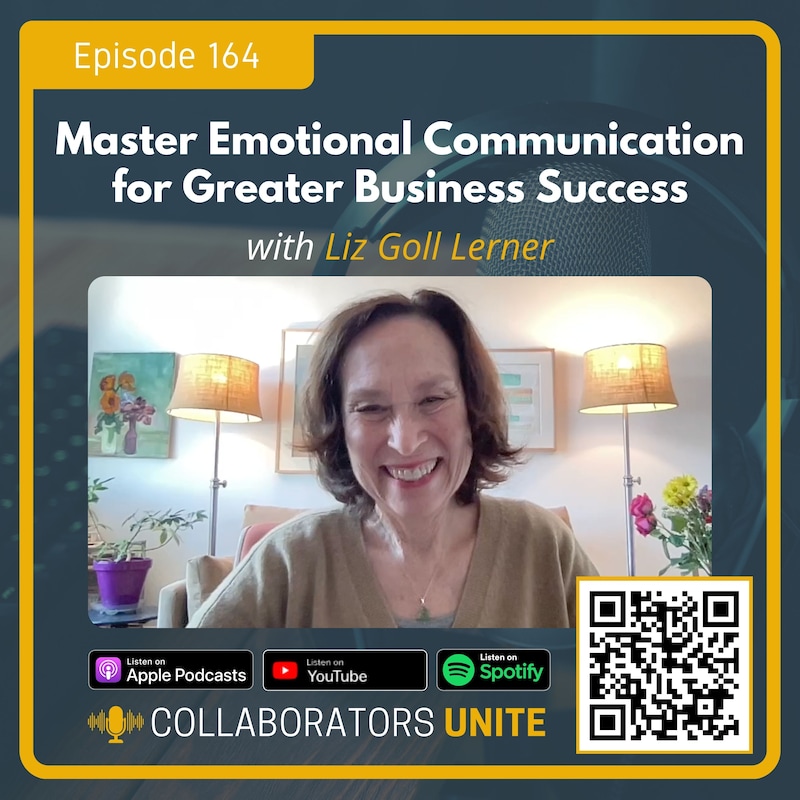
Shownotes
In this episode, Chuck Anderson sits down with Liz Goll Lerner to discuss how emotions and communication directly impact leadership, business growth, and personal success. They explore self-talk, emotional awareness, and how curiosity can help business owners overcome fear, self-doubt, and limiting beliefs to create stronger relationships and bigger impact.
GUEST BIO:
Liz Goll Lerner is a transformational coach, consultant, and former art therapist with over 40 years of experience helping leaders and mission-driven organizations improve communication, emotional intelligence, and personal growth. Through coaching, group programs, and her Luminous Living work, she helps people move past limiting beliefs and lead with greater clarity, confidence, and purpose.
CHAPTERS:
00:00 – Welcome & Why Emotions Matter
02:00 – Liz’s Journey Into Transformational Coaching
04:58 – Common Leadership Communication Challenges
08:10 – Emotional Awareness and Personal Choice
13:43 – Self-Doubt, Fear, and Negative Self-Talk
19:33 – Simple Steps to Shift Your Mindset
24:22 – Connecting with Liz and Next Steps
27:48 – Final Advice: Be Curious, Have Hope
LINKS:
Connect with Liz at: https://yourinspiredchoices.com/
Was this episode helpful?
Please leave us a review and subscribe to the show to be notified of future episodes.
Until next time, keep moving forward!
Chuck Anderson,
Transcripts
Hello everybody and welcome back.
2
:This is the Collaborators Unite podcast.
3
:Chuck Anderson here is your host.
4
:And this is the show for who we call Big Impact Experts.
5
:And that's you if you are on a mission to make a big positive impact with the work that
you do.
6
:And we know that we've had conversations with members of our audience who are coaches and
consultants and service providers of various types.
7
:And you know, what's unique about you is you don't just want to make money in your
business, but you...
8
:want to impact people's lives in a positive way.
9
:And maybe that even ripples out to your community or even the world.
10
:And, that's who we serve here.
11
:And along the way, when you are on that journey to make a big impact, there can be
challenges along the way.
12
:And uh we're going to be talking about emotions and communication and all things related
to those two things today, because they can.
13
:depending on how they're used negatively impact the impact that we want to make, or they
can lead us more towards the impact we want to make.
14
:And it's really just about how we use it.
15
:So today's guest is Liz Gull-Learner, and we're going to dive deep into this.
16
:So Liz, welcome to the show.
17
:Thank you so much.
18
:It's a pleasure to be here.
19
:Yeah, and I'm really looking for this conversation and you and I have, we've talked about
so many different angles that we can go with, but I really like this topic because, you
20
:know, emotions play a big part.
21
:You know, there's ups and downs and how it affects our communication and ultimately the
impact and how successful our business is.
22
:so, I'm excited to dive deep into this topic.
23
:with you and I think a great place to start Liz is let's tell your story.
24
:You know how it came to be that you are doing the work that you do right now.
25
:Well, I am happy to share that because I think that this work is essential for all of us.
26
:So I started way back, uh probably about 40 years ago as an art therapist, as a clinician.
27
:And what I noticed was that in the world of therapy, uh a lot of uh diagnosis and focus on
problems.
28
:was the core.
29
:And I chose art therapy because it focused on the whole person, on the positives, on where
the strengths were.
30
:So you move forward in time and I'm doing a lot of therapy and I'm working in patients and
I have a private practice and I realize that oh there's so much more, right?
31
:There's, you know, we are such evolving beings.
32
:I do a lot of spiritual work I have since the eighties and
33
:the whole person and the imagination and the creativity and the strength we have is really
important.
34
:So my work became much more transformational and I adore uh watching people uh sort of
push through a barrier and find the way for them to be really successful in life and
35
:business.
36
:uh
37
:So lots of ways that I do that.
38
:There are some group programs.
39
:There is individual coaching.
40
:I do a lot of systems work with mission-driven organizations.
41
:So there are a lot of ways to accomplish those things.
42
:And uh you were talking about the emotions and the communication.
43
:And I found that what I realized is that communication is the key.
44
:to everything we do, every relationship we have, every business deal we talk about.
45
:And our emotions, if we understand them, can be our saboteur or our champion, right?
46
:And so um how we speak, but particularly to ourselves, uh does a lot for our business.
47
:Yeah, and I think especially that latter part and how we speak to ourselves.
48
:I really love that you added that part in and uh communication with ourselves, with our
clients, with our families, our friends.
49
:It's happening all the time.
50
:And so it's such a big part of everything.
51
:uh And I wanted to ask you, know, in terms of the work that you do with business leaders
and business owners and
52
:What are you noticing when they first come to you?
53
:How would they describe what's happening now before you start working with them?
54
:And you know, how would they describe their challenge?
55
:Yeah.
56
:Yeah.
57
:I feel like there are kind of two categories of challenge.
58
:um One would be for the CEO, um where they're having trouble um helping the people that
they feel will do the best in their business do better, either in their communication with
59
:their clients or getting stuck if there is an opposition.
60
:No conversation with a client.
61
:um Having emotions rise up and then not knowing how to really coach that person into a
good conversation.
62
:um Understanding expectations is one.
63
:I think for the uh sort of the upper management uh people, it's a lot about communicating
with staff.
64
:A lot about how do you really coach someone else?
65
:And then what's getting in the way of their own ability to coach?
66
:Right?
67
:So that the mission of their organization can be aligned with all the staff.
68
:oh So there's communication on multiple levels, right?
69
:There's the communication of what is this organization about?
70
:What are we trying to accomplish?
71
:What are we doing if that's communicated properly?
72
:How do we show that?
73
:And how do we help all different kinds of people?
74
:be aligned with that and show it uh and speak it and live it when they're in that realm.
75
:um And then there's how do we speak to each other.
76
:But most important, it's the devil within, right?
77
:It's the, I'm not doing well enough.
78
:People who are uber, uber, uber successful are not doing well enough, not afraid.
79
:that someone above them will see a tiny little something that isn't quite right and then
they sabotage themselves.
80
:You know, it reminds me of when I was in senior management of a large company.
81
:And I often describe that experience of how lonely it actually is.
82
:And you can't talk to your peers.
83
:You cannot talk to your team.
84
:You certainly cannot talk to the...
85
:you know, the, your, your, your superiors or the board of directors or whoever else is
above you, because there's this, you always have to look like you have it all together.
86
:And, and so, so there's certainly all of that.
87
:And, um, what I wanted to ask you is, you know, when you have conversations with people
about this, what is their level of awareness that
88
:communication or their emotions as it relates to their communication is a factor to what
they're currently experiencing.
89
:Like, are they aware of this?
90
:Or is that something you need to kind of help them point them in that direction?
91
:Okay.
92
:You know, like people, people have an awareness that we all have emotion, and people have
an awareness that they affect some things that we do.
93
:But people do not have an awareness that they have a choice about it.
94
:And I think that's really critical.
95
:um I had someone that I was coaching not too long ago who
96
:you know, was because he was wonderful.
97
:His company was investing in him and he came and he said, basically, you know, I just
think this is all gobbledygook and I'm going to play along because I'm here.
98
:he had a way of doing things and he believed that was the right way and it couldn't be any
better.
99
:And this was great.
100
:And after I do an intensive for
101
:a lot of these companies and um the second day he said I never would have believed it.
102
:I never would have believed that I would think any differently about any of this and that
anything that happened in my life would have affected, had this much effect on how I
103
:communicate in my business and he became
104
:so much more resilient, flexible, able to not get freaked out if the client wasn't going
along with the road he had envisioned, right?
105
:But then could be curious and have a curious conversation with that client, with that
business partner, instead of like, my God, you know, like they're rejecting me.
106
:You know, it doesn't really have anything to do with him.
107
:It has to do with an idea.
108
:but we all personalize even when we're not totally aware that we're doing it.
109
:It's so easy to take things personally, right?
110
:I think it actually takes a conscious decision not to.
111
:Some people seem to do it very naturally.
112
:I am one of the ones that makes a conscious decision not to.
113
:Yeah, I mean, but to do that, you also have to have an awareness, or at least be curious
about why.
114
:Right?
115
:Why is that true for you?
116
:Right?
117
:Like, and not true for somebody else?
118
:Or, you know, why is it that um you one just assumes that whatever is being felt
119
:should be right that there's no other way.
120
:And a lot of us walk around.
121
:I did in the past walk around with this is just who I am.
122
:But it isn't who I am.
123
:You know, I have a feeling I am not the feeling.
124
:Right.
125
:So all of a sudden, that's open to doing something differently, which could
126
:change the whole face of the way somebody does business with another person.
127
:Yeah, it certainly does.
128
:you know, you know, one of these things coming back to that awareness piece is, that, you
know, and especially in the case where it's not the business owner or the manager
129
:themselves who have come to you, but somebody has sent them there, right?
130
:They haven't made that decision that something has to change yet.
131
:Whereas someone chooses it at least they might not have that.
132
:the full level of awareness, but they know something is up and they know that they're
reaching out for some type of help.
133
:you know, I will say that, like that one example I gave, that person did feel that
134
:They were getting in their own way, but they didn't connect it to what we're talking
about.
135
:They didn't connect it to um their emotions or a particular way of thinking.
136
:They just knew it was happening.
137
:And their method would be, me sort, let me do the logical end of it.
138
:Let me.
139
:know, column A, column B, whatever, um and do this thing better or finesse this a little
bit versus really look at an overhaul, um which might sound scary, but actually it's um
140
:exciting and um very uh nurturing, at least in my process.
141
:Yeah, well, at least having some level of awareness that perhaps I bring something to the
table that is contributing to this result I don't want um and that uh perhaps changes are
142
:needed.
143
:They might not know what changes are needed, but that's kind of where you come in.
144
:uh so I love how we clarified that and added to it because now I want to ask like,
145
:You know, what are, are there any sort of like common, you know, misbeliefs or mistakes
that you find that people are making that may lead them here or be potentially making it
146
:worse?
147
:Yeah, I think there are a few.
148
:think not thinking well enough of oneself is one that can be pretty powerful depending on
how it shows up.
149
:Because when we don't feel confident, we restrict.
150
:We can feel it in our bodies.
151
:We just sort of go, ugh.
152
:I think another is when...
153
:Somebody doesn't.
154
:um
155
:really take the time to be curious.
156
:about what their next meeting is really about.
157
:Like we do a lot of things by rote.
158
:Oh, we've got to go sign this or oh, we're going to have this, it's our next monthly
meeting.
159
:We're going to do this thing and it's a check-in, doesn't really matter.
160
:And that dulls.
161
:everything that happens in that meeting, nobody's really, nobody's really in it.
162
:And people feel that.
163
:um And that can be a problem.
164
:It doesn't mean you have to be excited all the time at every single moment.
165
:But, you know, having that that level of curiosity um really lightens up a room.
166
:um
167
:I think people being afraid of something bad happening is a real key one.
168
:Afraid that they will do something wrong, afraid that someone will notice that, afraid
that they'll lose their job for no apparent reason, frankly.
169
:I mean, if there's a problem and you know that you're doing something wrong and you're
afraid you're gonna lose your job, more power to you, fix it.
170
:The people I'm talking about are afraid of something going wrong.
171
:You know, that has a whole lot of different reasons for different people, but you know, if
somebody's walking around afraid that a shoe will drop or whatever, that would be, I
172
:think, a good reason to kind of explore because they're probably holding themselves back
quite a bit.
173
:Yeah, I love that.
174
:And, you know, I can relate to that feeling.
175
:And so and in and I know where it comes from.
176
:But but also uh having the awareness that some of this is is going on.
177
:And I think what the feelings you just described, I think somebody could hear you say that
and go, yeah, like I do that.
178
:Or, you know, that sounds like me.
179
:Mm hmm.
180
:to time.
181
:The question is, how much?
182
:And what is that self-talk that's happening when that happens?
183
:Because...
184
:um
185
:know, ages ago, I was running a department and I had all these things about what I was
doing wrong and how it wasn't working.
186
:you know, like we all have this stuff happen, right?
187
:And I was saying all of this stuff to a friend.
188
:We were taking a walk and he said, this doesn't sound like you.
189
:Like, who is that?
190
:talking in your head.
191
:And I thought about it and I had never it was really pivotal um in the work that that I
ended up doing because what I realized was that it wasn't actually my voice.
192
:Right.
193
:It was in that particular moment, it was my mom.
194
:But it was like a teacher, could be a teacher or a friend or something that stuck.
195
:Right.
196
:And we don't always, we have heard them for so long that we believe that they are us.
197
:But actually, they're not.
198
:So it's kind of like, okay, well, do I agree with that?
199
:Or do I not agree with it?
200
:If I don't agree with it, do I want to keep it?
201
:Probably not.
202
:Right.
203
:And it was just, you know, we all have these moments in time where
204
:somebody says something or something happens, but that's something that I teach people all
the time now because it's really pivotal in, guess I'm using pivotal a lot of that word,
205
:but there are so many pivotal pieces um to set you free from that negative.
206
:you know, conversation about not good enough or not this enough or that enough or perfect
enough when there of course is no perfection.
207
:So, you know, it's tricky sometimes, but really manageable.
208
:Like if you really understand what to be looking for, it's really manageable.
209
:It's not so hard.
210
:You know, and I think that's the pain.
211
:piece that's very encouraging is that, you know, the fact that it is manageable, you know,
gives people hope when, they're feeling this way.
212
:And, you know, that kind of leads me to my next question.
213
:And that is like, what, when people start to feel this way, what can they start to do
about it?
214
:I mean, should they be reaching out for help right away?
215
:Or are there some things that, and I know that we're going to, and we're going to give
them an opportunity to connect with you so they can learn more, certainly.
216
:But are there some things that
217
:You know, they need to do, they could do differently.
218
:um That would where start to notice things going the other way or getting better.
219
:So I think that, know, in my mind, um 90 % of any solution is consciousness.
220
:Right?
221
:So if somebody is beginning to notice, you know, like sometimes people walk around and
they just don't feel good and they don't really, if they just think of it as this is just
222
:what it is, or I don't like my job and I'm staying here or whatever.
223
:um
224
:So I think really noticing if something is troubling um or if there's a repetitive thought
that's negative um is actually the first step to doing anything and not just assuming that
225
:the situation is the situation.
226
:um If it's a job, then kind of opening the doorway to saying, well, you know.
227
:Do I want to look for another job?
228
:Do I want to explore something different?
229
:Because it allows us to bring our power back.
230
:I think a lot of what goes on is um people start to feel like they don't have any power.
231
:And that really isn't true.
232
:There's always choice.
233
:So, you know, that's one piece.
234
:And then if somebody says, yeah, well, I do really feel like there's something not so
great.
235
:You know, some an easy or a simple.
236
:uh
237
:thing would be to like in a moment if they're becoming a little bit emotional inside to
stop everything.
238
:Take a breath, you know, feel their feet.
239
:I like the feel people's feet because it brings you into the body and just go, okay, wait,
I'm going to reset.
240
:Let me just see where I am.
241
:You know, get my two feet on the ground and make a choice.
242
:about what's next in that moment, right?
243
:So if we're not paying any money to anybody, we're just sort of going, okay, let's stop
the action and let me choose what my next step is, right?
244
:Am I overreacting?
245
:You know, even at myself, right?
246
:So, I mean, I think those are a couple things.
247
:think certainly if somebody really is unhappy to reach out to a coach or a counselor or
248
:you know, a physician.
249
:Well, I think it makes sense because it can be challenging to ask yourself those types of
questions with the objectivity and the maturity not to use it in a judgmental way, you
250
:know, against yourself.
251
:Like I should, shouldn't be feeling this way, or I should feel a different way, or, you
know, why am I doing this again?
252
:And yeah.
253
:Right?
254
:Yeah, exactly.
255
:And, you know, it comes.
256
:Yeah, that and that's something that's come up in other conversations.
257
:And so, you know, this whole idea of this expectation that we have on ourselves that we
should be a certain way, or we should be at a certain level, or we shouldn't be where
258
:we're at, or we shouldn't be doing these things.
259
:And, you know, it does come up and it just might be part of being human.
260
:Right.
261
:is part of being human.
262
:comes up for the most evolved people and they have to deal with it too.
263
:So but yeah, I agree with you.
264
:I think that it is hard to do on one's own.
265
:um But there are certainly ways to begin and see where you end up, know, what you need.
266
:Well, speaking of that, let's give some people some next steps.
267
:And I think one of the logical next steps is that they could learn more from you.
268
:so tell people what the best next step is for connecting with you.
269
:And I'll make sure that all your information and your links are right beneath this video
so that they can connect with you.
270
:Yeah.
271
:I really think, uh you know, the best next step is to have a conversation.
272
:Just get on my calendar link and have a conversation to see what you actually might need.
273
:You know, like, is it is it some coaching?
274
:Is it joining my enlightened communication through Luminous Living Course?
275
:Like, what is it that, you know, would really serve you um or someone in your company?
276
:um And then, of course, we have some handouts we can.
277
:that can be available for people on communication, business communication.
278
:So, we get them going.
279
:Yeah, and I would say for anyone listening in right now where this conversation is
resonating with you and you're hearing this realizing, yeah, maybe it's time to take a
280
:look at this, then that I think is a cue to your logical next step is to connect with Liz.
281
:And so to make that very easy, I've put.
282
:her links right beneath this video.
283
:if you're listening to this on an audio podcast, it's right all there on your phone.
284
:Just open up the player that you're listening to this in and the links are all there.
285
:uh you know, any other, you know, like, you know, steps, you know, before we sort of sign
off and wrap up this episode steps that you that you would recommend.
286
:Obviously we've given them a way to connect with you.
287
:Yeah, you know, I don't know if it's a step, but I think it's a concept and it's that I
think people feel like this stuff is we kind of touched on it before, but this is stuff is
288
:hard.
289
:The change is hard that noticing stuff is hard that but frankly, it really isn't that it
doesn't have to be hard.
290
:It can just be an awareness and a decision.
291
:and noticing little step-by-step things at a time.
292
:And you find yourself in a very different place.
293
:So I really want to take away the burden around it.
294
:Like, this is going to take years.
295
:this is going to be like, that's not, that's, well, it's not the way I work, but it's not
true.
296
:It doesn't have to be true.
297
:So I think that's really important.
298
:I think that's really encouraging because, you know, when you look at a journey and you
look at the length of the journey or you interpret...
299
:you know, how long it's gonna be.
300
:I mean, that does take away a little bit of the motivation and it's very encouraging to
hear that there are steps you can take to, you know, to get better at it, you know, sooner
301
:than later.
302
:And so I think that's a great message.
303
:uh Liz, thank you.
304
:You are amazing and I love what you're doing.
305
:I know we've just barely scratched the surface of this topic, but for anyone listening in,
that resonates with what Liz and I have been talking about.
306
:here today.
307
:I want you to look right beneath this video and click the links and connect with Liz and
that would be a great next step for you to take.
308
:um Thank you Liz.
309
:I really appreciate it.
310
:Yeah and before we sign off I just wondering if you have any final piece of advice or
words of wisdom that you could leave with our audience.
311
:Be curious.
312
:Have hope.
313
:Be curious and have hope.
314
:I love that.
315
:I think that's a beautiful message to end this episode by.
316
:And so thank you for that.
317
:And to our audience, thank you as well.
318
:And hopefully you have found this to be uh inspiring.
319
:And I wanna remind you that the impact that you want to make is possible.
320
:And sometimes you're just one.
321
:uh tool or tactic or conversation or collaboration away from a big breakthrough that can
help you to make that bigger impact.
322
:you know, if this resonates with you today, I think you have your next steps and that is
to click the link beneath this video.
323
:And in the meantime, you know, I'll leave you with this thought and that is, you know, on
your journey, the only way to fail is to quit.
324
:So always keep moving forward and we'll see you on the next one.
325
:Thank you.
326
:All
