Shownotes
Audio • Season 2 • 8 • Series 2 Episode 8 - The Lambeth Articles to Hampton Court - No Bishop, No King! (Transcript added).
Audio • Season 2 • Episode 8 • The Lambeth Articles to Hampton Court, No Bishop, No King!.
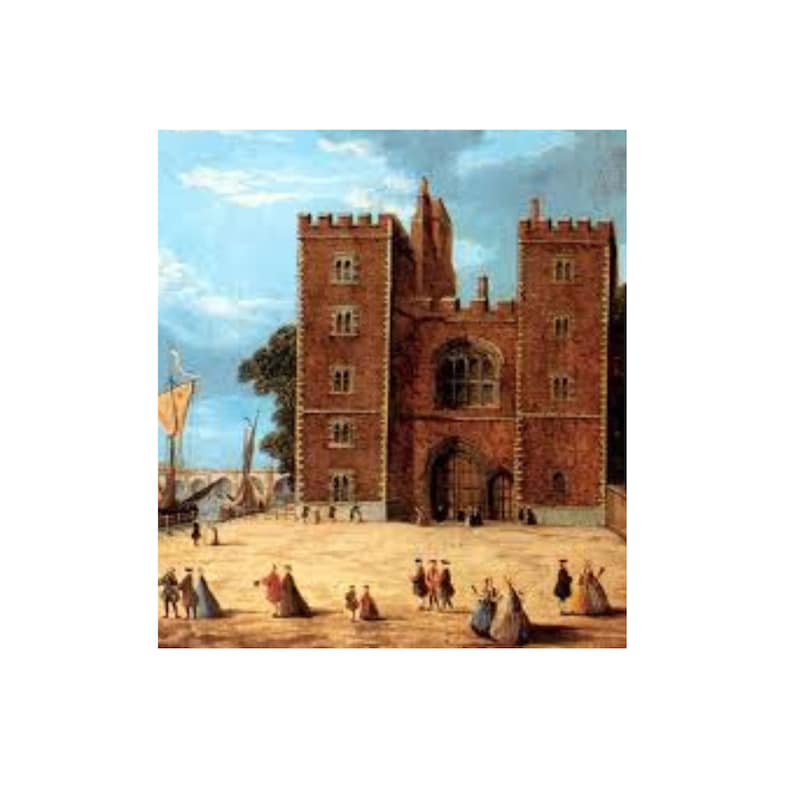
Artwork • Lambeth Palace
Music 1 • Royal Brass Music Of King James 1
This collection features 17th-century English instrumental music, primarily composed for brass instruments of the time, and recorded under the direction of Thurston Dart. The ensemble includes:
- Maurice André and Jean Pirot (trumpets)
- Maurice Suzan, Henri Arqué, Camille Verdier, and Bernard Gallot (trombones)
- Robert Veyron-Lacroix (harpsichord continuo)
The piece is performed by a six-member ensemble of trumpets and trombones, composed initially for King James I's court.
The ensemble, known as the Royal Wind Music, would have originally featured a twenty-piece band of sackbuts and cornetts.
A sackbut, is an early trombone from the Renaissance and Baroque eras, it features a telescopic slide, that adjusts the tube length to change pitch. Known for its softer, mellower tone, due to a narrower bore and smaller bell, the name "sackbut", comes from the Old French words for "push" and "pull," which describe its slide action.
The cornett, is a historical, lip-reed, wind instrument, from the Medieval, Renaissance and Baroque periods, made of wood, and covered in leather. It features fingerholes and a mouthpiece, enabling it to blend seamlessly with voices. The cornett was popular, for both instrumental and vocal music, before the invention of valved instruments.
Episode Notes:
In 1603, John Robinson delivered a sermon in Norwich based on Psalm 118:24, expressing the hope that King James would have a positive impact on the Church of England.
On 20 November 1595, church leaders, including Archbishop of Canterbury John Whitgift, convened at Lambeth Palace to draft the Lambeth Articles without Queen Elizabeth's consent.
These nine statements aimed to address predestination controversies and marked the first Calvinistic addition to the Thirty-Nine Articles, tackling the emerging threat of Arminianism.
In January 1604, King James I convened at Hampton Court Palace with representatives of the Church of England, including Puritans, in response to the Millenary Petition for reform.
The meeting, postponed from November 1603 due to the plague, featured Archbishop Whitgift leading eight bishops, including Richard Bancroft, who opposed the Puritan demands.
Transcripts
© 20 25 The Rise of the Protestants. Author, Shaughan Holt.
"All rights reserved. No part of this podcast may be reproduced, translated, distributed, or transmitted in any form or by any means, including photocopying, recording, or other electronic or mechanical methods, without the prior written permission of the copyright holder, except in the case of brief quotations embodied in critical reviews and certain other non-commercial uses permitted by copyright law".
Series 2.
Episode 8.
The Lambeth Articles to Hampton Court; no Bishop – no King.
The year is 16 03.
In 13 47, the bubonic plague, started its spread across south-eastern Europe, triggering severe outbreaks, resulting in the deaths of around one-third of the population.
By 13 49, the plague had reached Cambridge, causing tragic losses, including the death of Margaret Andrew, a key benefactor, in the establishment of what would become, Corpus Christi College.
Amidst this chaos, three prominent businessmen, William Horwode, Henry de Tangmere, and John Hardy, founded the Guild of Corpus Christi, in the town.
The first documentary evidence of the guild's existence, dates back to the will of Margaret Andrew, dated 7 May 13 49, in which she bequeathed lands to the guild.
Corpus Christi College, was founded in 13 52, and is the sixth oldest college at the University of Cambridge.
It was jointly established, by members of the Guild of Corpus Christi, and the Guild of the Blessed Virgin Mary.
The Latin phrase "Corpus Christi," which means "the body of Christ," signifies a deep devotion that was popularised by Juliana de Cornillon about a century earlier.
In medieval society, guilds played an essential role, by acting as networks of mutual support and spirituality, for both affluent and less fortunate community members.
The aim of Corpus Christi was to provide social and spiritual support, by financing prayers and masses, for deceased members, thereby aiding their souls.
Fortunately, the College archives have preserved Margaret Andrew's will, together with the memorial lists from the Guild of St. Mary, ensuring that her wish to be remembered is fulfilled.
In 16 03, John Robinson delivered a sermon in Norwich, based on Psalm 118 : 24, expressing hope, that King James would bring positive change to the Church of England, while also criticising, the presence of incompetent ministers within the Church.
Psalm 118, verses 24 to 26, in the Geneva Bible, reads:
"This is the day the Lord has made, let us rejoice and be glad today.
We beg you O Lord, save us, we beg you O Lord, give us success.
Blessed is the one, who comes in the name of the Lord, we bless you from the Lord's house".
These verses, describe a unique day in history, when the Son of God came to Jerusalem, and was hailed as the Messiah, only to be rejected, a moment of great historical significance.
The statement, is often understood, to mean that "Today", is God's creation, and we should therefore celebrate it.
Robinson's sermon, was observed by two informants, sent by Bishop Jegon, who described him as, "a restlessly critical, yet hopeful young religionist," optimistic about reforms; without embracing Separatism.
John Jegon was an English academic, and Bishop of Norwich, born in Cogges Hall Essex.
In 15 90, recommended by Queen Elizabeth, he became Master of Corpus Christi College Cambridge, where he improved the college's finances, by introducing Gentleman Commoners, wealthy boys from lower- to upper-middle-class families.
These students, who often did not formally enrol, stayed for a year or two, before attending law school, and were not required to take exams or earn degrees.
The college benefited financially from this arrangement, as the boys contributed silver cups or tankards, with at least 260 collected, most of which were later melted down.
On 22 July 16 01, John Whitgift appointed John Jegon as the Dean of Norwich.
Two years later, on 14 May 16 03, Jegon was consecrated, as the Bishop of Norwich.
Unlike Archbishop Matthew Parker, Jegon was not known for kindness, displaying the common vices of his era, such as cruelty, and a dark sense of humour.
As Bishop, he promoted uniformity in Anglican teachings, which led to tensions with John Robinson; however, he continued to support local Puritan communities, by assigning them qualified preachers.
In 15 93, Jegon objected to a sermon, given by William Barrett, in which he criticised Calvinism.
William Barrett was an English priest and theologian, in the Church of England.
He enrolled at Trinity College Cambridge, on 1 February 15 79.
Barrett earned his Master of Arts degree in 15 88, becoming a fellow of Caius College.
He delivered a sermon, for his Bachelor of Divinity degree, titled, "Concio ad Clerum", a Latin phrase meaning, "a sermon to the clergy", at St. Mary the Great Church, in Cambridge, on 29 April 15 95.
In his sermon, he strongly criticised Calvinist doctrines, which were popular at Cambridge University at the time, explicitly rejecting the concepts of assurance, and the indefectibility of grace.
As a consequence, Barrett's very public criticism faced a swift and firm rebuttal from Cambridge.
Furthermore, the college felt, that Barrett displayed a lack of respect, towards Calvin, Peter Martyr, and others, who were associated with the idea of unconditioned reprobation, which refers to those, who are not chosen for salvation.
The notion of "The Indefectibility of Grace", also known as "Final Perseverance", embodies the belief, that while an individual might stray from grace, and fall into sin, they can ultimately return to grace, and transform their life, through God.
In the Christian faith, "Grace", is viewed as an, unearned, gift, from God, freely given.
Serving as a foundation of the Christian faith, it is believed, to be the means, by which, humanity can achieve salvation.
Dr. Dupont, the vice-chancellor, called an important meeting with Barrett, who then engaged in discussions with the college heads, to ensure a thorough understanding and alignment on the matter.
Barrett acknowledged valid criticisms of his sermon, and was instructed to recant.
On 10 May 15 95, he withdrew his comments in a sermon, at St. Mary's Church, but did so irreverently, implying he had not truly changed his views.
The college then sought and received authorisation from Lord Burghley, to punish Barrett.
Facing expulsion threats from the college Heads, Barrett appealed to Archbishop Whitgift, who criticised the college's hasty actions.
Realising their mistake, the Heads requested that Whitgift investigate Barrett's defence, and so, Barrett was summoned to attend Lambeth Palace to answer questions.
After several delays, Barrett, facing a group led by Whitaker, eventually agreed to recant his earlier statements.
However, in March 15 97, the Archbishop warned the authorities, that Barrett might attempt to flee the country.
It was too late, by that time, he had already left.
While living in Europe, Barrett converted to Roman Catholicism, and later returned to England, where he lived, as a layperson.
On 20 November 15 95, church leaders, including Archbishop of Canterbury John Whitgift, convened at Lambeth Palace to draft, the Lambeth Articles.
These nine doctrinal statements, aimed to address the controversy within the Church of England, regarding the doctrine of predestination.
Their meeting occurred, without the consent of Queen Elizabeth, who would be displeased, with the convening of a synod, without Royal permission.
The Lambeth Articles of 15 95, were a significant Calvinistic addition, to the Thirty-Nine Articles, of the Church of England.
They were the first attempt, by any of the Reformed churches, to deal with a threat that would later be known as Arminianism.
They were drawn up by Dr. William Whitaker, Regius Professor of Divinity in Cambridge, with input from Dr. Richard Fletcher, the Bishop of London, Dr. Richard Vaughan, Bishop-elect of Bangor, and Humphrey Tyndall, the Dean of Ely.
Contemporary historians including Barrett have questioned Calvinism as presented, in the Lambeth Articles, and its subsequent theological implications.
The articles were endorsed by the Archbishop of Canterbury Dr. John Whitgift, and the Archbishop of York, Dr. Matthew Hutton, who deemed the first article as "Verissimum", meaning true, and approved the rest.
In 16 19, English representatives, presented the Lambeth Articles at the Synod of Dordt, outlining the Church of England's position on the Arminian controversy.
Their presentation highlighted the shared principles between the Lambeth Articles, and the Canons of Dordrecht.
Dordt was the only ecumenical gathering of churches during the Reformation, and as a result, its Canons weigh heavily, in the determination of Reformed orthodoxy to this day.
Arminianism is a Protestant theological system, named after Dutch theologian Jacobus Arminius that emphasises human free will, and God's universal love in salvation, contrasting with the Calvinist doctrine of predestination.
The nine articles adopted at Lambeth, contain a clear, and strong articulation, of the pre-destinarian system, teaching that:
1. ; God has from all Eternity, pre-destined some to Life, and reprobated some to Death.
2. ; The moving cause of predestination to life, is not the foreknowledge of faith and good works, but it is the sole, absolute, and simple, Will of God.
3. ; Of those that are Pre-destined, there is, a determinate and certain Number, which, can be neither increased nor diminished.
4. ; Those who are not pre-destined to Salvation, shall, of necessity, be condemned for their Sins.
5. ; A true, lively and justifying faith, and the sanctifying Spirit of God, is not lost, nor does it pass away, either totally or finally, in the elect.
6. ; The truly faithful man—that is, one endowed with justifying faith—is sure, by full assurance of faith, of the remission of sins, and his eternal salvation through Christ.
7. ; Grace sufficient for Salvation, is not afforded, communicated, or granted to all Men, by which they might be saved should they wish.
8. ; No man can come to the Son, unless the Father shall draw him, but all men are not drawn by the Father.
9. ; It is not put in the Will or Power, of every Man to be saved.
In 16 03, Sir Walter Raleigh, an English politician and adventurer, was imprisoned in the Tower of London for the second time, at the age of 51.
His imprisonment lasted 13 years, and was due to his alleged involvement in the Bye and Main Plots, to overthrow King James I.
These plots, orchestrated by courtiers, aimed to replace the king with his cousin, Lady Arabella Stuart.
The Bye Plot involved Roman Catholic priests and Puritans, collaborating, to kidnap the new king, in order to secure religious tolerance, ; although it was initially seen, as a minor part, of the much larger, Main Plot.
Lady Arabella Stuart (15 75 – 25 September 16 15) was an English noblewoman and first cousin twice removed of Queen Elizabeth.
Viewed as a potential heir to the English and Scottish thrones, she secretly married William Seymour, Lord Beauchamp, on 22 June 16 10, without royal approval, which led to their imprisonment by King James of England.
Arabella was confined to Sir Thomas Perry's house in Lambeth, while Lord Beauchamp was imprisoned in the Tower of London.
In June 16 11, Beauchamp escaped, hoping to reunite with Arabella, but their plan was thwarted, and she was recaptured.
Beauchamp found refuge in Ostend, but they never saw each other again.
Tragically, Arabella died in the Tower at 39, succumbing to self-imposed starvation.
Robert Cushman, was baptised on 9 February 15 77, in Rolvenden Kent, in a church font, still in use today.
The baptismal record, which covers the years 15 58 to 16 53, at the Church of St. Mary the Virgin, lists him as "Robart, son of Thomas Cutcheman and Ellen Hubbarde".
The next mention of him is in December 15 97, at St. George the Martyr Canterbury, where he was apprenticed to George Masters, a grocer and butcher, who had been granted exclusive rights to produce tallow candles.
Cushman's apprenticeship began at the age of eighteen, as detailed in city records.
Robert Cushman lived in George Master's house, in St. George the Martyr parish, until at least 16 03.
His widowed mother, Ellen, was re-married to Thomas Tilden, and was buried in Ashford in 16 01.
Tilden, was believed to be a Puritan, and may have influenced Cushman's religious views, and his subsequent involvement in illegal religious gatherings, known as Conventicles.
During his apprenticeship with George Masters in 16 03, Cushman faced trouble, for distributing libels and derogatory religious writings in Canterbury.
He allegedly posted signs on church doors, saying, "Lord, have mercy on us".
The authorities instructed the sheriff, to identify and question those responsible, labelling them as lewd and seditious.
If caught, they could be imprisoned for refusing to cooperate.
Cushman was eventually apprehended, but his unsatisfactory responses led to his detention in Westgate Prison for one night.
On 23 March 16 03, the Archbishop permitted John Smyth to preach, in the Canterbury diocese, which included Lincoln, where Smyth, was already considered a controversial figure.
Bishop Chaderton of Lincoln, objected to Smyth’s appointment by the Archbishop, but was overruled.
However, four-months later, on 26 July 16 03, Archbishop Whitgift revoked Smyth’s license, and requested that this revocation be widely publicised.
As a result, Smyth lost his livelihood.
He also faced reprimands for illegally preaching at West Burton.
Additionally, during his preaching sessions, he was cited for acting as a schoolteacher in North Clifton, located about twelve miles from Lincoln, while falsely claiming, to be a church curator.
Despite his belief, that the church was not adhering to biblical principles, John Smyth chose to remain within the established church.
In 16 03, he published "The Bright Morning Star," a collection of expository sermons, that sought to interpret Psalm 22.
This psalm, known as "The Hind of the Dawn", or "My God, my God, why hast thou forsaken me, describes an individual, crying out to God for rescue from the taunts and torment of their enemies, while ultimately, expressing gratitude for their deliverance.
In the same year, Thomas Helwys began holding regular Puritan services, at his home in Broxtowe Hall.
These services attracted many attendees, and over time, would become a hub for Puritan teachings.
Thomas Cartwright's interpretation of Puritanism is widely regarded as the standard representation of the movement, highlighting a distinct Presbyterian aspect.
His perspective, contrasts with that of earlier figures, such as; Wycliffe, Tyndale, and Hooper, who had previously offered, only fragmented insights into Puritan ideology.
Celebrated as the leading English Puritan scholar, Thomas Cartwright spent his final years in Warwick, where he passed away on 27 December 16 03.
He advocated for reform, within the Church of England, believing, that leaving it, was a grave mistake, and that the focus, should be on fostering unity rather than division.
The year is 16 04.
In January, King James I of England held a meeting at Hampton Court Palace, with representatives from the Church of England, including notable Puritans.
Initially scheduled for November 16 03, in London, the conference had been postponed, due to an outbreak of the plague.
The meeting was convened, in response to the Millenary Petition, which outlined various reform requests from the Puritans.
Archbishop Whitgift led a group of eight bishops, including his protégé, Richard Bancroft, the Bishop of London.
They were supported, by seven Deans and two other clergy members, all of whom opposed the Puritan demands.
King James had selected, the representatives from the Puritan community, including John Rainolds, Laurence Chaderton, Thomas Sparke, and John Knewstubs, to advocate for Presbyterian beliefs.
John Rainolds was the main spokesperson, while Knewstubs was largely silent.
Chaderton was described as "mute as a fish," and Sparke did not speak at all.
King James relied on Richard Bancroft, to present the government's stance, on religious matters.
During their first meeting, on 14 January, the King interacted, only with Archbishop Whitgift's delegation.
On 16 January, he met with Puritan representatives, but the day ended poorly, when Rainolds proposed establishing presbyteries in England.
King James saw this as a challenge, to his authority, famously declaring, "No bishop, no king!".
Unsurprisingly, the meeting ended early.
On 18 January, the King met with Whitgift and ecclesiastical lawyers, before summoning the Puritans, to deliver his verdict.
James chose to continue using the Book of Common Prayer, emphasising the importance of traditional practices, but he clearly stated, that he would not implement a preaching ministry.
He approved some modifications, such as removing the mention of baptism by midwives, replacing "absolution" with "remission of sins", and renaming "Confirmation", to "the laying on of hands", to distance it from its Catholic sacramental meaning.
However, James unexpectedly supported, the Puritan initiative, for a new, authorised Bible translation.
Bishop Richard Bancroft, had initially taken a conciliatory approach, during the Hampton Court Conference, but would later, adopt a hard-line, anti-Puritan stance.
Ultimately, the bishops triumphed over the Puritans, quashing their hopes for reform.
As the conference concluded, James I told the bishops that the Puritans must conform to the Church of England, warning, "Else I will harry them out of the land, or do worse".
This demand for conformity, would, inadvertently, create opportunities, for several historically significant figures.
These individuals, often seen as ordinary, came together to worship God, in a way that was meaningful two them!.
Guided by their convictions, rooted in Scripture, they aimed to reform the Church of England from within, rather than separate, from it entirely.
Richard Bancroft and the King James Bible Translation.
Richard Bancroft played a crucial role in the King James Bible translation project, as its chief director.
Initially, he was sceptical about the necessity, of a new translation, but once King James endorsed the project, he played a pivotal role in its success.
Bancroft coordinated efforts across six teams, in Westminster Oxford and Cambridge, ensuring the project’s effective management.
It was his organisational structure that allowed the most capable scholars in England, to come together successfully.
Bancroft was responsible for selecting and approving all translators, who represented a variety of religious beliefs and backgrounds.
The group, included Puritans and high churchmen, young and old scholars, academics and clergy, as well as individuals from both wealthy and impoverished backgrounds, urban dwellers and rural residents, worldly travellers and those who had rarely left their home town.
Despite their differences, the translators shared strong academic credentials, a commitment to the project, and an appreciation of its significance.
They approached their work with humility, recognising their duty, to both their sovereign, and a higher authority.
Bancroft established fifteen guiding rules, to ensure that each group of translators would own the final product, encouraging thorough investigation, and building on the work of earlier translators, such as Tyndale, Wycliffe, Coverdale, and Rogers.
He could have hindered the project, but instead facilitated and encouraged the team, providing financial support to the translators, enabling them to resolve issues effectively.
Ultimately, it was him, who had the final say, making just fourteen edits in the translation of over thirty thousand verses.
The King James Bible, commonly referred to as the KJB remains a prominent English text for many religious groups, including Anglicans, Baptists, Lutherans, Presbyterians, and Mormons, primarily due to the dedication of King James I and Richard Bancroft.
In 16 04, Robert Cushman faced prosecution, for distributing libellous material, and for failing to attend St. Andrew's parish church in Canterbury.
He was excommunicated on 16 January, for failing to acknowledge his offence, with the church raising concerns, regarding his lack of moral and intellectual improvement.
After apologising on 15 October, he was absolved of the charges.
However, he was threatened with excommunication again, on 12 November, for continuing to engage in defamatory behaviour.
By 7 July 16 05, he had succeeded in lifting the excommunication, and managed to clear himself of all charges.
Doubtless even at this age, Cushman held some influence in the town.
John Robinson resigned from his university fellowship in February 16 04, and married Brigit White, on the 15th.
Brigit's father, Alexander White, had been a prosperous yeoman and staunch Puritan.
Their wedding took place at Greasley parish, near Thomas Helwys's Broxtowe Hall.
After their wedding, John and Brigit visited her sister Katherine, who had married George Leggatt in 15 96, and had a daughter named Marie, but sadly, George passed away, leaving Katherine a widow.
To escape religious persecution, the White and Robinson families, fled to Amsterdam, and in 16 09, relocated to Leiden, Holland.
John Carver was likely baptised in Great Bealings, Suffolk, on 12 March 15 80, as the son of John and Margaret Carver.
In 16 08, he journeyed to Holland with the Kent Separatists, settling in Leiden after initially arriving in Amsterdam.
Carver joined the French Walloon Church in 16 09, quickly rising to the position of deacon.
Some time before 16 15, he married Katherine Leggatt, née White, a prominent figure in the English Separatist Church in Leiden.
After marrying Katherine, John Carver decided to leave the Walloon church, and fully dedicate himself to the Separatist movement.
Katherine and John Carver sailed on the Mayflower to Plymouth in 16 20, with John playing a key role in organising the voyage.
Originally headed for Virginia, they settled in Plymouth, Massachusetts, leading to the establishment of the Plymouth Colony.
John Carver is credited with writing the Mayflower Compact; he was the first signer and served as the first governor of this new political entity.
He was married twice, his first wife, Mary-de-Lannoy, came from L'Escluse, France, and both of them were active members, of the French Walloon church in Leiden.
Records from St. Pancras Church in Leiden, indicate that they buried a child, on 10 July 16 09.
Sadly, shortly after the child's passing, Carver’s wife Mary also died.
Katherine White was a prominent member, of the Leiden English Separatist church, and later became the wife, of the widowed John Carver.
On 11 November 16 17, Katherine Carver, buried an infant child, at St. Pancras Church in Leiden.
During this time, John Carver was in England, negotiating with the London Company, for passage to Virginia for the Leiden dissenters.
He was a wealthy man, and was able to contribute significantly, to the congregation, as well as to the, joint stock company, and the Mayflower voyage.