Shownotes
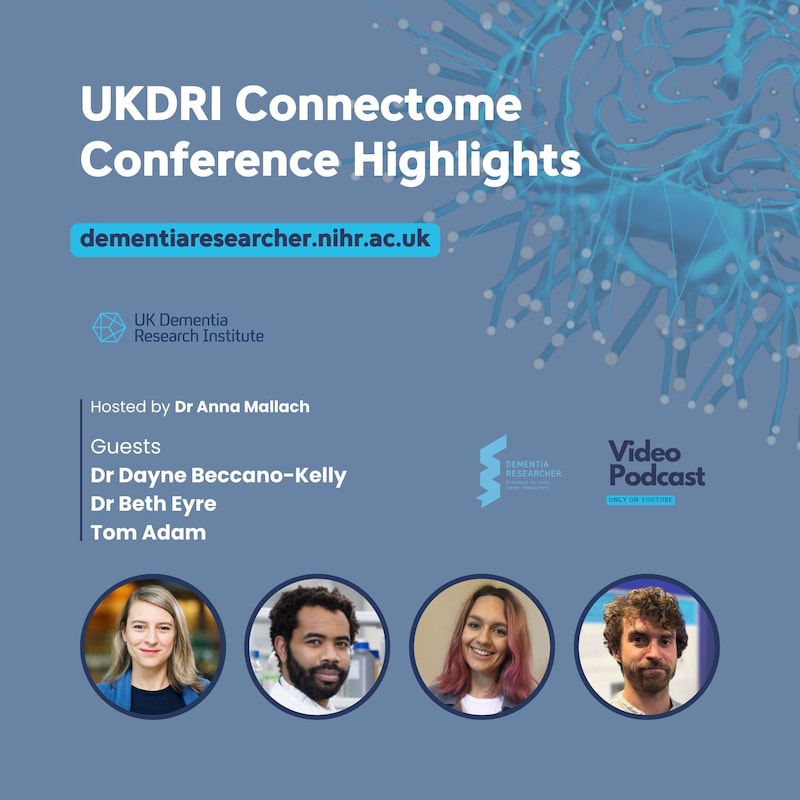
This episode shares highlights from the UK Dementia Research Institute (UKDRI) Connectome Conference. Host Dr Anna Mallach is joined by Dr Dayne Beccano Kelly, Dr Beth Eyre, and Tom Adam to reflect on talks, posters, and discussions that stood out.
The conversation covers lived experience sessions, keynote talks, early career presentations, and how informal conversations and parallel sessions shaped ideas and potential collaborations. The episode offers a snapshot of the breadth of work presented across the institute and the importance of connecting people as well as science.
Find out more about the UKDRI:
Watch our YouTube Shorts Series, with conference attendees presenting their posters in under 3 minutes: https://www.youtube.com/playlist?list=PLeUI1GHB4EvRFJl8tRC-wq5RxkDKF9twU
--
A transcript of this show, links and show notes and profile on all our guests are available on our website at https://www.dementiaresearcher.nihr.ac.uk.
If you prefer to watch rather than listen, you will find a video version of this podcast on Apple Podcasts, YouTube, and on our website.
Leave us a tip:
https://dementia-researcher.captivate.fm/support
Follow us on social media:
- https://www.instagram.com/dementia_researcher/
- https://www.facebook.com/Dementia.Researcher/
- https://www.twitter.com/demrescommunity
- https://www.linkedin.com/company/dementia-researcher
- https://bsky.app/profile/dementiaresearcher.bsky.social
Download and Register with our Community App:
https://www.onelink.to/dementiaresearcher
We gratefully acknowledge the support of our funders: Alzheimer’s Association, Race Against Dementia, Alzheimer’s Research UK, Alzheimer’s Society, and the National Institute for Health and Care Research.
The views and opinions expressed by guests in this podcast are their own and do not necessarily reflect those of the producers, funders, or sponsors.
Subscribe to our sister show 'Dementia Researcher The Blogs':
Transcripts
- [Voice Over] The Dementia
Researcher podcast,
Speaker:talking careers, research,
conference highlights,
Speaker:and so much more.
Speaker:- Hello and welcome to special podcast,
Speaker:recording highlights of the
UK Dementia Research Institute
Speaker:Annual Connectome Conference.
Speaker:(upbeat music)
Speaker:Hello, I'm Dr. Anna Mallach,
Speaker:and I'm from the UK Dementia Research
Speaker:Institute Centre at Imperial.
Speaker:And I look into the role of support cells
Speaker:and how they can contribute to Parkinson's
Speaker:and the progression of this disease.
Speaker:So those of you who don't know,
Speaker:Connectome is the UK
DRI's annual conference,
Speaker:which means that at the end of every year
Speaker:or towards the end of every year,
Speaker:over 600 UK DRI members
from across the institutes
Speaker:are coming together every
year in a different city
Speaker:across the UK to talk science and meet up.
Speaker:It provides a very important
opportunity to connect
Speaker:with colleagues from other
centres, other locations.
Speaker:And today we're giving you some insights
Speaker:into what was presented
over those three days
Speaker:that happened last week.
Speaker:Before we jump into the
highlights, let's meet our guests.
Speaker:Tom?
Speaker:- Hi, yes, so my name's Tom.
Speaker:I'm a researcher from Imperial College
Speaker:with the CR&T Centre,
Speaker:the Care Research and Technology Centre.
Speaker:And I'm with Paul Fremont's lab,
Speaker:and I, so I have a
background in engineering
Speaker:and the rest of the team are
all synthetic biologists,
Speaker:and we are developing a device
Speaker:which detects for urinary tract infections
Speaker:for people living with dementia.
Speaker:It's a home testing device
Speaker:that we're trying to provide to those
Speaker:so that we can mitigate the need
Speaker:for symptom recognition
and enable home testing
Speaker:for quick detection.
- Interesting.
Speaker:Beth?
Speaker:- So, hi, I am Beth.
Speaker:I am a postdoc at the
University of Edinburgh,
Speaker:and I really just recently
joined my supervisor,
Speaker:Susanne van Veluw moved
from Boston to Edinburgh.
Speaker:And we're part of the new
British Heart Foundation
Speaker:Cardiovascular Dementia Research Centre.
Speaker:I think that's right, I'll check.
Speaker:And I'm working on a disease
Speaker:called cerebral amyloid angiopathy,
Speaker:which is where amyloid
protein gets deposited
Speaker:around blood vessels within the brain.
Speaker:So I do lots of cool research into that.
Speaker:- Finally, Dayne.
Speaker:- Hi, I'm Dayne Beccano Kelly.
Speaker:I am a group leader here at the
Dementia Research Institute.
Speaker:Specifically the geographical location
Speaker:of this one is at Cardiff University,
Speaker:and I work on synaptic
dysfunction in Parkinson's
Speaker:as a way of identifying early therapeutics
Speaker:and how this may shift and
change over time to identify,
Speaker:basically the most efficacious
therapeutic strategies
Speaker:we could do at each phase of the disorder.
Speaker:(upbeat music)
Speaker:- Amazing, so now that
we've met the guests,
Speaker:for those who haven't had one
Speaker:of our conference podcasts
before, this is how it works.
Speaker:So we will each take turns
discussing an interesting talk
Speaker:or poster that they
attended at the conference
Speaker:that really made an
impression in whatever way.
Speaker:We'll loop around a couple of times,
Speaker:you really get a sense of the broad things
Speaker:that happened at the conference.
Speaker:So, Beth, let's begin with you.
Speaker:What stood you...
Speaker:What stood out for you at the conference?
Speaker:- So there's a couple of things.
Speaker:So, 'cause it was my first Connectome,
Speaker:I was just really surprised
by the size of it.
Speaker:I think I sort of didn't
realise like the scale
Speaker:of the UK Dementia Research Institute,
Speaker:and, you know, the vast amount of science
Speaker:that everyone sort of studies.
Speaker:I'm a blood vessel person
so it's really easy for me
Speaker:to just stay in my blood vessel field.
Speaker:So it was really nice
to sort of learn more
Speaker:about the genetics and things
like that, that people study.
Speaker:So that was just my first little thing.
Speaker:But for me, the main things
Speaker:that really stood out at this conference,
Speaker:and I feel a bit bad for saying it first,
Speaker:is the all the lived experience sessions.
Speaker:I think it was really fantastic how,
Speaker:like, the start of the
conference of the first day
Speaker:we had the lived experience conversation
Speaker:with I guest Rory Cellan-Jones,
Speaker:who's one of the hosts of the
Movers and Shakers podcast.
Speaker:And he talked about his own experiences
Speaker:with Parkinson's disease.
Speaker:And he actually was a gay gay,
Speaker:he, like, asked questions
to some scientists on stage.
Speaker:And from that he talks about,
you know, the importance
Speaker:of communicating with people
living with Parkinson's disease
Speaker:and communicating during
those clinical trials.
Speaker:And especially the importance of using
Speaker:sort of the correct language,
Speaker:like making our complex
science make sense to people.
Speaker:I think that's, you know,
something really important
Speaker:that all researchers
have to sort of focus on
Speaker:when talking about our work,
Speaker:and sort of the focus on when
there would be treatments,
Speaker:you know, keeping hope
but not overpromising.
Speaker:I thought they were
just some really lovely
Speaker:take home messages from
that sort of conversation.
Speaker:And then, you know, still going on
Speaker:about the lived experience sessions.
Speaker:I really also enjoyed how
the conference sort of ended
Speaker:with another fantastic
lived experience session,
Speaker:and it was totally
different to the first one.
Speaker:In this one Charles Sabine
sort of who represents
Speaker:the Hidden No More Foundation presented
Speaker:a really moving talk sort of,
Speaker:he, like, narrated sort
of his own experiences
Speaker:with Huntington's and this was sort of,
Speaker:you saw videos from his career
Speaker:and he talked about his family,
Speaker:and, you know, the hope that was now here
Speaker:with the gene therapy trial
that we've also talked about,
Speaker:which I'm sure somebody will
talk about in this podcast,
Speaker:but they were just particular for me.
Speaker:- Yeah and I think particularly with this,
Speaker:like, mirroring of having Sarah Tabrizi
Speaker:give the science talk just
before about the therapies,
Speaker:and then I think that
was timed incredibly.
Speaker:And then having, yeah, Charles
talk right immediately after,
Speaker:not as a scientist and coming at this
Speaker:from a very personal and
such different angle.
Speaker:I think that was incredible
'cause I think as scientists
Speaker:we want to develop these cures,
Speaker:and I think was often so siloed
in our little science boxes
Speaker:that it was a beautiful reminder
Speaker:as to what we're working for.
Speaker:- I also thought that Rory Cellan-Jones'
Speaker:section was fantastic.
Speaker:He had come here to Cardiff previously
Speaker:and we met with him individually
and he just so sharp
Speaker:and was great at translating
the science into very good
Speaker:and effective audio bites rather
than it just sounding cool,
Speaker:they were actually accurate,
Speaker:which sometimes may not happen
Speaker:when we are translating data
to the media, the main screen.
Speaker:So I also really liked that, Beth.
Speaker:I thought it was really good.
Speaker:- Yeah, I really liked his talk as well.
Speaker:I think it's just always so
compelling seeing the people
Speaker:that actually affected,
and, like, hearing,
Speaker:yeah, getting to engage in them and have,
Speaker:like, meaningful discussions.
Speaker:And yeah, like you said,
just not being lost
Speaker:in your day-to-day research and seeing
Speaker:actually where we're going with our work.
Speaker:- For sure, and I think kind of reflecting
Speaker:on maybe previous Connectome conferences,
Speaker:I thought this one was amazing
Speaker:that it had this focus
on the lift experiences.
Speaker:So, in a way that was kind
of one of the feedback
Speaker:that I gave like this.
Speaker:Maybe we should keep this up.
Speaker:All right, Tom, what was
one of all your highlights?
Speaker:- Yes, I mean Connectome's
always a bit of a funny one
Speaker:for me because I'm from
an engineering background,
Speaker:and obviously it's very
focused on neuroscience
Speaker:and it can be quite challenging.
Speaker:But in the same breath,
Speaker:there's so much to learn on on that basis,
Speaker:and it just highlights
how multidisciplinary
Speaker:the whole thing is.
Speaker:But I really liked, it was
one of the first talks,
Speaker:it was Malcolm Macleod and
he's a professor of neurology
Speaker:and translation of
neuroscience at Edinburgh.
Speaker:And I mean for, yeah, anyone who saw it,
Speaker:he is, like, super
entertaining, very funny.
Speaker:And his focus was much more
Speaker:on how researchers actually
conducts themselves
Speaker:and how to really push for
sort of good quality research.
Speaker:And while that sounds quite obvious,
Speaker:it's just not really discussed that much
Speaker:for early career researchers I've found.
Speaker:And like a lot of the emphasis
is on pushing for papers
Speaker:and getting into like good
journals and things like that.
Speaker:And he actually spoke in one
Speaker:of our centre meetings a few months ago.
Speaker:Yeah, just again, the same thing,
Speaker:a really thought-provoking,
Speaker:really makes you think about the quality
Speaker:of your own research
very, very introspective.
Speaker:Yeah, just talking about
how personal biases
Speaker:of researchers can really
steer your research
Speaker:and how to sort of avoid
those from creeping in.
Speaker:So, yeah, I always quite like his talk
Speaker:so it made me feel very reflective.
Speaker:- That was during the early career
Speaker:and technology stay, wasn't it?
Speaker:So that's the day...
Speaker:For people who don't know
Speaker:that's the day we have before Connectome.
Speaker:So this case on Monday
Speaker:for the early career
researchers and technologists,
Speaker:which again I think is
wonderful opportunity
Speaker:to kind of bring, yeah,
everyone together in a group,
Speaker:maybe without the scary group leaders.
Speaker:- Yeah, I agree with Tom.
Speaker:I think the Malcolm's talk was fantastic,
Speaker:like, super engaging.
Speaker:I think I heard so many people
talking about afterwards,
Speaker:and like you say, it's
just something that,
Speaker:you know, is definitely
needs to be talked about,
Speaker:but it's quite hard to talk about,
Speaker:and it's hard to talk about
in a really engaging manner
Speaker:that people don't feel,
Speaker:you know, he just explained
it in such a great way,
Speaker:and it wasn't just like you say
Speaker:about going in these top tier papers,
Speaker:it was about being, you
know, having integrity
Speaker:and doing the best research you can.
Speaker:And I think to hear it
Speaker:back from someone so high
up and so esteemed is,
Speaker:you know, really helpful for,
Speaker:you know, early career researcher.
Speaker:- You both just mentioned
it there as well,
Speaker:which is that there were quite
a few neurologists in there
Speaker:or practising neurologists
that also doing research,
Speaker:and that from my team and others
that I've spoken to about,
Speaker:it seems to have come
across that it was that one
Speaker:of the best things about
this particular Connectome
Speaker:was that there seemed to
be a really a good breadth
Speaker:from basic science, as we term
it, all the way through to,
Speaker:again you just said the
patient engagement as well
Speaker:or the people with dementia engagement
Speaker:and then neurologists. And
it just felt like there was
Speaker:a really good balance this year.
Speaker:So you can see how it can move
from one phase to the other.
Speaker:And that's been said a number of times
Speaker:at least here at the UK DRI,
Speaker:but you guys have just
mentioned it as well.
Speaker:So I think that's been
particularly good as well,
Speaker:and I'm glad it was, that
they were so engaging
Speaker:and that you guys found
it engaging as well as,
Speaker:you know, myself and everybody else.
Speaker:It was really good.
Speaker:It was really good.
Speaker:- Amazing, so now that
you're already talking
Speaker:about what you really enjoyed, Dayne,
Speaker:what was one of your personal highlights?
Speaker:- I thought all the plenary
speakers were really good.
Speaker:So it is not to say that they,
Speaker:like, anyone in particular
was better than the others
Speaker:'cause I actually, from
personal perspective,
Speaker:really liked Erin Schuman's talk
Speaker:'cause it worked on synapses.
Speaker:I'm not sure can we classify Sarah's
Speaker:as being a plenary talk?
Speaker:It wasn't specifically gay,
Speaker:but she just rushed back
from her BNA award ceremony.
Speaker:And so, I feel like it had quite a lot
Speaker:of billing leading up to that
and that was also really good.
Speaker:But I thought Christian
Haass talk was fantastic.
Speaker:I thought it was really good.
Speaker:It was quite refreshing
because he himself,
Speaker:I think by his own admission was like,
Speaker:I'm coming towards the
end of my career now,
Speaker:and he just kind of came
out and was just like,
Speaker:I don't think Michael Greger,
Speaker:the initiator of Alzheimer's disease.
Speaker:And he caught it, sort of
caught, like, almost a short,
Speaker:sharp intake of breath from
some people in the audience.
Speaker:And I was a bit like, okay,
this is gonna be a good one
Speaker:because I've seen him give talks before
Speaker:and he's always really good.
Speaker:But, yeah, I thought it was
quite nice to maybe start off
Speaker:with what could be perceived
Speaker:as a controversial statement perhaps
Speaker:to something in the crowd,
Speaker:but then, you know, back it up with all
Speaker:of the evidence that he's had over time.
Speaker:And he gave a lot of, not
only was the work really good
Speaker:and talking about the fine
balance that's required
Speaker:between, like, microglial
control within the brain
Speaker:and whether or not it's
attacking aggregation
Speaker:of amyloid beta or whether
or not it's maintaining
Speaker:the balance of whether
it's causing detriment,
Speaker:or keeping everything in
check was there as well.
Speaker:But he also gave really
insightful snippets
Speaker:as to how to manage the career,
Speaker:and I don't know if anybody
else sort of picked up
Speaker:that he was talking about
interactions with pharma
Speaker:and industry and the best
connections he's ever had
Speaker:and maybe huge pitfalls
that he'd interacted with
Speaker:and the things that to
do and perhaps not to do.
Speaker:And he interspaced it really
well with the idea that,
Speaker:you know, microglia may
not be the initiator,
Speaker:but may well be a driver
Speaker:and modulator of the disease process
Speaker:and affecting penetrance and
affecting the manifestation.
Speaker:And so, I just thought it was a,
Speaker:just a sort of a really
wonderfully well balanced talk
Speaker:in giving both insight into Korea
Speaker:as well as insight into the disease state.
Speaker:And so, I just thought it was a,
Speaker:I fanboyed a little bit and was just like,
Speaker:man, I hope I can be that cool
when I'm getting to the end
Speaker:of my career because it was really good.
Speaker:And I was like, yeah, so I was like,
Speaker:yeah, it was, I thought it was fantastic
Speaker:and just really, really well delivered
Speaker:and the science in it was so well executed
Speaker:as you would expect from
Christian Haass as well.
Speaker:- Yeah, but in a way I
had the similar feeling
Speaker:'cause I feel like I've worked on TREM2,
Speaker:I was quite familiar with the science,
Speaker:and so what I found really interesting
Speaker:was how he approached his career.
Speaker:And not just like science for
the sake of doing science,
Speaker:but also thinking about it strategically
Speaker:and kind of his shift
towards the microglia.
Speaker:He was like, you know, 10 years left
Speaker:and then we decided to
look at the microglia,
Speaker:and you're like, this is,
it's the art of doing science,
Speaker:- Yes.
- as well as doing science.
Speaker:- Yes, doing it well,
Speaker:and having a sort of a
clear understanding of like,
Speaker:he did it so methodically as well.
Speaker:And it sort of like, it seems...
Speaker:Possibly it seems like that
Speaker:the way he presented it and in hindsight,
Speaker:but from my impression of his
work throughout his career,
Speaker:it does seem like he
built the fundamentals up
Speaker:and then found something
and then expounded upon that
Speaker:and then found that and it just,
Speaker:it was just so well built.
Speaker:And so, yeah, I'm not
gonna start fanboy again,
Speaker:but it was really good.
Speaker:I thought it was great.
Speaker:So that's one of my highlights
Speaker:and it's not to say that
sort of Erin and Sarah's work
Speaker:wasn't beautifully well presented as well.
Speaker:It just struck me personally
from my personal point of view
Speaker:that it was just such a
beautiful balance in the talk.
Speaker:So it was good.
Speaker:I thought that was really great.
Speaker:- I think it was also super accessible.
Speaker:Like, I know a little bit about TREM2
Speaker:but I am definitely not an expert in TREM2
Speaker:and I think the way, you know,
his graphics on the slides,
Speaker:the way, you know, he
built up that information.
Speaker:I think it probably allowed people
Speaker:who didn't really know much
about microglia and TREM2
Speaker:to actually access some
of that information
Speaker:'cause, you know, it can be quite hard
Speaker:when you're at these conferences
Speaker:and if it's not your
sort of research realm,
Speaker:you know, we're all quite niche.
Speaker:I think when it's presented that way,
Speaker:it is just, like, more
achievable for everyone
Speaker:to kind of like understand
the concepts of it.
Speaker:- Yeah, you're absolutely right.
Speaker:And I think in similar vein,
Speaker:one of my conference highlights
Speaker:was actually Erin Schuman's
keynote on on the synapses
Speaker:'cause I'm not a synapse person.
Speaker:I kind of started to dabble in it.
Speaker:But she just started out her talk
Speaker:with this, like, beautiful rotating image
Speaker:of just, like, a neuro and
all of the projections.
Speaker:And it was so, even as a neuroscientist,
Speaker:just seeing that visual and she,
Speaker:you know, went very deep into
the structure and whatnot.
Speaker:So my team have been like,
Speaker:fangirling, boying over that
for a really long time now.
Speaker:And they all, I have to try and force them
Speaker:not to do any structural EM now
Speaker:because they were like,
yeah, it's structure.
Speaker:And I was like, oh, God, no.
Speaker:There are many steps we have to take
Speaker:before we can get as cool
as Erin, please, people.
Speaker:- No, yeah, yeah.
Speaker:It's gonna take several
years of dedicated work.
Speaker:I know that, yeah.
- Yeah.
Speaker:- My PhD student wanted
to go and talk to this.
Speaker:Erin, if you're watching this,
Speaker:we'd love to collaborate with you.
Speaker:I don't know if that was
just a shameless shout out.
Speaker:My PhD student tried to
find you directly after this
Speaker:and we couldn't find you, so.
Speaker:But yeah, the work was great, I agree.
Speaker:It was really great.
- Yeah.
Speaker:And again, like, really accessible
Speaker:'cause by the end, like, all of the,
Speaker:like, really nitty gritty
of the findings and the,
Speaker:you know, the ribosomal
changes at synapses,
Speaker:I think that could have
immediately gone over my head.
Speaker:And yet, kind of she slowly built it up
Speaker:that by the time she got
to that point, you're like,
Speaker:well, of course that makes sense.
Speaker:(all laughing)
Speaker:- Yeah, I'm excited.
- Yeah, excited.
Speaker:Well, this doesn't feel
like a breach anymore
Speaker:to kind of say, of course they,
Speaker:you know, within 10 minutes
neurons or ribosomes,
Speaker:synapse become so stressed
that they shut down.
Speaker:And by the end, you were like,
Speaker:yes, that's, now I can go read the papers
Speaker:and maybe understand slightly more.
Speaker:- Yeah.
Speaker:- But what I also really...
Speaker:Then she kind of also highlighted,
Speaker:you know, the website
that they had on like,
Speaker:the synaptic RNA versus the cellular RNA.
Speaker:And I think that just,
Speaker:as a kind of notch to, like, data sharing
Speaker:and making data available
and accessible in a way that,
Speaker:you know, everyday
scientists are interested
Speaker:who don't necessarily have a background
Speaker:in bio can access it.
Speaker:I thought that was just
one of the many things
Speaker:that I really enjoyed about her talk.
Speaker:- Very good, really good.
Speaker:(upbeat music)
Speaker:- Right, so we've done the
first round of highlights,
Speaker:I think we're gonna go around again.
Speaker:So, back to you, Beth.
Speaker:- Oh, yeah, so I think the,
Speaker:there's obviously just so many
really cool, exciting talks,
Speaker:but I have to sort of highlight the,
Speaker:we had a whole session on introducing
Speaker:the British Heart Foundation,
Speaker:UK Dementia Research Institute Centre
Speaker:for Vascular Dementia
Research, that's the correct.
Speaker:You know, when you move somewhere new
Speaker:and you have to learn
all these new acronyms.
Speaker:And I loved that session because,
Speaker:you know, it's a new sort of centre,
Speaker:it's not a specific place.
Speaker:The idea is it's, you know,
Speaker:it's the whole institute as well.
Speaker:We've not done it in geographics.
Speaker:So there's people from Oxford,
Speaker:there's people from Edinburgh.
Speaker:Where else?
- UCL, right?
Speaker:UCL, there we go.
Speaker:So it's really nice, and
this was a great talk,
Speaker:like, great session.
Speaker:We learned about oligodendrocytes, CAA.
Speaker:We learned about brain energy supply
Speaker:and blood-brain barrier
models in vitro models.
Speaker:And I think it was a
really nice way to sort
Speaker:of introduce the centre to everyone,
Speaker:and, you know, give an idea of the work
Speaker:that some of these scientists do
Speaker:And then, you know, hope for,
Speaker:you know, collaborations from people
Speaker:'cause a couple of these
scientists are new to the field.
Speaker:So my supervisor, Susanne van
Veluw, she's moved to the DRI.
Speaker:We have new TA who's a Oxford,
Speaker:Rakesh Jain who's at Edinburgh.
Speaker:And then we have Catherine
Hall who's at UCL
Speaker:and also at the University of Sussex.
Speaker:So I think it's just a really nice,
Speaker:and this is headed by
Dave Attwell who's at UCL,
Speaker:and I think it was just a
really lovely introduction to,
Speaker:you know, something that
I'm really passionate about,
Speaker:which is blood vessels.
Speaker:I love blood vessels.
- I love it, I love it.
Speaker:I love it, really good.
Speaker:- Yeah, one of my highlights as well
Speaker:was specifically Catherine Hall's talk.
Speaker:I thought it was just very interesting,
Speaker:yeah, talking about the oxygen supply
Speaker:and how that affects the
brain and and memory.
Speaker:And I think for, yeah, from my background,
Speaker:she managed to explain it very well
Speaker:and I was able to follow
through a lot of it.
Speaker:But, yeah, just interesting how like,
Speaker:sort of subtle reductions in oxygen.
Speaker:And yeah, and therefore
energy to the brain
Speaker:just have a real impact on memory
Speaker:and how this can show up
very early for the disease
Speaker:and more obvious symptoms.
Speaker:But I thought that I found
that quite interesting.
Speaker:It clicked for me that it
links with some of the work
Speaker:that's actually done in
our own centre by Derk-Jan.
Speaker:He focuses a lot on sleep.
Speaker:I don't know if you guys
saw his talk as well,
Speaker:but he's spoken before about sleep apnea
Speaker:and how that obviously has big reductions
Speaker:in oxygen while sleeping.
Speaker:And yeah, obviously affects
Speaker:the energy supplies of the brain.
Speaker:But just interesting thinking
about those two separate
Speaker:sort of indicators that they both can,
Speaker:yeah, just lead to memory
problems specifically.
Speaker:- Definitely, and I think this is why,
Speaker:for example, the new Centre
for Vascular Research
Speaker:is such a good addition to the GRI
Speaker:'cause I think we have
a lot of GRI researchers
Speaker:who kind of dabble on the edges
Speaker:of kind of vascular dementia research.
Speaker:And so it's really nice to kind of say
Speaker:we have this concrete centre now
Speaker:with our four dedicated group leaders,
Speaker:but we also obviously have
a lot of other group leaders
Speaker:in the DRI who are doing
a bit of research on that
Speaker:and kind of just giving
them the biggest space now
Speaker:to collaborate and do something.
Speaker:So I thought definitely, with
our asset here at Imperial,
Speaker:there was a lot of discussion afterwards
Speaker:of, like, collaborations,
Speaker:maybe even with Susanne specifically,
Speaker:and doing a range of
those different things.
Speaker:I think it's a nice addition to the DRI
Speaker:and I think we'll add a lot more
Speaker:than just four group leaders,
Speaker:and David Attwell, I
guess five group leaders.
Speaker:- Yeah, I agree.
Speaker:There are already so many people
Speaker:who do blood vessel research,
Speaker:you know, endothelial cell research,
Speaker:astrocytes sort of research
Speaker:who have done amazing
work on that already.
Speaker:And I think you're so right.
Speaker:Just the addition of the centre is just,
Speaker:I think it's just nice
for everyone who is,
Speaker:you know, interested in blood vessels,
Speaker:and like you say, people who
are sort of on the cusp of it.
Speaker:I think it's really nice to,
you know, there's so much,
Speaker:we need so much more
research in that area.
Speaker:So it's really nice that there is this,
Speaker:you know, the funding for this new centre.
Speaker:- All right, so I guess,
Speaker:Tom, you just talked
about your highlights,
Speaker:so we're back to you, Dayne.
Speaker:Another highlight.
Speaker:- So I think, it's
gonna sound a bit weird,
Speaker:the breaks were really good.
Speaker:(indistinct)
Speaker:But specifically, specifically,
Speaker:and I say this in jest,
but also I'm serious
Speaker:because we just, again,
briefly touched on it.
Speaker:It's really nice to sit down
Speaker:and have conversations with your peers,
Speaker:with, you know, next
generation of scientists,
Speaker:and actually come up with some new ideas
Speaker:and really spit balling based on X talk.
Speaker:You've just seen that stimulated ideas,
Speaker:and has led you to maybe
continue the conversation
Speaker:as you're coming out of the auditorium
Speaker:and then sitting down and sort of really,
Speaker:you know, shooting it
out and really starting
Speaker:to come to a conclusion that,
Speaker:you know, you possibly could
work on something together.
Speaker:I had a really good chat
with a few people from this,
Speaker:including Marco Brancaccio
and hopefully we're gonna do
Speaker:some new innovative work together.
Speaker:And it's all come from
just sort of sitting down
Speaker:and working through some of the ideas
Speaker:and really trying to hash it out.
Speaker:Could we actually do this?
Speaker:What would we need first?
Speaker:Is there preliminary data we can gather?
Speaker:Does this, you know, meet our needs?
Speaker:Yes, no, maybe.
Speaker:Can we really work this through?
Speaker:And so, yeah, I've really
valued that ability
Speaker:to have the period of time
where you can sit down
Speaker:and really sort of chew
the fat around the science.
Speaker:Especially when you did have,
Speaker:you know, talks like Christian's
Speaker:who was being a bit
controversial about something,
Speaker:or had said a controversial statement.
Speaker:And so, it sort of drove the conversation,
Speaker:the discussion that you could have,
Speaker:and sort of really generated
that ability to have,
Speaker:you know, a really raw chats about data,
Speaker:which can be really sort of stimulating.
Speaker:And so, I do sincerely mean it,
Speaker:although it does sound
funny that the breaks
Speaker:were really useful in between all of those
Speaker:to really sit down.
Speaker:I think there was the ability to do that.
Speaker:There was that room way at the back
Speaker:that had tables that people suddenly found
Speaker:when we were trying to
eat dinners and lunch
Speaker:that it was kind of that
we found ourselves in there
Speaker:and chatting way a few times.
Speaker:And so that was really, really powerful.
Speaker:I'd say another thing, sorry,
just that was really good,
Speaker:was the, I know it's general,
Speaker:but in the area where we had
Speaker:the poster sessions was the table,
Speaker:and for instance, the
dementia researcher section
Speaker:was really good for me to volunteer,
Speaker:voluntold some of my
students and postdocs to go
Speaker:and chat about their
science and get it out there
Speaker:because I think that the fact
Speaker:that we do have so many outlets
Speaker:for showcasing the work
via different platforms,
Speaker:YouTube, shorts, audios,
podcasts, et cetera,
Speaker:it's really powerful for getting our data,
Speaker:but also exposure of the
ECRs datas, data sets.
Speaker:And I think that's really
important personally,
Speaker:and I pushed forward Gloria
Cimaglia, my postdoc,
Speaker:and Shikha Kataria and Susanne
Speaker:to put their either
audio or minute shorts,
Speaker:and those are already up online on like,
Speaker:LinkedIn and YouTube and
talking about their data
Speaker:and sort of metabolism Parkinson's
Speaker:and also looking at lysosomal dysfunction
Speaker:and be able to showcase it
in sort of different styles.
Speaker:Shorts, audio, where you
are answering questions
Speaker:kind of gives access to what we're doing
Speaker:'cause I'm really a big proponent of,
Speaker:sort of demystifying
the science that we do
Speaker:because I don't think it serves
anything to keep it sort of,
Speaker:oh, you can't know about this,
Speaker:we're just doing science things.
Speaker:You don't need to look behind
the curtain sort of idea.
Speaker:It's much better to just be out there
Speaker:with all the information
for various reasons,
Speaker:but not least of which,
'cause we're doing this for,
Speaker:you know, the populace,
Speaker:and so they should know what we're doing.
Speaker:So I think having all that data out there
Speaker:in these different
mediums is really useful.
Speaker:And so it was really nice
to have that opportunity
Speaker:in those spaces as well.
Speaker:So I really love that.
Speaker:- That's good, and I think
talking about the ECRs
Speaker:or slightly more ECRs,
Speaker:one of my highlights
now we've talked about,
Speaker:you know, the big keynotes
Speaker:was actually the parallel sessions.
Speaker:So I thought it was so nice
that for a couple of moments
Speaker:at the conference we could break up
Speaker:into two smaller groups,
which also meant that
Speaker:for at least the session
that I was hosting
Speaker:on data and digital,
Speaker:which means we moved
into the room upstairs.
Speaker:So it wasn't the big scary auditorium,
Speaker:which it was a smaller contained group
Speaker:and they listened to maybe,
yeah, more the ECRs talk.
Speaker:And I thought that was
really powerful as well
Speaker:to kind of hear from the
people leading the research
Speaker:and doing the research,
what they were doing.
Speaker:So one highlight for me was Magda Kolanko,
Speaker:who is from David Sharp's lab
Speaker:at the care tech research,
Care Research and Tech.
Speaker:- Yeah.
- CR&T.
Speaker:- CR&T, yeah, we've already defined it
Speaker:so you can use the acronym now.
Speaker:- Centre at Imperial who used,
Speaker:who's kind of working on
something very different
Speaker:to what we are doing, but
using early detection systems,
Speaker:in this case, a sleep mat,
Speaker:to be able to predict
respiratory infections
Speaker:in people living with
dementia, living at home.
Speaker:And to really enable with that,
Speaker:feeding this to the NHS
Speaker:and enabling people to stay
in the home for longer.
Speaker:And I thought that was just a really nice,
Speaker:just such different approach, but giving,
Speaker:just such different approach,
Speaker:but, like, using data for common good.
Speaker:And we had a lot of
discussion about it afterwards
Speaker:in terms of data analysis and training,
Speaker:you know, something that
sounds very scary, AI systems,
Speaker:but, like, how can that best be done
Speaker:and what uses do they have
Speaker:and how do we actually do science?
Speaker:So I thought her talk was a
really good jumping off point
Speaker:to maybe have other discussions as well.
Speaker:So, yeah, that was one of my kind of very,
Speaker:yeah, one of my highlights, for sure.
Speaker:And if you do parallel sessions,
Speaker:you can showcase double
all the amount of talent
Speaker:in a way mathematically.
Speaker:So, yeah, I think we'll do one last whip
Speaker:around about highlights.
Speaker:So, Beth, final comments.
Speaker:- More comments.
Speaker:So I was genuinely very impressed
Speaker:by all of the flash talks.
Speaker:I think sometimes you
can go to a conference
Speaker:and they say flash talks,
Speaker:and they said it was one
minute and I thought,
Speaker:how can anyone describe what
they've been doing in one?
Speaker:Because that one minute is really short.
Speaker:- Oh, yeah.
- Like, I've been to them
Speaker:where three minutes and I'm
like, okay, three minutes,
Speaker:you know, it's a good amount of time.
Speaker:But one minute, and I thought,
how are they gonna do this?
Speaker:And every single person
explained their work
Speaker:in such a succinct manner.
Speaker:It was clear, it was
concise, they were engaging.
Speaker:There were a couple of like, little like,
Speaker:ooh, come and see my post
Speaker:if you wanna actually
know what we're doing.
Speaker:But, like, I just think they,
Speaker:all of the researchers did
such a good job of that.
Speaker:And I think it's the best flash talks
Speaker:I've ever seen at conference.
Speaker:I was really, really impressed.
Speaker:And then it made me, like, want to go
Speaker:to some of the posters.
Speaker:I saw somebody who was
reaching Gaia Brezzo
Speaker:from University of Edinburgh
in the same institute as me,
Speaker:but you don't always know
what people are doing.
Speaker:And I really loved the project
that they were working on,
Speaker:so I then went and spoke to them about it,
Speaker:some of the models that
they've been using.
Speaker:And I found that was a really
good sort of starting point
Speaker:to chat with people about their work.
Speaker:So the flash talks were
done fantastically.
Speaker:- Yeah, they were really good.
Speaker:Did you see the one done by abs that was,
Speaker:he took a bit of a different approach
Speaker:where he asked the questions to the crowd.
Speaker:- Yeah.
- And I think, different,
Speaker:I think he just like worked
Speaker:that format very well rather
than sort of squeezing,
Speaker:squeezing the PhD or
whatever into 60 seconds.
Speaker:It was just perfect.
Speaker:(indistinct)
Speaker:- The mindset, it was really good.
Speaker:- It was really good.
- So for people
Speaker:who didn't see it,
Speaker:do you wanna just
briefly say what Abs did,
Speaker:and maybe where he's from?
Speaker:- So Abs, this is slightly
biassed, he's also from CR&T
Speaker:but, yeah, he basically asked a question
Speaker:of how many people in the
room think that EEG could be,
Speaker:could cause accelerated ageing.
Speaker:And people put their hands up
Speaker:and then he asked about different factors
Speaker:and gradually the hands went down,
Speaker:but some people still thought
that they might affect it.
Speaker:And then he was like,
"Well, you guys don't need
Speaker:to come to my poster, but
everyone else come along."
Speaker:And it was just, yeah, it
was just perfect I thought.
Speaker:But also, yeah, a really
impressive bit of work from him
Speaker:and looking at how these EEG signals
Speaker:can predict accelerated ageing.
Speaker:And yeah, just super,
Speaker:like, 15-year-long data set,
Speaker:is, yeah, it's just very,
very compelling data,
Speaker:and, yeah, a bit different.
Speaker:- Yeah, it did stick in the mind.
Speaker:It was such an interesting approach to it.
Speaker:It was brilliant, yeah.
Speaker:- And very efficient, part
of it takes, like, very much,
Speaker:like very different than
any other flash talk,
Speaker:but hit it on the nose,
and all within 60 seconds.
Speaker:I was the timekeeper for
that flash talk session.
Speaker:And I have to say I was really worried
Speaker:they would run over boards.
Speaker:We were very strict with them.
Speaker:Not a single one.
Speaker:A lot of them I think, 'cause
I scared them a bit too much,
Speaker:stuck to 30 seconds.
Speaker:I was like, no, so like
you can talk a bit more.
Speaker:- Yeah, yeah, you really
embedded a lot of fear,
Speaker:I think, in the-
- Oh, god, we don't need
Speaker:to have this on the air, sshhh.
Speaker:Okay, Dayne, one of your highlights.
Speaker:- Okay, sorry, I'll try
and swiftly lead it on.
Speaker:I apologise, guys, that's funny.
Speaker:One of the other talks,
Speaker:so, again, I thought this
sort of parallel sessions,
Speaker:this sort of were brilliant,
Speaker:but one of those from one
of the parallel sessions
Speaker:was one of the first parallel sessions,
Speaker:the exchange auditorium.
Speaker:It was specifically Amanda Heslegrave.
Speaker:She was talking about the
Biomarker Factory, yeah.
Speaker:And she's just, her style
in delivery is brilliant
Speaker:and she just seemed relaxed
Speaker:and knowledgeable at the same time,
Speaker:which was a brilliant mix for the platform
Speaker:that she's trying to push forward.
Speaker:The Biomarker Factory platform,
Speaker:which, you know, we have access to,
Speaker:which allows us to
interrogate different systems
Speaker:with different bio fluids and et cetera
Speaker:that we can look for different markers in.
Speaker:But because she's so sort of
knowledgeable and laid back,
Speaker:you feel like it's an
approachable thing for you.
Speaker:She showcased the work, she
showcased the abilities,
Speaker:she also highlighted some
of the current caveats
Speaker:that were there, but delivered it
Speaker:with what we can talk about
how we would build this up
Speaker:and how this might work
for your particular samples
Speaker:and how we might push forward with that
Speaker:and the current strengths
maybe with the gaps
Speaker:in their particular
data sets are currently.
Speaker:So I just think overall, whilst,
Speaker:again, showcasing the
capabilities and like I said,
Speaker:the caveats, I feel like a lot of people
Speaker:might have been inspired
by what is possible
Speaker:and also have felt the
ability to be able to go,
Speaker:right, well, I can just go up to her,
Speaker:chat to her about what
we can do moving forwards
Speaker:and that's can only be good for a platform
Speaker:that's basic to be utilised by all
Speaker:of the different teams across the DRI.
Speaker:So I just think it's really good,
Speaker:and I'm a big fan of the sort of work
Speaker:that she and Henrik Zetterberg are doing
Speaker:at the Biomarker Factory.
Speaker:So I think the delivery
of that was spot on.
Speaker:So it was really good.
Speaker:- Oh, that's good because I think,
Speaker:yeah, it's one of those weird things
Speaker:when you have platforms and researchers
Speaker:and you somehow want the platforms
Speaker:to be very accessible and yet,
Speaker:so I think it's a definitely tough sale.
Speaker:She was trying to do that.
Speaker:I had another highlight from
actually the same session.
Speaker:That's something that
my team that came back
Speaker:and we just did a kind
of highlight session
Speaker:in the lab meeting yesterday,
Speaker:and they all really enjoyed
Ganna's talk from UCL.
Speaker:So she's leading the,
or she's co-leading the,
Speaker:or she's involved with
the human tissue hub
Speaker:that the DRI is now setting up
in combination with Holland,
Speaker:Colin, who's up at Edinburgh,
and Susanne's down at UCL.
Speaker:And I think she gave a
really interesting talk
Speaker:coming kind of from the
pathologist background of,
Speaker:these are the different aggregates,
Speaker:and she showcased the digital
pathology they're doing
Speaker:and the most recent
preprint of kind of scanning
Speaker:in a lot of archival brain
tissue and analysing that.
Speaker:And I thought that was
something that inspired,
Speaker:yeah, my ECRs and the team a lot,
Speaker:and we've been kind of having long
Speaker:and hard discussions about
how we do neuropathology
Speaker:and how best to approach it.
Speaker:So that was great to kind of,
Speaker:yeah, inspire students.
Speaker:- Good, inspirational, I love it.
Speaker:- Inspirational, yes, exactly.
Speaker:Which is I guess ultimately
the entire point of Connectome.
Speaker:(upbeat music)
Speaker:So before we close,
let's zoom out a little.
Speaker:What do you think were the
hot areas of discovery?
Speaker:What was the big takeaway?
Speaker:And in your own research areas
Speaker:to maybe bring it down a bit more,
Speaker:what do you see as the next big challenge?
Speaker:Where are we moving towards?
Speaker:- Can I start?
- Anyone wanna go?
Speaker:Yes, go for it.
Speaker:- I'll keep it brief and
then we can hear from them.
Speaker:I'll just give you time.
Speaker:I'll just, I think, like I said before,
Speaker:I and a lot of other
people that I spoke to
Speaker:really liked the sort of breadth
Speaker:of going from basic science to,
Speaker:you know, drug discovery
even or testing of drugs
Speaker:to hearing from individuals with dementia.
Speaker:And so I think one of the things,
Speaker:the big things that came over to me
Speaker:was the idea of translation,
translational science,
Speaker:and even to a degree,
although may be to a degree,
Speaker:is applied science.
Speaker:So the idea of trying to get our work
Speaker:out from bench to bedside.
Speaker:So trying to see what we can do
Speaker:with the research that we're doing.
Speaker:And it just came over well
as to us to not have any,
Speaker:not have any one stage of
that have too much emphasis.
Speaker:So you can see how basic
science can be translated
Speaker:to identifying the best targets
Speaker:and the best way to then
stratify those targets
Speaker:and the best way to identify
the best therapeutics
Speaker:for those targets and then execute it.
Speaker:And perhaps we need,
Speaker:we obviously need more
of that execution part,
Speaker:but for me, the way that it was styled,
Speaker:it was a doable visible thing.
Speaker:And I suppose the block
to that at the moment
Speaker:or one of the blocks to
that at the moment in,
Speaker:for instance Parkinson's
research is the idea
Speaker:of when you would test those things.
Speaker:So we currently have the ability
Speaker:to identify individuals to,
Speaker:you know, a fairly good positive degree
Speaker:once they have the actual
manifestation of the disorder.
Speaker:But quite often perhaps we're
working on model systems
Speaker:that predate that, the
upper precursors for that.
Speaker:And so translation of our drug
Speaker:is perhaps not working when
we do take it to clinic
Speaker:because it's at a different
stage of the disorder.
Speaker:And so I think getting biomarkers
Speaker:and ways of identifying,
Speaker:again, let's take Parkinson's earlier,
Speaker:is gonna only help us to translate
Speaker:because perhaps we can work
Speaker:towards using different
identified therapeutics
Speaker:and tools at different phases,
Speaker:really trying to stratify it
Speaker:into different stuck
parts of the disorder.
Speaker:But yeah, for me, translation
is one of the things
Speaker:that really we're strongly coming across
Speaker:and that's the next thing is to work out
Speaker:how we get much more of the
work that we're all doing
Speaker:to clinic to actually
help the individuals.
Speaker:- Good point.
Speaker:Beth?
- Yeah.
Speaker:- Yeah, no, I, like,
second that completely.
Speaker:One of the things that I really
took from the conference,
Speaker:and I think probably
because the last session,
Speaker:you know, sort of ended talking
about a clinical trial was,
Speaker:you know, the, how do we
get to a clinical trial,
Speaker:and, you know, how would that work?
Speaker:What's the best way to
have the clinical trials
Speaker:and how do we get the most out of them?
Speaker:And obviously, you know, Sarah
Tabrizi's talk talking about,
Speaker:you know, going from
discovery and all of that,
Speaker:you know, basic science work
Speaker:to the actual gene therapy clinical trial.
Speaker:And that sort of leads onto
in my sort of area of research
Speaker:in cerebral amyloid angiopathy.
Speaker:There's actually the first
clinical trial happening
Speaker:for CAA called the Capricorn trial
Speaker:and it's for both individuals
with Dutch-type CAA,
Speaker:which is like a familial
version, so genetic.
Speaker:And then, also sporadic CAA.
Speaker:I mean it's like an RNA therapeutic
to reduce the production
Speaker:of the protein that, you know,
Speaker:produces amyloid protein within the brain,
Speaker:and then, which obviously
goes to the vessels.
Speaker:So this is super exciting
'cause in this study that,
Speaker:you know, they'll be using,
there'll be extracting CSF ,
Speaker:and looking at, you know,
species of amyloid within there.
Speaker:And I think it's, you know,
it's a really exciting time
Speaker:for the CAA field specifically.
Speaker:And I think it, you know, really hits
Speaker:on these hot areas of discovery,
Speaker:and, you know, how you can go from,
Speaker:you know, sort of basic research up to,
Speaker:you know, clinical trials.
- Sure.
Speaker:Tom, what do you see
Speaker:as the next big challenge or opportunity?
Speaker:- Well, I guess for me,
Speaker:I think the emphasis around
lived experience participants
Speaker:coming to the Connectome,
Speaker:I think, yeah, it's
the inclusion of people
Speaker:with lived experience in designing.
Speaker:Particularly in my work where
I'm trying to design a home,
Speaker:a home testing device and
actually really considering
Speaker:the co-design process and
how to make people's thoughts
Speaker:feel validated and listen to
Speaker:and really help that drive the sort of,
Speaker:I guess the design and
development of my device.
Speaker:But then, yeah, and see how that affects
Speaker:the progress being made in these projects.
Speaker:And then, yeah, I guess how
that then translates into,
Speaker:yeah, commercialising these things
Speaker:so that they do get to bedside.
Speaker:Yeah, that was my big sort of takeaway
Speaker:and the theme of the whole
conference, I really felt that,
Speaker:- Yeah, no, I think I
agree and I think that was,
Speaker:I guess ultimately the
intent of the conference
Speaker:and I think it was executed
beautifully in that way.
Speaker:So, yeah, even for the
fundamental researchers,
Speaker:not basic fundamental researchers-
Speaker:- That's a better word, thank you.
Speaker:- Oh, you're welcome.
- I prefer that.
Speaker:I prefer it.
Speaker:- Just when you say like-
- Foundational.
Speaker:- Foundational, yeah, because
I'm like, I do basic science.
Speaker:It sounds just bit math.
Speaker:- I always think it hits
the ear wrong as well, yeah.
Speaker:- All right, well, I
think that wraps things up
Speaker:for today's episode.
Speaker:Huge thanks to everyone at the UK DRI
Speaker:for putting together
such a brilliant event.
Speaker:I think we've been definitely highlighted
Speaker:some of the highlights.
Speaker:And of course, thank
you to our great guests,
Speaker:Beth, Dayne, and Tom for joining me today
Speaker:and sharing such insightful reflections.
Speaker:See you next time, but
for now, I'm Anna Mallach,
Speaker:and thank you very much for listening.
Speaker:(upbeat music)
Speaker:- [Voice Over] The
Dementia Researcher Podcast
Speaker:was brought to you by
University College London,
Speaker:with generous funding from
the UK National Institute
Speaker:for Health Research,
Alzheimer's Research UK,
Speaker:Alzheimer's Society,
Alzheimer's Association,
Speaker:and Race Against Dementia.
Speaker:Please subscribe, leave us a review,
Speaker:and register on our
website for full access
Speaker:to all our great resources.
Speaker:DementiaResearcher.nihr.ac.uk.







