Shownotes
In an industry that often celebrates rapid growth, visibility, and bold ambition, there’s a quieter reality that rarely gets attention:
The design businesses that last aren’t built through speed.
They’re built through discipline.
Through showing up consistently.
Through making careful decisions when shortcuts are tempting.
Through taking responsibility for outcomes, not just ideas.
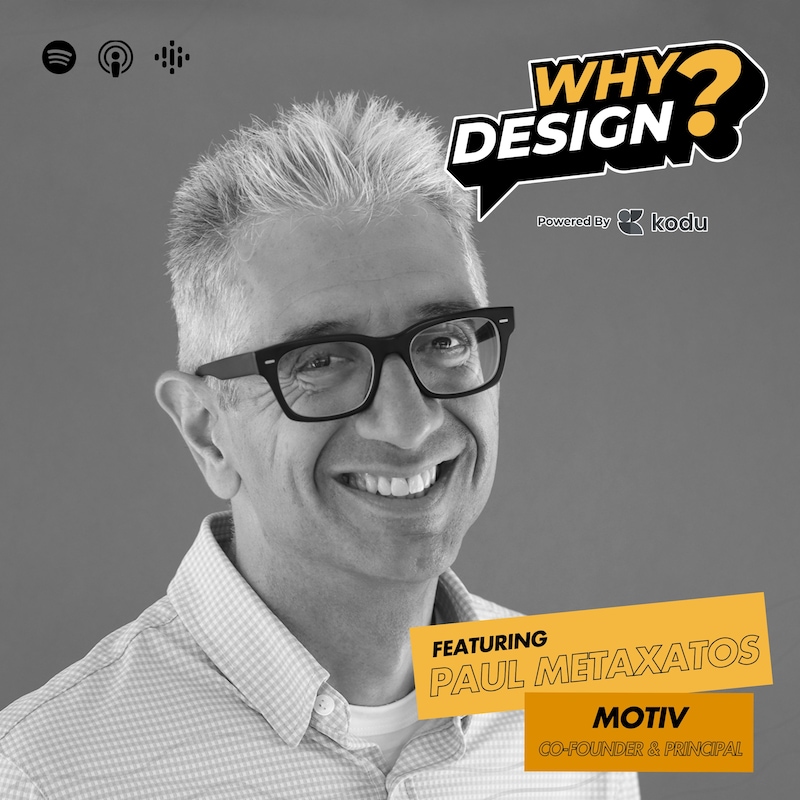
In this episode of Why Design, Paul Metaxatos, Principal and Owner of Motiv Design, joins host Chris Whyte to unpack what it actually takes to build a consultancy that endures, not just commercially, but creatively and personally.
Paul shares his journey from industrial designer to business owner, and why Motive Design has prioritised steady relationships, clear judgement, and long-term thinking over chasing size or short-term wins. It’s a candid conversation about restraint, responsibility, and staying committed to the work even when growth is uneven or unglamorous.
This episode isn’t about scaling for the sake of it.
It’s about the quiet discipline required to build trust, credibility, and a business that lasts.
Don’t just listen. Go beyond the podcast.
Join the Why Design community → teamkodu.com/events
💡 What You’ll Learn
🤝 Why relationships are the real currency of consultancy life
🧠 How trust is built slowly through judgement, honesty, and consistency
🏗️ What running a design consultancy actually demands beyond creative output
💬 Why communication and expectation-setting matter as much as ideas
📉 Why not all growth is good growth, and how to recognise the difference
🎯 How staying in the work, not chasing scale, shapes better long-term outcomes
💬 Memorable Quotes
“There’s little doubt the number one thing is the relationship. That is currency.”
“You’re in the ring. This is what you’re going to be doing, and you don’t step out unless something really massive happens.”
“Design is a conversation. There are always solutions, big and small.”
“If you want design to have influence, it has to carry responsibility.”
“People are the biggest challenge, and the biggest opportunity.”
🔗 Resources & Links
🎧 Listen on Spotify, Apple Podcasts, YouTube & Amazon → whydesign.club
👥 Join the Why Design community → teamkodu.com/events
🔗 Explore Motive Design → http://www.the-motiv.com/
🔗 Connect with Paul Metaxatos → https://www.linkedin.com/in/paul-metaxatos-037838/
📸 Follow @whydesignxkodu on Instagram
🎥 Watch full episodes → YouTube.com/@whydesignpod
🔗 Follow Chris Whyte → LinkedIn.com/in/mrchriswhyte
About the Episode
Why Design is powered by Kodu, a specialist recruitment partner for the hardware and physical product development industry.
Through honest conversations with designers, engineers, and creative leaders, we explore not just what they build but why they build it, and what that means for teams, careers, and leadership.
About Kodu
Kodu is a recruitment partner for ambitious hardware brands, design consultancies, and product-led businesses.
We help founders and teams hire exceptional talent across industrial design, mechanical engineering, and product leadership with structure, clarity, and care.
🔗 Learn more → teamkodu.com
Transcripts
live. So, Paul, welcome to the podcast. Great to have you on here. I should have asked you this before I click record actually. Your surname, Paul, perhaps before I get too far and I just call you Paul from motive, perhaps you could help me out with the pronunciation of your surname because I believe it's Greek, is it? Yeah.
Paul Metaxatos (:Thank you.
Paul Metaxatos (:It is, full name is Paul Kiriakos Metaxatos. But for most people, it's Paul Metaxatos. And for my family that is not Greek, they've had adjust to that. And so my wife's been called Mrs. But most people do make an attempt at Metaxatos and they see the X, it throws them off. But once they get through it once, they're usually help free.
Chris Whyte (:tax it is. Yeah.
Chris Whyte (:Okay.
Chris Whyte (:That's it, yeah.
Brilliant, thank you.
Paul Metaxatos (:I am the first generation American. My parents came from Greece and Cyprus.
Chris Whyte (:Amazing. Well, there you go. Much better than the intro I had scripted. So thank you for that. But Paul, you're the principal and owner or one of the owners at Motive Design in Boston. You built a consultancy that major brands trust for physical product and packaging, often in long-term relationships rather than one-off projects. But before we get into that, I want to take us back to a moment where everything shifted.
When did you stop thinking like an industrial designer, and start thinking like an owner, whether you liked it or not?
Paul Metaxatos (:Yeah, it's a really great question and I would say for me, I always had it in me to be an entrepreneur. When I was when I was really young, I had had the benefit of being around a few people who were entrepreneurial and I saw how they thought and how they operated. It really intrigued me. It made an impression. I got a couple of great friends who's
families had enjoyed a certain lifestyle and had also enjoyed a certain mindset, which seemed really interesting. And it just had an early age. I thought, wow, I want to do that at some point. And then when I embarked on my career, I've never worked for a large corporation. So I always worked in these small firms like our own today that were similar in scale where you could see the entire sausage making. So from
what I did when I first joined as a junior designer to the partners. And in fact, as an interesting thread throughout my career, I've actually either worked for partners or become a partner, right? So two owners, meaning 50-50 owners, that's really been a thread throughout my entire career, with the exception of the first guy that I worked for in college, who was just a single owner, really unique, exciting, and interesting, eccentric guy.
That was my first exposure to working in a design studio in Manhattan's West Village. West Village. Yeah. And so, but what really got me interested was one, following that thread. So jumping into these businesses, working with the principals and founders, even as a junior, and I accelerated pretty quickly in my career. I was very, very blessed with skills and talent that I could understand the craft.
I was also blessed with working with some fantastic people in early in my career, just super, super talented people. I, there's a list of them that were just great mentors. And, you know, they saw that I had an interest, I was engaged. This is what I really wanted to do. Um, and so, you know, working with them, you know, working closely with the principles and that meant actually going early on, on calls with customers and sort of seeing the whole operation, but really focusing on what I did.
Paul Metaxatos (:And I would say that and I saw a huge benefit, in fact, in working in these operations and learning the ropes, learning all aspects from doing the design, doing the development, working on different, working with different teams, engineers, marketers, really just enjoying that, not really overthinking kind of my future, although it was always in the back of my head. But the entrepreneurial thing was there. And I'd say probably midway through my last
working opportunity for somebody else, I was really chomping at the bit. And so it was an interesting situation because, you know, in life things happen for a reason and that business, um, the founder had driven it to failure. And, know, while we were in that mode, it was a extraordinarily valuable lesson in the things you should do and shouldn't do.
So was sort of the pre-training and I had already wanted to be entrepreneurial getting there and then the moment presented itself. So it was an unusual sequence of events that came to that conclusion and I was very fortunate also to have my best friend and current business partner by my side in the trenches, in that situation. And we both looked at each other and said, well, we both have young kids. We either go for the home run now or not.
and regret it. So here's the opportunity. Let's do it.
Chris Whyte (:Amazing and that was 15 years ago pretty much to the day isn't it? December 2010 that finished. Yeah
Paul Metaxatos (:That's exactly right this was the fall of twenty ten when that company imploded and i'm essentially rome was just falling apart around us and so it was a very stressful interesting and exciting time and then january twenty eleven motor was born.
Chris Whyte (:Well.
Chris Whyte (:Bro.
From that time, what lessons have you kind of brought forward? bet you either learn from making mistakes yourself or learn from other people's mistakes. And you've got a great opportunity there to bounce into what motive became. think about what are the key ones that still kind of ring true today?
Paul Metaxatos (:Yeah. Well, you're absolutely right. So that that experience beforehand was fantastic. And again, my training in terms of working for very closely with owners over the years really taught me a tremendous amount. And so there was the basic mechanics of the business. mean, the business breaks into a couple of categories, right? There's a mechanics of running a consulting business, cash flow, all that kind of stuff. There's a support structure of, your your account and your lawyer and those kinds of things.
And then there's sort of the intangible of like the sort of the passion behind it and that's sort of an evolving thing. You know, that's I think the other two aspects of really stay pretty consistent and there are certain guidelines you can follow. And again, fortunate to have the experience seeing what works and what doesn't. The intangible is really the fluidness of the changes in the business climates as you move forward.
There's little doubt the number one thing is the relationship. And if you've been in an industry for a long time, you do have the benefit of actually creating more relationships than you may have thought you had. And that is currency. So I was very, very blessed to, again, since the beginning of my career, consult and become and be forward in terms of interacting with customers. And so this gave me a lot of confidence in terms of really
expanding those relationships, growing them. And in fact, in my prior role before launching Motive, I had been very forward. I was really running design and then really moving towards running significant accounts. In fact, one of my favorites was Keurig. Keurig was an account where I just really saw eye eye with what I, to this day, still think is one of the most remarkable CEOs.
and it was very formative for, for me and for him. mean, like that guy, you know, wrote the script for one of the most sensational, appliance and food businesses. you know, of recent times and, know, I was just very fortunate to be in the right place at the right time and have the right mindset to align. And, and so that was very meaningful and productive at the same time, both, both from a education and a fulfillment.
Paul Metaxatos (:to a productivity perspective.
Chris Whyte (:Yeah, huge. And at Proteus, were you exposed to the inner workings of the consultancy, the finance, the legal side, as you mentioned, the bits that, often in a consulting firm, know, my industry included, it's like you get to principal, you get to director level, but you're not showing how the business actually works. You're not showing how much money it costs to run and what cashflow is.
Paul Metaxatos (:That's right.
Paul Metaxatos (:Yeah, that that part was definitely eye opening, so I thought I saw some things and again I was we were working with a with an owner. I had been fortunate for most of my career to walk work with fantastic folks with you know high levels of integrity and and the last guy, maybe not so much. And so there was there was a certain opacity to what actually was going on there. So that was a little bit of a wake up. You know, for one, the the.
The clothes came off, you know, at the when when the company had collapsed. so then it became very apparent what the situation was. And certainly we very quickly ramped up on all those details to understand what we were dealing with in order to make the decisions that we made in order to start a business. Again, very valuable. And and then, you know, that was also that was just a great ramp up to how we ran and manage our business. I have always been and my partner as well. We're pragmatists at heart.
You know, we are unique personalities in that we can compliment each other, but at heart we're reasonably conservative pragmatists. And that has been massive. You you certainly take a risk, a massive risk being an entrepreneur. There's little doubt about it, right? And you you also take a lot of responsibilities when you not only are entrepreneurial, but the business supports other people.
So, you know, you really do need to take those things seriously and really learn to manage with a level hand. And that's been, you know, fortunate that the personalities going into it, you know, had the right mindset. Again, partnerships are its own. You could do a podcast on partnerships, right? I mean, the do's and don'ts. And it's an interesting thing. It's like any other relationship. If you choose wisely and you communicate often, you will be productive.
And there's always going to be interactions that may spark some challenges. And it's how you manage them that really moves things forward. so I think all of those aspects together have grown on each other over the years. And we've managed to reflect quickly and understand and then move on to the next thing. And then
Paul Metaxatos (:I think really the most important part is really being in a mode. It's like, it's like a boxer being in a ring, right? You you're in the ring, so stuff's going to happen. You could get hit and, you're, you're always in, you're, you're in that right pose. You're in that right position. it's not like you're angry. This is just, this is just business and you should just expect things to always be fluid and stuff to happen and just, you know, maintain the idea that I'm in the ring. You know, this is what I'm going be doing and I'm not.
stepping out of the ring unless something really massive happens, but that's my job to be in the ring.
Chris Whyte (:I love that analogy. No. Yeah, but I think everyone can resonate with that, can't they? So that's amazing. Thank you for bringing through that. So let's, let's wrap back to the, the title of the podcast, which is why design and it's the key question I had to ask people at this stage, you know, and what was the emotional driver? Why, why design? Why industrial design all those years ago?
Paul Metaxatos (:I've never been a boxer, I've never been in a ring, but that's the analogy of the day.
Paul Metaxatos (:Yeah, yeah. Well, I mentioned at the beginning of this that my my parents are immigrants and my mother moved from Cyprus, the warm, the warm, friendly island of Cyprus to London, where you are. And she embarked at 18 on her goal of becoming a fashion designer. And there she was in this chilly climate.
Chris Whyte (:Yeah.
Paul Metaxatos (:And she went for her dream and she landed her dream. So she she started working in the fashion design space and it went really well for her. And then she went from London to New York. so continuing in that same field. So my mother, again, was a fashion designer, fashion illustrator, very gifted hand, very visionary. She met my father in New York City, who was a recent immigrant coming from Greece, couldn't speak any English.
Chris Whyte (:Where is it?
Paul Metaxatos (:He's trained as an engineer. And a little, maybe a lot of background here, but my father's very practical. He's an electrical engineer. So he really was very inclined to understanding nuances that you couldn't even see, but then he was also very, very well mechanically inclined as well. I mean, he was a problem solver if there was one. So I like to think that my upbringing was really the merger of those two aspects. Really.
the creative vision and then the practical aspects of engineering. And I'm not an engineer. I initially studied engineering because my father wouldn't hear it any other way. But quickly showed him that that's not my gift. I have another gift and that is design. And so to answer the question of why design, I think there's an aspect that's genetic. And then that may also be just the influences of my childhood watching my mother sketch.
following my father around fixing things and really developing a deep appreciation of things to the point that when I was in high school, I started making things. I was a maker. I was an avid maker. Go tinker, make stuff. And I just love the idea of realizing things quickly. And that really got me hooked. And so then when I started studying, as I said, I started engineering. said, you know what, this is a little too much.
Too much into the calculations for me. I need to really realize it directly. And, I had learned about, it, I'll design and, Gigero, which is one of my favorite, I mean, if there's a conversation with a designer in the past, I'd love to have it. We'd be sitting down with Gigero at this point and, and really talking about design. Cause that guy really influenced me seeing what he did, the cars he styled and then moving into.
founding a etal design, a very successful product development consultancy, that sort of framed up my vision. And I'm proud to say that I've been able to kind of move through the space and kind of start with a career where I've been able, fortunate to work on some really, really exciting and successful products and then found a business that continues that. not only that today, really.
Paul Metaxatos (:teaches people getting into the field. I couldn't be any more proud of this right now. The quality of the interns that we have and the students, the high school students that I've been tutoring recently that, hey, there's this exciting career out there and you can be part of it. And let me show you the ropes.
Chris Whyte (:That's awesome. And what you think back to the kind of 35 years or so you've been in the industry, what's a belief about design that you've carried with you that still holds up today?
Paul Metaxatos (:At least.
Paul Metaxatos (:Yeah, you know, there's always ways to solve. You know, there's always solutions that are out there, big and small. And and it's a conversation. And, you know, like the beauty of consultant design. And I just frame that up in itself is that it's it's something where you drop in on something quickly. You understand it. You go through a pretty rigorous process. This is not random, meaning understanding the user, understanding the consumer, understanding the marketing issues, understanding the market.
But each and every time it's still fresh and interesting and that's what keeps me engaged. And the things I've heard from our team over the years is that even though in many ways they are doing the same thing, the problems are always unique and different. And you couple that with sort of the change of the time, right? I mean, what's trending? What people are doing? mean, we're all, especially if you design product for the consumer market, which is most of our business is retail, consumer oriented products and packages.
It's such a fluid space, know, consumers are so fickle. And so it always makes the challenges unique and interesting. And that's really another part of the draw is that it always stays fresh from that perspective. It can be hair pulling out type of, you know, interactions to try to solve these things. And that's certainly one of the challenges we face is you're always, you know, working through business and working through opportunities and looking for more. But that's the job.
Chris Whyte (:what have been some of the, you know, the challenges where you've lost more hair in those kind of situations. You're doing well. You it's, yeah, you've got plenty of hair. You've obviously gone Silver Fox, but yeah, it's still, I think I'd rather go Silver than Bald. I'll be joining you in a few years. Yeah. Absolutely. Yeah. But
Paul Metaxatos (:Mine's firmly attached, but it's very white at this point.
Paul Metaxatos (:Hahaha!
Paul Metaxatos (:I'll take what I've been given. I'll take what I've been given.
Chris Whyte (:Think about some of the more frustrating challenges. Do they come more from the client side, like expectations? Perhaps you can give us some kind of anecdotes around that.
Paul Metaxatos (:Sure. Yeah. Yeah, I'd be happy to. And I'd be breaking into two lanes. mean, like, you know, again, there's design and then there's consultant design. Right. So and you know, so so a big part of that is really managing those relationships. And I and I learned early on from some some really great, wonderful people how to how to engage and hone that skill over the years. And it certainly was not without some some.
some pretty significant breakdowns, but that's how you learn. Because there's expectations that are set and you realize that the designer really sees things, that those that have the gift and the ability really see it early on. You have a conversation, like, I just visualized that. Yeah, the challenge is not everybody else in the room is seeing the same thing, right? And so the opportunity is really to...
to bring everyone along in a way and over the years those those approaches have changed whether or not it was early sketching and post its or quick cad modeling or a generated renditions today you know of a of nugget of an idea i mean that the job is really to bring people along in the breakdowns happen when there's a miscommunication and those miscommunications can happen in terms of people's expectations and so.
Managing expectations along the way in consultant design is absolutely critical, meaning even from the initial engagement, understanding what that expectation is, where do you want this to go? The question is always asked then, well, what does it cost? And that's a very difficult question to answer sometimes when you're building something where you don't know what it is, right?
inevitably those are also challenges as well, managing the financial expectations, managing the investment. So it's really multifaceted. I would say the design part of it, meaning the look, the feel, in many ways tends to be the more sort of easily fulfilling aspect versus the mechanics of moving a relationship along and really sort of building something. And that's where there are a lot of challenges. But
Paul Metaxatos (:Those are also opportunities where you can engage with people. where relationships have not come along is where really there are glaring differences in really core values. And I could say that with great confidence at this point that you can only go so far in a relationship where the values are just, they're far apart. Fortunately, most relationships that we embark upon are self-correcting.
in the sense that, you know, life is like that where you engage with people and then you, I mean, I consider many of my customers really great and dear friends. really, I mean, we both enjoy what we do. You might as well enjoy the people you work with. And I believe that sort of just happens in a manner over time. If you are proactive, engaging in the conversation. And so I think that's one of the, one of the big people are the biggest challenge and then people are really the biggest opportunity.
Chris Whyte (:I totally hear that. Yeah. We see my line of work, how we go about things isn't, isn't too dissimilar the output, you know, strikingly different, but you know, it's about curiosity. It's about working together to achieve the goal, the output that the clients looking to achieve. But quite often they don't know what they've got an idea that it's a bit fuzzy, but you know, you need to tease out of them. You need to ask questions. You need to work with them to define, you why do you want this thing? And, know,
Paul Metaxatos (:Yeah.
Paul Metaxatos (:That's right.
Chris Whyte (:If it's successful, why is it successful? know, so when you talk about junior designers and, you know, grads and, you know, interns coming in, how much of that, you know, the curiosity, the consulting kind of traits, you know, they're kind of going on the talking a client through a journey, you know, to tease out those actual briefs, you know, how much of that
Paul Metaxatos (:That's right.
Chris Whyte (:do they come pre-armed with and how much, is that something you end up having to teach them or is that, you know, is that an innate kind of skill?
Paul Metaxatos (:Mm.
Paul Metaxatos (:Yeah, I strongly feel that that is taught, you know, that's that's something you engage in. I can I just think about my own career and that's just something we touched on materials and process and creativity and drawing and, you know, CAD and all that kind of stuff. But, you know, the soft skills of engaging with people, especially in a consultative manner, I don't maybe it's changed today. I mean, I haven't been in school in a long time, but.
What I see from students today is really no different, except, I mean, the skills they have are fantastic. I mean, their technology skills are amazing. I think, you if you think of what we've been through with COVID and you think of some of the changes in terms of how people communicate, there probably are some challenges there in terms of that sort of level of interaction. And that's kind of what it entails, right? I mean, you know, being a really sort of strong and the consultative side is really...
being able to sit down with people and open conversations and kind of move people through. So the positive is though I see interest, I see when people come and join us, they're like, wow, you know, I'd love to listen in. I'd love to be part of that meeting. I'd love to experience that. And that's what we try to do. And, you know, I will share with you one of the things that brought us more back into the space post COVID.
Was me thinking to myself as a younger me going, boy, if I was just coming on now, what would I do? And if I didn't have the opportunity to really go into an exciting and interesting environment, I think my career would be very different. And I just, I thought so hard about that, that I shared with our team. said, guys, we really need, you know, like we want to have interns. can't be in their bedrooms. They got to be here with us. They, this is a, this is a hands-on kind of business. It's not every waking hour of the day.
You know, we've learned a lot from that experience, but it really makes a huge difference to sort of have those water cooler conversations that people like to talk about and just be in the space. There's so much early on in the career that's absorbed through just environment.
Chris Whyte (:Huge.
Chris Whyte (:Yeah, there's nothing, there's so much you learn that isn't on the SOP or a kind of instruction manual. It's just an osmosis. No, I love that. When you're interviewing, guess designers or engineers at any level really, are there any telltale signs or things that you can pick up on that will give you a clue as to?
Paul Metaxatos (:That's right.
Chris Whyte (:this person's got it, know, when it comes to that curiosity, when it comes to that kind of that ability to absorb and eventually consult. Are there any things you're looking at for?
Paul Metaxatos (:Yeah.
Paul Metaxatos (:Yeah, that's it's a great question and I think that one's that one's a little bit more challenging with the nuance of consult, right? So there's the there's the skills of coming in and doing design. You know the the nuance of really somebody who's just you know they and and and some may not know they've been in the space right and then you open that option up, know, because you know there's a there's the job of doing the design work and working with the team and.
You know, and in many organizations, obviously, have more senior leadership that are handling the relationships and the conversations. As you push it down, then you can you can you could see if somebody is interested and capable. And and it's fine if they are. And it's fine if they aren't. mean, our environment is full of people who some like to be forward and some like to be back. It doesn't change their value in terms of the total operation. That being said, in a consultant operation, you do need people who are more forward.
You can you can have several that are you know like hey you're amazing what you do and you can be in the room and you can be quiet and you can absorb and say three words that are super meaningful that's great. Or you can be like me who you know can't can't bear the silence and you know needs to articulate it and time should probably be quieter but you know i always feel like.
Chris Whyte (:Yeah.
Paul Metaxatos (:It is somebody's job to manage a conversation, especially in a business environment, to move it along. And early on, I learned that, you know, like you people can look around the room, but there's a lot of confidence that's given, you know, when somebody really takes the lead and leadership is something where people give it if it's offered up and if it's done in a manner that's productive.
Chris Whyte (:Yeah, massively. There's a bit of a sales superpower as well, it? Knowing when to offer silence. The question you ask followed immediately by silence and letting that vacuum pull the other person in. Because you're not alone feeling awkward with silence. I think it's a natural human trait. yeah, let's make this...
Paul Metaxatos (:Yeah.
Paul Metaxatos (:That's right.
Chris Whyte (:keep the podcast on track and not move into a BD conversation. Cause I can wax lyrical about that, but tell me about that is another podcast. Yeah. go back to starting motive. What problem were you and Bill determined to solve that you couldn't solve inside someone else's company?
Paul Metaxatos (:Hahaha!
That's another podcast.
Paul Metaxatos (:That's right. Well, it's multifaceted in the sense that our situation was kind of unique because our business, the business that we managed that we didn't own failed. So there was no there was no going back. Right. So that was that was over. And, know, we certainly enjoyed working with each other. We enjoyed what we do. We enjoyed our customers. And, know, in many ways, there was there was a bit of an anger because we had done everything right. And the business failed. Right. I mean, because it wasn't it wasn't based on our leadership. And that is something that we said, you know,
I really would like to avoid that going forward. I'm willing to bet on myself that I could do this well and do this right. And so that was really part of that charge. Like, yeah, could we go inside? I did entertain some other opportunities to go join some other people, but there was this thing in the back of my head that said, you know, that could happen again. This could be out of my hands. I am a bit type A if you haven't noticed already. And so I do like to have...
you know, my sense of control of things in a manner that I feel I can operate and as as risky as it is, you know, sort of knowing and then learning, you know, there's one thing to talk about it. There's another thing to be in the position. And they are very different things. mean, that that gap between, you know, looking up and saying, you know, drive the bus harder and being the bus driver is a very different situation. Right. And so I think the.
Chris Whyte (:You
Paul Metaxatos (:the situation that we were presented with was unique and beneficial. so we kind of knew where we getting into, but did we really know the entire picture? No, because I mean, obviously there's a lot more that goes into doing it again and again and again. The interesting thing about consulting design, especially in the space of when you're really doing unique, different things, and we've got
plenty of long-term customer relationships, right? 10, 15 years, but they do go through a natural curve. That's just the way business works. And the goal is you have these curves that overlap each other, you know, so that you can maintain a productive business. those are the challenges you face. So, you know, the initial challenge was, what are we doing? And we were very blessed in that the relationships that we had forged,
Were our relationships meaning that that the guy who we were working with really had i'm, sorry
Chris Whyte (:so the customers came with you.
So your customers came with you when the last business failed. Great.
Paul Metaxatos (:That's right, that's exactly right. And that's really, that's critically important. And it wasn't like we were taking them, the business had evaporated, you know, so we were true to our integrity and our mindsets of which we still, Bill and I hold those things very, Bill's my partner, very highly, those are very highly valued aspects today about just doing the best you can. That was part and parcel.
Chris Whyte (:Yeah.
Chris Whyte (:Yeah.
Yeah, I mean, it's the, you the upside of a, you know, terrible situation where, you know, you've got to be looking at other employment or starting your own thing. You know, you could be doom and gloom, but actually, you know, silver lining, you've got no restrictive covenants and clearly done a good job for the clients who want to come with you. yeah. Yeah.
Paul Metaxatos (:That's right.
Paul Metaxatos (:That's it.
None. That's exactly right.
And just as a quick sidebar, that is what we were dealing with prior to this. As I mentioned to you, I was really chomping at the bit. like, you know what? I'm kind of ready to do something different, but I was, had my hands tied and it was a really kind of a miserable situation for a period of time between having my hands tied and then, and knowing that something was not quite right.
Chris Whyte (:Yeah.
Yeah.
Chris Whyte (:Yeah and then with your patience I guess it all paid off in the end anyways yeah. it leads me on to the next question you know motives growth has largely been through referral and inbound you know and you know aside from obviously maintain those excellent relationships was there anything that you did early on that made people recommend you?
Paul Metaxatos (:Patience, patience.
Paul Metaxatos (:Correct.
Paul Metaxatos (:You know, I mean, it's the things that people typically hold true, build, build, you know, good relationships, solid ethics. You know, you have to be forward, you have to be out there, you know, there's just really no substitute for that. So, you know, you visit, visit clients and then obviously pre COVID, there was a lot more of that, you know, post COVID things have become a bit more efficient in terms of how we operate. you know, be a presence the the
the things I learned in my career working for others, which again, very fortunate to work for a number of people. And again, both those with, those have been positive and negative influences was really getting out there and interacting with customers, going to trade shows, you know, just being really out there and learning how to engage with people and sort of read, you know, what their needs are. And so that really built a bit of an inventory.
And then you just continue to recharge it. Unfortunately, our business is a very long sale cycle. So you do the seeds you plant early on, you you will reap later in life. And, you know, these businesses early on, they're quite fragile. If you don't have the bit of a legacy, we were very fortunate 10 years of the prior business as a legacy, essentially. We're able to really build on that and then sort of.
Additionally, you know, plant new seeds and really sort of work hard to nurture those relationships and more importantly, nurture not the businesses themselves, but the people as they then move to other things. And in our space, know, marketers move with prior much higher frequency than technical people and, you know, really following them and offering to support as we always do. You know, like, hey, where are you at now? How can I help? know, even just to chat when somebody's had.
Chris Whyte (:Yeah.
Paul Metaxatos (:a change in their life, you know, really, really matters. And I think those are the moments that are important where you just build a rapport. And at the end of the day, your goal, your mission is to make people successful, you know, as a consultant and then and also as a creative, using your superpower to make that happen.
Chris Whyte (:Yeah, I love that. I think, know, I speak to a lot of young consultancies, you startup consultancies. And, know, those that been going for a number of years and they can often find themselves in that loop of working with, you know, inventors and startups and it's small, know, very difficult. It's very, you know, they're short projects. They might come on quickly, but, you know, it's very, very difficult to maintain a pipeline and cashflow. But you're always busy.
Paul Metaxatos (:Very difficult.
Chris Whyte (:So actually committing time and investing time into networking and building those relationships, you know, it's difficult for them to justify because of because they're so busy. But I'm a true believer in, know, compound interest effect of relationship building. You know, the time you invest meeting people, especially post COVID, you know, so many people.
Paul Metaxatos (:That's right.
Paul Metaxatos (:Especially.
Chris Whyte (:appreciate we are talking on a video call here, but you know, we have met in person as well. And you know that the impact that that little gesture has is huge today. And so on.
Paul Metaxatos (:Huge, You coming into my studio and sitting down together, massive, massive.
Chris Whyte (:It's awesome. Yeah, you get such more insight into what that person's about, what the business is about, whether it's going on site, it's meeting at a post CS mixer or a hardware event or whatever it might be. It's people. You're solving people's problems. So go out and see them.
Paul Metaxatos (:It is.
Paul Metaxatos (:Yeah, build a relationship up or down, you know, depending on where somebody's at in their career. And, know, and again, the more you've been in it, the more that you see the value there. And and that that definitely has a massive ripple effect on the on the team. You know, that and I and I do my best really to try to and that, you know, again, not everybody everybody's got different skills within an organization. I certainly do my best to share.
Chris Whyte (:Yeah.
Chris Whyte (:Huge.
Paul Metaxatos (:The best that I can about how to how to manage that and I think there is a certain approach that we've that we've used within our organization that's that's worked well. That being said, you know you're you're you are still living in a replacement business. Make no mistake and I think you know like you cannot. You cannot rest on your laurels that this business is is one where you know piece of wood comes in the front door and goes out the back door is dust and you need to go find another piece of wood. You know so.
Chris Whyte (:Yeah, awesome.
Chris Whyte (:Yeah.
Paul Metaxatos (:If you're going to run an organization like this, it's not passive.
Chris Whyte (:Absolutely not. But do think any, you know, if you're not going to any networking events or you're not going to set and seeing any customers, anything is an infinite like improvement, isn't it? From, from where you are at the minute. So, interesting question for you to now pull. what's the most important? No, you've ever, said as a business owner.
Paul Metaxatos (:That's right.
Paul Metaxatos (:Hmm. Wow. Well, I think for us, it was probably if I really if I step back and think as a business owner, you know, it was probably taking on debt. Yeah, I mean, we run a we run a debt free cash flow business and, know, you have to think about how you sleep at night.
Chris Whyte (:Yeah.
Chris Whyte (:Okay.
Paul Metaxatos (:and everybody's different, everybody's risk profile's different. I think being an entrepreneur, you got to think you're taking risk being an entrepreneur. Then there's various qualities of that. And the guy that we worked with prior to Motive loved to take on a lot of debt. just, lived, he enjoyed running a business off somebody else's money. And you know,
He did a very good job of it for a period of time, but then you realize quickly when things turn, if you're leveraged, you have challenges. And so it's not the sunny day stuff, it's the rainy day stuff. You really need to think very hard about it. And if you're heavily leveraged, you don't have control. And so I would say that was really one of the, because it's always offered. mean, money, especially,
Chris Whyte (:yeah.
Paul Metaxatos (:If you go back a number of years, money's harder to come by right now for sure. But if you go back 15 years when we founded this business, people were throwing money. They're like, sure, I want to be part of that. Take on some money, you know, like, there's a couple of strings here and there, and then soon you're a puppet. that's something that and, you know, there's probably there could be other paths to gross with with leverage. But you just got to pick what suits you. And, you know, this is what suited my partner and I to really
Chris Whyte (:Yeah. Yeah.
Paul Metaxatos (:manage, you know, manage our business, manage our finances and, you know, run something that, that we can feel comfortable with because, know, again, you, you, you really don't know you extraordinarily hard to project in our business. You know, you have a guess, and you have optimism, but that's, that's kind of thin. And, so you have to really take out some other risk aspects.
Chris Whyte (:Yeah, that's a great answer. I'm looking at the dates here of when proteus ended. I'm reading between the lines here, heavily debted up until the financial crash. And then it's a spiral then, isn't it? yeah. Yeah.
Paul Metaxatos (:That's right. I whacked the knees out of it in 2007, 2008, and then it was just hobbled and then ran on fumes for a little while longer, which is a testament to how long a business can go in a broken state, but it's not fun.
Chris Whyte (:Yeah.
No, not all but yeah, give being debt free. Yeah, it's not to be sniffed at it's, you know, and having that long kind of sustained growth as opposed to, you know, debt fueled or investment fueled kind of steep growth.
Paul Metaxatos (:That's right. And it's also a personal thing. The way that we look at this business, it is a personal business. It's a private business. so we choose to run it, and both of us, just in the manner that we run our own households, that we're not necessarily extravagant people. Stay humble. Stay humble and stay hungry.
Chris Whyte (:Yeah.
Chris Whyte (:Yeah. And you know, there's a lot to be said and actually I'm seeing a lot of smaller consultancies doing particularly well now with, know, having a really strong core founder led team where you can deliver an excellent service to your clients. You know, much better than the larger agencies might be able to, especially a lot more personal anyway. And then, you know, as you take on the bigger projects, you've
Paul Metaxatos (:That's right.
Chris Whyte (:you've got a big network of freelancers. You're going to augment that team to scale kind of for short term if you need to without taking on too much risk, like you say.
Paul Metaxatos (:That's right.
Paul Metaxatos (:You take on a ton of overhead and it's inevitable that it has to be financed in a way that can allow it to continue to operate.
Chris Whyte (:Yeah.
Chris Whyte (:Yeah, wonderful. So let's talk about motive. Obviously, we talked about motive quite a bit, but I wanted you to kind of give us like the the rundown for people kind of tuning in now or that have never heard of motive before. We've been talking about it and around it. But who is who is motive? What does it stand for? You know, the elevator pitch, I suppose.
Paul Metaxatos (:Yeah.
Paul Metaxatos (:Yeah.
Paul Metaxatos (:Sure, Motive is a creative agency based in South Boston. Our core channels are brand packaging and product development. As I mentioned earlier, we take great pride in working closely with our customers focused on retail and consumer challenges, opportunities.
I'm that being said we also solve lots of other unique and interesting problems we work. many large organizations we've also work with early stage our book of business is a is like a well diversified portfolio most times you know where we have large cap and early stage and you know really you oriented and some of it is by selection some of it is you know.
fortuitous in terms of the relationships that we have. But that's what that's what that's what fuels it. The team is made up of graphic designers and mechanical engineers and industrial designers through and through. It is a creative team. You know, that's the DNA of the organization. There's really their creatives that have had long tenures with us. They've had great backgrounds, unique, different backgrounds.
We take great pride in some of the people that we've nurtured from the ground up from college and others that have come from amazing and unique, exciting challenges that have wanted to join and be part of our team. We run a pretty broad bandwidth in terms of ages and experience. And it's a living thing. Where people do come in and out and that's just the nature of the business. And we also take great
pride in people that, again, we've nurtured and have had the pleasure of working with that have moved on to great, unique, interesting, different things. Year 15, learned a lot, a ton about this business and this industry specifically, and really looking forward to continuing to do what we do in the way that we do it and really nurturing our team so that our team can take on that challenge and continue this.
Paul Metaxatos (:So that, anything, and I'll speak for my partner, that is really our legacy that we can develop motive as a brand, which is challenging for sure. mean, in the service industry, one that stands for a level of creativity and pragmatism and execution and the delivery of really great experiences for customers.
Chris Whyte (:Awesome. If we surveyed your client base tomorrow, we asked them to describe Motive using one word, what words do you think would come up most frequently?
Paul Metaxatos (:Yeah. you know, I think, I think many would say that our team is, is driven and motivate, probably motivated, you know, like, mean, it's a little bit of tongue in cheek there, but, we, really like to instill that, you know, the phone rings, answer it. A customer asked for something, give it to them. so it's a level of motivation based on.
Chris Whyte (:Yeah.
Chris Whyte (:Yeah.
Paul Metaxatos (:an understanding of the principles of great, great relationship giving, know, deliver the best quality, deliver the best interaction, enjoy the process. This is life. You know, you don't get to do it again. So really. And, know, it's multifaceted that way, but, you know, enjoy the relationships, enjoy the time you spend together, have some fun, be productive. But yeah, I'd say motivated is probably the key term.
Chris Whyte (:And is that where the name originates from as well? Or is there a story behind that?
Paul Metaxatos (:No, I wish I had a better origin story. We were actually in a tight spot once we figured this thing was going to work. We did a quick naming study internally and came up with a bunch of interesting ones. And and motive sort of came to the top when we took the off of it. And there it was. And but but time was not our friends. Time was a helpful deciding factor.
In addition to what was available, so you know, make no mistake, you can have all kinds of great ideas and then you go and try to trademark them and try to own it in your trade of business and it may not be available. So we were very fortunate to then, you know, distill it down to a few good ones and then be able to take motive in our trade and our in our class for trademarking.
Chris Whyte (:Yeah.
Chris Whyte (:Yeah.
Chris Whyte (:Yeah, I know that all too well, but roughly a year ago, I had a message from a podcast host of a very similar named podcast in French, targeting a slightly different audience. But he took umbrage with the fact my design journeys was stealing his audience. So so that prompted a rebrand. so here we are.
Paul Metaxatos (:Yeah.
Paul Metaxatos (:Yeah. boy.
Paul Metaxatos (:You know, funny you should mention that early on after we started up, I did get a call from somebody and they were like, yeah, we're also motive. I was like, huh. Now they were, turned out they were at a different, you know, they were in a, I'd say the same playground, but not the same sandbox, you know. So it did not turn into an issue and they don't exist anymore. There are other motives out there, but we're the Boston motive.
Chris Whyte (:Huh.
Chris Whyte (:Yeah.
Chris Whyte (:Yeah.
Well, that's it. At the time, I had a choice between fighting it and I fought it with a few emails, but then Spotify and Apple got involved. whilst I had a case, because they didn't own the trademark, I thought I could just put these calories into something more productive. And actually, the positive is that, why design came out of that. consulted with my
Paul Metaxatos (:Yeah.
Paul Metaxatos (:Yeah.
Paul Metaxatos (:There you go.
Chris Whyte (:network, my advisors, people who've been on the podcast and actually now it's kind of, it's now a community, it's more than just a podcast, it's like bringing people together and it's brilliant. Thank you.
Paul Metaxatos (:It built on it.
Paul Metaxatos (:I think you've built something amazing. I will touch on one other point there that you just made, I love, and that is negotiate. Standing on your principles is great, but to a fault. another core foundational thing over the years is that when you're confronting, we've had situations, all different kinds of unique and interesting things over the years.
Just very quickly, learn, educate, negotiate and make the best. Don't don't get angry. Don't get don't get upset. You know, just and this is the same thing I teach my kids right now who are teenagers and sort of jumping into that next stage in their lives is like it's it's easy to get angry. It's really harder to step back and really, OK, take stock and like just be the bigger person and figure something out. And so to your point, change the name, move on to the rear view mirror, you know, like
Don't end up in a bar fight when it's not necessary.
Chris Whyte (:Yeah.
Chris Whyte (:Yeah, it was, you know, in hindsight, probably the best thing that could have happened for the podcast is, you know, me. Yeah, absolutely. That's it. We both win in this scenario. So I mean, it feel like that in the moment. It took me 24 hours to step back and reflect and go, let's just grow up and just just move on.
Paul Metaxatos (:Yeah. Otherwise they're multiple losers.
Paul Metaxatos (:That's right.
Paul Metaxatos (:Yeah. Sage, sage words anytime in your career. And again, if you can, if you can use the benefit of that experience and then you can stay stock. Let me think about those times where I, you know, I went, I went so far and then realized, okay, you know what? This is just a losing, losing proposition. And, let's, let's not go there. You spend money on, on attorneys. You spend, you waste time, you waste calories at your point. Not worth it.
Chris Whyte (:Yeah.
Absolutely.
Chris Whyte (:Yeah, I, I've had a few moments with, because we've got a very new team being a startup ourselves. you know, where, you know, people make mistakes, they're learning, you know, and, and I'm pretty Zen about these things. You know, I've interviewed, Will the CEO of Brompton bikes a few weeks ago and says, no one died. You know, these things like mistakes, you know, so long as I, you know, we're not making mistakes that lead to someone dying or seriously hurting themselves.
Paul Metaxatos (:Sure.
Paul Metaxatos (:I love it.
Paul Metaxatos (:Yeah.
Chris Whyte (:Who cares? know, this is a flash in the pan. Yeah, no one died. So yeah, it's disappointing. But no one died. So let's learn from it. And let's move forward. Yeah.
Paul Metaxatos (:I might borrow that one. No one died. So let's...
Paul Metaxatos (:Yeah and move forward you very quickly assess have the conversation you know we always follow up and you know where we win and lose everyday right in terms of pitches and ask the question and i always think any customer who re-engage they've not hired us but they're willing they know the effort that we spent and we spent a lot of effort on pitches and
Chris Whyte (:Yeah.
Chris Whyte (:Yeah.
Paul Metaxatos (:And they say, you know what, let me just tell you everything that happened. Well, thank you. I really appreciate that. You were now friends. We're where I mean, like maybe next time. Maybe we'll crossroads and have a coffee at some point, you know, but just give me the real. put the effort into it. You asked the question. This is not brutally transactional. There's a relationship here somewhere. And that I bristle at that a bit, you know, that because there is there is a bit of that in our industry, which is.
Chris Whyte (:Yeah.
Chris Whyte (:Yeah.
Chris Whyte (:Yeah.
Paul Metaxatos (:purely transactional procurement is going to get their pound of flesh. I love procurement people and I want to make them happy. But at the same time, you got to build a relationship to really make for a functional interaction that's long term, that where both parties win.
Chris Whyte (:Yeah.
Yeah, huge. But no, it's still still very relevant to the whole discussion. I'm going back to the my kind of question line though, if someone joined motive tomorrow, what would surprise them about your standards or your process? I'm guessing if they listen to this, probably not a lot. But you know, if assuming they haven't, what would surprise them?
Paul Metaxatos (:So again, slight side rant.
Paul Metaxatos (:Yeah. Well, I mean, you know, standards are high and processes defined, but not necessarily chiseled in concrete. So, you know, it is a bit of a living process with the team, a very well-oiled team that I'm extremely proud of that, you know, we've we've gravitated towards each other. We've worked together, we've collaborated, but we're certainly very, very open. I think if you ask anybody, they'll say that.
Boy, that team at motive is very welcoming, you know, and they're going to do their best to make somebody successful. And, and, it's not easy. And this is not a, it's not a pushover and nobody is, um, is not under the, under the microscope is a strong word, but everybody just needs to pull their own weight. We're a small business and the expectations are high that, you know, you will be productive in the capacity that you've committed to. And I take commitments very, very seriously. take the commitments we make to our customers seriously. So.
I take the commitments that we have to our employees very seriously and they should take those commitments seriously as well. There's nothing that I find more frustrating than when people say, I said I could do this, but you know, like, no, no, I'm holding you to task on that because that's what you said you're going to do. I have got contracts with customers to say, that's what I'm going to do. They're holding me to task for that. Why shouldn't that trickle down to you?
Chris Whyte (:Yeah, absolutely. I think, you know, that's the some people really resonate with that, because it's the ownership. It's the auto, mean, some people were like, actually, no, I want a cushion. want like, I want to be protected. And it's not exactly. Yeah.
Paul Metaxatos (:Yeah.
Paul Metaxatos (:Maybe our kind of business is not for you. If you want to be in an environment where people are enthusiastic about what they do, the work is diverse, there's the thrill of the kill, there's the agony of defeat, it's shared, it's an alive environment.
Chris Whyte (:Yeah, awesome. Touching on the the heck in here for the defeat, not wanting to take it down a negative point, but what's the hardest thing about running a consultancy that spans brand, product, packaging and engineering? Where do things typically break?
Paul Metaxatos (:Yeah.
Yeah, yeah, you know, well, there's that's a multifaceted question because, by by design, you know, we we we offer a bit of a broader range of services for a small firm. And you mentioned it earlier as well. We're blessed to have a great core team of 20 people. We're we're blessed to have an amazing network that's much larger than that, that helps us punch above our weight. But, you know, there there are there are there are challenges, you know, that
Chris Whyte (:Yeah.
Paul Metaxatos (:that you face as a small team in terms of constantly, I guess, going head to head with larger firms, larger agencies, where you really need to sort of dig deep. And if you don't hit the mark, then you need to retrench quickly. we as a team tend to pivot
Chris Whyte (:Mm.
Paul Metaxatos (:You know, once we once we hit something and we hit an impasse, you know, we're like, we'll retrench quickly. That is key. It's people. mean, that's what it comes down to. I mean, I can't parse it any other way. It's really the level of the level and the quality of communication you have with your people internally and having difficult conversations that's just part and parcel to it in order to improve things.
Chris Whyte (:Yeah.
Chris Whyte (:Yeah. And in terms of the people side of things, and you mentioned obviously the bigger competition, what's your approach to keeping your team sharp and relevant as the market shifts, whether that be technology, whether it be, you know, the market's flooded with freelancers kind of taking on some of the smaller projects or the bigger agencies that are maybe undercutting because, you know, the economy's tight, but how are you keeping the team sharp?
Paul Metaxatos (:Yeah.
Paul Metaxatos (:We try to communicate as much as possible. the winds, mean, you know, again, we're not a huge company, but, again, there's there are separate discussions that are happening. And, you know, the business side of it is very, very difficult. The climate has become more difficult in the last number of years. We are the tip of the spear in terms of development dollars. You know, when when dollars dry up, development dries up.
Chris Whyte (:Yeah.
Paul Metaxatos (:And so I mean, feel strongly about just being as open and honest with the team as possible in the most positive manner. I'm generally a very optimistic guy. Otherwise I would not do this. And but sharing with people like, hey, here's the benefit. Like we met somebody new and yeah, we didn't get this one. We'll get the next one. But I don't take those losses easily. We want to win. Make no mistake. We were we're driven to win, driven to succeed, but also.
Chris Whyte (:Yeah.
Paul Metaxatos (:very realistic that we may not get every one of them. And along the way, we want to make friends and we want to move things along. But, you know, it's a hard goal to the wind because you really, got to make this business work. It's a monthly kind of thing. It's a cashflow business. So it does matter. If you don't find one, you got to find another. But by the same token, you know, like nobody died. And I will now use that term. And at the end of the day,
Chris Whyte (:I love that you pulled that strip back in.
Paul Metaxatos (:people matter, know, like within the organization, you know, it's, can, you can have a scuffle and then you just got to communicate as humans and move on.
Chris Whyte (:Yeah, absolutely. I'm going to try and wrap things up quick and conscious of time, but I want to ask you about something that you're proud of. You mentioned you're proud of the team, but what's the kind of motive win that you're proudest of where you felt the partnership really delivered long-term value?
Paul Metaxatos (:You know, any of these and any I could say, because we've had a number of them over the years, right, where we've been running with a customer and really being a part of their team. One of our current wins is our friends at Capital Brands, which is the new NutriBullet, MagicBullet. This is a business unit of Delonghi. And I think we're going on maybe nine years, 10 years of that relationship. And it's been fantastic. It's been, you know, a wonderful collaboration, you know, where you're really
running and gunning with your customer and, and, know, sort of solving things and very quickly seeing the product launch. And, you know, I mean, you, you essentially are operating as one business, but you're, you're a unit within that business. And, we really enjoy those kinds of relationships because again, now you're really, now you can interact, you know, it's, like when you go to the doctor for the first time, it's like,
What's wrong? I don't know. You know, let me hang out with you for a little while. But once you've been to that doctor for five years, you know, like there's a rhythm, you know, that you can get a basic understanding. And I think that's really a massive benefit in our space. You need to be kept hungry as a consultant because there's a massive benefit in that. But then you also need to be kept close as a partner. And I think those businesses that operate in that manner where they see the value and you can.
Chris Whyte (:Yeah.
Paul Metaxatos (:Build a bridge and we've had many. mean, another one for many years was Keurig. Keurig, we had a fantastic run with Keurig for, I think probably 15 or 17 of their most critical years as an early stage to a business of scale. And it was an absolutely fantastic run. Amazing people, amazing creativity that happened. And iRobot was another one.
really sad to see that they're filing for bankruptcy. And that was a wonderful run that we had together for probably more than 10 years. So, you know, very, very proud of those relationships that we build long term where we partner with the company and they've seen success and we've seen success. And, you know, that those are the kinds of relationships that we look forward to that, you know, you can help you can help build a company and you can reflect on it later and go, wow.
Chris Whyte (:Yeah.
Paul Metaxatos (:That was really pretty amazing and that's the stock that I hope to be able to reap maybe in the last the last section of my career or my life, you know where I can spend time with wonderful people that I work with and you know really share that wisdom with another generation as they're coming on like hey may not be identical but there are certain things here that worked and let me share that.
Chris Whyte (:Yeah, it's amazing when you think about the impact you've had and the relationships you've built up over the years where, they're not just looking at you as a supplier, they want to speak to you because you're a good human being, you you're a friend as well. Yeah, absolutely.
Paul Metaxatos (:That's right.
Paul Metaxatos (:A trusted partner, you know, like it's essentially you really become part of the family and you know for that for that period of time, which is wonderful and these things come and go and you can't you can't you know, you can you can mourn their loss for a very short period of time and then move on to the next thing. It doesn't mean that that it wasn't impactful or meaningful, but it means that you need to replace that both.
Chris Whyte (:Yeah.
Paul Metaxatos (:financially and mentally, you know, with something else and that's, and everybody moves on.
Chris Whyte (:Yeah, absolutely. So we're gonna wrap up quick, shortly, but I want to look ahead now to the next 12 months. Now this this section may age terribly, you know, this episode, you can see there's a Christmas tree behind you. This episode will probably go out in late February, early March time. So but let's let's assume it's there it is yet. So thinking about 2026, the next 12 months, Paul, what are you most excited about?
Paul Metaxatos (:Hahaha, right.
Paul Metaxatos (:That, you mean that one?
Chris Whyte (:personally and professionally.
Paul Metaxatos (:Yeah, okay, I guess I'll unpack a couple of things. One, I mean, we went through a real big challenge here in the States with the latest regime. A lot of things that were unstable or seen as unstable for business that pose a lot of challenges, especially in our space, especially in the consumer retail, know, we're working closely with our partners over in Asia. So that made things really, really difficult. So
Not that all that stuff is resolved, but I think it is in a better place for twenty twenty six, where there's a greater understanding around it. So I think that that provides some some foundational confidence of a way forward. Again, I hope that I hope I'm not completely wrong on that one, but it feels that again, we've we've yeah, we've beaten this thing up a bit. So I so I think there's that. I think personally, I'm I'm.
Chris Whyte (:Me too. It does feel that way though, doesn't it?
Chris Whyte (:You're okay? You're still there?
Paul Metaxatos (:Yeah, sorry, just something just popped over on my screen. Hold on one second while I fix this. I don't know what what just happened. Can you see me?
Chris Whyte (:Yeah, I can see you. You still there?
Paul Metaxatos (:Okay, sorry about that. Something just popped onto my screen. So I think from the, on the personal side, I've been sort of reflective on strategies that will take that, you know, that may be a bit fresher, a bit different in terms of how we organize our team and how we present ourselves. So I think that's always a healthy thing to sort of look at those.
Look at how you approach things and mix it up a little bit. I mean, I mean, personally, I feel like I'm in a I'm in a good space. You know, I'm starting to approach 60 years old and sort of thinking about the next phases there. And I think taking a more of a measured look at things long term. so, you know, really thinking strongly about, know, how we how we move our business into the next five years, you know, and
it's been very difficult for: Chris Whyte (:death.
Chris Whyte (:Mm.
Chris Whyte (:It's certainly an exciting 12 months ahead. think if you think about, know, hopefully things will ease up, you know, like I said, a bit more certainty around, you know, what the, the terrorist landscape looks like, as, as one thing, but then, know, with the advancements in AI and the technology, it's like, how can we, how can that positively impact our business and our customers and, you know, and, and, and level us up. I'm certainly did a lot of thinking around that for, for my business as well.
Paul Metaxatos (:think so.
Paul Metaxatos (:That's right, massive.
Paul Metaxatos (:Yeah, you can't have a podcast without bringing up AI, especially now. And I mean, I feel I feel fortunate, you know, members of our team have taken on the responsibility of just being more proactive of following it. And boy, that's it's just it's changes so often. I mean, it reminds me of the dot com days. And, know, it's just it just you just have to be mindful of the tools that are out there and testing and trying and.
Chris Whyte (:Well, no, that's it. So tick, done.
Chris Whyte (:Yeah.
Chris Whyte (:Mm-hmm.
Paul Metaxatos (:You have to be also mindful of not being just chasing shiny objects. I mean, there's still a core business. our business model is not one that is based on a trend. Our business model has been around for many, many years in terms of, so really just being mindful of, of just knowledgeable about the tools is key, but it's not necessarily changing it in its entirety.
Chris Whyte (:No, it's got to bring it back to what are the core things that you're delivering and it's communication, it's problem solving, it's people. It's the same in my business. I'm leveled up with AI. It's helped me produce the notes for our core here. It's integrated into my business, but all it does is enable me to have...
Paul Metaxatos (:That's right. Right. That's right.
Paul Metaxatos (:love that.
Chris Whyte (:more conversations like this. that's that's the that's the point. So yeah, well, we'll wrap things up. I know I've said that three times now, but quick fire questions. So I'm gonna ask you just some quick fire questions. Say the first thing that comes to mind. So fastest way to lose client trust is
Paul Metaxatos (:That's right, hugely appreciate that.
Paul Metaxatos (:Poor Ethics.
Chris Whyte (:Cool. Well, not cool. But yeah, good answer. One thing you always look for in a client relationship. You say the same thing, I guess, energy. Cool. A packaging detail most people don't notice, but you obsess over.
Paul Metaxatos (:Energy.
Paul Metaxatos (:closures.
Chris Whyte (:and skill young designers undervalue.
Paul Metaxatos (:conversation.
Chris Whyte (:a belief about innovation you've changed your mind on.
Paul Metaxatos (:increments, you know, rather than, rather than wholesale increments are important.
Chris Whyte (:cool. A product or pack you think is quietly world-class.
Paul Metaxatos (:There's so many today. mean, the landscape of packages and products. It's hard for me to pick a brand right now. It's like picking a child. I've got three wonderful children. I don't pick favorites.
Chris Whyte (:Yeah. Hundreds of favorite products as well. The final question, your default move when a project starts to wobble?
Paul Metaxatos (:Get involved and communicate.
Chris Whyte (:I love those really good answers. So Paul, thank you so much for spending the time with me. I really enjoyed the conversation. I'm confident our listeners will as well. the final thing, just as a parting kind of message, if a brand is listening to this, thinking we need that kind of partner, what's the best first conversation to have with you?
Paul Metaxatos (:Chop a note, let's set up a Zoom and have an initial discussion and then sit down for coffee in Boston or some other location and let's learn, let's interact and let's discuss.
Chris Whyte (:Awesome. And if people want to reach out, is LinkedIn the best way? Are you more of an email guy, a phone guy? Both? Yeah.
Paul Metaxatos (:Both, LinkedIn's fine or paulatthemotiv.com is the way you can find me. But go to our website and you can go to motivedesign.com or themotiv.com and you can find us there too.
Chris Whyte (:Yeah.
Chris Whyte (:I'll include all that in the show notes. Paul, thank you so much for spending the time with me, it's been an absolute pleasure.
Paul Metaxatos (:Thank you.
Paul Metaxatos (:Chris, I would agree. I'm glad we had an opportunity to do this and have this conversation and I'm looking forward to the next one.
Chris Whyte (:Likewise. Thank you.
Paul Metaxatos (:All right, take care.


