Shownotes
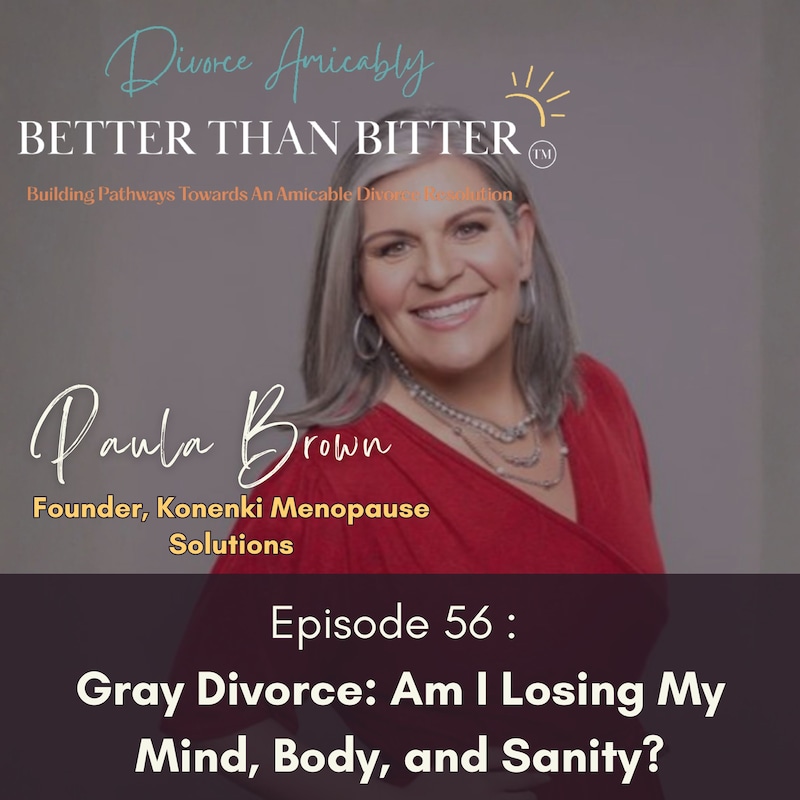
Episode 56: Gray Divorce: Am I Losing My Mind, Body, and Sanity?
Our guest for this episode:
Paula Brown, MAIOP
Founder, Konenki Menopause Solutions
Paula Brown holds a Bachelor’s in Human Resources Management and a Master’s in Industrial and Organizational Psychology, blending nonprofit and corporate expertise. A learning and development leader, she excels in designing impactful training programs and fostering inclusivity through strong communication and facilitation skills. Resilient and committed to helping others overcome challenges, Paula drives organizational growth with a focus on continuous learning.
Paula is the creator of Rita’s Labyrinth in Holliston, MA, offering mindfulness and spiritual practices inspired by diverse traditions, especially the divine feminine. She is also a facilitator of The Artist’s Way, creating spaces for exploration and growth, integrating her professional and spiritual passions to inspire lasting positive change.
Konenki Menopause Facebook Page
Summary
In this episode of the Better Than Bitter podcast, Tania Leichliter and Paula Brown discuss the intersection of divorce and menopause, exploring the challenges women face during this transitional period. They share personal stories of struggle, resilience, and the importance of support networks. The conversation highlights the impact of hormonal changes on mental health, relationships, and personal reinvention, emphasizing that menopause is a natural life transition rather than a crisis. Listeners are encouraged to seek help and find hope in their journeys.
Keywords
divorce, menopause, women empowerment, mental health, hormone therapy, personal stories, resilience, support networks, life transitions, relationship dynamics
Takeaways
- Divorce can be navigated amicably with the right support.
- Menopause brings significant physiological changes that can affect mental health.
- Personal stories of struggle can inspire resilience in others.
- Hormonal changes during menopause can lead to brain fog and other symptoms.
- Support networks are crucial for women going through divorce and menopause.
- Reinventing oneself post-divorce is possible and empowering.
- Menopause is a natural life transition, not a crisis.
- Open communication with partners about menopause is essential.
- There are professionals available to help women navigate menopause.
- Hope exists for maintaining intimacy and connection in relationships.
Titles
Navigating Divorce and Menopause: A Journey of Resilience
Personal Stories of Struggle: Finding Strength in Transition
Sound Bites
"It's life-changing."
"I thought I had a brain tumor."
"I was fired from two jobs."
Chapters
00:00 Navigating Menopause and Divorce
02:28 Personal Journeys Through Menopause
09:11 The Role of Support Networks
16:37 Coping with Stress and Brain Fog
18:17 Impact of Menopause on Relationships
28:45 Rekindling Passion and Libido
33:38 Finding Hope and Support
38:36 Introduction to Amicable Divorce
40:05 Resources for Support and Growth
On our website you'll find details and additional information on our 5-Step Gameplan multimedia course, our different types of coaching
methods, monthly memberships, events and retreats, and a whole lot more. Plus, we've got a ton of free resources, like our monthly newsletter, our private Facebook group, our Instagram channel, and a library of articles and free webinars to help you along the way. When you go to our website, you'll be able to schedule a free 45-minute breakthrough call. Remember, we're here to help you reach an amicable resolution. Find your courage and believe in your brighter future because you know what? It is possible.
At Better Than Bitter™, we measure success by what we give and not by what we get. So, let's change the divorce dialogue together. It's time to be better than bitter.
Do you want to know if We Can Help You? Book A Free 1:1 Breakthrough Call Now! Click Here
If you want to connect with a Divorce Concierge, contact Vesta Divorce Concierge here!
Transcripts
Welcome to the Better Than Bitter Divorce Podcast, where we flip the script on divorce and show you how to have a more amicable divorce resolution. I'm your host, Tania Leichliter a divorce coach, a certified life coach, and the mastermind behind the Better Than Bitter five-step game plan course, where I help individuals build a pathway towards a more amicable divorce resolution.
Each week, I'll bring you uplifting stories from people who've successfully experienced amicable separations, proving that divorce doesn't have to be a battleground. Whether you're overwhelmed with grief, struggling with custody and co-parenting, or just dealing with a high-conflict individual, this podcast is here to guide you towards reclaiming your life and being what I know is possible, better than bitter.
Tania Leichliter (:Welcome to the Better Than Bitter podcast. Today, we are going to continue our conversation about divorce and menopause. And I'm so excited that I'm going to be joined today by Paula Brown, who is founder of Konenki, a professional network for menopause specialists. I love her concept here because there are so many different people out there who are focused on helping people.
With menopause and so many women out there who are out there trying to find a specialist really don't have anywhere to start. And what Paula has done is vetted all of these incredible specialists, and she is putting her stamp on it, so when people need a resource, they know exactly what these professionals can provide.
Paula found herself struggling with all of these perimenopausal symptoms and then started moving into menopause, and was faced with divorce all at the same time. years of confusion, misdiagnoses, Paula...
encountered all of these gaps.
So I get it. People are frustrated with their own personal health, but in the same time, having to also face an incredibly challenging transition. So I'm so excited to have Paula on today.
Paula, welcome.
Paula Brown (:⁓ Tania thank you so much for having me. I ⁓ have really enjoyed getting to know you and, you know, learning more about your business. And I just love the name Better Than Bitter. I think it just frames this stage of life, of going through a divorce, so positively and with so much hope. So I really dig that, and so glad to be here.
Tania Leichliter (:Well, I just want to start off, Paula, by saying I have so much gratitude for what you're doing because I have so many clients who are really struggling right now. They're not only struggling with a late-in-life divorce, but so much is happening with their own personal well-being. The physiological changes are so overwhelming. And it's not just...
You know, the night sweats that we hear, but it's the brain fog. It is the lower libido. It is the potential kind of feeling of just, you know, what is in my future? Like this was, you know, people don't get married to get divorced, right? And even if you were feeling like yourself every day, divorce is just something that is so challenging. So to have all these physiological things happening,
to you at the same time, and maybe really thinking about the fact that you might not have had a spouse who really understood anything about menopause and what the real symptoms are. And yeah, maybe they're like, whatever, you just got night sweats, or maybe you're having hot flashes, but that's the extent of it. And not feeling seen and not feeling heard during this time is so hard for women.
because it's something that we really can't control. We can control the symptoms to some extent now, but we can't control them from happening, and it really is life-changing. So if you wouldn't mind really talking about your story, Paula, because it is so powerful just to hear from somebody who really has struggled through every single thing I'm talking about.
Paula Brown (:Yeah, yeah, have, unfortunately, right? So my story goes back to 2018. And that's when I was finishing up my...
graduate degree in industrial and organizational psychology. And I was finalizing my divorce. And I thought I had a brain tumor or early-onset Alzheimer's because my brain just wasn't working properly. And it was to the extent that I did a day of neuropsych testing. And after that testing, they told me I was fine, which I was not.
Not fine at all. I was forgetting things. literally had what they call inflexible thinking.
⁓ That's where that saying, you can't write my mind around this, comes from, you know, like I was in a group project with people who I knew to be like, you know, very qualified deep thinkers, you know, great cohort. I was in grad school, and we were doing a group project, and they're like, you know, I think I went into it saying, you know, I think we need to approach it this way. I say like ABC, and they're like, No, we think we need to do XYZ.
And I'm like, I don't understand. And it wasn't just in the moment that I didn't understand, like, even after they explained it to me extensively, even a couple of days after that, even a couple of weeks after that, like, I wasn't understanding how we were approaching this project. And it wasn't like a stubbornness, like it has to be my way or the highway. It was like, I really don't understand what you're saying. Terrified.
So that's, you know, why I went and had the testing. They said I was fine. I was not fine. And I was just kind of grasping at straws. What they did say as part of that evaluation was that I had attention issues. So I went and got help from one of the region's preeminent experts on ADD. He's published books. He is renowned, and he is awful. I'm not going to share any names.
ysician, probably starting in:And I had lots of other symptoms too that I did not recognize as perimenopausal or menopausal, nor did any of the other specialists that I was seeing. So, for example, one was a frozen shoulder. I was seeing a physical therapist for that.
for good two or three months, and she never once mentioned that it might be related to estrogen depletion. I just thought, you know, I'm kind of overweight. I must be sleeping on it wrong. I lost a tooth.
And there's some, was, I forgot to pull up the statistic. There's a crazy statistic about the number of women who lose a tooth in the years that straddle the onset of menopause. And again, I went into the self blame, like, I guess I'm not flossing enough. But, you know, the dentist never said, did you know that, you know, this enormous percentage of women lose a tooth around menopause? And it's related to
hormone depletion. So these specialists don't even understand the impact of hormones on these different body systems. So, you know, continue to experience the brain fog to the point that I was fired from two jobs.
within 12 months. It was, you know, toward the end of that second job that I had a friend who had been telling me.
Paula, think it's menopause. I think it's menopause. And I'm like, no, you know, my hot flashes are fine. And, you know, it took her, like, she really almost handed me the phone, and she's like, call today and get help. And I finally made that call and...
And it finally started sinking in that all these, you know, weird symptoms, and especially the brain fog that I had been experiencing, were related to estrogen depletion. Yeah, I guess that's what I wanna say around that. So.
If we can go back to: Tania Leichliter (:I always open the door because I think it's such an incredible organization. So yes.
Paula Brown (:Yeah, they are. They're an incredible organization. And what they've done is they've curated a network of professionals who help you through divorce. So I went to one of their events, and I left with my financial planner, with our mediator, and with two coaches and a fabulous team. And they really
You know, made what could have been a horrible stage of my life bearable. And so when I went through this experience of realizing that my situation that I was in was related to menopause, I had the thought that what Vesta had done for divorce,
needed to be done could be done for women experiencing menopause. How wonderful would it be to have one place to go and find every type of provider that you need to help you through this stage of life? And there are so many because we're so, we're humans, we're multifaceted. And so what we're doing is we're thinking of everyone, from clinicians who can prescribe
hormone therapy to boudoir photographers who help us get our, you know, see ourselves in a different way, get our mojo back, and every therapist and coach in between. Because it is a body, mind, and spirit stage of life. And so I went to the co-founders of Vesta and pitched my idea, and they said, You know, we think you're right. And they mentored me.
to create Konenki.
Tania Leichliter (:And I just love your story because so many of my clients who are trying to figure out, you know, what can I do for a living? And how am I going to support myself? Maybe they've stayed in the home, and they raised the children, and they've had an incredible full-time career, and they believe that they have no skills. And that's your story of
Just reinventing yourself in such a transitional time, coming up with an idea that you've then brought to fruition, is so admirable and also just so needed in the world of menopause. As I said, there isn't a time or a day that I don't go out with my friends that we're not sitting around a table talking about menopause.
You know, everybody who is midlife, whether you're getting divorced or not getting divorced, we're all going through it. It happens to every woman. You know, I personally have been very blessed because mine hasn't been as prominent in terms of, you know, I didn't have hot flashes. I didn't have a lot of those symptoms. But the one that I can relate to the most, Paula, is the brain fog. Because again, just like you, I'm like,
Do I have like late onset ADD? You, because you talk about certain things that I feel like I was in a pickleball clinic yesterday, and he started talking about strategy, and it was quick, you know, and talking about how to be in certain places at certain times during certain scenarios. And I'm like, why am I not grasping this? Like why?
It's going in one ear and out the other. By the time I got to the court, I had forgotten what he had said. I'm like, why can't I capture this? And this is from an individual who used to not even enter a meeting with a notebook. Like I used to be able to retain everything and regurgitate it in perfect fashion. Just to wait tables when I was younger and never had to write anything down. I had an incredible audio auditory memory.
And now I'm having to make a lot of accommodations for things that just don't work for me anymore. And just like you, I'm like, do I have ADD? I was like, Or do I just have menopause? It's one of those moments. It's like, I'm hoping it's just menopause. So the question, Paula, is if you do not go out and get some sort of hormonal replacement, if you do not replace that estrogen,
Will you be out of that same brain fog for the rest of your life? Or does it ebb and flow? Like, does it come back without the replacement? Like, what are your professionals telling you?
Paula Brown (:Okay, so yeah, I need to be crystal clear that I, I'm probably not qualified to give an answer about this. And I do want to say, I mean, I can talk a little bit about my experience. But I will say we have some really good professionals in the Konanke network that can help your listeners, your viewers, you know, sort through what's right for them personally.
Tania Leichliter (:Yeah.
Paula Brown (:The information that I'm aware of shows that there is a window, a five-year window, between the onset of menopause and when estrogen replacement is most effective when it comes to brain fog. Unfortunately, I was outside of that window when I started the hormone therapy. And this is where, you know,
I just have to tell myself that just because that's true for the majority of people who participated in this one study around brain fog doesn't mean that it's going to be true for me. So I put that patch on religiously. There is some evidence that the addition of testosterone helps with brain fog.
Tania Leichliter (:Yeah.
Paula Brown (:around menopause, and so we added that to my regimen.
The one piece of my current regimen that I have found the most improvement in my brain fog is after having what's called hair HTMA, hair tissue mineral analysis, where they take an actual hair sample and send it off, and it's analyzed to see which minerals you're deficient in. And it's funny because I started the
testosterone and the minerals at the same time. And I'm like, I'm probably not going to know which one is really working if either of them works. But what happened was I didn't get the retest of the minerals done in time.
to have continuity in my dosing. And when I stopped taking those minerals, the brain fog came back quite pronounced. So I'm a big fan of the HTMA, but I have to tell you, I still don't feel like I'm back to where I was pre-menopause. And there's some grief around that. When I heard you talking, I could tap into that.
It's a loss. It's a real loss. You know, a lot of that has to do with literal inflammation of the neurons. And there are some peptides that are showing promise. I don't think they're FDA approved yet, but they, you know, might show some promise in this area.
You know, I'm
Tania Leichliter (:Yeah, I know that in my own household, as like this time in my life, again, I didn't have these more overt symptoms happening. I didn't know any of this was going on because it's like I wasn't having the hot flashes, and I wasn't having some of the other more overt experiences. But my kids were like, Mom,
Paula Brown (:Go ahead.
Tania Leichliter (:Why, what's wrong with you? Like, why can't you find everything? You used to know where everything was. Like you were the person. They're like, we think you're losing your mind. And like, maybe I'm losing my mind again, but it was also aligned with getting divorced, and I had a lot on my mind. So not only did I have a lot on my mind, I felt like I had too much going on, and I couldn't organize it as well as I had functioned, hyper-functioned.
⁓ In the past, I always had really great executive functioning, and now it was like, why can't I take this all on? I'm so used to taking this all on. Yes, divorce is so stressful, and stress itself can cause brain fog. So you and I want to talk about that because the stress of getting divorced doesn't help with what's happening to you physiologically. I'm assuming it just literally exacerbates everything.
But again, I feel like divorce itself, during this time period, is so challenging because again, you're taking on so much more in that same time period than somebody who's not going through menopause. So let's talk about what you know about divorce and menopause and just the fact that there are so many...
Paula Brown (:Yeah.
Tania Leichliter (:people out there who are in this category of gray divorce, the relationship with their partner really shifts during perimenopause when they're not quite sure they're even going through it because they were physiologically going through changes, but yet might not be pinpointing it back on a menopause, and therefore not framing it with their partner in a way that makes sense. And then all of a sudden their relationship really changes. morphs.
and it's now an unrecognizable relationship because one person doesn't feel seen and heard, and the other person still has needs that aren't being met. And next thing you know, we're not in a good place, and divorce might be on the table.
Paula Brown (:Yeah, yeah. And before we go there, Tania, I wonder if we could just spend a minute on cortisol. You talked about the stress of, of divorce. And cortisol just really wreaks havoc on our bodies. And it's often the reason for the midlife weight gain when you're doing everything the same as you were. And you still get that, you know,
gain in your mid-belly. Often, that's a signal of cortisol. Cortisol is a sleep disruptor, and sleep also, you know, it is, you need, what happens when we get a good night's sleep?
Is the brain literally flushed out? It's like a sponge that flushes out. I forget what chemical, but it's part of the healthy functioning of the brain. When your sleep is disrupted, that's another reason that brain fog can be exacerbated during this stage of life. Yeah, that was coming to me when you first started talking about this.
stress in that. But yeah, I mean, let's talk about the effect of all these physical changes on your interpersonal relationships. And I think, you know, at least one of two things can happen, you know, if and when you realize
You, I guess, experience these symptoms, you know, and it's possible that, you know, until the idea of them being related to menopause is introduced to you, you might just chalk it up to the fact that my spouse has got to go, like, I just can't stand this person anymore.
Now it's possible when you realize that there's a physiological change happening that's underlying that decision, that evaluation, that you might get help addressing the physiological symptoms, and then you realize you have some capacity to then address the interpersonal ones.
I think you might also reach a position like I did, where you're like, my God, enough. Like half my life is gone. I only have so much left and I can't imagine spending the rest of my life in this marriage. And know, Tania, you had also talked about, you know,
This stage of life, employment, and being divorced, I stayed home with the kids. I have three kids, and I stayed home with them for 20 years. The reason I went back to grad school was that I was thinking that would be a signal to employers that I had brushed off the cobwebs and I'm ready to get back in there. And...
In a million years, I never thought I would be one of the statistics of being unemployable in midlife, but I was. I graduated with a master's, and I tried for the better part of the year to get a job in that field, but I just couldn't do it. I wasn't even getting interviews. So after I was fired the first time,
You know, it came at a point in my life where I, you know, I was still putting out feelers. And so the first couple months of, of, you know, being fired, I tried, you know, again, to pursue my field of study. And finally, you know, I had a lot, a lot of anxiety about money after being fired that first time. I was pinching pennies. I was really anxious, and I
experience, I think prior to:You know, I felt like I had to, like I'm a single mom with a mortgage, I have to get a job. And, after I sent out that version of my resume, which made me look about 30 years old, I got three interviews the next week. But they were all for admin assistant jobs. And this is where you know,
where some people might look at the role of an admin assistant and say, ⁓ I'm overqualified. But the skills and abilities that you need to be an admin assistant are off the charts. And I failed miserably. It was a crash and burn. I don't think I was even in that job for six months. luckily, luckily,
And not just luck, I did a lot of work. All of this is in the context of doing a lot of emotional, spiritual work. And I think there was an element of grace after being fired the second time, where I had healed, had some healing around my money, my relationship to money.
And I wasn't quite as worried about it. I realized I had to start spending money on my healthcare. Like, there was no choice. The irony, right, is that all of my healthcare spending
Prior to being fired, I was just trying to work the insurance system and who's covered and which providers are in network, which meds are covered. After being fired the second time, that was out the door. Just like, I just need to see who I need to see to get the help I need. If only I had done that when I had an income.
Now, you know, I'm spending my retirement on healthcare and on launching this business, but I'm doing it with more of a sense of ease around it and trusting and, you know, just knowing that I will be taken care of.
I feel like it was a moment of grace where I had the idea of starting Konenki and going to the co-founders of Vesta. I don't know, maybe that was part of my subconscious that was percolating all this as I came to realize. It really felt very fluid and just came to me and fell into place in the
know, days after being fired the second time. So all of that to say, you know, I remember one of your questions in that is like, what to say to women in this situation is, you know,
I don't know, there's an element of trust, but it came after a lot of work.
Tania Leichliter (:Yeah, and I think that just in general, you know, I always tell women who are going through that, what are your skill sets? It doesn't have to be an office skill set. If you've been driving kids around, that's a skill set. Lots of people pay people a whole lot of money to drive their kids around. You know, if you are really good at managing a household, shopping, I have a good friend who got divorced, and she started
A company called Jane, Just About Anything You Need. And that was what the company was called. And that is what she did. She did Just About Anything You Need, from buying executives' gifts for their wives for Valentine's Day, all the way to doing food shopping and meal prep, to picking up kids at school, like whatever you needed. She was a personal assistant.
But it was a really great name of the company, Jane, and it had an incredible acronym, and she made a living doing it. Again, you all have skill sets. You all have passions. Deciding to become an entrepreneur, I did the same thing, Paula. I decided to leave my company, not knowing I was getting divorced. And I had...
because I wasn't happy anymore. I thought I had a plan to start at a different company, but then that opportunity ended up falling through after I had already left my job. And I felt like there was no way that, I mean, I left the job because I wanted to be courteous of the company to let them know what my runway was, thinking I was going to start this new job, you know, literally right after. And then the funding for that new job didn't come in.
And I was already a life coach, but I didn't believe that this was the right stage in my life to put all my energy into life coaching. thought that I had a little more left in me in the advertising, tourism, and marketing world. And I thought I had some more left in me. So I wasn't quite ready to step out. But then I just took it as a sign. And I don't know if you ever felt that way, as to why you kept getting let go of jobs. It's because that's not where...
You were supposed to be going. You had this bigger purpose in life. I had a bigger purpose in life. What's meant to be is meant to be. And that's always been my mindset. And I'm like, yeah, like I'm supposed to be a life coach. And once I was faced with divorce and was able to navigate a good divorce, an amicable divorce, you know, I was like, this is my calling. I need to help more people.
And today, this is your calling. I love it, Paula. There are so many women out there struggling. And what you and I haven't approached is the lower libido and how that affects, you know, women in menopause and divorce. had, you know, as I said, there's never a moment that as people our age don't sit amongst their girlfriends and talk about menopause. Well, libido is a huge thing, and feeling like you're not connected to your spouse in the same way as you were before.
Your desire has changed, and your being attracted to them has changed. These are physiological changes that you don't really know why they're happening or what's in your body that's happening. But how do you approach that? Because again, that's going to affect your spouse, right? And so I have friends who've gone on testosterone, which has really helped kind of bring back that desire.
⁓ but some individuals don't get to that point, and they end up in a divorce because again, they're not attracted. The other person has needs. It's just not fleshing out, and they decide to divorce. And I can't say because of that, but I do firmly believe that we would be falsely claiming that it has nothing to do with it. And I just believe, and again, this is my personal opinion. I'm not a doctor, but.
You know, so much of our, you know, romantic connection is a physical connection. I always say there are three parts to every relationship: playmate, passion, and partnership. And in those three different areas, if you have lost that passion for whatever reason, and that partnership is now evolving because you might not be feeling
seen and heard going through these transitions that you don't even know what's going on. But if your partner doesn't have a level of awareness that there are physiological changes that you might be working on, that you're trying to get a hold of, you know, if there isn't that sense of partnership there, a marriage can fall apart, which could lead to divorce because it is a life transition. I mean, it's so much more well-known
about the midlife crisis, like the men who go through midlife crisis, that's definitely a much more, a topic by which people correlate more closely to divorce, right? he must've been going through midlife crisis. But we don't really spend a lot of time talking about, you know, some things that are more specific to women. And I think menopause is that thing. It's our own midlife crisis. It's just coming from...
a different place. And I do believe physiologically that men are also challenged with midlife issues as well. You know, mean, their testosterone levels are also dropping. You know, they might have, you know, problems in the bedroom as well that they are doing. And I don't want to discount that at all. I think that men and women have their own things that we're both struggling with. You know, I'm not saying that menopause trumps anything that a man might be going through, but
In order for us to maintain a healthy marriage, that level of partnership needs to exist, and that level of support needs to exist. And again, as it relates to passion, you have to work on that. And Paula has incredible people within her network that, if you're struggling with that, can help you address that to bring that back up to where it needs to be. And again, now I'm saying, okay, well, most people who listen to my podcast,
Either contemplating going through a divorce or maybe post-divorce. Well, I'm just prepping you that there is hope for another relationship. And just because you might not be, your libido hasn't been high for a certain amount of time, there is support for you to be able to regenerate and to be able to have a new romantic partnership where that passion can exist. don't want people to throw up their hands.
Do you want to address that a little bit as well?
Paula Brown (:I would love to, I love talking about this. And I feel like Konenki has really attracted a lot of providers that are passionate about sexual health to the point where I think we're gonna start a series that we'll call Frisky Fridays and rotate our providers through, you know, every Friday offering, you know, short sessions about sex
during this stage of life. I can tell you, know, anecdotally, my sample of one, I've had the best sex of my life in my 50s. So I wanna offer hope to, yeah, all the women out there. But, you know, I think, you know, a couple of things are essential to that, and that's a level of compassion.
⁓ for yourself, for your partner, because, you know, as you said, there are issues that both genders face, and it needs to be met with compassion by everyone at every stage. I started taking testosterone for brain health, and I really didn't think I had an issue with libido, but ooh.
I mean, like, things really got fun after, you know, adding that to my regimen.
Tania Leichliter (:I appreciate you being forward about sex in our 50s. And I agree that the best sex of my life has happened in my 50s. And I am not on testosterone. And I can't imagine what getting on testosterone might feel like. But my friends who are taking it have had exactly the same response as you. And they're like,
whoa. And then I have male friends whose wives have been on it, and they're like, whoa. So I think that if you are struggling out there, definitely go to Paula's website and make sure that you're looking for incredible individuals who can help you and support you through this challenging part of your life. And those of you who are getting divorced, just know that
You have an incredibly long sexual life ahead of you. And it can be the best sex of your life. And don't let menopause take you to a place where you believe that, you know, it's not possible. It's definitely possible. Go out and get that support. What I want people to get out of today's session is just that
I don't want people blaming themselves and blaming their menopause for the reason why they got divorced. I know that, you know, there are a lot of great divorces going on out there, and yes, we are all physiologically changing. But if you are not with a partner who can support you through it, I don't want you to blame your menopause on the reasons why you're getting divorced. You're getting divorced because you are in a partnership with an individual
That's not a true partner and supporting you through a life transition. Again, it happens the same for men and for women. If anybody is going through a midlife crisis, and I guess menopause is just another way of saying we're going through a midlife transition, and I hate that word crisis. It's not a crisis; nobody's in crisis. We're just evolving as humans, whether it's physiologically, physically, or mentally.
emotionally. We're all just transitioning in this later stage of life. There's other things happening. Maybe you had children, and you're becoming an empty nester. Maybe you're reaching a point of retirement. Maybe you're at a point of career transitions. I know a lot of people midlife also do career transitions. There's just a series of things that are happening in our lives. And just because the partnership that you started, maybe in your late 20s,
Or early 30s, maybe it's not the relationship that you have today. And so your menopause is not the reason why you're getting divorced. You're getting divorced because there's been a breakdown in your partnership. And there are a lot of other reasons why there's been that breakdown in your partnership. So again, menopause is just another life transition. Paula has such an incredible place for you all to go.
So, Paula, can you just let us know how people can find you and find all of your incredible professionals?
Paula Brown (:Yeah, we're on social media as Konenki Manipoz, K-O-N-E-N-K-I. The company name is Konenki Manipoz Solutions. So our website is konenkims.com. Check out our events tab.
We have some great events coming up. We have one on sex and menopause. We have the Brain Fog one coming up. We have some really, really great programming. And then we have the Find the Provider tab. So you can click on
That tab, see who's in the network. If you're unsure about where you want to start, there's a button that you can click for the wing woman concierge. It's a free 20-minute phone call, either with me or my business partner, Jennifer. I feel terrible for not mentioning Jennifer. She's frickin amazing. And we're also launching a paid membership. My other business partner, Wendy, is launching that one.
She's freaking amazing, too. She's a former Tony Robbins coach, registered dietitian, and food psychologist. So lots of resources there on the website to get you going.
Tania Leichliter (:Well, thank you again, Paula. This has been so great. Again, please make sure you check the show notes. And if you've liked today's episode, please make sure you subscribe to the Better Than Bitter podcast. We'd love to grow our audience, love to have more people like Paula. So the more people that subscribe, the better guests we will attract here.
⁓ We will continue to bring on more information about menopause and divorce. I think it's such an incredibly powerful topic to continue to embrace and continue to learn. Thanks for joining us at the Better Than Bitter Podcast. Until next time.
Tania Leichliter (:Thanks for tuning in to Better Than Bitter, navigating an amicable divorce. Whether you are at the beginning of your divorce journey, midway through, or even done, we want the stories from our guests to give you hope that an amicable resolution is possible. If you'd like to dive deeper into today's episode, check out our show notes for a full transcript, reflections, and links to learn more about Better Than Bitter's coaching courses.
and how to connect with our fabulous guests. If you're ready for more support, you can head over to betterthanbitter.coach. Daily, you'll find details and additional information on our five-step game plan multimedia course, our one-to-one Zoom coaching, group coaching, monthly memberships, events and retreats, and a whole lot more. Plus, we've got a ton of free resources, like our monthly newsletter,
our private Facebook group, Instagram channel, and a library of articles and free webinars to help you along the way. When you go to our website, you'll be able to schedule a free 45-minute breakthrough call. Remember, we're here to help you reach an amicable resolution. Find your courage and believe in your brighter future because you know what? It is possible.
At Better Than Bitter, we measure success by what we give and not by what we get. So let's change the divorce dialogue together. It's time to be better than bitter.



