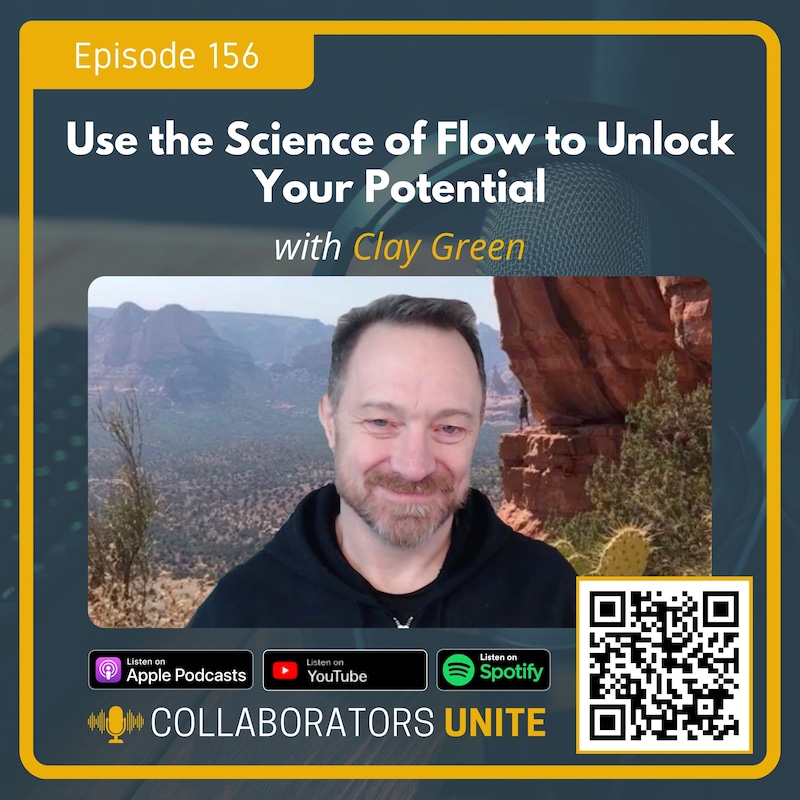
Shownotes
In this episode of the Collaborators Unite podcast, host Chuck Anderson speaks with Clay Green about the challenges faced by Big Impact Experts, particularly regarding stress and overwhelm. Clay shares his journey from a technical background to becoming a coach who helps others manage their energy and productivity. The conversation delves into the science of flow, the importance of recovery, and practical steps to cultivate gratitude and empower oneself for greater impact.
GUEST BIO
Clay Green is a flow and performance educator who helps entrepreneurs, executives, and high-performing experts overcome overwhelm by mastering their unconscious mind. With a background as a nuclear reactor operator in the U.S. Navy and over 20 years in semiconductor manufacturing, Clay blends deep scientific understanding with practical, habit-based tools. For more than 15 years, he has trained adults to consciously access—and disengage from—flow states so they can increase productivity, energy, and impact without burning out.
CHAPTERS:
00:00 Introduction to Big Impact Experts
02:41 Clay Green's Journey and Background
05:19 Understanding Stress and Overwhelm
08:00 The Science of Flow and Consciousness
10:47 Managing Flow and Recovery
13:20 Empowerment through Conscious Flow Control
15:49 The Importance of Recovery
18:42 Building Gratitude and Positive Mindset
21:14 Final Thoughts and Advice
LINKS:
Connect with Clay and the Conscious Flow Community: https://consciousflowcommunity.com/
Was this episode helpful?
Please leave us a review and subscribe to the show to be notified of future episodes.
Until next time, keep moving forward!
Chuck Anderson,
Transcripts
Hello everybody and welcome back.
2
:This is the Collaborators Unite podcast.
3
:Chuck Anderson here, I am your host.
4
:And this is the show for what we call Big Impact Experts.
5
:And that's you if you wanna make a big positive impact in the lives of your clients, in
your community, and even the world.
6
:And when we have conversations with big impact experts, they always prioritize impact over
profits.
7
:I always say that you need to be a...
8
:profitable as well because the more profitable you are, the more impact you can make.
9
:Now on this journey of making a big positive impact, you're gonna come up against some
challenges.
10
:One of the challenges is your own energy.
11
:From time to time, you could feel stressed, you could feel overwhelmed, you could feel
overworked, and you might even feel like you're spinning your wheels.
12
:you know, it's like that impact you wanna make is the horizon and you're not.
13
:quite getting there and it's like, it can be a little bit overwhelming sometimes.
14
:So we're gonna talk about that and today's guest helps with that in various ways and we're
gonna dive deep into that.
15
:So Clay Green is my uh guest today.
16
:Clay, welcome to the show.
17
:It's great to see you, Chuck.
18
:Thank you for having me.
19
:I vibe so much with everything you just said.
20
:I like what you're running through.
21
:we all will be there again, but do we have the tools to manage it and get out the other
side and get what we really want out of it, right?
22
:And so, yeah.
23
:ah So I gave you the light introduction, Clay, share everybody with everybody a little bit
more about yourself.
24
:How did it come to be that you started speaking on this topic and doing the work that
25
:Woo!
26
:It's a long story.
27
:didn't, I was not successful in establishing myself as a business owner, if you will,
until I was about 45, 42, something like that.
28
:So there was a lot of years of struggle and strife and trying and trying and trying.
29
:And I learned over my life in those struggles and strives that that's one of my gifts, I
guess, is that I, it takes me a long time to figure it out.
30
:But when I figure it out, I know the nitty gritty.
31
:So the first two,
32
:The first thing I like to tell people about my background is I was a nuclear reactor
operator
33
:I was in the Navy.
34
:learned about subatomic physics.
35
:I learned ah how to control a nuclear reactor on a submarine and on aircraft carrier.
36
:learned how to teach how teach others how to do that.
37
:And that's when I fell in love with training.
38
:Um, then I spent another 20 years or so in semiconductor manufacturing, making these
marvelous computer chips.
39
:It's making all this possible.
40
:So every time I have a meeting with someone, I'm just in this state of gratitude for
understanding what's happening in this little box sitting on my desk.
41
:You know, it's just if everybody understood just what's going on in there would blow their
mind So the point is science I have a very strong scientific engineering background and
42
:like I said It wasn't till around 42 or 43 where a few different things happened all in
the course of a few months Maybe a year and I unlocked some things and I realized some
43
:things and I learned some things
44
:And basically I've been teaching that for the last 15 plus years, almost 15 years now.
45
:uh Like I said, I'm an adult trainer and that brings us to what I do today, I guess.
46
:But ah any questions, any clarifying questions?
47
:no, I like the background em and you know, how did it, how did you come to be doing what
you're doing right now?
48
:So with your helping experts and coaches with, you know, their stress, their overwhelm,
feeling like I'm being overworked.
49
:Was it from your own experience with that and breakthrough or was it, do you have specific
training in that?
50
:What led you to the work that you're doing now with experts?
51
:um Like I said, I was in the Navy.
52
:uh not just the Navy, but the nuclear Navy.
53
:And anybody out there that's ever been exposed to the nuclear Navy, they'll speak up and
agree and understand there's a tad bit of stress when you're hanging out under the water
54
:and the training to get there.
55
:uh So yes, I have familiarity with pushing myself to my limits, to my edges.
56
:ah That's me on a cliff there where I was just on a walk one day and found a cliff.
57
:Let's just put it that way.
58
:ah So yes, I have a lot of experience finding those edges.
59
:um To get to this point, like I said, I'd spent 20 plus years in very technical
backgrounds.
60
:And I got exposed to a class on the internet that was teaching people how to build a
business.
61
:And me and the founder of that class, very small class, not one of the big ones, I
resonated with him.
62
:And because I resonated with him, I kind of believed in him.
63
:And it caused me to kind of bite into it and sink my teeth into it and really try to
understand and listen.
64
:But that wasn't where I learned the lessons.
65
:The lessons got involved.
66
:when I was exposed to about 50 people that ah frankly didn't have the same skill sets as
me.
67
:Like I knew I have a very technical, educated, I know how to think, I know how to teach, I
know how to speak.
68
:And I was exposed to a lot of people that were less experienced in those fields than I
was, yet they were more successful than me.
69
:in building their own business and it caused me to really dive in to understand why and
that got me into the brain.
70
:So I learned that the biggest impact on us all is in the first 18 months of our lives.
71
:um What I mean by that more gray matter is built in the first 18 months than after.
72
:And that causes uh what I'm going to call your unconscious or your subconscious.
73
:That's what we're talking about here.
74
:It's not like you chose to go study math at nine months old.
75
:So it's this unconscious stuff we're dealing with.
76
:What did it take for me to realize that?
77
:I hit a deer going 85 miles an hour on motorcycle.
78
:Correction, the deer hit me.
79
:it technically hit me.
80
:ah I can go into the deep physics of everything that happened but the bottom line is I
didn't crash.
81
:I performed.
82
:I did the right things at the right time on that motorcycle.
83
:I flew 13 to 15 feet.
84
:I jumped on a sport bike, which shouldn't be done.
85
:I landed, I kept the bike up and I went around the turn, the curve and I parked it and I
freaked out, but I performed.
86
:what happened, we don't really have time to go into that detailed story.
87
:What happened in those few seconds exposed me.
88
:to this separation between conscious and unconscious in a very unique and very rare way.
89
:I consciously processed some things, but my unconscious processed others and I never
consciously perceived those things.
90
:So I went back and I took photos and like right after the incident, I took photos and I
can photographically prove things happened that uh
91
:I never consciously perceived, yet my unconscious drove my body to perform in certain ways
that ensured I survived and got around the turn.
92
:I found a book of literally, I took my bike to the shop and dropped it off and I knew it
was going to be there for a while because it broke the bike pretty badly.
93
:um I still have that motorcycle today, by the way.
94
:This was back in 2012.
95
:um So, ah
96
:I took the bike to the shop and I went to the library and I found a book because I knew I
was going to be sitting on my butt and not ride my motorcycle.
97
:And that book taught me about the state of flow.
98
:It taught me literally.
99
:I finished it in like two days.
100
:It taught me everything I needed to know to understand what happened in my body in those
two to five seconds that unlocked the teacher in me going, holy cow.
101
:Look at this information.
102
:Um,
103
:Met then I then then to get into the baby steps, which is a very important word a phrase
to get into the baby steps of it.
104
:I had another mentor that um
105
:inspired me to test a practice and when I tested that practice within three to four days
my life changed and I realized holy cow that's the power that brings us down into what do
106
:I do today?
107
:I teach people to unlock this unconscious power I teach people to turn it on and turn it
off um the key thing being turn it off.
108
:the introduction you gave most, people I've met are suffering from not being able to turn
off the state of flow, state of flow, not being positive or negative state of flow being a
109
:biological condition inside your body.
110
:Does that make sense?
111
:Did I answer the question?
112
:I think we're definitely scratching the surface.
113
:So let's connect the dots between the overwhelm, the stress that someone might be feeling
as they're trying to grow their business and make this big impact and what you can do to
114
:help with that.
115
:And so let's go there.
116
:So the stress and overwhelm, if we're talking stress and overwhelm, we're talking about
the fact that our bodies are addicted to what is the state of flow.
117
:I found that most people crave being in this flow state to bring it into modern terms,
doom scrolling.
118
:Everybody out there, hopefully, that's on this podcast is trying to make this big
influence.
119
:Hopefully they've learned enough to know that what's happening when you're scrolling or
when you're working intensely is kind of the same thing.
120
:Your body is shifting into this flow state.
121
:and your body is addicted to it.
122
:And the more you're in that flow state, the more you're in that flow state, the more
you're addicted to it.
123
:And so you keep spiraling.
124
:um Most, if we kind of get out of the entrepreneurial world and we step into executives.
125
:executives will work all day and work hard and be wonderful and productive.
126
:They made it to the C-suite, they're directors of or VPs of and they're really good at
this thing and they work really hard and then they step away from work and what happens?
127
:They go get into uh a game of golf, they start playing a video game, they watch TV shows
or they watch movies or maybe they go home or maybe they're addicted to sex or maybe
128
:they're
129
:addicted to the drama that's going on with their teenage kids or maybe they're addicted to
the fight with their spouse about whether to buy this house or that house it's that
130
:constant burning and churning that's happening to the body that that's the the overwhelmed
side of it on the other side
131
:If you learn how to control that and turn that off, that gives you so much more energy to
be so much more productive.
132
:When you are focused on what you want to focus on.
133
:Mm-hmm.
134
:Yeah, so, and this is not the first time we've had this conversation, well, that I've had
conversation with other experts about this whole idea of becoming addicted to the chaos,
135
:right?
136
:So we may be externally saying, oh, I'm overwhelmed, I feel stressed.
137
:It's like, not this happening again.
138
:um But subconsciously,
139
:uh We're kind of uh excited by that because we know we've learned how to thrive in those
conditions.
140
:We may not say that we like it, but we become addicted to it and in a way even create the
situations where we can uh manifest that.
141
:Is that accurate with what you were thinking?
142
:say yes a hundred percent the trick Chuck I've found is figuring out how to describe this
problem at what level what existence and I've worked with a lot of people in a lot of
143
:different genres a lot of different demographics a lot of different job roles titles
success levels um and that's that brings me back to the science thing that I was talking
144
:about.
145
:A lot of what I share and what I help people develop or what many people would label kind
of woo woo or spiritual habits, practices, but I know the science behind it and regardless
146
:of how we talk about
147
:uh, overwhelmed stress, productivity, impact, whatever we're, whatever metric we are
trying to play with, it all comes back to that little bit of gray matter right back here
148
:between your ears, the unconscious and we're learning how to manage that.
149
:I don't know if you ever heard of the book flow by Mahaly chicks, mahali
150
:I have.
151
:Yeah.
152
:Interesting book, not my favorite book on the subject, but he's considered the grandfather
of flow because he's the guy that uh labeled it, if you will.
153
:He went out and did a study in the late 80s and wrote the book in the early 90s, late 80s,
early 90s.
154
:uh And he has a quote in that book that I love and learning how to manage this and
learning how to manage your world.
155
:in order to control your flow, in order to turn it on and turn it off and burn it, burn
your energy on what you want to burn your energy on, quality time with the kids, ah the
156
:sport that you're pursuing.
157
:ah your career or your business.
158
:When you learn how to master your focus and ability to put that energy where you want it,
it unlocks everything.
159
:ah He has a quote and he says, I'm gonna read it.
160
:It's a circuitous path that begins with achieving control.
161
:This is tricky.
162
:It begins with achieving control over the contents of your consciousness.
163
:So it's like, it's this weird circle that I've found.
164
:We talk about all this productivity, we talk about all this efficiency, we talk about all
this uh anxiety relief, stress relief, and managing and turning off that addiction that
165
:we're talking about, but it comes down with simply learning how to control what you're
thinking about.
166
:And it blows my mind how simple it is.
167
:Mm, I love that.
168
:And I wanna unpack a little bit of like what the, you know, what the, you know, the
check-in and what the, you know, what some of the steps are.
169
:So I, we hear you talk about the flow.
170
:And again, if we're trying to move away from the chaos, move away from the overwhelm, move
away from the stress and...
171
:So we're conscious now that that's happening and we're maybe even now conscious about that
we create that intentionally because we're addicted to it.
172
:And we've made the decision now that we wanna move away from that.
173
:What are some of the steps?
174
:What are some of the things that people need to do so that that's no longer the case?
175
:Those are my three words ah Enable empowered and do's ah Obviously I'm enthusiastic
Remember when I first started my business I asked all my friends and all my associates all
176
:the people I was hanging out with hey What's my superpower they're like your enthusiasm?
177
:So that's why that's there enthusiasm if you if you check out the origin of that word,
it's kind of Important it's cool.
178
:I like it
179
:uh So I break it down into a couple different areas then enabling and empowering um
Empowering we're talking about two things.
180
:We're talking about what I don't know if you guys are familiar with Brendan Bouchard and
his high performance habits Wow
181
:about eight times.
182
:I was associated, I think that's almost as much as me.
183
:I've been associated, I was associated with him for about a decade.
184
:I was one of his high-performance coaches.
185
:There's things I like and love about it.
186
:Most of everything I like and love about it is amazing.
187
:I'm kind of sad he's doing much fewer live events than he used to and I'm sad about that.
188
:But...
189
:I customize a high performance habit process with my clients.
190
:So there's six habits there and you can Google them and you can look it up.
191
:ah But that's one aspect of it.
192
:That's kind of underneath everything.
193
:The other one is conscious flow control.
194
:Conscious flow control means you need to understand what flow is.
195
:So I have a training program that I put people through about flow.
196
:Uh, the most important part is realizing there's four stages of flow.
197
:And every time you go into a flow session, you're going through those flow stages.
198
:the stages are struggle, release, flow state and recovery.
199
:Struct simplest way to describe this is like getting ready for a test.
200
:uh like in school or maybe a podcast interview or a sales pitch uh or sales call with 101
client before the call there's nervousness.
201
:Before the call, there's uh worry and anxiety.
202
:I'm going to use myself as an example.
203
:Am I going to be eloquent enough?
204
:Do I look cute enough?
205
:Am I going to be good enough for Chuck's audience to hear the message I'm trying to
provide?
206
:I'm worried about that.
207
:And that's normal, natural, expected.
208
:The difference is, like, how worried about it?
209
:How much time and energy do you exert stressing about that?
210
:I imagine Chuck, some people have come on your podcast and they've worried about it for
weeks.
211
:I teach people how to condense that down into minutes or seconds depending on the event
that they're trying to go into.
212
:Release is the...
213
:It's a very unique and very interesting thing because there's an infinite number of ways
to go through the release stage.
214
:But I train people to do it in a few seconds.
215
:It's something mechanical.
216
:It's where you stop stressing about the thing and you worry about doing something like
launching the right website and making sure your background is right and getting your
217
:lighting right and making sure the voices work.
218
:And you're doing this stuff but that struggle and that worry is still back there but
you're
219
:focused on something else mechanical.
220
:If you're going snowboarding it's when you're putting your boots on.
221
:That's another way to say it.
222
:Or if you're getting on your motorcycle going for a ride it's when you're slipping your
gloves on or putting your helmet on and starting the bike and getting on the road.
223
:It's that mechanical aspect.
224
:Flow state's obvious.
225
:The best result, my favorite result was an accountant that I worked with many years ago.
226
:And the very first time she tried to consciously put herself in a flow state, sorry, into
a flow state, she literally doubled her output and then freaked out thinking, my goodness,
227
:I just worked two hours, but she hadn't.
228
:She forgot to set the timer.
229
:And when she looked at the clock, only half an hour had passed.
230
:So she doubled her output, her experience,
231
:And it's like, that's an accountant that's, that's the measures numbers.
232
:was like really excited about not an artist making a pretty painting.
233
:It's, it's, it's, it's something very tangible.
234
:And here's the important part recovery.
235
:Recovery is the stage.
236
:So, so flow was biologically invented for us by us, by our caveman ancestors.
237
:And
238
:It's that survival instinct.
239
:It's fight or flight.
240
:That's what it really is.
241
:It's, it's, got to chase down this rabbit.
242
:We got to get this squirrel or we got to run from the saber tooth tiger.
243
:Um, so it's flow state is fight or flight.
244
:Flow state is putting yourself into that state where everything depends on the next 15 to
30 to 60 minutes.
245
:Flow state requires recovery because recovery is when you consolidate the learning.
246
:It's when your body, first off, flow state feels great.
247
:Flow state's amazing.
248
:And then you come out of flow state and you stop your snowboarding.
249
:You stop your motorcycle ride.
250
:You stop your copywriting.
251
:You stop your interview.
252
:All of a sudden, you are now in recovery.
253
:your excitement, your enthusiasm drops because your body needs to recover.
254
:Your body needs to listen to what you just did, think about how you did it, and decide if
is that better or worse than the last time I did it?
255
:Did I just learn something new?
256
:So what I've found, Chuck, over the last decade plus of teaching this is most people don't
understand the importance and value of the recovery.
257
:It's gained popularity with athletes when you start talking about bodily recovery from a
workout, but people don't understand, man.
258
:It's all about the mind.
259
:You got to get your, you got to allow your brain and the gray matter of the time to
consolidate this stuff, just like it was a muscle.
260
:Problem is people are addicted to being in flow.
261
:So they'll go from being very productive to watching some kind of crazy extreme adventure
movie or turning on a video game or going out and playing golf and getting into flow
262
:again.
263
:they're going flow, flow, flow, flow, flow and draining that body instead of flow
recovery, flow recovery, always increasing their performance.
264
:So recovery is the most important step.
265
:on that recovery is going to happen, but are we also misinterpreting that recovery?
266
:So if you're expecting your energy to be here and now all of a sudden your energy drops
because you're in recovery, do we even realize that's what's happening?
267
:And are we judging ourselves like, why is my energy so low?
268
:And is that what happens?
269
:What does that do?
270
:When you start beating yourself up, that puts you back in a flow state.
271
:See, there's different triggers of flow states.
272
:There's different kinds of flow state.
273
:Going so.
274
:can be undoing the productivity you just did.
275
:So you start second guessing yourself, you start undoing things that you did.
276
:uh You start, like you said, beating yourself up for feeling a way or not feeling another
way, right?
277
:And so, yeah, wow.
278
:That's the most valuable, that surprised me when I first, like maybe two or three groups
of people that had learned Flow and I kept asking that question, what's the most important
279
:thing?
280
:What's the most important thing?
281
:And everybody, 100%.
282
:What I do with this Chuck, is I teach a Flow launch and Flow landing routine.
283
:So I don't need to teach people what to do in flow.
284
:That's their expertise.
285
:Um, but what you do as you launch into flow and land, and then go into your next flow
session, and then there's a daily launch and daily landing.
286
:So developing these practices enables you to appreciate all of it and become much more
effective at it.
287
:And that
288
:I want to remind you though, this is still the empowerment.
289
:We haven't really talked about enabling because before people can effectively do these
things, they got to learn how to master the contents of their consciousness.
290
:That's what it's really about.
291
:Fascinating.
292
:um Well, we're running short on time.
293
:Anything else you need to add to that before we connect the dots so that people can learn
more from
294
:I would say the most important, the most important, there's a couple habits and these are,
I label them enabling habits and a few minutes ago I kind of alluded to them when I was
295
:talking about the importance of recovery.
296
:The habit, the habits are and then the probably the most important one is building your
gratitude muscle, building a deep-seated insanely optimistic
297
:edge of psychotic level of gratitude.
298
:If you can just be grateful, grateful, grateful, grateful and train yourself to be in this
joyous gratitude state, then when you hit recovery, instead of going, oh shit, I'm I'm I'm
299
:a, one of my favorite training aids.
300
:Oh shit, I'm a big turd.
301
:I suck.
302
:Instead of, instead of that reaction, you get the woohoo.
303
:m
304
:I feel like crap.
305
:That means I was really in a deep state of flow.
306
:I feel really down.
307
:I'm beating myself up good.
308
:I tell my clients all the time, ah Tuesdays and Thursdays are my big meeting days.
309
:And on in the evenings on Tuesdays and Thursdays, I'm horrible to myself.
310
:I'm like, God, you screwed that up.
311
:You screwed that up.
312
:You shouldn't have done that.
313
:You shouldn't have done that.
314
:my gosh, you went too long here.
315
:You went too long there.
316
:You said too much.
317
:You didn't say enough.
318
:And the whole time I'm doing it, I'm in joy.
319
:Because I understand that means I knocked it out of the park that day.
320
:My unconscious is like doing a lot of processing.
321
:So that's the big habit, one of the big habits.
322
:Sounds very familiar uh because that's, and I think for those of us who care deeply about
the impact that we are making, when we're out of that, we're going to automatically think
323
:about how could I have done that better or that's not what I plan to do at all.
324
:Or what should I be doing now instead of what I am doing?
325
:What should I be doing?
326
:That's that whole should it?
327
:Yeah.
328
:I'm a hundred percent with you.
329
:You should sit there and feel like crap and be grateful for it.
330
:That's yeah.
331
:Because that's getting you ready for the next one.
332
:And I love it.
333
:ah How do people connect with you?
334
:How do people learn more from you?
335
:What have you got?
336
:The one website that I'm focusing on right now is conscious flow community Conscious flow
community comm uh if people are interested.
337
:There's an application form ah My emails on that website.
338
:I don't even want to like yes My email doesn't match that website and you'll see why when
you see my email not gonna bog it down conscious flow community comm That's that's it
339
:Consciousflowcommunity.com.
340
:If you're watching this on video, there's a link to click right beneath this video that'll
take you directly there.
341
:If you're listening on a podcast, you will see the link there on your phone as well.
342
:Clay, this has been great.
343
:And I feel like we even just scratched the surface of it, but I like the idea uh of what
we're talking about here, because the feeling and the experience that you described.
344
:is very, very, very common among big impact experts and that feeling like, um I making a
big enough impact?
345
:Am I doing it right?
346
:Like all of these things.
347
:And I think we have a better understanding of why that happens and what we can do
differently and where we can go and learn more from you on how to be better at it.
348
:So thank you for that.
349
:uh And before we sign off, Clay, I just want to ask you.
350
:any final words of advice or words of wisdom for our audience here today.
351
:How much time do I have?
352
:have that craving to make a big impact.
353
:What's the most I can say here?
354
:Yeah, if you could choose one thing, what would it be?
355
:meditate to grow awareness of your body.
356
:Meditate to grow your skill in controlling the conscience contents of your consciousness.
357
:Meditate to practice your skill on amplifying your physical sensations and feelings of
gratitude about anything.
358
:Just grow that gratitude muscle.
359
:Yeah, gratitude.
360
:think that right there is great advice and great way to end this episode.
361
:So Clay, thank you so much for everything that you've shared.
362
:uh I uh like the depth and I like the uniqueness of the message and that it's not
something that we hear every day, but probably something that we should or could.
363
:And I really love that.
364
:So Clay, thank you.
365
:To our audience, thank you as well.
366
:Hopefully this has been time well spent.
367
:I want you to take one thing that you thought of or were reminded of or maybe learned
while you were here today and I want you to take action towards that thing.
368
:And maybe it's just as simple as being grateful for something uh that you're currently
experiencing.
369
:Whatever that is, take action towards that.
370
:take what you've learned here, put it into practice.
371
:And I want you to remember that there's no obstacle too big to be overcome.
372
:And you might just be one collaboration away from the big breakthrough you need in your
business to make the big positive impact.
373
:And perhaps Clay is that person to collaborate with and all his contact information is
beneath this video.
374
:So remember the big impact that you wanna make is possible.
375
:You have a message that we all need to hear.
376
:So.
377
:uh Keep moving forward everybody and we will see you on the next one.
378
:Thank you.
