Shownotes
Life is a long and winding road. When you are in the arena, doing the hard jobs with your head down, in the hustle and bustle of everyday life –- this is when you might go astray. If you craft a personal mission statement, aligned to your values, and refer to it as you create annual goals, you will remain focused on what is really important to you. This episode will guide you to define your values and draft a personal mission statement. Use this mission statement in your goal development.
Takeaways:
- In our lives, the core values we embrace dictate the paths we ultimately choose.
- Understanding your own values and principles is essential for a fulfilling life journey.
- Success devoid of moral integrity can lead to profound regret at life's end.
- Engaging in self-reflection enables us to define what truly matters in our lives.
---
Elevate Your Leadership Visibility
**[FREE COURSE] The Visibility Blueprint:** Step into the spotlight on your own terms. Get my free 3-day email course featuring daily bite-sized lessons and worksheets to increase your authority without changing who you are: https://join.introvertedexecutive.com/visibility
**Join the Weekly Newsletter:** Receive actionable strategies, short weekly activities, and direct insights to continually improve your career and life. Subscribe Here: https://newsletter.introvertedexecutive.com/riseandshine
**Inside the EVOLVE Membership (Coming January):** I'm building a brand new group coaching community designed for introverted leaders. Join the waitlist to secure early access and founding-member pricing when doors open. Join Here: https://coach.introvertedexecutive.com/
**Private 1:1 Coaching:** Are you ready for deep, personalized executive career coaching? Let’s ensure we are a perfect fit. Book a private 45-minute Discovery Call to discuss your goals and map out your path forward. Schedule a Strategic Visibility and Leadership Elevation call with me here: https://calendly.com/introvertedexecutive/strategic-visibility-call-1v1
**Leave a Review Here:**If something in this episode truly resonated with you... I have a little favor to ask: Please a review. Not for me, but for the next overlooked person who's about to scroll past this show, seven years into her career, wondering if there's a different way lead. If you take 30 seconds to leave a review (short, sweet and positive) it will make a huge difference in helping other people find the show. Thank you!! **CLICK HERE to Leave a review**
You can also follow me on Facebook at https://www.facebook.com/IntrovertedExecutive.
Transcript
Transcripts
Yes, you can. A Podcast for High Achievers hi, I'm Tami North.
The goal of this podcast is to help you become the best that you can be. Don't ever doubt the power you have to make the world a better place. Yes, you can make a difference.
There are only a few things that are going to matter at the end of your life. There have been countless interviews with people who've lived long, full lives, full of adventure, tragedy, love and loss.
And at the end of their life, what they thought about most was how thankful they were for their family, the regrets that they had for opportunities that they had never even attempted, and then a satisfaction that they lived a life for which they could be proud.
However, if they had any success from any unscrupulous means or gained any of the spoils of life through unsavory means, then sitting at death's door filled them with great remorse and they had a huge desire to go back and set things straight. The key to getting to the finish line with your head held high is what we're going to talk about today.
Some more present examples are stories from people in the News.
You know CEOs, commanding officers of Navy ships, senior government officials, mega church pastors, and you know, the boy or girl next door celebrities who everybody thought were angels. But often you hear stories of some of them falling from grace in one way or another.
And as people gossip about these events, you know, around the water cooler, you hear things like, how could they have been so stupid? She had it all. Why did she throw it away? He was too smart to have done that.
But on the other hand, we know very famous people, CEOs, movie stars and others who seem to be truly good at their core. They become philanthropists or spend large portions of their life doing charitable work.
Or they seem to have some strange, strong moral center and they become thought leaders in one way or another. So what is the difference in those two extremes, the good and the so called bad? It all comes down to values, principles and virtues.
If you're sure who you are and what you believe, and if you care about what is good and moral, then let those beliefs become your guiding light. Even when times get hard. If you do this, you will find your way through with your soul intact.
I know that talking about values, principles and virtues, it might not always sound sexy, but imagine getting to the end of your life, which could be tomorrow or it could be in 40 years, but imagine getting to that point and how you want to Feel when you have no more time to do any further actions. The only way you're going to feel complete peace with yourself is if you are guided by something powerful, something that you believe in.
And that's where values, principles and virtues come in. I want you to dream much bigger than you ever have before.
And I want you to set out climbing that mountain of success, whatever success means for you. But the thing is, as you do, you're going to find challenges that you had no way of predicting.
When we see our best possible self, we usually see how great everything will be when we get there. And when we have any negative thoughts, it's usually about our current self or our past selves in the form of limiting beliefs.
Like, for instance, think about all the parents who wanted their kids to be child stars.
I'm sure that when they thought about their child on the TV screen or the big screen, I'm sure they thought about things like the money, the fame, how taking this opportunity would give their children new opportunities in their future, such as being able to pay for their college or taking the entire family out of poverty in some cases. But the sand trap that they didn't see was that it was possible they would lose control of their own kids.
So in a rush to sign a contract, they essentially handed over their children to someone who didn't have the best interests of the child at heart. And then they looked the other way when their kids were acting out sexually or becoming drug addicts.
I know it's much more complex than that, but you see what I'm talking about where you can want something, you have a dream, but if you go after that dream in the wrong way or in a way that's out of alignment with your own values, then there will probably be negative consequences along the way.
And you can reduce the chances of that happening if you know what is most important to you and you keep those most important values as your guideposts.
I thought the story of child stars was a good example because there's certainly examples of child stars whose parents had values, principles, and were virtuous and they refused to budge. Those kids probably had contracts where the parents were highly engaged.
They, they had rights to protect the interests of the child and they never broke the parent child bond. You might say the parents who traded their kids for money and fame were naive and definitely they lost their way on their path.
And I'm sure they had the best of intentions at some point.
However, if they were clear on their values and principles before they ever had a child, and if they had remained 100% aligned with their agreement with themselves, they probably would have made some different decisions along the way that might have had a better outcome. That's just one example among infinite other possibilities. Okay, but let's pause and listen to what I said about the parents.
If they were clear on their values and principles, if they were clear on their values and principles. That's the key part. Do you even know what your values are and what principles you're aligned to?
I'm sure that most of you think you're mostly good or generally good, maybe a mix of good and bad. We all are. But are you clear on what you stand for? Do you have some something in your head that you strongly believe in?
If somebody asked you point blank, what is your number one value? Would you know what it is right off the top of your head? What is the most important principle or virtue that you are aligned with?
Can you say that without even thinking about it? Have you ever even considered what is it that you do believe in? What do you truly stand for? And I'm not talking about politics.
I'm talking about your core values. What do you believe in? What matters to you most?
And this shouldn't be what somebody else has told you to believe in, or just because your parents believe this, or just because your grandparents believed it, that now you believe it. This is something that you've actually decided for yourself, that you're an independent person.
You've had input from many others around you, friends, family, media, things you've read, things you've learned along the way. You have all of this input that's come to you.
But have you actually thought to yourself independent of all of that, this is what I do believe, and that you've basically made a commitment with yourself that these are your values. That's what we're going to work on today.
So when you decide what you want in life and you decide why you want it, if you are on the right path, there's going to be the good times when the path will feel like a wild, fun amusement park ride. And you're going to run up hills and around corners and you're going to feel like you're flying.
And when things are going this well, it's going to be very easy to stick to your guiding lights.
But it's when you start to struggle and when you're crashing down toward the ground that you're going to be tempted to take a shortcut or a dark alley. And it is in those moments when who you are at your core is going to matter most if you're crystal clear in who you are and why that matters to you.
When you see that detour through a dark alley, it's going to be a lot easier to stay on the better path, the right path, even if it takes a little more work. After all, what good is it to win or to actually achieve that goal if you feel like you compromised your soul once you arrive there?
So this is exactly why this episode is so important. I know that you are going to succeed. I have no doubt that you're going to do big things in your life.
I'm so certain that I know in my soul that I could not help you get there without pausing for a moment to make sure you are absolutely clear in who you are and who you want to be. When you succeed, I want it to feel amazing. I want you to beam with joy. I want you to be moved to tears because the journey was the best part.
When you arrive at your winning moment, I want others to celebrate with you and to honor your servant heart. I want you to savor that success with no regrets and to know you got there fully in line with who you want to be.
So let's spend a little time diving into the difference between virtues, principles and values. Virtues describe the highest moral excellence.
The definition in the dictionary of a virtue says that a virtue is a trait or quality that is deemed to be morally good and thus is valued, has a foundation of principle and good moral being. A virtue is the opposite of a vice. So the virtues are the foundation of all that is good.
I actually found a really good resource that depicts the traceability from a virtue to a principle very well. It's from the VIA Institute for Character, which is a nonprofit organization dedicated to bringing the science of character traits into the world.
I put a link to them in the show notes. They have a lot of great resources helping you understand virtues and principles and values.
They believe there are six foundational virtues that link to 24 character strengths. And for the purpose of this conversation, I'm going to call those character strengths principles.
So virtues lead to principles, and then from the principles you will decide what you are aligned with and that will become your value. So the six foundational virtues from the VIA organization are wisdom, courage, humanity, justice, temperance, and transcendence.
And then the related principles for wisdom, the related principles are creativity, curiosity, judgment, love of learning and perspective. For the virtue of courage, the principles are bravery, perseverance, honesty and zest.
For the virtue of humanity, the related principles are love, kindness and social intelligence. For the virtue of justice. The related principles are teamwork, fairness and leadership. For the virtue of temperance.
The related principles are forgiveness, prudence and self regulation. For the virtue of transcendence, appreciation of beauty and excellence, gratitude, hope, humor and spirituality.
And again, I got this entire list of virtues and character traits from via character.org so the principles that trace back to the virtues I want you to think of, the principles has a standard. Principles are something like a yardstick. They're factual, everybody knows what they mean, and they don't change. Principles are external to you.
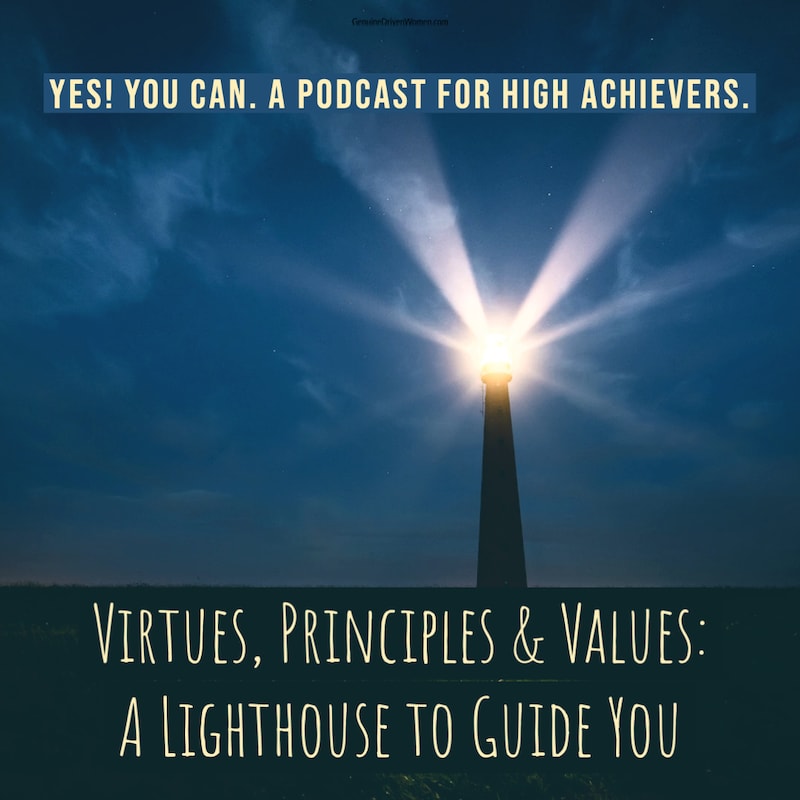
Principles are fundamental truths that are permanent, unchanging, and universal in nature. Stephen Covey compared them to lighthouses in his book the 7 Habits of Highly Effective People.
So let's say you're on a ship in the ocean and you're navigating your way into port. After you've had a great adventure on the high seas, you're going to be looking for the direction that you need to go.
Now, these lighthouses or principles are concrete clues to let you know where you are right now and if you are on the right path. The lighthouses along the coast provide you with that guidance. They warn you of danger.
They help you know when you're getting into the shallow areas and the rocky terrain, and they will help you find your way. So then the values are internal beliefs that are based on principles, but they demonstrate your alignment to the principle.
So values are internal to you.
For instance, if I state that fairness is one principle that my business aligns to, then I might also say that I value diversity and inclusion by ensuring that I represent a wide community of women who desire to discover and design the life of their dreams. Values are how we behave. They're subjective and they could change over time. So how do you decide and define your own personal value?
Well, there's seven steps that you could take. And again, I want you to go ahead, get your journal. I also did create a worksheet for you that you can go down to the Show Notes.
There's a link there to take you to the free download to give you a guide to work through. If you'd like to draft a personal mission statement for yourself that is fully aligned to your values.
And also for that process, you're going to have to define your values. So I'll walk you through that process in this worksheet. Again, just go down the Show Notes and there's a link there where you can get it for free.
So the first step is in your journal or on the worksheet. Write down what do you consider important to you in your overall life, Just take some time to write about that.
It's going to be different for everybody. So I'm not going to give you any other further guidelines than that. But what is important to you in your life? Take some time.
Write an entire page, write two pages, write more, write less. But capture some key points about what you think is important.
The second thing is if you could have any career without worrying about money or other practical constraints, what would you do?
So if you knew you would have whatever you needed taken care of, but you have a certain passion or something that you feel very strongly about, or something you really want to do, what would you spend your day? What would be your vocation? What would you do for work?
Number three, when you're reading either articles, blog articles, stories, maybe you're watching videos, news articles, some special interest thing that you hear about on the tv, tv, what sort of story or behavior that you see in everyday life or that you read or hear about inspires you.
Think about characters and books, think about inspirational stories, think about, you know that there's always an inspirational football story on your movies, that kind of thing. What do you read about? Social media is very popular for these.
As you're scrolling, there'll be something that pops up that is a tear jerker because somebody did something particularly wonderful that made a difference in somebody else's life. What types of those kinds of stories or other behaviors really speak to you and get your attention?
Take note of those types of things and then in a similar vein, but opposite, out of all of those types of stories or behaviors, what makes you feel really angry or really upsets you? So that's three and four.
The number five what do you want to change about the world, especially when you're a genuine driven woman that you believe you can change the world, you believe you can make the world a better place. So in what way do you think that you best would want to change the world and what would you want to change about yourself as well?
Number six, what are you most proud of in the entire world? And number seven, think back across your entire life. When were you the absolute happiest that you've ever been?
Think of those times and write down some of those thoughts. So the action I want you to take that will set you up for success is to take time to consider what matters to you most.
What virtues and principles do you want to align yourself with and which ones do you want to make a priority in your life? Once you've decided that what are the Values that you will use to light your path as you develop your own life plan.
As I already mentioned, I suggest that you develop a personal mission statement that includes the virtues, the principles, and the values that matter to you most.
And then I want you to use this mission statement that you write has a lighthouse when you have very difficult decisions to make or when you're struggling with advice from one of your mentors. Or maybe you know, you're trying to develop your own personal goal strategy. There's times that you might think about this.
Maybe you get a new job opportunity, but it requires you to move to another city that's going to have pros and cons. The pros might be amazing, but oftentimes you know the balance of the world.
When there's something a really amazing pro, there might also be a very powerful con at the same time. So what are you going to choose? How will you decide at those times when these opportunities come to be?
If you have very strong moral character, you'll look at your mission statement and you will decide what is best for your life based on that.
If you say you value staying close to your family, taking care of your children, and you have young children, then maybe you say to right now is not the time to move to a different city. Or maybe it, maybe it would be the right time take your children there.
You can have all new adventures, but it sort of depends on the impact that any of your decisions will make. And so what I'm trying to say there is that you can make a decision that is technically a good decision.
I am going to accept this new job or position which will change your life in many ways for the better. But there's the other side of it that you have to consider. And so going against one of your values might not actually be doing something very bad.
Such as, you know, in the last episode we talked about self destructive behaviors.
Obviously in many cases the self destructive behaviors are probably against your mission statement, but you can actually take things that are aligned with your overall goal but are off the path of your mission statement. They're not necessarily self destructive, but they aren't the path that you have already decided and committed to yourself that you want to be on.
So you're going to have to kind of weigh that and work through these decisions.
But the way for you to get to the end of your life and feel the absolute best about yourself is going to be making sure that you're doing things in line with your values. Life is a really long and winding road and it's Easy to get off track, and it's easy, easy to lose your way.
When you're in the arena doing the hard jobs with your head down and you're in the hustle and bustle of everyday life, this is exactly when you might go astray. And as I mentioned, you might even have a really good reason or a really good intention when you do.
But what I want you to do is, after you draft your mission statement, refer to it as you create your annual goals and remain focused on what is really important to you. I've already talked about this before, but I believe that the moment you're born, you have infinite paths that your life could take.
And as you move forward on your path in life, different paths light up and other paths go dark. And that's kind of how things are where new opportunities pop up, has other opportunities pass by.
So there are going to be many, many paths as you continue along in your life that are going to be aligned with what matters to you most. So don't be afraid to pass up on a path that feels like it's in conflict with your soul.
You are a genuine, driven woman, and that means you're not looking to succeed at all costs. You want to find success that you can be proud of, success that came the right way, success aligned with your own moral path.
You're off to a good start. Complete your mission statement again. There's a worksheet in the show notes to help you out with that. And then take that mission statement.
And I've made a little badge in the worksheet that you can cut out and put that in the front of your planner, your daily planner, and keep it with you until you memorize it.
When you're writing your goals, when you're working, when you have big decisions to make, when you are faced with some dilemma in your life, then review your mission statement and let that give you the guiding light to the path that you should take.
Make sure as you go along in life that you update your mission statement because the values, as we already discussed, your values, could change over time. That's okay. Just update your mission statement so you stay aligned with who you want to be and then finish strong.