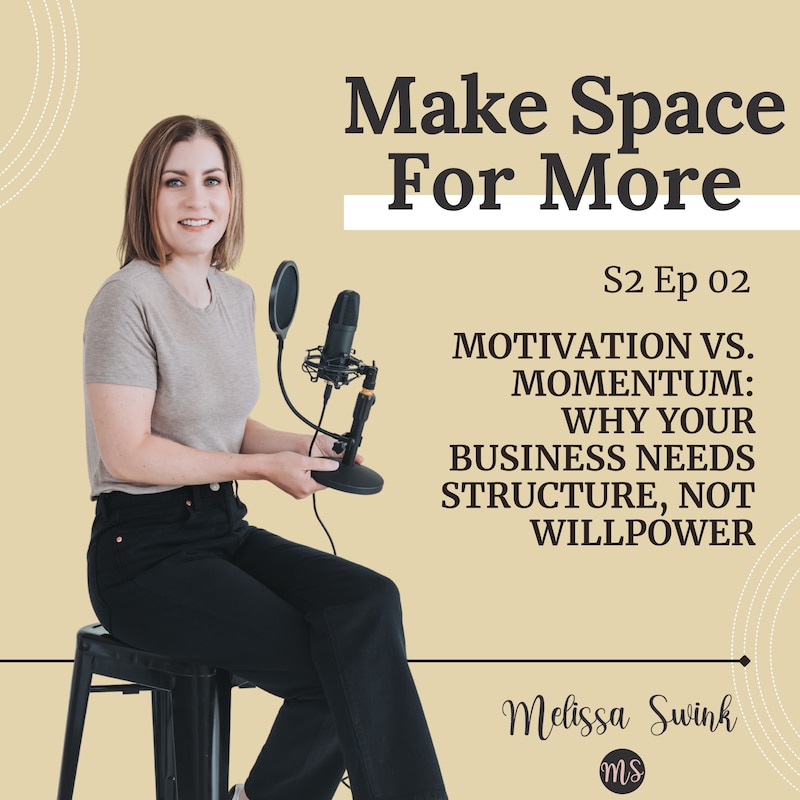
Shownotes
Episode Summary
In this episode, Melissa Swink, founder and CEO of Melissa Swink & Co., shares why lasting progress isn’t about feeling motivated every day—it’s about creating the right structure and support to keep moving forward.
Melissa explores how workload, decision fatigue, and competing priorities can cause meaningful goals and projects to stall. Through practical strategies and a real client story, she explains how clear next steps, thoughtful systems, and the right support can help you build momentum that lasts—even on your busiest or most challenging days.
Key Highlights:
- Why motivation can be fleeting—and how structure creates sustainable momentum
- How workload, decision fatigue, and mental fatigue can quietly stall your progress
- Why momentum isn’t about pushing harder or simply doing more
- A real client example of how structured working sessions revived an overwhelming CRM project
- The importance of replacing open-ended tasks with clear, actionable next steps
- How elimination, automation, and delegation can create more capacity
- Why clarity and systems should come before delegating work to your team
- How to recognize when you’ve outgrown doing everything yourself
- Ways your support team can help carry momentum forward
About Melissa:
Melissa Swink, Founder & CEO of Melissa Swink & Co., has a team of virtual assistants who provide administrative and marketing support for small businesses and non-profits.
Since 2012, Melissa and her team have helped more than 100 businesses grow through the services they offer, and she is dedicated to helping entrepreneurs create profitable, scalable businesses they love.
Her work is all about doing what works (and eliminating what doesn’t) and driving real, measurable results. Visit www.melissaswink.com to learn more!
Thanks for listening!
If you enjoyed this episode and think that others could benefit from listening, please share it using the social media buttons on this page. Do you have some feedback or questions about this episode? Leave a comment in the section below!
Subscribe to the podcast
If you would like to get automatic updates of new podcast episodes, you can subscribe to the podcast on Apple Podcasts or Stitcher. You can also subscribe in your favorite podcast app.
Leave us an Apple Podcast review
Ratings and reviews from our listeners are really valuable and greatly appreciated. They help our podcast rank higher on Apple Podcasts, which exposes our show to more awesome listeners like you. If you have a minute, please leave an honest review.
Transcripts
Hello, my name is Melissa Swink and I'm the founder and CEO of Melissa Swink & Co, which is a virtual assistant services company that provides administrative and marketing support for businesses and nonprofits. I wanna talk a little bit about momentum and how we can create this structure in order to keep momentum happening towards your goals, your initiatives, your projects, rather than relying on motivation alone.
So let's talk about motivation versus momentum for a moment here. Motivation tends to be very fleeting, very tentative, inconsistent. It's often emotional. It's often based on how we're feeling in terms of our energy level, our focus, you name it. So there are days that I feel very motivated in that I get up and I get going on my day and I'm getting all the things done.
And there are some days where I'm just tired or I'm feeling really distracted and I'm not as motivated. But what happens is, is that when we rely on motivation, it's very easy to stall out in terms of actual progress on the goals that you've set for yourself or the projects that you're meaning to be working on. So what we want to do is we want to find ways to stay in momentum. And we stay in momentum through building out the structure.
and creating the capacity for you to be consistent in terms of your progress towards your goals, projects, initiatives, you name it. So momentum, I can tell you, is not about pushing harder. Certainly there can be some days where it's mind over matter, where like, you know what, I just need to be dialed in, I need to focus, I need to get this done, but it's not necessarily working harder, doing more, anything like that. momentum is really about designing support
around you in order to create capacity. So we want to talk about, you know, setting, creating the structure, maybe setting the boundaries and incorporating team in order to help you stay in momentum and not have your goals and projects and initiatives stall out. So at this stage of where you're at in your life, in your business, your motivation isn't necessarily the bottleneck as to what's getting things done.
Melissa Swink (:Oftentimes, it's just the overall workload. It's the decision load. It's the mental fatigue that we're battling here. Businesses and progress stalled out when your progress depends on your energy. We want to create something that is very sustainable so that you can grow even on average days or even some of your worst days. Days that you have a lot of meetings or days that you're being pulled in different directions or you're trying to
help your team solve a problem that came up so that even when these things ultimately are impacting your day, that they're not completely derailing the progress that you're wanting to make. Now wanted to share a little bit of a real client example of why momentum can break down. So again, we're not talking about motivation anymore. We're talking about momentum. So to give you an example, one of our clients asked us to help her implement a CRM system.
Now this person is very well networked. She is a connector. She has so many great relationships with people in her field and beyond. It's just incredible what she has built. so naturally over many years, she's accumulated a lot of contacts. So she's got contacts on her phone, in her email. She's got contacts through lists, maybe spreadsheets from events that she's either hosted or attended over the years.
I mean, LinkedIn, she has so many people on LinkedIn. And so she's like, I want to create a tool where I can have all my contacts in one place. And I know exactly, you know, which contacts are potential clients, which.
Contacts are potential speakers, which contacts are, you know, vendors for various things, which ones are friends, family, you name it, because she had a lot of personal contacts as well. And she's like, that way, I have, when I need to send out information or I'm looking for resource, I can send an email to very specific people that it's relevant to in that moment. And so our team started building out the CRM system. We imported all the various contacts from all the various places.
Melissa Swink (:And then we created those tags for her in order to assign them to all of these various contacts. Because the challenge was, in this part in the project, was that the decision making relied on her because she was the one who had those relationships and she knew which tags needed to be associated with each contact. And so we would just regularly remind her, hey, how is it going in terms of...
assigning these tags to these particular contacts. And to be honest, the project stalled out for a period of time because it was just so overwhelming to her. She would sit down and she'd log in and she'd see thousands of contacts and then she'd just start assigning some tags. And it just got to be really overwhelming for her. And then she's trying to remember, where did I meet this person? What did we talk about again? And so it just something that just kept being pushed to the back burner because there was always more pressing work, of course.
that needed to be done. And yet this project was really important to the future success of her work and her company. And so what actually looked like procrastination was just cognitive overload and just, you know, even just competing demands based on her time on a given day. So what we did is we changed the way that we supported her through this project. So we scheduled 30 minute working sessions.
which added in that accountability that we were gonna show up and we were gonna get into the system and we were gonna just start knocking out these contacts. And sure enough, after a couple of weeks that we were meeting 30 minutes a week to sit down and work through this so that ultimately she would never have to do this again. It was just this initial part of the project that unfortunately the knowledge relied on her, but we were able to provide her that structure in order for the project not to stall out. And so that means that
Another six months went by, a year went by where she's like, I really wish that I would have had that CRM set up, or I really wish that I could have emailed all of my contacts in this particular field about the X, and Z. That is something that is actually close to the finish line. It's something we're still working with her on, but we're almost there. We didn't necessarily change the effort involved, but we changed the structure around it. The momentum return
Melissa Swink (:once we found a way to fit her capacity in what she was able to do. So that is one example of how momentum can stall out on a project, but then also how we can introduce a different way of working and create some structure in order to revive that project and get back into momentum. So how are some other ways that momentum is created? One note here that I want to say is that progress
can't rely on willpower. If we're talking about holding yourself accountable to log in for a period of time, to start assigning tags to your CRM, and just like that grit and determination, yes, it can work, but it's not always feasible and realistic to expect that you're going to stay in momentum that way. Another thing that we want to talk about when it comes to momentum is we want clear next steps, not open-ended
tasks. So, one example here briefly, maybe you've decided that this year you're going to run a marathon. Maybe you used to be a runner and then for several years you had to take a step back, other things got in the way, but you're like, want to return to running. If you just have on your calendar, run for 30 minutes every day after work and then building up that time, over time we're pretty sure you're doing like a one hour run or two hour run, that's great.
It's a starting point, but that's pretty open-ended. We want to have an actual training plan in place that you can follow so that you stay in momentum and then you're not just kind of throwing darts at the wall to see kind of what happens or how things turn out. We want very clear steps. The other thing that we want to talk about in terms of momentum is that delegation works best when clarity and systems come first.
So one of the things that I talk about throughout my blog and certainly in my podcast in the past is that we want to focus on first of all determining what are the most important things that you and maybe your team need to be focused on. Here are our goals, here's our initiatives. These are the priorities. But then there's everything else, right? So maybe there are some things that just no longer are aligned or fit in with where you're headed this year.
Melissa Swink (:These things we can look at eliminating them. Then we take a look at what are all the recurring tasks and projects that happen throughout the course of a given day, week, month, so on, and how can we systematize those? Are there automations that we can build? There's so many great AI tools now that if you're doing a lot of repeatable work, many of these can be solved with some AI automations or the right software or tools in order to take that lift off of all of your plates.
And then lastly, we want to look at delegation. So when you look back at your most important tasks, what are some of the things that are busy work not bringing you towards your goals that can be handed off to another person? Can't be eliminated, still need to do them. Can't necessarily be automated because it's higher level work than that, but we need another human being in order to take that off your plate. So that is the order that we delegate. Ultimately, our goal is that momentum
should be carried forward by your support team. So we want the support team, we want the structure built around you in order to keep you in momentum, keep you focused, provide you with that structure, and sometimes even those boundaries in order to continue making progress on the things that are most important to you. So all of that being said, if you are experiencing slow momentum right now, it's not a signal that you and your team are failing.
It's a signal that a couple of things, you outgrown doing everything yourself, just kind of depending on where you're at in terms of the team that you've built around you. And then it's also a signal that we need some better structures in place in order to keep momentum to continuing on. So if any of that was particularly helpful for you or you're curious about how can I create more structure.
in terms of my personal life, professional life, so that I can continue to stay focused on the goals and the initiatives that are most important to me. Would love to have you book a consultation. It's 30 minutes, no obligation. You and I can chat and I can learn more about what are you working towards? What does your current team look like? What are some of the bottlenecks that you're experiencing? And we can talk about how we can help you create that structure that you need in order to create that momentum.
Melissa Swink (:and get some progress made on your goals and achieve the things that you've set out to this year. So thank you so much for watching. I hope this was helpful for you. Have a wonderful day.




