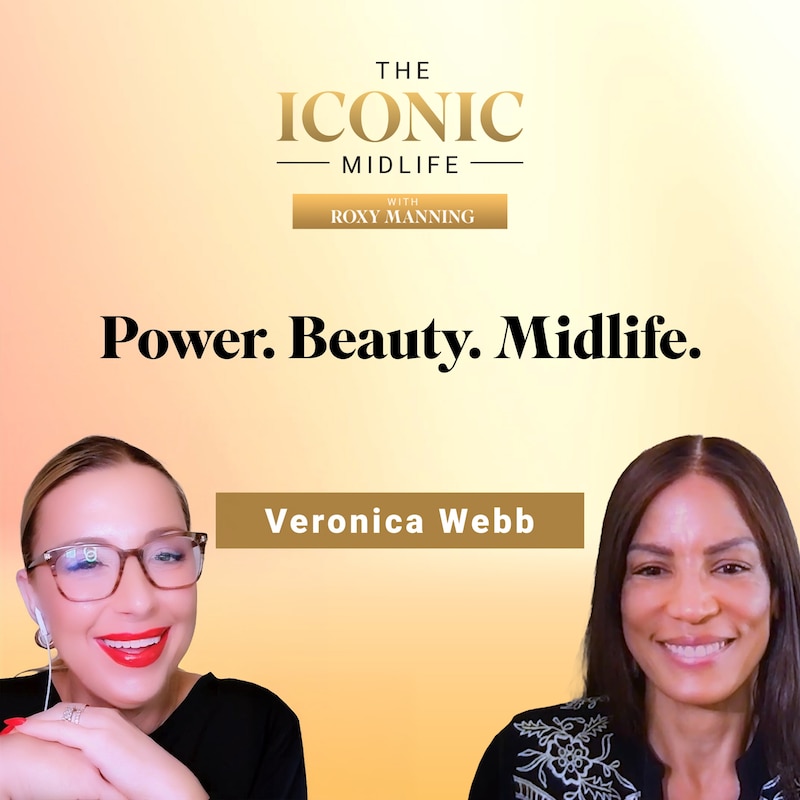
Shownotes
Supermodel Veronica Webb joins The Iconic Midlife for a thoughtful and honest conversation about beauty, aging, and what perspective really looks like after decades in fashion.
As one of the most recognizable faces of the ’90s fashion world — and the first Black model to land a major exclusive cosmetics contract with Revlon — Veronica helped redefine representation in the beauty industry. But beyond the campaigns and runway moments, this conversation focuses on what happens after the spotlight, and how confidence, identity, and power evolve over time.
Roxy and Veronica talk about the reality behind the fashion industry, how beauty standards shift with age, and what it means to move through midlife with clarity and self-possession. It’s a grounded, intelligent look at experience, reinvention, and the freedom that comes from truly knowing yourself.
This episode is reflective, insightful, and a reminder that style and substance only deepen with time.
In this episode, we discuss:
• The reality behind the fashion industry and modeling world
• How beauty and confidence evolve with age
• What midlife perspective actually feels like
• Power, identity, and self-trust after decades in the spotlight
• The freedom that comes with experience
💌 Join the Inner Circle: https://the-iconic-midlife-with-roxy-manning.kit.com/3433416614
Want bold guests, unfiltered stories, and iconic midlife insight in your inbox?
🎧 Listen & Follow
The Iconic Midlife is where smart, stylish women over 40 come to rebrand midlife on their terms.
New episodes every Tuesday. Bonus game episode drops on Thursdays.
Tap “Follow” so you never miss a moment.
🎙️ Listen on:
Apple Podcasts: https://podcasts.apple.com/us/podcast/the-iconic-midlife-with-roxy-manning/id1817484587
Spotify: https://open.spotify.com/show/4FRDzq3AalXaqfpfWq7dlm?si=7e91db12ba1f4bfa
Amazon Music: https://music.amazon.com/podcasts/ff905ad8-332f-430e-a040-ce1ba5047483/the-iconic-midlife-with-roxy-manning
📲 Let’s Connect
• Instagram: https://www.instagram.com/theiconicmidlife
• TikTok: https://www.tiktok.com/@theiconicmidlife
• Facebook: https://www.facebook.com/p/The-Iconic-Midlife-61572430341428/
• YouTube: https://youtube.com/@theiconicmidlife
• Host: https://www.instagram.com/redcarpetroxy
Transcripts
The power of hair and makeup and clothes. It's not for when you feel like it. It's really for when you don't feel like it. That's when it helps you the most. It can be like medicine.
I'm really loving my fashion game right now. I think it's pretty iconic.
My personal wardrobe at the top of my game in terms of chic, which is a grown woman's game because it takes decades to get there.
Roxy Manning:Just dipping my toes right now into the HRT world.
Veronica Webb:So, yeah, so hormones are sort of like hair color. You have to keep working it until you get it right. Running a little bit every day, like, at a very slow pace. And now I can do anything I want to do.
I can go into any gym. I can keep up with any workout. And what I loved about running was it was free, no schedule, and I already owned the equipment, my feet.
If you're an adult, you need to know better.
And I was lucky that I had a family to rely on and go back to, because a lot of the girls, you know, they were either escaping their family circumstances or escaping the circumstances in their country.
Roxy Manning:What is one beauty tip that you've learned along the way that people wouldn't know that might surprise them?
Veronica Webb:Stretch before you get out of bed.
Roxy Manning:My guest today helped shape a pivotal shift in the beauty industry in the early 90s.
She became the first black model to sign an exclusive major cosmetics contract with Revlon, a milestone that expanded what representation looked like in a global beauty advertising.
But beyond the campaigns and the supermodel era headlines, Veronica Webb has always brought something deeper to the intelligence, presence, and evolution. Today we're talking about what it means to move from image to identity, from visibility to power, and how that transformation shows up in midlife.
Veronica, I'm so glad you're here, and welcome to the iconic midlife. How is your day going? I know you mentioned you have a lot of children in the house right now.
Veronica Webb:They came back to visit, so I'm down from five kids to one right now. So I have a, you know, happy and sad, like, sad to see the other four go, happy to still have one with me.
Roxy Manning:Does it get easier, like, as they go one by one, do you get used to, like.
Veronica Webb:Well, you know what they say. It's like little people, little problems, big people, big problems. So, you know, and my cousin Bruce always says it's the best.
Like, when they're babies, it's. It's a complete physical game. You just need stamina. But when they're. But when they're big. It's a complete mental game.
And you need a different kind of
Roxy Manning:stamina because I'm also raising a daughter. So how old is she? Please tell me she is 11. But the pre teen stuff is kicking in right now.
It's like, you know, they want to go to the mall with their friends and, you know, they don't want to be around us as much anymore. And it's just, I feel the change happening, the pulling away, the. The independence, which I know is part of it. But what. How does that work?
Veronica Webb:But it still hurts. It still hurts because that's your tiny baby, right?
And also, like, we know what they don't know, and we also don't know what we don't know about what they might do. So, you know, there's a. There's a high level of anxiety. It's like when your first baby starts walking. Do you know what I mean?
Like, you know, you're worried about the stairs, you're worried about this, you're worried about that. And then you don't really know, like, the baby's personality. So you don't really know what your baby might do, how impulsive they are.
But the world that they're navigating right now is so tough. You know, my kids are a little bit ahead of. My youngest one is 21.
But the thing that saved me the most, I think, and saved them the most two things was I was. I was always in contact with their friends. Mothers, right?
Roxy Manning:Oh, right.
Veronica Webb:So, you know, Layla says, Molly says, Anderson, you know, Alessandra says, Leonard says, I'm going here to meet so and so. Well, I'm going to call their mother and just say, hey, they're doing this. And, you know, are there any rules?
Are there anything, you know, that, that you want to know? Call me when she gets to your house. I'll call you when they leave our house.
You know, so there was just, you know, like, that kind of watchful eye and also accountability. And when they, whenever they had friends over, right.
Especially in the preteen time, you know, I would just, you know, call the person's mom and say, listen, I want you to know that if your kid is spending the night this weekend, you know, my husband's in the house, their older brother is here, but he can't have friends over because there's, you know, your daughter's here, so he can't have a friend to spend the night, or he can't have a friend late, you know, and vice versa, you know, when, when Leonard had Friends over. The girls couldn't have friends over because it's. It's too much mixing, you know? And I.
To know also, like, if someone's, you know, uncle or, you know, the dad has a bunch of friends over something, like, you just. You just need to know who they're around. I know.
Roxy Manning:I.
Veronica Webb:So I'm sorry. It's like, I think maybe I turned this into a TED Talk.
Roxy Manning:No, it's good. I want to hear all the advice because I feel like I'm on the cusp of, like, the change, you know?
Veronica Webb:You know, and then the final thing was, like, Layla came home from college, and she said to me one day, she said, you know, mom, in high school, all my friends thought that you were such a. You know, and my jaw hit the floor because, first of all, like, they're never allowed to use a word like that with me.
But, you know, I calmed myself, and I was like, well, what are you saying? She's like, oh, my God, mom, it has saved me so many times.
If I didn't want to do something, I would just say, listen, my mom, if she finds out, she will kill me. She will beat me in the street, and she will not be friends with your mother anymore if she finds out that I did this with you. So I just can't.
So she's like, whenever I didn't want to do something, I just blamed you.
Roxy Manning:Perfect. Perfect. And then she still can feel like, you know, she looks, you know, friendly and everything else, and then. Right. It's like, the perfect excuse.
That's great.
Veronica Webb:Y.
Roxy Manning:And so you didn't even know this until after. Until after she told you. Wow. You know, I love that you are saying to stay good friends with the other moms, because I think that, like, so important.
Yeah, that's so important. Keeping that communication alive and well between the parents must be huge.
I've heard also that, like, it's always good to have the kids over at your house to kind of keep an eye out a bit, and if that's something, too, to kind of look out for, I'm like, well, as much as you can host.
Veronica Webb:Host, right? Because it just, you know, it's safer. It's better. It teaches your daughter responsibility for her environment, for the people who she picks.
You know, because you're in somebody's house, it's like, well, whatever happens over there, that's between you and your mom.
Roxy Manning:Great. Great. Exactly. Okay. These are all good tips.
I'm, like, making mental notes of all of these things, and I'm like, I Feel like I have to have an arsenal by the time she hits, like, full teenage. I, you know, have followed you for a while, Veronica, and, you know, really have admired your career because.
Veronica Webb:Thank you.
Roxy Manning:Absolutely. You. You really made such an impact, not only on the modeling world, but just in even pop culture, because you've had, you know, many milestones.
But I kind of wanted to take it back just a little bit because, you know, I feel like your story was very unique, especially as a model, because you actually came to New York to study.
Veronica Webb:So here's what happened. I always wanted to be a model.
My mother always said no, you know, because I used to see, like, you know, I used to see, like, Beverly Johnson and Pat Cleveland and Iman in the magazines. And, you know, that was back in the day when like, Ebony landed in. In. In your.
In your living room every month, and you saw the pictures of the Ebony Fashion Fair, and it was just. It looked like such a glam, exciting world, you know, but what my mom wanted for me more than anything was she was, you know, she's like, you.
You have to get an education. That's something that, you know, it's intransigent. You take it with you for the rest of your life once you have your education.
But also, you know, talking to her later on, you know, when I was in my 20s, almost 30s, and I became successful, you know, my mom said to me, listen, I wanted you to work all those jobs that you did. Like, I worked at a Dairy Queen. I worked at an ice cream parlor. I babysat. You know, I did 100 million odd jobs.
She said, you know, I wanted you to understand the value of a dollar. And I also wanted you to learn to get by on your personality.
I had to figure out a way to get to New York, and I had to figure out what I was good enough at where I could get a scholarship to a school in New York, you know, and when I was a kid, you know, I could never quite reach, like, the academic level that I wanted to. And it was always. And it always had something to do with spelling and it had to do with reading speed.
You know, like, years later, I realized, you know, that I'm just very dyslexic.
But, you know, that was something that even though, like, I would always, like, I would all, like, my stories would always get published in the school newspaper, right?
But then when it came to the spelling test or it came to my final grade because of that, you know, I couldn't, you know, I. I couldn't get out of the B plus, you know, or the A minus category. Like, I couldn't go to where I wanted to go because I just didn't have the learning tools, you know, to get around the dyslexia.
So I got a scholarship to Parsons, and I went to Parsons. So that got me, you know, that got me to New York. It allowed me to afford to be in New York.
And then I was working at a store in soho as a cashier because I had had plenty of experience from working from the time I was 13. And there happened to be a Vogue shoot in front of the store I was working in that day. And the crew came in on their lunch hour.
It was a fancy, beautiful store.
And Billy Ford, I mean, Ford's son, was there, and Linda Cantello, who was a famous makeup artist, and Valentin, who was a famous hairdresser in France. And they all said, oh, my God, you know, you should be a model. So they. So the rest is kind of history.
So then I called the Better Business Bureau to make sure. Remember that?
Roxy Manning:Oh, yes, the bbb.
Veronica Webb:Yes.
Roxy Manning:Yes.
Veronica Webb:Yeah. To make sure that they really were who they said they were. Because, you know, you couldn't Google it back then.
You had to rely on the phone book and the Better Business Bureau. And that's how it started. Wow.
Roxy Manning:What an interesting. And I mean, start. Wow. It's like you were jettisoned immediately, immediately into the world of, like, high fashion.
It seemed like your career just took off, you know, and, you know, not without all of the amazing things that you did along the way. I mean, you made history being the first black model to have a major makeup contract, a beauty contract with Revlon. I mean, that's huge.
And that was: Veronica Webb: That was:That was a great moment, you know, really acknowledging, like, all the gains of the civil rights movement that were, you know, in large part economic, where you had a whole cadre of black and brown customers who had incredible amounts of disposable income, you know, significantly enough that every large corporation had to respond. So that was amazing to me. That was, like, one of the biggest milestones.
And you know, what I also love is that my daughters have grown up in a world where beauty isn't so narrow. Beauty comes in all ages, all sizes, all races, all orientations, preferences. So that feels really good to me,
Roxy Manning:girl.
Veronica Webb:My girls see beauty for who people are, not where people come from.
Roxy Manning:Yeah, that Is amazing. And. And like you're saying with your daughters, they're following in your footsteps. I mean, they're modeling as well.
So do they come to you for any sort of advice or, you know, to ask you about the business or anything like that, or do they pretty much have their, you know, kind of their own way?
Veronica Webb:Well, you know, like every kid, they have to have their own way. You know, they do. Lots of times they come to me for advice when something goes wrong. And sometimes they come for me advice.
They come to me for advice, but they don't take it, which is okay, too. But yeah, yeah, they do. And, you know, and. And you have to stand back and let them make their own mistakes.
Roxy Manning:Yeah, I mean, that's. I think that might be one of the hardest lessons of parenting is doing just that is standing back and letting them make their own mistakes.
Because you do know, you know, they're in a safe. Because you've got them. They're. They've got saf boundaries around them. But just. You want to.
You want to save them from pain, but that's not realistic. Right? I mean, in the real world, they have to learn how to deal with the pain. So that. That is a huge lesson.
Veronica Webb:And it's. And it's more a lesson as a parent, you know, and like, when I think of, like, did I always listen to my mother? No.
Did I think I knew more than she knew? Yes. Did I think I was immortal because I was 20 something years old? Thank God I did. Otherwise I never would have left the house. You know what I mean?
So, yeah, that's, you know, that's motherhood. You know, it can take you to the mountaintop or it could take you to hell.
But what I love most about them following me into the fashion business is that I built enough of a business as a woman that I can then, you know, give something to my children that gives them a head start.
Roxy Manning:Yes, yes, it's true. And like, you're saying, you've got the advice whether they take it or not, you know, you've been there, you know that experience.
And, you know, you rose to fame pretty quickly when you started modeling. So, you know, fame is a funny thing. People want it. People, especially people who don't have it, you know, they.
They look at it as such a high currency, and they're like, you know, I want to reach that level of fame, or I want that notoriety. But, you know, not. Fame is not always pretty, you know, and, you know, I think there are parts of fame that no one really talks about.
And what do you think when you reach that point of, you know, being famous and people knowing who you were? Were there things that it took away from. From you that you were not prepared for?
Veronica Webb:Well, you know, like you said, fame is currency, right. But it costs. Right.
You know, and one of the biggest things, you know, the constant interest that that is attached to the cost of fame is you're always on. You're always fair game. So, you know, and there's this wonderful side of. Of it where, you know, people.
People experience connection through you, and they feel inspired by you.
And, you know, they look to you as a beacon of, you know, whatever it is, whether it's beauty or economic freedom or adventure or something that gives them a touchstone to a way that they grew up. And that's incredible. You know, the other part of it is, you know, people sometimes feel that they're.
That they can judge you and judge you harshly and that you don't have feelings.
So anything that they might, you know, in the olden days, you know, people would have to walk up to you and say something to your face, you know, but now that we have the Internet and we hear everyone's opinion every second on everything that ever was and ever will be, um, you know, there's so much more slings and arrows that come at you, and you have to learn to sort of toughen up. And you have to learn that, you know, a lot of how people speak to you or treat you is a reflection of how they feel about themselves.
More, you know, more than anything or, you know, I find lots of times that people lash out or they're particularly nasty or something like that. They're trying to heal a wound.
Roxy Manning:Yeah, definitely.
Veronica Webb:Yeah. So either, you know, they're trying to heal a wound or they're retaliating, you know, at you, not against you, but at you.
Because the person, whoever did what they did to them, they're unable to speak to that person or stand up to that person.
And that kind of, you know, you carry that in everyday life, you know, so when, you know, the lady at the DMV gets short with you or, you know, another driver flips you off from. From another car, you kind of have to just let it roll off and realize it's not you, it's not them, you know, and everyone makes mistakes.
And if you do make a mistake, you can say, you know, I'm sorry. If someone else makes a mistake, don't punish them.
Roxy Manning:Yep. You don't know what people are going through. Right. I Mean somebody you do not. Right? That's the thing.
And that's also, I think, feel like a really big lesson that I've had to learn is that, you know, somebody might. The worst day of their lives. They could have lost their job, they could have lost a family member, like whatever that is, that story is.
I, I have to like, consciously try to remind myself.
Veronica Webb:That's why it's really important, I think also for women to like, for women to compliment other women, like on a job well done. You know, when you see a woman on the street who looks nice, you know, speak up and say, you know, you look great, you look beautiful.
I was walking down the street one day and there was a woman, she had like this, this gorgeous head of gray hair. And she was kind of dressed, you know, in, in. In Comme des Garcons.
You know, she had a very kind of like sophisticated, you know, avant garde sort of, you know, Prada esque style. And, you know, I was walking behind her and I made an effort to catch up to her on the street. New York. I said, you look amazing.
You look so pulled together and beautiful. And she stood there for a second and then tears came to her eyes. She said, that is the nicest thing anybody said to me in six months.
Roxy Manning:Wow, it's complete.
Veronica Webb:And I. And you know, and I hugged her, you know, because I could, you know, see that she was in pain and she felt so lonely.
And it was, it was such a nice moment.
Like, I still remember that I thought, you know, she gave me so much, you know, inspiration by looking so great and just reaching out and saying, thank you for pulling, for celebrating your day out in the world. Because I always say the power of hair and makeup and clothes, it's not for when you feel like it. It's really for when you don't feel like it.
That's when it helps you the most. It can be like medicine.
Roxy Manning:Absolutely.
And, you know, I'm glad you brought up like, complimenting other women because kindness goes a long way as you describe her, a woman, you know, with beautiful gray hair. And I can kind of picture her and, and I too, I can look at a woman like that and say, that's beautiful. You know, aging is a gift.
Veronica Webb:Yes, it is.
Roxy Manning:Right? It's not something to look down upon because not everybody gets it. You know, not everyone's lucky enough to live that.
So what are your thoughts on, you know, aging, especially in a business that is so focused on youth culture and trying to chase that, you know, the clock backwards. What are Your thoughts on that?
Veronica Webb:I don't want to turn the clock backwards, you know, I want to, I want to stay neck and neck with time. And you know what? I'm, I'm, I want to get older. I hope to be a very old woman. You know, I hope to live, you know, to be more than 100 years old.
I really do. Because I want to, you know, I want to see my kids lives unfold more than anything. You know, I want the time with my husband more than anything.
But what I am fighting is decrepitude. Right? So, you know, I'm just not going to allow myself to get weak. That's what I'm fighting.
And you know, and it's like, it's easy sometimes to think, well, you know, it doesn't matter, you know, I don't have to work out as much. I don't have to eat as well. I don't have to take my supplements. I don't have to go to the doctor.
Well, yeah, you know what, it matters because you would never let your child say that, you know, you would never let you know, your loved one, your husband, your wife. Do you. That way you'd be like, no, you're not. You know, you're going to stay, you're going to stay healthy, you're going to stay strong.
Because if you don't do that, then it falls to someone else and then you become a bird.
Roxy Manning:Do you see people, like people's attitudes changing around aging in modeling and in this kind of sort of, you know, entertainment world?
Veronica Webb:Yeah. I mean, like look at what Matthew Blasey just did at Chanel. You know, the first and the first 10 people in the show, which is the most important.
You know, in the New York show, he sent out that fabulous girl from India who had literally just graduated NYU the week before. You know, she was 25 years old. So for someone who's just starting their career, that's also a milestone in this business that someone starts at 25.
And then at the couture show, Stephanie Cavalli, who's 40 something years old, we're at the same agent agency. Stephanie opened the show. So that's, that's a seismic shift.
Roxy Manning:Right. We didn't see that in the 90s as much or in the 80s. Right. I mean, it was like.
Veronica Webb:No.
Roxy Manning:What, what would you say what was like the cutoff age? Would you say the cutoff age used to be like for like the 30. 30. Right.
Veronica Webb:And you better be a tight 30.
Roxy Manning:Wow.
Veronica Webb:But also, you know, we have so many more different things at our disposal now than we did.
You know, like, we have, you know, we have infrared light, we have infrared sauna, we have, you know, Botox Dysport laser, and an infinite amount more of leisure time. Right. And that's time that could be devoted to, you know, working out, resting, you know, because sleep is never underrated, let me tell you.
Roxy Manning:That's, like the best beauty hack ever, is sleep.
Veronica Webb:Yes.
Roxy Manning:Right.
Veronica Webb:Yes. Yeah. Like, your body can get very organized if you give it enough sleep. It can really organize. So. Yeah.
You know, and even stuff like, you know, a Swiffer, right? Like, you're not out there, like, you know, with a bucket and a mop and, you know, doing, like, you know, housework that just wears you out.
You know, you bust out that or at the end of the day and kind of, you know, go over the floor every day for five, 10 minutes. And, you know, it's not that you have to give up your entire Saturday to clean the house like you used to.
Roxy Manning:Yeah, you're absolutely right. What are your thoughts on that? Because it's interesting. A friend of mine who is also, like, in the public eye, she recently had a facelift.
And so she posted all about it. Like, she was very transparent about it. Kind of went. Took. Took everyone inside to the doctor's office.
There are even pictures of her on the operating table. She's very transparent about it, you know, and I also try to be. I'm gonna. Haven't had a facelift, but that'll come one day, I'm sure.
But, you know, with the other things I've done, you know, I've been transparent about.
Veronica Webb:Yeah, no, I love. I love Botox, Dysport, laser ipl, you know, everything in moderation.
Because, you know, you just, you know, you just want to make sure that you guard the integrity of your skin. Right. Because it's our largest organ. It's the body's first line of defense against infection and disease.
So, you know, just making, like, taking the time, like, you know, putting lotion on everything. You know, if you have dry skin, like some people have normal skin, I have one or two friends. They don't have to do anything.
Like, they don't use any face cream. They don't. Nothing, nothing, nothing.
Roxy Manning:It's genetic for them. Right. Like, just jeans and. Wow.
Veronica Webb:I mean, I'm not that way. Like, I have the driest skin in the world.
So if I don't get up and put on some lotion, if I don't go to bed and put on face cream, Lotion, it's, it's, you know, it's. It's curtains for my face and, you know, and my skin.
But it's really, you know, I'm glad that people, you know, don't gatekeep about what it is that they use to keep themselves looking the way that makes them feel at their best.
Roxy Manning:Yep. And I think it's a choice, too, right. Like, you can choose to do as many or as little things as. As you want. It's what.
That whatever you feel is right for you. Because I do also see that there's a lot of either a lot or nothing.
When, When I've heard other discussions, it's like, oh, well, you either, you know, you either do all the things or you can't touch your face and do anything, you know, and that, like, a lot of times it's very black or white, and I'm like, it doesn't have to be. It can be gray.
Like, if you want to do one thing or two things, or you want to do 10 things or you want to do nothing, like, it's whatever that person wants, you know, I think the
Veronica Webb:most important thing is you find a conservative dermatologist or plastic surgeon and someone who is much more likely to tell you no than yes.
Because, you know, as much as we think we know, we have no idea how, you know, the deep plane muscles of the face actually work, you know, and you know, how the ankle bone is connected to the D bone. We really know. But your doctor knows way better than you do.
And if your doctor tells you no, or this could happen, or that can happen, listen, err, on the side of caution.
Roxy Manning:Yes, 100%. It's much easier to add things in than to try to correct or replace what you've done, you know, which is tricky.
Veronica Webb:Yeah. And if you have any kind of comorbidity, do not be foolish. Do not be foolish.
Like, you know, make sure that you are in excellent health all around before you do anything to yourself.
Roxy Manning:Right. Absolutely. You know, it's interesting. People have talked a lot about these GLP1s, right. They've become so popular, you know, in all facets of life.
Veronica Webb:I use them to get rid of my menopause weight.
Roxy Manning:Oh, my gosh. See, I want. I really want to do it as well because I gained so much weight in my belly.
Veronica Webb:So.
Roxy Manning:Did it work for you? It worked well for you.
Veronica Webb:Yes. I did it very conservatively. You have to be careful because once. Once we're in menopause, Right. You know, you start to have bone Redaction.
And so if you're, if you are taking in less calories and exercising less, you know, it can lead to bone loss.
You also have to really make sure that you're doing resistance weight bearing exercise and be consistent on it because you know, you can, you can lose muscle very quickly because, you know, the GLP one gets in there and it just, you know, it tells your body that it doesn't need as many calories. Right.
And so when you are eating less and not working out, that's not good for your body and you have to make sure that you really eat right and do it slowly. Like slowly is. Because you can always stop, you can always correct. If you go slowly.
Roxy Manning:Yes, that's a good point. You don't want to lose all the, the muscle too quickly too because that also affects skin elasticity. Right. And you can get droop your skin.
Veronica Webb:Well, you know, we're getting older. So, you know, I'm, I'm about to be 61 right.
Roxy Manning:Next week is a matter of fact.
Veronica Webb:Right next week. So it's like I'm in the phase of my life now where, you know, I am fighting to maintain muscle and fighting to maintain tissue. Right.
Because you know what happens when we die? We slowly disappear. You know, we go from everything to nothing. So, you know, it is a fight constantly for healthy, strong tissue.
That is what the second half of your life is about.
Roxy Manning:Yes. And it's about protein, right? All I hear is protein to eat more protein. Many, many, many, you know, grams of protein.
So that's like the other battle is I feel like, okay, I've got to get like protein here, protein. I can protein wherever I can get it, you know, so it changes. It's been changing as we've gotten older. But I will say, and tell me,
Veronica Webb:if you feel so much protein out of chicken though, I gotta tell you. Yeah. And there's plenty of protein in beans. And you can always toss like, you know, if you have a can of like white beans.
It sounds gross, but you know, you can, you can put a heaping tablespoon into a smoothie.
Roxy Manning:Oh, makes it a little creamy too, doesn't it?
Veronica Webb:Yep.
Roxy Manning:Okay, okay, that's a good point. That's a good point.
You know, I don't know about you, but I do feel, I think maybe because I'm so conscientious of it now, but I do feel stronger in my body now than I ever have before when I was younger. Because when I was younger I feel like I wasn't as focused on like, you know, the heavy lifting and like you're saying like the eating protein.
It was about look skinny, be skinny. You know, like the skinny, skinny, skinny was in my head and now it's like be strong is like kind of like the different sort of.
I don't know, I just, maybe it's, you know, part mental for me too, but I do feel stronger in my body now. Do you also kind of feel that way?
Veronica Webb:Well, you know, I had two very not easy pregnancies where I had a cholestasis of pregnancy. Both times I was bed rested both times for like six weeks, two C sections. And after that like I was never more in awe of my body. And I was also.
How can, how can I put this? My body had never been weaker, you know, like my feet hurt. For two years I couldn't do a sit up.
The last, and the, and the last two, they were 22 months apart. Oh, so quick. Yeah, yeah. So, you know, I just made up my mind.
I'm going to get up and I'm going to be the strongest that I've ever been and I'm not going to look back. And. And I started, you know, just running a little bit every day, like at a very slow pace. And it took me. How old was.
It took me like three and a half, maybe four years. But then I ran a New York City marathon and then I ran three more after that.
And just having that conditioning and that stamina, I now I can do anything I want to do. I can go into any gym, I can keep up with any workout, I can do anything I want to do.
And what I loved about running was it was free, no schedule and I already owned the equipment, my feet.
Roxy Manning:And how much of that was mental for you? Did it really just kind of like put you in a good head?
Veronica Webb:It's all mental.
Roxy Manning:It's all mental, right?
Veronica Webb:Well, first of all, it was such a blow to my ego, you know, because I'm used to being good at things. I'm used to being praised for things. Right.
And you know, here I am 40 something years old and I don't know what I'm doing, you know, sometimes like, because running is, running is all pain management. Running is all talking yourself through it until you break the wall. Like the first 10, 15 minutes running, it's yuck.
But then you break the wall, right?
And then you feel free and then you feel good and everything's like moving all together at once and like you're just, you're like your body is flooded with air Your brain is flooded with blood. Like, you feel the most alert and alive, you know, that. That. That you ever have. And then, you know, five, 10 miles later, you hit another wall.
And, you know, your feet hurt. You know, your, Your, your, your, your.
Roxy Manning:Your.
Veronica Webb:Your calves are burning. You're like, oh, I can't believe this. But you keep. You talk yourself through it, and you keep going.
Roxy Manning:Wow.
Veronica Webb:Yeah. And it kind of lets you know you. You can do whatever you want to do. It's a question of talking your.
And dealing with the embarrassment, dealing with the pain. And, you know, I.
And, like, for the marathon, I kept thinking, oh, well, you know, I have to do it in, like, three hours, which, you know, would be competitive for my age. And then finally, I was like, you know what? You're not going to win, so just get in it.
Do the best you can, and enjoy the fact that you can actually even be there. That's enough. That's it.
Roxy Manning:You know, And I like that you said that. You said, you know what? Screw the timeline, because that is a big thing.
Also, that, for me is like, okay, I can say it's great to have goals for yourself and say, okay, I want to do this, and I want to accomplish this. But then we put these little restrictions around those, you know, and it's like you're saying, I have to finish it in three hours.
But then when you let go of those kinds of things, you can actually enjoy the experience. It changes things.
Veronica Webb:Yes.
Roxy Manning:What are the things that you are not willing to put up with now? What are the things that have changed as you've gotten older and sort of entered into this midlife realm?
Veronica Webb:I'm not willing to put up with mean people.
And that's kind of the biggest thing, you know, because if you have, like, you know, if you have a good crew and you have people who really, you know, care about what they're doing, you know, then you can always have a good day. No matter if, you know, a tornado comes through and there's no light and, you know, everything on set is blowing away.
You can have a good day, you know, if everyone has a good heart.
Roxy Manning:Yeah, no, that's a good point. Do you feel like, you know, in your experience in the modeling world, were you protected in that way?
Like you were pretty much around good people for the most part?
Veronica Webb:Well, I've had the same agent in Italy now for 42 years, so, yeah. And, you know, Bethann was my agent for years and years when she. When she owned an agency, and she was very protective of me.
Karl Lagerfeld, Azadeen Alaia, Isaac Mizrahi. I mean, that was like my family.
And they really took care of me and countless other people whose names I can't, you know, even begin to list here because it would be too long. I've received so many blessings and so much goodness in my life that.
Yes, you know, and I also think, you know, just like, you know, I had good parents, I was raised with good values. I came from the Midwest. I also grew up in a big city, which is Detroit. So I was sort of street wise and naturally suspicious in many ways and.
Yeah, a healthy way, you know, and very often like, you know, and I was lucky that I had a family to rely on and go back to because a lot of the girls who.
Terrible things happen to them, you know, they were either escaping their family circumstances or escaping the circumstances in their country or they came from a small town where everybody pretty much knew everybody. And so they were very trusting. And, you know, that's not.
And like, when people take advantage of children because in the most, you know, for the most part, models are children. They're children, you know, they're 15, 16, 17 years old, sometimes even younger. They're, you know, young college students, 20, 21 years old.
And they're thrust into an adult world where they have to be completely professional. And anybody who does anything to a young person who, you know, they know that the person doesn't know better.
And even if they seem willing and they want to be down and they want to be cool, if you're an adult, you need to know better.
Roxy Manning:Yeah, no, I feel for those girls because I know, like you're saying they're all different circumstances where they come out of and they're just pursuing their dreams.
You know, they're trying to get out there and do this and, you know, they're hearing all these adults, you know, that try to influence one way or another. So I can imagine how, you know, tricky that is, you know, and I
Veronica Webb:also have to say, like, there's no type of girl that that abuse happens to. It happens across the board. It can happen to anyone. And there for the grace of God go I. Right.
Because there's so many times I was thousands of miles away from home on a booking by myself, no agent, nobody I knew, you know, somehow, you know, I, I had grace, I was protected.
Roxy Manning:What are the things that you think saved you from, you know, harrowing things like that? Were there certain, like, because you, you know, were. Had street smarts or, you know.
Veronica Webb:Yeah, there's that, you know, and a lot of it. And a lot of it is just luck. Like, you know, one of the very first experiences I had, you know, trying to be a model or.
Or thinking about being a model when I was 15, you know.
You know, because I used to, you know, I. I loved getting dressed, and I was always totally styled out every day, no matter where I was going, because life is the occasion. You get ready for each day.
And I was maybe 15, 16, and I was walking down the street in Detroit on Woodward Avenue in front of our big department store called Hudson's, and this guy came up to me and he was in a nice suit, and he said, oh, you know, I am head of the fashion department at Hudson's, and we are starting to recruit for our annual Model Go See contest. And you would be great. Will you come to my office with me right now? And I said, you know what?
I'm on my way to meet someone, because I was going to my girlfriend's house, and she lived not far from there. And I said, you know, could I either come back later or tomorrow? So he described to me how to get there.
You know, go through the store, go to the right, go on the service elevator, get off on this floor, go down the hallway. So I came back the following day with my older sister, and the place that he had directed us to was a dark storeroom.
Roxy Manning:Oh, boy, oh, boy.
Veronica Webb:Thank God no one was there. Thank God it was before cell phones or any of. Or anything like that, because, you know, you have a cell phone.
I might have shot a quick text to my girlfriend and said, hey, you know, I'm just going to run this errand, you know, I'll. I'll. I'll be right there, you know, or we would have contacted him the next day, you know, to say that we were coming.
So we went and we told the store manager.
The store manager called the police, and I could hear them on the phone, and I could hear the policeman on the phone saying to him, well, this is probably the same guy who assaulted a couple other women. Can you get a description? Oh, so I gave a description of the guy. I don't know if they ever caught him, but, I mean, it's. It's really. It's like.
It's caution and it's luck. It's caution and it's luck, you know, and that's. That's, you know, that's one thing.
Like, you know, I tell my girls, you have to be, you know, you have to be cautious. You have to be Cautious. And then you hope you have luck, right?
Roxy Manning:Oh my God. Well, that's a thing too. It.
And as a parent, it just, that's like next level anxiety too because that, you know, especially with daughters, like you can tell them all the things, but like they're crazy people out there, you know, I guess you just prepare them as best as you, as you can tell.
Veronica Webb:Funny story. Funny story. So my youngest daughter, the first time she goes to a nightclub, right?
Of course, like all this crazy stuff happens to her and she's, you know, and she's call, you know, and she's calling me the whole time. She's calling me all the way there. She's like, you know, text me from the club, love. She's like, oh gosh, mom.
You know, this guy came over and started, you know, and started doing magic tricks and I was like, what are you crazy?
And then, and then she said, you know, then this other guy, and then her friend went to the bar and then her friend came back with this 40 year old guy. And, and, and then, you know, she said she told her friend, she's like, are you crazy? We're 18, he's 40.
You think he's interested in anything any of us have to say? Are you stupid? Oh my gosh.
Roxy Manning:See, you prepared her well. She knows.
Veronica Webb:Yeah, that was, that was another proud moment as a parent.
Roxy Manning:Exactly. You're like, I've done my job. Like this is what you want your daughter to say in these crazy times. Oh my gosh.
Veronica Webb:That's the thing.
Roxy Manning:It's like all those things that we did now, like the tables are turning and it's now them living that life, you know, I mean, that's what blows my mind. I'm like thinking in my head about my daughter. I'm like, please don't jump out the window, sneak out of the house like I used to.
But I guess, you know, what you're saying is right, like we have to prepare them and just let them know, make the good choices, you know, make the good choices in life. I mean, that's hopefully what they will do. But it sounds like you've done that, so that's good.
Veronica Webb:I mean, yeah, as, as much as I could. No parent is ever going to be perfect. Every parent is going to have heartache.
Every parent is going to, going to, you know, have a mistake that they'll kick themselves for forever. That's just, that's the game, right?
Roxy Manning:That is the game. That's, that's absolutely true. So what do you think? For women, midlife Women. What does it look like to be powerful at this age to you?
Like what, what does that mean to you? What does that feel like to you?
Veronica Webb:Confident in your body, in control of your finances.
Roxy Manning:Yes.
Veronica Webb:Having a perspective and a calm about your future.
Roxy Manning:Yeah. Do you, do you think about your future? How do you think about it when you do?
Veronica Webb:Oh, sure.
Roxy Manning:Okay.
Veronica Webb:Yeah.
Roxy Manning:What does that look like to you?
Veronica Webb:I mean, the thing that, you know, the thing that I put like my North Star is staying healthy because, you know, if, if I'm, if I'm healthy, I can pretty much do anything. So physically healthy and then, you know, financially healthy. Right.
Because the, the world is in such flux and it's changing so much, you know, and, and how do you really budget day in, day out to make sure that, you know, you'll have what you need when you, you stop working? Or God forbid, like all your analog and early aughts digital skills become irrelevant.
Roxy Manning:Right, right. So can we bring back some analog? I mean, I miss the days of the planner and writing things down, but I don't see it coming back. Right.
Veronica Webb:Yep. So, you know, and then just, you know, little things day in and day out. Like, you know, I think about like, how, how much more independent can I be?
And a lot of it is, you know, and a lot of is always making my own coffee interesting.
Roxy Manning:What, what is it about the coffee?
Veronica Webb:I know that sounds, I know that sounds crazy, you know, but I have a friend, she's the budget Nista and she said to me about 10 years ago, she really helps women and families financial plans.
She said what you're spending at Starbucks, especially if you have a refill card where you're giving them an interest free loan every month, is probably more than most people add to their 401k every year.
Roxy Manning:That's big.
Veronica Webb:And now times that by, if you give your kids a coffee habit. See where this is going?
Roxy Manning:Yes. Multiple. I mean that's just more and more and more.
Veronica Webb:And like if I'm in the city. Right. What's a, what's the coffee? $7. You do that seven days a week. That's $49 a week. That's 200 bucks a month.
Roxy Manning:Okay, so you're saying make the coffee at home. Make the, make your cappuccino or your drip or whatever you're having at home, you know, just.
Veronica Webb:And like little things like that, you know, and I feel like it's better, you know, to do your own manicured pedicure a couple times. And then when you go to the salon you know, it's really a treat.
And you'll also have more money aside to give your, your, your, your esthetician a better tip.
Roxy Manning:That's a good point. It's like making little changes like that, right? Like it's, you don't even have to do overhaul your whole life.
It's like little smart choices like that add up.
Veronica Webb:Yeah. You know, and even simple things like, you know, there's that washcloth that's called the makeup eraser.
Roxy Manning:Yes, yes.
Veronica Webb:That saves you a lot of money because, you know, makeup wipes, all these different removers. That adds up.
Roxy Manning:Yeah, that's a good point. That's a good point. Now, have you ever given yourself an at home facial? That's the question.
Veronica Webb:Oh, I do it all the time.
Roxy Manning:Do you? Okay, what's your, what do you do? What do you do?
Veronica Webb:So you take Greek yogurt.
Roxy Manning:Okay.
Veronica Webb:You take papaya seeds. You scoop out the papaya seeds, you put the yogurt and the papaya seeds into the blender.
You put a little bit of honey and then you put it on your face. You leave it like 20, 30 minutes and rinse it off.
Roxy Manning:Ah, okay.
Veronica Webb:And then I love a Biore pour strip. Love. Do you really? Yes. Okay. Yes, I do. I love Biori pore strips. I love the Meta cube. I think the Meta cube is great. What else do I use?
You know, and then like there's, there's a lot of great, great sheet masks.
Roxy Manning:Okay.
Veronica Webb:You know, like SK2 Sephora makes some really good ones. Although I feel like they have better ones in Europe than they do here.
They have like this big bubble cleansing mask in Europe that, that they don't have.
But those charcoal cleansing masks, like once a month or after you've been wearing makeup for five days a week or something like that, you know, or like a lot of, especially sunscreen. Yeah, sunscreen's hard to get out of your pores.
Roxy Manning:It, it can clog your pores and make you break out. Can it? Yeah.
Veronica Webb:La Ro Pos is fantastic. Those are fantastic products. I think they're at, they're at cvs, I think has, has La Roche Posay. The ordinary is fantastic.
So, you know, if you go in there or you look on their website and you really look at, you know, what your skin concerns are, you know, you can, you can add all that stuff into say, whatever drugstore product you're using. So if you need some more hyaluronic acid, you just add it, you know, from the ordinary.
So, so you added it to the, to the drugstore thing that you got from Neutrogena or wherever or, you know, if you want vitamin C, you use it from the ordinary, and it boosts all your products very economically. And the other thing, too, it's like, it's. It's consistency of care.
If, you know, if you have a real skin issue that you're battling, like, rosacea or acne or something like that, and you need extra help, get it, because that's your health, you know, that's your skin saying, you know, help me. But if you have, like, you know, normal, oily or combination skin that doesn't tend to have too many problems, you can, you. You can.
You can do a lot of daily maintenance on your own that will take you very, very far.
Roxy Manning:Yes, absolutely. Okay. What is one beauty tip that you've learned along the way that maybe isn't so like, that people wouldn't know that might surprise them.
Veronica Webb:Stretch before you get out of bed,
Roxy Manning:really, just to limber up and like, kind of get the, the blood flowing. Okay. Okay. Yep.
Veronica Webb:Relax your jaw. Like, scrunch up your face, open your mouth really wide, stick your tongue all the way out.
You know, roll your head around, roll your shoulders, hug your knees into your chest.
You know, take one knee and, and, and, and bend it into a figure four and stretch sideways and then do the other way, and then when you get up, touch your toes.
Roxy Manning:That is really good. That actually is good for longevity, too, I hear, you know, keeping that limber, flexibility.
Veronica Webb:And also, you know, because I love my morning coffee, but I wait 45 minutes before I drink it so that my own cool cortisol and my own adrenaline gets me up and ready to go. And.
Yeah, and, you know, the caffeine bonds better to your caffeine receptors in, in the brain if you wait a little bit, because otherwise you're like, jacking your whole system awake, you know, like, like you're jacking your gut awake, you're jacking your brain awake. Give. Give your body a chance to do it.
Roxy Manning:Yeah, Give it a chance to, like, wake up a bit, Right?
Veronica Webb:Yes.
Roxy Manning:I mean, so much of the midlife game, too, is what I've noticing is, like, the hormone balance.
You know, it's like I've got to feel, you know, if it's not the melatonin, it's the cortisol, and then it's like insulin and, you know, it's this game. It's like a, you know, like a checker game almost of, like, trying to get these hormones in check. I mean, was that something that.
Did you deal with any sort of hormone fluctuations or anything?
Veronica Webb:Yes. And there's, there's a, There's a fabulous doctor, Dr. Tara Allman.
You can read her, you can listen to her podcast or, or read her book Menopause Confidential. And then also there's Dr. Mary Claire Haver, which, you know, she's huge on. She's huge on Instagram.
She's putting out great information every single day.
Roxy Manning:Okay.
Veronica Webb:Yes.
Roxy Manning:No, that's, that's a great thing. I know. I'm just dipping my toes right now into the HRT world, so.
Veronica Webb:Yeah, so hormones are sort of like hair color. You know, you just have, you have to keep working it until you get it right.
Roxy Manning:Right. And it changes. Right. Like sometimes one thing is good and then something, you know, things change and you kind of have to curate the recipe. Yeah.
Veronica Webb:We're women. Our bodies are dynamic.
Roxy Manning:Right.
Veronica Webb:Our bodies, you know, are designed to do so much. Our bodies are designed to make like multiple different kinds of people. Like men.
You know, we're, we're designed to make boys, girls, kids with straight hair, kids with curly hair, kids with dark skin, kids with freckles. I mean, you know, a lot goes on.
Roxy Manning:Right.
Veronica Webb:It's true.
Roxy Manning:Our bodies are literally like amazing, you know?
Veronica Webb:Yep. And they grow, you know, and our bodies change every 30 days.
Roxy Manning:Yes, that's true. That's absolutely true. Absolutely true. The fact that we can bleed consistently and not die. I mean, we're pretty amazing.
Veronica Webb:Yes, we are. Women are rugged machines. We are rugged, rugged, rugged. Yes.
Roxy Manning:Built to last, that is for sure. What is the 25 year old Veronica? What was she like? What was she doing?
Veronica Webb:The 25 year old Veronica was trying so hard to figure out what her true north star was creatively. Was it, was it fashion? Was it acting? Was it writing?
25 year old Veronica wanted so much to be a mother and a wife and to know who her children and who the love of her life was going to be. The 25 year old Veronica was trying so hard to prove that, you know, she belonged in the fashion industry and could really do it.
The 25 year old Veronica was at the same time in awe and terrified of how far she had come. Wow.
Roxy Manning:A lot of duality, like a lot of both sides of the coin. That's so interesting. So what advice would you give her now? What would you say to 25 year old Veronica?
Veronica Webb:You're harder on yourself than anybody could ever be. And beating yourself up all the time thinking that, you know, you're not enough and you need to do more.
And, you know, you're comparing yourself to others and thinking that, you know, someone else is, you know, better than you somehow, or has something that you don't have just really opens the door to disaster. It's like. It's. That's just. That's just a bottomless pit of misery when you're comparing yourself to other people.
I remember that year I interviewed Barry White for Details magazine, and I asked him, actually, what's the most important advice that you can give to a young person? And he said, never ask yourself, when will I? Ask yourself, how can I?
Roxy Manning:Oh, it's like reframing that whole question. Wow, that's powerful.
Veronica Webb:Yeah. Because when you say, when you're waiting, when you say how you're doing, it's active.
Roxy Manning:It's action.
Veronica Webb:Yeah.
And, you know, my mother always, you know, supported everything that we wanted to do, but she would say, okay, well, how are you going to get started? So it very much, you know, echoed my mother's advice.
Roxy Manning:That's amazing. So you already had that seed planted almost, you know, where it was. So how do you keep yourself. Because comparison is natural.
I mean, we all have it to some degree. But when you're in the modeling world, you know, and you're.
You guys are all stunning and gorgeous and doing all of these amazing things, how do you keep yourself from falling too far into that comparison world?
Veronica Webb:The only thing you can do is the best that you can do. Right. So if you want your legs to be a certain way, or if you want your skin to be a certain way, or if you want.
You want your money to be a certain way, whatever, you know, you better ask yourself, am I doing the best that I can do, or what can I do better? Because I have a goal. I can't have what you have. I can't have your life. I can't have your body. I can't have your career.
I can't have your background, you know, I can't have your personality. I have what I have. Right. So what are my goals and what's the best I can do? Like, how do I get 110% out of everything I have to reach that goal?
Roxy Manning:Good point. That's a great point.
Veronica Webb:Because if you're lacking something, it's within you.
Roxy Manning:It is. You have to look inward. You do have to look inward. You know, like you're saying, what is the biggest lesson that you have learned in midlife?
Veronica Webb:Very often, we don't realize how much we have. Like, every morning, as soon as I open My eyes, like, I. I look around and, like, you know, I start, like, just being thankful.
I start thanking God, like, thank you for this day. Thank you for letting me be awake.
Thank you for, you know, letting me have my health, the roof over my head, safety, you know, the love of my life next to me. My children are okay. You know, I have a car to drive. I have the ability to help other people, which is also amazing. Right.
You know, you think because the world is hard, you know, most people can barely get by, let alone have enough to be able to help others. And so it's really a question of, like, you know, when I real world, it's.
I am healthier, safer, and richer than I ever thought I would be in every way.
Roxy Manning:And you're still doing your pat. You're still doing what you love to do, you know, I mean, you're walking those runways, you're doing the modeling. Like, you're.
You are still very present, you know, in the world. Like, it is a gift. Like, you're right. It's like looking at that and having gratitude. Right?
Veronica Webb:Yeah. You know, and like, some of the people who I admire most are doctors. My sister's a doctor. And so, you know, I'm kind of in that. In that world.
And, you know, Jennifer just retired a year ago, and she said, I may be retired, but here's the thing. I can always help.
Roxy Manning:It doesn't change anything. Right. I mean, she still can do what she wants. That passion, you know, is still there and still very much alive.
Veronica Webb:And that intransigent education that my mother made us all get. Yes.
Roxy Manning:Isn't that a gift? Like, because that is something that was so important that has, like, carried you through, you know, having that education.
So how are you living iconically right now?
Veronica Webb:Well, let's see.
Health wise, you know, having the absolute privilege of being able to set aside an hour a day for my health, fashion wise, having gathered the best of the best, you know, and really at the top of my game in terms of chic, which is a grown woman's game, because it takes decades to get there. Right. You know, you have to know what fits you, what flatters you, and financially, what makes sense to hang in your closet.
So I'm really loving my fashion game right now. I think it's pretty iconic, my personal wardrobe, and then, you know, really just basking in all the aspects of love that is my family.
You know, love is not always easy. Love is not always romantic or pretty. You know, very often, love is tough. Love can be rejected. Love can be frustrating, but you have it.
Roxy Manning:You seem to live in the present, which is a gift.
Veronica Webb:This is it, right?
Roxy Manning:This is it today, like, that's this minute. This is all we have, you know?
Veronica Webb:Yeah. Like, I'm never, you know, I'm never going back to the time when I could put my head in my mother's lap when I had a problem.
I'm never going back to the time when, you know, I was the biggest mall in the world and walking the Chanel Runway and Karl Lagerfeld was there or, you know, walking Azzedine's Runway. You know, I had my time with them. You know, they were here and they were wonderful. They were angels in my life. They passed on.
I'm never going back to the time my kids are babies again, which was some of the most awesome moments in my entire life. I mean, you know, like, the first time you walk down the street holding your.
Your child's hand, that's like bigger than getting an Oscar, you know, when your child's walking on their own. So, you know, like, I'm not going back to my wedding day again. But all those things make today good.
All those memories save me, you know, and knowing that today is all I have, and that's all I have to give to the people who I love. That's very freeing.
Roxy Manning:That is. It's very freeing. It forces you to live in the moment and for good reason. Well, thank you so much, Veronica.
Veronica Webb:Thank you, Roxy. This was a pleasure.
Roxy Manning:Oh, it's been wonderful. It's been wonderful. And I just want everybody to know where they can find you. I know you're. You're popular on Instagram.
Veronica Webb:Aronica Webb. Or go to Substack, where my column is Haute Mess. H A U T E M E S S on substack.
Roxy Manning:Very nice. And what's coming up for your substack? Anything exciting?
Veronica Webb:Well, I'm going to give you a full fashion week download as soon as. Yeah, next week when I stop working and I can kind of share all the little behind the scenes secrets that I picked up this season.
Roxy Manning:How was this season compared to others? Are you enjoy. Did you enjoy it as much?
Veronica Webb:It's always good. Yeah, it's always good.
Roxy Manning:Amazing. Well, thank you so much, Veronica. It's been wonderful. So enjoyed it.
Veronica Webb:Thank you, Roxy. And shout out to the orange lips and lipstick. Nice touch.
Roxy Manning:This is what I love about conversations like this. We get to see the woman behind the mythology. Reinvention, power, boundaries, truth.
Veronica, thank you for your honesty, your perspective, and the evolution you continue to embody. If this conversation resonated with you, make sure you follow the show wherever you're listening, leave a rating or review it.
Gentlemen genuinely helps more women discover these stories and share this episode with a woman who needs to hear it. And don't forget the Game episode with Veronica drops this Thursday.
You're going to want to hear her Rapid Fire takes new full episodes of the iconic Midlife Drop every Tuesday. Unfiltered, unapologetic, and built for a midlife that doesn't ask for permission that.




