Shownotes
At your last physical, your doctor told you, "your blood pressure is too high," or "your A1C is too high," or "your cholesterol is too high." Then the doctor told you to cut back on sugar, salt, fats, or dairy. Add exercise to your life.
You may have left the office with good intentions, but lifestyle changes are hard!
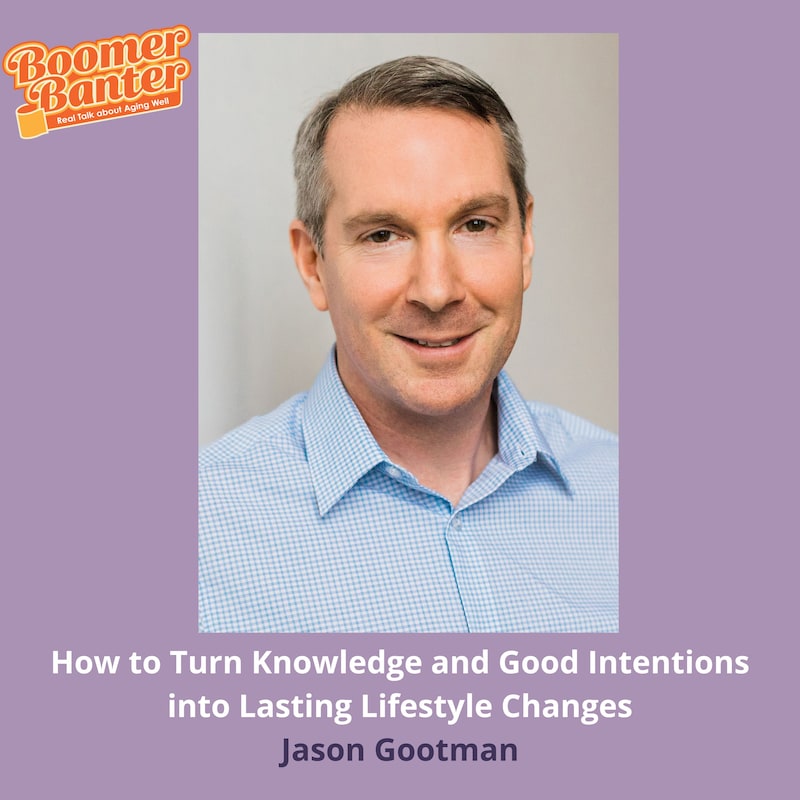
In this episode of Boomer Banter, I sit down with wellness coach Jason Gootman, to delve into the transformative power of mindset and self-talk in making lasting lifestyle changes. Jason shares invaluable insights and practical strategies to help you develop new, healthy habits and sustain them. Whether you’re struggling to stay active, seeking ways to make workouts enjoyable, or curious about making your indoor environment more motivating, this episode provides robust, evidence-based solutions to guide you on your journey to better health.
Three Key Takeaways:
- Adopt an Experimental Mindset: Be open to trying different strategies and learning what works best for you. View challenges as opportunities for growth rather than setbacks.
- Embrace "Good Enough": Let go of all-or-nothing thinking. Small, consistent actions lead to lasting change more effectively than striving for perfection.
- Remember the Seven Keys: Clarity on what habit you want to form, understanding your "why," and taking small, actionable steps can significantly aid in behavior improvement.
Links:
- Visit Jason’s Website: Read Jason’s insightful blog posts and subscribe to his newsletter for more tips on health and wellness.
- Join the Boomer Banter Community: Engage with us and become part of the conversation on aging well. Follow the link and click on Connect with Us
- Support our sponsor: Road Scholar is the leading non-profit travel site for Boomers and Beyond
Mentioned in this episode:
Road Scholar Great Global Giveaway
roadscholar.org/heyboomer
This podcast uses the following third-party services for analysis:
OP3 - https://op3.dev/privacy
Transcripts
Hello and welcome to Boomer Banter. We have real talk about aging well. My name is Wendy Green and I am your host. With many years of aging well already and plenty more to come, I am here to tackle all the uncomfortable, unexpected, and hopefully life affirming questions you've been pondering to help make the journey a little less rocky and a lot more fun. If you want to age well, you are in the right place. So here we are at the end of August, and I'm going to ask you about your New Year's resolutions. Were you going to lose weight, eat more plant based meals? Or were you going to get in your 10,000 steps a day? Or maybe take up pickleball? So how'd you do on those resolutions? We all know the things we are supposed to do to stay healthy and to have a longer health span. But we don't always do them, do we? We have worked hard to plan for our financial retirement.
Wendy Green [:That was not always easy. We constantly had to make choices between saving for retirement, taking a vacation, replacing a broken appliance, or buying that shiny new car with all the bells and whistles. And to live well and age well does not mean you have to give up things that bring you pleasure, but it might mean adjusting your mindset or your beliefs about some of those things, just like saving money. There are choices and trade offs, and there is discussion these days about the difference between lifespan and health. Spanish, you know, what good is it to have a long life if you don't have a long health span to go with it? My guest today, Jason Gootman, is a Mayo Clinic certified wellness coach and national board certified health and wellness coach, as well as a certified nutritionist and certified exercise physiologist. Jason helps people reverse and prevent type two diabetes, cardiovascular disease and other ailments with evidence based approaches to nutrition, exercise, stress reduction, holistic wellness, and most importantly, lasting behavior improvement and positive habit formation. As part of this work, Jason often helps people lose weight and keep it off, in part by helping them overcome the common challenges of yo yo dieting and emotional eating. Jason helps people go from knowing what to do and having good intentions to consistently taking great care of themselves in ways that help them add years to their lives and life to their years.
Wendy Green [:So today I'm looking forward to learning more about turning our good intentions and knowledge into lifetime habits that will help us have a longer health span. So join me in welcoming Jason Gootman. Hello Jason.
Jason Gootman [:Thanks for having me. Wendy.
Wendy Green [:I'm glad that you were able to be with us today.
Jason Gootman [:Me too.
Wendy Green [:Thank you. So, as a certified Mayo Clinic wellness coach, I had never heard of that before. And I think of Mayo as an outstanding medical institution. Will you tell me about the certified wellness coaching program?
Jason Gootman [:Well, you can think of wellness coaching as an emerging allied medical profession. And what I mean by that is something like an allied medical profession is something like occupational therapy or physical therapy. And we're here to start filling a gap, a gap that you alluded to in your introductory comments. I call it the implementation gap, the gap between information and implementation. And so over the last 20 or so years, more and more wellness coaching certification programs have been emerging. And the one I went through was at the Mayo clinic. It still exists. And people who become certified as wellness coaches through an accredited training program are then eligible to become national board certified health and wellness coaches.
Jason Gootman [:And we're really here to be the professionals who help people who know what to do have good intentions and are having trouble consistently doing it. My job to help you consistently do it.
Wendy Green [:So if I'm understanding you, that means when your doctor says to you, you need to lose ten pounds or your a one c is too high, and you say, well, I don't want to take a drug yet, I want to try and. Right, but he doesn't tell you how to do it.
Jason Gootman [:That's right. They might tell you. They might get a little more specific with, I recommend you eat this way, I recommend you exercise that way. And in a sense, that's telling you how to do it. What it isn't telling you is how to form, how to form habits, how to work with yourself on a psychological level to get yourself to do something you're not currently doing. Right. If a to do list equaled implementation, then all we would have to do is write to do lists and everything would get done. Right.
Jason Gootman [:But there's something, or many things about human nature that mean merely knowing something doesn't mean we'll follow through and do it. And, yeah, and that's why wellness coaching is emerging as an allied medical profession, is because it's filling a missing need. People go home with those recommendations from a physician, or they go home with a brochure and it just doesn't go anywhere. The brochure collects dust, so to speak. Right. And then people end up feeling frustrated. People end up feeling nothing, maybe more than frustrated, feeling like a failure. Because there is this idea that if I've been told what to do, I should do it, I should, as Nike says, just do it.
Jason Gootman [:And if I don't do it or don't consistently do it. The only explanation for that is that. That I'm a failure, that I'm somehow lacking the proper character to do these things. And I would say that willpower is important, but it's only part of the game of making lifestyle improvements. And I sometimes say it in a slightly corny way that what you need is willpower plus skill power. And what I teach people are the skills of making lifestyle improvements. When you have those two tools in the toolbox, willpower and skill power, you're much more effective than when you're merely relying on willpower.
Wendy Green [:Okay, so I have to ask you this. In your bio, it says that you help people reverse and prevent type two diabetes, cardiovascular disease, and other ailments with evidence based approaches to nutrition, exercise, stress reduction, holistic wellness, and behavior improvement, positive habit formation. So, with all of that, do you believe in the use of medical interventions?
Jason Gootman [:Of course. I also should say that my answer to this is as a layperson, or what we would consider a non medical professional. And I guess the way I would think of it is certainly if I fell down and broke my arm today and developed some sort of infection, and the clear options were medication, potentially save my life, or medication, or not taking medication means I'm likely to die. I would certainly take that medication, and I would certainly, that's the way I would orient myself toward thinking about my family members and my relatives and my, and my friends. And that's the way I think of it generally. But here's what gets interesting, is most of what plagues us today could be thought of as lifestyle ailments. And that's in contrast with hereditary ailments, infectious ailments, and accidents. And essentially, our medical system evolved when most of what was plaguing people were hereditary ailments, infectious ailments, and accidents.
Jason Gootman [:And you can't out broccoli or out yoga, a hereditary ailments. We can't, you know, down syndrome, as an example. You can't out broccoli or out yoga and infectious ailments. You have an infection at that point, and the same thing with an accident. But things like type two diabetes and cardiovascular disease and increasingly other ailments, it's becoming known that most of what causes them is lifestyle. And if we can thus learn, if we can learn to live in different ways, there's a lot that could be done to reverse and prevent those types of ailments.
Wendy Green [:Yeah. So I've read something where it's like 20% is hereditary and 80% is lifestyle. Is that about right?
Jason Gootman [:About in line with what I've seen? Yes. Yes.
Wendy Green [:Huh. Amazing.
Jason Gootman [:Neat way to think about that is we can't make ourselves invincible, be a lifestyle improvement, but we can put the odds in our favor not only for longer lives, but for higher quality lives, for preventing most of these ailments that tend to be a drain on one's quality of life.
Wendy Green [:So, you know, as we established, the medical system was established to take care of illnesses that we inherited, and now they are really into the intervention. That's their mode of operation. They're not as much into prevention.
Jason Gootman [:Right.
Wendy Green [:Okay, so what is it that a wellness coach or lifestyle coach does to work more towards prevention?
Jason Gootman [:Well, first of all, the person has to come to someone like me wanting to do that. Right. They have to already be thinking less from a perspective of reactive intervention and more from a perspective of proactive prevention. Otherwise, they don't even have a conversation with someone like me. Yeah. You know, the kind of person that comes to me that you alluded to this a few moments ago is thinking, I'd love to do this without medication if I could. I'd love to avoid the side effects of medication if I could. For example, they're thinking about the generation before them and what they saw their parents or their uncles and aunts experience with things like type two diabetes and cardiovascular disease, and thinking, I'm living fairly similar to the way mom did or dad did.
Jason Gootman [:If I continue on this course, I'm likely to experience a similar fate and I'd like to take my life in a different direction. And so what I do is meet people where they're at, help them develop a clear wellness vision where they see themselves in the future, what a life of ideal well being would be like for them. And then we go through lots and lots of steps to help them start creating that life one step at a time.
Wendy Green [:So how much resistance do you get when, I mean, I know they've come to you, right? But now if I sat down with you and you said, so, what's your wellness vision like? Well, I don't want to be in pain, but how do you make it small enough, manageable enough. Right? Do you know what I'm saying?
Jason Gootman [:Uh huh. Yeah. So the fact that people come to me willingly and pay for wellness coaching means that they're already at a, we call it a stage of change where they're going to have less resistance than the average person, or certainly less resistance than a person who isn't even thinking about making lifestyle improvements. But still, because change is hard, none of this is sort of like, they show up, I show up, and it's an effortless, smooth path to making lifestyle improvements. But the idea of first getting clear about a person's wellness vision can usually open up very nicely by asking a person what's most important to them in life, what are their values, what have been the best times in their life so far? And you can also get there by talking about what have been the hardest times of their life so far, what have been the crux of their biggest challenges in life. Because typically one's wellness vision is simply the opposite of the things they don't want to have happen or the most challenging things they've already had happen. And through open conversation, where I'm asking open ended questions and giving a person a chance to talk, people love being listened to. They love being accepted.
Jason Gootman [:You give a person a chance to talk out what they'd like to experience. Most people get fairly chatty, and they get fairly excited, and they get. They become interested in sharing their vision. Or another word for that would be a dream. Right. And you let them know that there's no right or wrong answer. This isn't a test that they're here to get a good grade on. This is them having a chance to work on themselves and having an ally in the process.
Wendy Green [:Yeah.
Jason Gootman [:And that's a good way to get someone going.
Wendy Green [:You have to build the relief. Right. So if they come to you with, oh, I just had my physical, and I have all these things that the doctor said I have to work on, and you start to get them to talk about their vision. You also have to work on their belief that they can reach that vision.
Jason Gootman [:Sure. Sure. And I often ask someone if they're. If they're low in confidence that they can achieve their vision or create their. I create their vision, live out their vision. I'll ask them what kind of visions they've had in the past, what kind of goals they've had in the past. And as they talk about that, they'll often recall something they've achieved in the past that they weren't sure they could achieve, something in school, something in their career, something in parenting. And that helps a person see themselves in a different way.
Jason Gootman [:It helps them see who they are, and it helps them see, in this case, something specific. They're the strengths that they have, strengths that are part of who they are. And it's a very neat part of the process to help a person see that, because ultimately, they're the ones living their lives. I'm there to help them see how they can be, how they can do it, how they can be living their lives better. And I come from the, from the perspective that people are inherently capable of solving their own problems, and people are inherently capable of creating the lives they want. And if you. If they give them a chance, they often will end up surprising themselves.
Wendy Green [:Parents. And you're their best coach. So you mentioned that you have seven evidence based keys to lasting behavior improvement in positive habit formation. Could you talk to me about those seven keys?
Jason Gootman [:Yeah, maybe. I'll give you a brief overview, and then we can see if we want to dig into some of them a little more.
Wendy Green [:Okay.
Jason Gootman [:I think of the first one as something like getting very clear on the habit you want to form. The idea there being. If someone's thinking, I want to eat better, it's too vague. There has to be a clear habit they want to form in order to even get a little bit of traction. Even to get a little traction with moving forward. Number two, I talk about getting very clear about why you want to form that habit. I hear this talked about even in pop psychology, and some people call this your why. So when we know what a person wants to do, I work to help them get clear on why they want to, why they want to form that habit.
Jason Gootman [:And everyone has unique reasons. Everyone has. Each person tends to have a very unique why. What I'll say is, seems to be part of human nature. It tends for most people to come down to very simple, yet very powerful things. Like, there are a lot of things I'd like to still experience in my life. And if I can form that habit and I can improve my well being, I'll be in a much better position to be able to keep enjoying things in my life that are very important to me. Other people's answers.
Jason Gootman [:It's very common for people's answers to have to do with other people, whether it's wanting to be around longer, for certain people, whether it's wanting to be a good role model for kids or grandkids, that's often a part of the equation. Then step three starts to make it more actionable. The first two steps are essentially helping a person start to draw out their intrinsic motivation. And then the important thing is to start taking some small steps in the direction of the habit you want to form with an emphasis on small steps. So if someone knows the habit they want to form is to walk for 45 minutes, five days a week, that could be a perfectly good habit for them to want to form over a period. But if they haven't been walking or haven't been exercising at all for a period, they're most likely not going to do very well if they try to go from where they are to that habit overnight. We talk about what kind of a small step feels very doable in the immediate future, and this sets a person up for success. So I always want a person to come back after their first wellness session and a week or two between our sessions with the best chance of saying, when I say, how do you do with what you're working on? I want them to say, I crushed it, I did it, and I even did a little more, as opposed to saying, I only did half of what I set out to do.
Jason Gootman [:Because in that latter scenario, person tends to feel like a failure and the self talk tends to be, I never do what I set out to do, or I always come up short when I set out to do something like this. Whereas in the former scenario, they tend to feel very good about themselves, they tend to be proud of themselves, they tend to be starting to build some confidence, and that confidence has a contagiousness to it, and it makes them want to do more. Step four and five, I'll do quickly, are to tie your new habit to your interests is step four. And to tie your new habit to your strengths is step five. You often hear about this in the workplace is that people are generally more motivated, generally more engaged when you give them a chance to do projects that are tied to their existing interests and strengths. And when we want to make lifestyle improvements, we can do them in ways that are antagonistic to our existing interests and strengths, or we can tie them to our existing interests and strengths, and it goes a lot better when we do the latter. Step six is a very fun one. It's to make your new habit as convenient as possible.
Jason Gootman [:We are, we humans love convenience. We love to do what requires the least energy. And this can work for us or against us if we go out of our way to make the things we want to be doing, the new habits we want to be forming, as convenient as possible, so that there's as little resistance or as little friction as possible to doing them. That goes a long way. And number seven is probably my tie for a favorite. And my favorites change from time to time, like your favorite song changes from time to time, but it's to garner the personal and professional support that's most helpful to you. This is to be an antidote to the idea that a person should be able to make lifestyle improvements entirely by themselves. We humans are highly social animals.
Jason Gootman [:So the more support you get, generally the better. So I help people build out support systems that are helpful to them. So that is a nice big overview, Wendy. That is skill power encapsulated in seven ideas. And if we lean into those seven ideas, we're essentially leveraging human nature so that we're not just sucking it up and just doing it, but we're taking advantage of our wiring to make it easier to make lifestyle improvement.
Wendy Green [:I love how you went through that, Jason. Thank you. And I think there's so much to that as you were going through it. I'm thinking, okay, so let's see, I'm not even shooting for 10,000 steps a day because that's too many. But if I can get to 5000. All right, so tie that to something you love. Well, I would rather be out hiking in the woods, but that's not convenient. So I just walk at the park, you know.
Wendy Green [:So it's like I said in the beginning, it's the trade offs. You got to find what works, right?
Jason Gootman [:That was a brilliant way of looking at it is the difference. Steps can sometimes seemingly be working against each other. It's about finding the ideal compromises. You know, a good example might be a person wants to do a strength workout and their favorite place to do it is at a certain gym. But on a given day, the only time they could go to that gym, the only time they can go to that gym is rush hour. And that makes it inconvenient if they also have a simple set of workout equipment at home that allows them to do a strength workout at home on some days, the right move for them as they're forming a habit of consistently strength training might be to do a strength workout at home. And these aren't all or nothing propositions that you might be able to find yourself deep in some woods on a beautiful day when that is convenient, and then on other days the local park sounds like is a good option for you. But the neat thing is in both of those examples, to not try to force yourself to do the thing that's inconvenient and isn't enjoyable just because you think you get extra points for doing things that are hard, you get the same amount of points for doing the exercise, whether it's whether you had a great time or it was miserable and you're much more likely to do it if there are ways to be enjoying the process.
Wendy Green [:So you got to talk about your mindset too then, Jason, because I'm thinking, okay, it's August, but in January I'm not very much going to want to walk in the park, so now I have to get up in the dark and go to the gym and, you know, walk on the treadmill and. All right, so I'll listen to a podcast or something. But, you know, how do I make that fun and enjoyable?
Jason Gootman [:I think he answered it in one way. Listen to a podcast is a good one. And then this is the kind of question I would ask a client. And I would ask you, because when I work with clients, it's very collaborative, because I want you to come up with your own answers, because if the answers come from you, you're more likely to follow through on them. But what I'll do is I'll share some options as if I'm presenting almost a dropdown menu for you. And then you can choose from the ones that sound the best to you. One is to lean into that 7th idea of garnering some personal support. So you might ask a friend, ask a neighbor, ask a coworker, hey, what are you up for? Are you up for forming some sort of a buddy system around walking on winter mornings? And you have a nice thing going there because on the days when it's a little harder for you to get going, there's a chance that your buddy is, you know, is rose with a lot of energy that morning and vice versa.
Jason Gootman [:So you could sort of be each other's backup system. So that's always something that can be very helpful to be a boost.
Wendy Green [:Yeah, that's a good idea.
Jason Gootman [:Yeah, I think that's one that can work for a lot of people. And then think about the setting. You know, where are some indoor settings that are as aesthetically pleasing as possible? Right. I often, this is an example that comes up a lot with clients is they might have put a treadmill in their basement or an elliptical machine in their basement or something like that. And I'll say, what's it like over where the treadmill or the elliptical machine is? And if it's like, if it's still kind of like basement y, they're less likely to go down there, especially when it's dark and cold outside. But if they spruce it up a little with a piece of art or something like that as an example, you're literally making that setting more appealing. And the part of you, this is a very neat idea. The part of you that is wired for instant gratification doesn't have to overcome.
Jason Gootman [:Oh, I'm going to go into the sort of musty basement because it'll be good because it's good for me, and it'll help me five years from now, ten years from now kind of thing. But if some art you really enjoy is down there on an unconscious level, you think, I'd love to go down there, because I always like being over in that little nook of the basement where the treadmill is. And you don't even necessarily think of it as where the treadmill is. You've kind of tricked yourself into where your favorite art is.
Wendy Green [:Right?
Jason Gootman [:Those are two ideas of ways to sort of work with. It's sort of like knowing thyself, right? And knowing, like in this example, Wendy. Knowing that when it's dark and colder, you're less likely to be excited about getting up to go exercise. But if you can play with that environment in a way that you make it more appealing, you can sort of leverage your human nature to help you get there and do it.
Wendy Green [:I like that. Okay, so, jace, you have on your website, which is puvima.com, p u v e m a. You have a whole series of blog posts that you've put up there. Very well written. I've enjoyed reading them. But there was one title that really stood out to me.
Jason Gootman [:Okay.
Wendy Green [:And it's called Jimmy Kimmel is making you fat. Tell me how Jimmy Kimmel is making me fat.
Jason Gootman [:There's a neat relationship between sleep and both body composition and eating behavior. Essentially, a fun way to talk about this is to talk about some scientific studies. What I'm going to describe is essentially the amalgam of a handful of scientific studies. What's been done are researchers subjects to a grocery store at some time in the morning, call it eight or nine in the morning, and give each subject a certain amount of money. Call it $100, and say you've got x amount of time, say 15 minutes to go, spend your hundred dollars. And there were two conditions. People who got something like seven to 9 hours of sleep the night before, and people who got something like three to 4 hours of sleep the night before, and the people who only got three to 4 hours of sleep the night before. When you measure it by the amount of energy, the amount of kilocalories in the food, people who were sleep deprived buy more total energy of food.
Jason Gootman [:They buy more energy dense food. And the way that works in our current grocery store environment is they buy more junk food. And the explanation for this has to do with hormones in your body. There's essentially a hormone that makes us feel full, and there's a hormone that makes us feel hungry. And to keep it very simple. When we get less sleep, we have more of the hormone that makes us hungry, and we have less of the hormone that makes us full. It seems to be an adaptive evolutionary mechanism of some kind. And when we get plenty of sleep, we normalize or optimize the level of those hormones, and our appetite satiety response is essentially normalized or optimized.
Jason Gootman [:And when we're not getting enough sleep, all of that goes a little haywire, essentially.
Wendy Green [:So if we're going to stay up and watch Jimmy Kimmel, we have to sleep in. That's interesting. So, you know, and as we get older, we tend to have more interrupted sleep. So we have to be careful about that. Then you're saying is to manage our feeling of hunger and fullness.
Jason Gootman [:Yeah. There are other things that affect our drives to eat. Gets a little into the topic of emotional eating, and I often say with, with my clients that the big four things that seem to drive most emotional eating are. We already talked about one of them. It's the last one. But the big four are bored, lonely, stressed, tired. So those things are important to pay attention to as well. Bored is often a function of work or other aspects of life, sort of lacking in enjoyment or lacking in meaning.
Jason Gootman [:Lonely is obvious. Our relationship needs might not be being met as well as they could be. And then stress, obviously a common one in our culture, and a neat opportunity if one is noticing their eating behavior being driven by any of those factors. I like to think of it as the check engine light. So you see that your eating behavior is being altered, and instead of just fighting against it, you use it as almost like a warning sign, almost like the check engine light coming on in your car. That it's important to look at some other aspect of your life from the perspective of holistic wellness and ask yourself, do I need more sleep? Do I need more rest? Do I need to take some action to help make my work more fulfilling? Do I need to take some action to make my relationships more fulfilling? And when we do that, we can solve the eating problem challenge, and we can improve another area of our life that we might have not even been paying too much attention to.
Wendy Green [:There's a lot to this, right? There's a lot to this. And I would say to anyone listening, you gotta pick an area to start with, right? You can't do them all at once. Yeah. Here's a question that you, in a way, you kind of already answered this, but, you know, a lot of the women that listen to this show have left full time careers and feel still like they're not done. You know, they're doing a lot. They're working out, volunteering. They're very involved. A lot of them see their husbands, on the other hand, who also are no longer at full time careers going, I am so done.
Wendy Green [:I know I don't want to do all that other stuff. Is there anything that they can do to try and get him to motivate, to at least go for a walk with them or somehow eat or something?
Jason Gootman [:Oh, interesting. You're asking. I want to make sure I understand the question, how spouses or other two people, one could help the other with making lifestyle improvements.
Wendy Green [:Yes.
Jason Gootman [:All right. Well, yeah, this is a great question because I'll start with the way not to do it. Right. The way most of us know this but still can find ourselves doing it is sort of nagging in the answer. Right. It doesn't get anywhere. Neither person enjoys it. Something you do is this takes a little patience.
Jason Gootman [:It'll usually happen, is to wait for the other person to complain about something that is essentially an opening. Right. So if someone's in your life says, wow, I am just so tired all the time, that's an opening. They are saying they're not experiencing life in the way they want to, they do the way they want to be. And then I would come with first. What I would do is ask for permission. So where people don't like to be told what to do, that's when it, even if the intentions are good, even if it's said with a smile, it feels like nagging. It feels you're being told what to do.
Jason Gootman [:If you're being controlled or something like that. What I would ask is something like, are you up for a few ideas? So someone in my life says, complain, they're tired all the time. I might say, hey, are you up for a few ideas? This gives them permission. You're giving them a chance to give you permission to offer some advice or make some recommendations. And just the fact that you asked their permission makes them orders of magnitude more receptive to advice. This changes advice from unsolicited to maybe not solicited, but at least permitted. Right. That makes a big, big, big, big difference.
Jason Gootman [:If that's all you do, you very much change the tone of the conversation. And then you could play a little game. And we did a little bit, a little of it earlier where you put some ideas on the table. I alluded to it earlier as a drop down menu.
Wendy Green [:Right.
Jason Gootman [:And then you ask them to put some of their ideas on the table or add to the drop down menu and then your idea storming together. And then all of the ideas are on this figurative table. They might do it automatically. Or you could ask them, of all these ideas, which one seems the easiest or which one seems the most doable or which one seems the most actionable? You're essentially doing some wellness coaching with them.
Wendy Green [:Yeah.
Jason Gootman [:And you can remember these seven keys, and you can ask specific questions around that. So if the other person said, well, I know if I got some exercise going, I probably would help me lose a few pounds. That's going to help me start to get some of my energy back. And then they say, I'm going to. I'm going to. I'm going to pull out my old tennis equipment and start playing tennis on Monday. But you, if you know this, in this example, you know that whenever they try to play tennis, they run into a stumbling block of, it's hard to find someone to play with. So then you kind of work them through that, of, how could you? What are some steps you could take to make sure you consistently have tennis partners available? Because, you know, in the past, that's been a challenge for you, where if someone says, I'm gonna, I'm gonna start swimming, and, you know, they have a bad shoulder, but they're sort of using the no pain, no gain idea, like, I'm gonna get back to swimming.
Jason Gootman [:Cause the best time of my life, when I was in the best shape, I was a swimmer, you might work them through. What's some activity, what's some physical activity you could start doing that wouldn't be so hard on your shoulder. Sure. So there's a whole bunch of them.
Wendy Green [:Tell them to go call Jason. Yeah, those are some really good suggestions, Jason. And I think it's a delicate dance.
Jason Gootman [:To do with a partner, depending on the way partners are oriented. What I'm describing is essentially being collaborative as opposed to being authoritative. And I think that works for many aspects of relationships, but definitely when you'd like to see the other person doing something differently for their benefit as much as anything else, if you come at it from this collaborative approach, this sort of coach approach, as opposed to something like a drill instructor approach or like the nagging approach, you tend to do a lot better.
Wendy Green [:I like that. So give me two or three takeaways for people listening who want to live a more. Let's see. Who want to live a longer. Health. Spanish.
Jason Gootman [:Three takeaways. Okay, I'm going to give two that we haven't talked about because I think they're fun. And then one we've talked about, okay, these are sort of neat ways to set the table for this whole process. And the first one I call having an experimental mindset. And that's in contrast to a past fail mindset. So as you go about making lifestyle improvements, instead of thinking about it of if I do well, I'm passing, if I do poorly, I'm failing. Think of it like scientists think about that. Each effort is something we can learn something from.
Jason Gootman [:In this case, it's learning something about yourself. So if you're stumbling or not making as much progress as you'd like to make, instead of saying thinking of it as I failed, think of it as what can I learn from the efforts I've made so far? So I think that's a neat takeaway. And then you can use the seven keys. You can say, which one of those could I run a new experiment with going forward in a similar vein, but certainly a little different. I like the idea of having a good enough mindset. I think of a good enough mindset as in contrast to an all or nothing mindset. If you have an all or nothing mindset when you're making lifestyle improvements, unless you can guarantee you're always going to be able to do all of it, you're often choosing nothing because it's all or nothing. Right? It's kind of binary.
Jason Gootman [:Whereas if you can learn to do go for optimal, go for doing all of it as often as you can, but when life makes it so, you can't do all of it, doing three quarters of it is certainly better than doing none of it and certainly helps you create more momentum in the habit formation process. So that would be my second one is try to unsubscribe from an all or nothing mindset or being a perfectionist, if that's your tendency, and try to think about excellence, or even this term, which is intentionally challenging, good enough or a good enough mindset. Good enough to get the job done well, good enough to be making progress, that's going to help you get a lot more momentum than something like that all or nothing mindset. And then my third takeaway would be keep these seven keys that we've talked about in mind. And then I alluded earlier to my two current favorites, the one being garnering support. The other one is taking the small steps. So I would take those two away. If someone's trying to do something new, they're having some trouble.
Jason Gootman [:Ask themselves, how could I break this down into a smaller step? How could I get some support with this.
Wendy Green [:Great. Thank you so much. So if you would like to follow up with Jason or read some of his blogs, like I said, he's a really good writer. Check out his website. It's Puvema and it's puvema.com. and you have to subscribe to his newsletter to know what that means. And you can subscribe to his newsletter from his website as well. So go to Puvema.com. Jason, this has been very, very helpful.
Wendy Green [:Thank you so much.
Jason Gootman [:My pleasure.
Wendy Green [:And if you would like to be part of the Boomer banter, real talk about aging well community, feel supported and encouraged on your aging well journey. Then join us by going to heyboomer.Biz and click on Connect with us and we will keep you in the loop. And finally, I have on September 9, in two weeks, my 200th episode. And for my 200th episode, what I have chosen to do is to be vulnerable and answer your questions. Now, I may filter some questions depending on what comes in, but go ahead and email me at wendy@boomer.biz and ask me about myself, about my podcast, about my family, about my future, about my past, about, you know, things that I believe in, why I'm doing this, whatever is important to you.
So, talking about next week, okay, when you plan out your calendar of topics in advance, you never know how that's going to turn out, right? So with the passing of my mother's husband a week ago Sunday, the upcoming month's topics seem very timely. Next month of September, we'll be talking about navigating grief, end of life discussions, and all the organization and paperwork that's required when someone passes. So next Monday, my guest will be Katherine Marino, PhD, professor emerita at DePaul University. Catherine is a member and former co chair of the End of Life Options Coalition. She is also co host of the Women over 70 podcast, which I had the opportunity to guest on a month or so ago, so I hope you will join us for that. Each episode of Boomer Banter is an invitation to listen, learn, and apply the wisdom gained to your own life.
Wendy Green [:We are a supportive community, so join us as we age well together. And the Boomer Banter podcast is produced by me, Wendy Green, and the music comes from Purple Planet Music. Jason thank you.
Jason Gootman [:Thank you for having me, Wendy.



