Shownotes
Audio • 4 • Series 1 Episode 4 - Bloody Mary (Transcript added).
Audio • Season 1 • Episode 4 • Series 1 Episode 4 - Bloody Mary (Transcript added).
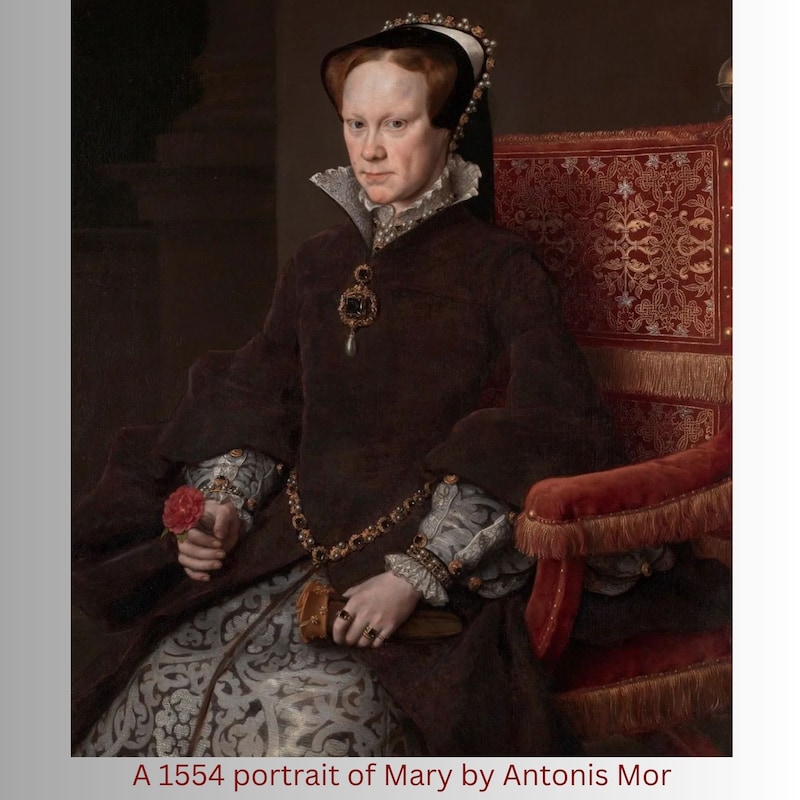
Artwork • Portrait of Mary by Antonis Mor. c.1554
Music • The Lord is my light and my salvation (Psalm: 27) Anglican chant.
After Edward's death, Lady Jane was proclaimed Queen on 10 July 1553 and was held safe in the Tower of London chambers awaiting coronation.
After hearing about Edward's death, Mary Tudor, fearing for her safety, escaped to East Anglia where she held ownership of several estates.
Stephen Gardiner, an English Catholic bishop, crowned Mary Tudor as Mary I, Queen of England and Ireland, at Westminster Abbey on 1 October 1553.
Mary was the first Queen to rule England in her own right.
She was known as "Bloody Mary" for her persecution and executions of Protestants.
Most controversially, over her reign she ordered 280 Protestants to be burned at the stake as heretics, in a vain attempt to restore Catholicism in England.
Her reign led to a clandestine Protestant church in London as a reaction to her enforcement of Catholicism as England's official religion.
It was on waste ground beyond that ditch, now the site of Broad Street, that the three Protestant Martyrs of Oxford Cranmer, Ridley, and Latimer were burnt at the stake.
The trial of Thomas Cranmer began on 12 September 1555, held under papal jurisdiction, with the final verdict decided upon by Rome.
The first Vestments controversy, or Vestarian Controversy, arose during the English Reformation concerning the wearing of vestments and clerical dress
It was the first significant attack in the Puritans' campaign for reform.
Transcripts
© 20 25 The Rise of the Protestants. Author, Shaughan Holt.
"All rights reserved. No part of this podcast may be reproduced, translated, distributed, or transmitted in any form or by any means, including photocopying, recording, or other electronic or mechanical methods, without the prior written permission of the copyright holder, except in the case of brief quotations embodied in critical reviews and certain other non-commercial uses permitted by copyright law".
Series 1.
Episode 4.
Bloody Mary.
The year is 15 53.
In January 15 53, the 15-year-old King Edward VI fell ill with a fever and a cough.
His health would remain erratic from then on, often seeming to improve, only to later deteriorate.
Fearing the restoration of Catholicism and the reversal of Henry VIII's reforms, Edward had disinherited his half-sisters, Mary Tudor and Elizabeth, in favour of his cousin, Lady Frances Grey.
Mary Tudor was born in Greenwich on 18 February 15 16, the only surviving child of King Henry VIII and Catherine of Aragon.
Her life was blighted when Henry separated from her mother, and, following the annulment of their marriage, Mary was declared an illegitimate child.
Henry's next wife, Anne, - Boleyn, gave birth to another daughter, Elizabeth.
On 25 May 15 53, John Dudley the first Duke of Northumberland, arranged the politically advantageous marriage of sixteen-year-old Lady Jane Grey, to his fourth son Lord Guilford Dudley, at his lavish mansion in London.
The marriage took place alongside the weddings of Lady Jane's sister Katherine Grey, and her sister-in-law Katherine Dudley, in a triple ceremony.
Lady Jane Grey, was born in the autumn of 15 37, the eldest of the three daughters of Lady Frances and Henry Grey, the third Marquess of Dorset.
She came from a high-status family that resided at Bradgate House in Leicester.
Lady Jane was thin, freckled, and had sandy hair, so short in stature, she needed to wear elevated shoes.
As Henry VIII's great-niece, she was third in line to the throne, and was therefore regarded as a valuable asset.
On 6 July 15 53, King Edward VI, aged 15, died of a possible tuberculosis lung infection.
After hearing about Edward's death, Mary Tudor, fearing for her safety, fled to East Anglia, where she held several estates.
On 9 July, from her home in Kenninghall, Mary instructed the Privy Council to formally recognise her as the legitimate heir to Edward's throne.
With considerable popular support and a growing military presence on her side, Mary was in a strong position, especially as nearly all of Northumberland’s followers had abandoned him.
Despite this support, on 10 July, the Council declared Lady Jane Grey as queen, securing her within the Tower of London’s chambers until her scheduled coronation.
On 19 July, the Privy Council of England, acknowledging the weight of her popular support, changed their allegiance and proclaimed Mary Tudor as Queen, effectively ousting Jane Grey from the throne.
Reports indicate that Jane, received the news of her dethronement with joy, and expressed a desire to return home to her family.
Despite her brief reign of just nine days, Jane was not permitted to return home, and was instead, imprisoned in the Tower of London.
On the 18th of August, Jane's father-in-law and benefactor, the Duke of Northumberland, was accused of treason and subsequently tried at Westminster Hall.
He was quickly convicted and executed, beheaded at the Tower of London on 22 August 15 53.
In September, Parliament officially recognised Mary as Edward's rightful successor, denouncing and revoking Jane's claim to the throne, to be that of a usurper.
On 1 October 15 53, the English Catholic bishop Stephen Gardiner, crowned Mary Tudor as Mary I, Queen of England and Ireland, in a ceremony at Westminster Abbey.
Stephen Gardiner, 14 83 to 15 55, was an influential English Catholic bishop and politician, during the English Reformation.
He received his education at Trinity Hall Cambridge, later serving as secretary to Cardinal Thomas Wolsey.
The role provided him with valuable experience in foreign politics, involving him in the negotiations surrounding King Henry VIII's divorce, from Catherine of Aragon.
Gardiner was known for his conservative stance and often clashed with the more progressive reforms of his era.
His relationship with Archbishop Thomas Cranmer was particularly fraught.
While he supported King Henry's right to annul his marriage, he faced numerous obstacles and ultimately, fell short of attaining his goals regarding the papal decree.
During the reign of Edward VI, Gardiner found himself sidelined from the council, and was imprisoned, due to his resistance to radical Protestant reforms.
However, with the accession of Mary Tudor to the throne, he regained his freedom, was reinstated as Bishop of Winchester, and assumed the role of Lord Chancellor.
In this capacity, he dedicated himself to restoring Catholicism and legitimising Mary’s birth.
Despite being responsible for the executions of several preachers, Gardiner was recognised, for his generosity and humane treatment of others.
He passed away on 12 November 15 55, and later, found his final resting place at Winchester Cathedral.
When Mary ascended to the throne, Vermigli found himself in a difficult position due to his opposition to the Catholic Church.
As a result, he was placed under house arrest for six months, facing the threat of capital punishment.
Despite the evident risks, he initially agreed to engage in a public debate in support of Cranmer.
However, after Cranmer was imprisoned, he wisely decided, to withdraw from the debate.
On 14 September 15 53, the Star Chamber Council, summoned Cranmer to respond to the serious accusations of sedition against him.
That same day, after bidding farewell to Vermigli, Cranmer was escorted from the Star Chamber to join Latimer and Ridley in the Tower prison.
Following Cranmer's advice, Vermigli now asked permission to leave England, and his request was granted.
He arrived in Strasbourg towards the end of 15 53 and was able to resume his original teaching position.
Jane Dudley, referred to as Lady Jane Grey, was brought before the court and charged with high treason, along with her husband, Guildford Dudley, two of his brothers, and notably the former Archbishop of Canterbury Thomas Cranmer.
The charges against Cranmer were supported by witnesses, who claimed that he had authored and propagated heretical writings.
Their trial, ordered by a special commission, took place on 13 November 15 53, at Guildhall in the City of London.
Sir Thomas White, the Lord Mayor of London, and Thomas Howard, the 3rd Duke of Norfolk, chaired the commission.
As expected, all defendants were found guilty, and received prison sentences.
Jane was convicted of high treason for having unlawfully assumed the title and authority of the monarch, as evidenced by several documents she had signed, as Jane the Quene.
Her sentence was to "be burned alive on Tower Hill, or beheaded as the Queen pleases".
Burning was the traditional English punishment for treason committed by women.
However, Queen Mary showed Jane leniency, deciding to spare her life.
However, investigations soon revealed that Jane's father, Henry Grey, the Duke of Suffolk, had supported Wyatt's rebellion against Queen Mary's proposed marriage to Philip II of Spain.
As a result, Lady Jane began to be seen as a potential threat by the Crown.
Tower Hill.
Tower Hill is the area surrounding the Tower of London, located in the current London Borough of Tower Hamlets.
It rises from the north bank of the River Thames to a maximum height of 48 feet or 14.5 meters.
The site gained notoriety, for the public execution of prominent prisoners, from the late 14th to the mid-18th century.
Historically, the land was part of the Liberties of the Tower of London, a territory managed by Tower authorities, to prevent construction that could compromise the fortifications of the Tower.
The hill extends on both sides of the London Wall, a defensive structure first built by the Romans, a significant portion of which can still be seen today.
Public executions of high-profile traitors and criminals, often attainted peers, as well as innocent Catholics during the 16th century, were carried out on Tower Hill.
Some executions also took place within the confines of the Tower of London itself.
The last judicial decapitation in England occurred in 17 47, when Lord Lovat was executed for high treason, while the final hangings on Tower Hill took place in 17 80.
The year is 15 54.
On the morning of 12 February 15 54, the authorities took Guildford Dudley from his rooms in the Tower of London to the public execution place at Tower Hill, where he was beheaded.
His remains were then transported back to the Tower Chapel, known as St. Peter ad Vincula, in full view of the rooms where Lady Jane Grey was staying.
Lady Jane was subsequently escorted to Tower Green, within the tower confines, and was also beheaded.
Both Jane Grey and Guildford Dudley were ultimately laid to rest in the Chapel of St. Peter ad Vincula, located on the northern side of Tower Green.
This chapel, also referred to as "St Peter in Chains," was once the parish church of the Tower of London.
No commemorative stone was erected at their burial site.
At the time of his execution, Guildford was only 19 years old, and Jane was even younger at 17.
Just eleven days later, on 23 February, Jane's father, the Duke of Suffolk, was executed by order of the Crown.
These executions did little to improve Queen Mary’s or her government’s standing with the public.
Five months after the deaths of the young couple, John Knox, a notable Scottish reformer, referred to them as Innocents.
Asserting; neither just laws and faithful witnesses, could ever prove they had offended by their own actions.
After executing Jane Grey and the other rebels, Queen Mary now turned her attention to the leaders of the Reformation.
On 8 March 15 54, the Privy Council ordered the relocation of Cranmer, Ridley, and Latimer to the Bocardo prison in Oxford.
Bocardo, located next to St. Michael's Church at the North Gate of Oxford, was a fortified guard tower with a suite of rooms.
The Chapel Royal of St. Peter ad Vincula.
St Peter ad Vincula, the Chapel Royal, also known as "St Peter in Chains", was once the parish church of the Tower of London.
The chapel's name refers to the story of Saint Peter's imprisonment under Herod Agrippa in Jerusalem.
Located within the Inner Ward of the Tower, the chapel was constructed in 15 20, although it is believed that the church itself was founded in the 12th century.
It is notable for being the burial place of several famous prisoners of the Tower, including three queens of England: Anne Boleyn, Catherine Howard, and Jane Grey.
All three were executed in the 16th century, and their headless bodies were buried under the chapel floor without any memorial.
Mary Tudor was the first queen to rule England, in her own right.
Her aim was to halt the English Reformation, and restore the Church of England to full communion, with the Church of Rome.
She became known as "Bloody Mary" due to her persecution and execution of Protestants.
During her reign, she ordered the execution of 280 Protestants by burning at the stake, in a controversial effort to restore Catholicism in England.
As a result of her policies, approximately one thousand English Protestants, known as the Marian exiles, fled England to escape potential imprisonment and execution.
The term "Marian" can be traced back to the medieval period, when Mary was a common name.
Although initially met with hostility in the German Lutheran regions, these exiles successfully established English Protestant parishes in several Rhineland towns, such as Wesel, Frankfurt and Strasbourg, as well as in Swiss cities like Zurich Basel and Geneva.
While in exile, they were able to immerse themselves in the practices and philosophies of prominent Calvinist congregations, especially those based in Geneva during the Reformation period.
Many of them expressed a strong desire to incorporate these concepts into England, should they ever return.
The Marian underground.
During Queen Mary's reign, a secret Protestant Church was established in London, which later functioned as a precursor to the Underground Church during the reign of Queen Elizabeth.
This movement emerged in response to the Queen's decision to restore the Catholic Church as the official religion of England and Wales, along with her efforts to persecute Protestants.
Initially, the assembly met in private homes and inns, starting with just 20 members, however, over time, the number of participants would grow to over 200.
Notable underground ministers in London included Thomas Rose, John Rough, Augustine Bernher, and Thomas Bentham, who later became the Bishop of Coventry and Lichfield during Elizabeth's reign.
Tragically, some members, such as Deacon Cuthbert Symson and Margaret Mearing, were executed alongside John Rough.
At the age of 37, Queen Mary now focused, on securing a marriage and producing an heir, to ensure a Catholic succession to the throne.
Her goal was to prevent the Protestant Elizabeth, who was next in line, from succeeding her.
Mary aimed to restore Catholicism and become the wife of Philip II, the eldest son of Charles V, king of Spain.
However, neither of these policies gained popularity; Philip was Spanish and met with distrust, while many in England had a vested interest in the prosperity of the Protestant Church, especially because they had received Church lands and funds after Henry VIII dissolved the monasteries.
In 15 54, Mary suppressed a rebellion, led by Sir Thomas Wyatt, and, taking advantage of the situation, she quickly married Philip.
The "First Book of Common Prayer" was introduced in 15 49 during the reign of Edward VI.
This book, compiled by Archbishop Thomas Cranmer, was a Protestant liturgy designed to replace the Roman Rite.
The Catholic Mass, the principal act of medieval worship, would now be substituted with an English Communion Service.
This prayer book significantly influenced the theology of the Church of England, steering it in a more Lutheran direction.
However, some Protestants expressed dissatisfaction with it, due to its similarities, to Roman Catholic rituals.
In response to this criticism, Edward VI released the "Second Book of Common Prayer" in 15 52, which was intentionally crafted to reflect Reformed theology.
However, when Mary ascended to the throne, she reinstated Catholicism, withdrawing the formal recognition of Edward's Books of Common Prayer.
Edward Grindal, born around 15 19, came from Cross Hill House in St Bees, near Whitehaven in Cumberland.
Interestingly, this charming hamlet of St Bees was the birthplace of two archbishops during the reign of Queen Elizabeth.
These two men were close acquaintances and shared a mere five-year age difference.
The distinguished figures were:
- Edmund Grindal: The Archbishop of Canterbury.
- Edwin Sandys: The Archbishop of York.
Edmund Grindal received his education at Magdalene and Christ's Colleges before attending Pembroke Hall Cambridge.
He earned his Bachelor of Arts degree and was elected as a fellow in 15 38.
Completing his Master of Arts in 15 41, he took deacon's orders in 15 44, served as proctor in 15 50, and held the position of Lady Margaret Preacher at Cambridge University from 15 48 to 15 49.
Grindal was a loyal supporter of Edward VI.
Although the events leading up to Queen Mary's rise to power did not politically endanger him, he chose to resign from his Westminster prebend by 10 May 15 54.
Afterward, he relocated to Strasbourg as one of the Marian exiles.
In 15 46, a twelve-year-old boy named Thomas Cartwright, began his education journey at Clare College.
Born around 15 34 to a yeoman in Royston Hertfordshire, he pursued theological studies at St John’s College Cambridge, starting in 15 53.
In English history, a yeoman is traditionally recognised as a landowner, representing a social class that served as a bridge between the gentry and the working class.
When Mary Tudor became queen, Cartwright’s college tutor, Thomas Lever, who was also a future Marian exile, chose to resign rather than compromise his faith.
However, Cartwright waited until 15 56 to resign, finding employment as a clerk to a legal counsellor.
The timing of his resignation indicates his conversion to Puritanism.
Clare College, established in 13 26, is the second oldest college at Cambridge.
Initially named University Hall, it was renamed Clare Hall in 13 38 after receiving a generous donation from Elizabeth de Clare, the granddaughter of Edward I.
The college underwent another name change in 18 56 and is now known as Clare College.
Clare has a history of being a progressive institution and, in 19 72, became one of the first three Cambridge colleges to admit undergraduate women.
At the heart of Clare College lies the elegant Old Court, which features the Great Hall, the Buttery, and communal spaces for both postgraduate and undergraduate students.
Old Court is unique among the Cambridge Colleges founded before 18 00, having preserved its architectural integrity and resisted later modifications.
With the exception of a facelift in the early 19th century, which enlarged the windows and added some Regency elements, it has remained true to its 17th-century character.
Old Court is a charming miniature representation of a classic Cambridge court; - it is enclosed on all sides, but remains open to the sky in its centre.
Tucked away from Trinity Lane, the small courtyard entrance, features gateposts, sculpted in 16 73 and iron gates from Warren, dating back to 17 13 - 15.
The year is 15 55.
In May 15 55, John Whitgift was elected as a fellow of Peterhouse College at Cambridge.
He was born around 15 33, the eldest son of Henry Whitgift, a merchant from Great Grimsby Lincolnshire.
Whitgift started his studies at Queens' College in Cambridge in 15 49 but switched to Pembroke Hall by May of the following year.
While at Pembroke Hall, he was mentored by John Bradford, who would later become a martyr for the Protestant cause.
John Whitgift served as the Archbishop of Canterbury from 15 83 until he died in 16 04.
The trial of Thomas Cranmer began on 12 September 15 55.
At Queen Mary's request, the trial was held under papal jurisdiction, meaning that the final verdict would be decided by Rome.
During his interrogation, Cranmer admitted to all the facts but denied any treachery, disobedience, or heresy.
On 4 December, the Papal Court found Thomas Cranmer guilty and officially removed him from his position as archbishop.
This decision enabled the English secular authorities to determine his punishment.
The trials of the Protestant bishops Latimer and Ridley followed soon after.
They were found guilty and subsequently burned at the stake in Oxford on 16 October 15 55.
Stripped to the waist and tied together, they were burned, in a single fire, while Cranmer was forced to watch the gruesome spectacle.
Latimer became immortalised at the stake by exhorting his fellow victim Ridley, with the words: "We shall, this day, light such a candle by God's grace in England as I trust shall never be put out”.
A Cross in Broad Street Oxford marks the spot where Latimer & Ridley died.
The Vestment, or Vestarian controversy, arose during the English Reformation, due to concerns about vestments and clerical attire.
The first wave of this controversy occurred between 15 51 and 15 56, and presented a significant challenge to the Puritans' reform efforts.
John Hooper, appointed as the bishop of Gloucester, was instructed to wear the surplice and rochet--the white ceremonial vestments required for his anointing--as specified in the 15 49 Prayer Book.
However, he chose not to comply with this instruction.
After seeking advice from Martin Bucer and Peter Martyr, Hooper eventually reached a compromise with the Privy Council, likely prompted by the threat of consequences.
Both Bucer and Martyr supported the Church's position in the Vestarian dispute.
While Vermigli acknowledged Hooper's wish to remove elaborate garments from the Church, he did not believe such garments were expressly forbidden.
He therefore, advised Hooper, to adhere to the authority of the Council and the Bishops, which likely contributed to Hooper's eventual decision, to conform in February 15 51.
However, it was not until he spent several weeks in the Fleet prison, that this, "father of nonconformity", consented to conform.
Hooper ultimately submitted to consecration using the legal ceremonies on 8 March 15 51.
John Hooper, believed to have been born around 14 95, was an important figure in the English church establishment.
He served as the Anglican Bishop of Gloucester and Worcester, and was a prominent Protestant reformer, who defended the English Reformation.
Due to his circumstances, Hooper often had to relocate to the continent, but he finally returned to England in May 15 49.
Upon his return, he emerged as the leading advocate of Swiss Calvinism, opposing both Lutheranism and Catholicism.
When Catholic Mary I ascended to the throne, Hooper became a champion of Protestantism's more extreme factions.
However, his position became increasingly precarious, as he faced increasing scrutiny and condemnation from other bishops.
With the revival of the heresy acts in December 15 54, Stephen Gardiner, the Bishop of Winchester, formally arraigned Hooper on 22 January 15 55.
Although he initially found temporary refuge at Sutton Court manor, he was transferred to the Fleet Prison on 1 September, based on a fabricated accusation of debt.
In 15 54, Queen Mary began to revoke many of the church laws that had been established by Edward VI.
One regulation, addressed the issue of clerical celibacy, which resulted in John Hooper being removed from his position as bishop, because he was married.
Following this decision, Stephen Gardiner, the Bishop of Winchester, asked Hooper to renounce his marriage.
However, Hooper refused to comply with his request.
As a result, Edmund Bonner, the Bishop of London, stripped Hooper of all office.
On 4 February 15 55, the Queens Council condemned Hooper to death by flame, for supporting the rights of priests to marry and for defying the doctrine of transubstantiation.
Sir Anthony Kingston – whom he had once offended for rebuking his sins – came to see Hooper just days before his death, telling him to consider his safety and asking him to recant.
John Hooper, awoke on the morning of 9 February 15 55, knowing, that day, he would be burned to death.
At 9:00 AM, soldiers arrived at his door, fully armed and ready to escort him to his execution.
When Hooper saw their weapons, he assured them they would not be necessary, calmly stating, “I am no traitor, - I would have gone to the stake alone and troubled none of you.”
Ordered not to speak, Hooper looked upon the multitude of people, gathered to witness his execution, many of whom were part of his former congregation.
Upon reaching the place designated for his death, he knelt to pray, - until a soldier placed a stool before him.
On top of it, rested Hooper’s pardon, - from Queen Mary herself.
He could either accept it and live, or reject it and die.
At the sight of the pardon, Hooper exclaimed, “If you love my soul, take it away!”.
The soldiers then secured him to the stake.
John Foxes Book of Martyrs described Hooper’s execution, noting, that "the executioners used green branches to carry out the horrific execution, making three attempts over 45 minutes".
During Queen Victoria's reign, a monument to Bishop Hooper was erected in Saint Mary’s Square, Gloucester.
This monument is located near the site of his execution, where he was burned at the stake, making him a Protestant martyr.
The central feature of the monument is a sculpture of Hooper, who is depicted wearing his bishop's vestments and mitre.
He holds a book under his left arm, while his right hand is raised, in a gesture of blessing, towards the people gathered around him.
A plaque on the monument reads:
“Gloria soli Deo, for the witness of Jesus and the Word of God, not accepting deliverance”.
“John Hooper, Bishop of Gloucester and Worcester, was burnt to ashes on this spot on 9 February 15 55”.
Anne de Tscerlas was a dedicated Flemish Protestant activist and the wife of John Hooper.
The couple met while John was studying at the University of Basel, and they married in 15 47.
When John was appointed the Anglican Bishop of Gloucester and Worcester, she became one of the first wives, of an English bishop.
However, her life was endangered when her husband was imprisoned.
Concerned for her family's safety, she made the difficult decision, to leave John behind.
Accompanied by a small group of friends from Blackfriars in Gloucester, she embarked on a journey overseas.
Before she departed, Anne wrote a final letter to Bullinger, her daughter's godfather, asking for the publication of one of her husband's manuscripts.
Tragically, in 15 55, both Anne, and her daughter Rachel, succumbed to the plague in Frankfurt, the same year her husband John was executed.
The year is 15 56.
Between January and mid-February 15 56, Thomas Cranmer ultimately caved to pressure and renounced his Protestant beliefs.
In four, recantations, he had acknowledged the authority of the King and Queen and accepted the Pope as the true leader of the Church.
Initially held at Bocardo Prison, he was moved to the Dean of Christchurch residence, where he debated papal supremacy and the concept of purgatory with a Dominican monk.
However, on 14 February, he was stripped of his Holy Orders and returned to the Bocardo Prison.
His minimal concessions left Bishop Edmund Bonner unsatisfied with his confessions.
A writ was issued on 24 February, establishing the date for Cranmer's execution as 7 March 15 56.
Two days after this writ was announced, Cranmer issued a fifth recantation.
In this final document, Cranmer renounced all doctrines of Luther and Zwingli, fully embracing Catholic theology, including the supremacy of the Pope and the concept of transubstantiation.
He asserted that salvation was impossible for those outside the Catholic Church and expressed his joy in returning to the Catholic faith.
He now sought and received sacramental absolution, and was permitted to partake, in the Holy Eucharist.
In light of this, his execution was delayed, and on 18 March, the now defeated Cranmer submitted, one last denunciation of his previous beliefs, and admitted, to his transgressions.
Despite a specific, legal provision, stating that heretics who retract their views should be spared, Mary, remained firm, in her decision to enforce his sentence.
She condemned his sins and obstinacy against God and her Grace, as too severe for either leniency or mercy to intervene, instructing the officials, to carry out his execution.
On 21 March 15 56, the day of his execution, Bishop Bonner told Cranmer that he could make a final recantation, but this time, it had to be made publicly during a ceremony at the University Church.
Cranmer began with a prayer, and called for obedience to the King and Queen.
However, he deviated from his prepared speech, renouncing all of his previous recantations.
He was quickly taken down from the pulpit, and brought to the site, in Oxford, where Latimer and Ridley had been executed, six months earlier.
On reaching there, he denounced the Pope as an enemy of Christ and the Antichrist.
In keeping with his vow of self-punishment, for signing his retractions; he thrust his right hand into the flames before any other part of his body.
His final words were, "Lord Jesus, accept my spirit".
"I glimpse the heavens parting and Jesus stationed at God's right hand".
In the sixteenth century, St. Michael-at-the-Northgate Church, in Cornmarket, marked the northern limit of Oxford.
A trench, often used for the disposal of rubbish, flanked the city's fortifications in that area.
Beyond this trench, was an area of uncultivated land, now known as Broad Street.
The three Protestant martyrs of Oxford--Ridley, Latimer, and finally Cranmer--were executed at the stake in this location.
In Oxford, on Broad Street adjacent to Balliol College, a granite cross is embedded in the centre of the street.
This cross marks the site where Latimer and Ridley were executed by burning, followed by Cranmer a few months later.
Serving as a permanent witness to that terrible event.