Shownotes
Protecting assets in divorce doesn't have to be confusing. Learn how prenups, postnuptial agreements, trusts, inheritance, and estate planning can help protect your financial future before or during marriage.
What happens to an inheritance in a divorce? Does putting assets into a trust automatically protect them? Is a prenuptial agreement only for wealthy couples? Can a postnuptial agreement protect your family if addiction, business ownership, or financial concerns become part of your marriage?
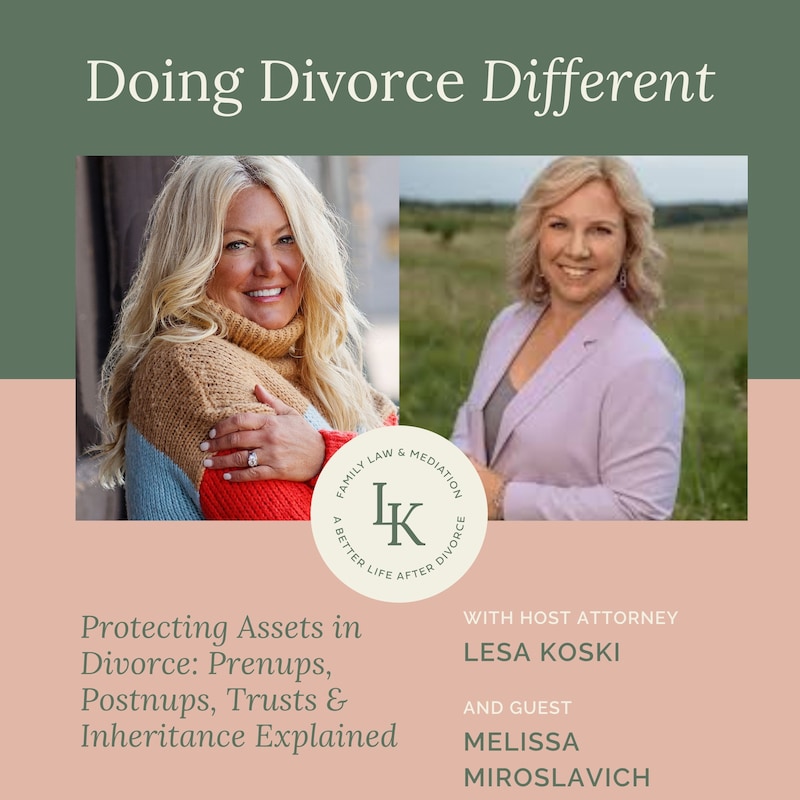
In this episode of Doing Divorce Different, Lesa Koski sits down with Minnesota estate planning attorney Melissa Miroslavich to answer the questions many people don't realize they should be asking until it's too late.
Together they discuss protecting assets in divorce, the differences between marital and non-marital property, when prenuptial agreements and postnuptial agreements make sense, how trusts actually work, and why estate planning should be part of every family's long-term plan.
Whether you're happily married, engaged, considering divorce, or simply planning for the future, this conversation will help you better understand your options and make informed decisions.
In this episode you'll learn:
• What a prenup really does (and doesn't do)
• When a postnuptial agreement may be appropriate
• How inheritance is treated during divorce
• The difference between marital and non-marital property
• Common misconceptions about trusts
• How addiction or financial struggles can affect long-term planning
• Why mediation allows families to create customized solutions
Every family is unique, and every situation deserves thoughtful planning. This episode is educational in nature and is not legal advice. If you have questions about your own circumstances, consult an experienced attorney in your state.
If this episode helped you, please subscribe, leave a review, and share it with someone who may benefit from understanding how to better protect their family and financial future.
Timestamps
(00:00) Welcome and introduction to protecting assets in marriage and divorce
(02:15) What every couple should know about prenuptial agreements
(08:30) Marital vs. non-marital property explained
(13:45) Can inheritance stay separate during divorce?
(20:05) Trusts explained: Revocable vs. irrevocable trusts
(29:40) Real-life divorce scenario involving inherited assets
(37:20) Addiction, financial protection, and postnuptial agreements
(48:15) Divorce, legal separation, or postnuptial agreement—which offers the most protection?
(56:10) Estate planning after divorce
(1:02:45) Beneficiary designations people often forget to update
(1:07:30) Final thoughts and practical planning tips
Key Takeaways
- A prenuptial agreement is more than planning for divorce—it creates clarity, transparency, and shared expectations before marriage.
- Simply placing assets into a trust does not automatically protect them during a divorce.
- Keeping inherited assets separate is essential if you want to preserve their non-marital character.
- Postnuptial agreements can help couples proactively address financial concerns, but they have unique legal requirements.
- Estate planning and beneficiary designations should always be reviewed after a divorce or major life change.
Guest Bio
Melissa Miroslavich is a Minnesota attorney focusing on estate planning, prenuptial agreements, postnuptial agreements, business succession planning, and asset protection strategies. She helps individuals, families, and business owners create thoughtful legal plans that protect what matters most while preparing for life's expected—and unexpected—transitions.
Resources Mentioned
Melissa Miroslavich Law
Schedule a Divorce Clarity Session
https://www.lesakoski.com/offers/2HAtaGZ6/checkout
Divorce Comeback Community
https://www.skool.com/divorce-clarity-40-8663/about
Soberlink – A Trusted Tool for Accountability in Family Law Cases
OsteoStrong Minnesota – Bone Health & Strength
https://osteostrongmn.com/affiliate-referral-koski/
Tags / Keywords
protecting assets in divorce, divorce, divorce mediation, mediation, prenuptial agreement, prenup, postnuptial agreement, postnup, inheritance and divorce, trusts, revocable trust, irrevocable trust, estate planning, marital property, non-marital property, asset protection, Minnesota divorce, divorce planning, divorce coach, Lesa Koski, Melissa Miroslavich, family law, divorce education, financial planning after divorce, collaborative divorce
Transcripts
Welcome to Doing Divorce Different.
2
:I'm happy to have you here,
and I'm so blessed to have
3
:Melissa Mirles-Avich with me.
4
:I love saying your last name.
5
:It's like a hard one that
I actually think I get.
6
:Speaker 2: You do.
7
:You did a nice job.
8
:Speaker: So, and here's the thing,
Melissa is an awesome attorney.
9
:She works in Minnesota.
10
:She does some family law.
11
:She does estate planning.
12
:Are you still doing family law, estate- I
13
:Speaker 2: still do estate planning.
14
:I do prenuptial agreements, so
that's the part of family law I do-
15
:Yeah … pre-planning kinds of things-
Mm … and business succession planning.
16
:Speaker: Yeah, which we really love
for today because I told Melissa I
17
:wanted to have her on because I've
had some clients coming to me who have
18
:questions on both sides of divorce, if
they wanna stay married or if they're
19
:thinking about divorce, on how we
can protect the assets in a marriage.
20
:And I'm gonna let Melissa kind of
take over and explain ways, and then
21
:I'm gonna jump in with my scenarios
to see how this actually plays out.
22
:So Melissa, welcome.
23
:Thanks so much for being here.
24
:Thanks for sharing all your
knowledge, because you have
25
:a lot, and I appreciate you.
26
:Speaker 2: Oh, thank you.
27
:I'm happy, happy to be here.
28
:Um, yeah, so protecting assets in a
marriage, um, I guess it depends on what
29
:the end is for the marriage, like what
are we protecting them from or whom.
30
:And so if you think about a marriage, um,
and a marriage ends in one of two ways.
31
:It either ends in a divorce
or it ends in a death.
32
:And so, you know, life happens and
things can get complicated, so one of
33
:the ways that you can look at maybe,
um, when we're talking about things
34
:like this, like a yours, ours and mine,
like yours and mine and ours assets,
35
:in a marriage in Minnesota, a lot of
those assets are assumed to be ours.
36
:And so when we're looking at a divorce,
for example, those, those, um, assets
37
:that are considered ours by the statutes
tend to be broader than maybe what people
38
:think, um, if they don't know that.
39
:And so one of the ways that you can
sort of protect what is yours versus
40
:ours or mine versus ours is actually
doing a prenup before you get married.
41
:Speaker: Mm-hmm.
42
:Speaker 2: Um, and that's a really, um,
important step that I like to do because I
43
:feel like it makes a stronger relationship
and you also go in with your eyes wide
44
:open, and there's a base understanding
of what could happen in either of those
45
:scenarios, um, being death or divorce.
46
:And so a prenuptial agreement can
say, "Hey, we like those laws and
47
:we agree with them," and it sort of
stamps in time what you've brought to
48
:the relationship and to the marriage.
49
:Or you can say, "Hey, I
don't wanna do it that way.
50
:My fiance doesn't wanna do it that way.
51
:We wanna do it some other
way," and you can make your own
52
:private agreement basically.
53
:Um, there's lots of rules about how
those work to make them really strong
54
:and valid, but that's one way to do it.
55
:If you're already married- You
could do a postnuptial agreement.
56
:A postnuptial agreement is saying, "Hey,
we're already married, but these are some
57
:of the things that we're concerned about.
58
:This is how we feel about
it now, and we don't…
59
:We wanna do a yours, mine,
ours kind of scenario."
60
:You can also do that after marriage.
61
:There's, um, different rules
associated with that in Minnesota.
62
:Um, the specific two that are important
probably is that you both would be
63
:required to have an attorney, which
in my opinion makes a lot of sense,
64
:because at that point in time, you have
spousal rights that you may be choosing
65
:to give up, and you wanna know what
those rights are before you do that.
66
:Um, and you also, um, once
you sign it, it's not actually
67
:truly enforceable for two years.
68
:So there is a period of time where you
can't just, like make an agreement,
69
:and then a week later get divorced.
70
:So that doesn't make sense.
71
:So that's one of the protections that
the, the statutes have in place for you.
72
:So post-nuptial agreements, prenuptial
agreements are great when we're
73
:thinking about divorce scenarios.
74
:Um, you can also handle death
scenarios in those kinds of
75
:agreements, so those are super helpful.
76
:And then when we're looking at
estates, um, there's ways that
77
:you h- can waive your spousal
rights when it comes to an estate.
78
:Um, and I will just say the longer you're
married, the more the, um, the statutes
79
:would say as a spouse you are entitled to
if your, um, if your other spouse dies.
80
:So, um, you can also waive those.
81
:It's stronger if you have a prenup and
the waiver when you do the estate plan.
82
:So those are some of the vehicles
that are available to you.
83
:Speaker: Well, and I love that, and I
just wanna say for listeners, because
84
:believe it or not, I have so many
clients that come to me and they say,
85
:"Well, I'm just gonna keep my car.
86
:He's gonna keep his,
and this is in my name.
87
:We've, we've already
divided everything up."
88
:And I think what they're not
understanding is, no you haven't.
89
:You know what I mean?
90
:In, especially in Minnesota,
Wisconsin I've worked in a little
91
:bit too, um, what you own in that
marriage, you own together, and it
92
:doesn't matter whose name is on it.
93
:And so I think people…
94
:That's why that prenup is so important.
95
:I don't think people understand the, the
power of the, the bond of that marriage.
96
:It's like starting a business
together, and that's why this is
97
:so important to the listeners.
98
:You need to know, um, that you've
got to set this up differently
99
:if you want a different result.
100
:Speaker 2: That is absolutely accurate.
101
:Um, and in Minnesota, we, we have this,
sort of a short form of, um, saying
102
:this, but if you own real estate,
you'll, you'll say you buy a house
103
:together, um, in Minnesota you can buy
a property individually in a married-
104
:if you're married, but you can't sell
it without your spouse's signature.
105
:Mm-hmm.
106
:So we call that one to buy, two
to sell, um, and that's something
107
:that's very important in Minnesota,
and the reason for that is so that
108
:spouses aren't just left high and
dry without a place to live, right?
109
:Yeah.
110
:Nothing can get sold out from under
you when it comes to property.
111
:So different types of property
is handled differently.
112
:Um, you know, and in a divorce you
can also come to agreements where
113
:you might decide, like, your car's
your car, and my car's my car.
114
:Speaker: Yes.
115
:Speaker 2: Um, but as long
as you're agreeing, right?
116
:It's the, it's when we don't agree that
things get really, um, long, involved,
117
:exhausting, courts are involved, and
judges start making decisions for us.
118
:Speaker: I'm glad that you said that,
too, because if you use mediation or
119
:collaborative law, you can do this how
you want to as long as you're clear, and
120
:I always kind of say state a reason why-
121
:Speaker 2: Mm-hmm
122
:… Speaker: you're doing it that
way, just so the judge knows,
123
:like, "I know I'm not getting as
much, and this is why I want it."
124
:You know what I mean?
125
:I don't know.
126
:Speaker 2: Yeah.
127
:This is why it felt equitable to me.
128
:Speaker: Yes.
129
:Speaker 2: Yeah.
130
:Speaker: Yeah.
131
:Okay.
132
:All right.
133
:So let me ask you, I'm gonna ask you
about a particular case- Where I have
134
:a couple, they have a lot, a kind of a
lot of assets, and they've been married
135
:a long time, and they're divorcing.
136
:Right.
137
:And during their marriage, uh,
husband received a gift, an
138
:inheritance that was just to him,
and we haven't talked about this.
139
:We've said everything belongs to both
of you, except for non-marital property.
140
:Speaker 2: Exactly.
141
:We have the concept of marital property
and non-marital property in divorce.
142
:That concept doesn't really
exist in death, by the way.
143
:Um, we can make it exist, but
it doesn't really exist there.
144
:Yeah, so that, that distinction between
marital property and non-marital property
145
:becomes, like, the most important thing
if you're going through a divorce.
146
:And a prenuptial agreement can really be
clear about what is, in fact, non-marital
147
:property, which does not get split,
that's why that's important, versus
148
:marital property, which does get split.
149
:Speaker: And so in general, Melissa,
can we say that if you get a gift
150
:or inheritance that's to you alone
and you don't mix it in with your
151
:family, um, that can stay yours?
152
:Or, like, if you had a 401before the
marriage, you can keep that portion of it?
153
:Is that true?
154
:Speaker 2: We start doing math.
155
:Um, so yes, um, if you get an inheritance
and it is only to you, so the check
156
:is literally to you, not to both
of you, then technically that would
157
:be considered non-marital property.
158
:But what you do with it is
really important, right?
159
:So if I get a check and it's non-marital
property, it's an inheritance or a
160
:gift from my long-lost cousin, and
I put it into my joint account, I've
161
:now just basically gotten rid of the
non-marital property part of that
162
:because of how I'm choosing to use it.
163
:Or let's say I get, um, $100,000 'cause
somebody died and I put it into my own
164
:account and I can show that this is what
I inherited, this is where I put it,
165
:and I haven't used it in any other way.
166
:I basically have to set up all the
dominoes, because in Minnesota, the
167
:person who says something is non-marital
property has the burden of proving
168
:that it's non-marital property.
169
:Speaker: Okay.
170
:Speaker 2: And if you remove
one of those dominoes, you lose
171
:the non-marital property, like,
like, protection, basically.
172
:Speaker: Right.
173
:Okay.
174
:Mm-hmm.
175
:So this is, this is…
176
:So I, back to my scenario.
177
:Speaker 2: Okay.
178
:Speaker: Went off on a tangent
on non-marital property.
179
:So we've got this couple, he receives
an inheritance that is just to him.
180
:He puts that in the tru- in a
trust, and in that trust, he
181
:purchases a home in Arizona.
182
:that the family uses.
183
:I mean, I asked this and they said, uh,
and, and the wife is, is, is even like,
184
:"Oh no, the, the financial planner said
that's his 'cause he put it in a trust."
185
:And I said, "I don't know if that's
necessarily true if he's using it."
186
:The wife and daughter go
there and vacation there.
187
:I mean, I think he's kinda
living there more now.
188
:Speaker 2: Sure.
189
:Speaker: Um, but is that, is that
a way to keep your money safe from
190
:your spouse when you inherit it,
just by putting it in a trust?
191
:Speaker 2: Not necessarily, no.
192
:Um
193
:Speaker: Let's talk, let's
dive into that a little bit.
194
:Speaker 2: Yeah.
195
:So, um, I guess the first question I
would ask is what kind of a trust is it?
196
:Because there's lots of
different kinds of trusts.
197
:Mm-hmm.
198
:So, um, if you set up what's
called a revocable trust, um,
199
:versus an irrevocable trust is what
we're gonna kinda dive into here.
200
:Um, 'cause when I s- when I hear
the word trust, I start thinking,
201
:"Okay, well, what, what…
202
:Who created the trust?
203
:What's in the trust?
204
:When was it created?"
205
:Those are the questions
I start to ask myself.
206
:Um, so to make it very simplified, if
you have a revocable trust, which is a
207
:tool we use a lot in estate planning,
quite frankly, because it helps you
208
:avoid probate and it has other benefits.
209
:If it's revocable, I think about it
as, um, you kind of own a shed in your
210
:backyard, and you can put things into that
shed, and you can take things out of that
211
:shed, and you have the keys to the shed.
212
:So you are in full control of the
assets that are in the revocable
213
:trust and what you do with them.
214
:Um, you can also change that trust.
215
:You, you, you maintain holding the keys.
216
:You're in charge.
217
:Versus something called
an irrevocable trust.
218
:An irrevocable trust is not
like the shed in your backyard.
219
:It is basically like when
you go to deposit a letter.
220
:Do people still write letters?
221
:Um- I do.
222
:And you go to the mailbox that's
not your personal mailbox.
223
:Maybe that's a better analogy.
224
:It's not my personal mailbox, it's
just the mailbox by the gas station
225
:or whatever, and I put things into it.
226
:I can't get them back.
227
:I'm not in control of it anymore.
228
:Somebody else is.
229
:That's more what an irrevocable trust is.
230
:So we might set up assets
in an irrevocable trust.
231
:I might be the one
who's feeding the trust.
232
:I might be the one who created
it, but I'm not in charge of it.
233
:I don't have the keys.
234
:I can't make changes.
235
:It's really not mine anymore.
236
:It's really owned now by the trust itself.
237
:And the reason people do
that, 'cause you're like, "Why
238
:would you give up control?"
239
:Um, is because they're
looking for protection, right?
240
:So maybe we want protection from
creditors, or we want protection
241
:for, um, somebody in our family,
or maybe we want a tax benefit.
242
:So, uh, Minnesota has estate taxes.
243
:Not every state does that, um, but
we do, and one of the tools that
244
:we can use to minimize somebody's
estate or make it smaller is to
245
:remove assets from the estate and
put them in an irrevocable trust.
246
:It's no longer counted
towards your estate.
247
:So there's reasons people
would do an irrevocable trust.
248
:If you get an inheritance from a parent
and they want you to be able to have
249
:benefit from that trust as a beneficiary,
but they don't want you to have control
250
:over it, um, that would be a way to
sort of separate out those assets.
251
:And they're no- they're not really yours
until you get them as a beneficiary.
252
:Does that make sense?
253
:Speaker: Yeah.
254
:Okay, so in my scenario,
I don't know for sure.
255
:I don't know for sure if
it was an irrevocable.
256
:If it was irrevocable, though, how would
he have used it to purchase a home?
257
:Speaker 2: That would be very dependent
on the language in the trust itself.
258
:Okay.
259
:So this is now where you do a
deep dive into, like, have an
260
:attorney look at the tr- the trust
document and say, "What is allowed?
261
:What isn't allowed?"
262
:But if he has control over those
assets, I would be surprised, um,
263
:that he is, um the, the trustee or the
g- the person who created the trust.
264
:Like, you, once it goes
into an irrevocable trust,
265
:you lose control, right?
266
:Um, so that would be a great area for me,
and I would want a question about that.
267
:Okay.
268
:Because if it's a revocable trust, we
haven't protect- protected the assets
269
:from the yours, ours, mine, marital
property, non-marital property at all.
270
:It's- Right … you,
you're in control of it.
271
:Um, irrevocable would be like,
it's not part of my estate.
272
:I don't have access to it.
273
:I can't get the money out of it.
274
:That seems like a scenario where you might
be like, "Okay, so what's really going on
275
:with that particular irrevocable trust?"
276
:Because just because you have
one, doesn't mean that it's not
277
:considered marital property.
278
:So, that doesn't just
automatically protect you.
279
:Okay.
280
:So, let's say somebody knows they're
getting divorced, and they're planning
281
:it out, you know, three years in advance
or something, and they go create this
282
:irrevocable trust during the marriage,
depends on what money they used.
283
:Um, because a court might look
at that and say, "Yeah, that's,
284
:that feels wrong," right?
285
:That just hits wrong, and so you, you
might not be able to access that money,
286
:but you still might have to cover off
the marital portion of that money-
287
:Speaker: Mm-hmm
288
:… Speaker 2: and, um, and divide
it equally anyway, even if
289
:you can't access it directly.
290
:Speaker: Yeah.
291
:Speaker 2: It's gonna
be very case specific.
292
:Speaker: Okay.
293
:And so I like that, and so I feel
like in that situation, absolutely the
294
:wife should have someone on her behalf
looking at that trust and the wording,
295
:um, to know what her rights are.
296
:Speaker 2: For sure.
297
:Yeah.
298
:Speaker: Yeah.
299
:Speaker 2: Yeah.
300
:I mean, if…
301
:I would always say, if
it doesn't feel like…
302
:I always start with this, what
does this feel like to me?
303
:Like, what's happening?
304
:And that first question
is, who set up the trust?
305
:Who's in charge of it?
306
:Who has access to it?
307
:What's in it?
308
:Where did that asset come from?
309
:When did it happen?
310
:Was it pre-marriage, after marriage?
311
:All of those factors are gonna
play into- Yeah … whether that
312
:asset is now considered marital
property or non-marital property.
313
:Speaker: That, that's, that was
my thinking, and it was during
314
:the marriage, so to be determined.
315
:Speaker 2: Yeah.
316
:What I'll say is this, a, a judge
would not just assume that- Mm
317
:they're not gonna ignore the asset, right?
318
:They're gonna question it, they're
gonna look at it, they're gonna ask
319
:similar questions to what I asked, which
is very different from what the IRS
320
:does, just in case you're wondering.
321
:Speaker: Good
322
:Speaker 2: to know.
323
:You know?
324
:Good to know.
325
:They're more like a creditor, right?
326
:So- Different strokes for different folks.
327
:Speaker: Right.
328
:Right, right, right.
329
:Okay, okay, that's super helpful.
330
:You're helping me out, you're
helping the listeners out.
331
:Now, I have a different scenario,
and interestingly enough, I'm helping
332
:someone r- right now through this, and
this isn't the first time, so I feel
333
:like, well, there might be some other
listeners who are going through this.
334
:So, I'm gonna tell you, in the past, I had
a lovely couple, they w- had been married
335
:a long time, and he had an addiction
problem, and they came to me because
336
:he was afraid- If he lost it again,
he would spend all the money, and he
337
:wanted to take care of her and his kids.
338
:And he was, he was gone for, I don't
know, three years, and she didn't see
339
:him, and he spent a bunch of money.
340
:And they loved each other, but he just
had a really … So he was in a great
341
:place when they came and they worked
with me, and we did do a divorce for them
342
:even though they kind of stayed together.
343
:And that way she was able to separate
out the finances and she was safe.
344
:And gall darn it, I talked to her
later and he did lose it again and
345
:was gone, and so we were so thankful.
346
:So, you know, let's fast-forward
to just recently I've got a
347
:young couple kind of in the same
scenario, and I feel protective, a
348
:little protective of mom and kids.
349
:Um, and she doesn't wanna get divorced.
350
:She has hope.
351
:And so we're trying to look at,
and I've, I've trying to come up
352
:with ideas like, okay, you could…
353
:I mean, you can always get
divorced and stay together.
354
:That's one option.
355
:Speaker 2: Mm-hmm.
356
:Speaker: You can do a legal separation.
357
:Mm-hmm.
358
:Um, and that the laws are a little bit
different in Minnesota and Wisconsin.
359
:Um, you c- she, she was wondering
if there's any way you could
360
:set up some kind of a contract.
361
:I believe that would be a postnuptial.
362
:Speaker 2: Yeah.
363
:Speaker: Can you speak to
what her options might be?
364
:And his.
365
:He's in this with her right now.
366
:Yeah.
367
:He feels the same way.
368
:He doesn't want a divorce, but he wants
her protected because he knows it's scary.
369
:Speaker 2: Yeah.
370
:I mean, I feel like you're kind
of hitting the nail on the head of
371
:what the three options would be.
372
:So you have the, the first option…
373
:Well, let me, let me give you
worst-case scenario first option, right?
374
:Um, and I will do this
from my own experience.
375
:So, um, I did practice family law.
376
:I chose to focus on estate planning,
but, um, I did have a client who, um,
377
:spouse had an addiction, and they were
together, I wanna say, 20, 20 plus
378
:maybe, 20 plus years, enough for the
kids to, like, be out of the house-ish.
379
:Mm-hmm.
380
:And, um, at that point in time, we did
a divorce, and, and lots of assets had
381
:been misused and, um, there's things
that you can fight about when there's
382
:misuse of marital assets and things
like that, but that, again, that's
383
:expensive and drawn out, and nobody really
wanted that in this particular case.
384
:And, um, for me, um, in the attorney
role at that point, it was really
385
:hard because I felt for the situation.
386
:Um, everybody's concerned and
is worried about the money.
387
:There's no getting the money back
once it's gone, to be honest with you.
388
:Mm-hmm.
389
:Like, that's not possible.
390
:And in Minnesota, we're a no-fault
state, so we can't say, "We're divorcing
391
:because of your infidelity," or- Yeah
392
:"We're divorcing because of your
addiction," or whatever the…
393
:So those, those are out
the window, and so…
394
:And there's good reasons for that.
395
:I'm not against that at all.
396
:Um, but it was kind of a, kind of a tough
cookie situation because her choice was
397
:to stay even though she knew that this
was happening, and he had periods where it
398
:was great and periods, periods where there
was relapse and everything in between.
399
:And so that's a hard pill
to swallow, I'll just say.
400
:Um, but that is the pill that you
sort of swallow at that point.
401
:Mm-hmm.
402
:Um, another option would be to say,
"Okay- We're both in a good place.
403
:We really, um, do wanna protect
the assets, and how do we do that?
404
:I would be looking at a postnuptial
agreement, um, in that scenario, which
405
:is basically, it's kind of like a
prenuptial agreement, but you basically
406
:sit down with each other and you say,
"Okay, here's the assets that we have.
407
:I'm going to start shifting assets
and saying that they're non-marital
408
:property, and putting them in the
spouse that isn't ha- struggling with,
409
:uh, chemical health issues, and start
separating those out so that we are able
410
:to protect the more of the assets, let's
say, um, in the case of a divorce."
411
:Um, one of the benefits of that is that
you get a nice, clear picture of what
412
:the assets are and the liabilities.
413
:We do both, because you have
to have full disclosure of the
414
:financials in that situation.
415
:Um, and once you sign that on the
dotted line in Minnesota, it takes a
416
:couple years, um, to actually make it
enforceable, but you could also make an
417
:argument that it's enforceable before
the two years, but you'd have to prove
418
:it and you'd have to win that argument.
419
:Um, I also think- Oh,
420
:Speaker: it takes two years for that.
421
:I…
422
:Okay, I did see that, which
may not be great in this
423
:scenario right at the moment.
424
:We don't really wanna wait two years.
425
:Okay.
426
:Speaker 2: Well, you have to sign it,
and then you've got two years before
427
:it, before it's basically, like, a-
Uh-huh … assumed to be enforceable.
428
:So there's a period of time where it's
not, and that is really meant for the
429
:benefit of the people who are part of this
process, because if you're doing, um, if
430
:you're making marital property non-marital
property, 'cause remember, you're
431
:already married, so the rights exist.
432
:You have them.
433
:You're not…
434
:In a prenuptial agreement, you're not
married yet, so you're not giving up
435
:something that you already have, you're
giving up something that you could have.
436
:But in a marriage, you might be giving up
things that you already have rights to.
437
:And so, um, so there is this
sort of period of time where it's
438
:not assumed to be enforceable.
439
:You could argue if you were in
court that it is for a bunch of
440
:reasons, and I don't know if you
would win that argument or not.
441
:Um, that's very dependent
on the situation, obviously.
442
:Speaker: Okay.
443
:So that, that doesn't sound like a
great option in the situation with
444
:addiction, where you don't know timing.
445
:Um, so it's good to know that that is…
446
:You know, and I think I know, like,
people who have done postnups are,
447
:they're maybe starting a business.
448
:Mm-hmm.
449
:You know what I mean?
450
:And they have a partner, and so
they, they work that all out.
451
:I get that, and I understand the two year.
452
:That makes complete sense, you know,
because someone is giving up their rights.
453
:Okay.
454
:So kind of sounds like a separation
or a divorce- Might just be the option
455
:Speaker 2: That's probably
the most protected, right?
456
:Because you do, when you have a
divorce or a legal separation,
457
:you are separating assets, right?
458
:So, and that's, that's a completed
transaction, if you will.
459
:So, once a divorce is finalized and
it's effectuated, like, the assets
460
:are going to the person they're
supposed to go to, and based on the
461
:agreement that the parties make or
what the judge tells you or whatever.
462
:Um, so that's probably the strongest,
right, way to protect financial assets.
463
:Um, with a postnuptial agreement, we do
have this wiggle room of time before the
464
:presumption is that it's enforceable.
465
:Um, in addition to that, I would
also be looking at, in an estate
466
:plan, um, you know, with addiction,
there is possibilities for overdoses
467
:and all, all those kinds of things,
so we start talking about death.
468
:Um, depending on how the estate plan
is set up, I do know that there are
469
:people who are concerned if the person
who doesn't have the chemical health
470
:issue dies first, and the person who
does have the chemical health issue dies
471
:second, they've inherited potentially
the whole estate, depending on how long
472
:you've been married, and the family
dynamics, and kids, and all of that stuff.
473
:But, um, but that's, that's a scary
scenario too, and so lots of times people
474
:will make a plan for in the case of
death, what's happening with these assets.
475
:In Minnesota, your spouse has a certain
level of rights to- Mm-hmm … the
476
:assets of the estate, and so you
can work your way around that.
477
:One of the ways to do that is to do a
combination of a postnuptial agreement,
478
:as well as waivers and consent to what we
call in Minnesota is your elective share.
479
:So a spouse gets a certain amount.
480
:The longer you're
married, the more you get.
481
:Um, and lots of spouses just give
everything to each other, so m-
482
:most people, it's not necessarily on
their radar that that's what happens.
483
:But there is, um, an elective
share component to this that
484
:you could waive your rights to.
485
:But you would wanna sign
waivers, show consent.
486
:Like, you want it documented
that that's what's happening.
487
:Speaker: Okay, so you're kind
of saying that for if you
488
:take the postnuptial route.
489
:So now let's just clarify too for
the listeners, if you get a legal
490
:separation or a divorce, and you
separate those assets and, oops, you
491
:had a will and you forgot about it, does
that null after you've been divorced?
492
:Speaker 2: So in Minnesota, we have
laws that say with divorce, the day that
493
:judgment decree is signed by the court,
that there's a severance, basically.
494
:We're severing the role of spouse.
495
:And so even if you named your spouse
as your beneficiary in your will,
496
:if you are divorced, as of the date
of the divorce, spouse is no longer
497
:eligible, uh, to be the inheritor, or
your personal representative, or your
498
:trustee, or your power of attorney.
499
:So there's an automatic moment
in time where those are severed.
500
:Um, since I do estate planning and I'm
very much about proactive thinking, I
501
:will say even though that sever- that
severs automatically, I think it's
502
:really important to make sure you pick
the people you want, because we'll just
503
:go down the line and who was next, and
maybe it was your spouse's brother, and
504
:that's no longer appropriate, right?
505
:So, um, or maybe it is.
506
:I actually have, um, lots…
507
:I've had several, especially in the
collaborative process, people who
508
:are divorced and their spouse has
been severed from those roles, and
509
:they still want them in those roles.
510
:Speaker: Mm-hmm.
511
:Speaker 2: So when you talk to me about
people who are divorced but are actually
512
:still together and, um, and they still,
um, like the protections and the person
513
:would make good decisions for them, I
will, after the divorce severs their role,
514
:I will go and reinstate them sometimes.
515
:Speaker: Yeah.
516
:Speaker 2: Maybe not as often as other
cases, but it does happen occasionally.
517
:Speaker: And especially in collaborative
law and mediations where people
518
:are working together, which I
think is the best way if you can.
519
:Mm-hmm.
520
:Um, and then I just wanna add one
other piece- When you get divorced,
521
:and if you have beneficiaries set up
for, like, life insurance, does that
522
:automatically sever, or would that still
523
:Speaker 2: go to the ex?
524
:We always need to check our beneficiaries.
525
:Let's just do that, okay?
526
:Like, rule of thumb, let's just
check the beneficiaries, because we
527
:do get into, like, wow, that could
be an interesting argument, right?
528
:Or an interesting fight.
529
:So, once…
530
:But just to be clear, in Minnesota,
if you're in a divorce process
531
:You cannot change your beneficiary
designations, that's not allowed,
532
:um, unless everybody agrees.
533
:After the divorce, then you can.
534
:So there's that, that time period
where you have to be careful.
535
:One of the benefits of doing a prenup,
since we did mention them earlier, is that
536
:you can change that rule for yourself.
537
:Right.
538
:So in lots of prenups that I do, I…
539
:We s- we change the date.
540
:We don't say, "You can't change
your beneficiary designations until
541
:the divorce is finalized," we say,
"If it's started, you can change
542
:your beneficiary designation."
543
:So there's, there's lots of different
nuances to the prenup that people
544
:can benefit from, even if they agree
with how things would get separated.
545
:Speaker: Right.
546
:And I just…
547
:Okay, so and ano- a point I was
trying to make, though, is that if
548
:you get divorced and you have your
spouse as the beneficiary of, like,
549
:your life insurance, and then you
die, it goes to your spouse, correct?
550
:Speaker 2: Let's change that, yeah.
551
:Speaker: Yes.
552
:Speaker 2: Yeah.
553
:Speaker: So-
554
:Speaker 2: And there's no-
555
:Speaker: So the will ends,
but not the- There's no…
556
:Speaker 2: Yeah, so the, the
statutes will end it for wills,
557
:trusts, powers of attorney,
executor roles, that kind of stuff.
558
:But those beneficiary designations,
when you're working with
559
:big companies, those are…
560
:They're great tools, because they
keep you out of probate court.
561
:But, um, yeah, we need to change
those beneficiary designations.
562
:Yeah.
563
:When it's appropriate to do so.
564
:Speaker: So much to think about.
565
:That's why- Yeah … I mean,
I gotta tell you, I love AI.
566
:I love it.
567
:I use it every day.
568
:But I have had people coming to me
and thinking they know everything.
569
:It's just hard.
570
:You do need a little bit of help a
lot, or, you know, just get informed
571
:on what you need to do as best you can,
'cause there is so m- I mean, this,
572
:I'm like, okay, we're at our time now.
573
:Like, and I feel like I thought
this was gonna be a quick little…
574
:You know?
575
:But these are really in-depth
things, and I'm so thankful.
576
:You clarified things.
577
:I learned.
578
:Yeah.
579
:This is gonna help my listeners,
so I so appreciate you.
580
:I know I'm gonna have you back on-
Great … 'cause I love having you.
581
:Speaker 2: Yeah, I'd love to be back.
582
:Hopefully we sh- shed some light
a- at least to, to know that
583
:there's, like, things you can do.
584
:Um, I don't think there's a,
a solid best-fits-everybody
585
:answer to that question.
586
:I think there's a lot based on the
individual circumstances, which is
587
:one of the reasons I like working with
families, 'cause everybody has their
588
:own things that they bring to the table.
589
:Right.
590
:Yeah, so.
591
:Speaker: Yeah.
592
:It's good.
593
:And so I would highly recommend you to
my listeners if they're in Minnesota.
594
:Speaker 2: Yeah, mm-hmm.
595
:Speaker: And we'll have your,
um, contact in the show notes.
596
:Okay, great.
597
:But otherwise, it's Melissa Miroslavich.
598
:How can they reach you?
599
:Speaker 2: They can go miroslavichlaw.com
600
:if they can spell it, but it'll be
601
:Speaker: right there.
602
:I'll have it in the show notes too.
603
:But if you're thinking, "Oh, I'm getting
married, I wanna talk about the prenup,"
604
:or if you're thinking about, even just
thinking about divorce, I don't think
605
:it's a bad idea to touch base with
you to find out, okay, how is this…
606
:What do I need to be thinking of?
607
:Because sometimes, darn it,
that family law attorney isn't
608
:always remembering those things.
609
:Speaker 2: That's true.
610
:So- That's true.
611
:Well- Yeah.
612
:Speaker: Well.
613
:It's
614
:Speaker 2: true.
615
:Absolutely.
616
:Speaker: All right.
617
:Well, Melissa, thank you.
618
:I appreciate you.
619
:Thanks so much for being here.
620
:Speaker 2: Thanks for having me.
621
:It's good to see you again.
622
:Bye, Lisa.
623
:Yes,
624
:Speaker: you take care.