Shownotes
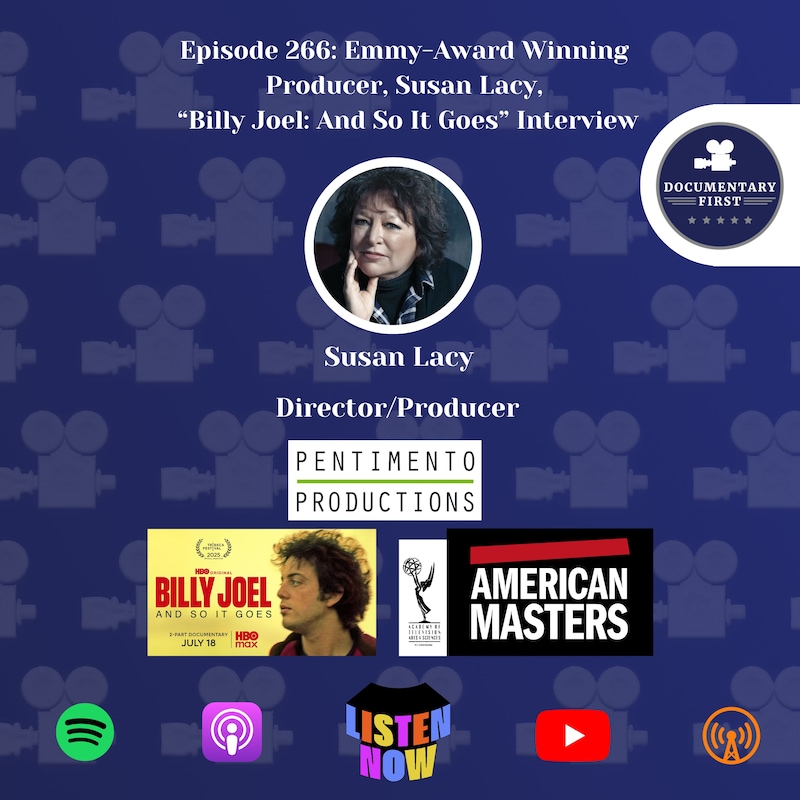
Susan Lacy—the iconic creator of PBS’s American Masters and one of the most influential voices in biographical documentary filmmaking joins us. From her early roots in journalism to building a landmark series that reshaped cultural storytelling on public television, Lacy shares the real behind-the-scenes truth of what it took to launch American Masters, fight for ambitious filmmaking, and evolve from producer to director.
Together, Christian and Susan dig into what makes a documentary last: deep research, emotional access, trust with subjects, and interviews that go beyond “good questions” to uncover the soul of a story. Lacy also reflects on being a woman leading at the highest levels of the industry, the power of mentorship, and how shifting economics—from the DVD era to today’s streaming landscape—have changed development, financing, and distribution.
If you care about documentary storytelling, PBS history, HBO documentaries, or how to direct intimate, character-driven films that preserve legacy and culture, this conversation is essential listening.
No DocuView Déjà Vu
Links:
American Masters: American Masters (TV Series 1985– ) ⭐ 8.2 | Documentary, Biography, History
Pentimento Productions: HOME
Spielberg: Spielberg (TV Movie 2017) ⭐ 7.7 | Documentary, Biography
Billy Joel: And So It Goes: Billy Joel: And So It Goes (TV Mini Series 2025) ⭐ 8.6 | Documentary, Biography, Music
Episode 256 | HBO Max "Billy Joel And So It Goes" Interview with Executive Producer, Steve Cohen - Part 1: https://open.spotify.com/episode/1v6X33Wu3IPCczl0uL4SvN?si=cc53ba405c254126
Episode 264 | Billy Joel: Telling the Story Behind the Musician (with Jessica Levin): https://open.spotify.com/episode/5GRU4wDlnYa9cmXBAo3eKz?si=1d721c5270ed4a37
Time Codes
00:00 — Welcome + Susan Lacy Intro
05:38 — Journalism roots and learning the value of truth
08:55 — Breaking into PBS (Channel 13) and the art of public television
12:06 — Launching a cultural institution: American Masters in 1986
22:08 — HBO era + Directing Debut
32:16 — Billy Joel: And So It Goes Documentary
43:00 — Interview + Story Tips
57:12 — Final thoughts, American history
Sponsor: Virgil Films http://www.virgilfilms.com/
Support us by buying merch or watching our films: https://documentaryfirst.com/
Transcripts
Alright.
2
:Welcome to Documentary First, an inside look at documentary filmmaking.
3
:I'm your host, Christian Taylor, a documentary filmmaker myself.
4
:This podcast is where we hope to help filmmakers make better stories.
5
:And I can tell you, I can't think of a better guest to help us achieve our goals than the
guest we have today.
6
:Today, I am thrilled to have the guest, the gift of time from the remarkable Susan Lacey,
one of the most respected and influential documentary filmmakers working today.
7
:She is best known as the creator of American Masters, the groundbreaking PBS series she
launched in:
8
:cultural icons who helped shape our American story.
9
:Under her leadership, American Masters earned dozens of Emmy and Peabody awards, and she
set a new standard for biography and documentary filmmaking.
10
:In 2013, she began a new chapter, founding Pintamento Productions.
11
:where she shifted her focus entirely to directing and producing her own films.
12
:Since then, she's created an extraordinary body of work for HBO, including Spielberg, Jane
Fonda in Five Acts, Barry Routh, The Janes, and most recently, one of my personal
13
:favorites, Billy Joel, and So It Goes, which premiered as the opening night film in the
:
14
:Her films have also been nominated for and won multiple Emmys, Peabody Awards, and even
Grammys.
15
:But beyond the award, Susan has spent her career preserving the creative legacies of
others while continually redefining her own.
16
:Today, we'll talk about that incredible journey from producing to directing, from American
Masters to HBO, and explore what it takes to tell the stories of living legends like
17
:Steven Spielberg and Billy Joel.
18
:Welcome, Susan.
19
:I am delighted to have
20
:here.
21
:I am delighted to be here.
22
:Thank you so much.
23
:Yes, you know, we had to jump right in because we've now spent too much time getting to
know each other before I hit the record button.
24
:And I thank you for your time.
25
:You've been a delight just to give me your time today.
26
:I have been waiting for this interview now for weeks.
27
:I've spoken to Steve Cohen and I've spoken to Jessica Levin, your co-director of Billy
Joel and So It Goes.
28
:ah But I've just been waiting to speak with you because I thought this film was a
masterpiece.
29
:Thank you.
30
:It was a masterpiece uh of directing.
31
:And I say that because I started watching it at like 8 p.m.
32
:the night that I received the screener and I couldn't stop watching it until it ended at
like 2 a.m.
33
:And I was just blown away by the depth of the interviews and how um Billy Joel was so open
and honest and revelatory about his own life.
34
:And then how
35
:the people in his life where he had difficult and tumultuous relationships were included
in the film, willing to be interviewed, which I know could not have been easy.
36
:And then how creatively you wove his story together with uh unique pieces.
37
:I loved how you used graphics of his own handwritten notes of the lyrics and his own
photos or the archival video no one had ever seen before.
38
:um Man, that is just incredible storytelling.
39
:So ah thank you for that film.
40
:And I do want to talk about how you came up to all of that, but we need to start at the
beginning.
41
:So you were telling me when we first jumped on, I told you I was from Chicago.
42
:We talked a little bit about what's happening in Chicago today.
43
:And today is October 22nd, 2025.
44
:And there's a lot happening in downtown Chicago right now.
45
:And you mentioned that in 1968, was that it?
46
:I was at the Democratic convention in 1968.
47
:well, guy named Frank Mankiewicz, who might not mean much to people listening to this
podcast today, but he was a very big deal politically back in the day in the 60s, very
48
:connected with Kennedy.
49
:And there was a man named Dick Tuck, who was a well-known political prankster.
50
:Anyway, they decided that there should be a student newspaper put out on a daily basis
during the convention.
51
:and they picked 10 college newspaper editors.
52
:And I was the one of the 10, the only woman and the only one from a weekly paper.
53
:Everybody else was big dailies, you Harvard, Princeton, Yale, Penn, know, Michigan, and a
lot of editors who went on to, you know, make names for themselves as well.
54
:But I was from a weekly and I was the only woman and they gave us one room at the
Blackstone Hotel.
55
:And so it was it was a learning experience and incredibly fascinating my job was to write
a story about the people that the the Pinkerton's and the National Guard people that were
56
:being brought in to supplement the Chicago police.
57
:And and that was fascinating because that I put myself in some dangerous places I was in
fact I was hit over the head and dragged across the street about to be thrown in a paddy
58
:wagon until.
59
:famous uh ABC correspondent who I had gotten to know at the early breakfast in the hotel
where all the reporters were staying.
60
:And he came over and he flashed his badge and he pulled me out of the wagon.
61
:His name was Luciaffi, was ABC News.
62
:And uh anyway, it was an incredible experience because I had never, you know, written
under that kind of pressure.
63
:um And
64
:But I also realized how important it was to have that point of view em from the students,
from the young people.
65
:They were out in the streets being beaten up and we were reporting it from our point of
view.
66
:uh We never did come up with a name for it because we couldn't think of one.
67
:was just that every day was the date.
68
:And somewhere I have all those newspapers.
69
:I'd love to read that.
70
:How old were you?
71
:I was a junior in college.
72
:was probably, you know, 18 or 19 years old, not more than 19.
73
:Unbelievable.
74
:Well, that's documentary storytelling at its finest.
75
:Just was with a pen and paper and not a camera.
76
:I remember that I ran into my father's cousin was the head of the B'nai B'rith for South
America and they were having a meeting in Washington and both presidential candidates were
77
:speaking to them on the same day.
78
:So it was Nixon and Humphrey.
79
:And I saw, I went with my, we were invited and my parents and I went and there was
Luciaffi and he saw me and he came over to my parents and he said,
80
:you have to watch out, take care of that young girl there.
81
:She put herself in a lot of danger and I was like, Lou, I'm a reporter too.
82
:I was insulted that he was not taking me seriously as a reporter because I was out there
being a reporter.
83
:Anyway, uh but I always wanted to write and I was a journalist.
84
:uh I I thought I was gonna be a journalist.
85
:Then I thought I was gonna be a scholar.
86
:And when I got to college, I ended up majoring in American studies.
87
:And I went far along with that.
88
:I've got a master's and, you know, almost a PhD, everything, but actually writing the
dissertation.
89
:Yeah.
90
:I really, and I loved, I loved, I loved school.
91
:I was one those weird people that loved school.
92
:Anyway, then I was living in Rome because my first husband was the head of the American
Academy in Rome, which is a very prestigious place of.
93
:scholars and artists, a residential community of artists and scholars that are selected.
94
:You have to be very, very talented.
95
:It's called the Prix de Rome when you win, when you get to go there.
96
:Yeah.
97
:And so uh we were living in Rome.
98
:Not a good life.
99
:And then, which was not bad, and uh I wrote, I was writing stuff, did a, know, anyway,
doesn't matter.
100
:And then um I got a call one day because my first husband was, it was rumored that we were
coming back to New York because he was becoming president of Cooper Union, which is a very
101
:prestigious college.
102
:And I had written an article about television and the arts for the American studies,
something or other, and about how it could be better.
103
:I was not even 30 years old.
104
:Wow.
105
:And uh anyway, I get a call from the president of channel 13 saying, how'd you like to
come put your money where your mouth is?
106
:Wow.
107
:That is how I ended up at channel 13.
108
:I did not think I was going into television.
109
:It was going to be a scholar.
110
:And uh so I got there and it turned out I was, I have some kind of a knack for it.
111
:mean, partly because I had worked at both the NEA and the N.E.A.
112
:I've worked at both NEA and NEH, which are probably both gonna go out of business at some
point, but.
113
:Unfortunately.
114
:ah So I learned how to write a grant proposal and that made me extremely popular.
115
:Listen, you still need that today.
116
:eh
117
:I was, you know, doing that and then one day the man who was the head of Arts and
Performance Programs, a kind of legend named Jack Venza, said, I want her to be in my
118
:department.
119
:I want her only for me.
120
:So I would say within, I don't know, eight months of arriving there in 1979, I was a
deputy head of Arts and Performance Programs.
121
:And we were doing things like great performances and theater in America and dance in
America and
122
:You know, a full-scale artistic department and great performances was a pretty big deal.
123
:We bought things like Brideshead Revisited and I don't know if that means anything to
anybody.
124
:no, well, mean, well, does to me.
125
:Yeah, of course.
126
:I'm not sure who's listening.
127
:uh But one day I said to myself, you know, I'm so much more interested in the stories of
the people who create the works that we're putting on.
128
:uh The lives of the creators fascinating.
129
:And since I had majored in American studies and all background American studies, said, I'm
going to focus on America.
130
:I came up with this idea to do something called American Masters and nobody thought it was
a good idea.
131
:Nobody.
132
:I mean, they practically laughed at me at PBS, because I had never produced anything.
133
:I just had good instincts about stuff.
134
:so they didn't really take me seriously.
135
:And I got no support.
136
:This was back in, no, not not, but about 83.
137
:And at the station, they were very indulgent, but nobody ever thought this was really
going to happen.
138
:So I got my first little grant to develop this from NEA, National Endowment for the Arts.
139
:And at same time, I got a call from Robert Redford.
140
:No way, how did that happen?
141
:because somebody had told him and the guy who was the executive director of Sundance at
the time, remember this is 83.
142
:No, is this 83?
143
:Yeah, this is 83.
144
:So anyway, they were starting a new program and they said, best person to run this program
should be Susan Lacey because I had been involved in helping to develop and get on the
145
:American Playhouse, which was the first.
146
:Remember American Playhouse.
147
:independent films made for public television.
148
:So they kind of connected with Sundance's mission.
149
:Anyway, I met with him and I said, uh I'm really committed to developing this thing called
American Masters.
150
:If I take this job, could I continue to do that?
151
:And he said, yeah, as long as it doesn't affect your job.
152
:So I left 13, I moved down the street, took offices with American Playhouse, and I had my
153
:Sundance desk over there and, you know, my American Masters little corner and continued to
s until it went on the air in:
154
:I basically, willed this series into being.
155
:And I say that with all due humility, because I didn't get help from anybody.
156
:But the thing that when I asked 13 if I could continue to do this,
157
:And basically said, you don't even have to pay me.
158
:I mean, that's how committed I was.
159
:I was walking out the door and said, yeah, but Susan, if it ever does happen, remember we
own it because you had the idea while you were on our payroll.
160
:And that was maybe one of stupidest things I ever did in my life was not say, well, let's
have some groundwork because I have ground rules about that.
161
:Because I raised all the money myself and uh I did that for the next 30 years.
162
:So then did you just pay yourself through the money you raised and that's the only way you
ever were renumerated?
163
:Yeah, well, we had a budget and then I have salary on that budget,
164
:and they owned all the things you made.
165
:yeah, absolutely.
166
:And then when I left Sundance after the first season, which was a big success, I had a
choice uh to make and we had just started the Sundance Film Festival.
167
:And I don't think I had any idea what was gonna happen with that.
168
:And I sometimes say to myself, if you'd know what was gonna happen, would you have stayed
or would you have...
169
:The answer is I'm really glad I did what I did because I was able to make my own thing
and...
170
:uh
171
:And I was really committed to it.
172
:And I believed fervently in the importance of creating a cultural library of American
cultural history.
173
:And because I knew that one day all these important people would be gone and their stories
wouldn't be out there and people would forget who they were, which is happening so fast in
174
:this culture right now.
175
:My head is spinning.
176
:I mean, I'm trying to develop a film on Mike Nichols, who's one of the greatest American
directors ever.
177
:And I'm told that most people don't know who he is anymore.
178
:And he's only been gone like five years.
179
:Yeah.
180
:It is.
181
:And before we know it, people won't remember Robert Redford, you know?
182
:I know.
183
:that's, and I was committed to doing that.
184
:Now, obviously I came from it from an academic background, but um my job for the next 30
years to keep PBS appeased was to always balance, always making sure I had a couple of
185
:really popular subjects along with the things that really were the hugely important
foundation of American cultural history.
186
:You know the Balanchines and the Ernie's Hemingway's and you know balanced against film
stars and pop stars, which is basically was the appetite that people want you had and
187
:except that Because you know PBS would say I mean nobody's gonna watch these I see well
the problem is you put them on at four o'clock in the morning and nobody watches them at
188
:four o'clock in the morning so You know and and and nobody can get them made because
there's no place to put them So nobody can get funding because they can't guarantee
189
:they're gonna have broadcasts
190
:So a filmmaker will do it on their credit card and it'll show.
191
:It won't be worthy of prime time.
192
:But these are great stories and uh the stories of people who are transcending the often uh
convention, their times, trying to create something new, overcoming their own demons.
193
:mean, endless, endless stories of creators that are captivating, which has proven true.
194
:Look at how many...
195
:how many of our films we made in American Masters ended up becoming feature films.
196
:Yeah.
197
:Truman Capote, Ray Charles, Edward R.
198
:Murrow, Leonard Bernstein, I could go on.
199
:But at the time, nobody was doing that.
200
:mean, that had gone out in the 40s, you know, in a way to kind of make those biopics, the
Cole Porter story, that wasn't a true story at all.
201
:It was very Hollywoodized.
202
:Anyway, so I fought that battle.
203
:And I said, look, can't have a series called American Masters.
204
:That doesn't have the integrity of being a about American Masters.
205
:can't all be pop stars and film stars.
206
:so, but we turned out to hit a nerve and people loved the series and we had an audience
and we won a ton of awards.
207
:I think we won the Emmy for Outstanding Documentary Series 10 years in a row.
208
:Yeah, so that was the vindication was that there was an audience for this and I knew there
would be and there were people who just uh
209
:You know, we didn't approach the films.
210
:got about maybe $150,000 a show from PBS.
211
:And these films cost well over million dollars.
212
:So you can imagine.
213
:Fundraising that had to go uh on.
214
:um But it wasn't worth making.
215
:That's what other TV series did.
216
:I'm not going to mention who.
217
:They would do them for very little money in six weeks.
218
:We would do the work that went into making something that was lasting.
219
:And I said, if we can't.
220
:make films that are as excellent as the people we're making films about, we shouldn't be
in this business.
221
:So that's what we did.
222
:Well, you I want to go back to the point where you said it, took three years, you willed
it into being, ah you faced a lot of headwind.
223
:There are so many filmmakers that are in that position right now.
224
:And, you know, talk about what headwinds you faced, you know, how you willed it into being
and why, uh and, you know, what it took to get it there.
225
:Oh, that's such a complex, don't want to get too much in the weeds, it's a very different
story today, which is why I think it's a lot.
226
:Well, that's true.
227
:First of all, I was creating something that had not been done before.
228
:And as much as there was no support for it, that was an entry, know, like this is going to
happen.
229
:And I never believed it wasn't going to happen.
230
:So I would approach people and say, you know, I mean, I went to every market, I went to
every film festival, I went to Europe.
231
:created contacts with BBC and, you know, the South Bank Show, was the equivalent of
something like American Masters in England, met commissioning editors from all over the
232
:world when documentaries still had a place on the schedule.
233
:And, you know, I had good relations at NEA and NEH.
234
:And I mean, I just mosaiced this thing together, you know, in any way that I could,
whether it was a co-production or an NEH grant or, you
235
:a lot of that I'm hearing was probably on your own dime as you were saying.
236
:No, one on my own dime, because I was on a salary there.
237
:Not a big one, but I was on a salary.
238
:Oh, before getting it up to that point.
239
:Yeah.
240
:I went to uh Cannes for what was called, god, it wasn't the film festival.
241
:It was the television, a MIP back in those days.
242
:And I owned my own dime.
243
:I got a hotel.
244
:I went around.
245
:I met all the commissioning editors from all the different countries.
246
:And I'm going to do this series called American Masters.
247
:And I didn't have a penny.
248
:I mean, seriously.
249
:uh But I formed relationships and somehow cobbled together a 15-week series and offered it
almost for nothing to PBS.
250
:uh But from the very beginning, you have to go once a year and tell the stations what's
coming up.
251
:And my first one that I had to go and tell them what was happening.
252
:I was so nervous.
253
:mean, literally my knees were knocking.
254
:I'd never spoken publicly before.
255
:never done this.
256
:I had to get up and tell people why this was going to be an important series.
257
:and you know who loved it from the beginning was the press, the press.
258
:They, oh, oh, oh, this was, this was, this was, this is how it finally got on the air.
259
:My mentor, Jack Venza had said to me, just don't let them put it on Sunday afternoon.
260
:Cause it won't last there.
261
:You have to be in prime time.
262
:So I told him when I said this has to be in prime time.
263
:And they said, well, we're not going to give that to you because uh people probably don't
know that prime time on public television is 10 hours a week.
264
:It's not a schedule.
265
:It's, you know, from some time to some time, five days a week or whatever.
266
:And that's one of the stations have to carry it all at the same time.
267
:That's very limited.
268
:And I said, hmm, why don't you put it on in the summer when everybody else is in reruns?
269
:launch a new series in the summer.
270
:Never been done before.
271
:And that's what happened.
272
:And so that's why the press was so happy about it, because they had something to write
about that they could sink their teeth into.
273
:And from the beginning, they were behind the series and behind Saucy Susan, one of them
called me.
274
:That's so smart.
275
:So smart.
276
:Beautiful.
277
:That's outside the box thinking.
278
:And a lot of those tactics actually, I think still can apply today.
279
:I was talking to Nicholas Bruckman of People's TV yesterday.
280
:His podcast will come out before yours.
281
:And actually your daughter is his sales rep.
282
:That's one of the reasons I have him.
283
:He's got a new series coming out called The Price of Milk.
284
:I don't know if you've heard of it.
285
:uh I watched it yesterday.
286
:Phenomenal series.
287
:um And he was saying the exact same thing to filmmakers that it is really important that
you just go to these markets, that if you have some sort of film, some idea, you need to
288
:get into the markets, you need to meet people, you need to make relationships.
289
:It all starts with networking and getting to know people.
290
:And the most important ingredient?
291
:Passion.
292
:It's the single most important ingredient.
293
:If you're climbing an uphill battle, you do it because you've got to.
294
:Because something in you is saying, I've got to make this happen.
295
:And uh that keeps you going.
296
:It's something you love, something you have a passion about.
297
:That passion can get across to people.
298
:eventually,
299
:Eventually, it was never very much, but when Pat Mitchell became president of PBS while I
was still there, she saw its potential and she gave a little bit more money.
300
:But it was not at the level that I wanted these films to be at.
301
:So I went out and supplemented all the funding to get the films that we wanted to make
made.
302
:And that led to all kinds of interesting partnerships too.
303
:I mean, when we did Dylan, which was
304
:the biggest thing we had done.
305
:You've seen the director.
306
:And we hired Martin Scorsese to do it.
307
:uh You know, that involved partnerships from around the world and Paramount at very high
levels.
308
:So it, you know, the series went from the little engine that could to sort of becoming an
institution.
309
:And it was, but then some important things happened.
310
:The DVD market died.
311
:uh
312
:changed the picture for people piecing funding together to do these because like on Dylan,
we got a huge DVD advance from Paramount.
313
:That market disappeared.
314
:And when that disappeared, I kind of knew that I really wouldn't be able to compete in the
marketplace anymore to get the kind of names that kept the series alive, know, the
315
:balancing off with the Dylans and the Paul Simons and with the Balanchines and the
316
:Ernest Hemingway's, um and I knew that I wouldn't be able to compete and I wouldn't be
able to bringing the kind of titles in that had come to be associated with us.
317
:um that's when I, but by the way, I should mention that I started directing films at
American Masters.
318
:I waited a long time, but I waited like at least 10 years to do that.
319
:And in the 215 films that were made during my tenure there, I only directed six of them.
320
:I wasn't hiring myself all the time.
321
:want to move into that directing piece actually because I know I didn't know it started
there didn't know how much so was it really towards the end was it somewhere in the
322
:middle.
323
:It's after the first 10 years, but before I go then, I want to say that the other reason
that American Masters uh became what it became is that I sought out the best filmmakers in
324
:the country, the best documentary filmmakers, and people who had a passion for something.
325
:I gave uh first directing to many, many women directors.
326
:mean, a phenomenal number of women were first-time directors under American Masters who
went on to create big names, and I'm very proud of that.
327
:But the series, I didn't make every film in American Masters.
328
:I did choose them.
329
:I chose who we were gonna make films about.
330
:um And I had kind of an ongoing list of the most important people in the fields,
photography, architecture, dance.
331
:And I would see whether we had done those things.
332
:um Sorry.
333
:But um it was...
334
:It was the filmmaking talents of many, many, people that made the series what it was.
335
:I am proud of the selections that I made, because I think it's sort of, if you look at
that list, you go, my God, that's a phenomenal library that is irreplaceable.
336
:uh And it won't ever happen again, I'm afraid.
337
:anyway, at certain point, I decided that I needed to flex the directing muscle.
338
:um I sat in a lot of edit rooms.
339
:uh
340
:with very talented filmmakers, learned a lot.
341
:Sometimes I was able to make some very good suggestions and I realized that I was pretty
good at it.
342
:uh so I directed my first film, which I believe, trying to remember, but it was Rod
Serling.
343
:And I did it very creatively, I think, know, with kind of creating an open that looked
actually like a Twilight Zone.
344
:It was shot in 35 millimeter black and white.
345
:and it really did and it was anyway it's very interesting film.
346
:I haven't seen it, so now I'm interested.
347
:Yeah, well, I'll have to send you a link because it's out of rights.
348
:Now their partnership couldn't do that without CBS, who own all the Twilight Zones.
349
:that I was able to make, say, give me all the clips for free.
350
:You have the DVD rights.
351
:And we did a lot of that kind of stuff.
352
:I mean, that's why I'm saying that the loss of the DVD market, I think has had a huge
impact on documentaries today.
353
:We've got nearly as many tools for getting this stuff.
354
:I agree, agree.
355
:You know, we are still selling DVDs of my film, uh remarkably so, but I'm having to do it
personally, and I only am because my film is very popular among the older generation and
356
:in Europe.
357
:And so that's where the DVD market is still alive.
358
:They still have DVD players and they still are interested in watching them because it's
easier technology for them.
359
:without those things, nobody's watching DVDs, you know.
360
:No, I don't even have a DVD machine anymore.
361
:Well, I will tell you, you can get them on Amazon for about $15.
362
:Because I had to buy one to review my DVD.
363
:It was pretty interesting.
364
:Is there any place where people can watch your American Masters episodes now?
365
:Only the ones that are still in rights.
366
:that's, you know, we've been on the air now.
367
:I I left after 30 years and that was 12 years ago and American Masters is still on the
air.
368
:So I don't know how they're clearing rights now.
369
:When I first started the series, we really couldn't afford to clear anything for more than
10 years.
370
:And so after 10 years, a lot of these masterpieces, and I mean masterpieces uh of films
are out of rights.
371
:uh
372
:I have been, I haven't put this away.
373
:I believe I still would like to put a lot of effort into trying to find somebody, somebody
out there who says, I want to preserve this library and give it to the library of Congress
374
:and give it to the Smithsonian and, you know, we clear all the rights in perpetuity, but
give it away, put my name on it.
375
:It cost about $10 million to do what I'm talking about for the best of these, like
probably a hundred.
376
:50 or so of these films, maybe less.
377
:And then if somebody wanted to take it on as a marketing idea, they could say, okay, well,
we got these five films about photographers.
378
:That could be then taken out and tried to sell, the rights would be cleared already.
379
:So it could go on the air for relatively little money if there was a distributor
interested in trying
380
:idea.
381
:I'm going to this out there.
382
:Everybody listen.
383
:This is a great idea.
384
:I know everybody loves the series.
385
:Everybody's admired it.
386
:It's been awarded.
387
:I've gotten tons and tons of individual awards for it and all that.
388
:And it's going to die.
389
:These masterpieces of films and the history that goes with them will die.
390
:On a shelf somewhere and it just breaks my heart.
391
:We're not gonna let that happen.
392
:We're not gonna let that happen.
393
:We're gonna put out a request for somebody to hear what you just said.
394
:So from your lips to God's ears and the internet's ears as well, we're gonna hopefully
make that happen.
395
:All right, so moving on to-
396
:started directing some films and I did about six and then I did Leonard Bernstein, which
was in my heart from the very beginning of starting the series.
397
:I wanted to have a film about Leonard Bernstein.
398
:I had a list, by the way, of the 10 people that absolutely had to have in the series if it
ever happened.
399
:Leonard Bernstein, Bob Dylan, Martha Graham.
400
:I can't remember exactly.
401
:We ended up doing almost everybody on that list except Elvis Presley.
402
:And when the year 2000, the turn of the century, Time Magazine came out with the 100 Most
Important Americans of the Century.
403
:And I was so excited to see that list because I was always fighting with PBS about this.
404
:And I took the list of 30 % cultural figures and we had done almost all of them, including
people like Alfred Stieglitz, which are PBS saying, who is Alfred Stieglitz?
405
:And I said, he's one of the most important people in America.
406
:Modern art and history, you know, he's the one who brought modern art to America, blah,
blah, blah.
407
:And he was on the list.
408
:So I took it.
409
:I showed it to him.
410
:said, look.
411
:uh
412
:love it.
413
:I would really do have to save the serious people.
414
:Listen up.
415
:All right.
416
:So you've got the six at American Masters and then you decided that you wanted to start
your own thing.
417
:This was 2013.
418
:So let's talk about that.
419
:How did that begin?
420
:Well, it actually began with a phone call from the head of HBO who called me and said he'd
like to meet me for lunch.
421
:And I was a really big admirer of HBO documentary films was legendary and a little bit of
a competition.
422
:and anyway, he invited me to lunch and asked me if I would make films that have been HBO.
423
:And I said, well, I can't.
424
:I'm an employee of Channel 13 in New York City.
425
:And he said, hmm.
426
:I thought you were independent.
427
:Everybody thought I was independent, including, it made Channel 13 crazy, by the way,
because I had to keep reminding people, she's here, she's at 13.
428
:Because I was so out there and had spent so many years putting this thing together on my
own.
429
:But then I was at 13 for a long, physically there.
430
:And anyway, he asked what it would take to get him and I had no idea.
431
:So I called David Geffen, who I'd made a film about it.
432
:I love that one.
433
:And I said, David, I have no idea what to ask for.
434
:I was a graduate student, and then I was at 13 for 35 years.
435
:I have no idea what I should ask for in this.
436
:he said, will you do my deal?
437
:And he laughed at me, and he said no.
438
:But he introduced me to his lawyer, who was a big entertainment lawyer.
439
:And somehow an arrangement was made, and I jumped ship with heavy heart in some ways, but
very excited in another.
440
:I mean, I was...
441
:giving up something that I practically opened a vein for every year and loved and it was
very much my identity.
442
:And to, you know, an unknown new world, setting up a company and being on my own.
443
:But I wasn't completely on my own.
444
:um I had two women who had worked with me on films I had directed.
445
:They were not employees of 13, but they had been my line producers and...
446
:uh Jessica Levin and Emma Pildes, who's also producer on Billie Joel.
447
:And uh I said to them, I've got this opportunity, but I can't do it without you guys.
448
:So will you make a commitment to me?
449
:And they made a five-year commitment, and that was 12 years ago.
450
:So it looks like, and we're very connected to each other and a real team, and we all bring
something very vital to that team.
451
:I to run uh a different podcast.
452
:And if you guys haven't watched or listened to that when you should, but yes, she, she
kept saying, you just have to talk to her because she talks about how influential you have
453
:been in, know, in teaching her em and what she has learned from you.
454
:So yeah, it sounds like you guys have had amazing partnership and working together there.
455
:But what I gleaned from listening to her,
456
:and from like reading about you was just your uh desire and gift for mentoring women,
young women filmmakers.
457
:And uh just what a gift that is, I think um that is so needed in our, uh you know,
industry.
458
:uh Speaking as a woman filmmaker myself, I still have found it so difficult to make
inroads um in this industry and um just yearn for.
459
:leadership like yours.
460
:So I know that that is just so such a blessing to whoever finds you.
461
:well, thank you.
462
:I mean, that was important to me because I was a young woman who had to fight really hard
against...
463
:in much more difficult times.
464
:Much more difficult times.
465
:Yes, in some ways, yes, in some ways, you know, I mean, I don't think that even at his
heyday, mean, if there weren't all this nonsense going on with Trump wanting to eliminate
466
:any alternative voice to his and PBS wasn't under such attack and NEA and NEH, I think
even if all that wasn't happening, it would be impossible to make American masters happen
467
:today.
468
:Too much out there.
469
:There is so much competition.
470
:Yeah.
471
:There's so, you know, it's really, I was doing something at a time when there were three
networks in PBS and there had never been a biography series on television.
472
:That didn't make it easy.
473
:It just meant that at least there was that opening that had never been done before.
474
:And there wasn't that much competition.
475
:We created our own competition.
476
:we did Dylan and we sold a million DVDs, everybody went, whoa, there's something out here.
477
:But all of sudden we had a lot of competition.
478
:And then of course the DVD market died.
479
:That's a whole other story.
480
:I think it's hard to make anything happen right now.
481
:This is a very challenging time for filmmakers, no question.
482
:But before we get to that, I want to talk a little bit about your evolution as a director
and a producer.
483
:I could be, I thought I saw some of it as I watched two different films and maybe I'm
right, maybe I'm wrong.
484
:So I'm going to ask you, um I'd like to compare and contrast Spielberg with Billy Joel and
so it goes.
485
:because I've now watched both of these and Spielberg was earlier in your time, 2017, Billy
Joel is more recent.
486
:They are very different people.
487
:So it could just be that they're very different people, but they also are very different
films.
488
:Billy Joel, super revelatory, know, just very open and he's not an open person.
489
:He's not somebody that really wants to talk, but somehow you were able to get in there and
he really shared.
490
:um
491
:On the other hand, Steven Spielberg, um also a private person, also has lots of difficult
stuff in his history, barely could crack that nut, it felt.
492
:And we spent a lot of time.
493
:Well, everybody said at the time, I did 40 hours of interviews with Stephen.
494
:I could tell there was lots of different times because he was shot in different places and
in different clothes.
495
:So I could tell that.
496
:But I, you know, when people saw the film who know him, they said, you got him to tell
more than he's ever told before.
497
:You know, I'm of a belief that there are about 10 layers of every person.
498
:And if you can get through seven of them, you've done a good job.
499
:I think the only person who, I'll tell you what's really fascinating.
500
:My Spielberg film opened at the New York Film Festival and it was big deal.
501
:and there was a dinner afterwards HBO put on, blah, All his children were there and every
single one of them said, we never knew any of this.
502
:I said, what did you talk about?
503
:The dinner table, you know?
504
:We didn't know any of this.
505
:So I think you have to rethink that.
506
:I Yeah.
507
:were still stories he'd never told.
508
:My job, what I wanted to do in the Spielberg film was to find Steven Spielberg in his
movies.
509
:And.
510
:and so much of it was actually autobiographical at the beginning.
511
:uh And it was very personal.
512
:think his choices were very personal to his own story up through Schindler's List, where
he comes to terms with his Judaism and uh makes, finally wins an Oscar, but he makes a
513
:grown-up masterpiece.
514
:And the second part of his story is, now he's an elder and he has a responsibility to...
515
:you know, to make films that his children will remember.
516
:So he kind of changes where he's going in that direction.
517
:But he's not, listen, he's not as emotional.
518
:uh
519
:a good point.
520
:That's a good point.
521
:And I think you're right.
522
:his, you know, it's true.
523
:Billy Joel's life is evident in his music.
524
:There is no question about it.
525
:It's all there now.
526
:And you showed that Steven Spielberg's life is evident in his films as well.
527
:You wouldn't know it unless he tells it to you, but once you got it out of him, you can
see it there.
528
:had never been sort of done before in a film.
529
:There'd been some writing about it, you know, but I mean, he brought all his experience
into those early movies.
530
:Well, not Jaws.
531
:Now, that's why Jaws is a very different movie.
532
:uh Jaws was a 23-year-old kid trying to prove himself and every single day thought he was
going to get fired because he made the...
533
:I had never heard that story before.
534
:That was completely.
535
:Yeah, so but but when you know and it was this monster monster hit which put him into the
pantheon almost from the beginning but uh He was compelled, you know, I Don't know this to
536
:be the like the case but it would appear to be the case that After this movie when he
wrote me a letter by the way that I want to be buried with I'm you know Very private
537
:letter about what he felt about the film.
538
:Hmm what it meant to watch it
539
:watch it with the woman he loved and to watch it with his father.
540
:oh He personally and privately watched it with them and he wrote me afterwards about what
that had meant to him and you know complimentary about my filmmaking and stuff and I want
541
:to be buried with that letter but I think that that inspired him that movie inspired him
to make the Fableman's.
542
:Interesting.
543
:I think he saw, I mean maybe he'd seen it before, I don't know, but uh he made Fableman's
after this documentary.
544
:And uh we did like 12 or 13 interviews, mean, each every one over two hours and all over
the place, the office here, home there, Berlin.
545
:He was excited.
546
:What I did notice, there was a joy in his countenance when he was talking to you.
547
:It was never, he didn't want to talk to you.
548
:So what I noticed is you had cultivated a relationship with him that was comfortable and
he liked talking to you.
549
:He loved sharing his stories.
550
:That I could see.
551
:Yeah, it did.
552
:And I must say, when we start these things, it's always, we get oh a sign off that they
are approving us making this film, because nobody's going to put up that kind of money and
553
:then find out that the subject says, don't want this on the air.
554
:So you always have to get that agreement and no editorial control, which is a part of that
agreement that they do not have editorial control.
555
:And they have to agree to at least four interviews.
556
:So after the first interview,
557
:He said this was fun.
558
:Why are we doing this again?
559
:And that kept happening until like 12 or 13 interviews.
560
:It was always him.
561
:Why are we doing this again?
562
:This was fun.
563
:And the only request he had made, which I think was very smart on his part, and he's a
very smart guy and I adore him, was that it be chronological.
564
:Because he's got this steel trap memory.
565
:And so he would know before each interview, okay, this is what we did last time.
566
:This is what we're gonna do now.
567
:And he could mentally prepare himself.
568
:Wow.
569
:Isn't that interesting?
570
:Yeah.
571
:mean, that's what I took away from your film is how his mind works so differently from
every other filmmaker I've ever studied.
572
:And even, you know, that he's ever in like, you know, in his world, how different he is
from all the other filmmakers that you briefly profiled or briefly in the film.
573
:He's just a different beast the way he thinks.
574
:um
575
:very articulate and he's very smart and he's a very prepared director.
576
:mean he doesn't, you know, he knows what he knows exactly what he's doing.
577
:And yet...
578
:Yet he'll show up to set and say he doesn't.
579
:oh He'll say that he's terrified before he starts every movie.
580
:And that's how it's good.
581
:Yeah, fear is a great motivator.
582
:Absolutely.
583
:Like Billy says, pain is a great, you know, love is a great, you can put that into music.
584
:Now, I think that there was a difference with Billy in that I did not do it
chronologically on purpose.
585
:But I mean, didn't even do the interviews chronologically.
586
:I realized that he was going to be a tough nut to crack.
587
:And um that he, think he was really doing this because his management said you should do
this, you know, and he wasn't really into it.
588
:But there were two points of personal connection that I thought I could develop with him.
589
:And I started with the Holocaust story because my father and his father came over from
Germany and exactly Nazi Germany the same year.
590
:And they both, as Jews, became American soldiers, went back to Germany as American
soldiers.
591
:I lost family in the Holocaust.
592
:He lost family in the Holocaust.
593
:So we had a, I started everything with that story.
594
:And we kind of connected, and the other thing of really big point of connection is my
mother was a concert pianist.
595
:So all the music that Billy loved and grew up with and inspired him, the romantic piano
music, you know,
596
:That's what I grew up with and I knew it really well.
597
:I could talk classical music with him in a way that probably not that many people had ever
tried to do.
598
:know, things have had long interviews with Billy about classical music.
599
:So we kind of had these two points of, and I think he realized after those two interviews,
okay, I trust this person and I now see that this is not a fly-by-night film.
600
:This isn't, you know,
601
:behind the music.
602
:This is a serious uh exploration of my music and my life.
603
:And he opened up, uh gradually re-interviewed, opened up a little more, a little more, a
little more, until finally we got to some really tough territory.
604
:But I saved it for the end.
605
:you did.
606
:You know, it's funny, I said that I loved the fact that you did not do it chronologically.
607
:um And it was so masterful because at some point I'm like, we haven't heard it all about
his dad.
608
:mean, when are we going to learn anything about his father?
609
:And like the next thing was about his dad.
610
:And I was like, you you brought these things along just when my mind was wondering, you
know, asking that question.
611
:your timing in storytelling was just perfect.
612
:um
613
:Well, I knew from the beginning that I not want to start with the baby pictures.
614
:I didn't want to start the film that way.
615
:I wanted to start the film, and you'll find this interesting.
616
:I don't know whether Jessica told you this or not, but Billy had written a memoir, which
he then gave back the advance and did not want to publish.
617
:It was too personal.
618
:But I had access to that memoir.
619
:And I designed the open and the close of the film.
620
:The opening of the film is the opening of the memoir.
621
:Closing of the film is the last words in his memoir.
622
:And I knew I wanted to do that.
623
:And he was great.
624
:directed him into it.
625
:You know the first conversation I had with him, I asked him if there were any
sensitivities.
626
:And I said, not that I'm gonna stay away from them.
627
:I just wanna know what they are.
628
:And he said, Susan.
629
:tell the truth.
630
:Tell the truth.
631
:And I think we were faithful to that.
632
:There's a lot of ups and downs in that.
633
:But I knew from the beginning that I wanted to tell the story of his childhood when he
goes back to New York from California after all kinds of Michigan in his life and whatever
634
:and he's gone to California has not found his voice in California.
635
:But he does now have a new deal with Columbia Records and he comes back to New York and I
knew that's when we were going to, I was going to tell that story.
636
:um And I also knew that I was going to tell the Holocaust story after Nylon Curtain when
he has uh begun to branch out from just writing very personal songs to, you know, kind of
637
:tackling issues like, uh you know, the Allentown, closing of the steel mills and the
effect that it was having on people and then the Vietnam.
638
:you know, a song, he was tackling different issues.
639
:And even though was a little bit out of time that he wrote Vienna, I said, I'm gonna go
from those, you know, looking out at the world stories to him saying, I never wanted to be
640
:overtly political, but then something happened that was beyond the pale.
641
:And he walks out on stage with a yellow car.
642
:I knew that from the beginning too.
643
:There's certain things that you kind of know.
644
:that you're really gonna do and then you kind of work.
645
:mean, did an outline of this film early on and strangely enough, we almost completely did
that outline.
646
:At one point it was gonna be three parts and...
647
:um
648
:I had to make a tough decision.
649
:We did make three parts.
650
:That I felt that the way it was gonna be broadcast was a week, a week, a week, not
dropping it all at one time, like the way the Scorsese documentary is being dropped on
651
:Apple.
652
:And I thought, I designed this for the opening shot to match the final shot.
653
:And by the time people get to episode three, they will have forgotten that.
654
:Also, I think HBO felt two parts was what they wanted.
655
:So we made the tough decision to make it two parts.
656
:We took quite a bit out of the film.
657
:ah But sometimes less is more.
658
:Yeah.
659
:And you know, it's five hours altogether.
660
:It's two and a half for the first part, two and a half for the second.
661
:And I will tell you, I didn't feel like I was missing anything.
662
:So if that, if that makes you feel better, I don't feel like I was missing anything.
663
:And I didn't feel I watched it all in one city.
664
:So I,
665
:That's what I want.
666
:That's why I made that decision.
667
:Also, you know, we had stories in there that we didn't necessarily move the story along,
like Movin' Out, the Broadway show that Twyla Tharp made brilliantly based on Billy's
668
:music.
669
:That was really her story more than his story.
670
:I it wouldn't happen without, I I wanted it terribly because I thought it made him like
Rodgers and Hammerstein because she was able to take these lyrics and these words and
671
:create a dance.
672
:out of it, which I thought was amazing.
673
:But anyway, we had to drop things like anything that didn't directly, the rule was if it's
not directly related to the music, it doesn't go in the film.
674
:And the that he wrote about everything in his life, very little was not okay.
675
:Right.
676
:Exactly.
677
:You had a wide swath of things to choose from.
678
:So you told me how you started with Billy and how you kind of had those points of contact.
679
:also had Long Island.
680
:So you had that.
681
:He has a house in St.
682
:Harbor, totally coincidental.
683
:Now it's pandemic, I live here full time.
684
:And I've seen him around town, but I'd never met him.
685
:And I never met him.
686
:And the truth is, I got into this film because Tom Hanks and his company approached me and
asked me to make this film.
687
:um And I didn't know Billy's music that well.
688
:Really?
689
:No, I really didn't.
690
:I was, know, I mean, I've made films about Joni Mitchell.
691
:I've made films about Paul Simon.
692
:I mean, I love making films, Leonard Bernstein, but I really didn't know Billy's music
that well.
693
:And uh yeah, was, she wasn't a co-director from the beginning.
694
:I kind of realized at a certain point down the road that this was massive and that her
knowledge of his music was really, really, really, really helpful.
695
:a uh fan perspective.
696
:Right.
697
:She brought the fan perspective to this that, you know, I wasn't a fan.
698
:I wasn't not a fan.
699
:I just wasn't a fan.
700
:And uh she's a different era.
701
:She grew up with this music.
702
:I really didn't didn't grow up with it.
703
:uh So for me, delving into the lyrics and the autobiographical part of how incredibly I
mean, I couldn't get over it was like a page from a diary, you uh
704
:and this connection to classical music and the Holocaust, I began to really explore and
realize there was a man of incredible depth there.
705
:Incredible depth, incredible talent that had been uh made fun of, not appreciated, the
fact that it came so easy to him, the fact that he had all these hits, you know, and he
706
:had to face tremendous criticism and non-acceptance for a long time.
707
:I mean, I just connected emotionally to him.
708
:really a lot.
709
:So talk to me then about, go back to Steven Spielberg then.
710
:So how then, and I would have thought just like his children said that he would have been
a harder nut to crack because in that movie, there's a lot about his movies and there's
711
:not as much talking about his life.
712
:There is, but not like in the Billy Joel film.
713
:um So that's why I thought he was a harder nut to crack.
714
:Um, now explain to me then how you developed with the relationship with Steven, because as
I said earlier, I could tell when he did talk to you, he was happy about it and he wanted
715
:to talk to you about it.
716
:So how do you normally like break the ice with a subject and get their trust like that and
get them to open up?
717
:You know, that's a really hard question to answer because everyone is so different.
718
:think I have, I really prepare very carefully for this.
719
:I mean, I don't just walk in there, read one article about it and go in and do an
interview.
720
:I really work hard at it and I read everything.
721
:look at, I listened to all the music, I watched all the movies.
722
:And I think with Stephen, it was because he knew that I really knew his work and could
talk, you know, I wasn't, I wasn't,
723
:with bullshitting and I wasn't off the cuff.
724
:I took it very seriously.
725
:I took his work seriously.
726
:And most people really appreciate if you take their work seriously.
727
:mean, sometimes it's as simple as that.
728
:Not only did I know it, I loved it.
729
:And I wanted all the stories he could tell about the making of these films.
730
:And I then found ways to say, well, let's talk about your dad.
731
:Because you know that...
732
:the divorce, is, you know, scenes in, in the close encounters are right out of his life.
733
:I know.
734
:ET are right out of his life.
735
:Um, so that wasn't, that wasn't that hard after a while.
736
:I think Steven is more used to public speaking.
737
:And I think that he probably has a, kind of a disconnected way of doing a lot of
interviews.
738
:you know, and responses he's given over and over and over before.
739
:I tried to break through that.
740
:I think I got as far as is possible to get.
741
:I think I did.
742
:I know.
743
:mean, but the fact that his children didn't know any of these stories kind of shocked me.
744
:Yeah.
745
:I mean, they said, we know our dad so much better now, you know, from watching a movie.
746
:That kind of surprised me, but also tells you not everybody likes to talk about themselves
all the time.
747
:But by the way, don't think that a lot of, I think most people, unless you live Billy's
life, knew any of this about Billy.
748
:Even the big fans didn't know about our story really.
749
:fan and there was so much in there that I had no clue about, particularly about his first
wife and how much all of those songs were about their relationship and the beginning of
750
:it.
751
:I mean, had no idea plus ever seen any pictures of her and the fact that she was in your
movie telling those stories.
752
:That was just jaw dropping for me.
753
:It really, really was.
754
:Well, I gotta tell you that when she left Billy and left that marriage and moved 3,000
miles away, she spent 40 years not mentioning Billy Joel's name.
755
:I don't know how you got her back in that movie.
756
:I made a lot of effort.
757
:I went out to California several times.
758
:We had lunch, we had dinner, we talked on the phone a lot.
759
:And I basically said, listen, you were his manager, you're the muse for some of his most
famous songs.
760
:I think what you did to help his career and to help him become Billy Joel has been
misunderstood in social media.
761
:I think you've been mistreated in social media.
762
:I think this is an incredible woman's story, a feminist story, and I want to tell that
story.
763
:And I hope that you'll help me do it because I want your voice in this film.
764
:This story is going to be told.
765
:I would like your voice to be part of telling it.
766
:And then of course, we did four interviews.
767
:So, when it finally convinced her, then we did four interviews.
768
:And she was a little reluctant at first to talk about the music.
769
:I think she kept saying, well, Billy should talk about the music.
770
:I'm going to talk about the other things.
771
:And we did three interviews, they very good interviews.
772
:And uh then she called me and she said, I think I held back maybe a little too much.
773
:Let's do another interview.
774
:that's amazing.
775
:Wow.
776
:Well, I mean, that was that that interview really, um I think, added so much to the film,
like you said, and it was wonderful to get the female perspective, even Christie, frankly,
777
:to have her there, hearing their perspective.
778
:I mean, the great thing about Billy is he was broken.
779
:He was heartbroken about what happened in all those relationships, especially now.
780
:And that's what's so great about Billy.
781
:He learned from those mistakes.
782
:It's not like he's this hardened man and never realized that he didn't do wrong in all of
those things.
783
:He realizes he wasn't what he should have been.
784
:And so I think it was good to hear him say that.
785
:And it was also good to hear their perspective um of what happened.
786
:Yeah, no, no, it was incredible.
787
:I mean, listen, all four wives are in this film.
788
:One of the things that surprised so many critics, you know, I mean, and they were all
wonderful interviews and they were all honest.
789
:They were so honest and so generous with their storytelling and their vulnerability, you
know.
790
:think that's a testament to of you wanting to give women a voice.
791
:And I'm so grateful for that.
792
:It just adds a rounded dynamic to the whole story.
793
:um And I really am appreciative of that.
794
:um And, you know, speaking of a woman's voice, you have given us so much of your time
today.
795
:I'm so grateful for that.
796
:And I feel like we have learned a lot, particularly about how to talk to, you know,
797
:filmmakers who are anyone who we want to interview.
798
:I think that's a really important uh aspect, knowing your subject, knowing what they're
interested in.
799
:I learned that skill from Flo Plana, a Frenchman in my film, The Girl Who Wore Freedom.
800
:He is uh a French tour guide, but really he's a historian of World War II.
801
:And he studies the battles intricately of every World War II veteran he's going to
interview.
802
:and he knows the battle so well, it's like he was in the division, brigade, regiment,
whatever, know, in this battle with the veterans so that when he interviews them, it's
803
:like they're battle buddies and they're in the foxhole together.
804
:And I watched them, the veterans open up to him in that way.
805
:That's how I learned that same thing.
806
:You've got to know oh your subject and be in the foxhole with them.
807
:Absolutely.
808
:It's the most important thing uh is to not be winging it and to genuinely have
conversations.
809
:I don't approach these things.
810
:I have like reams of notes and I sit down with them in my pen and never look at them
again.
811
:Because it's here.
812
:here.
813
:mean, it's all written down, but it's here because I've spent so much time into it.
814
:And then I just go with a conversation.
815
:It works so much better than, okay.
816
:I I've watched interviews where I just want to go, my God, I can't believe that she'd go
into the next question because somebody has something really interesting that you need to
817
:follow up on.
818
:uh But it's, I think the comfort of being able to have that kind of conversation comes
from knowing what you're, knowing the work, knowing the person, knowing as much as you can
819
:and try to go deeper with that.
820
:uh
821
:I'd be genuinely interested.
822
:Exactly.
823
:was going to say that.
824
:What I love about you so much, and I've known you now a little over an hour, but what I've
watched your work is you are a curious person.
825
:And you started this interview by saying that you thought you were going to be a scholar
and that you loved going to school.
826
:Well, Susan, you've been in school.
827
:You've been in school forever because what you're doing is you're constantly studying
every single person that you interview.
828
:And all of these things are related to American history.
829
:Everyone that you have interviewed and they all have some, they're woven into the fabric
of our American society.
830
:And so you are continuing to be a student.
831
:And you are continuously curious.
832
:And I think that is one of your greatest gifts that we can take away from this podcast is
to be.
833
:I think you're a great interviewer too, by the way, and I wish you so much luck with your
films.
834
:And I'm sorry, it's a tough time for everybody.
835
:But if you ever want to have an offline conversation about some of this, I'm happy to.
836
:I would love that so much.
837
:Thank you so much for your time today.
838
:We are blessed to have you and it's been a great conversation.
839
:So everybody, thank you so much for listening and watching documentary first.
840
:We really appreciate your time.
841
:We believe that everybody has a story to tell and you can be the one to tell it.
842
:Bye everybody.
843
:Don't hang up, Susan.
844
:Don't hang up.
845
:This has to upload first before we stop.
846
:Yep, so I'm going to just stop recording and then.






