Shownotes
We have all been there: you walk into a new client engagement ready to implement modern patterns, only to find a tangle of a 20-year-old legacy system and a wall of resistance from the existing staff. It’s easy to label the old system as "crap" and the gatekeepers as "blockers," but what if that legacy system is the only reason the company survived long enough to hire you?
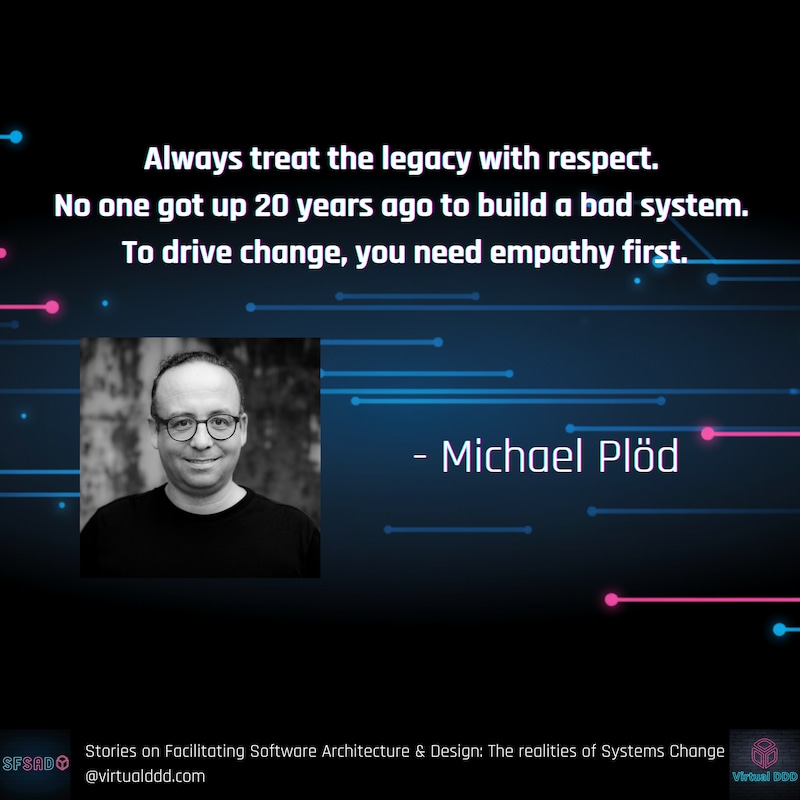
In this episode of Stories of Facilitating Software Design and Architecture, Michael Plöd shares a powerful story about a modernisation project that was nearly derailed by a "difficult" stakeholder. By taking a massive emotional risk and stepping away from the technical arguments to ask, "Why are you resisting?", Michael uncovered that he was criticising the life's work of the company's original "rockstar developer."
Michael, together with Beija and hosts Andrea, Kenny, and Andrew, explores the critical role of empathy in architecture. They discuss how to reframe legacy conversations using Gregor Hohpe’s concept of shifting from "Economies of Scale" to "Economies of Speed," and why the most important tool in an architect's belt isn't Kubernetes—it’s the ability to ride the "elevator" between the engine room and the penthouse without losing the message.
Key Discussion Points
- [00:02:50] Conference Driven Development: The danger of throwing buzzwords like Microservices, DDD, and Kubernetes at a problem without understanding the context.
- [00:06:00] The Hidden History of Legacy: Discovering that the "blocker" in the room is often the creator of the system that earned the company millions.
- [00:09:20] Contextual Reframing: How to explain the need for change by contrasting the historical need for "Economies of Scale" (centralization/control) with today's need for "Economies of Speed."
- [00:10:00] The Architect as Path-Maker: Transforming a legacy developer from a defender of the old guard into the architect of the new context.
- [00:14:00] Professional Resilience: How to draw boundaries and not take professional resistance as a personal attack, allowing you to stay objective in heated modernization efforts.
- [00:25:00] Riding the Elevator: Why stakeholder communication—translating technical complexity for different audiences—is the number one skill for aspiring architects.
Transcripts
Hello and welcome to another episode of Stories of Facilitating
2
:Software Design and Architecture.
3
:Today we are joined by, Michael
Plot and Beja Niel Niel, as.
4
:I, hopefully I got that right.
5
:Um, and, uh, we're gonna
hear a story from Michael.
6
:I'm hoping that he's gonna tell
a brilliant story and then we're
7
:gonna ask some questions and make
some comments and see what happens.
8
:As usual, I'm joined by my,
co-conspirator Andrew Harm Law and
9
:Kenny Basser, Michael, the floor is all.
10
:Michael Plöd: Yeah.
11
:Thank you.
12
:Um, I want to talk about a story, that
maybe quite a few folks encounter when
13
:they're working on legacy modernizations.
14
:I mean, it's a rare case that we work,
in our industry on the Greenfield.
15
:Everyone who works in a
larger organization, deals
16
:with legacy systems that are.
17
:20 years old, 30 years old.
18
:Were some old tech maybe
in place, but also maybe.
19
:Old processes and, I very often
hear about, from younger folks or
20
:from folks who come in externally,
like from external consultants.
21
:And I'm an external consultant by
myself, have been for most of my career.
22
:oh, this legacy system sucks.
23
:This is so bad and we need to
get rid of this, and so on.
24
:And my story is, um, a little
bit about, empathy in this case.
25
:And, it was a couple of
years ago when I was, uh.
26
:Leading architect for a big
legacy system modernization.
27
:And there was, this was a very old
system, quite a bit of a cobalt code
28
:base involved mainframe systems, but
also, Java swing, user interfaces
29
:and, and uh, a lot of that stuff and
a lot of that embedded in a very.
30
:hierarchical organization.
31
:Yeah.
32
:With a lot of command and
control, a lot of micromanagement.
33
:They claim to be agile
because they used Scrum.
34
:But, it wasn't like really
agile in any way in that.
35
:But, there was the decision
to modernize this thing.
36
:And of course, all the fancy passwords
were thrown around microservices,
37
:cloud, agile, domain driven design.
38
:Angular Spring Boot, whatever.
39
:Yeah.
40
:All the, all the stuff.
41
:Uh, DevOps of course as well.
42
:And Kubernetes of course,
all the, all the fancy stuff.
43
:what you usually hear, when
you do CDD, which I refer to as
44
:conference driven development.
45
:And, so it was hard to sort these things
out and to really bring in some sense,
46
:a part of the modernization frenzy.
47
:But, I realized there was one person
who was resisting very, very heavily.
48
:In that way, and part of the resistance
I could understand, but there were
49
:other parts of the resistance where
I really struggled to get a grip.
50
:Yeah.
51
:To really get into that.
52
:Why is this person acting like that?
53
:And, Especially in, um, like, higher
management circles, when the management
54
:came together in Germany, it's called
the lan, steering committee is probably,
55
:the best, English term for that.
56
:there was sometimes vetos about
things where I was like, oh.
57
:Why, why is this person acting like that?
58
:And there were quite a few voices
that said, oh, someone from the
59
:upper management should get him
in control and, uh, whatever.
60
:And I.
61
:I reached a point where I was so
fed up with that person that I was
62
:like, okay, I have nothing to lose.
63
:I went up to him and said, Hey,
can I have 30 minutes of your time?
64
:Why?
65
:What do you want?
66
:What do you want?
67
:And I was like, sort of a target
for him because I was driving
68
:part of that modernization and I
was like the marketing phase also
69
:for the modernization, so to say.
70
:he was like, ah, what do you want?
71
:What do you want?
72
:Why should I spend time with you,
blah, blah, and all that stuff.
73
:And he, he agreed to
have a meeting with me.
74
:And it was at the end of a business day,
like 4:00 PM, 5:00 PM something like that.
75
:And I was like, Hey, I don't
understand parts of your system.
76
:there is something that I
don't see that you see, and I
77
:would like to understand that.
78
:Um, you are, you have a history
of over 30 years in that company.
79
:You know, way more stuff than I do about
this company, about this system and so on.
80
:And I would like really
to, to really understand.
81
:Where your assistance is coming
from, because I want to avoid
82
:making any mistakes or, not
understanding a certain context.
83
:And not seeing a certain context.
84
:Yeah.
85
:Maybe I'm blind because I'm an
external consultant and I don't
86
:claim to know everything because
I'm just an external consultant.
87
:He brush me off.
88
:He was like, go away.
89
:What is this crap all about?
90
:Well, you want to throw everything
under the bus and blah, blah,
91
:blah, and, and, and so on.
92
:And I was like very dissatisfied with that
and left and two weeks later he came up
93
:to me and said, Hey, let's meet again.
94
:I was like, oh, interesting.
95
:And I came into his office and he
said, you need to thank my wife.
96
:For this meeting, I was like, okay,
I'm, I'm getting really curious now.
97
:He was like, yeah, when you
came to me, I was really pissed.
98
:I was really angry.
99
:And, I came home and took the
anger, to dinner and my wife like,
100
:was like, why don't you tell him
what's, what's this fuss all about?
101
:Tell him.
102
:And so he was like, yeah, okay.
103
:I'm going to tell you now very
honestly, and this, Stays in this room.
104
:I am allowed to talk about this publicly,
but in a very, anonymous fashion.
105
:So I won't disclose the industry, the
area, or wherever I'm allowed to tell
106
:the story, but no further details.
107
:Yeah, so, um, I'm not stabbing
his back behind and right now.
108
:And, um, he said, well, listen, I started
at this company when I was 16 years old.
109
:I am going to retire in five years.
110
:And I was what you young folks
now nowadays say the rockstar
111
:developer of the company.
112
:I created all of this.
113
:This is my baby.
114
:And now everyone is running around
claiming that this system is a pile
115
:of crap and that it needs to go away.
116
:And I am struggling with that.
117
:Are you actually aware how much
money this system earned the company?
118
:And I was like, okay.
119
:Thank you very much.
120
:Now we are talking, I
understand your context.
121
:I understand why you think that way.
122
:And by the way.
123
:What I always say is, to any external
consultant, or to any facilitator when you
124
:deal with legacy, that system must have
been very, very successful in the past.
125
:Otherwise, they couldn't pay
your daily rates right now.
126
:And, always treat the legacy with
respect and, always assume that
127
:no one 20 years ago got up saying.
128
:Oh, let's build a really bad system.
129
:No one ever did that, I'm very sure.
130
:And, um, so, so I was talking with
this person and we talked a little bit
131
:about context the context back in the
day was what Greg or Hopi very often
132
:says, economies of scale for systems.
133
:Yeah.
134
:So, reusability, centralization, control.
135
:The context has changed, and I'm also
quoting Gregor towards economies of speed.
136
:Yeah.
137
:And I said, well, you made a lot
of really good decisions in the
138
:context that you were in, but
the environment maybe changed.
139
:He was like, I never looked
at that from this perspective.
140
:And I said, okay, I'm not going
to give you any advices right now.
141
:Let's leave this where it is.
142
:I'll think about it and I'll come back
to you A week later, I approached him
143
:and asked, Hey, do you have more time?
144
:I have an idea.
145
:And I said, Hey, actually, you
have a really cool chance in
146
:your career at this moment.
147
:You can be, you are already the
architect and the the developer, the
148
:lead developer for the very first,
very successful systems, architecture
149
:and system for that company that
earned them millions, if not billions.
150
:But you can now open the gate for
a context switch of this system.
151
:Yeah.
152
:Getting that system ready for a changing
context that's happening now, and
153
:you can bring in all your knowledge.
154
:About these things, about the
company, about the system to be
155
:the path maker for the second, very
successful architecture in there.
156
:And he was like, Michael, I want
to kick you out of the room right
157
:now because I hate your pro, your
positive attitude all the time.
158
:But I let it sink in and a few days
later, I just received a mail I'm in.
159
:That opened many doors.
160
:And what I want to tell with this story
is don't brush off resistance and always
161
:try to find out where this stems from.
162
:Yeah.
163
:I would say 98% of the people
don't work on, ill intents.
164
:Or bad intents, they
don't have bad intentions.
165
:But they have a certain perspective.
166
:And when you facilitate things
167
:When you don't try.
168
:And I think that's a key differentiator
between architecture as a hierarchical
169
:position of power where you say,
Hey, I'm the big boss architect now,
170
:and you do it my way and shut up.
171
:And, the discussion is over versus.
172
:Facilitating architecture.
173
:I think, what, what is very important when
you are a facilitator and when you want
174
:to facilitate architecture especially.
175
:Yeah.
176
:Uh, also when you want to
facilitate architectural change,
177
:you need to have empathy.
178
:You need to try to
understand these dimensions.
179
:you need to understand ver.
180
:Resistance from certain players and key
players, stakeholders comes from, and
181
:then you can actively work with that.
182
:I think that can open many doors.
183
:And, this question, Hey, why are you
like, that opened quite a few doors.
184
:Hey, could have also gone terribly wrong.
185
:Yeah, that they kicked
me out, uh, and so on.
186
:But sometimes.
187
:You have to take a risk,
and that's risk taking.
188
:Yeah.
189
:these things can go wrong, but
there is no guarantee for that.
190
:And also, part of that empathy is try to
understand the context and no one got up
191
:and said, let's build a horrible system
where they will hate us 20 years later.
192
:Uh, no one ever did that.
193
:No one probably thought about
that system existing 20 years
194
:later when they designed it.
195
:So that would be my story
that I want to tell.
196
:Kenny Schwegler: thanks.
197
:So you the, at the end especially, I'm,
I'm very curious, because at the end you
198
:say, I take a lot of risk and I think a
lot of people, myself as well in the past,
199
:taking that, that does a lot to a person.
200
:When he kicked you out, sort
of like kicked you out or
201
:say it's nonsense, right?
202
:There was two weeks in between.
203
:how did you feel in those two weeks?
204
:did you ever meet him then,
and how did you cope with that?
205
:I'm very curious because many people
probably find it hard to do this
206
:because they feel very uncomfortable
getting into that situation.
207
:At least I am still to this day,
feel very uncomfortable with that.
208
:Were you.
209
:Michael Plöd: Um,
210
:I think I have quite a bit of
a resilience with these things.
211
:So, um, I don't know why.
212
:I can't tell you I didn't
train that or whatever.
213
:I can live very well with
people not liking me.
214
:Yeah.
215
:So that gives me that, that doesn't
mean that I don't care at all.
216
:Yeah.
217
:Uh, but I can, uh, I can draw
very good boundaries for myself.
218
:I don't know why, how that came to place.
219
:I never explored that.
220
:I'm not a psychology person or anything
like that, but it is like that.
221
:of course I encountered him in meeting
and I just ignored the situation.
222
:I just dealt with it
like this never happened.
223
:I remained professional.
224
:I didn't take it any,
in any personal thing.
225
:I always say, You can toss a lot to
my head in a business context and I
226
:can still go out to a bar with you.
227
:Yeah.
228
:Um, so, so that doesn't mean that
I appreciate any toxic behavior or
229
:there are certain boundaries to that.
230
:Yeah.
231
:Um.
232
:For myself, I can draw very
good boundaries, I think.
233
:so that it doesn't bother me too much.
234
:but I thought about that, taking
that risk very, very explicitly.
235
:So I was prepared for various
situations how that could go along.
236
:Yeah.
237
:So when I do that, that stuff, I
just don't do that intentionally.
238
:Oh, let's go in there and whatever.
239
:So I weigh in the pros and cons and I
already have a plan how I deal with that.
240
:If things like that happen.
241
:Beija Nigl: But I think what you
just said, the splitting of, the
242
:person and the conflict or the topic.
243
:Something that I feel like, makes it
very essential to feel respected, even
244
:though you might disagree on something.
245
:and that already helps people to
actually be digest what you just said.
246
:uh, about this, what
you said, Kenny, like.
247
:helped me in this is to accept that some
people need time, and especially when
248
:it's about switching perspective and being
like saying, okay, I was wrong, or, this
249
:takes a lot of time to jump over your own,
like shadow to, to be like, okay, shit.
250
:maybe I need to, I need to switch.
251
:And this takes time and being patient
and to learn to be patient and to
252
:tell one yourself every once again,
be like, Hey, give the people time.
253
:He won't get anywhere if you stress
them, let them come back to you
254
:instead of forcing it too much.
255
:That helps me in such situations,
256
:Kenny Schwegler: I,
257
:Beija Nigl: at least.
258
:Kenny Schwegler: you said
something very interesting.
259
:So I, I do, uh, so
everyone's different, right?
260
:So I do have a personal problem
with people not liking me.
261
:But, what you said was very interesting.
262
:I think we should take the
same approach, which I always
263
:try to ask to people as well.
264
:And I think that's a learning
point, is before you go into that
265
:discussion or that conversation.
266
:Try to already imagine.
267
:And it's a stoic thing actually.
268
:I found out later on stoics do it a lot.
269
:The stoics are not emotionless.
270
:They already went through the emotion
before it happened so that in the
271
:moment they are more, grounded.
272
:So I think that's an interesting.
273
:thing that I do as
274
:I imagine what will happen during
that and I weigh the pros and cons
275
:and then I already went through
276
:what was going
277
:on Not always right
278
:Andrea Magnorsky: I find that really.
279
:find it really interesting
that you're able
280
:to set really good boundaries while at
the same time you're able to be highly
281
:empathetic.
282
:Uh, I think that is a
very, very hard skill.
283
:'cause I find, for example, have high
empathy, but if it's someone that is
284
:attacking me personally, I find that
very hard to, like, it's something
285
:that that cost me emotionally.
286
:It's a, it's emotional work I
have to Do Do you find that.
287
:You have to do work or is it you are
doing the boundary stuff and it doesn't
288
:require any emotional work for you?
289
:Michael Plöd: I don't, take these
offenses personally, to be honest.
290
:because I think, you can, for
instance, exchange me for Andrew,
291
:for you, Andrea, for Kenny, and
the result would be the same.
292
:It's not, uh, it's not, I, I don't
think that I personally get attacked.
293
:I think the position that I am in
is the one that is being charged.
294
:So, uh, I don't, I, I don't
think that this person thinks I,
295
:Michael, am a full-blown idiot.
296
:I think, this person has a problem
with the task that I have, with the
297
:position that I'm in, and I think that
is the first, boundary that I draw.
298
:Andrew Harmel-Law: Yeah, I wanted to,
there's, so I think there's one thing
299
:you said, Michael, I thought was super
interesting 'cause people talk about like.
300
:Certain types of people take
risks and they always mean like
301
:intellectual risks or like financial
risks or some other kind of risk.
302
:But you took like an emotional risk
with yourself just to like, like I
303
:would be like Andrea, I get, Very
physical reactions to these things and
304
:whether I can like, think about, you
know, intellectually I could be like
305
:they're talk, like everything you said,
I'll still feel it really physically.
306
:Physically in meetings, which is not fun.
307
:but then the person as well,
then you gave some space and
308
:they took an emotional risk.
309
:And I think that, especially in
software where we get super emotionally
310
:involved in what we build the
results of those things, which is
311
:exactly what you described, right?
312
:that kind of risk is a really big.
313
:Key part of this, and it's
less, it's less talked about.
314
:I think people are like, oh yeah,
we just, we we ran fast and broke
315
:things and you didn't, you like went
slow and like listened to people and
316
:that had the biggest impact, right?
317
:The more you push this person, it probably
would've got worse, worse and worse.
318
:Right?
319
:Then his wife would've been, yeah, you're
right, this Michael ge, a complete jerk.
320
:You should really make his life hell.
321
:But instead it was different.
322
:So.
323
:Kenny Schwegler: I
completely agree, Andrew.
324
:it's a construct, but because we do
get emotional, because, angriness
325
:is also an emotion that people
don't construct as an emotion, but
326
:there's always underneath that.
327
:So I think that's something we
should talk about more often.
328
:Beija Nigl: Yeah, and I mean something
that also I tell my teams that I work
329
:with when we have discussions, that
it's not about my idea or your idea,
330
:but it's about ideas that one person
brought up or another person brought up.
331
:But if you get too Emotionally attached to
the idea or to your idea, or for example,
332
:in Michael's story to your change.
333
:If Michael would've said, Hey, this
is, I want to drive this change because
334
:this is my initiative, then you get
emotionally attached and then it's harder
335
:to detach this from you as a person.
336
:and that also helps a lot.
337
:it's hard.
338
:It's easier to say and to consult
other people to make, Hey, don't take
339
:it as your decision or your idea.
340
:still it helps to repeat it for one
other people, but also for yourself.
341
:Andrea Magnorsky: I I have practical
342
:to
343
:you
344
:are they acting like this?
345
:I I do believe people are self-consistent.
346
:My question is, how do you
manage to carve out time?
347
:Because even this half an hour investment
and this other hour investment, as
348
:consultants, we tend to, need to,
uh, have to explain all of our time.
349
:and sometimes I can't invest in
all the whys I want to answer.
350
:Um.
351
:And, and this is, this is a, a, a
hard problem for the consultants
352
:and also for the companies.
353
:So I think both are disserviced by our
lack of discretion on the usage, our time.
354
:Sometimes I just do it anyway because I
think it's a risk to the project, like
355
:a high risk, it also means that we're
losing on some, good key learnings.
356
:I wonder how you manage that or if you
kind of build in some, some, you know,
357
:discretionary use of meetings, whatever.
358
:Michael Plöd: Um, I must say that I've
rarely been in an environment where I
359
:had to justify 30 minutes of my time.
360
:On a time sheet, maybe I was just lucky.
361
:but that 30 minutes or something, or
scheduling a meeting with some key
362
:stakeholder has never been seen as
something that I have to justify.
363
:And if someone would've come to me and
asked, Hey, why did you, what, what were
364
:these 30 minutes on your time sheet for?
365
:Or this one hour on your time sheet for?
366
:I would say, Hey, listen, I'm.
367
:One of the driving
architects, for this change.
368
:And I think stakeholder management
and dealing with stakeholders and
369
:talking to stakeholders is one
of my key tasks of an architect.
370
:Yeah.
371
:Um, I, I would say it's not my
task to what I, let's say, set
372
:up some really low level details
in the Kubernetes installation.
373
:Yeah.
374
:Maybe.
375
:Yeah, I think it's my task to
bring, to align the perspectives of
376
:various stakeholders together and
to create a shared understanding
377
:about this modernization.
378
:And this is one of the key stakeholders.
379
:So, I think it's, integral part
of my job to talk to this person.
380
:And if you have a different perspective
381
:on the work of an architect Yeah.
382
:Uh, we have to talk
about my role in general.
383
:So that would be the thing that I would
say if someone would've challenged that.
384
:Andrea Magnorsky: like
385
:know,
386
:in a
387
:see that I'm not allowed.
388
:Michael Plöd: What I, what I always
say, I sometimes, teach software
389
:architecture foundation courses for
the I-S-A-Q-B and what I say in these
390
:trainings to aspiring young architect.
391
:It is that, Stakeholder, communication
in a way that is suitable for
392
:certain stakeholder groups is one
of the most important key skills
393
:for any architects in my eyes.
394
:Yeah.
395
:So I think, if you would ask me what is
the key skill of a really good architect,
396
:it's like, I love quoting Gregor Hopi.
397
:it's riding Gregor's elevator.
398
:being able to talk to stakeholders on
various levels with various perspectives
399
:in a way that they understand you.
400
:Yeah.
401
:Don't bring out a life coding
session to the C level.
402
:Yeah.
403
:And don't bring, McKinsey style,
slide decks to the engineering team.
404
:Yeah.
405
:Uh, to, to, to say in
a very blunt fashion.
406
:And I think that's one of the most
important skills as an architect
407
:Kenny Schwegler: and I want to add to
408
:Michael Plöd: for me.
409
:Kenny Schwegler: not not to
an architect, to architecture.
410
:you look at domain driven design, the
most important aspect of domain-driven
411
:design is understand the problem.
412
:Who knows the problem
413
:stakeholders.
414
:Beija Nigl: If you don't have the
people on board, you cannot drive
415
:any change because the changes in
the people are not in the system in
416
:the end.
417
:Andrea Magnorsky: this is, this is,
uh, it's been, uh, wonderful to have
418
:uh, for for joining us, uh,
Michael and Beja, and, uh, we'll
419
:see you again in the next episode.
420
:Goodbye.
421
:I.
