Shownotes
Audio • Season 2 • Episode 2 • Series 2 Episode 2 - Martin Marprelate. Part 2, Progression.
© 20 26 The Rise of the Protestants., Author, Shaughan Holt.
Artwork • The Cambridge University Library copy of:
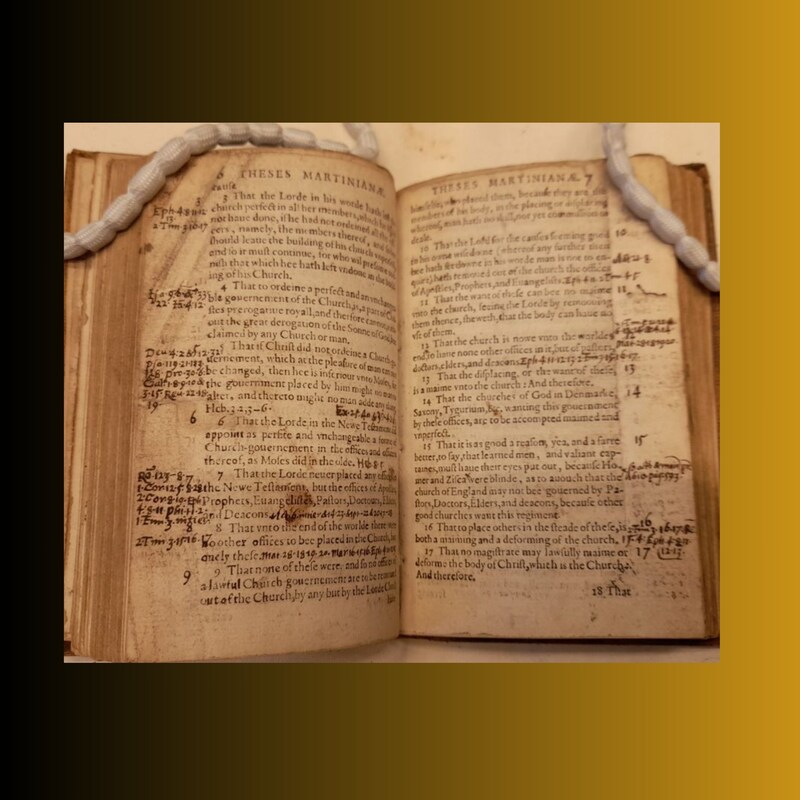
The fifth Marprelate Tract "Theses Martinianæ", published 22 July 1589.
Printed by John Hodgkins in Wolston Priory Warwickshire, at the residence of Roger Wigston. Exhaustive biblical references fill the margins, connecting passages with specific verses related to Christian brotherhood.
Music • Bradley Johnson plays Monsieur's Almain by Daniel Bacheler, - on guitar. Guitar arrangement by Phillip Woodfield. 2013.
Original Composer: Daniel Bacheler. 1572-1619.
Original Instrument: Lute.
Genre: Allemande, a popular dance form of the era.
Historical Context: Bacheler was a prominent court musician, serving as groom of the privy chamber to Queen Anne of Denmark. The tune of "Monsieur's Almain" is thought to predate Bacheler's variations and appears in other settings by composers like Thomas Morley and William Byrd.
This set of variations on a popular tune is found in Robert Dowland's Varietie of Lute Lessons.
The title is thought to refer to Francis Duke of Alençon and, later Anjou, youngest son of Henry II of France and Catherine de Medici and brother of two French kings (Charles IX and Henry III).
He paid suit to the English queen Elizabeth I and she referred to him on correspondence as ‘Monsieur’; Elizabeth also referred to Francis as 'The Frog’ - perhaps the origin of the title of John Dowland’s Frog Galliard.
Episode Notes:
For more than 4 centuries, scholars have been intrigued by the authorship of the Marprelate Tracts.
From their very beginning, the publications aimed to protect, both authors and printers, by purposefully concealing their identities.
A total of 7 anonymous Marprelate tracts, were secretly printed on a movable press, and transported across several counties in England, to avoid detection by the authorities, during Queen Elizabeth’s reign.
From October 1588 to September 1589, the press operated in the homes of Puritan sympathisers, in many counties across England.
© 20 26 The Rise of the Protestants., Author, Shaughan Holt.
"All rights reserved. No part of this podcast may be reproduced, translated, distributed, or transmitted in any form or by any means, including photocopying, recording, or other electronic or mechanical methods, without the prior written permission of the copyright holder, except in the case of brief quotations embodied in critical reviews and certain other non-commercial uses permitted by copyright law".
Requests regarding translation, licensing, or republication should be directed to: [email protected]
Your feedback matters, send me an email at [email protected], with any comments, suggestions, or criticisms.I read every message
Transcripts
© 20 26 The Rise of the Protestants., Author, Shaughan Holt.
"All rights reserved. No part of this podcast may be reproduced, translated, distributed, or transmitted in any form or by any means, including photocopying, recording, or other electronic or mechanical methods, without the prior written permission of the copyright holder, except in the case of brief quotations embodied in critical reviews and certain other non-commercial uses permitted by copyright law".
Requests regarding translation, licensing, or republication should be directed to: [email protected]
Your feedback matters, send me an email at [email protected], with any comments, suggestions, or criticisms.I read every message
Series 2.
Episode 2.
Martin Marprelate, Part 2; - Progression.
The year is 15 88.
For more than 4 centuries, scholars have been intrigued by the authorship of the Marprelate Tracts.
From their very beginning, the publications aimed to protect, both authors and printers, by purposefully concealing their identities.
A total of 7 anonymous Marprelate tracts, were secretly printed on a movable press, and transported across several counties in England, to avoid detection by the authorities, during Queen Elizabeth’s reign.
From October 15 88 to September 15 89, the press operated in the homes of Puritan sympathisers, in counties such as Surrey, Northamptonshire, Warwickshire, and Lancashire.
In July 15 88, Robert Waldegrave set up a secret press, in Elizabeth Crane's home, East Molesey, near Kingston, a town in southwest London, known for its royal history and riverside location.
It would be easy to view Waldegrave as merely a peripheral figure—just another name in a larger, more interesting story.
However, this perspective would not do him justice.
The publication of the first four-tracts relied on Waldegrave's active involvement; without his participation, the timing and format of the pamphlets could have been significantly different.
His involvement was essential for the initial success and swift distribution, of the first wave of pamphlets.
Would the Marprelate tracts, have seen the light of day, without Robert Waldegrave?
The answer is yes.
They would have been published eventually, as the organisers were determined to voice their criticisms of the Church of England's episcopacy.
Key figures such as Job Throckmorton and John Penry, deeply invested in their cause, would likely have sought other ways to publish their message, though this would create logistical challenges and delays.
This determination, however, faced a setback in early 15 89, when Waldegrave refused to print any further tracts, citing Puritan ministers' disapproval, of Martin Marprelate's satirical tone, and the increasingly hostile stance, of church and state authorities.
As a result, after Waldegrave stepped down, the secret press fell silent for a time.
Printing was delayed while a replacement for Waldegrave was sought, specifically a printer who aligned with the project's objectives, and was willing to undertake the work.
Waldegrave was replaced by printer John Hodgkins and his partners, Valentine Simmes and Arthur Thomlyn, who assumed responsibility for the project.
This sequence of events indicates that, even in the absence of Waldegrave, the group would have actively pursued and secured another printer to ensure publication.
Robert Waldegrave was a well-known Puritan printer, born around 15 54 near Fawsley, Northampton.
He began an eight-year apprenticeship, with London stationer William Griffith, on 24 June 15 68.
In 15 84, the Court of High Commission, ordered the Stationers' Company, to seize Waldegrave and any unlicensed books found in his shop.
This action was prompted, by his publication of two strongly Presbyterian works: William Fulke's "A Briefe and Plaine declaration", and "A Dialogue concerning the strife of our church".
He was later found guilty, and imprisoned in the White Lion prison, for six weeks.
Waldegrave's printing career in England ended suddenly in April 15 88, when his shop was raided, for printing Udall's Presbyterian manifesto, "The State of the Church of England Laid Open".
Under pressure from the church and the state, the Court of the Stationers' Company ordered his press destroyed, and all his materials rendered unusable.
Later that year, when the first Marprelate tract appeared, it was illegal because it was published without permission, and printed by someone, who was not allowed to work in the trade.
To avoid persecution, by the English authorities, Waldegrave left the country.
By May 15 89, Penry reported that Waldegrave had arrived in La Rochelle France.
After several months of travel, Waldegrave finally reached Edinburgh in early 15 90.
In March that year, he received his printing license, and on 9 October, King James VI of Scotland appointed him as the King's Printer.
With King James’s support, Sir Robert Melville asked Queen Elizabeth to help Waldegrave who was facing persecution.
Despite these efforts, Waldegrave stayed in exile until Elizabeth died in 16 03.
Waldegrave played an important role in Scottish printing, publishing more than 100 books in Edinburgh including the first editions of several works by King James.
When King James became king of England in March 16 03, Waldegrave went back to England, leaving his printing business, in the hands of his wife.
He got his printing license in June that year, but sadly died later in 16 03 at age 49, due to a plague outbreak.
Robert Waldegrave was buried at St. Mary Magdalen church, in London on 22 October 16 03.
In July 15 88, John Udall, who was not yet known as the author of, "Diotrephes", angered the Church High Commission, by giving a series of strong sermons at the Kingston parish church.
Even though Udall had support from the aristocracy, James Cottington the Archdeacon of Surrey, managed to remove him from his lecturing job in Kingston.
Later that month, church officials, summoned Udall to Lambeth Palace, where they confirmed, that he was dismissed from his lecturing position.
Stephen Chatfield, the vicar of Kingston, later said, that Udall had suggested he wanted to take revenge for the way he had been treated.
The year is 15 89.
On 25 February 15 89, after nearly a year of delays, Archbishop Whitgift gave John Aylmer the Bishop of London, permission to issue a directive about the underground church in London, and their petition to the Queen.
Forty-two ministers were assigned to meet every two weeks with Separatists who had left the church and with inmates serving sentences.
A review, of the list of fifty-two prisoners, held in various jails, such as the Gatehouse, Newgate, and the Fleet, shows the harsh treatment they endured, at the hands of church authorities.
Among the prisoners, Barrow and Greenwood were held in the Fleet prison, while Rippon was kept in the Counter prison, on Wood Street.
Between 9 March and 13 April 15 90, seven examinations took place.
Uncomfortable in the oppressive prison cells, the preachers chose to meet with the Separatists in the facility's parlour.
The ministers selected for these sessions were mainly known for their strong Puritan values and beliefs.
Unfortunately, there was little goodwill between the Puritan ministers and the imprisoned Separatists.
Some ministers even openly expressed their contempt for the Separatists, calling them "renegade Reformists".
It was no surprise that these meetings were filled with wild accusations and heated responses, and in the end, they produced no tangible results.
In March 15 89, after a long period of inactivity and uncertainty, the bishops finally decided to hold their fifth examination of Barrow.
After this session, Barrow felt wronged, and believed he had not been treated fairly.
The accusations were not new to him, he had faced them before.
For example, he objected to specific prayers used in the church, refused to accept the Queen's authority over the church, and claimed that the Church of England was not legitimate.
The conference mainly focused on Barrow and Greenwood, drawing significant attention from the ministers.
Realising that Archbishop Whitgift wanted to gather evidence against them, Barrow and Greenwood seized the opportunity to speak out, addressing the crowd gathered outside their cell windows.
Both men defended their views with great courage, and perhaps even some recklessness, speaking openly and without hesitation.
Up to this point, the authorities had not linked Udall to the earlier illegal publications.
Feeling relatively secure, Udall invited Waldegrave to his home in Kingston to discuss the current situation.
Penry also joined the conversation, and together, they began to develop plans to distribute additional pamphlets throughout England.
At this point, Udall shared important information with Penry; about suspicious activities he had discovered involving the Bishop of London.
The group, then decided, to launch a series of attacks against the bishops using the pseudonym Martin Marprelate.
The first Marprelate tract, called "The Epistle," was printed in October 15 88 and relied a lot on Penry's own writings.
The name "Marprelate" was chosen carefully.
"Mar" suggests something spoiled or damaged, and "Prelate" means a bishop or high-ranking church official.
After Waldegrave decided to publish Udall's Presbyterian manifesto on his own, their original printing press was seized in April 15 88.
George Carleton and Sir Richard Knightley began looking for a suitable replacement for the printing press.
To keep it safe, the new press was moved several times to different locations, including East Molesey in Surrey, Fawsley in Northamptonshire, Coventry, and other locations in Warwickshire.
The Marprelate publications, created in secret, still spark debate today.
Udall helped write several pamphlets, but it remains unclear whether he had any other roles in the project.
Job Throckmorton is now widely recognised as the main author of the Marprelate publications, with Penry as his collaborator.
Job Throckmorton, born in 15 45, was an English religious pamphleteer and served as a Member of Parliament during Queen Elizabeth’s reign.
Throckmorton was a devoted Puritan, and a member of the Warwickshire gentry.
He died intestate at the age of 56 on 23 February 16 01, following a brief illness.
Seven unauthorised pamphlets, were circulated across England between 15 88 and 15 89, under the pseudonym Martin Marprelate.
The anonymous author, targeted specific bishops in the Church of England, ridiculing them, and sharply criticising the institution as a whole.
The publications stand out, for their mocking tone toward church leaders, and their condemnation of corrupt practices, within the Church of England.
The writing style, blends nonsense, satire, protest, irony, and gossip, all enriched by a sharp sense of humour and many colloquial expressions.
The main goal of the pamphlets, was to challenge the leadership of the Anglican Church, especially the Archbishops and Bishops.
The term Anglican Church, comes from the Medieval Latin phrase, "Ecclesia Anglicana", meaning the English Church.
The name specifically refers to the Church of England and highlights its origins, particularly its separation from the Roman Catholic Church, during the Reformation.
The term was first mentioned in 12 46, and appears in the Magna Carta of 12 15 as, "Anglicana ecclesia, libera sit", which refers to the church's freedom.
John Aylmer was appointed Bishop of London in 15 77, and played an important role in the constitutional debates of Tudor England.
He was especially influential during the 15 62 convocation, which aimed to reform the Church of England's doctrine.
Aylmer served on the commission, that considered adopting the Gregorian calendar, and played a key role in delaying its adoption in England.
The delay was mainly due to the Protestant theologians, who opposed any change supported by a Papal Bull.
Aylmer was well known for his expertise in Greek, but his strict church policies often caused controversy.
By 15 88, he had a deserved reputation, for being harsh toward Puritans and Roman Catholics, which led to criticism, especially in the Marprelate Tracts.
Feeling that church authorities had mistreated him, Udall continued to express his criticisms anonymously in his second publication, "A Demonstration of the Truth, of that Discipline, which Christ Hath Prescribed".
In this work, he openly challenged the leaders of the Church of England, including the archbishops and bishops.
In late spring 15 88, Mistress Crane allowed Waldegrave and John Penry to set up a secret printing press at her manor house, across the Thames from Hampton Court Palace.
The first tract printed there, was Udall's, "A Demonstration of Discipline".
This work was secretly published in November 15 88, around the same time the first recognisable Marprelate Tract appeared.
In late 15 88 and early 15 89, Waldegrave began a controversial project, publishing four pamphlets, authored by an anonymous satirist, under the pseudonym Martin Marprelate.
At that point, he did not realise that these writings would directly challenge church authorities, attracting significant attention, heated debate, and considerable risk.
The first Marprelate Tract, "The Epistle", was printed at Mistress Crane's home in October 15 88.
Mistress Crane, born Elizabeth Hussey, was the widow of Anthony Crane a notable official, in Queen Elizabeth’s household.
She came from a strong Puritan family that followed a strict religious tradition.
After she married George Carleton, she faced serious legal troubles, when the Star Chamber, a powerful court, charged her with operating an illegal printing press.
Her husband, George Carleton, was a Member of Parliament and supported Puritan ideas.
In April 15 89, he was called to appear before the Privy Council for advocating free speech in Parliament.
Unfortunately, before any formal charges could be brought against him, he died in early January 15 90 leaving Elizabeth as his executrix.
Church officials Whitgift and Aylmer, questioned her several times, about her role in the underground printing press but she always refused to answer.
As a result, she was fined 1,000 marks for refusing to take the oath, and another £500 for assisting in the operation of an illegal underground printing press.
In medieval England a mark was worth two-thirds of a pound.
It was used as a unit of account rather than as a real coin.
At the age of 50, Mistress Crane was imprisoned by order of the Queen, but the records do not show how long she was held.
As a result of her imprisonment, and her refusal to take the ex officio oath, the Crown was able to confiscate a significant portion of her estate and possessions.
The first Marprelate tract, called "The Epistle", appeared anonymously in October 15 88 and attracted a lot of attention.
It was written as a reply to a recent document called, "A Defence of the Government, Established in the Church of England, for Ecclesiastical Matters", which in turn, had been based on a sermon by Dr John Bridges in 15 87.
In his sermon, Dr Bridges supported the current structure of the Church of England, and argued against the governance ideas suggested by Thomas Cartwright, Laurence Chaderton and Walter Travers.
The Marprelate Epistle, which falsely claimed it was "printed overseas, in Europe", marked the beginning of a series of anonymous publications, that supported the Presbyterian cause.
These writings, directly opposed Archbishop Whitgift's attempts, to enforce uniform worship and increase the power of bishops.
After publishing "The Epistle" and fearing discovery, the group moved their printing press to Sir Richard Knightley’s home in Fawsley near Northampton.
The second Marprelate tract, called "The Epitome," was released in November 15 88.
This tract takes a more serious approach but covers similar themes to The Epistle.
Worried about his safety and wanting to avoid being found out, Knightley moved the press to Whitefriars in Coventry, where his great-nephew John Hales and his wife Frideswide, lived.
Frideswide was named after a Christian figure who later became Oxford University’s patron saint.
On 5 September 15 88, John Penry married Eleanor Godley, a member of their congregation.
In January 15 89, Thomas Cooper, the Bishop of Winchester, tried to answer Martin for the first time by publishing a book called "An Admonition to the People of England".
As a devoted patriot, the bishop struggled to understand why so many people were defiant, especially after England’s remarkable escape from the Spanish Armada.
He wanted to guide the discussion back to a more civil tone, but his book seemed defensive and did not respond well to Martin’s satire and mockery.
Throkmorton and Penry did not plan to publish more tracts, but after Cooper released his "Admonition," they felt compelled to respond.
Between late January and early February 15 89, the third Marprelate tract called "Certain Mineral and Metaphysical Schoolpoints" was published, drawing inspiration from Luther's Ninety-five Theses of 15 17.
The title intentionally uses obscure, academic-sounding terms like, "mineral" and "metaphysical", to satirically frame the author's critiques of the church hierarchy as an intellectual challenge.
The term "Schoolpoints," meaning "scholarly points," refers to arguments or debates, echoing the style of university disputations that were very popular at the time.
In the third tract, Martin makes it clear that his objections are not treasonous, and that they are more supportive of Queen and Country than the episcopacy itself.
As he had previously claimed, the bishops saw themselves as the heads of the church, putting themselves above the Queen.
One of Martin's main concerns was the church's excessive influence over civil matters.
He gave examples, like Whitgift's seat on the Privy Council, his role in the Star Chamber, and the use of the ex officio oath procedure.
In March 15 89, the Marprelate group published a detailed response to Cooper's "Admonition", in their fourth tract, "Hay Any Work for Cooper".
The familiar London street cry of the time, "Hey, any work for a Cooper?" inspired Martin, with a pun on Thomas Cooper's surname.
He explains this pun further in his next two paragraphs, using terms like “barrelling up,” “tub-trimmer,” and “leaky tub”.
A cooper is a skilled worker, who makes and repairs wooden containers such as casks, buckets, and tubs, built from staves and hoops.
Waldegrave printed the first four Marprelate tracts, on a portable press, using a typeface called Continental Black-letter, which had been originally designed to mimic monks' handwriting.
Thomas Cooper was born in Oxford, and became known as a physician, bishop, lexicographer, theologian and writer.
He became Bishop of Lincoln on 24 February 15 71, and later served as Bishop of Winchester from 12 March 15 84.
His literary journey began in 15 48 with his editing of the "Bibliotheca Eliotae", a Latin dictionary, soon followed by "Cooper's Chronicle" in 15 49 which detailed history up to his time.
His most important work, was the "Thesaurus Linguae Romanae et Britannicae", a Latin-English dictionary published in 15 65.
It is believed to have influenced William Shakespeare, and Queen Elizabeth is said to have valued her signed copy.
Bishop Thomas Cooper died at the age of 77, on 29 April 15 94 in Winchester.
To push back against Marprelate's influence, religious leaders started bringing in writers to answer Martin with the same kind of satire.
An approach which helped the bishops keep their dignity and avoids making a public scene.
It also gave them a chance, to add new voices to the debate, just as Martin had done when he created his fictional sons, Martin Jr. and Sr., in his later pamphlets.
When Waldegrave finally realised the danger he was facing, he decided to cut all ties with the group.
After he left, the group moved their printing press to Wolston Priory where John Hodgkins became the new printer.
Not long after, Waldegrave escaped to La Rochelle in France.
In July 15 89, John Hodgkins and his team ran the printing press at Wolston near Coventry, where they produced the fifth and sixth Marprelate Tracts.
The two works were called "Theses Martinianae", written by Martin Junior, and "The Just Censure of Martin Junior" by Martin Senior.
John Hodgkins joined the Marprelate project after being recruited by Humphrey Newman in London in July 15 89.
Hodgkins does not appear in the Stationers' Company records, but his assistants, Valentine Simmes and Arthur Thomlin, were licensed printers.
The Worshipful Company of Stationers, or Stationers' Company, is a livery company in the City of London.
Founded in 14 03 and granted a royal charter in 15 57, the company held a publishing monopoly, and played a key role in regulating the industry.
In modern times, a Livery Company in London can be seen as a contemporary version of a medieval guild, serving as a professional association for various trades, crafts, or modern professions.
As of March 20 25, there are 113 livery companies.
The term "livery", originally referred to the distinctive clothing, worn by a nobleman's servants.
Subsequently, the term came to denote any distinctive attire, indicating an individual's association with a particular trade.
On 14 August 15 89, agents representing Henry Stanley, the 4th Earl of Derby, located, and confiscated the Marprelate printing press, from a rented house in Newton Heath near Manchester, in northern England.
The printers, John Hodgkins and his assistants, had selected this location because they believed it would offer greater safety further north, far distant from their previous workplaces.
They intended to begin work at this site, on the sequel to, "Hay Any Work", which had been given the working title of "More Work for Cooper".
However, before the manuscript could be type set or published, their printing press was confiscated.
The three men present—Hodgkins, Simmes and Thomlin—were initially interrogated by the Earl of Derby.
They were later moved to London, where the Privy Council questioned them before committing them to Bridewell jail.
A special committee, tried again to obtain information from the prisoners, but their attempts were unsuccessful.
As a result, the men were sent to the Tower of London, with orders to use torture if they refused to cooperate.
Between October and December 15 89, Simmes and Thomlin were re-examined in the Tower prison, after which, they disclosed Job Throkmorton’s involvement in the project.
Hodgkins was tried separately, and sentenced to death, but he was released after he agreed to sign a court document.
Simmes and Thomlin, on the other hand, were fined and jailed but were eventually released.
Later, Hodgkins would claim that their confessions were forced through torture, but the commission denied this.
Despite considerable adversity, the Marprelate group succeeded in producing one final pamphlet.
In September 15 89, the Wolston site released "The Protestation of Martin Marprelate," identified as the final entry in the series and labelled Number 7.
This final work was produced under challenging conditions, including the arrest of the Marprelate printers, confiscation of their press and type, and the fear that caused some co-conspirators to withdraw support.
The pamphlet was poorly produced on an old press, hidden in a barn on a country estate near Coventry.
The type was likely first set by Martin's co-authors, Job Throckmorton and John Penry, who were not trained printers.
An examination of the Cambridge University Library's copy of "The Protestation" reveals the chaotic conditions in which it was produced.
In the first edition, the justification is uneven, words are misspelled and some letters are reversed.
Gaps appear throughout the text, catchwords are absent and the typefaces change unexpectedly.
In his court testimony, Henry Sharpe, the bookbinder of "The Protestation," reported that Robert Waldegrave, a Marprelate printer, returned from hiding at the end of August to assist with the printing.
By the third print run, the quality of the prints had significantly improved, suggesting that Waldegrave had resumed his role at the press.
From this point onward, page justification remained consistent, while the clarity of each impression was noticeably enhanced.
By early September, it became increasingly evident that Martin's pursuers were rapidly closing in.
Humphrey Newman, the primary distributor of the Marprelate tracts, now travelled up to Coventry to collect the final batch of pamphlets.
By the time "The Protestation" reached the bookstores of St. Paul's in London, Martin's remaining collaborators had been arrested, effectively ending the Marprelate project.
The St. Catharine's College library at Cambridge holds a Sammelband, a collection of separately printed texts, which sheds light on how popular the Marprelate tracts were.
The word 'Sammelband' comes from German and means 'gathered volume'.
This Sammelband contains the last three Marprelate tracts, along with Throckmorton's pamphlet "Master Some Laid Open in His Colours" and Penry's "A View of Some Part," both from 15 89.
This arrangement indicates the compiler's awareness of the connections among these works and the broader Marprelate project.
The volume has detailed notes in the margins, showing that Martin's work was read closely.
In the same meticulously neat handwriting, the errata listed at the back of the fifth Marprelate tract, "Theses Martinianae," have been corrected at the relevant points within the pamphlet.
The careful preparation of the entire volume suggests it was deliberately assembled for circulation.
The collaborative effort behind "The Protestation" is evident in its text, and the entire volume illuminates Martin's final weeks and his legacy.
The complete list of the Martin Marprelate Tracts is:
1. Oh Read Over Dr. John Bridges, The Epistle, published October 15 88.
Printed by Robert Waldegrave in East Molesey Surrey, at the residence of Elizabeth Crane. Additional work was undertaken to prepare the opening section of "The Epitome".
2. Oh Read Over Dr. John Bridges, The Epitome, published November 15 88.
Printed by Robert Waldegrave in Fawsley House Northamptonshire, at the residence of Sir Richard Knightley.
3. Certain Mineral and Metaphysical Schoolpoints, published 20 February 15 89.
Printed by Robert Waldegrave in Whitefriars Coventry, at the residence of John Hales.
4. Hay, any Work for Cooper, published March 15 89.
Printed by Robert Waldegrave in Whitefriars Coventry, at the residence of John Hales.
5. Theses Martinianæ, published 22 July 15 89.
Printed by John Hodgkins in Wolston Priory Warwickshire, at the residence of Roger Wigston.
6. The Just Censure and Reproof of Martin Junior, published 9 July 15 89.
Printed by John Hodgkins in Wolston Priory Warwickshire, at the residence of Roger Wigston.
7. The Protestation of Martin Marprelate, published September 15 89.
Printed by Job Throkmorton and John Penry in Wolston Priory Warwickshire, at the residence of Roger Wigston.
