Shownotes
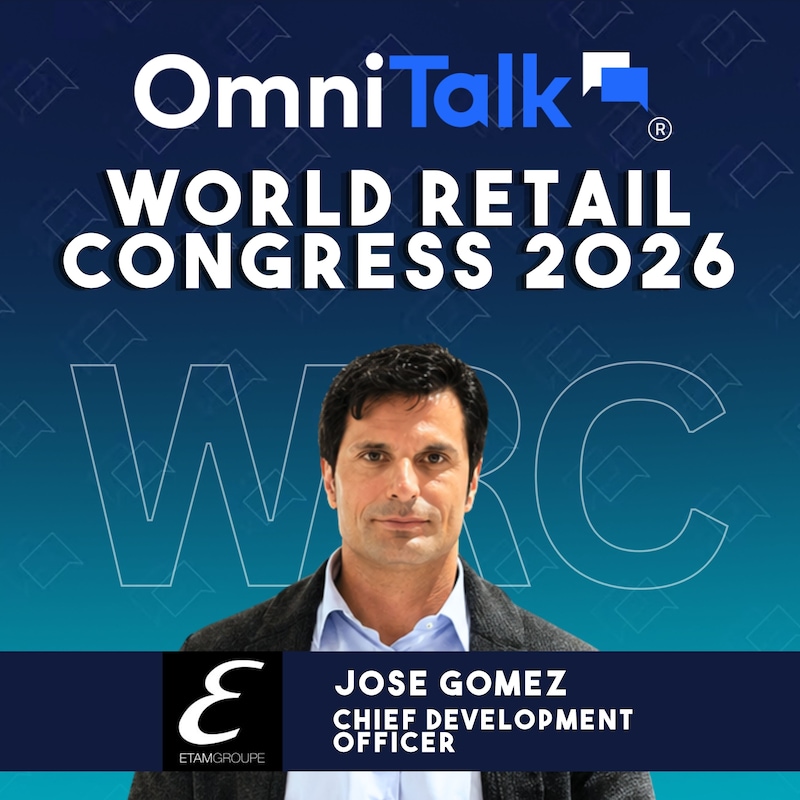
In this Omni Talk Retail interview, recorded live from World Retail Congress 2026 in Berlin, Chris Walton reconnects with Jose Gomez, Chief Development Officer at ETAM, to discuss how the global lingerie and fashion retailer approaches international expansion, franchise strategy, and navigating today’s nonstop retail disruption.
With nearly two decades of World Retail Congress experience, Gomez breaks down how ETAM’s international development strategy has evolved, including how the company evaluates franchising, consignment, and joint venture models across different global markets. He also shares insights into ETAM’s expanding US presence through Nordstrom partnerships, the challenges of operating amid tariffs and economic uncertainty, and why adaptability has become essential for modern retailers.
The conversation also touches on the realities of entering competitive international markets, why brands can only learn so much before launching, and where Gomez sees ETAM’s biggest future growth opportunities around the world.
Key Topics Covered:
• ETAM’s global retail expansion strategy
• How ETAM decides between franchise, consignment, and joint venture models
• Why joint ventures work best in high-potential strategic markets
• ETAM’s US growth strategy and Nordstrom partnership
• The operational realities of tariffs and global retail uncertainty
• Why resilience has become critical in modern retail leadership
• Lessons learned entering the US fashion retail market
• How global retail development has evolved over the last decade
• Why international retail expansion still requires “learning by doing”
• Markets ETAM sees as future growth opportunities
Thank you to Vusion for supporting Omni Talk Retail’s live coverage from World Retail Congress 2026 in Berlin.
#WRC2026 #WorldRetailCongress #OmniTalkRetail #ETAM #FashionRetail #RetailExpansion #GlobalRetail #RetailStrategy #Franchise #LuxuryRetail #RetailInnovation
This podcast uses the following third-party services for analysis:
Podcorn - https://podcorn.com/privacy
Transcripts
Hello, everyone.
Speaker A:This is Omnitalk Retail.
Speaker A:I'm Chris Walton and we are coming to you live from the World Retail Congress in Berlin from the Vusion podcast studio.
Speaker A:Now, joining me is a man we've had on the program before, Jose Gomez, the Chief Development Officer of etam.
Speaker A:Jose, welcome back.
Speaker A:It's been a couple years since we saw you in Paris.
Speaker B:It has been time flies.
Speaker B:Thank you for having me.
Speaker A:Yeah, it's great to see you.
Speaker A:So what brings you back to World Retail Congress this year?
Speaker A:How many times have you been here.
Speaker B: Since the beginning,: Speaker B:I haven't missed one.
Speaker A:You haven't missed a single one?
Speaker B:I haven't missed a single one.
Speaker B:Only the one that they did not do through Covid.
Speaker B:I guess I have a pass since it wasn't happening.
Speaker A:Oh, my God.
Speaker A:Yeah, you do.
Speaker A:So you're almost.
Speaker A:So next year will be like 20 years of experience.
Speaker B:Next year it will be like 20 years.
Speaker B:I was the original members.
Speaker B:I was in the advisory board as well.
Speaker B:And listen, I keep coming because this is a great gathering of sea level executives.
Speaker B:The quality of the talks and what we share there is.
Speaker B:It's a phenomenal.
Speaker B:It's a phenomenal Congress.
Speaker B:It really is.
Speaker A:It really is.
Speaker A:Yeah.
Speaker A:The caliber of people here is very, very topping.
Speaker A:What is different about it now, say, versus 19 years ago?
Speaker A:What's the biggest difference?
Speaker A:I'm curious.
Speaker B:You mean about the Congress or about the Congress?
Speaker B:The Congress evolves every year.
Speaker A:Yeah.
Speaker B:Every year is a different.
Speaker B:Because the Congress evolves with what's going on.
Speaker B:And in 20 years.
Speaker B:And you don't have to go back 20 years.
Speaker B:Yeah, the war from 20 years was very different.
Speaker B:But war from 10 years ago is where most of the troubles, you know, started happening.
Speaker B:Right.
Speaker B:And it's the new normal.
Speaker A:Yeah, right.
Speaker A:Yeah.
Speaker A:And even with the AI, you know, like AI coming on the scene, that's been a topic today for sure.
Speaker B:AI is a big topic, of course, this year, but it was also last year and it was also when I met you.
Speaker A:Yeah.
Speaker B:For the first time.
Speaker B:Because it was just starting off and it was.
Speaker B:It was.
Speaker B:And it is developing story at, you know, light speed.
Speaker A:Right, right.
Speaker A:So similar question then.
Speaker A:I'm curious too.
Speaker A: velopment officer Since what,: Speaker B: Yes,: Speaker B:Yeah.
Speaker A:How has development changed over that period of time?
Speaker A:Like, or has it not changed that much?
Speaker A:I'm curious.
Speaker B:It has, it has.
Speaker B:In the way we do development.
Speaker A:Okay.
Speaker B:The business models continue to be the same, but we apply them differently.
Speaker B:We continue to do franchise, we continue to do consignment, we continue to do joint ventures.
Speaker B:We apply them very differently.
Speaker B:Franchising 20 years ago was a lot more prominent because the economic conditions at the time, globally, in a global world, allowed for the proliferation of that type of model.
Speaker B:Today, depending on what parts of the world, is a little more difficult.
Speaker B:So you need to apply other types of business model like consignment, when you can do it, or if the country has significant potential, then is where we are ready to go in and franchise.
Speaker B:I'm sorry, enjoying venture and become partners, become real partners of the venture.
Speaker A:So how do you decide which model is right for which areas of the country?
Speaker A:Is there a formula, a framework that you tend to use more than a.
Speaker B:Formula is the economic conditions on the environment that dictate different parts of the world.
Speaker B:The country, whatever that country is, is very significant in the terms of potential and in terms of potential of the revenue you can generate and the units that you can open.
Speaker B:I don't mind considering a joint venture in there because joint ventures have to have scale.
Speaker B:Everything has to have a scale.
Speaker B:But a joint venture has to have scale.
Speaker B:So in there, for me, it's more than justified.
Speaker B:It's probably my preferred way to go into one of those big strategic markets.
Speaker A:Is it okay?
Speaker B:Yeah.
Speaker B:We have one going on right now that we've done a few years in Mexico and it's doing really good.
Speaker B:And I'm considering others in other parts of the world.
Speaker B:And the typical franchise, as we used to do it, continues to be alive.
Speaker B:It is possible to do it.
Speaker B:Conditions have changed a little bit in terms of what the brand represents.
Speaker B:You need a strong ISP to be significant in the market.
Speaker B:And normally the consignment, we do it in Europe mostly because it's the simple model.
Speaker B:There is no customs where share one currency.
Speaker B:So it's like managing your own stores, right?
Speaker A:Yeah.
Speaker A:Do you ever have anybody move from franchisees to another model?
Speaker B:We have.
Speaker A:You have?
Speaker B:Yeah.
Speaker A:How does that work?
Speaker B:We have, but it's a process.
Speaker B:You start on the season.
Speaker B:No, basically it is a process in many ways.
Speaker B:Right.
Speaker B:In the logistical way a typical franchisee will come and buy.
Speaker B:And then there is a lot of assistance that we provide to that franchisee.
Speaker B:But we don't manage the stock.
Speaker B:The consignment model, we do manage the operation like we will manage any other unit that we have in our chain.
Speaker B:So we become not only the owners of the stock, but we also become the managers of that stock with the local assistance of the partner in that area.
Speaker A:Okay, so it does happen.
Speaker A:Okay, I was curious.
Speaker B:It does happen.
Speaker B:And every year I have a list of countries that I say, well, this one, it might work, or I may have more potential if I switch them between regular franchise and the consignment model.
Speaker B:But there is a list of requirements that you need to hit in order for consignment model to work.
Speaker A:Well, that was gonna be my next.
Speaker A:Okay, that was gonna be my next question.
Speaker A:Like, how do you think about how do you coordinate all that?
Speaker A:Like, do you have a list of requirements depending on the model and a different structure of support depending on the model, or do you try to keep it as similar as possible for the brand's pur.
Speaker B:No, it's different.
Speaker B:Each business model.
Speaker B:Each business model has its own characteristics and its own team, and it's work very differently.
Speaker B:If you are on the traditional franchise model, we have conventions that the people come to.
Speaker B:You know, our franchisees come to Paris four times a year.
Speaker B:They make their buys, and then we can refresh through our website every month what they may need additionally.
Speaker B:Okay, if we're on consignment model, we manage from the central stock, like regular store, and if it's a joint venture, obviously belongs to part of the group.
Speaker B:So it's like another store.
Speaker B:Right.
Speaker B:There's no difference in there.
Speaker A:Yeah, man, you got a complicated job, but it sounds very, very cool.
Speaker A:So last.
Speaker A:Last time we talked, you guys had just gone into Miami, right?
Speaker A:Yes.
Speaker A:Right.
Speaker A:So how's that going?
Speaker A:Like, how's.
Speaker A:How's that going?
Speaker A:How's the US Market shaping up?
Speaker B:It's.
Speaker B:It's going well.
Speaker B:You know, the US Market is a very challenging market as well as a lot of things that happened since the two years ago that we, we talked.
Speaker B:Yes.
Speaker B:You know, tariffs coming in, a lot of uncertainty of what's going to happen to the business.
Speaker B:We.
Speaker B:Since we talked to you, we opened 55 corners at Nordstrom's.
Speaker A:Oh, yeah, that's right.
Speaker B:It's going well.
Speaker B:It's going really well.
Speaker B:The customer likes it.
Speaker B:But that adjustment that we have all through last year on, you know, trying to keep the price as close as possible to the regional while taking the impact of the tariffs in the US that was quite an exercise.
Speaker B:But, you know, it's.
Speaker B:Anything they throw at us at retailers today is just to prove and to build resilience.
Speaker A:Right.
Speaker B:Every time we come out of one of these, we come stronger than before.
Speaker A:Do you ever wish you would just.
Speaker A:You could just say, okay, let's just not change anything for a Little bit, though, macroeconomics, like, let's just keep everything a little bit the same.
Speaker B:My God, that happened when I started my career over 20 years ago, like, I don't know, 25 years ago, that the world was a lot more stable.
Speaker B:We had recessions every five years.
Speaker B:We had a recession that lasted one or two years.
Speaker B: Now, since: Speaker B:If it's not, one thing is the other, and that's the way we are.
Speaker B:You know, we're used to operating and I don't think it's going to change anytime soon.
Speaker A:Yeah.
Speaker A:The number one word in retail is resiliency.
Speaker A:You said it.
Speaker A:I mean, it is.
Speaker A:You have to be resilient to have in this business.
Speaker B:You know how you react to those shocks because you can't really prepare for them because you don't know.
Speaker B:Right.
Speaker B:So when it hits you, the success is in the reaction time and what you apply.
Speaker A:Right.
Speaker A:Yeah.
Speaker A:And how do you take advantage of the opportunity that others may or may not see in front of them, given the situation?
Speaker B:Because there is always advantage, There is always a possibility.
Speaker B:It's hard, but there is always a way to find.
Speaker B:There's always a way to find your way.
Speaker A:Yeah.
Speaker A:It reminds me of saying that like for every trend, there's a counter trend.
Speaker B:Correct.
Speaker A:You know, I'm curious though.
Speaker A:So is there anything you wish.
Speaker A:Well, let me ask it this way.
Speaker A:Is there anything you wish you knew then that you know now about entering the US Market that other people that are considering entry?
Speaker A:Because I talked to somebody at the Retail Technology show last week that was thinking about entering the US market from Europe.
Speaker A:So I'm curious, like, what, what would you do again?
Speaker A:What would you do differently if you were trying to enter the US Market for the first time?
Speaker B:I don't think you can learn.
Speaker B:You can learn a little bit.
Speaker B:You can learn a little bit from other people's experiences, but I don't think what the experience of a different retailer will be exactly the same experience for another one.
Speaker B:So I think you can all the more you can learn, the better.
Speaker B:But being in the market, that's you the real learning curve and that's what you have to go through, especially in a market that is as important as, as the US and as competitives with all the shocks that the US Market has suffered in the last couple of years.
Speaker A:So your point being?
Speaker A:Do something, Try something.
Speaker A:Learn from it to understand.
Speaker B:Yeah.
Speaker A:And course correct.
Speaker B:And course correct.
Speaker A:Got it.
Speaker A:All right, well, let's get you out of here on this.
Speaker A:So I'm curious, do you think that is there any market that you think, as you look at it geographically, that is under penetrated in your mind today and that if you cracked it, you know, it'd make a significant difference for you?
Speaker B:Oh, I mean, there's a lot of markets where we underpenetrate.
Speaker B: You know, we have around: Speaker B:So in some of the countries, we are still a lot of markets were under penetrated even without going away in our home country.
Speaker B:In Europe, you know, we could do more in Germany, Spain, a little more, but we are pretty much France, definitely not.
Speaker B:We're completely covered.
Speaker B:We are the leader of lingerie in the market.
Speaker B:We're not in Italy, so we could go to Italy.
Speaker B:The US Is another big market.
Speaker B:You know, despite the difficulties, you know, of entering a market like that, if you make it, you make it really big.
Speaker B:There is Asia, where we exit through Covid.
Speaker A:Okay.
Speaker B:And we haven't been back.
Speaker B:So that's on my plate again, coming over.
Speaker B:But, you know, so the world is a very large place.
Speaker B:So, yes, we are under penetrated in a lot of.
Speaker B:In a lot of the markets that I wish that I wish I could be.
Speaker A:Oh, my God.
Speaker A:You got to be the busiest guy here, my friend.
Speaker A:You got to be so busy.
Speaker B:I think every retailer is very busy at the moment.
Speaker A:True.
Speaker A:That's very true.
Speaker A:But different.
Speaker A:Different retailers bite off different things, too.
Speaker A:But I've been noticing you milling around, and you seem like a busy guy.
Speaker A:A lot of people want to talk to you too.
Speaker A:So thanks for taking the time, of course, Your busy schedule, to meet with us.
Speaker A:It's always a pleasure to have back and enjoy catching up with you.
Speaker A:It's a good time.
Speaker B:Thank you.
Speaker B:Same here.
Speaker B:Thank you for having me.
Speaker B:And I'll see you in a year.
Speaker A:All right.
Speaker A:Sounds great, man.
Speaker B:Thank you.
Speaker B:Bye Bye.
Speaker A:Thank you.
Speaker A:And to all our fans out there, as always, be careful out there.