Transcripts
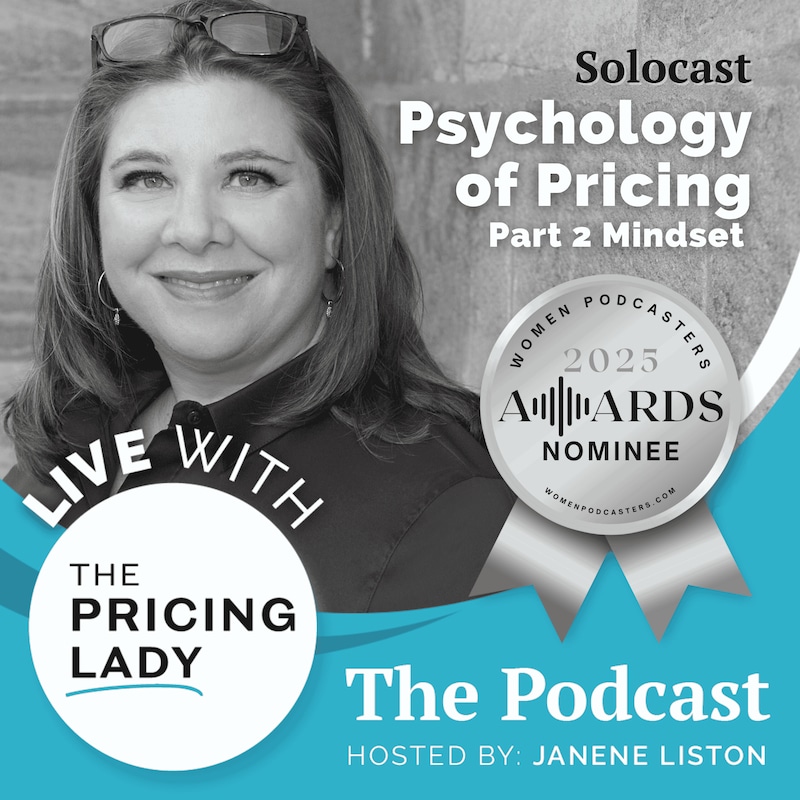
In this episode of Live With the
Pricing Lady, we're taking a look at
2
:part two of Pricing and Psychology.
3
:Where we'll be talking about how your
mindset influences your pricing decisions.
4
:Sit back, relax, and enjoy the episode.
5
:Hello and welcome to this episode
of Live With the Pricing Lady.
6
:I am Janene, your hostess.
7
:This show is all about helping you build
a more sustainably profitable business.
8
:By understanding the tactics
and strategies of pricing, we
9
:can build your confidence and
help you make better decisions.
10
:Let me start by asking you a question.
11
:What if your pricing problem isn't
what you charge, but what you
12
:believe about what you charge?
13
:Ouch.
14
:That's a tough question, right?
15
:And I ask it with a lot of love in my
heart because I know that there is a lot
16
:going on behind the scenes that influences
your pricing and your decisions.
17
:And that's what we're here to talk about
in this episode because while the external
18
:aspect of pricing psychology is something
we all, you know, are fascinated by and
19
:enjoy to talk about, the internal part
is the part that's influencing much
20
:more than you can possibly imagine.
21
:Often when I run rep classes or
I give a presentation, I will
22
:ask people, what has the biggest
influence on your pricing today?
23
:Is it the customer?
24
:Is it the competition?
25
:Is it the cost?
26
:Is it you?
27
:And 99% of the time, people will
pick one of the first three.
28
:The reality is it's almost
always answer number four, you.
29
:You have more influence over your
pricing and your pricing strategy
30
:than anybody else, and the sooner that
you take ownership for that and start
31
:taking steps to do the right things in
the right way, the easier pricing is
32
:going to become for you and the more
confidence you're gonna have in it.
33
:So let's dig into the psychology,
the internal psychology that lies
34
:behind your pricing decisions.
35
:We're gonna look at this in three
sections, why it's important to take a
36
:look at this, what the challenges are,
and some tips that you can use to start.
37
:Shifting what's going on.
38
:Why is it so important that you
understand this internal aspect?
39
:Can't you just be like an ostrich
and dig your head in the sand?
40
:But we all know the answer
to that already is no.
41
:You will always, and I do mean
always struggle and lack confidence
42
:in your pricing if your money and
value beliefs are getting in the way.
43
:There's just no two ways about it.
44
:You have to tackle that in some ways
straight on first by create, creating
45
:awareness around them and sometimes
by shifting those things that are
46
:getting in the way or reframing them.
47
:What we're going to be looking
at today are some different
48
:ways that you can do that.
49
:The second reason that this is important
is that the internal psychology that's
50
:going on, and some of it, you may
be aware of it and some of it may be
51
:going on at a subconscious level, will
lead you to undercharge over, explain
52
:and hesitate when you least want to.
53
:It's really important that you take
that ownership for the fact that you are
54
:the biggest influence on your prices.
55
:You can't point the finger
and blame the customer or your
56
:competition or your cost structure.
57
:In the end, your pricing comes down
to what you choose to do with it.
58
:The more you know about what to do and
how to do it, the more likely you can.
59
:It is that you will be doing the right
things and it will get easier for you.
60
:The third reason.
61
:Why this is important is that shifting
your mindset or being, having the
62
:tools and the awareness to be able
to shift your mindset is key to
63
:making sustainable and empowered more
empowered decisions in your business.
64
:Instead of saying, oh, I set this price
just because that's what so and so does.
65
:You can say, I set this price because it.
66
:Fair.
67
:It is reflects the value that I
deliver and it is market driven, and
68
:you can say that because you've done
the work and you know it, right?
69
:As opposed to saying, well, so and so
just told me to, or somebody said A
70
:little offer should cost this much.
71
:Right.
72
:You don't, you're guessing at it, right?
73
:You're assuming that what that
other person is telling you is
74
:correct when you do the work and
understand the why behind your prices.
75
:When you are able to shift that
mindset, then it opens up doors and
76
:the possibilities become that you're
going to make empowered decisions,
77
:decisions that you decisions.
78
:You can believe in those.
79
:That possibility increases significantly.
80
:It's a magical shift.
81
:I see it all the time with my clients,
so I, I can, can, can say that with
82
:an enormous amount of confidence.
83
:So what are the challenges that
people face when it comes to this
84
:internal aspect of psychology?
85
:One of the biggest ones is
imposter syndrome and that the
86
:tone of voice of that is, you
know, who am I to charge that?
87
:Or why would anybody ever pay me that?
88
:So this is a common thing
that I hear from people they.
89
:Don't believe on some level that they
can do that, that they can charge that.
90
:And there are many different things
that could be influencing that.
91
:It could be, you know, they're
hearing that in the voice of a parent.
92
:I have one one client.
93
:Somewhat recently, I guess who, you
know, who specifically said, okay,
94
:my, you know, my parent has told
me that I'm crazy to charge that.
95
:Literally it came straight
from their parents' mouth.
96
:And that isn't necessarily
helpful or constructive feedback.
97
:And being able to challenge
that in your own mind, if that's
98
:what you're hearing from some.
99
:One in your circle is important, or if
it's not, you know, that you've heard
100
:that feedback specifically, but there's
a little voice in your head telling that,
101
:being able to, you know, isolate that
voice and, and challenge it and say,
102
:Hey, you know, don't say that to me.
103
:It's important because if you
deliver the value, then yes, you
104
:are capable of charging that.
105
:And if people believe that you
can deliver that value, they
106
:would be willing to pay for it.
107
:The second common challenge is
simply the fear of rejection.
108
:Or, and this is when I hear from
a lot of ladies, is the fear
109
:of being perceived as greedy.
110
:I'm gonna lump these two fears
into one common challenge here
111
:because they are often related.
112
:Now they're not exactly the same.
113
:The fear of rejection is,
basically being told no.
114
:And this is a fear that a lot
of people have, but the reality
115
:is who cares if we're told no?
116
:Yeah.
117
:Most of us have been told no in many
different aspects of our lives at
118
:many different times in our lives.
119
:And sometimes it cuts to our heart
and other times we just go on and
120
:do whatever the heck we want anyhow.
121
:And so in the context of your pricing,
hearing no isn't necessarily a bad thing.
122
:So if you can reframe that,
then it's going to help you.
123
:And what I have to say about
being perceived as greedy.
124
:If your intention is to take advantage
of people and you said exorbitantly
125
:high prices as a means to take advantage
people, then yeah, you're greedy.
126
:But everybody I've ever met in the
context of running my business,
127
:that's not their intention.
128
:Their intention is to deliver a
service, a product, or a software
129
:at a price that is good for the
customer and good for their business,
130
:and they're delivering great value.
131
:So there is no risk really
of being seen as greedy.
132
:And sometimes I've had clients who have,
been challenged by people on social media.
133
:How dare you charge for this?
134
:You know, blah, blah, blah, blah, blah.
135
:And those types of people who
don't understand that you're
136
:running a business, I mean, doctors
charge for what they do too.
137
:So why if you're helping people
and delivering value, then
138
:there's no reason you shouldn't.
139
:So again, with these two fears,
a lot of, you know, being able to
140
:shift, it will come from reframing.
141
:The third one is tying price to
time and effort instead of value.
142
:This is very much service related
and usually when I'm first working
143
:with a new client who has a service
based business, they're always talking
144
:about, oh, it takes me this time, or I
have to put so much effort into this.
145
:And during the course of our work
together, we will shift that.
146
:I was like, every time you think about
cost, I want you to think about value.
147
:Every time you think about the number of
sessions, you're gonna look at the value
148
:as well, and we're like re-patterning
their brains to go to value all the time.
149
:So tying your price to time and effort.
150
:Is not going to help you because the
time and effort are not related to
151
:the value that you're delivering.
152
:That's why we want you to shift
your focus to value instead.
153
:So if you're always focused on how
much effort you have to put in and how
154
:much time it takes, that's actually
more related to your efficiency as
155
:opposed to the value you're delivering.
156
:And that's something you're
gonna wanna keep in mind.
157
:I'm getting a little bit ahead
of myself into tips here.
158
:I can't help it with this topic so much.
159
:Alright.
160
:Another common challenge
is simply avoiding pricing,
161
:discussions and or decisions.
162
:My friend and I, I bring that decisions
aspect into it because avoidance is
163
:not just in having the discussions,
but it's about making the decisions
164
:around pricing in your business.
165
:So one of my clients last year, she's
like, I don't know why I put off the
166
:decision for so long to work with you.
167
:She'd been looking at working
with me for quite a while.
168
:But she hesitated.
169
:She was just avoiding
making that decision.
170
:And when we talked about why it came
down to her fear, she didn't wanna fear.
171
:Feel foolish for not
having addressed it sooner.
172
:But of course then the longer she
waited to do it, then you know,
173
:the longer she was avoiding it.
174
:And it was like a
vicious, a vicious circus.
175
:Finally, thankfully something clicked for
her and she decided to to work with me.
176
:But the point is avoidance.
177
:Is a coping mechanism, but it's
not one that always helps us.
178
:If you are avoiding having pricing
discussions with clients, it's very
179
:hard to sell things, especially
in a service-based business.
180
:If you're avoiding deciding what to price.
181
:The offer that the client you had
a conversation with last week if
182
:you're avoiding making the decision
on the price for that, then you're
183
:not getting the offer out to them
in a timely fashion, which is going
184
:to impact their decision, right?
185
:So avoidance is a common challenge that
presents itself when you're having mindset
186
:issues or internal psychology issues.
187
:The last challenge here is, is when you
are feeling a lack of confidence when
188
:your mindset isn't in the right place.
189
:This is when you get into behaviors like
people pleasing, unnecessary discount,
190
:and in offering unnecessary discounts.
191
:When you feel under pressure.
192
:Or what I call preemptive discounting.
193
:So the preemptive discounting is when you
wanna offer a discount before you, and
194
:you've even presented the client a price.
195
:Yeah.
196
:There's rarely ev ever a valid business
reason to offer a preemptive discount.
197
:But if you're feeling, you know, if you're
feeling that you are not worthy or that.
198
:You don't understand the value,
even then you're more likely to do
199
:these self-sabotaging behaviors like
people pleasing, which leads then to
200
:unnecessary discounts when you feel
under pressure or preemptive discounting.
201
:So those are the common challenges
that people face when their internal
202
:psychology, you know, internal
to themselves is off kilter.
203
:Now let me be clear about.
204
:One thing because these internal
psychology challenges also
205
:present themselves in larger
businesses, like where they have
206
:a sales team or a marketing team.
207
:They are not immune from these
things because it's a team.
208
:They also have these issues.
209
:And I I just wanna bring you
one example so that you know
210
:that you're not alone in this.
211
:Years ago I was working with a company
and they, they were in a price war with.
212
:In their market, let's say.
213
:And when we met, they said to
me there's nothing we can do.
214
:It's not worthwhile to do this pricing
project because we are in a price war
215
:and there's nothing we can do about it.
216
:The other guy started it and
there's nothing we can do.
217
:We just have to wait it out.
218
:And that was their approach.
219
:It was basically learned
helplessness, if you will.
220
:Yeah.
221
:They just gave up.
222
:In that situation, and this can also
oftentimes be the case, when you
223
:have your own business, you feel
like that's not possible for you
224
:that you can't do anything about it.
225
:So you just kind of give in and
you give all your power away.
226
:And that's what they did.
227
:Well, it turned out not only had they
contributed to the price war, but
228
:they could also contribute to taking.
229
:You know, lifting the industry
up out of this situation.
230
:It had gotten this too by doing some
very specific things with their pricing.
231
:So it's important for you to understand
that we are all human beings.
232
:I know that, you know that.
233
:And these internal aspects of human
psychology influence pricing, whether
234
:it's a one person company or a,
you know, 50,000 person company.
235
:So I know you'd like to get into
the tips, so let's start there.
236
:The first thing you have to do
is create awareness and audit the
237
:stories that you're telling yourself.
238
:So if you're telling yourself.
239
:I'm not worth it.
240
:It's helpful for you to understand
where that's coming from and
241
:start shifting that story.
242
:Say, yeah, I deliver value, I deliver
value, I deliver value, right?
243
:So you need to shift those stories,
audit and shift your money.
244
:Stories could be money,
success, or worthiness.
245
:Those are usually the three
areas that we're talking about
246
:when we're looking at B Pricing.
247
:Second tip.
248
:Is to detach your pricing
from your personal worth.
249
:And I know some of you, it might
be you, dear listener, will roll
250
:your eyes when you hear that.
251
:I know I should do that.
252
:I think the key here is to
understand how to do that and
253
:in my work with people what.
254
:Helps them to make that transition most
effectively is to understand the economic
255
:value of what your work really brings.
256
:So not benefits and features, but the
real economic value that is going to
257
:help you shift your thinking from.
258
:It's going to right now because you
don't understand the value in an
259
:economic sense of what you bring.
260
:You're left comparing it to
the only thing that you think
261
:you know, which is yourself.
262
:Now, the reality is you have infinite
value as a human being, as we all do.
263
:So that comparison is let's say silly
at best, but because it's the only like.
264
:Point of, of comparison that you
have, then you go there where if
265
:you understood the economic value,
then you'd have a different point of
266
:reference that you can be utilizing
that is actually more relevant and
267
:a healthier point of reference.
268
:So if you can detach from your personal
worth, it'll be very beneficial.
269
:The best way in my experience
to do that is to understand the
270
:economic value that you bring, that
your offer brings your clients.
271
:So the third tip.
272
:This is often when people feel
challenged in pricing conversations
273
:they haven't taken the time to
practice saying their prices out loud.
274
:And this seems so simplistic and it
is simple, but it is very powerful.
275
:So build comfort for yourself.
276
:Build muscle memory by practicing.
277
:Your prices and saying them out loud,
and especially if you're shifting or
278
:changing your prices, then that is
a, a good opportunity to make sure
279
:you reinforce the right price in your
own brain so that it rolls off the
280
:tongue when, when you need it to.
281
:The fourth tip is to flip your focus.
282
:What do I mean by flip your focus?
283
:So for example, here are two
examples of flipping your focus.
284
:First, think less about what
they pay you and more about
285
:the results they're gonna get.
286
:I.
287
:Why?
288
:Because it goes back to
shifting the value, right?
289
:So instead of focusing on, oh, they're
gonna pay me the same, you're focusing
290
:on, I help you dear customer, do X, Y, Z.
291
:And that is a much healthier focus,
both for you and for the client.
292
:Second example, think less about the
number of sessions and more about the
293
:journey that gets them the results.
294
:The number of sessions, especially
with coaching, it drives me crazy.
295
:People focus so much on the
number of sessions, the number
296
:of sessions, and the number of
sessions is not related to the value
297
:in general.
298
:The journey you take them
on, the way you onboard them.
299
:These things are the things that
bring results for your customers, and
300
:you and your customer will benefit
more from focusing on those things.
301
:To me, the number of
sessions is simply logistics.
302
:Yes, you do have to set boundaries.
303
:Which leads me to the last and
final tip, which is set very
304
:clear boundaries for yourself.
305
:And the reason you do this is when you
don't have any boundaries in your pricing.
306
:Then if somebody asks you something
that you don't have an, an answer for
307
:or you haven't really thought about
how you would handle that, then your
308
:brain kind of goes into little bit
of panic mode and you start making
309
:decisions in a high emotional state.
310
:As opposed to making a
decision from a logical.
311
:Cognitive state, right?
312
:So if you have thought in
advance about when and under what
313
:conditions you would offer a certain
discount, then when someone says
314
:can you give me a 10% discount?
315
:Instead of going I don't know.
316
:You'll already have thought,
well, you know what?
317
:Mm.
318
:I only offer this discount
under these conditions.
319
:This client is not doing this.
320
:So actually, no, I don't offer a discount
for this offer because the price is
321
:market driven and it's very much related
to the value that it deliver, right?
322
:So setting clear boundaries allows you, or
enables you to stay in a more let's say.
323
:Logical thinking frame of mind as
opposed to an over emotional one.
324
:And when you're overemotional, then
you're more likely to do things
325
:like offer unnecessary discounts.
326
:Those are the five tips that I
wanted to share with you today.
327
:Now, your tasks, should you choose to
take this task on as a result of this
328
:session today, is to identify one mindset
or belief you believe is currently
329
:holding you back to journal about where
this has come from and what it's costing
330
:you, but also to think about how you can
reframe it, how you can shift your focus.
331
:So every time you think that.
332
:Thought, what's, you know, a way you
could reframe that to focus more on
333
:the value or some aspect of value
so that that mindset issue won't
334
:be getting in your way as much.
335
:Now, as you know, this was part two of a
two-part series on pricing and psychology.
336
:Both external and internal psychology
are important to pricing and often
337
:issues with internal psychology will
lead to poor choices when implying
338
:some of those external tactics.
339
:So if you don't.
340
:Know what to do with your prices, for
example, you're feeling uncertain or a
341
:lack of confidence around your prices,
you may use some tactic that you heard
342
:from some guru somewhere on your pricing
that actually doesn't fit your business.
343
:So you wanna be careful about that.
344
:That's why one reason it's so
important to address both the
345
:internal and the external.
346
:At the same time, when you understand
the buying behavior of your customer,
347
:it will support your confidence and
you will make better decisions, which
348
:again, is why you need to also understand
the external aspect of pricing.
349
:So when you trust the value you bring
and understand your audience, you create
350
:, an environment for stronger offers for.
351
:Better price positioning for easier sales
conversations and for closing more deals
352
:at better prices, which quite frankly
is what we would all want for you.
353
:That is what I wanted to share
with you in this episode.
354
:I hope you enjoyed this two part
series on pricing and psychology.
355
:It is one of my favorite topics when it
comes to pricing because it is so powerful
356
:and so impactful in your business, and
there is so much to unpack in there
357
:and get into the nitty nitty gritty.
358
:We've, you know, scratched the
surface on some of this, and
359
:hopefully it's given you some things
to reflect on in your business.
360
:If you'd like to find out more about
how to work with me, I suggest you
361
:head on over to the pricing lady.com
362
:and book a call with me.
363
:You can share with me what's going on
in your business and I'll share with you
364
:how we might be able to work together.
365
:That's all for today.
366
:I wish you a great day, and
as always, enjoy pricing.