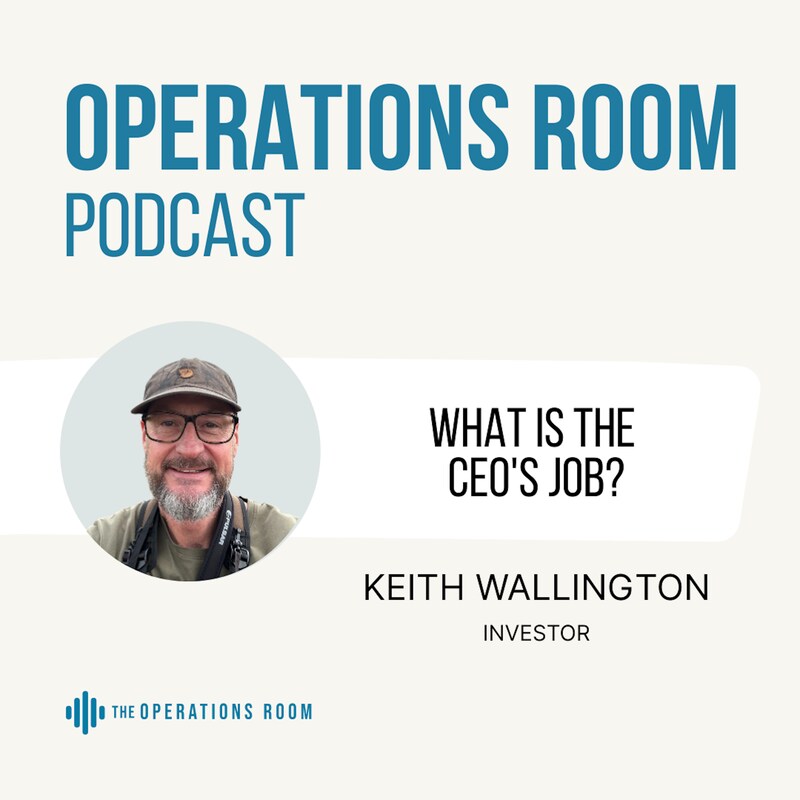
Shownotes
In this episode we discuss: What is the CEO’s job? We are joined by Keith Wallington, Chairperson and Investor in B2B SaaS businesses
Love The Operations Room? Please support us by rating and reviewing it here.
We chat about the following with Keith Wallington:
- What actually changes in an operating model as a company scales – and what shouldn’t change, even under pressure?
- How do you design an organisation that moves fast without creating chaos or decision fatigue?
- When does adding structure genuinely unlock performance, and when does it quietly slow teams down?
- How can operators tell the difference between a scaling problem and a leadership problem?
- What questions should COOs be asking before a Series B or major growth phase to avoid painful rework later?
References
- https://www.linkedin.com/in/keithwallington/
Biography
Focussed on Series A and Growth stage B2B SaaS businesses that deliver vital, core services to their customers.
Keith has led strategy and execution in technology businesses since the 1990’s, driving growth in Europe, the USA and Africa: His experience in driving online business models spans Retail Banking, Telecommunications, Online Live Broadcasting and Software as a Service (SaaS): He has led strategy and execution initiatives at businesses including Microsoft, Standard Bank, Omnicom/TBWA, MTN Group and Mimecast.
From 2008 – 2014 Keith spent 6 years driving growth at Mimecast, best in class and global leader in SaaS based email security, archiving and continuity: Here he assumed a number of C Level roles, including COO, spanning most of the business from Marketing to Customer Experience to Technical Operations as he championed scalable, efficient growth during this phase of hyper growth (from $6m to over $110m Annual Recurring Revenue) and global expansion from the UK base.
After preparing Mimecast for IPO Keith refocused his attention to support businesses on their growth journey. Keith invests in and assumes board roles with post Series A businesses. He engages directly and also collaborates with Venture Capital and Private Equity teams to co-invest and add depth to portfolio company boards.
To learn more about Beth and Brandon or to find out about sponsorship opportunities click here.
Summary
05:30 – Why operating models break during growth
12:45 – The tension between speed and structure
19:30 – Horizontal vs vertical operating models
26:00 – Decision-making at scale
30:00 – What scaling exposes about leadership teams
38:30 – Preparing for Series B (before it’s too late)
47:00 – Operating principles that actually stick
55:30 – Signals your operating model needs a reset
This podcast uses the following third-party services for analysis:
Podcorn - https://podcorn.com/privacy
Transcripts
Hello and welcome to another episode
Speaker:of the Operations Room, a podcast
Speaker:for COOs.
Speaker:I am Brandon Mincing, joined by my
Speaker:lovely co-host Bethany Ayers.
Speaker:How are things going, Bethany?
Speaker:I have been getting face peels for
Speaker:easily 20 years, and I've
Speaker:never had really any reactions at
Speaker:all. And then last time I had one a
Speaker:couple months ago and had a really
Speaker:bad reaction and I thought, oh,
Speaker:maybe I was just being a bit
Speaker:aggressive beforehand,
Speaker:like using too many products,
Speaker:whatever, it's fine.
Speaker:And then I just got one on Wednesday
Speaker:and I'd been super gentle with my
Speaker:skin since the last one.
Speaker:And so I thought it would be fine,
Speaker:but it's not been.
Speaker:My face hurts.
Speaker:It feels like it's on fire.
Speaker:They're basically everything.
Speaker:Cheek, nose area below,
Speaker:so chin, jaw,
Speaker:neck. I don't even think she put
Speaker:stuff on my neck, but for whatever
Speaker:reason, my neck is really
Speaker:on fire.
Speaker:Okay. So break it down for me.
Speaker:You've gone to this woman for 20
Speaker:years.
Speaker:You haven't had a problem, but
Speaker:you've had this problem this last
Speaker:time. So what's going on here?
Speaker:Is it, is your face somehow
Speaker:different or what's, what's the
Speaker:deal?
Speaker:Basically, I think if you speak to
Speaker:any woman of a certain age,
Speaker:everything is hormones.
Speaker:Everything is perimenopause.
Speaker:I can only imagine that that's what
Speaker:this is, but it's really annoying,
Speaker:really painful, didn't sleep last
Speaker:night, grumpy.
Speaker:Okay, so being in a position where
Speaker:you can't sleep because of a face
Speaker:peel seems like the last thing that
Speaker:you need given your circumstance
Speaker:of, you know, your CEO
Speaker:position.
Speaker:My stressful life.
Speaker:Yeah, stressful life and now pain on
Speaker:top of it.
Speaker:So, you know, I go to my French
Speaker:electricity gym.
Speaker:It closes after today,
Speaker:so this is the last session of the
Speaker:year. Supposed to go at half 12.
Speaker:I don't think I can.
Speaker:Oh, because of the face.
Speaker:Because of the face.
Speaker:Right. Okay.
Speaker:It's upsetting your day now as well.
Speaker:So you can't sleep.
Speaker:You can't do your stuff during the
Speaker:day. What is going on here?
Speaker:What do these women do to you?
Speaker:But the thing is, is what did I do
Speaker:to myself?
Speaker:It's not her.
Speaker:It's really damaged my skin.
Speaker:It's healed, but this is not what's
Speaker:supposed to happen for a face peel.
Speaker:You're not supposed to destroy
Speaker:the outer barrier of your skin.
Speaker:Well, thank God as a man or
Speaker:a male I don't have to do face feels
Speaker:or be in a position where somehow
Speaker:that's the expectation.
Speaker:Yeah, well, I used to get them
Speaker:because it was really good for
Speaker:all of my spots and it
Speaker:just like really healed any kind of
Speaker:acne that I had.
Speaker:And then I carried on doing it
Speaker:now, you know, my hormones have
Speaker:calmed down over the years until now
Speaker:where they're going crazy the other
Speaker:way. And so I don't
Speaker:even know if I need them anymore.
Speaker:I think I'm now doing them for
Speaker:anti-aging, but questionable
Speaker:as to whether or not it makes a
Speaker:difference.
Speaker:Speaking of anti-aging, I just
Speaker:caught up with my former VP
Speaker:of Operations at Trent
Speaker:for lunch yesterday and
Speaker:it was wonderful to catch up.
Speaker:She's actually written a book, which
Speaker:is phenomenal.
Speaker:So apparently she's shopping around
Speaker:with, what do they call them,
Speaker:agents, I guess, for trying to sell
Speaker:the book onwards type thing.
Speaker:It's a very talented woman.
Speaker:When I first hired her, she had come
Speaker:out of, I think it was BCG
Speaker:Consulting, and very
Speaker:talented individual came in as the
Speaker:head of ops and graduated over the
Speaker:course the four year period.
Speaker:And now she effectively runs that
Speaker:place, I think, with Jeff, the
Speaker:founder.
Speaker:So I'm just telling her,
Speaker:by the way, my company is growing
Speaker:and we're looking for people.
Speaker:So if you know of any good head of
Speaker:ops coming from a consulting
Speaker:background similar to you four years
Speaker:ago, please recommend them.
Speaker:So if there's anybody listening to
Speaker:this podcast that is coming from the
Speaker:consulting background that would
Speaker:love to be a head of Ops, hit me
Speaker:up on LinkedIn.
Speaker:I think that's basically what our
Speaker:audience is.
Speaker:So I should be getting
Speaker:quite a few after this.
Speaker:Be inundated.
Speaker:Yeah.
Speaker:Well, that's great news.
Speaker:Did you write fiction on fiction?
Speaker:I think it was fiction.
Speaker:Yeah, sorry. What am I talking about
Speaker:here? You know her.
Speaker:I do, which is why I was, like,
Speaker:particularly interested, you know?
Speaker:I was like, oh, cool.
Speaker:I totally forgot about this.
Speaker:You were mentoring her for a
Speaker:short time period.
Speaker:Yeah, yeah. So I believe it's
Speaker:fiction. She went to New York City
Speaker:for the summer and spent three
Speaker:months, I think, taking a course and
Speaker:writing the book at the same time.
Speaker:What else is happening?
Speaker:So I was inspired by you,
Speaker:Bethany, with your company offsite
Speaker:and bringing Charlie Cowan in to
Speaker:talk about ChatGPT Enterprise
Speaker:and upskilling the company.
Speaker:And you had Ryan Fuller also come
Speaker:in, who also is a guest on our
Speaker:podcast to kind of do all the
Speaker:upskill on the technical side of
Speaker:things for the developers.
Speaker:So I've taken your idea and I've run
Speaker:with it, and it's now gotten out of
Speaker:control.
Speaker:So we've got a hundred people in
Speaker:the company, we've gotten the team
Speaker:from the U.S. Flying over, so
Speaker:roughly 25 people.
Speaker:So we got a two day event.
Speaker:Day one, as usual, is strategy
Speaker:alignment, et cetera, et cetera.
Speaker:Day two, I've dedicated to AI
Speaker:up-skilling and taking six
Speaker:challenges of the business, six
Speaker:execution challenges, and
Speaker:saying to them, look, let's up-scale
Speaker:in the morning using AI tools.
Speaker:And let's take our kind of newfound
Speaker:skills and get together
Speaker:cross-functionally, self-select
Speaker:into the six challenges, and do
Speaker:those in the afternoon. And we can
Speaker:showcase some of our results in the
Speaker:afternoon, or at the end of the day,
Speaker:rather. To show what we've come up
Speaker:with in terms of artifacts or demos
Speaker:or what have you.
Speaker:So, the interesting bit now is that
Speaker:I've got a three-track program for
Speaker:the morning.
Speaker:Track number one is Charlie Cowan on
Speaker:the ChatGBT Enterprise side of
Speaker:things. I'm very excited for that.
Speaker:Track number two, we've got another
Speaker:individual that has a deep
Speaker:technology background, but in fact
Speaker:he's a CEO of a company,
Speaker:but very practical, hands-on.
Speaker:He's going to run our product
Speaker:engineering track and he's
Speaker:focused on cursor in Cloud
Speaker:Code. And we had our VP
Speaker:of AI and our tech
Speaker:lead sit with him for half an hour
Speaker:to kind of just vet him, just make
Speaker:sure he had the chops necessary to
Speaker:pull off this session.
Speaker:And he's done this session several
Speaker:times in the past.
Speaker:And obviously he knows Charlie
Speaker:through their consulting AI
Speaker:network thing, whatever it is.
Speaker:So he's individual number two,
Speaker:and then individual three for track
Speaker:three is more of that
Speaker:product focus, lightweight
Speaker:prototyping for the designer,
Speaker:for the product team.
Speaker:Our CEO of our company actually
Speaker:wants to take this track.
Speaker:So this is lovable, replete,
Speaker:and that third person coming in to
Speaker:do that. So we've booked off 9
Speaker:o'clock in the morning to 12 at noon
Speaker:for the three hour block, take
Speaker:lunch, and come back and work on the
Speaker:challenges cross-functionally.
Speaker:Do people get to choose which
Speaker:stream they go in or are they
Speaker:assigned their stream?
Speaker:Yeah, we're going to allow them to
Speaker:self-select, so the week prior to
Speaker:the event.
Speaker:During the morning.
Speaker:For that too actually.
Speaker:So the note that we'll send out the
Speaker:week prior will have two
Speaker:self-selections.
Speaker:One will be which challenge do you
Speaker:want to work on and which
Speaker:track do you to select into.
Speaker:That sounds really cool.
Speaker:We'll have to hear how it goes after
Speaker:you've run it.
Speaker:We're getting Charlie back in as
Speaker:well for training in
Speaker:Q1.
Speaker:Not quite sure which date, because
Speaker:we have a big customer
Speaker:commit that is yet to land,
Speaker:and so we're waiting.
Speaker:We have to be a little bit flexible
Speaker:in January to know when we can do
Speaker:our offsite versus when we're all
Speaker:going to be focused on customer
Speaker:work.
Speaker:So are you doing another offsite, is
Speaker:that what you just said?
Speaker:Yeah, well, I think we're going to
Speaker:do it on-site, but we'll do two
Speaker:days.
Speaker:And that will be Charlie
Speaker:training on
Speaker:Claude Desktop.
Speaker:So Claude desktop now has all of the
Speaker:skills, and skills really
Speaker:are the way of making easy
Speaker:agents or more repeatable.
Speaker:We can start to move into the world
Speaker:of automations for just all of
Speaker:us, rather than having to use NAN
Speaker:or anything complicated.
Speaker:So we're going to do a special
Speaker:deep dive into skills.
Speaker:And so much has happened between
Speaker:when we talked to Charlie on Tuesday
Speaker:and now it's Friday around
Speaker:skills and Anthropic and
Speaker:what they're releasing that
Speaker:I can't wait to see what's going to
Speaker:happen by the time we get to the
Speaker:training in January.
Speaker:It could be a completely
Speaker:transformational new technology.
Speaker:So we are doing that for the
Speaker:team on day one and then day
Speaker:two we'll be
Speaker:building stuff and also.
Speaker:Doing a certain amount of slowing
Speaker:down to speed up, particularly on
Speaker:the engineering side.
Speaker:I think we just need to build a
Speaker:lot of guardrails, for lack of a
Speaker:better word, so that the
Speaker:code written is automatically good
Speaker:code no matter what.
Speaker:So all of those instructions,
Speaker:a bit boring, time consuming,
Speaker:but if that's just what we do for
Speaker:a day, it'll make a huge difference.
Speaker:I kind of feel like the half day for
Speaker:the training, half day for the
Speaker:challenges is way too short.
Speaker:Like you get a little taster of
Speaker:things, and I kind feel like to your
Speaker:offsite, that seems like
Speaker:the clear evolution of what needs to
Speaker:happen here, which is a full day
Speaker:dedicated to the training part and a
Speaker:full date dedicated to the so-called
Speaker:challenger making whatever
Speaker:you want to make.
Speaker:Yeah, just because basically
Speaker:what you need to do is give
Speaker:the teams time to actually
Speaker:do stuff because there is
Speaker:in the same way as when you're a new
Speaker:manager or a manager and you have a
Speaker:new team member and you to
Speaker:slow down, teach them
Speaker:stuff and there's this feeling of
Speaker:like, I'll just do it myself, I can
Speaker:do it faster.
Speaker:And you know, you have to get past
Speaker:that. It's the same thing with
Speaker:AI. And so it's
Speaker:hard for the teams.
Speaker:To accept not hitting their
Speaker:deadlines because they have to train
Speaker:AI, even though once they do, it'll
Speaker:be five times faster.
Speaker:So it's an opportunity to give the
Speaker:teams permission to
Speaker:slow down.
Speaker:No, it makes a massive difference.
Speaker:I remember this is not to do with
Speaker:AI, but it's a similar idea.
Speaker:We hired an individual,
Speaker:this is many, many years ago.
Speaker:They came in at somewhat of a senior
Speaker:level. As they came in, there was,
Speaker:as always, tremendous pressure on
Speaker:this person to deliver it instantly.
Speaker:So within the first, I don't know,
Speaker:week and a half of their
Speaker:onboarding, it was even onboarding
Speaker:almost immediately, that person
Speaker:was stressed out, felt they
Speaker:had a massive to-do list,
Speaker:and almost ignored the onboarding in
Speaker:a sense and we're just.
Speaker:Trying to like, I don't know, I
Speaker:guess like talk to people, pull
Speaker:together their action set almost out
Speaker:of the gates basically.
Speaker:And I had to sit down with that
Speaker:person and say to them,
Speaker:stop what you're doing.
Speaker:You know, you don't need to be in a
Speaker:stressful situation right now.
Speaker:You really shouldn't be, you can't
Speaker:be because what you have to do is
Speaker:pull back, do the onboarding,
Speaker:think thoughtfully and
Speaker:observationally around what's
Speaker:happening and take the time to do
Speaker:that. Because if you don't you're
Speaker:going to catch yourself out, where
Speaker:you're gonna spin your wheels
Speaker:working on stuff that may or may not
Speaker:be the most important thing, and you
Speaker:may or might not be doing a good job
Speaker:of it because you don't know enough
Speaker:about the company and the product
Speaker:and what we're dealing with to
Speaker:really do things that are useful
Speaker:basically.
Speaker:So just stop where you are doing,
Speaker:put your list down and
Speaker:take some time to think about what's
Speaker:going on here.
Speaker:It's basically the same thing.
Speaker:So we'll probably just get Charlie
Speaker:in every quarter.
Speaker:Everything's moving so quickly.
Speaker:Also, one of our OKRs
Speaker:in the past quarter was to
Speaker:become an AI first company, but
Speaker:now I was at an
Speaker:event and I got very inspired and
Speaker:I'm like, fuck being AI first,
Speaker:we're small enough. We need to
Speaker:become AI native.
Speaker:And so it's not
Speaker:an OKR in this
Speaker:quarter. It's now just
Speaker:like.
Speaker:In our culture, in our
Speaker:performance reviews,
Speaker:in the rhythm of the company,
Speaker:how do we become AI native?
Speaker:How do we not hire people?
Speaker:How do speed things up?
Speaker:60%, 70%
Speaker:increase in optimization isn't
Speaker:acceptable.
Speaker:How do 3X, 4X, 10X
Speaker:what we're doing?
Speaker:So the vision is 50 people,
Speaker:100 million.
Speaker:So how do stay that
Speaker:slim and that lean and how
Speaker:do outperform everybody else?
Speaker:And that's what we have to get
Speaker:people's brains open to.
Speaker:Yeah, you know what's interesting?
Speaker:I because of our situation right
Speaker:now. I feel like cash is
Speaker:not our constraint So therefore the
Speaker:natural thing to do is to add people
Speaker:and you get requests obviously to
Speaker:add People do all sorts of things
Speaker:that we're trying to accomplish I
Speaker:think in your situation having this
Speaker:forcing function where you can't
Speaker:just lay out The next hire net
Speaker:new hire and you have to do things
Speaker:in a different way to get a
Speaker:bigger outcome You're forced into a
Speaker:position where this AI shift
Speaker:becomes more not
Speaker:possible, but like you're forced
Speaker:down that road, whereas I'm not
Speaker:forced down that road.
Speaker:So the question is how best in my
Speaker:situation to kind of get the company
Speaker:in a position where I know I
Speaker:guess we're doing both. We're doing
Speaker:the net new hires, I need to get
Speaker:done, but we're very much rethinking
Speaker:and reinventing how we're going
Speaker:things in a way that makes sense.
Speaker:So part of it for me is a forcing
Speaker:function with cache, but part of
Speaker:that is, so there's three elements.
Speaker:One is a forging function with cash.
Speaker:One, which I think is genuinely the
Speaker:deeper drive is I'm curious to see
Speaker:if we can do it and I want to learn
Speaker:and I to.
Speaker:And then the third is
Speaker:it's so nice
Speaker:to work with a small team and
Speaker:the speed and the nimbleness of a
Speaker:small time.
Speaker:We're actually a smaller team than
Speaker:when I started and
Speaker:it's amazing how much faster we are.
Speaker:Yeah, they're really such an
Speaker:overhead. I think what you have,
Speaker:because you have more of the pizza
Speaker:table effect happening where you
Speaker:have a small group.
Speaker:You don't need to have all these
Speaker:crazy communications and repackaging
Speaker:of things, which is beautiful.
Speaker:And to your point, once you get to
Speaker:this, I don't know what the number
Speaker:is exactly, but 45,
Speaker:50 people from that point, it
Speaker:just gets amplified in terms of
Speaker:you become like an orchestrator.
Speaker:Like the little operation stopping
Speaker:us from what we do for living in
Speaker:some respects but how do we
Speaker:orchestrate large functional groups
Speaker:to work together and then nimbus
Speaker:way possible given the fact that
Speaker:we're no longer twenty people.
Speaker:Yeah, and it's really nice to
Speaker:be small, but we have a
Speaker:lot of hangover processes
Speaker:from when the company was bigger.
Speaker:And so part of what we're also doing
Speaker:is just tearing down process,
Speaker:tearing down the processes that
Speaker:don't serve us and that ironically
Speaker:we also are missing key ones.
Speaker:So it's kind of like getting rid of
Speaker:the stuff that doesn't serve and
Speaker:adding the things it does.
Speaker:That's part of we're working on
Speaker:at the moment.
Speaker:So we've got a great topic today,
Speaker:which is what is the CEO's
Speaker:job? We have an amazing guest for
Speaker:this, which is Keith Wellington.
Speaker:He is the chairperson, or is
Speaker:a chairperson and investor in a
Speaker:variety of VC-backed businesses,
Speaker:which come to mind peak.
Speaker:C2, Senson, Abley, and
Speaker:the list goes on and on based
Speaker:in London here.
Speaker:So with Keith, he talked about a
Speaker:variety things. The first thing that
Speaker:I wanted to ask you was this
Speaker:question of the CEO bottleneck
Speaker:problem.
Speaker:Where they really have to be the
Speaker:approver and their blessing needs to
Speaker:be given for almost everything
Speaker:or a large portion of
Speaker:decision-making.
Speaker:How do you deal with that bottleneck
Speaker:as a COO?
Speaker:And now that you're a CO, maybe you
Speaker:have some new thoughts on this, I
Speaker:don't know.
Speaker:I think as a CEO from a
Speaker:COO, I'm probably a little bit less
Speaker:controlling.
Speaker:There's definitely things where I'm
Speaker:happy to not make decisions,
Speaker:but yeah, I also now understand a
Speaker:bit more why CEOs care
Speaker:about everything from the
Speaker:lighting in the office to
Speaker:the fundraising deck and
Speaker:everything in between.
Speaker:Actually, maybe maybe a different
Speaker:question. Now that you're a CEO,
Speaker:just reflecting on the challenges
Speaker:that you've had in the past related
Speaker:to this bottleneck thing, like what,
Speaker:how does that inform how you now
Speaker:think about delegation, I guess.
Speaker:I think one of the things that's
Speaker:interesting for me is how
Speaker:few decisions people want
Speaker:to make.
Speaker:A lot of stuff seems to bubble up
Speaker:to me to get approvals.
Speaker:I realize that's because I
Speaker:hadn't been clear on what I
Speaker:do and don't care about and where I
Speaker:do, and don't trust people.
Speaker:It's back to this really clear
Speaker:delegation.
Speaker:I don't need to read every blog post
Speaker:before is out as
Speaker:long as the blog posts.
Speaker:Hit this level of quality, this
Speaker:is good, this is bad, I'm
Speaker:fine, like, just
Speaker:post them.
Speaker:So it's been a little bit the other
Speaker:way of like realizing I am a
Speaker:bottleneck and it's because of
Speaker:lack of clarity. And it's like made
Speaker:me reflect on what do I care
Speaker:about and want to see
Speaker:and have sight of either
Speaker:approval or decision-making and
Speaker:what I don't care about.
Speaker:And then ultimately it comes down to
Speaker:whether or not I trust the person
Speaker:who's doing that work.
Speaker:To do a good job and how
Speaker:quickly they learn and are
Speaker:making good decisions.
Speaker:But it does require a level of
Speaker:reflection that again, it's maybe
Speaker:the theme of the day is slowing
Speaker:down to speed up.
Speaker:If you don't actually sit and figure
Speaker:out and reflect on how
Speaker:you're being a bottleneck, you can't
Speaker:fix it.
Speaker:Yeah, so this takes a certain amount
Speaker:of self-awareness to really
Speaker:understand what is it that you're
Speaker:actually interested in or concerned
Speaker:about and to your point, having
Speaker:enough trustworthy relationships
Speaker:in place where you're fully happy to
Speaker:delegate A, B, and C, and it
Speaker:depends on the importance level of
Speaker:it as well and kind of this idea
Speaker:of giving flexibility,
Speaker:not just to the individual to make
Speaker:different decisions, but also to
Speaker:make mistakes at some level because
Speaker:that's going to happen too and being
Speaker:comfortable with that personally.
Speaker:One thing that I have done
Speaker:repeatedly over time with myself
Speaker:specifically as a CEO working with
Speaker:a CEO, and I've done this three
Speaker:times over, is create
Speaker:these so-called delegations of
Speaker:authority. And it sounds formal, but
Speaker:really what it is, is literally a
Speaker:table that says between
Speaker:myself and the CEO, what can
Speaker:Brandon decide?
Speaker:And it's very practical things that
Speaker:do in fact, slow the business down.
Speaker:So we think about signing employment
Speaker:agreements, signing vendor
Speaker:contracts, you know, up to a certain
Speaker:level, threshold wise,
Speaker:expenditure-wise what can Brandon
Speaker:approve.
Speaker:Type of thing without having to
Speaker:consult with the CEO,
Speaker:all that kind of practical
Speaker:consideration stuff to help the
Speaker:business move faster, being
Speaker:clear on what I can and can't do
Speaker:instead of guessing or
Speaker:me thinking I can do something when
Speaker:in fact I can't and I get slapped
Speaker:down for it. Nobody wants that,
Speaker:right? So this delegation of
Speaker:authority can be fairly straightforward
Speaker:in terms of Here's 15
Speaker:things we've decided between
Speaker:the two of us and we've signed off
Speaker:that I can actually make decisions
Speaker:on. I've taken the delegation of
Speaker:authority and then I communicate
Speaker:that to the broader operations team
Speaker:so they clearly understand as well
Speaker:when they should be referring things
Speaker:to me and when they should be
Speaker:refering things back into the CEO
Speaker:or things I need both of us to
Speaker:sign off on.
Speaker:Or what they can decide themselves
Speaker:as well, or like how far
Speaker:down does the decision framework go?
Speaker:Yeah, so actually this is a good
Speaker:point. It goes no farther than me
Speaker:right now.
Speaker:Right, so now it's time for you to
Speaker:do that reflection.
Speaker:Yeah, it is a good point because I
Speaker:kind of it's almost like as always
Speaker:in life you deal with like the first
Speaker:problem The first problem is always
Speaker:at the top So now it needs to
Speaker:sit with me in terms of perhaps
Speaker:doing the same thing with my heads
Speaker:of
Speaker:Yeah, what are you being a
Speaker:bottleneck for?
Speaker:But that sounds like a really
Speaker:helpful template to
Speaker:share with our listeners.
Speaker:Oh, yes.
Speaker:A template. It should go into our
Speaker:template pack or whatever we're
Speaker:doing on our...
Speaker:Yeah, exactly.
Speaker:The second thing that he'd spoken
Speaker:about was the five
Speaker:jobs of a CEO.
Speaker:And I found this list of his five
Speaker:immensely illuminating and quite
Speaker:interesting.
Speaker:So I'll just quickly read
Speaker:through this just to refresh your
Speaker:memories.
Speaker:Number one, strategy.
Speaker:Ensure there's a clear focus
Speaker:strategy in the market that
Speaker:you're focused on. That makes
Speaker:obvious sense. We know that number
Speaker:two, the top team.
Speaker:Building and evolving the best
Speaker:possible leadership team for the
Speaker:stage that you're at.
Speaker:That makes sense.
Speaker:Number three, the horizontal
Speaker:operating model.
Speaker:So there's a clear system for
Speaker:turning strategy into execution.
Speaker:And as I'm reading through this
Speaker:list, other people do these jobs
Speaker:obviously, but it's for the CEO
Speaker:to be kind of accountable and
Speaker:responsible to ensure all this stuff
Speaker:happens.
Speaker:Number three usually that is the
Speaker:CEO, but that needs to fall into the
Speaker:responsibility overall bucket of the
Speaker:CEO ultimately.
Speaker:Number four, observation.
Speaker:This one I loved.
Speaker:So number four, the number four job
Speaker:of a CEO is purely observation,
Speaker:creating deliberate space to observe
Speaker:the business, the team, and
Speaker:the market dynamics.
Speaker:And then number five, special
Speaker:projects and or interventions, as
Speaker:they call them.
Speaker:And the interventions was quite
Speaker:interesting. It was kind of like, if
Speaker:there's randomized thoughts coming
Speaker:from the CEO or from others in the
Speaker:company that the CEO likes.
Speaker:What do you do with those things?
Speaker:So this is specific bucket of
Speaker:how do you triage those ideas,
Speaker:select what actually is useful
Speaker:utility wise, and then package
Speaker:that into an actual so-called
Speaker:intervention with a series of
Speaker:specific deliberate activities,
Speaker:which we can kind of get into in a
Speaker:second. But with those five, what do
Speaker:you make of those five?
Speaker:What do like there?
Speaker:I find it very helpful as a
Speaker:first-time CEO.
Speaker:I refer back to it quite often and
Speaker:feel like I've been focusing almost
Speaker:in the order.
Speaker:So figuring out strategy, figuring
Speaker:out top team, and we're already
Speaker:talking about some of that operating
Speaker:model.
Speaker:I naturally do a lot of observation,
Speaker:so that one I think almost is
Speaker:by default.
Speaker:And then special
Speaker:projects.
Speaker:I basically think right now I don't
Speaker:need a special project, although I
Speaker:don t know if you would argue that
Speaker:the becoming AI native is a special
Speaker:project or is that the operating
Speaker:model is a little bit of both.
Speaker:But it is, and they all
Speaker:feed into each other.
Speaker:So your observations then change
Speaker:your top team and change your
Speaker:strategy and create the special
Speaker:projects
Speaker:Okay, so you love it.
Speaker:So wholesale, those five, you think
Speaker:those the golden five as well.
Speaker:Yeah, well, I mean, I think there's
Speaker:the one that's missing for
Speaker:startup world, and
Speaker:that people always talk about is
Speaker:ultimately the CEO's job,
Speaker:which is make sure that the company
Speaker:has enough money.
Speaker:And so I'd actually add a sixth
Speaker:song.
Speaker:All right, so I love that.
Speaker:And then in this observation bucket,
Speaker:so just a bit of a deep dive into
Speaker:this one. So he was saying, and
Speaker:this kind of dovetails into what you
Speaker:just said, but he was saying for
Speaker:observations, you're looking
Speaker:at market signals,
Speaker:you are looking at customer
Speaker:patterns, you looking at team
Speaker:capability signals, you're looking
Speaker:at process breakdowns internally
Speaker:within the company.
Speaker:And as you're look at those things,
Speaker:obviously you can't act on
Speaker:everything.
Speaker:So the question then becomes, out of
Speaker:all those things that you're
Speaker:observing, how do you then
Speaker:start to activate yourself and what
Speaker:the most important things are?
Speaker:So what he was saying was, and
Speaker:he called this CEO-led
Speaker:interventions, where working with
Speaker:a CEO as an example,
Speaker:you would try to scope a specific
Speaker:intervention in terms of what it is,
Speaker:the explicit ownership of it,
Speaker:the time-bounded nature of it
Speaker:and some kind of success criteria.
Speaker:So kind of typical things, I
Speaker:suppose. But I guess the idea is,
Speaker:you've got a bunch of observations
Speaker:and what is most important that can
Speaker:be serviced out.
Speaker:And then applying a bit of like kind
Speaker:of like a project to it, I suppose,
Speaker:that's being led by somebody that's
Speaker:not necessarily the CEO themselves.
Speaker:And there's clear accountability for
Speaker:doing something useful in terms of
Speaker:either validating it,
Speaker:killing it off, resolving it
Speaker:effectively.
Speaker:Uh, is there a question or are you
Speaker:just summarizing?
Speaker:Yeah, sorry, I was partially
Speaker:summarizing or personally asking the
Speaker:question, like, do you like that?
Speaker:Because I've never really thought
Speaker:about it this way, like as an
Speaker:actual, I've never
Speaker:thought about observation as a
Speaker:thing, and I've never really though
Speaker:about the packaging as
Speaker:a discrete project thing either.
Speaker:But as I say it out loud, that
Speaker:makes tremendous sense.
Speaker:I'm just curious what you think.
Speaker:Yeah, I think I have
Speaker:done, I've also done it as a COO
Speaker:before, like when I was, I think
Speaker:I was the official titles chief
Speaker:customer officer, but at peak, I had
Speaker:marketing sales, customer success
Speaker:and delivery all reporting to me.
Speaker:So I was responsible for the full
Speaker:customer life cycle.
Speaker:And I actually created a slide
Speaker:that had all
Speaker:of the customer life cycle on it
Speaker:and every month
Speaker:or quarter, I would
Speaker:share the slide with
Speaker:my team.
Speaker:With basically just a
Speaker:worry scale.
Speaker:It wasn't more scientific
Speaker:than what's the most burning
Speaker:thing. And I would rate from
Speaker:most worried to least worried.
Speaker:And the thing that was most worrying
Speaker:would be what we focused on
Speaker:to fix.
Speaker:And then when that went away from
Speaker:being the number one, we would go to
Speaker:the next and it would move around.
Speaker:And so sometimes it would be over
Speaker:months or sometimes it will be
Speaker:something that you resolve in a week
Speaker:or two. And so it's just very much
Speaker:looking at that customer lifecycle
Speaker:and figuring out what's the
Speaker:most pressing issue.
Speaker:And I think I'm doing that without
Speaker:it being a visual, again,
Speaker:anatomic.
Speaker:So as a CEO, there's
Speaker:unlimited things to worry about and
Speaker:unlimited issues.
Speaker:And there's also unlimited
Speaker:opportunity and nothing is
Speaker:ever fast enough.
Speaker:And I won it all yesterday.
Speaker:And those are not, it can be
Speaker:completely overwhelming.
Speaker:And so stripping it
Speaker:out and figuring out.
Speaker:What is the most important
Speaker:issue to think about and everything
Speaker:else can just wait, I have found
Speaker:very liberating.
Speaker:Fabulous, so why don't we park it
Speaker:here and get on to our conversation
Speaker:with Keith Wellington.
Speaker:What is it that we're supposed to be
Speaker:doing as CEOs?
Speaker:And what is it that we should be
Speaker:reminding our CEOs that their jobs
Speaker:are?
Speaker:So I'm going to focus
Speaker:this quite specifically on the types
Speaker:of CEO that I find myself working
Speaker:with, and they are generally
Speaker:founders or sometimes non-founder
Speaker:CEOs of
Speaker:disruptive tech plays.
Speaker:And those types of CEOs often
Speaker:display quite a specific
Speaker:type of analogy trait.
Speaker:But inevitably, if we just simplify
Speaker:it, You know, day one,
Speaker:they're kind of doing everything,
Speaker:aren't they? Or they're doing everything
Speaker:that their co-founder isn't.
Speaker:And then as the business gradually
Speaker:develops and adds more people,
Speaker:there are more people doing stuff
Speaker:such that the business can scale
Speaker:through people doing stuff in
Speaker:parallel and are not all being done
Speaker:by the CEO.
Speaker:Inevitably, therefore, the CEO's
Speaker:role is almost to constantly
Speaker:assess what the
Speaker:business needs and hence
Speaker:what the business needs from the CEO
Speaker:and that role does need to change.
Speaker:And we see some classic
Speaker:patterns that develop in the in the
Speaker:evolving journey of a startup,
Speaker:where CEOs can
Speaker:get the balance wrong, the balance
Speaker:being how much are they in the
Speaker:business versus on the business.
Speaker:And if a CEO remains
Speaker:in the businesses, in other words,
Speaker:owning a process or being
Speaker:a part of a decision
Speaker:chain, if they're in too
Speaker:much of that longer than they
Speaker:should be, They become a pinch point
Speaker:for the business, they become a
Speaker:bottleneck.
Speaker:The business.
Speaker:And so it's quite a difficult
Speaker:balancing act for CEOs to
Speaker:constantly think about where they
Speaker:need to be elevating themselves
Speaker:above the business versus where
Speaker:they might need to stay in the
Speaker:business and I find that
Speaker:generally CEOs either inherently do
Speaker:this subconsciously without even
Speaker:knowing that they're doing it or
Speaker:more commonly doesn't happen
Speaker:at all and they do become pinch
Speaker:points.
Speaker:I should counter this because I'm
Speaker:going to talk a little bit now about
Speaker:some of the frameworks I used to
Speaker:talk to CEOs about this, but I'm
Speaker:just going to quickly add some
Speaker:balance here.
Speaker:We also see the opposite where
Speaker:CEOs detach themselves
Speaker:too quickly, become too
Speaker:elevated above the business.
Speaker:So the balance really is important.
Speaker:A lot of people don't enjoy the CEO
Speaker:that's constantly under their feet
Speaker:and trying to everything and
Speaker:interrogating everything or
Speaker:still kind of being a part owner of
Speaker:everything. But on the other hand,
Speaker:the equally dangerous CEO is the
Speaker:one that loses context on what's
Speaker:going on in the business is no
Speaker:longer close to their team and
Speaker:really understanding what's working
Speaker:and what's not and who might need
Speaker:more support or where
Speaker:the business might need to evolve
Speaker:its processes.
Speaker:So it's really important that
Speaker:CEOs also appreciate that this isn't
Speaker:a suggestion that you should step
Speaker:away and kind of, you know,
Speaker:waft about 30,000 feet above
Speaker:your business and hope that
Speaker:everything goes well.
Speaker:So there's this kind of balance that
Speaker:needs to be managed. There's two
Speaker:approaches that I use quite a lot
Speaker:when I'm talking to CEOs about
Speaker:this stuff and helping them see
Speaker:it all through.
Speaker:And also I should add that, you
Speaker:know, this podcast generally focuses
Speaker:on the COO and the COO
Speaker:will crop up in this because
Speaker:the CO and
Speaker:that type of role becomes
Speaker:more and more important to the CEO
Speaker:as the business evolves.
Speaker:And I'll probably kind of naturally
Speaker:get to that.
Speaker:So there's two things that I work
Speaker:on. The one is this concept called
Speaker:balance on the business versus in
Speaker:the business.
Speaker:And it's a really, really useful way
Speaker:of constantly assessing where
Speaker:should I be getting out of the way
Speaker:here versus where should I be
Speaker:staying in.
Speaker:The second framework, and
Speaker:I'll circle back between them, the
Speaker:second framework is, I don't know
Speaker:how academically
Speaker:correct this is.
Speaker:This is my own view after
Speaker:having done this now.
Speaker:As a sort of a Ned chair type
Speaker:person for about 10 years now.
Speaker:And of course, prior to that, I was
Speaker:an executive working with CEOs and
Speaker:stuff for some decades.
Speaker:But I think there's five things that
Speaker:make up the CEO's job.
Speaker:This certainly works for me when I'm
Speaker:talking to CEOs and it seems to
Speaker:help us audit the CEO
Speaker:and how they're doing and where the
Speaker:business needs them more or less.
Speaker:And those five things are as
Speaker:follows. First,
Speaker:And by the way, it doesn't mean that
Speaker:the CEO has to do each of these
Speaker:things themselves. They have to make
Speaker:sure that these things are done.
Speaker:Initially, the CEO does them all.
Speaker:And that might be where the COO
Speaker:comes into play, I'm guessing.
Speaker:So item one is we need the
Speaker:best possible strategy we could
Speaker:possibly have in the largest market
Speaker:in the largest town.
Speaker:I mean, it kind of goes without
Speaker:saying, but without that, everything
Speaker:else is just a waste of time and
Speaker:money. We need to have a great
Speaker:strategy, clear focus around
Speaker:that strategy, well, well-documented
Speaker:strategy that can be understood.
Speaker:Again, that shouldn't be built by
Speaker:the CEO alone, but it needs to
Speaker:exist. And generally, it's the job
Speaker:of the CEO to make it exists.
Speaker:Two.
Speaker:We need to ensure that we've got the
Speaker:best possible top team
Speaker:we can recruit within the geography
Speaker:the business operates in.
Speaker:That could be global, if it's
Speaker:a fully remote business that can
Speaker:recruit globally or in some specific
Speaker:geography needs an exceptional team.
Speaker:By the way, the businesses that I
Speaker:work with, I tend to focus on
Speaker:businesses that are, hopefully have
Speaker:potential to be unicorns.
Speaker:So we really are looking for the
Speaker:best people on the planet to build
Speaker:these businesses. We're not looking
Speaker:at to create a little sort of.
Speaker:Lifestyle business, we're looking at
Speaker:fundamentally changing an important
Speaker:part of how the business, how the
Speaker:world does a thing in enterprise
Speaker:software, particularly in my case.
Speaker:So number two, we need an
Speaker:exceptional top team,
Speaker:leadership team, depending on the
Speaker:size of the business. That could be
Speaker:the first team or it could be that C
Speaker:suite or whatever is appropriate to
Speaker:the business of the state.
Speaker:Three, we need to ensure that
Speaker:there is a really appropriate
Speaker:functioning horizontal operating
Speaker:model in place.
Speaker:Now, if one, two and three are in
Speaker:place, so we've got a great
Speaker:strategy, we've got a good team and
Speaker:that great team and all the other
Speaker:people in the business are being
Speaker:effective in executing on achieving
Speaker:the strategy because we've got this
Speaker:great operating model, this
Speaker:horizontal operating model that's
Speaker:working and by operating model I
Speaker:mean a clear framework for how
Speaker:we set strategy, how we turn that
Speaker:into goals, how those goals cascade
Speaker:down through the business, how, we
Speaker:communicate with the business how we
Speaker:review and iterate strategy how
Speaker:various parts of the organization
Speaker:meet And to what end?
Speaker:The full...
Speaker:Horizontal operating model of the
Speaker:business.
Speaker:If one, two, and three are done and
Speaker:are working fairly well, our
Speaker:CEO, depending on the stage of
Speaker:business, our CEOs should have
Speaker:the opportunity to somewhat
Speaker:extract themselves from
Speaker:being a part of daily business
Speaker:as usual.
Speaker:And that should give them, and I'm
Speaker:not saying that they should, you
Speaker:know, not have a day job and should
Speaker:waft around, but it should give them
Speaker:enough space to do.
Speaker:Numbers four and five, and numbers
Speaker:four and five are four is observe,
Speaker:observation.
Speaker:And people often think, what are you
Speaker:talking about? That sounds like a
Speaker:luxury. That sounds a waste of time.
Speaker:But if you look at, say, military
Speaker:models, you've got things like OODA
Speaker:loops of observe, orientate, decide,
Speaker:act.
Speaker:Observation is fundamental.
Speaker:You have to understand the
Speaker:environment you're in to be useful
Speaker:in directing your
Speaker:team.
Speaker:And so observation is a methodical,
Speaker:conscious process of.
Speaker:Observing your team, observing your
Speaker:business, observing the ecosystem
Speaker:your business operates in, looking
Speaker:at the horizon and you're looking
Speaker:for opportunities, challenges,
Speaker:maybe internal processes that are
Speaker:reaching the point where they're no
Speaker:longer fit for purpose, you're
Speaker:consciously observing the world
Speaker:around you.
Speaker:That is the thing you put in your
Speaker:calendar and you do that
Speaker:and good things happen.
Speaker:Observation leads to number five.
Speaker:Because through these observations,
Speaker:you can have identified a couple of
Speaker:things that actually do need your
Speaker:attention. Maybe it's an
Speaker:opportunity, maybe it's the need
Speaker:to go and work on a strategic
Speaker:alliance, because you've noticed,
Speaker:you and your team have noticed a
Speaker:significant overlap in customer
Speaker:base.
Speaker:This point four of observation, as
Speaker:I say, might lead to
Speaker:an insight that you should work on a
Speaker:strategic alliance because there's
Speaker:an opportunity to, I don't know, get
Speaker:inside somebody else's distribution
Speaker:in some symbiotic way.
Speaker:Or it might be that there's an
Speaker:executive team member that's,
Speaker:as much as they might have been an
Speaker:amazing contributor to date, might
Speaker:no longer be stage appropriate and
Speaker:they might need to be a change to
Speaker:the executive team. Tough and
Speaker:unpleasant as it is, you know, these
Speaker:things need work.
Speaker:Now, number four leads to
Speaker:number five, which is...
Speaker:Call them special projects or
Speaker:call them interventions, but this is
Speaker:where the CEO says,
Speaker:okay, there's a thing that might
Speaker:require a team or it might require
Speaker:just me, but I'm now going to step
Speaker:in and take on a special project,
Speaker:which might be one of the examples I
Speaker:just gave.
Speaker:Well, why is this important?
Speaker:Well, if you think about CEOs, the
Speaker:CEOs that I've worked for and now
Speaker:work with, they have a lot of ideas.
Speaker:And on a daily basis
Speaker:or at very least a weekly basis,
Speaker:those ideas are brought to the fore
Speaker:and they can create quite a lot of
Speaker:confusion and disruption and
Speaker:they can disrupt the team from
Speaker:executing on the plan.
Speaker:Now, sometimes that's important
Speaker:because the idea is like, you know,
Speaker:OMG, we're about to run a ground
Speaker:here, but a lot of the time it's
Speaker:actually almost a subconscious
Speaker:process of a CDO that's
Speaker:just playing out their personality,
Speaker:which is an idea generator, which is
Speaker:why the business was started in the
Speaker:first place.
Speaker:And that can be very chaotic
Speaker:and I've lived in this world in
Speaker:many ways and arguably even though
Speaker:I've not been a ceo I suspect I am
Speaker:like this too so I'm very self-aware
Speaker:by going through Four
Speaker:and five by methodically observing
Speaker:and telling the team that this is
Speaker:part of your job Like part of my job
Speaker:is to do this observation work and
Speaker:actually it should be everybody part
Speaker:of everybody's job to to a greater
Speaker:or lesser Degree depending on their
Speaker:role in the business and how much
Speaker:discretionary time they have doing
Speaker:this observation Work you tell
Speaker:people will lead to me occasionally
Speaker:Engaging myself in strategic
Speaker:projects or special projects now
Speaker:the team know that there will be
Speaker:places where the CEO is going
Speaker:to engage might go ferreting deep
Speaker:down into the organization, working
Speaker:with people that are, you know,
Speaker:multiple layers away from the CEO
Speaker:who might otherwise be picked up by
Speaker:the fact that the CEO has turned up.
Speaker:So this process of like methodical
Speaker:observation and moving to clearly
Speaker:defined space projects helps the
Speaker:team a lot.
Speaker:Because what it does is it actually
Speaker:quietens down and orders.
Speaker:The degree to which the CEO sort
Speaker:of, you know, engages in the
Speaker:business. And it seems a little less
Speaker:random and it seems like everybody
Speaker:understands the structure for how
Speaker:this happens and why this happens.
Speaker:And it's kind of more acceptable.
Speaker:So that's one of the frameworks I
Speaker:use, which is the five functions of
Speaker:a CEO.
Speaker:And what I'll often do with CEOs is
Speaker:actually run this almost like an
Speaker:audit, quarterly or every
Speaker:six months, sometimes every
Speaker:year.
Speaker:We're actually going to say, right,
Speaker:let's talk through the five
Speaker:functions and see how we're doing.
Speaker:So we'll talk about how we are doing
Speaker:with strategy.
Speaker:Do we need to do any work with
Speaker:strategy? Do we have the right
Speaker:strategy?
Speaker:Or is there work that needs to be
Speaker:done? We'll work through each of
Speaker:the team members.
Speaker:So how are we feeling about the
Speaker:members of the teams?
Speaker:How they're doing relative to plan,
Speaker:what do we need to do to make them
Speaker:more successful, you know, etc.
Speaker:And we'll pick up specific actions.
Speaker:Each one of these steps in the audit
Speaker:will pick up specific actions that
Speaker:gives the CEO a space to
Speaker:think about the CEO role, to think
Speaker:about what they should be doing as a
Speaker:CEO without them just kind of
Speaker:staring at the wall and thinking, I
Speaker:don't know, am I a good CEO or a bad
Speaker:CEO?
Speaker:And then we'll go to number three,
Speaker:how are we doing on the operating
Speaker:model? Is it working?
Speaker:Is a jelling? Do we feel like
Speaker:there's a cadence and a process.
Speaker:For this business that's working, or
Speaker:do we need to evolve stuff?
Speaker:It isn't all stuff that the CEO is
Speaker:going to do by themselves. This is
Speaker:just the two of us sort of auditing
Speaker:these areas so that we can then
Speaker:go away and work with the right
Speaker:people to evolve them where
Speaker:appropriate. We'll work on these
Speaker:matters that have arisen.
Speaker:And then we'll actually walk through
Speaker:observation, like how are we doing
Speaker:with observation?
Speaker:What are you finding?
Speaker:Where are you looking?
Speaker:Does that feel like something we
Speaker:should stand up in the next strategy
Speaker:session with the executive team, or
Speaker:should we work on that same?
Speaker:So we work on that and we work on
Speaker:working on the business versus in
Speaker:the business. And by doing those two
Speaker:things, we're assessing
Speaker:how's the CEO doing in the context
Speaker:of running the ship in
Speaker:terms of the five functions, but
Speaker:also what does your day look like?
Speaker:What does your week look like, what
Speaker:does you month look like.
Speaker:So in terms establishing
Speaker:the balance of on versus in,
Speaker:the approach is let's look
Speaker:at what you're doing.
Speaker:So let's at your calendar.
Speaker:Let's look your to-do
Speaker:list. Let's put them all in a long
Speaker:list.
Speaker:And let's establish which of those
Speaker:things you should be doing and which
Speaker:you shouldn't.
Speaker:And of the things you shouldn, who
Speaker:should, does that person exist in
Speaker:the business? Have they been
Speaker:empowered? Have they being
Speaker:disempowered? Are you trying to do
Speaker:somebody else's job?
Speaker:Are they wondering why you're trying
Speaker:to their job?
Speaker:And then equally, there might be
Speaker:things that you shouldn do, and
Speaker:there's no one there to do it, which
Speaker:brings up questions around org
Speaker:structure, hiring.
Speaker:Is that timing correct for
Speaker:that thing? So it's.
Speaker:It's a good way to really help the
Speaker:CEO get some order into
Speaker:their calendar, which can sometimes
Speaker:be very chaotic.
Speaker:And some of this is just a realization,
Speaker:which is, I'm just trying to do too
Speaker:much here, in which case you say,
Speaker:okay, we need to remove some stuff
Speaker:from your list. Maybe they shouldn't
Speaker:be done at all. Maybe we should be
Speaker:passing that to somebody else.
Speaker:So they're kind of simple, but very
Speaker:useful exercises.
Speaker:And yes, I tried to touch briefly on
Speaker:the COO thing. You get some
Speaker:CEOs, particularly non-founder
Speaker:CEOs, that are good
Speaker:methodical executors.
Speaker:And they tend to be that because
Speaker:they tend to have been brought into
Speaker:the business because the business
Speaker:needed a new CEO that could be
Speaker:a more methodical operator.
Speaker:And sometimes it's founding CEOs
Speaker:themselves that raise their hands at
Speaker:some point and say, look, I'm just
Speaker:not sure if I'm the right person to
Speaker:be a CEO, but just to reverse on
Speaker:this and offer a different angle on
Speaker:it, generally founder CEOs
Speaker:are product, visionary, disruptive
Speaker:thinkers.
Speaker:And generally in my experience,
Speaker:those people are not good operators.
Speaker:People bring me opportunities to be
Speaker:a chair of a board, and they talk to
Speaker:me about the CEO, and this is
Speaker:normally venture capital funds that
Speaker:come to me.
Speaker:I say to them, start talking to me
Speaker:about a founder CEO that's an
Speaker:effective operator and it's a red
Speaker:flag, because it means that they're
Speaker:probably not product visionaries.
Speaker:And amongst other things, very
Speaker:often, the CEO does need to be
Speaker:that representative of the
Speaker:vision of the concept that this
Speaker:business was formed around.
Speaker:And so generally they
Speaker:need to be balanced with
Speaker:an operator and that's not to say
Speaker:that non-founding CEOs
Speaker:that are brought in, amongst other
Speaker:reasons, because they can operate
Speaker:well, like you, Beth, if I may, I
Speaker:suspect, you know.
Speaker:I mean, there is a point at which
Speaker:every CEO, just because of what the
Speaker:CEO's job needs to be, will need
Speaker:someone that runs alongside them as
Speaker:their custodian of the operating
Speaker:model.
Speaker:And often that is, it could be
Speaker:a COO, which is somewhat a T-shaped
Speaker:role, which you can get to in a
Speaker:moment. It could be chief of staff.
Speaker:It could be a sort of
Speaker:an operations person.
Speaker:And sometimes it's even just like a
Speaker:kind of a assistant that picks
Speaker:up all the stuff that the CEO needs
Speaker:someone else to methodically focus
Speaker:on, but they need to be operators.
Speaker:And so.
Speaker:Generally, I find that most
Speaker:effectively, number three in the
Speaker:five functions of a CEO, which is
Speaker:the operating model, shouldn't be
Speaker:owned by the CEO.
Speaker:The CEO should make sure it exists.
Speaker:They should make that it is there,
Speaker:that it's transparent to
Speaker:everybody, and that there's an open
Speaker:discussion around how well it works
Speaker:and whether it should evolve.
Speaker:But it should be operated.
Speaker:It should be on a daily basis
Speaker:managed by somebody else.
Speaker:And that's very often a COO or a
Speaker:chief staff or a VP Ops or
Speaker:something.
Speaker:The COO and Chief of Staff roles are
Speaker:very fluid.
Speaker:I mean, sometimes they are really
Speaker:horizontal-only owners of an
Speaker:operating model and don't have any
Speaker:functional responsibility for any
Speaker:teams, and sometimes they have vast
Speaker:functional responsibility.
Speaker:You see some COOs that pretty have,
Speaker:and it's sometimes the entire
Speaker:executive team reporting to them,
Speaker:and the CEO has one reporter, which
Speaker:is the COO, in the extreme.
Speaker:I've been on that
Speaker:continuum in my various C-level
Speaker:roles, sort of COO-ish roles,
Speaker:generally somewhere only between
Speaker:half and zero percent
Speaker:of the functions of a business.
Speaker:One of the responsibilities
Speaker:you haven't listed is not running
Speaker:out of money.
Speaker:Yep, there's another one which is
Speaker:running the board.
Speaker:Yes. So is that in a different
Speaker:framework or are those just in
Speaker:addition?
Speaker:Those are six and seven.
Speaker:And I think they all sit inside
Speaker:strategy because a strategy includes
Speaker:a financial model, a budget to
Speaker:run a strategy.
Speaker:So I might be using, there might be
Speaker:a lot packed into some of those
Speaker:items. I mean, arguably even running
Speaker:a board you could put inside a
Speaker:horizontal operating model because
Speaker:some would say that a key function
Speaker:of a CEO is to ensure they have an
Speaker:effective board, which I suppose
Speaker:is right.
Speaker:But generally I would suggest not
Speaker:trying to do that yourself.
Speaker:At some point once you want to
Speaker:outsource it to a chairperson to
Speaker:some degree.
Speaker:But I would say, yeah, I would say
Speaker:that not running out of money sits
Speaker:initially in a budget.
Speaker:So this strategy with this financial
Speaker:plan gets us there without
Speaker:running out of money.
Speaker:But equally, your operating model
Speaker:needs to be checking in on that
Speaker:process, right? That whole pro that
Speaker:whole cadence of setting strategy,
Speaker:setting goals, review.
Speaker:Doing iterating.
Speaker:The CEO, especially in those early
Speaker:days, is the fundraiser.
Speaker:So when it comes to actual
Speaker:fundraising, it is the CEO that
Speaker:needs to go out there or express
Speaker:that vision, communicate that, get
Speaker:people excited by that.
Speaker:And hopefully they're paired with
Speaker:somebody useful to talk through some
Speaker:of the specifics around the
Speaker:financials and perhaps the pipeline
Speaker:and so on. But what's your view on
Speaker:that just in terms of the
Speaker:fundraising process, the
Speaker:responsibility of the CEO?
Speaker:Thank you so much for watching, and I'll see you in the next video.
Speaker:Whether a founding or a non-founding
Speaker:CEO, I think current and
Speaker:new investors all imprint on that
Speaker:CEO. So the CEO has to be
Speaker:at the front of the fundraising
Speaker:exercise, certainly for
Speaker:the early to mid-stages of
Speaker:a business's life.
Speaker:Because as much as it's not all on
Speaker:the CEO, the CEO is at
Speaker:the top of the org chart and people
Speaker:want to hear it from the CEO.
Speaker:They want to know that the CEO can
Speaker:lead this business effectively.
Speaker:So inevitably, they are the ones
Speaker:that are front and center in the
Speaker:fundraising process. But equally,
Speaker:investors need to know that there's
Speaker:depth, right, so you actually want
Speaker:to make sure that they can
Speaker:understand that there is this great
Speaker:executive team and that it's not all
Speaker:down to this, you know, one.
Speaker:One person as a CEO.
Speaker:As businesses get bigger,
Speaker:and I don't know what I mean by
Speaker:bigger, but certainly recently I've
Speaker:seen businesses raising C-RUNs
Speaker:where the CEO wasn't
Speaker:actually the primary actor.
Speaker:It was CFO
Speaker:And sometimes it'll be like a
Speaker:chief growth officer or something
Speaker:that actually was running the
Speaker:fundraising process with the CEO
Speaker:popping in and saying hello to new
Speaker:investors.
Speaker:Quite interesting.
Speaker:But generally, I would say CEO
Speaker:is the lead.
Speaker:But obviously, the CFO is typically
Speaker:the primary partner if
Speaker:there is a strong CFO.
Speaker:But there's generally eight
Speaker:partners. It's either going to be a
Speaker:CFO or a COO that are really
Speaker:fundamentally running the funding
Speaker:process together, the raising.
Speaker:And then this idea of
Speaker:a Series A moving
Speaker:on to a Series B, and
Speaker:your Series B is let's say 30
Speaker:million pounds, 35 million pounds.
Speaker:So it's a decent size Series B.
Speaker:And this question that comes up,
Speaker:which is, I have been a Series CCO.
Speaker:I think I've done a reasonable job
Speaker:of that.
Speaker:We're locked and loaded for the next
Speaker:fundraise and that's the expected
Speaker:amount. How does my job change?
Speaker:What should I expect in this next
Speaker:round? So if I was to evolve as a
Speaker:CEO properly,
Speaker:what should I be thinking about
Speaker:here? When we go back to your.
Speaker:Framework is a particular aspects
Speaker:your framework that are more front
Speaker:and center when you move from a to b
Speaker:size if we go
Speaker:right.
Speaker:We raised, if you
Speaker:think about how funds typically, and
Speaker:we think about the typical reasons
Speaker:for each of the funds in the earlier
Speaker:stages of tech startups,
Speaker:you raise a seed to
Speaker:validate problem solution.
Speaker:You raise an A when
Speaker:you've kind of got product market
Speaker:fit, right?
Speaker:So you sort of, that seed A phase
Speaker:is validating problem solution fit
Speaker:and then validating product market.
Speaker:When you raise product market, I
Speaker:mean, this is somewhat traditional
Speaker:definition now because things have
Speaker:moved around a little bit.
Speaker:And then you go on to raising
Speaker:your B when you think you found
Speaker:go-to-market fit.
Speaker:You then use your B to
Speaker:find a scalable, repeatable
Speaker:go- to-market motion that gets
Speaker:you to a point where you can raise
Speaker:the C, and the C is apparently
Speaker:where this huge chunk of cash
Speaker:arrives into this highly predictable
Speaker:machine. And, you know, we just
Speaker:basically rinse repeat
Speaker:on a three times scaled
Speaker:model and everybody's a winner.
Speaker:The point is...
Speaker:That at each stage of the, at
Speaker:each raise, you're
Speaker:proposing that the business will
Speaker:be, what the business would be
Speaker:optimizing for in that next period.
Speaker:So let's say it's 18 months of money
Speaker:or 24 months of the question
Speaker:is, what's the business optimizing
Speaker:for? What are we trying to learn in
Speaker:this new period?
Speaker:And hence, what are we going to use
Speaker:the funds for?
Speaker:And starting with that question,
Speaker:you can equally think about, okay,
Speaker:so what's CEO going to need to do.
Speaker:If the answer to what are we
Speaker:optimizing for in this next process
Speaker:is, let's say it's a
Speaker:B, which means we're
Speaker:going to now be
Speaker:working towards finding go-to-market
Speaker:fit and subsequently go-do-market
Speaker:repeatability such we're gonna be
Speaker:able to raise a C around, what's
Speaker:that gonna take? Well, let's look at
Speaker:our team now. Let's say
Speaker:hypothetically you've got a CEO and
Speaker:then you've got a, I mean, this is
Speaker:somewhat extreme, but just to make
Speaker:the point, let say you've like two
Speaker:reps that report directly to
Speaker:a CEO because it's quite a
Speaker:commercial CEO.
Speaker:And then the discussion needs to be,
Speaker:okay, but is that structure, is that
Speaker:level of sales leadership,
Speaker:both in terms of the amount of time
Speaker:the CEO can spend on that function
Speaker:as the leader or indeed
Speaker:the CEO's real experience
Speaker:in scaling a sales organization,
Speaker:is that sufficient to get us to
Speaker:a C-RUN? The answer might well be
Speaker:no, in which case the CEO
Speaker:should stop doing that.
Speaker:And what the CEO would do very soon,
Speaker:like rapidly after raising,
Speaker:is recruit an appropriate sales
Speaker:leader for that stage of the
Speaker:business's life.
Speaker:So the CEO must hire
Speaker:a great sales leader working with
Speaker:people that can help them do that
Speaker:and then not do that anymore.
Speaker:So the CEOs job will no longer be
Speaker:directly running sales.
Speaker:And you can go through all the other
Speaker:functions in the business based on
Speaker:what are we raising this round for,
Speaker:hence what does the business need,
Speaker:what does business need to look
Speaker:like.
Speaker:Which naturally tells you what the
Speaker:CEO should and shouldn't do.
Speaker:Does that make sense?
Speaker:Is that a fairly deductive process?
Speaker:No, that makes complete sense.
Speaker:Go ahead.
Speaker:I'll just overlay that with, and
Speaker:as we go, the CEO should be doing
Speaker:less functional
Speaker:BAU stuff.
Speaker:They should own less daily
Speaker:cut and thrust for the business.
Speaker:Why?
Speaker:Because we don't want to fall into
Speaker:this trap where there's a CEO
Speaker:that becomes a pinch point in the
Speaker:business because they're accidentally
Speaker:still owning too much stuff and the
Speaker:business is now waiting for the CEO
Speaker:to make decisions.
Speaker:And we've created a lag in the
Speaker:ability to evolve and
Speaker:execute, particularly challenging
Speaker:when you've started hiring great,
Speaker:more senior leaders who really
Speaker:don't need to, don't to constantly
Speaker:have to go back to a CEO for
Speaker:permission.
Speaker:They want empowerment.
Speaker:Which can only work as a
Speaker:strategy, going back to the five
Speaker:functions of a CEO.
Speaker:Clear strategy, clear operating
Speaker:model means you can empower your
Speaker:executive team to go off
Speaker:and act somewhat independently
Speaker:because we've fairly assured that
Speaker:they know what the plan is and we've
Speaker:gone through a process of hiring and
Speaker:observing them that suggests we can
Speaker:trust them so they can execute
Speaker:more in parallel.
Speaker:And then I guess the operating model
Speaker:also includes what
Speaker:good looks like, the values,
Speaker:the expectations.
Speaker:Cause I feel like a lot of times
Speaker:CEOs become the
Speaker:bottleneck, but they want to sign
Speaker:off on absolutely everything because
Speaker:they don't trust that
Speaker:others have the same
Speaker:eye that they do.
Speaker:I guess I'm thinking like marketing
Speaker:ways or the, you know,
Speaker:the right colors, the rights slogan.
Speaker:Etc. So it goes back to a
Speaker:combination of operating model and
Speaker:the right top team.
Speaker:Do you have a team that you can
Speaker:trust?
Speaker:Yeah. And also that CEO
Speaker:needs to observe themselves.
Speaker:Who am I? What are my issues?
Speaker:The control freak isn't
Speaker:going to fail as a CEO if
Speaker:they're self-aware.
Speaker:Why am I a control freak?
Speaker:How can I get over this?
Speaker:Do I have a disproportionately low
Speaker:level of trust in other people's
Speaker:ability to get stuff done properly?
Speaker:Okay. How do I work on that?
Speaker:Because the logic is simple that
Speaker:you're going to build a much smaller
Speaker:business or you're going to take
Speaker:much longer to get to success if you
Speaker:do it all yourself.
Speaker:So, but you
Speaker:see that a lot, you see fairly high
Speaker:levels of control,
Speaker:so, yeah, there needs to be a very
Speaker:conscious observation of
Speaker:themselves as CEO.
Speaker:Cause you see high levels of control
Speaker:and then you also see CEOs
Speaker:referencing Steve Jobs or
Speaker:well mostly Steve Jobs.
Speaker:I'm not sure who else was like,
Speaker:look, he was really controlling.
Speaker:Everybody was afraid of him and he
Speaker:built Apple.
Speaker:But he must have trusted people,
Speaker:right? Cause he didn't build it
Speaker:himself. He didn't do everything
Speaker:himself.
Speaker:You know, certainly the British
Speaker:design guy, I can't remember his
Speaker:name now. I mean, he, Steve wasn't
Speaker:telling him what the design should
Speaker:be. I don't think.
Speaker:So going back to, this isn't
Speaker:actually a COO problem, necessarily,
Speaker:or a COA CEO problem, but it's
Speaker:more a product
Speaker:CEO possible
Speaker:problem, which is founder
Speaker:CEOs tend to
Speaker:be the product visionary, hiring
Speaker:a good product person that
Speaker:will work with a CEO,
Speaker:that's a hard one to get right.
Speaker:Yeah, may I?
Speaker:Yep, that's my question.
Speaker:I know there was, but yeah, assume
Speaker:the question in that.
Speaker:Look, yes, you're quite right.
Speaker:And I've seen this.
Speaker:So what happens is, the CEO is
Speaker:the product visionary.
Speaker:The CEO is chief
Speaker:product officer for years, right?
Speaker:They effectively run product.
Speaker:And at some point, they or others
Speaker:convince them or they convince
Speaker:themselves that they just can't be
Speaker:doing that anymore.
Speaker:There's just too much other CEO
Speaker:stuff to be done for them to also be
Speaker:the daily custodian of the
Speaker:product vision, right down into the
Speaker:minutiae of where button should go.
Speaker:And so, they decide, right, it's
Speaker:time to replace myself as the leader
Speaker:of product.
Speaker:And inevitably, a smart,
Speaker:capable founder, product visionary
Speaker:CEO's gonna think, well, I must
Speaker:replace like for like.
Speaker:I'm only going to relinquish this
Speaker:task to someone who is my equal.
Speaker:And off they go, and they spend
Speaker:years finding this unicorn,
Speaker:and then they find them, and they
Speaker:have a huge love in.
Speaker:It's a honeymoon.
Speaker:It's beautiful, they love each
Speaker:other.
Speaker:And then, what happens is,
Speaker:the new person naturally
Speaker:starts to share their
Speaker:views because they're going to
Speaker:disagree, right? It's very unlikely
Speaker:they're gonna completely agree.
Speaker:And so this new, strategically
Speaker:highly capable product leader
Speaker:starts saying, well, actually, I
Speaker:think X, Y, Z, we should go in that
Speaker:direction. And they tend to really
Speaker:dislike each other now.
Speaker:And one of them leaves, I don't
Speaker:know, the CEO.
Speaker:So the trick is, I
Speaker:think, to hire product
Speaker:people or the first product person
Speaker:or the early product people that
Speaker:are, yeah, they need to be smart,
Speaker:obviously, and they need to have
Speaker:their own view of the strategy,
Speaker:but they should really be hired
Speaker:for their ability to
Speaker:take vision from a CEO.
Speaker:By the way, I think the CEO,
Speaker:particularly Founder CEOs, Product
Speaker:Vision Founder CEO's, I think they
Speaker:should always be very, very
Speaker:close to product strategy.
Speaker:I don't think they can step away.
Speaker:I mean, it's just too fundamental.
Speaker:And actually, I make that case for
Speaker:the non-Founding CEO as well,
Speaker:because that's what you
Speaker:sell. That's what people use.
Speaker:It's fundamental. Everything else is
Speaker:a complete waste of time and money
Speaker:if the product strategy and the
Speaker:product is wrong.
Speaker:So you always want them
Speaker:very close. So you want to hire
Speaker:product people that are smart
Speaker:and able to deliberate
Speaker:with the CEO and debate,
Speaker:but fundamentally can take vision
Speaker:and turn it into product
Speaker:strategy, product roadmap,
Speaker:chunk it down into the appropriately
Speaker:sequenced, well
Speaker:validated you know,
Speaker:pieces of functionality, and then
Speaker:organize a high-functioning
Speaker:relationship with the engineering
Speaker:team so that the product and
Speaker:engineering functions are well
Speaker:integrated and can execute on
Speaker:a product strategy.
Speaker:You want an operator in product,
Speaker:and if it's the first hire or the
Speaker:second hire, you don't just want
Speaker:them. You don't want somebody that's
Speaker:overseeing product. You want a
Speaker:doer, a product manager
Speaker:or a product owner, but that are
Speaker:operators that know how to
Speaker:orchestrate a product
Speaker:process.
Speaker:Product strategy, product roadmap,
Speaker:relationship with engineering and
Speaker:work well with engineering.
Speaker:You don't necessarily want this
Speaker:intellectual strategic sparring
Speaker:partner this year.
Speaker:You want them to be able to debate
Speaker:with the CEO well enough
Speaker:to sort the wheat from the chaff
Speaker:because, let's face it, sometimes
Speaker:this idea machine, the CEO,
Speaker:is going to come up with half-baked
Speaker:ideas, and we don't want a product
Speaker:person that's saying, oh, wonderful
Speaker:idea, wonderful idea, let me build
Speaker:that. There needs to be a gate,
Speaker:and that gate also needs to include
Speaker:decent validation with other
Speaker:stakeholders, other members of
Speaker:the team, customers, etc.
Speaker:I have seen this go wrong a number
Speaker:of times in the
Speaker:process that I just described where
Speaker:a CEO hires a
Speaker:perfect product visionary person as
Speaker:their first product hire or their
Speaker:CPO or something and it's a
Speaker:disaster.
Speaker:Well, that actually brings me to a
Speaker:question maybe for you, like
Speaker:in your relationship, Brandon,
Speaker:because Brandon's a COO
Speaker:whose background was originally
Speaker:product.
Speaker:Do you find yourself doing some of
Speaker:that operational work with founders,
Speaker:like product operational work,
Speaker:Brandon?
Speaker:It's fascinating I find myself
Speaker:not really doing that so to be
Speaker:honest for the most part I think
Speaker:over the past decade or so when
Speaker:there's been problems in product for
Speaker:whatever reason I've taken over
Speaker:product from a line management
Speaker:perspective to sort things out
Speaker:effectively and that's happened once
Speaker:or twice but beyond that I've always
Speaker:taken a step back from product and
Speaker:primarily because I'm not
Speaker:super interested in product these
Speaker:days, quite specifically, I'm much
Speaker:more interested in the horizontal
Speaker:operating system, how the
Speaker:revenue machine predictability-wise
Speaker:is working or not working, just from
Speaker:a personal interest standpoint,
Speaker:those are the two buckets that I
Speaker:find more fascinating, to be honest,
Speaker:in strategy as well.
Speaker:So the whole product side of things,
Speaker:I tend to leave alone unless there's
Speaker:an actual problem where I
Speaker:legitimately need to step into to
Speaker:help in some form.
Speaker:So just getting back to your two
Speaker:frameworks, we have working on the
Speaker:business, working in the business
Speaker:and we have your five layer and five
Speaker:bucket framework as well.
Speaker:How do you distinguish between the
Speaker:two in some sense?
Speaker:So if you're working on business,
Speaker:bucket number four, which is kind of
Speaker:looking at market dynamics outside
Speaker:of the company, that's a bit of
Speaker:working on-the-business per se.
Speaker:And there's some element of strategy
Speaker:which is also working on in the
Speaker:business. So when you think about
Speaker:those two frameworks can maybe just
Speaker:that be a little more clear in terms
Speaker:of the on versus in
Speaker:and how that relates to the other
Speaker:framework.
Speaker:For each item in the framework,
Speaker:I mean, let me just be clear here,
Speaker:these are just kind of rough sort
Speaker:of tools that I use, they're not
Speaker:peer-reviewed, highly researched
Speaker:pieces of the theme.
Speaker:You know what I mean?
Speaker:I'm not using this podcast to
Speaker:attempt to launch a business book
Speaker:with multiple frameworks by Keith
Speaker:Wellington. That is not what I'm
Speaker:doing. So if you think about,
Speaker:you know, setting strategy, hiring
Speaker:and overseeing the best possible
Speaker:team you can, having a
Speaker:great horizontal operating model,
Speaker:observing and special projects,
Speaker:each one of those things can
Speaker:be done in multiple ways.
Speaker:In some instances, the CEO should do
Speaker:them directly themselves.
Speaker:In some instance, the CEOs should
Speaker:not be doing them, but should make
Speaker:sure there are people that do them.
Speaker:So that's where the two kind of
Speaker:interact. So on the business versus
Speaker:in the business, for example,
Speaker:horizontal operating model.
Speaker:My suggestion fairly early on
Speaker:in a business's life is let's
Speaker:make sure it exists and let's make
Speaker:sure that it's just enough for the
Speaker:business. I love the phrase, we
Speaker:started using it when I was at
Speaker:Mimecast, just
Speaker:enough structure.
Speaker:In the very early days, let's just
Speaker:make sure there's a horizontal operating
Speaker:model that has just enough
Speaker:structures.
Speaker:CEO could probably do that
Speaker:themselves and there's couple of
Speaker:tools that I like to use that are
Speaker:pretty simple in that regard, one of
Speaker:them being Lencioni's
Speaker:Advantage model Which I'm a big fan
Speaker:of. But as you know, 18
Speaker:months later, and you've got, I
Speaker:don't know, 15 more people and
Speaker:there's a bit more complexity, maybe
Speaker:it's time to get that chief of staff
Speaker:to run the horizontal operating
Speaker:model and make sure that goals are
Speaker:being tracked and teams are glued
Speaker:together, etc.
Speaker:So does that give you an idea of how
Speaker:they work together?
Speaker:My key thing with Onverse N
Speaker:is, is the CEO actually
Speaker:doing the things on a daily basis
Speaker:that are most important for the CEO
Speaker:to do? Or have they actually got
Speaker:trapped in some busy work?
Speaker:Actually, they just shouldn't be
Speaker:doing that stuff. Yes, they did it
Speaker:12 months ago because there
Speaker:was no one else to do payroll, for
Speaker:example, but that's not what we
Speaker:should be doing today as a CEO when
Speaker:we have at least one person
Speaker:in finance.
Speaker:So I use the on-verse-in thing to
Speaker:make sure that CEOs are doing
Speaker:the things they should be at this
Speaker:stage of the business' life.
Speaker:And that will involve all five of
Speaker:those functions, but there'll be
Speaker:various levels of being the doer in
Speaker:each of those things, depending on
Speaker:where the business is at.
Speaker:And then a quick follow on, so the,
Speaker:the, in the business part of it,
Speaker:where they've done it 12 months ago
Speaker:and they did it their way and it was
Speaker:the right way and so on.
Speaker:For that CEO that continues to
Speaker:work with those people that are now
Speaker:taking over those different
Speaker:functions and responsibilities where
Speaker:effectively they're kind of checking
Speaker:their homework and they're catching
Speaker:them out, so to speak, where it's
Speaker:like, okay, You know now you're
Speaker:doing payroll.
Speaker:But by the way, I think you missed
Speaker:this account over here, and this
Speaker:over here is missing whatever number
Speaker:type thing, and the feedback
Speaker:may be legitimate where in fact
Speaker:something actually was missed.
Speaker:How do you respond to that kind of
Speaker:CEO's thing to the look, you know,
Speaker:you may be catching things, you may
Speaker:check your work in a way where you
Speaker:feel like you're being helpful,
Speaker:where in effect it's not, and here's
Speaker:the reason why.
Speaker:Yeah. So, you know, there's this
Speaker:phrase that emerged over
Speaker:the last couple of years, which is
Speaker:trust and validate.
Speaker:So you recruit people, you make
Speaker:sure everybody's aligned to the same
Speaker:strategy, partially because they
Speaker:co-authored that strategy with you
Speaker:and it wasn't just foisted upon
Speaker:them. And then everybody's clear on
Speaker:how we're going to operate.
Speaker:And then everybody goes off and does
Speaker:their jobs and they regularly review
Speaker:and interact with each other.
Speaker:So everybody's on the same page.
Speaker:And of course, the CEO is
Speaker:going and have chickens with people.
Speaker:And they should be checking in with
Speaker:people and in those check-ins they
Speaker:might discover that a thing didn't
Speaker:work properly and then it's a kind
Speaker:of a coaching discussion which is so
Speaker:what's up with that you know what
Speaker:went wrong how do we avoid it again
Speaker:you know why did it go wrong how do
Speaker:we avoided again is there a change
Speaker:in a process is there skills
Speaker:issue you know etc etc but
Speaker:there's another factor here which is
Speaker:CEO needs to think about the balance
Speaker:of experience in the business
Speaker:so if we
Speaker:only hired people that were doing
Speaker:their jobs for the first time
Speaker:The business will evolve at the rate
Speaker:at which these people learn how to
Speaker:do their jobs, and the business will
Speaker:suffer all of the experiments that
Speaker:those people will run and many
Speaker:before them doing the same job to
Speaker:figure out the right approach to
Speaker:doing that thing.
Speaker:Equally, if the CEO only recruited
Speaker:highly experienced multi-journey
Speaker:veterans, they might lose
Speaker:the, they might lack the
Speaker:plasticity and the creativity.
Speaker:That comes with people that are
Speaker:seeing something for the first time
Speaker:and don't know what the woods look
Speaker:like. They just know, I don't want
Speaker:to solve this problem like no one
Speaker:has solved this problem before.
Speaker:So there needs to be a balance.
Speaker:And I raise this now, Brandon,
Speaker:because it touches on your point
Speaker:around a CEO identifying
Speaker:an error in payroll.
Speaker:My view is it's unlikely that CEOs
Speaker:are going to know how to do payroll
Speaker:better than the person who's doing
Speaker:payroll.
Speaker:If we have a situation where that is
Speaker:the case, we have problem.
Speaker:There's kind of common sense and
Speaker:smarts and logic, but really...
Speaker:The research, I'm
Speaker:going to who did it and how long
Speaker:ago, but there is pretty strong
Speaker:research that says don't labor
Speaker:your business with unnecessary risk
Speaker:by recruiting too much
Speaker:first-timer.
Speaker:You need the balance and
Speaker:that is a massive, massive
Speaker:de-risking exercise and I've been a
Speaker:part of doing it.
Speaker:Subconsciously, we didn't know we
Speaker:were doing that and I'll say it's
Speaker:MIMECAST because the
Speaker:topic has been studied and it turned
Speaker:out that MIME weird because we
Speaker:didn't realize was actually one of
Speaker:the businesses that seems
Speaker:to have recruited more experienced
Speaker:people much earlier in its
Speaker:journey than the
Speaker:average.
Speaker:And I think that played out very
Speaker:effectively, except in some places,
Speaker:which is a topic of another
Speaker:podcast.
Speaker:But, you know, Kelly, the business
Speaker:was a great success and continues to
Speaker:be.
Speaker:It's really important that
Speaker:CEOs think carefully
Speaker:about the balance of experience in
Speaker:the team.
Speaker:And it also plays back to the
Speaker:profile of the CEO.
Speaker:So talking about the control freak
Speaker:CEO, as we did a few minutes ago,
Speaker:the control free CEO might
Speaker:be more predisposed to recruiting
Speaker:juniors because juniors are
Speaker:easier to, frankly,
Speaker:control.
Speaker:Also...
Speaker:It's possible that the control freak
Speaker:CEO can't recruit more experienced
Speaker:people because the more experienced
Speaker:I'm a full-blown adult now,
Speaker:so I'm not taking
Speaker:this role.
Speaker:It's really important that CEOs are
Speaker:very aware of themselves, so the
Speaker:kind of observational work that we
Speaker:do by going through these
Speaker:frameworks, and I'm also a big fan
Speaker:of personality profiling,
Speaker:should help a CEO understand who
Speaker:they are so that they know how
Speaker:to manage their own behavior
Speaker:so that can achieve those five
Speaker:functions most effectively.
Speaker:I think there's another part
Speaker:that I'm starting to find as
Speaker:being a CEO, which is
Speaker:a very quickly
Speaker:perspective taking is a lot easier
Speaker:than it used to be as COO because
Speaker:there's just everything ends up with
Speaker:you and being able to see the full
Speaker:perspective, the mess up
Speaker:in payroll suddenly it's just
Speaker:not very important compared
Speaker:to...
Speaker:The person who just signed off
Speaker:150,000 pounds on something random
Speaker:and how in the world were they able
Speaker:to sign it off?
Speaker:Like the three pounds in
Speaker:payroll is not an issue.
Speaker:And I don't know if that coming in,
Speaker:look, I'm not a controlling CEO,
Speaker:but also maybe just like
Speaker:stepping into more complexity has
Speaker:made it very fast for
Speaker:me to see perspective.
Speaker:And do you
Speaker:see that in other CEOs,
Speaker:that being able to see what matters
Speaker:and what doesn't becomes much
Speaker:clearer.
Speaker:Um, no, I don't,
Speaker:yes, but not as a, not as a rule,
Speaker:but interestingly, I've worked with
Speaker:quite a few people.
Speaker:Well, I mean, most people, their
Speaker:first job wasn't CEO, right?
Speaker:So actually we've all worked with
Speaker:people that have had lots of jobs
Speaker:before they became CEOs, but I have
Speaker:worked with quite a, few people in
Speaker:the last couple of years.
Speaker:That weren't the founding CEO,
Speaker:but are now CEO for various
Speaker:reasons, sometimes in the business
Speaker:that they co-founded and they
Speaker:all, well, the majority of them.
Speaker:Seem to go through the process that
Speaker:you describe which is wow my
Speaker:whole perspective has changed
Speaker:my sense of what's most
Speaker:important right now and how
Speaker:i wrap my hands around it is
Speaker:changed. I don't think that
Speaker:discredits the others in the team
Speaker:or other roles i think as you
Speaker:say you have you have a great
Speaker:altitude and you have more
Speaker:information on a daily basis and
Speaker:frankly probably more of a sense of
Speaker:responsibility notice i was
Speaker:less responsible you know you're the
Speaker:CEO of the backstop to you.
Speaker:Yes, that will happen, but isn't it
Speaker:also because just having the
Speaker:job CEO makes your
Speaker:brain shift that way?
Speaker:I mean, you're just naturally
Speaker:thinking, okay, it's on me.
Speaker:As a COO or a CPO
Speaker:or CTO, you might well
Speaker:feel like you're one of the
Speaker:custodians for a business, but I
Speaker:suspect when the job title changes
Speaker:to CEO, it is quite a
Speaker:fundamental psychological shift.
Speaker:There's that, and it's also just,
Speaker:even though as a CEO, you see the
Speaker:brets of the business,
Speaker:you just see that little bit more
Speaker:brets and just see all
Speaker:of the things going wrong all of the
Speaker:time. And you're like, oh, that's
Speaker:not really like, yeah, it's
Speaker:fine. That's your problem.
Speaker:This is the thing that's like the
Speaker:really big issue that I need
Speaker:to focus on.
Speaker:It's that higher level of
Speaker:perspective, I think, is
Speaker:interesting change.
Speaker:Look, I think it's very person
Speaker:dependent.
Speaker:It's also the dynamic of the CEO
Speaker:versus the COO or the personality
Speaker:type of the CO versus
Speaker:the other people in
Speaker:the sort of key leadership team.
Speaker:You naturally play to
Speaker:what the business needs from you.
Speaker:So for example, when I was
Speaker:COO, CXO at
Speaker:my cost, I mean, I'm quite a
Speaker:strategic person.
Speaker:I know from my previous work and
Speaker:my career that I'm a strategist.
Speaker:Peter Bala, the founding CEO of
Speaker:Mimecast, I would say, is an
Speaker:exceptional strategist.
Speaker:He's very good at a lot of stuff,
Speaker:but he's really
Speaker:strong in strategy in many
Speaker:facets.
Speaker:When he and I were together, either
Speaker:physically or just both operating in
Speaker:the business, I didn't feel like
Speaker:the business needed to
Speaker:hear from Keith as another
Speaker:strategist, I mean, yes, I was
Speaker:running some strategy stuff and I
Speaker:think we made some good strategic
Speaker:decisions, but I was naturally more
Speaker:the operator.
Speaker:My brain almost a sort of invoked
Speaker:operator, Keith, when I was next
Speaker:to Peter, because, you know, he was
Speaker:clearly in strategy mode.
Speaker:And so you kind of wanted to, I
Speaker:wanted to balance him.
Speaker:So, okay, well, like, that's the
Speaker:strategy.
Speaker:What do we do to put that in place?
Speaker:How do we execute on that?
Speaker:How we operate the business to bring
Speaker:that to bear?
Speaker:And I think, I think a lot of us
Speaker:just naturally do that almost,
Speaker:almost subconsciously.
Speaker:So, Beth, you're going through the
Speaker:counter sort of flow, which
Speaker:is moving from COO to
Speaker:CEO, you thinking, okay.
Speaker:So I need to invoke more of
Speaker:that, that more sort of strategic,
Speaker:high-altitude horrors,
Speaker:you know, almost looking at the
Speaker:horizon and seeing the bigger
Speaker:picture where the operator is
Speaker:tending to look at from your feet
Speaker:out to...
Speaker:The middle distance.
Speaker:The CEO almost maybe naturally is
Speaker:looking at the middle distance up to
Speaker:the horizon sometimes.
Speaker:Yeah, I think it's that.
Speaker:And so it's like, that's fine.
Speaker:So Keith, we are running out of
Speaker:time, unfortunately, but
Speaker:I have a final question for you,
Speaker:which is if our listeners can
Speaker:only take one thing away from
Speaker:today's episode, what is it?
Speaker:I would say if I have to pick one,
Speaker:it's be very clear on what your
Speaker:business is optimizing for right
Speaker:now.
Speaker:What are you trying to figure out
Speaker:over the next 18 months?
Speaker:And design your strategy and your
Speaker:operating model and your team for
Speaker:that.
Speaker:Don't just sort of rinse repeat or
Speaker:think you just kind of need to keep
Speaker:evolving in the trajectory you're
Speaker:on. Think very clearly around what
Speaker:are we trying to optimize for over
Speaker:the 18 months and
Speaker:design for that?
Speaker:Love it.
Speaker:So that is a wonderful core question
Speaker:that I will be contemplating post
Speaker:this podcast as I roll into
Speaker:our kind of series B round
Speaker:myself.
Speaker:So thank you, Keith Wellington, for
Speaker:joining us on the Operations Room.
Speaker:If you like what you hear, please
Speaker:subscribe or leave us a comment and
Speaker:we will see you next week.



