Shownotes
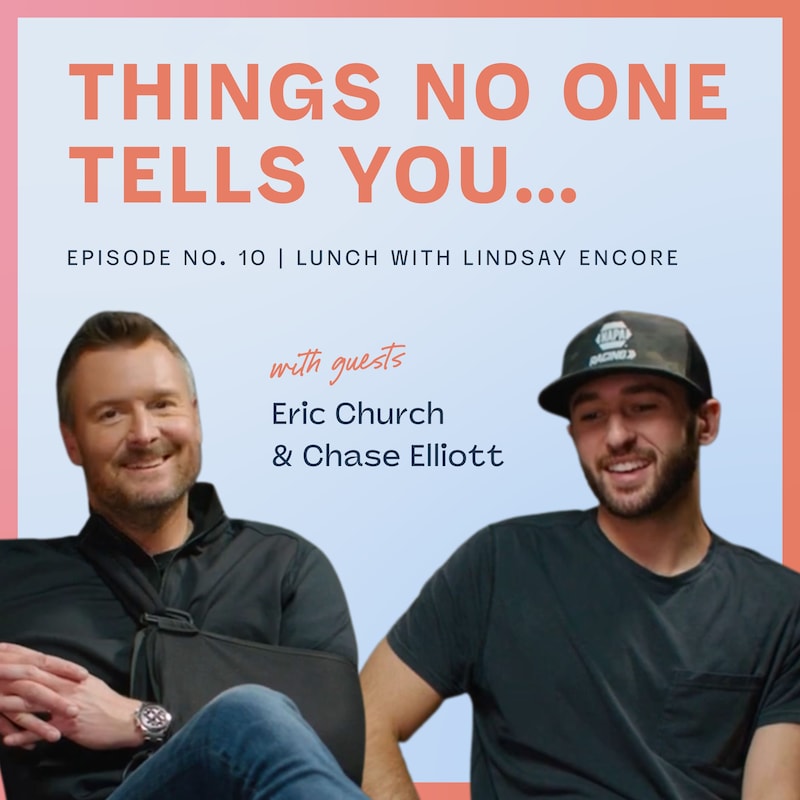
You may know Eric Church as a country music icon and Chase Elliott as a NASCAR champion, but what happens when two high performers sit down to talk, not about the spotlight, but about what keeps them steady behind the scenes?
Because rising to the top is one thing. Staying there? That takes a different kind of strength: the habits, the anchors, the quiet choices no one sees.
In this episode, I revisit one of my favorite conversations, which was originally recorded during my Lunch with Lindsay podcast series in partnership with FamilyMade. I joined Chase Elliott and Eric Church at Eric’s writer’s cabin for a special conversation.
Eric and Chase may seem like an unlikely pair, but sit with them long enough, and you’ll see the parallels run deep. Both have built careers in high-pressure arenas. Both have learned to tune out the noise. And both know the challenge of staying grounded when the stakes are sky high.
Chase and Eric open up about the moments that changed them, the pressures of being seen, and the quieter choices that shaped their careers. From Chase’s early days trying to outrun expectations to Eric’s defiant decision to tour solo after getting kicked off the Rascal Flatts stage, this episode is a deep dive into identity, legacy, and the kind of grit that can’t be taught.
What You’ll Hear:
- Eric’s surprising creative outlet: chainsaw therapy (03:28)
- Why Chase prioritizes fun off the track (06:45)
- Eric’s career-defining decision to go solo (14:09)
- Chase on separating passion from pressure (18:44)
- Why Eric stopped chasing charts, and found peace (20:23)
- The power of real connection in high-profile lives (31:49)
- The way both industries are changing over time (50:26)
If you’ve ever wondered what it really takes to stay steady in the spotlight, this one’s for you. Be sure to stay tuned for the special surprises Eric and Chase have for each other at the end of the episode.
You can watch this interview on YouTube: https://youtu.be/kvpVqCsbtlU
For a full transcript and more, check out our blog post: https://www.lindsaycz.com/show-notes/eric-church-and-chase-elliott
Connect with Eric Church and Chase Elliott:
For more from Eric Church, you can follow him on Instagram: https://www.instagram.com/ericchurchmusic/
And for more from Chase Elliott, you can follow him on Instagram: https://www.instagram.com/chaseelliott9/
Transcripts
[00:00:04] Lindsay: With chainsaws?
[:[00:00:17] It was a way to come out here, and if you're not focused on a 30, 40, 50-foot oak where it's gonna fall, if that's not something that's got your attention, it can kill you. And there was something so micro about it. It was a way for me to escape what was going on in the world, so I could get a chainsaw and I could go cut the tree and then process the tree, and it just got me away from that.
[:[00:01:00] Lindsay: Hey everybody, I'm Lindsay Czarniak, and this is Things No One Tells You.
[:[00:01:24] Follow me at Lindsay Czarniak and be sure to subscribe, rate, and review things no one tells you wherever you like to listen. Hey guys, it's Lindsay of Things No One Tells You, and I am so excited to share this podcast episode with you because this episode is actually one from my previous podcast, Lunch with Lindsay.
[:[00:02:13] Here's how this one happened. So I have been a fan of Eric Church and his country music for a very long time. But somewhere along the way, a few years ago, Chase Elliot, the NASCAR driver, I was covering him when I was working on a series, A racing series, and I was just asking Chase who his favorite musician was and what he listened to, and he said, Oh, Eric Church.
[:[00:02:53] So what I did not expect to happen was for Eric to invite us to his writer's cabin in Tennessee, outside Nashville. And Chase was like, yes, I will come, I will be there. I would love to have this conversation. It was so cool because Chase actually flew down there, on his plane with his dad, Bill Elliott, who's one of the most famous NASCAR drivers of all time.
[:[00:03:33] Soitt was a big deal for both of them. Eric had a broken shoulder and it was, and it happened in a snowmobile accident and Chase had another situation with his knee, and that was a unique scenario that he can tell you about because it was another winter sport. But, so here we are having this conversation.
[:[00:04:14] Eric Church and Chase Elliot.
[:[00:04:19] Chase: What's happening? How are you? You hurt yourself, too. Winter sports. I understand. Not the way to go. Who knew?
[:[00:04:28] Eric: to meet you.
[:[00:04:31] Eric: Oh yeah. I'm glad we could do it. Mr. Bill, good to see you. Good to see you.
[:[00:04:35] Eric: How's your leg?
[:[00:04:50] Lindsay: It is quite ironic, isn't it? It
[:[00:04:59] I understand. Thanks for having us.
[:[00:05:03] Eric: I'm here a lot. Yeah, right here. Fish here. Some good fishing out here.
[:[00:05:09] Eric: Yeah.
[:[00:05:18] Right. And so this has been a long time coming. I've listened to your music for so long. I feel like the first time. I heard your music was back when someone handed me a CD in like 2006 and was like, lemme know what you think of this guy. Right?
[:[00:05:39] We've got a broken shoulder. A broken leg, knee?
[:[00:05:46] Lindsay: Right?
[:[00:05:49] Lindsay: What the heck happened? What happened?
[:[00:06:05] Eric: For me, snowmobile and for me. But yeah,
[:[00:06:13] Eric: Let me go first. Chase,
[:[00:06:15] Eric: Yeah. His story's better. But I mean, for me, we were in Utah and we, so every year during spring break, my whole family skis and we pick a spot and we change every year and we'll go.
[:[00:06:45] Let's do something different. We skied for so many days, let's go do it. And they've had so much snow out there, at least for me. I hadn't been on a lot of snowmobiles either, but I caught an edge. And, the scariest part is I had my 8-year-old with me, my youngest, and he crashed with me.
[:[00:07:17] Lindsay: Right. Not a little bit. Right. So when that happened to you, though, was that what was going through your mind?
[:[00:07:27] We were, we were 10 miles from where we started and with no cell phone service. Oh my God. So he hit his head pretty good. He had a helmet on, but he hit his head pretty good. So we were concerned about a concussion and ended up calling paramedics. We ended up getting service by calling paramedics. And so I ended up carrying him on my shoulder.
[:[00:07:57] Lindsay: The adrenaline. Yeah, the adrenaline is kicking in.
[:[00:08:25] But actually, all things considered,e, it was not as bad as I think it could have been. So I think we're on the back end of it, so it should be good. Did
[:[00:08:36] Chase: I had a pretty good feeling. At the time I was, I was just kind of towards the end of the trip, getting ready to head to the next race.
[:[00:09:00] Lindsay: Well, and for both of you really, but for you being in the midst of what you're doing, chase, was it like, were you, what is that?
[:[00:09:10] Chase: Yeah, I mean, I, again, I, didn't feel like I was being irresponsible or doing anything that I wouldn't do any other day. But it was just one of those situations where, yeah, the timing was bad, and it was that perfect storm. And, at that point in time, I knew that it didn't feel good, but obviously hadn't been to the hospital yet.
[:[00:09:39] Lindsay: Was there a phone call that was hard, like that you were kind of nervous about making in that circumstance?
[:[00:09:50] I feel like, probably way cooler than I was expecting them to be about it. And, totally understood, and I feel like I understood, why I was there and why I was doing what I was doing. And, the fact that I've been snowboarding for a long time, and that's not something super uncommon, I guess.
[:[00:10:16] Lindsay: Well, also it's part of the conversation, I mean, there have been articles, like Ryan McGee had a great article about it. Yeah. People do what they do, and you've gotta let them do what they do sometimes, especially when I think Kevin Harvick was quoted on, it's talking about how what we do is such a lifestyle.
[:[00:10:36] Eric: Yeah. When I first bought this property out here, I used to cut trees down. That was my…
[:[00:10:44] Eric: With chainsaws. That was my escape. And, I don't do that anymore, but I did it for a long time because there's so much focus that goes into it, and at that time, that would've been the chief era.
[:[00:11:21] And that's not something I would recommend. I don't do it anymore. But at that time, it was very important to me. It was something that mattered to me. So whether it's's snowboard or a snowmobile, or you have to have that pressure valve that you can release that steam, when you do something that's exceptional.
[:[00:11:44] Lindsay: So you think that's something that comes with a certain level of, I, I
[:[00:11:50] Lindsay: That's what's required.
[:[00:12:03] Chase: I agree personally, I mean, I think there's, and I think a lot of people see just on the stage, right? Or just on the track, but there's a lot of stuff that goes on off the stage or off the track. Yeah. And obligations. And probably, I would even argue maybe more so balancing all of that stuff more than, yeah.
[:[00:12:37] Lindsay: How do you do that? How do you, because there's a lot of compartmentalizing, right?
[:[00:12:49] Chase: I think that's a very tough question. I think for me, I think, I was, dad taught me at a very young age to take this very seriously. That there's a lot that's going into this. It's not a joke.
[:[00:13:25] It's just not something that's given every day. And I don't want to ever, I don't want, I don't wanna ever disrespect that or feel like I'm disrespecting it. So, for that reason, I just always take the job very seriously, and I probably always will just because that's how I've always been.
[:[00:14:01] Lindsay: Like the fuel, you mean? Yeah. That's the fuel that drives you.
[:[00:14:24] So you realize at some point in time that you get to do this. And if you don't treat it with w certain amount of respect, Chase said it's really good right there with, you think about the people that came before you. You think about putting something up on that mantle, musically or racing-wise, that other people will look at and measure themselves against.
[:[00:14:53] Lindsay: I love that because it is its sort of, for a long time I've thought NASCAR drivers, you guys are a tick off. And I mean that so respectfully in a great way. Meaning to do what you do, right?
[:[00:15:25] What's the difference? But so I just think it's interesting.
[:[00:15:44] And I think a lot of, not only is, NBAs, everything's the same. You have to meet at the moment. And I think that, understanding that and being able to do that, and how you build your craft, too. I mean, Chase didn't walk out and just jump in a cup car and start, they call it Cup Cars anymore. That's the old days.
[:[00:16:19] Lindsay: I was thinking about the journeys that both of you have had. Cause I think there are a lot of circumstances that are similar time-wise for you guys. Like I was talking to Chase about. 2011, that's when, chief, right? That was the time of the chief.
[:[00:16:42] Right. So that's funny. In 2020, you won your championship. Eric wins. CMA entertainer of the year. Right? Yeah. It's interesting to note that the parallel.l
[:[00:16:56] Chase: I know the feeling. No banquet. No, no, nothing. No nothing. Yeah. Just here's the trophy. Go home.
[:[00:17:07] Lindsay: Yeah. What was it like? Did it,
[:[00:17:11] Eric: That's why I want another one. He probably does too. For the same reason. It's I wanna do this the right way.
[:[00:17:21] Eric: We met, I mean, I think the first time we met, correct me if I'm wrong, but it was in a, it was in a meet and greet.
[:[00:17:33] We were somewhere like Gwinnett Arena or something like that. Yeah. It was Gwinnett, I think. Yep.
[:[00:17:37] Chase: Around 2014, 2015. Somewhere in that timeframe.
[:[00:17:45] Chase: It was. Yeah. So, yeah, I mean, I was, he didn't know me, and that was totally fine.
[:[00:18:02] I guess today, right now,
[:[00:18:08] Chase: It was, yeah. A short time after. Yep.
[:[00:18:11] Chase: Just a few weeks. Yeah. Okay.
[:[00:18:17] Chase: I mean, I think, that's a really tough thing to ask when the guy's sitting, right?
[:[00:18:22] Chase: But, I think for me, I was introduced to his music, I would say probably around 2008, 2009, somewhere in there.
[:[00:18:58] That was how I learned about him and started listening to his music, and from there, for me, it was when you start to travel up and down the road, you have a lot of time to think, and sometimes that's good, and sometimes that's bad. But that does give you a lot of time to listen to music and for whatever reason, his way to, and this is one thing I've admired about just musicians and artists in general, is to be able to, it always blows my mind when I go to a concert that people are singing words back to you that started in your head, how, that process works.
[:[00:19:52] And that was why I got into it.
[:[00:20:33] I held him for a little while. First concert. Yeah.
[:[00:20:40] Chase: Close.
[:[00:20:48] Lindsay: Are you the guy who we'll play a song and then play it over and over? It's before switching to a different song.
[:[00:21:15] Yeah. To me, music that grows on you over time is the same way. That's something about his music that I think is really cool. And there aren't a lot of artists like that, that if their music gets better, the more you listen to it, that's doing something. And in my opinion, I think a lot of times those songs that are in between the ones that you hear on the radio tell that story the best.
[:[00:22:22] It's not about Drink in My Hand and Springsteen. It's about those other songs that tell the whole story. And it took me a tour to figure that out. My least favorite tour of my career was the Chief tour.
[:[00:22:36] Eric: That was the biggest album we had, but I didn't know how to do it. Right. I came from bars and clubs, and I was trying, I was like, well, they're here to hear Springsteen or drink 'em.
[:[00:22:55] Lindsay: Even though you had hits, like top 20 hits, never.
[:[00:23:04] Lindsay: Because you felt like you weren't connecting, is that?
[:[00:23:16] They're really good maps. But the real songs are the other ones. Like when you go to a Springsteen concert
[:[00:23:23] Eric: You want to hear Born to Run or whatever. Yeah. But it's those other ones, it's the pacers, that take you through it that makes the show. And it took me a minute to learn that.
[:[00:23:34] Eric: I learned it from fire, going through the fire. I didn't, it wasn't something I called anybody. I learned it from not enjoying my first, I think it was a, I forget the name of the tour. I think it was Blood, Sweat, and Beer Store. But, it was during the chief album, so we went from here to the biggest artist in music, and not just country music.
[:[00:24:10] And I thought, what, where did these people come from?
[:[00:24:24] Frankly, that's how I felt going from that to doing sideline reporting, 'cause I'm like, I don't know who... Right? It's when your norm feels shaken a little bit, then you don't, it's a weird feeling. I'm not comparing myself to you. No, I get what I'm saying, like it's yeah. Right. It's relatable on some level.
[:[00:24:51] Eric: Question. Can I ask a question? Oh, please. Was it hard with your dad? Was it hard, especially being younger? 'Cause I think about that, was it, the expectation part or the, I mean, right.
[:[00:25:04] Chase: Yeah. Yeah. I mean, I think it's interesting you asked that because I was wondering today too, I'm like, obviously we're not the same age, but I knew you had a couple of younger boys. And I'm like, no, that's interesting because they might, they could potentially be in a similar position as me one day.
[:[00:25:19] Chase: that I grew up in. So I was like, yeah, that's kind. That could kind of make sense, right? Or hit home a little bit. But for me, I think it was, I have felt like my parents and I, put Mom into that category too, 'cause I think she had a big role in, in obviously raising me, and going to the racetrack.
[:[00:26:03] And, racing was always my choice. If I went home, whether I was 10, 15, 20, if I went home and said, Hey, Mom and Dad, I don't wanna do this anymore, it would've been totally fine. And, they always made that really apparent to me. And I think because of that, it. It kind of became my own path, at least in my eyes.
[:[00:26:40] Like, on a personal level, I'd love to one-up him. Absolutely. I'd love to.
[:[00:26:51] Chase: I was about eight. So fairly young. I mean, obviously at that time, I mean, it's not, you're not seriously racing at eight, right?
[:[00:27:19] You went from go-karts to like, what was the first kind of full-size car?
[:[00:27:45] Eric: Did the Elliot name when you were in that situation, did that ever hinder you, help you, I mean, I'm assuming help you just 'cause I know your nature, but I mean, was it a thing like in some of those early ones, I'm trying to think if I, if you show up, right?
[:[00:28:24] Chase: I had a thought, and I just, I lost it there, but I think in, in, in some ways, I think you probably skirt it, but in some ways, I think to your point, you have to have that desire on your own to want to go do it. And, there were obviously, I admired dad's career and always looked up to him, from the racing side, but also had other people I looked up to right within the industry as well.
[:[00:29:14] Kids were doing on the weekends with their friends, I was off racing. At certain points in time, I might have been like, man, you're not, I wish I were doing this. But honestly, as time went on, I just, I, that fire and that desire to want to go and achieve that goal never went away, and that never burned out.
[:[00:29:39] Lindsay: Do you remember like the first time that you felt that fire that you were like, oh, this is
[:[00:30:02] Dad's career goes a lot further back than that. But those first two thousand years were the ones I was just barely old enough to remember. And, the way I looked at it as a kid was. If you weren't at the race that weekend, then you weren't living life like that. It was a sin for you not to be at the race that weekend.
[:[00:30:44] But obviously, when you're a little kid, that first spark is just the spectacle that it was. And the fact that he was a part of the show, I just thought was the coolest thing ever.
[:[00:30:56] Eric: Well, it's courageous too that you, actually, you do, you follow in those footsteps.
[:[00:31:06] Lindsay: I was gonna say, are they musically inclined? Do they like... Your kids? Are they,
[:[00:31:15] But, I try, not to sometimes I, I shudder when they, they'll sit, my oldest especially will sit at the piano and, figure some stuff out that I know he's, that's kinda gifted that he can do.
[:[00:31:49] I mean, three. I mean, it's a very exceptional thing.
[:[00:32:07] Yeah, that's right. That you've liked, really,yeahh, that's right. And Chase said to me because I was thinking about just the origin of it, and just earning what you guys have both accomplished, and Chase, you made a joke about inheriting your dad's fan base. And I understand why you're saying that, but the other thing is that's not how you become the most popular driver five times in a row.
[:[00:32:38] Chase: I mean it, I definitely stepped into a very fortunate situation. I think. My upbringing was much different than my dad's upbringing, and I think my dad's upbringing was something that the fans could really tie to through the late eighties and through the nineties.
[:[00:33:12] Right. I came up to your point, I definitely had some opportunities that I might not have had if I weren't Bill's son. But at the same time, I think the most important piece through that process is having respect for the people that are there before you at each step of the way, not just in NASCAR, but as I was coming along, racing short tracks and as I mentioned, when things started to get serious, you, you grow respect for those veteran guys who help shape you to be the race car driver that, that you are. And, I think having that respect can make you the driver's kid that I aspire to be, or not. And, I can't, I didn't choose that. Right. But you can certainly do what you have,
[:[00:34:05] Chase: Like short track guys? Any guys? Any guys who
[:[00:34:09] Chase: Yeah. I mean, short track guys, I don't know, Bubba Pollard and Auggie Grill were, wo extremely Talented. I mean, we can talk about the NASCAR people, but these were like some of the first guys that I remember going to race at Pensacola, which is a track, down in Florida, that is really well known in the super late model world.
[:[00:34:37] Lindsay: That was SRX was there last year. They, raced
[:[00:34:41] Lindsay: So hot.
[:[00:34:51] But at the same time, too, the more I raced with those guys and it took me a long time to get to where I could keep up with 'em, but once I could keep up with 'em, because I had that respect level for how long they had been there and how bad they had whipped my ass for the past two years, you race them with that type of respect that they deserve.
[:[00:35:33] coming along and making sure there, there are a lot of people that were here way before you, right? In whatever industry you're trying to jump into. And, I think there's something to be said for those men and women who have kind of helped pave the way,
[:[00:35:51] If yoyouaa a craftsman, and you know the names he mentioned, there are a lot of NASCAR people who would've thought he would've mentioned four or five, six of her names. But I can say from my standpoint, I'm gonna talk about John Prine.
[:[00:36:09] And there are a lot of people out there that would go, who, who is that? Now they'll know some of 'em, but some people won't. And I think that's a part of the craftsman part of it, a person who's a craftsman knows a craftsman, as Kobe Bryant has one of the greatest quotes. A lion knows a lion.
[:[00:36:45] And if you know that, it'll allow you to be the best you can be. So, those answers I was really intrigued by, because that would've been way lower on my list of what I thought he was gonna say. Yeah. But I think that shows you the level of commitment to what he does.
[:[00:37:21] Right. Or I think that's a common thread.. That's pretty cool. And it makes total sense. With fan bases. So with you, Eric, how did you do what you did? Did you believe that you were gonna have that rabid of a fan base at a certain point? Or did you? Was it strategic, or?
[:[00:37:43] I think a lot of our things were circumstances that happened, and then we reacted to the circumstances. Cameme out, we had, how about using our first song, and did okay. And then we released a song about teen pregnancy, two pink lines, 'cause I thought that was a good idea. That didn't work. And then we got fired from Rascal Flats' tour 'cause we didn't follow the rules and all these things happened, but we reacted.
[:[00:38:03] Eric: We, it was a bunch of things, but yeah, we can get into that another time. But yeah. Wasn't that simple, but yes, we got fired and, but we, reacted to those things, right? and our fan base, the way we reacted is how our fan base kind of, so when we got fired from the Rascal Flat Tour, we had 12 shows left.
[:[00:38:46] So the Rascal Flatts is playing the arena, right?
[:[00:38:49] Eric: I was playing the Little Rock Club down the street, and I would start my show when their show ended, and I did it every city on the rest of the tour.
[:[00:38:57] Eric: Honored the entire tour? The whole thing. Like we'd show up, and some nights you had 12 people.
[:[00:39:18] There wasn't a guy contingent.
[:[00:39:25] Eric: So as we would go play these places, you would get like this, cru disgruntled southern rock, classic guy, tattooed dude at the bar. And we kind of found a fan base.
[:[00:39:53] Lindsay: Did they know you were doing that?
[:[00:40:11] I've, we've tried to do that our entire career. I mean, I've done that. Yeah. I've done that a number of times, where I don't care if you agree with me. I'm gonna tell you what I think. I don't care how it affects my career. I'm just that'sho I am. And I think that the real, the real fan base is they understand that, and I think it makes 'em more passionate.
[:[00:40:36] Eric: No. No. I don't know of, no.
[:[00:40:39] Eric: I don’t really know of another one that it happened.
[:[00:40:44] Eric: That was the biggest act. Believe it or not, that was probably the biggest act in country music at the time.
[:[00:40:52] Lindsay: Is it true that Taylor Swift sent you a guitar?
[:[00:41:03] Lindsay: Yeah.
[:[00:41:09] I was planning to go to the next show, and then she called and said, Well, I'm doing the show. I said, well, okay, I guess I'm not, and I, I said, listen, you're gonna, she apologized, and I said, listen, don't worry about it. And I said, you're gonna,
[:[00:41:20] Eric: I said, you're gonna do great.
[:[00:41:46] Lindsay: Oh my God, wow. Right?
[:[00:41:49] Lindsay: I love that story though, about, I don't know what
[:[00:41:55] Lindsay: Yeah. Yeah. Oh my God. That's crazy. Yeah, when was the first time you heard Talladega?
[:[00:42:26] So, yeah, not long.
[:[00:42:32] Chase: Well, that, to me, that was one of the songs on the record that everyone was gonna and you knew, I knew the first time I listened to it, that was gonna be one of the ones that everybody was gonna listen to, right?
[:[00:43:00] Lindsay: How'd you become a NASCAR fan in the first place?
[:[00:43:11] Lindsay: Okay.
[:[00:43:15] Lindsay: The Jarretts race there.
[:[00:43:34] It probably doesn't matter as much now, but in that Golden era, let's say late eighties through the nineties of NASCAR, it was really a lot of it was about what you drove. Oh yeah. It was about the, it was about the brand of cars. Yeah. Chevy. And
[:[00:43:48] Eric: Was it really Ford or Chevy?
[:[00:43:52] Lindsay: Yeah.
[:[00:44:09] Lindsay: So the idea for Talladega was that percolating for you for a while?
[:[00:44:25] It's not about it's racing or could it have been football or could it have been soccer. It doesn't matter. It's about being with the people and experiencing that and letting that be a marker, a memory marker for their life. And that's really what it was. Ironically, when I wrote that song, I was on a bus at a festival, a July 4th in Daytona.
[:[00:45:03] It's like Woodstock, Yeah. And we start talking about it's a great way of describing, and I was like, well, we could, we could just write this, but we couldn't get Daytona to line up. Right. And for whatever reason, Talladega lined up better. So we wrote it that way.
[:[00:45:24] Lindsay: I love the way it starts. What, so what's it like to win Talladega?
[:[00:45:28] Lindsay: You won the last race that was there, in October. I'm gonna
[:[00:45:36] I'm great on a snowmobile. It looks like it. You, yeah, that's right. You take this one.
[:[00:46:08] That has made Talladega special, in my eyes. But just because, yeah, and I guess it's because it's so close to home. I don't know if it's just his past and the wins and the speed record and all that stuff, obviously have a great significance over the course of NASCAR history, or if it's just 'cause it's right across state lines, but nonetheless, it's always kind of felt like a home race.
[:[00:46:48] It's, it's just one of those things that certainly have to have some things go your way, but just that atmosphere is what makes that place special to me, and how close it is to the house.
[:[00:47:08] Right. Of course. That would
[:[00:47:31] Lindsay: Yeah.
[:[00:47:36] Yeah. Yeah. No, you're good at that. That, that, that's a whole, that's a whole different, like that's a, that happened in, that's happened in music too. That's happened in country music. If you go back to Aaylon, Merle Haggard, that era.
[:[00:47:47] Eric: It was different with how they approached shows, how they approached their interaction.
[:[00:48:17] And it's just, it changes, it changes. It's kind of a growing up in the sport, a little bit, it's gotten negatives and positives to me. Not to interrupt you, but that, no, something that
.[:[00:48:27] Eric: When you said that I've had to deal, I've had to do that too.
[:[00:48:35] Lindsay: It requires bandwidth that you would have to be by yourself or do whatever, right? Are you saying leading up to the event?
[:[00:49:03] Chase: And there's gotta be a switch in there
[:[00:49:25] Yeah. But at the same time, I think, because of that, it is just how I feel like I need to be, to go to perform at the level that I feel like I need to perform at. But balancing, taking care of your partners, and making sure everybody is, all those boxes are checked, a nd then to get in a competitive mindset for me is something very difficult.
[:[00:49:49] Lindsay: Yeah.
[:[00:50:05] Unless you win, most of the time you go home mad. But every now and again, you'll get lucky and go home happy. But that part of the day is really important to me because when you're getting in there, that's, you're finally in your space, it's yes, I'm finally here. Let's go to work. I want to go to work and do what I do, what I came here to do.
[:[00:50:36] Eric: I think what he said was very profound. You have to be able to flip the switch.
[:[00:51:00] But I need a minute before I go and then do my real kind of job, and
[:[00:51:07] Eric: That's just the way I process it.
[:[00:51:13] Eric: I go to the bus, kind of, I'm kind of alone for a minute. I kind of process where I'm at the show, when I pro, I usually have a Jack Daniels and then go play. It's just, it's a matter of getting in the spirit of what, got, how I started doing this in the first place.
[:[00:51:42] I don't, I've never driven a race car, but if you don't have that swagger when you walk out in front of that many people, or you drive a car in front of that many people, you're not, you're gonna lose. Some people have it, some people manufacture it. It doesn't matter as long as you get it there.
[:[00:52:06] Lindsay: Do you have a, like, a process?
[:[00:52:11] Chase: It's definitely not. It's definitely not, Jack Daniels. I think for us, it, is different because my time that you talked about kind of have a few minutes to yourself, that happens two or three hours before the race, and then in between those two hours before the event, I'm back to taking care of, the partners and, the things that we do all the way up till literally you get in the car.
[:[00:52:59] But you have a few minutes to. To kinda get your, get yourself back together.
[:[00:53:15] Chase: Yeah. I think you won in 19. I remember that. Yeah.
[:[00:53:19] What? Do you remember? The crowd?
[:[00:53:34] And then, I just think the great thing about being able to do that when it becomes a, these boots is that way where people raise their boots up when you have something that I never manufactured, I never said, Hey, do this. Right? Yeah. It was never something; there was never a cue. They just took that upon themselves to do that.
[:[00:54:06] Lindsay: Super cool. Do you remember seeing that?
[:[00:54:30] So yeah, definitely special and meant a lot to me.
[:[00:54:44] Eric: I've had, I've had a few, but I got to do, as far as like just shows, I mean, I have two that come to mind immediately, mine.
[:[00:55:04] Lindsay: Wow,
[:[00:55:35] And there was a moment during that when you look at the crowd and I'm looking, this fucking Bruce Springsteen that I kind of went, okay, this is one of those moments, so, so for me, there's there, there's more than that. But that's a couple that comes to mind.
[:[00:55:52] Right. Yeah.
[:[00:56:01] Eric: A good one. Yeah. That's another great place.
[:[00:56:19] If I stop singing right now, they're gonna sing every word to me that, yeah. Began as a thought that always has blown my mind about just the musicians and the great artists, and just how you can create those tunes out of thin air. I just, that, that blows me away.
[:[00:56:41] Yeah. Right. In your tour coming up this summer.
[:[00:56:51] Lindsay: I didn't realize that you never did. Well, you never had an opener.
[:[00:56:56] It's just us, so this is the first time we're actually bringing that.
[:[00:57:01] Eric: No, I'm just kidding. Good, good, comment though. But no, I think, it's just at least for this next tour, when you go out, so I've never played amphitheaters.
[:[00:57:31] I just wanna bring people in that I think we should champion. Cool. And I enjoyed that, so being able to bring these people in, it'll be something new for us. It'll be a new way to tour.
[:Eric: I love all of the, what's happening in the non-commercial aspect right now, the Americana aspect.
[:[00:58:03] Lindsay: What are you excited about with the future of NASCAR and for you?
[:[00:58:30] Probably a lot of your decision on who you decide to bring with you for that show or that festival is a lot of your decision? A lot of the things that NASCAR does on the weekends are not my decision. Frankly, I'm just a part of the, I'm a part of the event, and I'm just a competitor in the event. So I think for me to sit here and act like I have this perfectly mapped out story for where NASCAR goes over the next 10 years, I'd be lying because that's just not my call.
[:[00:59:18] Eric: Do you like the new rules, changes, and stuff at NASCAR, let's say the last three or four years? Is that something you like or don't like?
[:[00:59:42] And I think what scares me about some of those changes being made is they're not gonna be able to look in the mirror and say, this wasn't good, and we need to maybe do this a little differently or go back here or go back there. Not to say they're all bad, because I think some of them can be positive too, but, so I appreciate their willingness to try new things.
[:[01:00:05] Eric: There's a lot of correlation. I mean, the reason I'm always intrigued by this is with NASCAR and country music. There are a number of times that, let's say, I'll use country music as the example. There are a lot of times in country music history where we kind of found ourselves, right?
[:[01:00:41] And the market crashes. Right? And we have to find our way back to earth. NASCAR's a lot of the same way where, in the late nineties, early two thousands, NASCAR is building bigger and bigger tracks. It's the fastest-growing sport in the world. It's bigger than soccer. There are 200,000 fans at these places.
[:[01:01:15] Right? So country music's done the same thing, and it's not always worked, but so
[:[01:01:21] Eric: That's a great question. You meet in the middle. How do you? That's a great question. I think the soul of it, you still have to have, 'cause I think the soul of NASCAR is very similar to the soul of country music.
[:[01:01:35] Lindsay: I mean, I think that what you just said is also just anyone that came through that pandemic, it's like you realize so much more as well that the value of just the people, right?
[:[01:02:11] Chase: Start, why don’t you go ahead on that one?
[:[01:02:15] Eric: I think I got a few answers there. I mean, a lot of times that you look back on your career, I think for me it was, it was staying true to the art part of it. When we were in bars and we're in clubs, and you have a label going, Hey, this isn't working.
[:[01:02:53] You kind of stick to your guns. I see so many young artists who work their whole lives to get a record deal. That's their dream. And then things start to go a little bit sideways. And you have a label or somebody goes, This is what we need you to do. And they do it because they just want it so bad.
[:[01:03:30] And I think a lot of young artists that the pressure to not do that is enormous, and they don't do it normally. So I think for me, that moment was, big moment.
[:[01:03:45] Eric: Well, for me, I made it go okay, if I may fail anyway, I'm at least going to fail on my own terms, I'm gonna get enough rope to hang myself.
[:[01:04:08] Lindsay: Did you have to ask people, because that's a hard decision to make, right?
[:[01:04:17] Eric: Yeah. I mean, you have to ask people, but at the same time, it all comes down to here. Yeah. Right. But I did. I was like, yeah, they want me to do this, and we do that, and we flirted with it. I mean, like any artist would, I mean, I'll admit it, I did too, and I was like, man, I can't do it. So we put out Smoke a Little Smoke Pro marijuana song, which is perfect for the time. You who thought that would work?
[:[01:05:00] And then that road to getting that first win in the Cup series was pretty rocky at times. And, there was some, and that kind of includes going home very disappointed, on a few occasions. Having were fortunate that we had opportunities to win, but we just couldn't get over that hump.
[:[01:05:46] And that road was, it was filled with a lot of good lessons for sure at the time. Didn't appreciate 'em, but looking back, definitely, I definitely do. And, I think that. Helped not only myself, but I think it helped our race team become who we are today, who, fortunately, a lot of us are still there, kind of the same group.
[:[01:06:11] Lindsay: What'd you take away from that? What was the lesson that you said, or one of them?
[:[01:06:55] What it should feel like and how much appreciation you should have for it when you get there, because that's a tough one to cross. And, those tough losses will show you how much it means to you because if you go home upset after a tough loss, it means you care. And if you had a tough loss, it means you're probably pretty close to achieving it in the first place.
[:[01:07:15] Chase: Well said.
[:[01:07:17] Chase: Agreed.
[:[01:07:23] Chase: I'd like to win one championship. We talked about the COVID year, right? So doing one outside of the COVID year would be cool. But, yeah, I mean I think that I could probably give a deeper answer than that, I think.
[:[01:07:59] But being able to win more than one is a big deal.
[:[01:08:20] It's not about I wanna win this award, I've won all the awards. I've sold all the albums, I've sold out all the venues. So it's a matter of what is something musically, or I don't know artistically, that has nothing to do with any of those measurements that I wanna. And I think that, I don't know whether it's writing, whether it's a Broadway show, whether it's, I mean, any of that stuff, I don't know.
[:[01:08:48] Lindsay: Is that... have you thought of those things then?
[:[01:09:06] But as long as you can lean into that, I think that, you'll, there's cool stuff that'll happen, at least in my life, remember.
[:[01:09:21] Like I'm gonna, I'm gonna figure it out and I'm gonna chase whatever comes,
[:[01:09:32] Chase: Yeah. We'll bring it up. I don't know where it is.
[:[01:09:58] It's something I keep at my house, and I greatly appreciate you doing it. Never had a chance to say thank you. So, thank you. Yeah, you're welcome. You're welcome. And yeah, so this is a, oh yeah, man, a helmet from oh, that's cool. 2021, 2022. and. Wrote a little note. You don't have to read it, but nonetheless, no.
[:[01:10:17] Chase: You can read it. Just don't read it out loud. I'm joking. Thank you. No, either way. But just appreciate y'all doing this and having us. And how tight are these things? They just, they gripy they, yeah. You won't, you don't want that to move.
[:[01:10:34] Eric: I drove the Pace car at Talladega in 2016-17. So I got to kind of go do that, hing. Awesome. It was fantastic. Thank you for this.
[:[01:10:49] Eric: I have a similar thing for you. I have a similar theme.
[:[01:11:15] Chase: Yeah. You got it. Yeah. Thank you very much. Wow. That's awesome. That is very cool. Yours comes with a much cooler story than mine. I
[:[01:11:31] Lindsay: Wow, that you had to go get it.
[:[01:11:34] Chase: Oh, you're being serious about that.
[:[01:11:38] Chase: Yeah. Oh, wow, I definitely don't.
[:[01:11:41] Chase: Yeah, I see that.
[:[01:11:44] So you're better?
[:[01:11:47] Eric: Yeah. That
[:[01:11:49] Eric: Cause it, I guess, it's the racing stripe. That was the thing when they did it, it was like the checkered flag kind of thing.
[:[01:11:55] Eric: That was the whole deal.
[:[01:12:01] Eric: but impactful.
[:[01:12:03] Eric: There you go. That's awesome. Thank you. Yeah. I appreciate it. Nice amigo. Yeah, you too.
[:[01:12:12] Eric: Yeah. Thanks for having us.
[:[01:12:19] And of course, if you're listening on Apple Podcasts, don't forget to leave a five-star review because that's really what helps people get more. Listeners, we would love to grow this community. We are so grateful that you're a part of it. See you next time.




