Shownotes
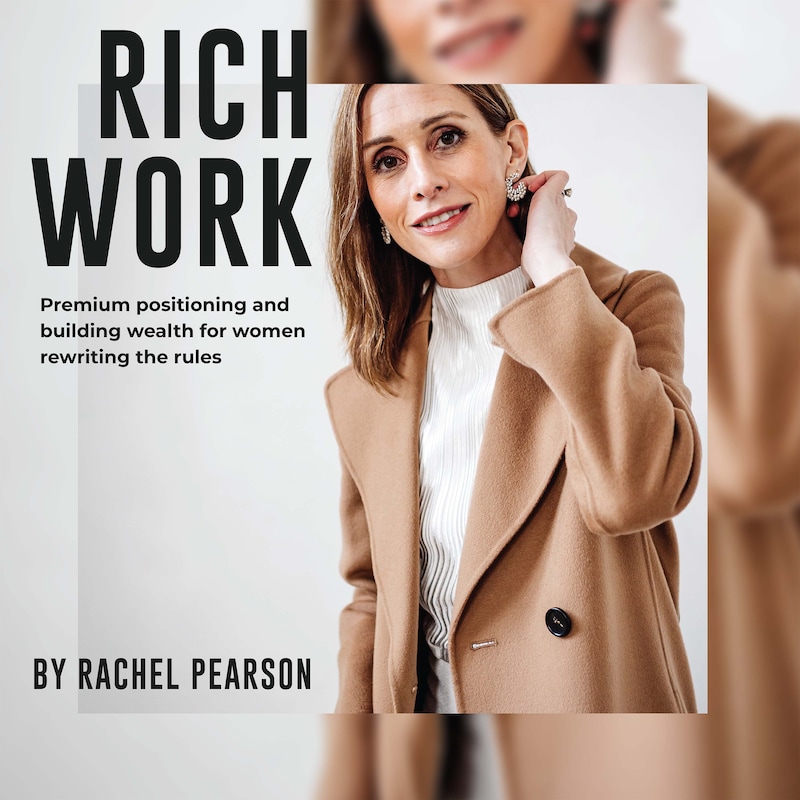
Welcome to Rich Work! The podcast where we talk premium positioning, high ticket strategy, and the identity shifts required to scale with intention. I'm your host Rachel Pearson, and I'm so thrilled you're here for the very first episode!
In this episode, I'm going to share with you what actually creates premium positioning (and it has nothing to do with elevated aesthetics or six-figure talk) and why most premium clients don't care how much you charge.
I spent 15 years behind the scenes with luxury brand houses, watching how they built incomparable empires. Then I brought those principles into my own high ticket business, and everything changed. The secret? Your business differentiation strategy can't live as words on your website. It has to be woven through every touchpoint, every client interaction, every decision you make.
This is how you stop being interchangeable. This is how you attract the clients who don't shop around. And this is how you build the kind of premium brand strategy that compounds over time, creating real wealth, real choice, and real impact.
If you're scaling your business but feeling like something's missing, this episode rewires how you think about what makes your business truly premium.
Topics covered on Premium Positioning:
- What most people get wrong about premium positioning (and why your branding isn’t the problem)
- The Chanel Principle: Why luxury brand positioning is never about the product
- How your philosophy becomes your business differentiation strategy that nobody can replicate
- Why premium clients don’t need convincing, they need congruency
- The three questions that sharpen your premium brand strategy immediately
- How to weave your positioning through your business so it becomes felt, not just said
- Why scaling your business without a clear philosophy leaves you exhausted and underpriced
Connect with Rachel:
- Come say hi on Instagram │Facebook │LinkedIn
- Calibration Mastermind: https://rachelpearson.kartra.com/page/Calibration-mastermind
Resources mentioned in the episode:
- Download your episode freebies: https://rachelpearson.kartra.com/page/sJM184
Related episodes you may enjoy:
Transcripts
Welcome to Rich Work
[:My name is Rachel Pearson and I'm a business strategist, a mentor and event host. My biggest mission is to enable women to build more wealth and to have more choice because they have their own wealth. The vehicle that I do that through is helping women to build sustainable and profitable businesses that have a high ticket element.
15 Years Behind the Scenes of Luxury Branding
[:I saw behind the scenes and was involved in shaping what those brands look like, advising on how to position them in different markets and articulate that into advertising campaigns. When I moved into the online space, especially within coaching, the language and the way that high ticket, premium, and luxury were talked about was really alien to me.
I didn't resonate with a lot of what was—and still is, to be honest—talked about in the online space when it comes to building premium businesses. From my perspective, a premium business is sustainable. It's long-term. It's about building a brand that's deeply recognised.
What I've always done within my own business and with my clients is bring a different conversation based on my lived experience—based on how I worked with luxury brands—and apply those principles to online businesses that you and I run. That's really where the concept for Rich Work came from.
Why This Conversation Matters Now
[:There's an estimated $124 trillion worldwide that's going to be transferred into the hands of women by 2048. Yet we're not having these conversations as part of discussions around building and scaling online businesses or businesses in general.
As women, we're having these conversations behind closed doors—around financial planning, in investor meetings, at breakfasts where people have exited businesses. I love that. It's such an important conversation to have. But my view is we shouldn't have to be in those smaller rooms to have this conversation, because we're seeing a scale of wealth transfer that's going to impact everything.
We need to be having more open conversations about what it takes to build businesses in a sustainable way, what it means to build premium brand strategies that last, that have longevity, that create wealth able to be transferred to future generations as well. So this is the time to really have this conversation, and why I'm so excited to bring it forward in this podcast.
What You'll Hear on Rich Work
[:There's always going to be a tangible element for you to come away with from these episodes. Not just concepts, but really how you can apply it to your business today.
But then there's also the work piece—the inner work, the identity that happens to be able to hold the business as it scales, the capacity that's required, and also your perception of yourself as you generate more wealth. Questions like: Who am I to be able to do this? What are people going to think of me? Have I left my clients, my loyal, lovely clients behind? What does this mean about my relationships with friends and people who have known me for years? Will I change?
All of these conversations come up when we're scaling your business and generating more money. We're also going to have conversations around how to think strategically and sharply about what to do with the wealth in your business. It doesn't mean just making high cash months—it's about compounding our wealth over time, because ultimately that's what's going to give you the biggest freedom and choice in your business.
We'll have solo episodes where I bring in my experience working with fashion brands, travel brands, and big global luxury and premium brands, as well as startups, and how these principles apply and keep you at the cutting edge of building a premium business.
I'm also going to be sharing my own perspectives on wealth building as someone who has invested and maintained an investment portfolio for nearly 20 years now. I'm also going to be inviting on some incredible guests—women who have built premium businesses, who are in the process of building and scaling their business right now, and who are able to talk about what it has taken for them to really hold the capacity to do that whilst staying aligned with their brand and their values.
We're going to have conversations with guests around what wealth ultimately means for them and how they resonate as women who are curating and creating this next generation of wealth.
The True Meaning of Premium Positioning
[:Let's get straight into it with what premium positioning actually is, because it's become one of those terms that gets thrown around—a bit of a buzz term. If you've been in business for a while, you don't need to be taught another framework. You don't need to be told what it is that you do.
When you hear premium positioning, you might think you've got a business that's really successful, that a lot of people look at and admire, and you know how to sign clients. Those clients are getting amazing results. So you kind of know what you're doing. But this is where premium positioning might be coming up for you.
When Premium Positioning Becomes an Issue
If you're seeing other people charge significantly more for similar work to you, that's where positioning comes up. Or maybe you've tried to raise your prices and it didn't hold. The inquiries slowed down. People hesitated. Again, that's where we start to look at premium positioning.
So what we're going to explore today is what premium positioning is and what it's not. Crucially, looking at your positioning doesn't mean we're looking at gaps. You're not missing anything. The way you've been taught to think about premium positioning is often limiting you.
What we're about to do is completely flip how you think about what makes something premium.
What Premium Positioning Is NOT
[:The second thing that comes up around premium positioning is thinking that you have to communicate only to people who have money—not in a way of understanding their mindset, but really just speaking to people who have a certain revenue level. The six-figure entrepreneur, the seven-figure CEO. That often brings to mind that scene from Jerry McGuire where Tom Cruise is shouting, "Show me the money!" That's what comes up when we think about premium positioning, and it's really not about the money somebody is making.
It's not about money amounts that makes them a premium client or means that you're speaking to premium clients. Premium positioning is certainly not just about talking more about money.
The Silhouette: Your Point of View
In this episode, we're going to dive into how premium positioning is about having a point of view that nobody else can copy. The best way I can explain this is by opening your mind to how luxury brand positioning works.
My background is in luxury marketing. I've helped build and position many luxury brands. I've worked on understanding what makes them different and how we articulate that to their consumers—how we take it into global advertising campaigns. I'm going to bring in this experience to totally shift how you think about positioning your own business.
The Chanel Principle
[:Let me take you back to when Chanel first came onto the scene. At that time, women's fashion was built around stiff clothes—corsets that would suck every ounce of air out of you, restrictive fabric, stiffness. It literally required women to contort their bodies into the clothes.
Chanel came in and she didn't just create beautiful dresses. She disrupted an entire way of thinking about tailoring. She flipped it so that she created simple, fluid lines where the clothes actually moved with women's bodies—didn't just make elegant dresses, but made it possible for women to move freely and also look exquisite.
So what Chanel brought into fashion, into women's wear, wasn't simply about beauty. It wasn't even about fashion. It was a completely different philosophy of what women's clothing should allow them to do. That was the disruption. That was the positioning.
Understanding the Silhouette
[:That's why you always see queues outside of Chanel physical stores. You know where they have security and it looks like they're letting one person in at a time—one in, one out. Chanel always has demand at the stores because the physical store is where you literally get to experience the silhouette. Everything in that store is set up so that you can see the silhouette from different angles. It's not just a clothes shop.
This is what luxury brands do incredibly well, and it's how they position so strongly. It's never just about the product. It's never just about the service. It's about their philosophy on what they've created, and this is exactly what premium clients want from you.
The Silhouette Applies Beyond Fashion
[:Before I moved into coaching, one of my roles was as head of marketing for an airline launch during the pandemic. That's a whole episode in itself because launching an airline during a pandemic when you don't know where you can fly is pretty tricky.
The brand philosophy, the positioning, was to reimagine air travel. What we were doing with that business was taking the old-school glamour of Pan Am and all those airlines you'd see in beautiful vintage posters—the fashion of the air stewardesses—and bringing that glamour into the modern day, where service and experience were really at the forefront.
But that just wasn't how we marketed the airline. It had to be how it lived through the business, how it lived in the brand. One example is that there wasn't a customer services team to help guests book flights. We had a concierge who supported flight bookings but also helped organise ground transportation, restaurant reservations, and anything that touched that travel experience.
Because the positioning of the airline wasn't simply premium air travel—lots of other airlines offer that. We had to position that we reimagined what service looks like in this category. So every single touchpoint around the brand reinforced that premium positioning.
Premium Positioning Is Your Business Differentiation Strategy
[:Both of those brands, as examples of luxury, high-end brands and how they approached their positioning, did something crucial: they didn't just sell the outcome. When you sell the outcome—"I'll help you scale to six figures"—you become interchangeable. Every business coach can say that. Every strategist can promise that.
What you want to sell and differentiate on is your point of view on how to get there. Not just the specific process, but the way you think about that problem that nobody else thinks about. That's the silhouette. If you are selling the silhouette—the specific way that you help your premium clients and what it says about who they are—that is when you become incomparable.
The Crucial Part: Your Philosophy Must Be Lived
[:This is an invitation to sharpen that up.
The crucial part of this is that your silhouette—your philosophy on how something's done, which is ultimately your premium positioning—cannot just live as words. It has to live in your business.
Let me use my business as an example. My silhouette as a business coach—and I'm one of gazillions of business coaches in the world—is innovation in high ticket. That's the core of my positioning. It's the core of everything that I do.
My mastermind, as standard, includes innovation sessions where I bring in people from outside the online industry—hospitality leaders who are leading high-end, luxury hospitality brands that are pioneering the way that service is delivered, luxury strategists who are advising brands that are revolutionizing how the next era of luxury looks. They come in and share their perspectives so that my clients can open their minds and think about what high ticket standards look like outside of the online business bubble they're in.
That's not a bonus feature of my mastermind. That's my silhouette put into operation.
Why Premium Clients Choose Congruency
[:When they feel that level of congruency—when your philosophy or premium positioning isn't just stated but woven through how you operate, what you do, your client experience, the way that you sell, the way that you market, the way that you interact at live events—that is when you become the only option, because nobody else is doing it like you.
That is what makes a premium positioning truly premium. That is what distinguishes you from everything else that is being done.
How to Find Your Silhouette: Three Questions
[:The first question: What do you believe about the problem that you solve that most people in your industry don't?
This is not what you do differently. That comes later. This is what you believe differently. And it's not about having a spicy opinion for the sake of being controversial. This is your philosophy. It's your way of thinking. It's your approach to the problem that's driven by your belief.
Maybe it's that most business coaches believe that scaling your business requires more automation and more team, and you believe scaling your business requires less—fewer offers, fewer clients, more focus. That's your belief. That is your philosophy. That is your premium positioning.
The second question: How does that belief change the way you approach the work?
This is where we get into the how. If you believe that scaling your business requires less and not more, then how is that showing up in your offer structure? In your client experience? In your business differentiation strategy?
The third question: What would someone experience working with you that proves this philosophy, this premium positioning, is true? Not what you tell them, but what they will experience.
I gave the example of innovation and how that comes through in my high ticket spaces. Maybe your version is fun, playfulness. Maybe it's simplicity. Maybe it's making sure that everything is driven by ultimate transparency and integrity—which should be the core of everything—but maybe that is your positioning, what you're really here to change.
The question then is: Is somebody working with you and afterwards able to describe exactly what experience they had in the way that you wanted it to be told?
The Gap Most People Miss
[:This is saying: You know what you stand for, but how are you living it? How are you embodying it right now? How are you making it this silhouette of everything that you do?
The Core of Premium Positioning
[:Because that silhouette, that premium positioning, shapes how you operate. It shapes what you do in your business. It shapes how you show up. It shapes the experience somebody has working with you that they cannot get anywhere else.
That's not just marketing. That is embodied leadership. And ultimately, premium clients aren't looking for someone who can simply deliver the result. They're looking for someone whose entire approach reflects the level they're trying to reach and the way that they want to reach it.
Your premium positioning isn't just what you sell. It's the richness of how you approach that problem. And when you get that right—when your philosophy is woven through everything that you do—you stop being interchangeable and start being the standard in your category.
What's Next
[:Until then, I'm Rachel Pearson. This is Rich Work. I'll see you next week.






