Shownotes
Episode type • Audio Season • 1 • Episode Number 1 • History. Part 2 - The Fall of the Anglo-Saxons. England’s fate turns on the wind and the sea.
© 20 26 The Rise of the Protestants., Author, Shaughan Holt.
In this episode, our journey through the Viking Age continues, drawing us ever closer to the dramatic events of the Norman invasion in 1066.
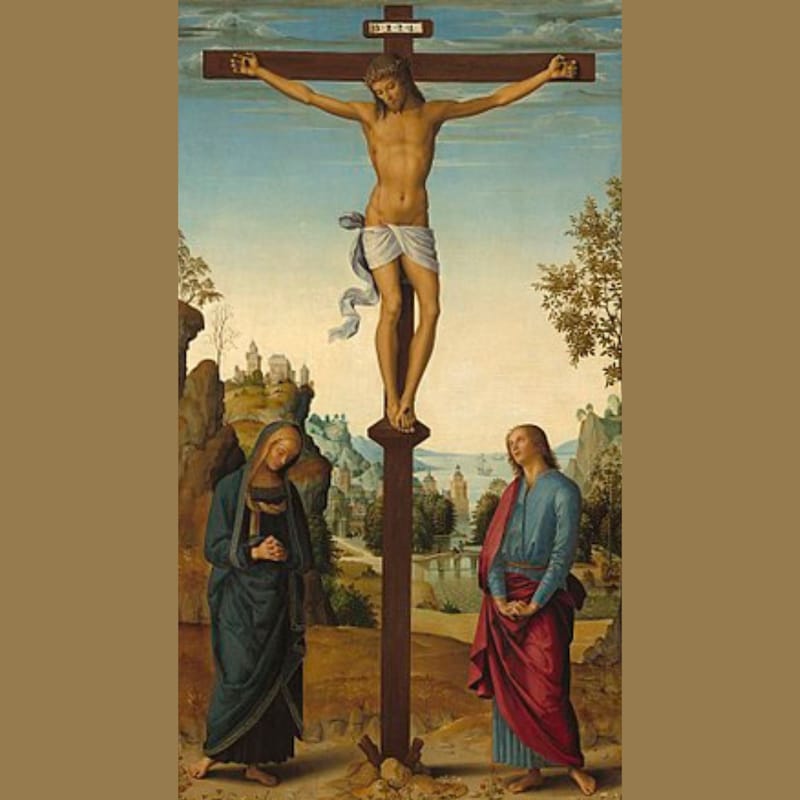
The artwork: Pietro Perugino painted Mary at the Cross around 1482.
The work is now in the National Gallery in Washington, DC. This scene forms the central panel of “The Crucifixion with the Virgin, Saint John, Saint Jerome, and Saint Mary Magdalene.”
But before we begin the next chapter, let us turn briefly to a hymn that has endured for centuries.
The music you’ll hear is Pergolesi’s Stabat Mater, performed by Emma Kirkby and James Bowman.
The Stabat Mater is a Latin poem, long set to music. Pergolesi’s version, written in 1736 for a Neapolitan brotherhood, soon became his most famous sacred work, so powerful that it even inspired Johann Sebastian Bach to create his own adaptation.
Its opening words, “Stabat Mater dolorosa”, mean, “The sorrowful mother was standing”. They capture a moment of grief, stillness, and deep reflection. Though its author remains uncertain, its influence is unmistakable, echoing through medieval churches and continuing to resonate today as a meditation on suffering, faith, and devotion.
The music plays for the first 90 seconds, then continues for another 35 seconds after the episode ends.
© 20 26 The Rise of the Protestants., Author, Shaughan Holt.
"All rights reserved. No part of this podcast may be reproduced, translated, distributed, or transmitted in any form or by any means, including photocopying, recording, or other electronic or mechanical methods, without the prior written permission of the copyright holder, except in the case of brief quotations embodied in critical reviews and certain other non-commercial uses permitted by copyright law".
Requests regarding translation, licensing, or republication should be directed to: [email protected]
Also feel free to email me your thoughts at : [email protected]
Transcripts
© 20 26 The Rise of the Protestants., Author, Shaughan Holt.
"All rights reserved. No part of this podcast may be reproduced, translated, distributed, or transmitted in any form or by any means, including photocopying, recording, or other electronic or mechanical methods, without the prior written permission of the copyright holder, except in the case of brief quotations embodied in critical reviews and certain other non-commercial uses permitted by copyright law".
Requests regarding translation, licensing, or republication should be directed to: [email protected]
Also feel free to email me your thoughts at : [email protected]
The Fall of the Anglo-Saxons.
History - Part 2.
England’s fate, now turns on the wind and the sea.
Long before England had kings, a Parliament or even a word for Protestantism, its story was already being shaped by new arrivals.
The Jutes - Angles and Saxons, came both as settlers and warriors, bringing with them their language, their customs, and their beliefs.
Their faith was never private; it was to be lived openly, woven into law, authority, and everyday life.
When Rome withdrew, only to later collapse and finally fall, - England did not.
Its identity endured, shaped by language tradition and the strength of the spoken word.
So when the Reformation, swept across Europe, England stood resilient and ready.
England did not simply change its religion, it chose a side.
It adopted the Bible in its own language, established a church independent of Rome, and supported a monarchy claiming divine authority.
For some, these changes represented reform; for others, they signified rebellion.
Religious belief now carried consequences.
To be Protestant was to belong, but also to live under watchful eyes.
Religious faith had now become a measure of political loyalty.
Catholics were feared, dissenters suspected, and even private conscience carried risk.
A system that once allowed religious freedom, now demanded conformity from all members of society.
Worship was no longer only an act of devotion. It became a political statement.
This is the second episode, in a three-part series.
It continues the story, of how Anglo-Saxon traditions eventually came to accept Protestantism, and how faith became a tool for power, control, and mistrust.
The episode examines rulers, who claimed divine right, and a people, who had to choose between their faith and survival.
This is no longer, just a story about religion, it is also a key part, of how England was shaped.
The Saxon Influence on Protestant England: Reformation through Conflict and Belief.
England’s Reformation, didn’t begin with Luther’s hammer or Calvin’s sermons, it began with a crown, a conquest, and a king who believed God ruled through him.
While Europe broke apart, over faith, England did something stranger.
It reshaped Christianity, - , without ever letting go of power.
In the year 10 66, England stood at a moment of uncertainty.
Its long-established Anglo-Saxon kingdoms, had brought a measure of unity and order, to its lands, and yet, the death of its King, - , Edward the Confessor would leave the throne disputed, and the kingdom vulnerable.
Across the Channel, in the duchy of Normandy France, a powerful duke was preparing his claim.
William of Normandy, believed the crown of England had been promised to him, and he was ready to enforce that claim, not just with words, but with an army.
When his ships finally set sail for the English coast, they carried more than soldiers — they carried the beginning of a new age in English history.
William the Conqueror, became the first Norman king of England in 10 66, and his victory, reshaped not only England’s politics, but its Church, - , a change, whose consequences would echo all the way to the Reformation.
Born the illegitimate son, of Duke Robert I of Normandy, William fought from childhood to secure his duchy, - , a territory or domain.
After the death of King Edward the Confessor, he claimed the English crown, arguing that Harold Godwinson, a powerful English nobleman, had sworn to support his claim.
His decisive victory at the Battle of Hastings, ended Anglo-Saxon rule, and brought a new Norman ruling elite to England.
William quickly realised, that ruling England, required control of its Church, as well as its land.
Anglo-Saxon bishops were removed and replaced with Norman clergy loyal to him.
He reorganised dioceses, rebuilt cathedrals in the continental Romanesque style, and strengthened church courts.
Yet he also insisted, that the English Church answer to the king, - , before the Pope.
Papal letters would now require royal approval, and no church council could meet, without his written permission.
In doing this, William created something new, a Church closely tied to royal authority, but still part, of the wider Catholic world.
England would remain Catholic, yet, its monarchy, exercised unusual influence over its religion.
He also, redistributed lands to his Norman lords, and ordered the Domesday Book in 10 86, effectively binding church and aristocracy, into a single, feudal structure, of loyalty to the crown.
The abbey, he founded at the site of his Battle, built as penance for the bloodshed at Hastings, symbolised, this union of conquest and religion.
William died in 10 87, but the system he established, would endure.
Centuries later, when English kings quarrelled with Rome, they could draw on a powerful precedent.
The ruler of England, had already claimed authority, over the Church, within his own realm.
Long before the Reformation, England had already begun to walk its own religious path, and that path started with the Norman Conquest.
When Henry VIII broke with Rome, he was not inventing a new power; he was reclaiming one first asserted, by William the Conqueror.
In that sense, the English Reformation, did not begin with Henry VIII, - , its foundations, were laid, in 10 66.
Long before Rome looked toward Britannia, the land was already home, to many indigenous Celtic tribes, known as the Britons.
These groups lived in organised societies, with clear territories and well-developed social structures.
Tribes like the Iceni in the East, and the Brigantes in northern Britannia, controlled large areas, and kept strong cultural and trading ties with continental Europe, long before the Romans arrived.
Other powerful groups, such as the Dumnonii, Catuvellauni, and Atrebates, ruled their own lands, built complex hill forts, and developed local economies based on shared Celtic traditions.
Over time, elements of these cultures, endured and evolved, shaping the later development of Welsh, Cornish, and Breton identities.
Breton identity, stands out as a unique and lasting part of Celtic heritage.
It is centred in Brittany, a region in north-western France, often called “Little Britain.”
This identity grew from ancient Briton communities, which were often forced to move, due to invasions and political changes.
They left “Great Britain” and settled on the European continent.
These migrants brought their language, customs, and social structures with them.
Their traditions, mixed with local practices, have preserved a shared Brittonic heritage that can still be seen in Brittany today.
Roman Roads and Enduring Pathways.
Long after the legions departed, their roads remained.
One of the best examples of these lasting roads is Ermine Street, a major route that once crossed the eastern parts of Britain.
Built soon after the invasion of 43 CE, Ermine Street bound together London,
Lincoln and York, carrying soldiers, supplies and the very authority of Rome itself.
The later name of Ermine Street, comes from the Old English, "Earninga Strǣt", meaning “the road of the Earningas.”
The Earningas, were an early Anglo-Saxon group, who lived in what are now Cambridgeshire and Hertfordshire.
The Old English word "strǣt", first meant a paved road, showing the influence of the earlier Roman term "via strāta".
Though its Roman name has faded into history, the road itself remains, steadfast through the centuries.
Today, the old road still shapes the routes of modern roads like the A1 and A10.
It quietly reminds us that while empires may vanish, some paths last.
The Vikings, the Danelaw, and the Rise of York.
Long after the Romans merged into history, a fresh force began reshaping the destiny of Britannia.
In the ninth century, the Vikings in Britain began to change their approach.
Seasonal raids gave way to carefully planned campaigns of conquest.
In 866 CE, a large Scandinavian force called the Great Heathen Army, crossed the North Sea from Denmark, and landed in Northumbria, an Anglo-Saxon kingdom.
Their eyes were set on Eoforwic, the settlement destined to become the city of York.
This ancient place was steeped in stories and tradition.
In 71 CE, Roman legions had built a great fortress there, naming it Eboracum, their principal military base in northern Britain.
Even after Rome withdrew around 410 CE, the settlement remained a centre of power, later becoming an important stronghold of the Anglian kingdom of Northumbria.
But by the mid-ninth century Northumbria was weakened by civil war.
Rival kings fought for power, and internal conflict threatened to tear the kingdom apart.
Sensing their opportunity, the Vikings—thought by later tradition to be led by the sons of the legendary Ragnar Lothbrok, moved swiftly to exploit the disorder.
In November 866, they stormed through the town’s defences and captured Eoforwic.
The following year, in 867, Northumbrian forces rallied and attempted to retake the city.
Their effort ended in disaster.
Rival kings, Ælla and Osberht, were killed in the fighting, leaving the Vikings in complete control.
Renaming it Jórvík, the city soon became a powerful Viking fortress, and an important trading centre.
Its position on the rivers Ouse and Foss, provided access to the North Sea, linking it to the wider Scandinavian trading network.
From this stronghold, Viking influence was able to spread rapidly.
Many Vikings, unlike those who came before them, chose to stay, rather than return home.
They settled in the lands they had taken over, and often brought their families to live with them.
Large areas of Northumbria, East Anglia, and Mercia, now came under Scandinavian rule.
Over time, these lands became known as the Danelaw, a large region that covered much of northern and eastern England.
The Danelaw stretched from the River Thames in the south, up to the River Tees in the north, and reached west toward Chester.
Within this territory, Scandinavian settlers governed according to their own customs and legal traditions, known as Dena lagu, or Danish law.
The region included many of the counties that form modern eastern England, among them Yorkshire, Lincolnshire, Nottinghamshire, Derbyshire, Norfolk, Suffolk, and Essex.
The Danelaw was formally recognised through agreements such as the Treaty of Alfred and Guthrum, which established boundaries between Viking-controlled lands and the Anglo-Saxon kingdom of Wessex.
After fierce clashes and relentless resistance, King Alfred the Great, rallied the West Saxons and finally brought the Viking onslaught to a standstill.
Alfred reshaped his army; built strongholds called burhs, and blended clever tactics with shrewd diplomacy.
In the south, Wessex stood alone as the only kingdom to defy and withstand Viking domination.
Although conflict continued, these agreements created a long period of uneasy coexistence between Anglo-Saxon and Scandinavian societies.
The impact of this era was profound.
Scandinavian settlement reshaped English law, landholding, trade, and language.
Many everyday English words, - including, "They", "Them", and "Their", -derive from Old Norse, a simple reminder of how deeply the two cultures became intertwined.
And yet, - the Viking age would eventually fade.
In 10 66, after the Norman Conquest, Jórvík became known as York.
The inhabitants of North-Eastern England rebelled against their new rulers; however, the Normans suppressed the uprising with ruthless force.
Villages were destroyed, farmland was burned, and Norman castles were built to assert their dominance over the region.
Yet, despite the devastation, York swiftly reclaimed its place as a vital centre.
By the twelfth century, York had become one of the greatest cities in England, second only to London in size and influence.
The magnificent York Minster, the largest Gothic church in England, was built between the thirteenth and fifteenth centuries.
During the medieval period, it was the seat, or “Cathedra,” of the Archbishop of York, who was one of the most influential leaders in the English Church.
Today, the city’s medieval walls still surround the historic centre, stretching for about two and a half miles.
Under these walls are layers of history, including a Roman fortress, an Anglo-Saxon stronghold, a Viking capital, and a Norman city.
There are few places in Britain, where you can see so clearly how conquest, settlement, and cultural exchange helped shape England.
Ireland, Britain, and the Viking World.
Another major influence on Britain’s early history came not from the continent, but from across the Irish Sea, through Ireland’s dramatic encounter with the Vikings.
Ireland’s first encounters with the Vikings were sudden and violent.
In 795 CE, Viking longships attacked the monastery on Lambay Island, just north of modern Dublin.
This marked the start of a series of fast and destructive raids on Ireland's wealthy coastal monasteries.
The Vikings burned churches, took treasures, leaving local communities in shock.
For decades, these attacks seemed sudden and predatory: the Vikings would strike, plunder, and then disappear back across the sea.
But by the early ninth century, this pattern began to change.
Over time, raiding gradually gave way to settlement.
Viking groups began spending winters in Ireland, building fortified camps, which became military bases, shipyards and trading centres.
In around 841 CE, one of their strongholds was built on the banks of the River Liffey, a base that one day would become Dublin.
During the Viking period, Dublin was known as Dyflin.
The name was a Norse adaptation of the original Irish name, Dubh Linn, meaning "black pool".
Right from the start, Dublin was more than just a place, from which to launch raiding parties.
It acted as both a fortress and a port, and over time, it emerged as the heart of Viking power in Ireland.
Silver - slaves, weapons, and other goods all left Dublin’s harbour, linking Ireland to Britain, - Scandinavia and mainland Europe.
As time went on, the Vikings founded Ireland’s first real towns: Dublin, Waterford, Wexford, Cork and Limerick.
But the Vikings didn’t remain outsiders.
Yes, they fought against Irish kings, but they also formed alliances and married into Irish families.
Over time, their cultures mixed, creating a unique Norse-Gaelic society, that influenced language, art, law and place names.
Many Vikings became Christians, and became part of Ireland’s social and political life.
By the 900s and early 1000s, strong Norse-Gaelic kings, such as Sitric Silkenbeard ruled Dublin.
While they were in power, Dublin became one of the most important centres in the Viking world.
Dublin was also used as a base for attacks on Britain from the west.
Dynastic leaders like Ivar the Boneless and Halfdan Ragnarsson, were key leaders in the Great Heathen Army, that swept into England in the 860s.
In 866 CE, the Vikings captured York, renaming it Jórvík, and made it the main Norse Settlement in northern England.
And for decades, Dublin and York served as the twin anchors of Viking control, across the Irish Sea.
The waters between them, became a Norse highway, linking armies, merchants, ideas, and goods across Ireland, Wales, and northern England.
However, the Vikings did not remain outsiders wherever they settled.
In Ireland, they became Norse-Gaels.
In England, they ruled and settled.
As a result, they reshaped the land, the law, and religious and political power.
The turning point came in 10 14, nearly 150 years after the capture of York, at the Battle of Clontarf near Dublin.
Brian Boru, High King of Ireland, had gathered an Irish army to face a Norse-Irish alliance from Dublin, Leinster, and beyond.
After a full day of brutal fighting, Brian’s army won the battle, but Brian himself was killed.
The Battle of Clontarf seriously weakened Viking power in Ireland, marking the end of Viking rule.
Within a few decades, Viking dominance in England also faded, leaving behind fractured kingdoms and shifting authority.
Here is a bit of trivia for you.
Although I am English, my first name, hints at my Irish ancestry, a part of my heritage I value.
Back in the 18 60s, my great-grandmother departed from Monasteraden, in County Sligo, fleeing the shadow of famine, searching for a brighter future.
Her journey began at the port of Cork, carrying her across the Irish Sea to Liverpool, and finally led her 35 miles inland to the city of Salford, now part of Greater Manchester.
Manchester, then a thriving heart of the English Industrial Revolution, had drawn them in with the promise of work and new beginnings.
Some women in that side of the family had striking red hair, a detail that always stayed with me, and for years, I assumed it came from the Vikings.
Evidently, this is a common belief, but it’s actually not true.
Red hair, was already in Ireland, long before the Vikings came, probably brought by Bronze Age settlers, around 25 00 BCE.
This trait is the result of a mutation, in the human, MC1R gene.
Over thousands of years, this genetic change, spread across Northern Europe, making red hair, especially common in Ireland and Scotland.
Where sunlight was scarce, pale skin, often found alongside red hair, helped the body produce vitamin D more easily, giving a natural advantage.
Today, around 10% of people in Ireland have red hair, and up to half the population carries the gene.
Because it’s recessive, a child must inherit it from both parents for red hair to appear.
The Vikings, often linked to this trait, were actually more likely to have blonde hair.
In fact, the highest concentrations of red hair are found in western Ireland—areas least touched by Viking influence.
So Irish red hair, is not a Viking legacy.
It is far older, shaped by migration climate and the slow passage of time.
This upheaval created a power vacuum.
When the Normans arrived in England in 10 66, they did not find a peaceful or unified land.
Instead, they entered a world already shaped and unsettled, by centuries of Viking invasion and settlement.
The sea routes they travelled, the cities they took over, and many of the power networks they used, all had Viking origins, showing how Viking influence continued.
Although the Normans built their own castles and kingdoms, the foundations, they inherited from Dublin to York, were first established by Viking longships.
Long before the Norman Conquest, Ireland, England, and Normandy were already linked together by the Viking world of the Irish Sea.
From the era of Viking kings, to the Norman Conquest, roughly between 10 13 and 10 66.
In 10 13, England came under Viking control again when Sweyn Forkbeard, the king of Denmark, invaded and forced King Ethelred the second, known as “the Unready,” into exile.
Sweyn became king, but his reign was short.
He died suddenly in 10 14, which left the kingdom uncertain once again.
Ethelred returned from exile, but Viking power was still strong.
The next year, Sweyn’s son, Cnut, renewed his fathers invasion.
In 10 16, Cnut defeated Ethelred’s son, Edmund Ironside, at the Battle of Assandun, and claimed the English crown.
Cnut turned out to be a capable ruler.
King Cnut, also known as Canute, is recognised as one of the most prominent kings of the Anglo-Saxon era.
Canute died in Shaftesbury, Dorset, on 12 November 10 35.
He was buried in the Old Minster at Winchester, the ancient Anglo-Saxon cathedral for the English diocese of Wessex, named after the "Land of the West Saxons".
He mostly ruled using existing Anglo-Saxon laws, supported the Church, and presented himself as a Christian king.
At its peak, his North Sea Empire brought together England, Denmark, Norway, and parts of Sweden under a single ruler.
But after Canute’s death in 10 35, his empire quickly started to fall apart.
His sons ruled for only a short time, and when the last one died without an heir, the crown went back to the old royal family.
In 10 42, Edward the Confessor, the eighth son of Ethelred the Second, became king of England.
Edward's reign appeared calm on the surface, yet beneath it, the balance of power teetered on a knife-edge.
As the old king’s influence faded, power started to move toward Harold Godwinson, who belonged to one of England’s most powerful noble families.
Years spent exiled in Normandy, had left King Edward, favouring his Norman advisers, a choice that quietly fuelled, the simmering resentment of the English nobility.
Because of this, there was always a sense of confusion and uncertainty, surrounding his decisions and alliances.
Edward never made clear who would succeed him.
At different times, he appeared to favour different heirs.
Among them was William, Duke of Normandy, who would later claim the crown, had been promised to him.
When Edward died childless in January 10 66, that uncertainty became a crisis.
The Witan, the king’s council, acted swiftly, choosing Harold Godwinson as king.
But their decision did not settle the question, it ignited it.
Rival claimants emerged almost at once.
From the north came Harald Hardrada of Norway, pressing an ancient claim.
From across the Channel, William of Normandy prepared to act on his own.
England now stood on the brink of conflict—its fate no longer to be decided in council chambers, but on the battlefield.
For 10 66 was not just another turning point in history, it was the moment when the future of England would be fought for, and finally decided.
And in the next chapter, we will follow those rival claims as they unfold, and see how a single year, would change the course of England forever.
